Original Article
Artigo Original
Theory of Mind (ToM) and language:
stimulating metalinguistic skills in
people with dementia
Vicent Rosell-Clari1
Beatriz Valles González1
Keywords
Dementia Speech Therapy Cognitive Therapy Theory of Mind Language Therapy
Correspondence address:
Vicent Rosell-Clari
Department of Basic Psychology, Faculty of Psychology, University of Valencia – UV
Avenue Blasco Ibáñez, 21, Valencia, Spain, 46010.
E-mail: [email protected]
Received: February 02, 2016
Study carried out at “Asociación de Familiares de enfermos de Alzheimer” - Valencia, Spain.
1 Universitat de València – UV - València, España.
Financial support: This work has been performed under the I+D project of the Spanish Ministry of Economy and Competitiveness with reference FFI2014-54088-P and entitled: “Language and executive functioning: A comparative study in aphasia, dementia and language development”.
Conlict of interests: nothing to declare.
ABSTRACT
Purpose: The purpose of this paper was to assess the use of the Metalinguistic Skills Stimulation Program in Theory of Mind (ToM) in people with dementia. Methods: An experimental research design was developed. Forty-two subjects, 28 women and 14 men, aged 61 to 87 participated in the study. The three following groups were created: Experimental Group and Control Group - both composed of people with dementia, and Normal Group - consisting of people without dementia or any medical and psychological disorders that keep them from living a normal life. All subjects in the sample were evaluated using the MMSE30 Test and the MetAphAs Test. The stimulation program was used with the Experimental Group in 40-minute sessions held twice a week for
ive months. After the program, a second evaluation or retest was performed. The data obtained were compared
statistically and qualitatively, individually and between the different groups. Results: A clear effect of the treatment was observed: most of the patients improved their average scores in the performance of various tasks
and on the MetAphAs Test. Signiicant differences were observed when comparing the Experimental Group
with the Control Group. Conclusions: The evolution of each patient presents a multifactorial etiology, and
it was inluenced by different variables related to the patients and their psychosocial environment. The data
INTRODUCTION
Dementia is a syndrome that affects various areas of functioning, especially the cognitive area(1,2). It requires an approach from a broad perspective, because people who suffer from dementia manifest a number of symptoms associated with its etiology or type, which can occur in many different ways. According to the Diagnostic and Statistical Manual of Mental Disorders DSM-V(3), dementia is a progressive and chronic condition of the central nervous system that affects high-level cognitive functions
(thinking, language, memory) and it is classiied according to
its etiology: Dementia of the Alzheimer’s type, vascular type; resulting from diseases such as HIV, Parkinson’s, Huntington’s, Pick’s, Creutzfeldt-Jakob disease, or head trauma; induced by
substances or not speciied, in cases where it is not possible to
determine the cause.
Dementia is a neurological disorder with neuropsychological and neuropsychiatric manifestations characterized by the impairment of cognitive functions and the presence of emotional and behavioral changes. Gaona, Valles and Suárez(1) deine it as a group of diseases characterized by damage to cognitive functions, producing greater cognitive disorder and leading to progressive loss of independence and autonomy.
Bayles and Tomoeda(2) assert that cognitive deicits interfere with social and occupational functioning. They also highlight that the linguistic function is altered as a result of cognitive impairment. In other words, memory loss and other cognitive
deicits produce a series of linguistic disorders, leading to limited
communication management.
Khosravi(4) notes that the irreversible and progressive damage to the central nervous system causes disturbance in executive functioning (judgment, reasoning, and abstract thinking); in memory and other cognitive functions in the motor area and in the behavior of the individual. These changes are heterogeneous and present different degrees of intensity, producing a strong impact on the patient’s daily social and relational activities.
To understand the impact of dementia, it is also necessary to consider the age at which it occurs, a factor that has quite different effects on each patient, which means that each person exhibits different symptomatology. In summary, dementia is a complex syndrome of persistent intellectual changes caused by various etiological factors, and which compromises proper functioning in many areas of human development, including language and communication.
Linguistic symptoms of dementia
People with dementia inevitably develop different types of language disorders(2). From early stages of the disease, dificulties in expression and comprehension are evident. The most striking linguistic limitations are observed at the lexical level (paraphasia, circumlocutions, anomia). These disturbances become more severe as the dementia progresses, and they vary from one patient to
another. Additional symptoms comprise dificulties coordinating
the production of movements for speech (dysarthria, apraxia) and problems with chewing or swallowing (dysphagia), which are manifested in advanced stages(1).
Language can be affected in different ways depending on
the type of dementia. For example, the irst linguistic symptoms
observed in Alzheimer’s disease are often dificulties in inding words and failures in semantic memory(5), whereas in
frontotemporal dementia, dificulties in following the social
rules of conversation (pragmatics) or disorders in the rhythm of speech are observed(2).
The linguistic symptoms of dementia include:
• Anomia (dificulty in remembering the names of things); • Perseverance (involuntary repetition of the same message); • Paraphasia (replacement of phonemes and words by incorrect
ones);
• Circumlocution (unnecessary words or phrases to express
an idea);
• Apraxia (faulty execution of movements); • Logorrhea (extreme loquacity);
• Agnosia (dificulty in interpreting sensations and stimuli); • Agrammatism (omission of words and dificulty in forming
sentences);
• Dysarthria (alteration in the articulation of speech); • Mutism;
• Dysphagia (dificulty in chewing and swallowing); • Dyslexia and Dysorthographia (acquired dificulties in
reading and writing).
Khosravi(4) states that speech and communication disorders in people with dementia vary with the severity of the brain injuries, depending on the intellectual and cognitive capacities and linguistic and communicative features of each patient prior to the onset of the disease, as well as on their quality of life. Linguistic symptoms
occur in three stages: The irst is characterized by the loss of a word in apparently luent conversations, where the patient is
able to rephrase the sentence based on a circumlocution. At this point, in the progression of dementia, there is no evidence of problems in reading and writing. In the second stage, phrases become more and more limited and simpler, but correct from a grammatical point of view; however, the ability to read and write begins to be altered because the person with dementia cannot comprehend what is read or properly organize written texts. Finally, in the third stage, verbal expression becomes more
incomplete and sentences are uninished, which results in the
inability to convey ideas, leading to social isolation.
As stated above, the evolution of language disorders depends on the etiological factors that determine dementia, the person’s overall health status, the characteristics of social life and the family environment, and the patient’s possibilities of receiving comprehensive treatment.
Conceptual review from a clinical-functional perspective
Language is the faculty that allows us to use different codes with the purpose of producing and exchanging information. It is linked to human beings, and from a functional approach, it is included in an interdependent relationship with the cognitive, social and cultural dimensions of the subject who makes use of it(6). Therefore, the relationship between language and communication is clear, as communication allows people to coordinate the relationship between the actions of two subjects. This element is decisive, because without communication there is no language, as language “[...] is established to articulate and
broaden/extend signiicantly our communicative needs, and only
to the extent that it serves this purpose [...]”(6).
In addition to serving as an instrument of communication, verbal language controls mental processes, moods, and behaviors. Thus many of our thoughts and experiences are supported by words(7). The aforementioned considerations lead us to conclude that the use of language is made possible thanks to a number of factors that allow its form to adapt to various prior objectives.
Cognitive control, speciically in terms of metacognition, allows
us to organize, select, and monitor the communication process and the way we adapt our linguistic activity to the many contexts in which human life unfolds, taking into account not only our own needs or interests, but also those of our interlocutors.
Human communication dynamics are controlled by metacognition, a process that involves introspective awareness of the states of knowledge and their operations, as well as the individual skills of planning and controlling our own thoughts and expressions. Thus the metalinguistic activity that regulates our linguistic ability to use the oral and written subcodes is included in metacognition.
The so-called Theory of Mind (ToM) is included in our
metacognitive functioning. It deines a speciic cognitive skill:
the ability to understand that others have beliefs, desires, and intentions different from or similar to ours, allowing us to explain and predict the intentions and behaviors of others. This skill is necessary in order to reduce levels of uncertainty when we communicate and adapt ourselves to our own intentions and to those of our interlocutors, regulating and organizing our inner and outer experiences.
According to Poletti et al.(8), the ToM presents two
components: The irst is a cognitive component which refers
to the possibility of making inferences about beliefs, desires, thoughts, motivations, and our own intentions and those of others (what I know); the second is an affective component based on the subject’s ability to infer their own emotions and/or feelings and those of other actors in social and communicative relationships (what I feel). This skill set enables us to explain and predict the intentions and behaviors of others, allowing us to reduce levels of uncertainty while communicating, adapt ourselves to our own intentions and to those of our interlocutors, and attribute mental states to people, ourselves, and others.
The alterations in the ToM functioning in the person with dementia are associated with changes in the brain structure at the cortical and subcortical levels. The regions responsible for various functions related to communication are affected by the progress of neurophysiological impairment. Poletti et al.(8) note that the superior temporal region, the dorsolateral prefrontal cortex, the
medial prefrontal cortex and the dorsolateral cortex, the posterior part of the superior temporal sulcus, and the temporo-parietal junction are active in everything related to the ToM.
Youmans and Bourgeois(9) consider that limitations in the ToM are responsible for social and communicative disorders in adults with injuries in the right hemisphere or frontal lobe, as well as in patients with frontotemporal dementia or Alzheimer’s disease. Harley, Jessiman, MacAndrew and Astell(10) argue that, for this reason, metalinguistic abilities are affected in various
types of dementia. Speciically, these authors found that the ability to produce adequate deinitions is affected in people
with Alzheimer’s disease. In contrast, Poletti et al.(8) suggest that patients with various degenerative diseases may present different patterns of disturbances in skills related to the ToM. Their research provides evidence that these functions are
compromised in Alzheimer’s disease due to cognitive deicits
in the ToM, whereas in frontotemporal dementia, disturbances have both a cognitive and an affective basis.
Valles González and Rosell-Clari(11) obtained data conirming
this variation when comparing functional proiles in the ToM
between people with different types of dementia who were treated with a stimulation program for ten metalinguistic skills. Their results show that skills related to memory (memory of recent events) in patients with Alzheimer’s disease remained at an average level, whereas skills with an affective basis, e.g.,
expressing sarcasm or emotion recognition, improved signiicantly,
reaching a high level. However, in people with frontotemporal
dementia, the functional proile showed that skills linked to memory improved signiicantly, but those related to emotions
remained at lower levels.
All these indings can be related to the limitations that individuals
with dementia face in terms of managing their communicative
exchanges in familiar contexts, as their dificulties are not limited to mistakes in lexical access, anomia, or dificulties in
expression. The language disorder also includes errors in the comprehension of contexts, causing disturbances in functioning at a pragmatic level. This situation interferes with their ability to understand the situations that surround a particular interaction, select the discursive order, adapt their body language and content depending on the situation, and adjust the volume, tone and timbre of their voice(2,12).
Speech therapy for people with dementia
Speech therapy for people suffering from dementia is relatively recent. In this regard, Bayles and Tomoeda(2) state that this type of intervention began in the United States in the mid-seventies. From that time on, the American Speech-Language-Hearing Association (ASHA) began publishing different professional resources to guide the work of speech pathologists in the process of assessing and treating cognitive-linguistic and swallowing disorders associated with dementia.
intact. The results showed that people suffering from this type of dementia can learn new associations and retain this knowledge after several months using these techniques(13).
In “Roles of Speech-Language Pathologists in the
Identiication, Diagnosis, and Treatment of Individuals with
Cognitive-Communication Disorders: Position Statement”(14), ASHA suggests that speech therapists should actively engage in the following activities: assessment and diagnosis of cognitive-linguistic disorders, provision of counseling to families and caregivers, direct intervention for the person diagnosed with cognitive impairment or dementia, advice to caregivers, prevention of dementias, and promotion of speech therapy programs. All these actions are developed in an interdisciplinary framework and have one main goal: to act on the communication of people affected by cognitive impairment from a comprehensive perspective.
The global aging process affecting the population worldwide makes it necessary for speech therapists to develop diagnostic strategies to differentiate normal linguistic functioning from others that may suggest the presence of symptoms of mild cognitive impairment. Murray(15) notes that there are suficient reasons to design diagnostic tools aimed at the elderly to assess functions such as attention, memory, and executive functions, and that they should be used by speech therapists to make an
early diagnosis and ensure speciic and specialized attention at
the most propitious moment. Smith(16) and Domoto-Reilly et al. (17) also stress the need to start speech therapy in the early stages
of dementia, even in stages when symptoms are manifested discreetly, as in cases of mild cognitive impairment.
This care can be based on either direct intervention programs, such as those performed by speech therapists after an assessment of the communication needs, or indirect intervention performed
by caregivers and relatives after receiving speciic guidance.
An example of the latter method, proposed by Wilson et al.(18), focuses on the use of communication strategies by caregivers to facilitate personal hygiene activities. Another proposal made by Mahendraa and Arkinb(19) is aimed at guiding volunteers on how to communicate with people with dementia during physical and recreational activities.
It is important to note that the work of speech therapists also includes the treatment of chewing and swallowing disorders. Therefore, the intervention in this population is complex, and it encourages the participation of different professionals(2).
It should focus on the timely identiication of certain symptoms
and specialized care based on an interdisciplinary model, which
further justiies the presence of these professionals in senior
centers.
Currently, there are various proposals of direct speech therapy for people with dementia. Some of them are aimed at improving lexical access(20); others focus on expanding vocabulary,
addressing dificulties in comprehension, expression and recent
memory(21), stimulating the development of semantics in order to improve the nomination and categorization capacity(22), and promoting emotional, cognitive and communicative functioning by using games(23) to modify and structure the communication context of patients(24).
Young et al.(25) developed a “dementia toolkit for effective communication” to guide the attention to people with dementia
in areas that can interfere with communication, such as conversation, nonverbal communication, the organization of the social environment, and behavior management. MacKay(26) recommends that speech therapy in patients with dementia should try to preserve the quality of communication and, in advanced cases, maintain the minimum necessary communicative skills to achieve an effective exchange in everyday situations.
Based on the discussion in the previous section, one of the fundamental goals of speech therapy is to provide patients with various resources that allow them to manage their communication, namely, the therapeutic effort must stimulate the metalinguistic activity in order to optimize the necessary skills to communicate in everyday contexts in the most effective manner possible.
It is important to highlight that researchers in the ield of
speech therapy in dementia have begun to assess the effectiveness of treatments, which has led to a better understanding of the different variables involved in the attention tasks and design of intervention programs. It has also made it possible to design better alternatives for both speech therapists and their patients, while guaranteeing evidence-based care proposals(27).
Metalinguistic Skills Stimulation Program in Theory of Mind (ToM) for people with dementia
The Metalinguistic Skills Stimulation Program in Theory of Mind (ToM) for people with dementia(28) was designed to stimulate the metalinguistic performance of patients in the most natural contexts possible, based on the production of texts from spontaneous linguistic activities led by functions such as listening-talking or reading-writing. This program provides a number of strategies for exercising ten key metalinguistic functions in face-to-face communication, using the theoretical foundations of the MetAphAs Test as a guide(7,29).
The overall objective of the program is to provide the speech therapist with a structured and organized guide to optimize the skills needed by people with early and middle-stage dementia to have an effective language exchange with their regular interlocutors. Its theoretical foundations follow a functional approach(6) which begins by establishing the interdependence between language, cognition, social context, and the culture of
the speakers. The speciic objectives are aimed at:
1. Stimulating the construction of narrative and descriptive texts based on the description of real and imaginary situations;
2. Understanding various intersubjective communicative situations and anticipating possible future events;
3. Describing and analyzing different contexts according to the activity of the people involved;
4. Detecting emotional states and organizing the linguistic activity of the people involved;
5. Understanding indirect speech acts.
Valles González and Rosell-Clari(11) conducted a study to assess the effects of the Program implementation in a group of
patients. The results of this study showed statistically signiicant
Group (Wilconxon Test z = -4.398; p = 0.000) and between the Control Group and the Normal Group (Wilconxon Test z = -5.123;
p = 0.000), but not between the Experimental Group and the Normal Group (Wilconxon Test z = -1.897; p = 0.058), showing clear effects of the treatment. Treated patients achieved a more
effective level of communication and signiicantly improved
their ability to talk and communicate.
It is worth emphasizing that this program is meant to serve as a guide for speech therapists when designing a treatment plan for people with dementia. In other words, professionals need to
bear in mind that each patient has speciic needs. Therefore, it is
not possible to follow only one path when choosing resources, strategies, and materials because it is important for each patient
to receive a speciic treatment plan that meets their speciic
communication needs.
MATERIALS AND METHODS
Subjects
The study sample consists of a total of 42 subjects, 28 women and 14 men, aged 61 to 87. The professions of the sample subjects are varied, and range from patients with higher education to patients with basic training, with a variety of professions, including a lawyer, a naval engineer, a businessman, a policeman, a sales clerk, a secretary, an administrator, an orange warehouse operator, and a housewife. Of the 42 subjects who comprised the initial sample, 22 were diagnosed with some form of dementia in which Alzheimer’s disease is prevalent (N = 16); the other 20 subjects are people who live their lives normally, without medical, cognitive or psychiatric histories that interfere with their quality of life and without receiving any type of treatment. The latter group was called the “Normal Group” (NG; N = 20; average age = 72; bottom = 63; top = 84).
Prior to the implementation of the stimulation program, the 42 subjects were assessed by the “Mini Mental State Examination” (MMSE30)(30) in order to verify whether any of the subjects in the Normal Group (NG) presented a suspected diagnosis of dementia. After conducting the MMSE30 and the clinical observation of the patients with dementia, two types
of patients were identiied depending on the severity of the
cognitive impairment: Patients with mild dementia (N = 14) and patients with moderate dementia (N = 8).
After providing their informed consent, the 22 patients with dementia (average age = 75; range: 61 to 87) were divided into two groups: a group to which the Metalinguistic Skills Stimulation Program was applied individually, called “Experimental Group” (EG; N = 12; average age = 74; bottom = 61; top = 87), and a group to which the program was not applied, called “Control Group” (CG; N = 10; average age = 76; bottom = 70; top = 84). Patients with moderate dementia were distributed equally in each patient group (EG mild dementia N = 6, EG moderate dementia N = 6; CG mild dementia N = 6, CG moderate dementia N = 4).
Procedure
During the months of January and February 2014, an initial assessment of the metalinguistic skills of all the subjects participating in this research was performed using the MetAphAs
Test(7). Subsequently, the Metalinguistic Skills Stimulation Program in Theory of Mind was applied only to the Experimental Group (EG).
The Metalinguistic Skills Stimulation Program was applied individually in two sessions per week, with average duration of
40 minutes per session, for ive months, between February and
June 2014. After this period, the MetAphAs test was applied again (re-test) to assess possible effects on the metalinguistic skills evaluated. Two independent referees participated in the initial evaluation and in the re-test, comprising a total of 102 cases.
The results obtained were qualitatively and quantitatively analyzed individually (within-subjects) and between the different groups (inter-group).
Materials
A series of original materials and activities were developed
and organized, according to their dificulty, in three levels:
low, medium, and high. They were designed to stimulate ToM metalinguistic skills in order to achieve both the main and the
speciic objectives previously proposed. A summary of the
activities is presented ahead:
1) Ability to discuss things that are not present: show pictures of monuments or scenes, withdraw the stimulus, and ask the patients to talk about what was shown;
2) Memory of recent past events: start a dialogue where the patients can talk about daily activities or recent events (vacations, leisure activities) and recall the activities of the previous session;
3) Memory of distant past events: encourage the patients to talk about some historical event or write their own autobiographies;
4) Anticipation of future events: the patients have to write about expectations, narrate possible actions, and write a short story;
5) Description of scenes: the patients have to elaborate oral and/ or written descriptive texts and assign a name to different movie posters;
6) Ability to contradict and/or ind antonyms: develop, orally
and in writing, a list of antonyms, antonyms to complete a box, say the opposite of what you hear;
7) Reading other people’s emotions: the patients have to identify moods and emotions in photos of people, imitate “body language”, and write texts or dialogues for short videos of movie scenes or TV programs;
8) Use of ictitious language: the patients need to complete
cartoons (orally and in writing), tell stories, add titles to short stories, develop short scripts and direct their staging;
9) Ability to lie: ask the patients to tell “a lie”, give the patient facts or events and ask them to determine whether these are true or false, and ask them to say the opposite of what is heard (giving false information);
RESULTS AND DISCUSSION
To assess the effects of treatment on the patients to whom the program was applied (Experimental Group), we compared the data obtained between subjects and the results obtained from each group (NG, EG, and CG) on the MetAphAs test and re-test, on Section VI, and on the complete MetAphAs test. Thus the results obtained from each patient in the EG, as well as individual performances, are assessed qualitatively. Individual results, between subjects, are presented qualitatively and quantitatively.
Qualitative results
A 3-point Likert scale (5 = low; 10 = medium; 15 = high) was used to assess the results obtained from each patient in February and July on the tasks proposed by the Metalinguistic Skills Stimulation Program, developed from each of the items in Section VI of the MetAphAs.
All patients improved their average scores on the tasks of the Metalinguistic Skills Stimulation Program comparing the results obtained in February with those obtained in July, except for one patient who received the same marks. It is clear that the evolution observed in each patient depends on many variables, such as degree of motivation and involvement in the program, patient’s attendance, degree of adaptation to the center, stimulation and care provided in the center and by relatives, other variables related to the patient, and psychosocial environment.
As mentioned above, cognitive-linguistic symptoms depend
on many factors. For this reason, it is very dificult to predict the progress or changes that a speciic care plan might produce
in a person with dementia.
It is worth mentioning that all the patients in the Experimental Group and the Control Group attend the Day Center several days a week, which guarantees cognitive-linguistic stimulation and a structured environment that can help reduce the signs of dementia.
Given the characteristics and possibilities of this research,
only the results obtained by patients with statistically signiicant
differences are offered.
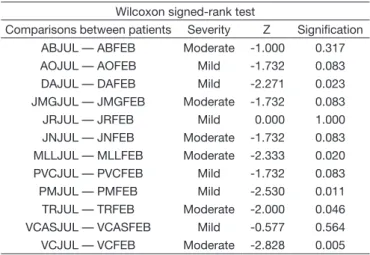
Table 1 shows that patient DA, diagnosed with Alzheimer’s disease, presented different levels of performance on ToM skills. At the end of the treatment, a clear improvement was observed
on six of the skills. These results are statistically signiicant
(Wilcoxon signed-rank test z = -2.271; p = 0.023).
The performance of patient MLL was between low and average. At the end of the program, MLL achieved improvement
on ive of the skills. These results are statistically signiicant
(Wilcoxon signed-rank test z = -2.333; p = 0.020).
Patient PM, diagnosed with Alzheimer’s disease, presented a low-to-average performance. After completing the treatment, an improvement was achieved on seven of the skills even though during the last month this patient did not attend many of the sessions because the family decided not to continue at
the center. These results are statistically signiicant (Wilconxon
signed-rank test z = -2.530; p = 0.011).
As it can be seen, patient TR had a poor performance on six of the skills. At the end of the period, there was an improvement on
four of them. These results are statistically signiicant (Wilcoxon
signed-rank test z = -2.000; p = 0.046).
Patient VC presented a low-to-average performance level. After the treatment, there was an improvement on seven of
the skills. These results are statistically signiicant (Wilcoxon
signed-rank test z = -2.828; p = 0.005).
The results should be analyzed taking different aspects into
account. In the irst place, all the patients who obtained statistically signiicant results were women aged 72 to 79 years, with regular attendance, and only one of them had dificulty participating
enthusiastically in the activities proposed. Moreover, this group
did not present health problems during the ive months of the
treatment, and they did not need to undergo surgery, unlike some of the patients in the Experimental Group.
Quantitative results within-subject test-retest MetAphAs
and Section VI
Before the metalinguistic skills program (test) and immediately after its completion (retest), the MetAphAs Test was used to assess the effects of the program on each of the subjects in the Experimental Group.
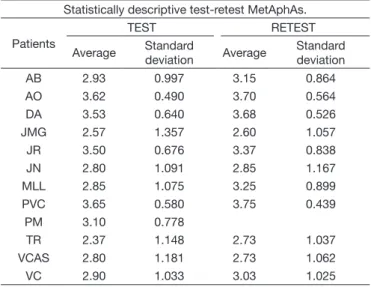
As shown in Table 2, all the patients except two (JR and VCAS) improved their average test-retest MetAphAs score. Patient PM did not take the MetAphAs retest because the family went on summer holiday. However, only the comparisons of two
patients (MLL and TR) show statistically signiicant differences
in their test-retest MetAphAs scores (t39 = -2.810, p = 0.008 and t39 = -2.876, p = 0.006, respectively).
When comparing the test-retest of Section VI of the MetAphAs (Table 3), the section in which the applied stimulation program was developed shows that there is only one patient who was not retested (PM) because the same no longer came to the Centre. The tendency when comparing test and retest data from Section VI varies from patient to patient, with patients who improved their scores (AB, DA, JMG, TR), patients who maintained the same average score (AO, JN), and patients who
Table 1. Comparisons of tasks performed between-subjects. February – July. Wilcoxon signed-rank test
Wilcoxon signed-rank test
Comparisons between patients Severity Z Signification
ABJUL — ABFEB Moderate -1.000 0.317
AOJUL — AOFEB Mild -1.732 0.083
DAJUL — DAFEB Mild -2.271 0.023
JMGJUL — JMGFEB Moderate -1.732 0.083
JRJUL — JRFEB Mild 0.000 1.000
JNJUL — JNFEB Moderate -1.732 0.083
MLLJUL — MLLFEB Moderate -2.333 0.020
PVCJUL — PVCFEB Mild -1.732 0.083
PMJUL — PMFEB Mild -2.530 0.011
TRJUL — TRFEB Moderate -2.000 0.046
VCASJUL — VCASFEB Mild -0.577 0.564
obtained lower average scores (JR, PVC, VCAS, VC). In all the comparisons made, only one patient presented statistically
signiicant differences (MLL; t9 = -2.753, p = 0.022).
These data suggest that speech therapy programs for people with dementia have the effect of attenuating deterioration, which means that, unlike in other diagnoses such as aphasia, improvement in the dementia population is discreet.
Comparison between-groups. Univariate analysis
Different univariate and multivariate comparisons have been made in order to determine whether the effects of the independent variables (exploration, referees, sex, age, medical diagnosis, sample type, severity, and group) on the dependent variables (Section VI MetAphAs results and overall results on
MetAphAs Test) are statistically signiicant. In this paper, only the statistically signiicant results are shown.
As Table 4 shows that all the analyzed independent variables
present statistically signiicant effects on the results obtained,
except for the variables “exploration” and “referees”. The results
were surprising because the statistically signiicant effects of
the “sex” variable were not expected; however, this is explained by the fact that, in this sample, there are more women with moderate dementia (N = 23), which is more severe than in males (N = 1). Regarding age, although not linear, there was a tendency for younger subjects to achieve better results, both in Section VI and in the complete MetAphAs (Pearson age correlation - Section VI = -0.231, p = 0.020; Pearson age correlation - Total MetAphAs = -0.212, p = 0.032).
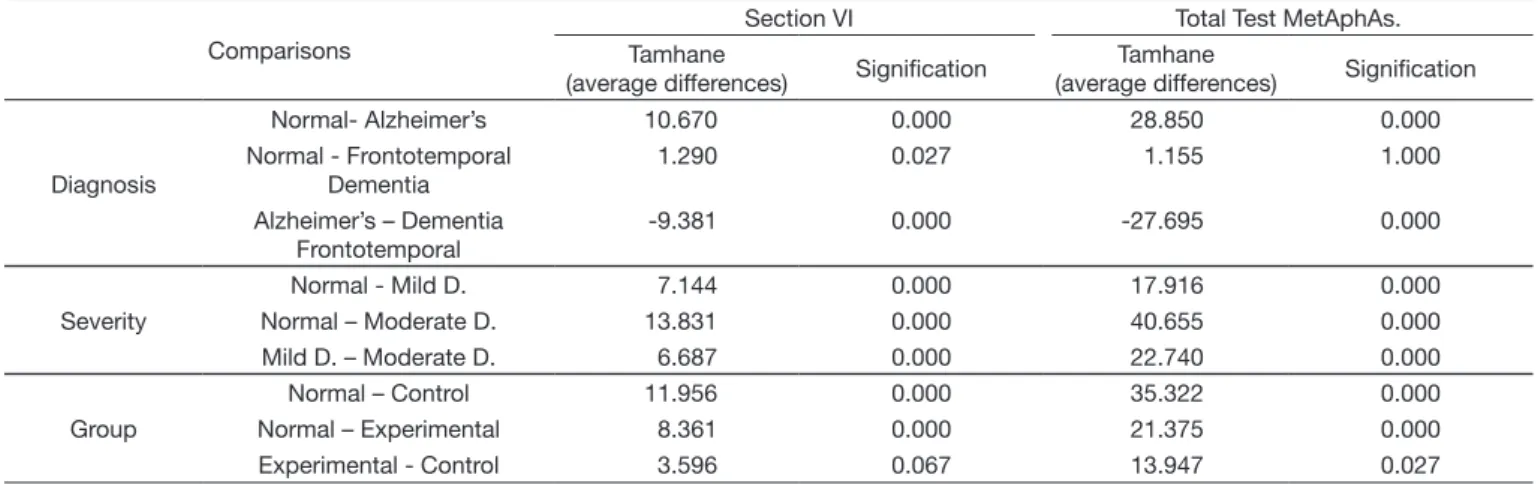
As expected, signiicant results were also obtained for the
medical diagnosis. Table 5 shows only post hoc analysis of the comparisons made with the diagnostic groups with more than one subject, showing that the group of normal subjects presented
signiicantly higher scores than the patients with Alzheimer’s
disease both in Section VI and on the MetAphAs test, as well as better results than patients with frontotemporal dementia only on the complete MetAphAs Test. Patients with frontotemporal dementia outperformed patients with Alzheimer’s disease in
Section VI and in the complete Test. In these indings, the variable
“severity” interferes, because a high percentage of patients with Alzheimer’s disease also present moderate dementia (43.75%), whereas all the patients with frontotemporal dementia present mild dementia.
As expected for the variable “severity”, statistically signiicant
results were also obtained both in Section VI and in the complete MetAphAs Test, in which the Normal Group obtained better results than the two groups of dementia patients. Moreover,
patients with mild dementia had signiicantly better results than
patients with moderate dementia.
Regarding the variable “group”, post hoc results are observed for Section VI compared with the complete MetAphAs test. As expected, in the post hoc tests of Section VI and
the MetAphAs complete test, signiicantly better results are
observed when comparing the Normal Group with the Control
and Experimental Groups. However, no statistically signiicant
differences were observed when comparing the results obtained by the Control Group with those obtained by the Experimental
Group in Section VI, but statistically signiicant differences were
observed when comparing the results obtained by the Control Group with those of the Experimental Group in the complete MetAphAs test, in favor of the latter. These results cannot be
Table 2. Comparisons between subjects. Statistically descriptive test-retest MetAphAs
Statistically descriptive test-retest MetAphAs.
Patients
TEST RETEST
Average Standard
deviation Average
Standard deviation
AB 2.93 0.997 3.15 0.864
AO 3.62 0.490 3.70 0.564
DA 3.53 0.640 3.68 0.526
JMG 2.57 1.357 2.60 1.057
JR 3.50 0.676 3.37 0.838
JN 2.80 1.091 2.85 1.167
MLL 2.85 1.075 3.25 0.899
PVC 3.65 0.580 3.75 0.439
PM 3.10 0.778
TR 2.37 1.148 2.73 1.037
VCAS 2.80 1.181 2.73 1.062
VC 2.90 1.033 3.03 1.025
Table 3. Comparisons between subjects. Statistically descriptive Section VI test-retest
Comparisons between subject test-retest Section VI MetAphAs.
Patients
TEST RETEST
Average Standard
deviation Average
Standard deviation
AB 2.90 0.876 3 1.247
AO 3.60 0.516 3.60 0.699
DA 3.20 0.789 3.40 0.699
JMG 2.00 1.563 2.20 0.789
JR 3.30 0.675 3.20 1.033
JN 2.50 1.509 2.50 1.434
MLL 2.40 0.843 3.20 0.632
PVC 3.60 0.699 3.50 0.527
PM 2.90 0.738 -
-TR 1.90 1.101 2.20 1.033
VCAS 2.70 1.252 2.50 1.434
VC 2.20 1.135 2.10 1.101
Table 4. Univariate analysis. Section VI MetAphAs and MetAphAs Complete Test
Independent variables
Section VI Total Test MetAphAs.
F101 Signification F101 Signification
Sex 8.315 0.005 8.913 0.004
Age 3.544 0.000 3.441 0.000
Diagnosis 41.729 0.000 32.499 0.000
Type of Sample
100.042 0.000 68.341 0.000
Severity 87.366 0.000 67.990 0.000
explained as an effect of the treatment, as these differences were already present before the program implementation. Failure
to obtain statistically signiicant results based on the variable “exploration” (initial or test; inal or retest) reinforces this
hypothesis (Section VI F101 = 0.006, p = 0.938; Total MetAphAs F101 = 0.261, p = 0.938).
Multivariate analysis
To assess the combined effects of independent variables that
have statistically signiicant effects on the results obtained for
Section VI and the complete test, we designed a Multivariate General Linear Model (Intersection + sex + age + medical diagnosis + type of sample + severity + group) where the total model explains much of the variance (R2 = 0.681). Regarding the contribution of each of the variables to the model, only the
variables “severity” and “group” presented statistically signiicant
effects on both Section VI and on the complete MetAphAs Test: Severity (F1 = 24.330, p = 0.000 and F1 = 28.984, p = 0.000, respectively) and Group (F1 = 4.361, p = 0.039 and F1 = 7.128,
p = 0.009, respectively).
CONCLUSIONS
Speech therapy in dementia is a ield that has made remarkable
progress in the last two decades of the 20th century. Today, there are diverse programs with different methodologies but a common goal: to attenuate the negative effects of dementia on patients’ communication.
From a functional perspective, the objective of this type of treatment should be to stimulate the fundamental elements of the natural use of language. Programs should try to provide people with dementia with better cognitive-linguistic tools that allow them to have an effective exchange of information. For this reason, the Metalinguistic Skills Stimulation Program in Theory of Mind (ToM) for people with dementia is designed to stimulate the skills encompassed in the Theory of Mind, as they are the foundation of natural language use in face-to-face situations, which is the most common way we communicate in our social contexts.
There is great variability in the functioning of these patients and the possibilities of making good use of the tools of speech therapy. The therapeutic effort must adapt to various factors present in each person or situation and keep in mind that the goal is to provide better tools for effective communication for patients, families, and caregivers.
In the results obtained after working with the stimulation program, a clear effect of the treatment was observed in both within-subject and between-subject comparisons: most patients improved their average scores on the tasks and on the MetAphAs
test (within-subjects). From a qualitative perspective, only ive out of twelve patients obtained signiicant results if their initial
level of performance is compared with the one achieved after the program. However, eleven of the participants showed a better cognitive-linguistic level in everyday activities. There
are signiicant differences when comparing the Experimental
and Control (between-subjects) groups.
The results of this study show that several factors may be involved in the linguistic performance of people with dementia.
The evolution of each patient is multifactorial and inluenced by
different variables related to the patients and their psychosocial environment. The data encourage the development of further research with larger samples in order to achieve more conclusive results.
REFERENCES
1. Gaona C, Suárez M, Valles B. La comunicación en Parkinson y demencia: ¿qué hacer?. CIAL: Universidad de Los Andes; 2012.
2. Bayles K, Tomoeda C. Cognitive-comunication disorders of dementia. San Diego: Plural Publishing, Inc.; 2007.
3. APA: merican Psychiatric Association. Diagnostic and Statistical Manual of Mental Disorders, DSM. 5th ed. Washington: APA; 2013.
4. Khosravi, M. La communication lors de la maladie d´Alzheimer et des troubles apparentés. Francia: Editions DOIN; 2011.
5. Morelli C, Altmann L, Kendall D, Fischler I, Heilman K. Effects of semantic elaboration and typicality on picture naming in Alzheimer disease. J Commun Disord. 2011;44(4):413-28. http://dx.doi.org/10.1016/j.jcomdis.2011.01.006. PMid:21546038.
6. Gallardo-Paúls, B & Hernández-Sacristán, C. Lingüística clínica: un enfoque funcional sobre las alteraciones del lenguaje. Madrid: Arco/Libros, S.L.; 2013.
Table 5. Post hoc tests. Univariate analysis. Section VI MetAphAs and Total Test MetAphAs
Comparisons
Section VI Total Test MetAphAs.
Tamhane
(average differences) Signification
Tamhane
(average differences) Signification
Diagnosis
Normal- Alzheimer’s 10.670 0.000 28.850 0.000
Normal - Frontotemporal Dementia
1.290 0.027 1.155 1.000
Alzheimer’s – Dementia Frontotemporal
-9.381 0.000 -27.695 0.000
Severity
Normal - Mild D. 7.144 0.000 17.916 0.000
Normal – Moderate D. 13.831 0.000 40.655 0.000
Mild D. – Moderate D. 6.687 0.000 22.740 0.000
Group
Normal – Control 11.956 0.000 35.322 0.000
Normal – Experimental 8.361 0.000 21.375 0.000
7. Rosell-Clari V, Hernández-Sacristán C, editors. MetAphAs: protocolo de exploración de habilidades metalingüísticas naturales en la Afasia. Valencia: Nau Llibres; 2014.
8. Poletti M, Enrici I, Adenzato M. Cognitive and affective theory of mind in neurodegenerative diseases: neuropsychological, neuroanatomical and neurochemical levels. Neurosci Biobehav Rev. 2012;36(9):2147-64. http:// dx.doi.org/10.1016/j.neubiorev.2012.07.004. PMid:22819986.
9. Youmans G, Bourgeois M. Theory of mind in individuals with Alzheimer-type dementia. Aphasiology. 2010;24(4):515-34. http://dx.doi. org/10.1080/02687030902801573.
10. Harley T, Jessiman L, MacAndrew S, Astell A. I don’t know what I know: evidence of preserved semantic knowledge but impaired metalinguistic knowledge in adults with probable Alzheimer’s disease. Aphasiology. 2008;22(3):321-35. http://dx.doi.org/10.1080/02687030701391065. 11. Valles González B, Rosell-Clari V. Programa de Estimulación Metalingüística
en Teoría de la Mente para personas con demencia. In: Linares JJG, Fuentes CP, Jurado MM, Rubio IM, Flores FS, editors. Calidad de vida, cuidadores e intervención para la mejora de la salud en el envejecimiento. Almería: Universidad de Almería; 2014. v. 2, Chapter 46.
12. Valles González B. Aplicaciones de la lingüística clínica al análisis de la conversación de la persona con demencia y sus interlocutores sanos. Rev Inven Logop. 2013;3(2):96-119.
13. Bayles K, Kim E. Improving the functioning of individuals with Alzheimer’s disease: emergence of behavioral interventions. J Commun Disord. 2003;36(5):327-43. http://dx.doi.org/10.1016/S0021-9924(03)00047-9. PMid:12927942.
14. ASHA: American Speech-Language-Hearing Association. Roles of speech-language pathologists in the identification, diagnosis, and treatment of individuals with cognitive-communication disorders: position statement. Rockville: ASHA; 2005.
15. Murray L. Assessing cognitive functioning in older patients: the why, who, what, and how. Perspect Geront. 2012;17(1):17-26. http://dx.doi. org/10.1044/gero17.1.17.
16. Smith P. How did the doctor decide? What SLPs should know about the medical diagnosis of dementia. Perspect Geront. 2008;13(1):12-9. http:// dx.doi.org/10.1044/gero13.1.12.
17. Domoto-Reilly K, Sapolsky D, Dickerson B. Mild Cognitive Impairment (MCI) stage of the frontotemporal dementias: early diagnosis and management. Perspect Geront. 2014;19(2):57-64. http://dx.doi.org/10.1044/gero19.2.57. 18. Wilson R, Rochon E, Mihailidis A, Leonard C. Quantitative analysis
of formal caregivers’ use of communication strategies while assisting individuals with moderate and severe Alzheimer’s disease during oral care. J Commun Disord. 2013;46(3):249-63. http://dx.doi.org/10.1016/j. jcomdis.2013.01.004. PMid:23523100.
19. Mahendra N, Arkin S. Effects of four years of exercise, language, and social interventions on Alzheimer discourse. J Commun Disord. 2003;36(5):395-422. http://dx.doi.org/10.1016/S0021-9924(03)00048-0. PMid:12927946.
20. Oren S, Willerton C, Small J. Effects of spaced retrieval training on semantic memory in Alzheimer’s disease: A Systematic Review. J Speech Lang Hear Res. 2014;57(1):247-70. http://dx.doi.org/10.1044/1092-4388(2013/12-0352). PMid:24023380.
21. Smalla J. A new frontier in spaced retrieval memory training for persons with Alzheimer’s disease. Neuropsychol Rehabil. 2012;22(3):329-61. http://dx.doi.org/10.1080/09602011.2011.640468. PMid:22272562. 22. Morelli C, Altmann L, Kendall D, Fischler I, Heilman K. Effects of semantic
elaboration and typicality on picture naming in Alzheimer disease. J Commun Disord. 2011;44(4):413-28. http://dx.doi.org/10.1016/j.jcomdis.2011.01.006. PMid:21546038.
23. Murray LL, Dickerson S, Lichtenberger B, Cox C. Effects of toy stimulation on the cognitive, communicative and emotional functioning of adults in the middle stages of Alzheimer’s disease. J Commun Disord. 2003;36(2):101-27. http://dx.doi.org/10.1016/S0021-9924(03)00002-9. PMid:12609577. 24. Brush J, Sanford J, Fleder H, Carrie Bruce C, Calkin M. Evaluating and
modifying the communication environment for people with dementia. Perspec Geront. 2011;16:32-40. http://dx.doi.org/10.1044/gero16.2.32. 25. Young T, Manthorp C, Howells D. Comunicación y demencia: nuevas
perspectivas, nuevos enfoques. España: Editorial UOC; 2010.
26. MacKay AP. Linguagem nas demências. In: MacKay AP, Asensio-Ferreira V, Ferri-Asensio-Ferreira T. Afasias e demências: avaliação e tratamento fonoaudiológico. São Paulo: Santos Livraria Editora; 2007. Chapter 5.
27. Hopper T, Bourgeois M, Pimentel J, Dean Qualls C, Hickey E, Frymark T, et al. An evidence-based systematic review on cognitive interventions for individuals with dementia. Am J Speech-Lang Pat. 2013;22:126-45. 28. Valles González, B. Programa de Estimulación Metalingüística en Teoría
de la Mente para personas con demencia. Valencia: Edición Beatriz Valles G.; 2014.
29. Hernández-Sacristán C, Rosell-Clari V, Serra-Alegre E, Quiles-Climent J. On natural metalinguistic abilities in aphasia. A preliminary study. Aphasiology. 2012;26(2):199-219. http://dx.doi.org/10.1080/02687038. 2011.630456.
30. Lobo A, Ezquerra J, Gómez-Burgada F, Sala JM, Seva Díaz A. El miniexamen cognoscitivo: un “test” sencillo, práctico para detectar alteraciones intelectuales en paciente médicos. Actas Luso-Esp Neur. 1979;(7):189-201.
Author contributions