Health Promotion Perspectives, 2015, 5(4), 241-249 doi: 10.15171/hpp.2015.029
http://journals.tbzmed.ac.ir/HPP
Smoke-Free Universities Help Students Avoid Establishing Smoking by Means of Facili-tating Quitting
*Tatiana I Andreeva1, Galina A Ananjeva2, Natalia A Daminova2, Tatiana V Leontieva2, Louise K Khakimova2
1National University of Kyiv-Mohyla Academy, Kiev, Ukraine
2Municipal center for addictions prevention 'Choice', Kazan, Russian Federation
ARTICLE INFO ABSTRACT
Article history: Received: Nov 21 2015 Accepted: Jan 02 2016 e-published: Jan 30 2016
Background: This study aimed to clarify whether smoke-free policies affect the initiation or the quit-ting of smoking among young adults.
Methods: In this natural quasi-experiment study, three universities with different enforcement of smoke-free policies were considered in Kazan City, Russian Federation. Exposure data were collected in 2008-2009 through measurement of particulate matter concentrations in typical sets of premises in each university to distinguish smoke-free universities (SFU) and those not smoke-free (NSFU). All present third year students were surveyed in class in April-June 2011. Number of valid questionnaires equaled 635. The questionnaire was adapted from the Health Professions Students Survey and con-tained questions on smoking initiation, current tobacco use, willingness to quit, quit attempts, percep-tion of smoke-free policies enforcement, and the demographic data.
Results: Among students of SFU, the percentage of current smokers was smaller than in NSFU: 42% vs. 64% in men and 32% vs. 43% in women. Prevalence of daily smoking was 11-12% in SFU, 26% in NSFU overall and 42% among male students. No advantage of SFU in limiting smoking initiation was found. Percentage of former smokers in SFU was 33% vs. 10% in NSFU. Among current smokers, 57% expressed willingness to quit in SFU and only 28% in NSFU. About 60% of current smokers in SFU attempted to quit within a year and only 36% did so in NSFU with 23% vs. 3% having done three or more attempts.
Conclusion: Smoke-free universities help young adults to avoid establishing regular smoking by means of facilitating quitting smoking.
Keywords: Students, University, Tobacco smoke, Russian Federation
*Corresponding Author: Tatiana I Andreeva National University of Kyiv
-Mohyla Academy, Kiev, Ukraine
Tel:+38 0504165200; e-mail:
Introduction
Smoke-free policies are among the effective to-bacco control strategies recommended by the Framework Convention on Tobacco Control and the MPOWER package.1 Smoke-free workplaces were effective not only in protecting non-smokers from the dangers of second-hand-smoke exposure, but also in encouraging smokers to quit or to re-duce consumption.2
Universities constitute a specific type of work-place for older adolescents and young adults who may still be in a process of smoking initiation and establishment3 if the socio-environmental condi-tions do not protect them from pro-tobacco
influ-ences. Rates of smoking uptake by college stu-dents were alarming while the information in the published literature on programs/interventions that have targeted tobacco use in colleges and universities is limited.4
Whether smoke-free policies are associated with changes in smoking behaviors in college and university students was considered in several stud-ies conducted in Germany,5 Switzerland,6 Taiwan,7 and the USA.8-10
The studies evaluated interventions ranging from limiting smoking to designated areas5,6 to smoke-free residence areas on university cam-Original Article
pus9,10 and to strict campus smoking policies in accordance with municipal8 or national laws.7
Different outcome measures were considered in published studies. Prevalence of current smok-ing was most frequently considered. No impact on smoking prevalence was detected in a situation of partial smoking ban in Geneva.6 In Texas, the ex-istence of smoking cessation programs and desig-nated smoking areas was associated with higher odds of smoking while no association of smoking prevalence was found with prohibiting smoking in residence areas.9 Positive impact of smoke-free housing was shown in a nation-wide study in the US (21.0% vs. 30.6%).10 A 32% decline in the smoking rate among college undergraduates from pre- to post-law was found in a community with a long-standing comprehensive smoke-free law8 while a decline after short-term smoke-free poli-cies was insignificant. In Indiana, students ex-posed to the smoke-free campus policy demon-strated significant favorable changes in smoking behavior (16.5% to 12.8%).11
Intensity of smoking, number of cigarettes smoked per time unit was another common out-come measure. In Germany, 28% of men and 30% of women surveyed self-reported to be smoking fewer cigarettes one month after policy implementation.5
Quit attempts were considered as well. In Ge-neva, Etter and colleagues found no impact on smoking prevalence (25%) while quit attempts increased significantly (from 2% to 3.8%) in the intervention group while remaining constant at 3.5% in the control group which could be due to the cessation program implemented concurrently.6
Smoking initiation was not equally addressed in the available literature. An interaction between the age of smoking initiation and impact of smoke-free residence policies was pointed to in a study of US colleges.10
Thus, there is no clear understanding whether smoke-free policies in universities affect particular processes of smoking initiation and quitting smok-ing by young adults, which may result in changes of smoking prevalence among student, found in some studies and not found in others.
In this study, we aimed to consider whether processes of smoking initiation and quitting smok-ing differ in universities where smoke-free policies are enforced to various extents. Though the ban of smoking indoors and on the territories of edu-cational facilities was a policy already recom-mended for a long time, some universities fully observed and enforced these policies, others just proclaimed the intention to do so. Whether this had an impact on students' smoking behaviors, we tried to explore.
Materials and Methods
This study design was a natural quasi-experi-ment with non-randomized comparison group and with post- measurement of outcome varia-bles.12 The study was undertaken in a less studied population of university students in Kazan city, Russian Federation. Kazan is a large city with a population over 1 million inhabitants and 15 sepa-rate universities along with several branches of universities having central offices elsewhere. The data were collected at the time when no well-established smoke-free policies were yet in place in the Russian Federation, which allowed for sub-stantial variability between the participating educa-tional facilities.
Exposure measurement
evidence of smoking in any premises within their university buildings was found.
Out of those eight universities, we selected three universities having different levels of smoke-free policies enforcement. One of these universi-ties (denoted A) was a recognized leader in estab-lishing smoke-free policies in educational institu-tions which voluntarily introduced smoking ban long before these policies were officially enacted in Russia. Experience of this university was earlier described in a form of a case study.14 Another university labeled B demonstrated good enforce-ment of smoke-free policies in its academic build-ings; nevertheless, tobacco smoke air pollution was revealed in dormitory kitchens. University C demonstrated high concentrations of particulate matter in restrooms, corridors and hallways, so we concluded that smoking most probably was fre-quently taking place in all these premises.
An additional exposure variable was collected in the survey conducted in April-June 2011 and
characterized students’ perception of smoke-free policies enforcement in the university. Available options were: (1) rules prohibiting smoking are followed; (2) rules are not followed; (3) there are no rules. These data were used to triangulate measurement of smoke-free policies in the univer-sity and to see whether instrumental and individu-al assessments meet.
Outcome measurement
Data on smoking behaviors of students were collected in April-June 2011 through self-adminis-tered questionnaires filled-in in class. Convenience samples included all third year students who were present and consented to participate.
The questionnaire was adapted from that used for the Global Health Professions Students Survey15 – part of the Global Tobacco Surveil-lance System16– and its translated versions have earlier shown good internal validity.17 The ques-tionnaire comprised questions on tobacco use be-havior, smoke-free policies in the university and their enforcement, attitudes towards tobacco con-trol policies, attitudes towards the role of health workers in smoking cessation, tobacco depend-ence and willingness to quit, educational tobacco
prevention activities in the university, and demo-graphic data.
Same as in other papers devoted to students’ smoking, those who reported smoking at least one day within the last month were considered current smokers. If no age of smoking initiation was re-ported, respondents were considered never ers. Among those who specified the age of smok-ing initiation, we distsmok-inguished those who started smoking before age 17 (typical age of admission to the university) and while being a student (after age 17). Students who reported age of smoking initiation and no current smoking were considered
‘former’ smokers. Contradictory records were ex-cluded from the analysis. Number of valid ques-tionnaires collected for university A was 193, uni-versity B – 330 and university C – 112.
Ethical Issues
Survey questionnaires were anonymous, stu-dents were informed that their responses would not be identifiable, and only generalized infor-mation would be used. Surveys were approved by the City Drug Prevention Committee, by each university’s administration and by social or ps y-chological services for students who typically or-ganized and conducted data collection. Only stu-dents who consented to participate took part in the survey.
Statistical Analyses
Demographic characteristics, as well as percep-tion of smoke-free policies enforcement and measurements of smoking behaviors were com-pared by university using Pearson Chi-square test of independence.
Multinomial logistic regression models were used to assess association between exposure measures – smoke-free policies indicators (on in-stitutional level – as measured by PM concentra-tions – and on individual level – perceptions of smoke-free policies enforcement by the survey participants), on the one hand, and smoking be-haviors measured as two outcome measures: (1) quitting smoking with participants grouped as
grouped as ‘never smoker—smoking initiation before entering the university—smoking initiation
after entering the university’ with age and gender
controlled for.
Analysis was conducted with SPSS 15.0 for Windows (Chicago, IL, USA).
Results
Characteristics of the study group are shown in Table 1. Most students were aged between 19-24 years. Females constituted 53-60% of the universi-ty samples.
Table 1: Characteristics of study participants by gender, age, university, perception of smoke-free policies enforce-ment, and smoking status: numbers and percentages
University Total P-Value
A B C
Gender N (%) N (%) N (%) N (%) 0.2
Male 77 (39.9) 155 (47.0) 45 (40.2) 277 (43.6)
Female 116 (60.1) 175 (53.0) 67 (59.8) 358 (56.4)
Age
Less than 19 yrs. o. 10 (5.2) 58 (17.6) 4 (3.6) 72 (11.3)
19-24 yrs. o. 181 (93.8) 270 (81.8) 103 (92.0) 554 (87.2)
More than 24 yrs. o. 2 (1.0) 2 (0.6) 5 (4.5) 9 (1.4)
Are the official rules banning smoking in your university strictly followed? Yes, the rules are followed
(no one smokes where forbidden) 150 (77.7) 117 (35.5) 23 (20.5) 290 (45.7) <0.001
No, the rules are not followed 32 (16.6) 139 (42.1) 38 (33.9) 209 (32.9) There are no official rules 0 (0.0) 25 (7.6) 40 (35.7) 65 (10.2)
Hard to say 11 (5.7) 49 (14.8) 11 (9.8) 71 (11.2)
Smoking status
Never smoker 61 (31.6) 104 (31.5) 43 (38.4) 208 (32.8) <0.001
Current smoker 69 (35.8) 142 (43.0) 58 (51.8) 269 (42.4)
Male 32 (41.6) 61 (39.4) 29 (64.4) 122 (44.0)
Female 37 (31.9) 81 (46.3) 29 (43.3) 147 (41.1)
Former smoker 63 (32.6) 84 (25.5) 11 (9.8) 158 (24.9)
Male 28 (36.4) 34 (21.9) 5 (11.1) 67 (24.2)
Female 35 (30.2) 50 (28.6) 6 (9.0) 91 (25.4)
Daily smokers 22 (11.4) 41 (12.4) 29 (25.9) 92 (14.5) <0.001
Male 10 (13.0) 11 (7.1) 19 (42.2) 40 (14.4) <0.001
Female 12 (10.3) 30 (17.1) 10 (14.9) 52 (14.5) 0.014
Started smoking after age 17 24 (12.4) 27 (8.2) 5 (4.5) 56 (8.8) 0.127 Started before age 17 108 (56.0) 199 (60.3) 64 (57.1) 371 (58.4)
Among current smokers 69 142 58 269
Willing to quit now 39 (56.5) 64 (45.1) 16 (27.6) 119 (44.2) <0.001 Attempted to quit within a year 41 (59.4) 86 (60.6) 21 (36.2) 148 (55.0) <0.001 3+ attempts to quit within a year 16 (23.2) 13 (9.2) 2 (3.4) 31 (11.5) 0.068
Total 193 330 112 635
Bivariate analysis
In university A, 78% of students reported that smoke-free policies are well observed; in university B, only 36% responded that rules are followed while 42% did not agree with this; in university C, 36% responded that there are no rules that
Among the universities A, B and C, percentages of never smokers and those who started smoking before entering the university did not differ signifi-cantly. Percentage of current smokers was greater where more tobacco smoke air pollution was found and constituted 36% in A, 43% in B and 52% in C (42–39–64% in men and 32–46–43% in women). Percentage of daily smokers constituted 11-12% in smoke-free universities and 26% in uni-versity C with this difference being greater in men (13% vs. 42%) than in women (13%–17%–15%). Percentage of former smokers differed much as well: from 33% to 26% to 10% (36–22–11% in men and 30–29–9% in women). Percentage of those who initiated smoking in the university was greater in smoke-free universities than in non-smoke-free.
Among current smokers, 57% expressed will-ingness to quit in university A and only 28% in university C. About 60% of current smokers in universities A and B attempted to quit within a year before the survey and only 36% did so in
uni-versity C with 23% vs. 9% vs. 3% having done three or more quit attempts.
Multivariate analysis
Two multinomial logistic regression models with two outcome measures characterizing smok-ing behavior – initiating smoking while being a student and quitting smoking – with independent variable characterizing smoke-free policies in a university are shown in Table 2. Smoking uptake after age 17 (usual age of entering the university in Russia) was more likely observed in female stu-dents (OR=0.44 95%CI 0.23-0.86 for men) and in those universities which observe smoke-free poli-cies (OR=0.36 95%CI 0.14-0.97 for non-smoke-free vs. smoke-non-smoke-free). The status of a former smok-er was to a smallsmok-er extent found in a non-smoke-free university (OR=0.27 95%CI 0.14-0.54) than that of a current smoker, thus turning from current to former smoking was more likely in a smoke-free university.
Table 2: Multinomial logistic regression modeling of becoming a smoker vs. never smoker after age 17 and
becoming a former smoker after being a current smoker, with aggregate level predicting variable „smoke-free policies‟;
controlled for age and gender
Outcome measure Predictors/values n OR (95%CI) P-value
Former smoker vs. Current smoker Not smoke-free 112 0.27 (0.14-0.54) <0.001
Smoke-free 523 1.00
Started smoking after age 17 vs. Never smoker Male 277 0.44 (0.23-0.86) 0.017
Female 358 1.00
Not smoke-free 112 0.36 (0.14-0.97) 0.043
Smoke-free 523 1.00
OR: Odds Ratio; CI: Confidence Interval
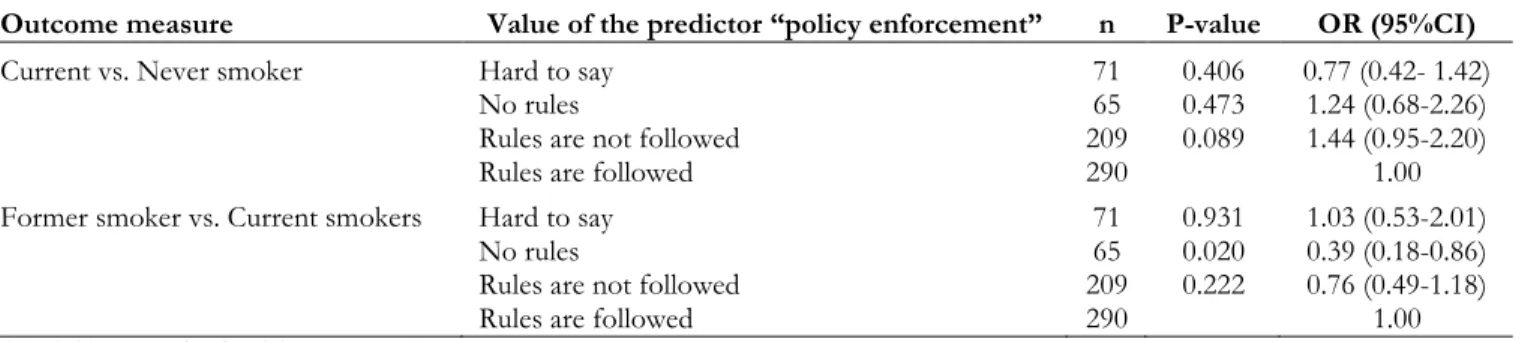
Two multinomial logistic regression models shown in Table 3 were used to analyze association between individual perception of smoke-free poli-cies enforcement as the predictor variable and the smoking status as the outcome. Current smokers were marginally more likely to report that rules are not followed (OR=1.44 95%CI 0.95-2.20; P=0.089) compared to never smokers. Former smokers com-pared to current smokers were less likely to report that there are no rules regarding smoking re-strictions (OR=0.39 95%CI 0.18-0.86 P=0.020); thus perception that smoke-free policies are ob-served was associated with being a former smoker versus a current one.
Discussion
Table 3: Multinomial logistic regression modeling of becoming a current smoker vs. never smoker and becoming a former smoker after being a current smoker, with individual level predicting variable characterizing perception of smoke-free policies enforcement; controlled for age and gender
Outcome measure Value of the predictor “policy enforcement” n P-value OR (95%CI)
Current vs. Never smoker Hard to say 71 0.406 0.77 (0.42- 1.42)
No rules 65 0.473 1.24 (0.68-2.26)
Rules are not followed 209 0.089 1.44 (0.95-2.20)
Rules are followed 290 1.00
Former smoker vs. Current smokers Hard to say 71 0.931 1.03 (0.53-2.01)
No rules 65 0.020 0.39 (0.18-0.86)
Rules are not followed 209 0.222 0.76 (0.49-1.18)
Rules are followed 290 1.00
OR: Odds Ratio; CI: Confidence Interval
It is important to state that the university with partial enforcement of smoke-free policies (B) showed intermediary and contradictory results with the outcome measures in some subgroups closer to the university that was smoke-free and in others closer to the university that was not smoke-free. Thus, partial restriction of smoking shows limited benefit.
Even more striking was the difference between smoke-free and non-smoke-free universities found in percentages of daily smoking: while it was slightly over 10% in a smoke-free university, it amounted to 26% in a non-smoke-free univer-sity overall and to 42% among male students.
As we aimed to disentangle the processes of smoking initiation and stopping smoking as af-fected by smoke-free environments, we clarified that there was no advantage of smoke-free univer-sities in limiting smoking initiation. In fact, even more students of smoke-free universities reported to have experimented with smoking during their university years. On the contrary, many more stu-dents in a smoke-free university reported having stopped smoking after having initiated it earlier. In accordance with this, we have seen more current smokers expressing willingness to quit and experi-ence of earlier attempts to stop smoking. Being a former smoker compared to current smoker was found to be associated with the existence of uni-versity policies that limit smoking. These various indicators collected in our study consistently show that the prevalence of smoking is reduced within smoke-free environments through creating condi-tions to stop experiments with tobacco, and
among those whose regular smoking has been es-tablished earlier - through considering stopping smoking. To the best of our knowledge, there was only one published study, which considered quit attempts in relation to limiting smoking in a uni-versity.6 However, an intervention evaluated in that study comprised smoking cessation program as well.
Beyond educational settings, smoke-free poli-cies at workplaces are not always associated with quitting;18 thus, smoke-free policies in educational facilities with older adolescents and young adults are extremely promising as a means to avoid to-bacco-related diseases and deaths among them in future.
en-vironmental influences in countries with high smoking prevalence.
Study limitations and strengths
Among the limitations of the study, we can mention its comparatively small scale with only 635 students included altogether. This did not al-low further detailed inquiry into some of the indi-cators we considered. Like in most similar studies, outcome indicators were self-reported. However, the strength of the study is that the exposure (presence and enforcement of smoke-free policies) was measured long before the self-reported smok-ing behavior information was collected. While the environmental situation could have changed, we have also collected the data on the individual per-ception of the smoke-free policies enforcement, which fully confirmed our earlier observations with regard to 100% (university A), partial (uni-versity B) and absent (uni(uni-versity C) restriction of smoking. Thus, we could consider exposure varia-bles of both institutional and individual level and triangulate the data. Along with earlier findings showing that students' perceptions of policy en-forcement significantly predicted school smoking prevalence and location of tobacco use,20 we also found that these perceptions are quite consistent with instrumental assessment of smoke-free poli-cies on institutional level.
Thinking about other potential limitations, solely post-intervention measurement can be con-sidered a limitation of our study, whereas similar approach with collecting exposure and outcome measures from different sources was implemented in a study conducted earlier in Texas.9 Moreover, as the observed policies are already in place for a long time, are mostly self-enforced by the consid-ered educational facilities, do not change over time, it was not feasible to evaluate them in a tra-ditional pre- and post-measurement study design. Besides that, as shown in a study that considered a community with a long-standing comprehensive smoke-free law,8 impact of smoke-free policies increases over time, which could be the explana-tion of the huge differences we found between university A and C.
A potential confounding bias that we could not control for in the analysis was related to the phe-nomenon observed in our work with universities in general - that is the difference between private and state universities. Samples in private univer-sities are usually small but cover almost all stu-dents. Samples in governmental universities are large but to substantial extent self-selected: stu-dents in state universities who usually get in the survey are those who regularly attend the classes and demonstrate more favorable behaviors in spite of less favorable environmental factors. The university B that demonstrated contradictory re-sults was an example of such entity. On the con-trary, universities A and C are both private ones, so our finding with regard to higher quitting in smoke-free universities is primarily related to pri-vate universities.
Further research
Studies to confirm or refute the hypotheses de-riving from our findings may apply longitudinal approaches, controlled designs, and larger samples that would allow for better control of concurrent factors. However, this might be not possible after all the universities turn smoke-free. Nevertheless, our conclusions of the favorable impact of smoke-free environments will probably remain valid; no matter whether additional factors are to be con-trolled in future research.
Conclusion
Smoke-free policies are not only an effective tool to protect non-smokers from secondhand smoke exposure but also a condition for smokers to quit. Earlier studies have shown the decline in the prevalence of current smoking in universities that run smoke-free.
cur-rent smokers and experimenters turning into for-mer smokers.
Acknowledgements
Authors are grateful for the help in data collec-tion to G.A. Liaukina, executive secretary of Ka-zan city Drug Prevention Committee, L.P. Shi-gapova, Vice-Principal in Educational Work of the Academy of Social Education, L.M. Sedova, Vice-Principal in Educational Work of The Academy of Management TISBI, I.V. Zhukova, Vice-Principal in Educational Work of The Kazan State Univer-sity of Energetic, V.G. Dvoenosov, Head of Valeology Center of Kazan Federal University.
Conflict of interest
Authors declare to have no conflict of interest.
References
1. World Health Organization. MPOWER: A policy package to reverse the tobacco epidemic. Geneva: World Health Organization;2008. Available from:http://www.who.int/tobacco/mpower/mpo wer_english.pdf
2. Fichtenberg CM, Glantz SA. Effect of smoke-free workplaces on smoking behaviour: systematic review. BMJ 2002; 325: 188. doi:10.1136/bmj.325.7357.188
3. Hammond D. Smoking behaviour among young adults: beyond youth prevention. Tob Control
2005;14:181-185. doi:10.1136/tc.2004.009621 4. Murphy-Hoefer R, Griffith R, Pederson LL,
Crossett L, Iyer SR, Hiller MD. A review of interventions to reduce tobacco use in colleges and universities. Am J Prev Med 2005;28:188-200. doi: 10.1016/j.amepre.2004.10.015
5. Apel M, Klein K, McDermott RJ, Westhoff WW. Restricting smoking at the University of Koln, Germany: a case study. J Am Coll Health
1997;45:219-223. doi:
10.1080/07448481.1997.9936889
6. Etter JF, Ronchi A, Perneger T. Short-term impact of a university based smoke free campaign. J Epidemiol Community Health 1999;53:710-715. doi:10.1136/jech.53.11.710
7. Chuang SH, Huang SL. Changes in smoking behavior among college students following implementation of a strict campus smoking policy in Taiwan. Int J Public Health 2012;57:199-205. doi: 10.1007/s00038-011-0265-58.
8. Hahn EJ, Rayens MK, Ridner SL, Butler KM, Zhang M, Staten RR. Smoke-free laws and smoking and drinking among college students. J Community Health 2010;35:503-511. doi: 10.1007/s10900-010-9220-2.
9. Borders TF, Xu KT, Bacchi D, Cohen L, SoRelle-Miner D. College campus smoking policies and programs and students' smoking behaviors. BMC Public Health 2005;5:74. doi: 10.1186/1471-2458-5-7410.
10. Wechsler H, Lee JE, Rigotti NA. Cigarette use by college students in smoke-free housing: results of a national study. Am J Prev Med 2001;20:202-207.doi:10.1016/S0749-3797(00)00313-5
11. Seo DC, Macy JT, Torabi MR, Middlestadt SE. The effect of a smoke-free campus policy on college students' smoking behaviors and attitudes. Prev Med
2011;53:347-352.doi: 10.1016/j.ypmed.2011.07.015 12. Cook PF. Study designs for program evaluation: How do we know what works? J Spec Pediatr Nurs
2009;14:70-72. doi:10.1111/j.1744-6155.2008.00177.x
13. Ananjeva GA, Andreeva TI. Scope of illegal tobacco products sales in Kazan city. Tobacco Control and Public Health in Eastern Europe 2011;1:32-36. 14. Vildanova FZ. Monitoring study of smoke-free
policies implementation in a higher education facility.Tobacco Control and Public Health in Eastern Europe 2011;1:39-41.
15. Warren CW, Jones NR, Chauvin J, Peruga A, GTSS Collaborative Group. Tobacco use and cessation counselling: cross-country. Data from the Global Health Professions Student Survey (GHPSS), 2005-7. Tob Control 2008;17:238-247. doi:10.1136/tc.2007.023895
16. Warren CW, Lee J, Lea V, Goding A, O'Hara B, Carlberg M, et al. Evolution of the Global Tobacco Surveillance System (GTSS) 1998-2008. Glob Health
Promot 2009;16:4-37. doi:
10.1177/1757975909342181.
17. Gualano MR, Bontempi C, Saulle R, Ricciardi W, La Torre G. Validation of the global health professions students survey questionnaire in Italy.
Ital J Public Health 2011;8:392-398.doi:10.2427/5686 18. Gao J, Zheng P, Gao J, Chapman S, Fu H.
with male employees' smoking behaviours: a cross-sectional survey in one company in China. Tob
Control 2011;20:131-136.
doi:10.1136/tc.2010.036335
19. Giovino GA, Mirza SA, Samet JM, Gupta PC, Jarvis MJ, Bhala N, et al. Tobacco use in 3 billion individuals from 16 countries: an analysis of nationally representative cross-sectional household
surveys. Lancet 2012;380:668-679. doi: 10.1016/S0140-6736(12)61085-X
20. Lovato CY, Sabiston CM, Hadd V, Nykiforuk CI, Campbell HS. The impact of school smoking policies and student perceptions of enforcement on school smoking prevalence and location of smoking.
Health Educ Res 2007;22:782-793.