% " $ Rev Saúde Pública 2005;39(5):745-53 www.fsp.usp.br/rsp
Factors associated to smoking habit among
older adults (The Bambuí H ealth and Aging
Study)
Fatores associados ao hábito de fumar entre
idosos (Projeto Bambuí)
Sérgio Viana Peixoto, Josélia O liveira Araújo Firmo and M aria Fernanda Lima-Costa
Núcleo de Estudos em Saúde Pública e Envelhecimento. Fundação Oswaldo Cruz e Universidade Federal de Minas Gerais. Belo Horizonte, MG, Brasil
Correspondência/ Correspondence:
Sérgio Viana Peixoto
Centro de Pesquisas René Rachou - Fiocruz Av. Augusto de Lima, 1715 Barro Preto 30140-002 Belo Horizonte, MG, Brasil E-mail: [email protected]
Financial support by Financiadora de Estudos e Projetos (Finep - Processo n. 6694009-00) and by Conselho Nacional de Desenvolvimento Científico e Tecnológico (CNPq - Processo n. 520337/96-4).
Received on 10/5/2004. Reviewed on 13/6/2005. Approved on 8/8/2005.
Keywords
Smoking, epidemiology. Older adults. Health surveys. Prevalence.
Epidemiology. Socio-economic factors. Educational status.
D escritores
Tabagismo, epidemiologia. Idoso. Levantamentos epidemiológicos. Prevalência. Epidemiologia. Fatores socioeconômicos. Escolaridade.
Abstract
Objective
To describe the characteristics and associated factors of the smoking habit among older adults.
Methods
A population-based study was carried out comprising 1,606 (92.2%) older adults (≥60 years old) living in the Bambuí town, Southeastern Brazil in 1997. Data was obtained by means of interview and socio-demographic factors, health status, physical functioning, use of healthcare services and medication were considered. The multiple multinomial logistic regression was used to assess independent associations between smoking habits (current and former smokers) and the exploratory variables.
Results
The prevalence of current and past smoking was 31.4% and 40.2% among men, and 10.3% and 11.2% among women, respectively (p<0.001). Among current smokers, men consumed a larger number of cigarettes per day and started the habit earlier than women. Among men, current smoking presented independent and negative association with age (≥80 years) and schooling (≥8 years) and positive association with poor health perception and not being married. Among women, independent and negative associations with current smoking were observed for age (75-79 and ≥80 years) and schooling (4-7 and ≥8 years).
Conclusions
Smoking was a public health concern among older adults in the studied community, particularly for men. Yet, in a low schooling population, a slightly higher level was a protective factor against smoking for both men and women. Programs for reducing smoking in the elderly population should take these findings into consideration.
Resumo
Objetivo
Descrever as características e fatores associados ao hábito de fumar em uma população idosa.
Métodos
% " %
Rev Saúde Pública 2005;39(5):745-53 www.fsp.usp.br/rsp
Smoking and associated factors among elderly Peixoto SV et al
de serviço de saúde e de medicamentos. Os dados foram coletados por meio de entrevista. A regressão logística multinomial foi utilizada para avaliar associações independentes entre o hábito de fumar (atual e passado) e as variáveis exploratórias.
Resultados
A prevalência de tabagismo atual e passado foi de 31,4% e 40,2% entre os homens, e de 10,3% e 11,2% entre as mulheres, respectivamente (p<0,001). Entre os tabagistas atuais, os homens consumiam maior número de cigarros diários e iniciaram o hábito mais cedo do que as mulheres. Entre os homens, o tabagismo atual apresentou associação independente e negativa com idade (≥80 anos) e escolaridade (≥8 anos) e associação positiva com percepção ruim da saúde e não ser casado. Entre as mulheres, associações independentes e negativas com tabagismo atual foram observadas para idade (75-79 e ≥80 anos) e escolaridade (4-7 e ≥8 anos).
Conclusões
O tabagismo constituiu um problema de saúde pública entre os idosos da comunidade estudada, sobretudo no sexo masculino. Mesmo em uma população de baixa escolaridade, o grau de instrução foi fator protetor para o tabagismo em ambos os sexos. Programas para a redução do tabagismo na população idosa deveriam levar estes resultados em consideração.
INTRODUCTION
Population aging was first observed in developed countries, but more recently this phenomenon has ex-tensively occurred in developing countries. In Brazil, the population aged 60 years or more increased from 3 millions in 1960 to 14 millions in 2002 and it is esti-mated to reach 32 millions by 2020, when it will rep-resent the 6th largest elderly population in the world.16
As observed in other countries, the leading causes of death among older Brazilian adults are cardiovascular diseases (cerebrovascular diseases and ischemic heart disease), neoplasms (malignant neoplasms of the lungs, trachea and bronchi, prostate and breast cancer) and respiratory diseases (chronic obstructive pulmonary dis-ease and pneumonia).17 This profile can be explained, at least partially, by the existence of modifiable risk fac-tors, of which smoking is the most important.3 However, smoking habit among older adults in Brazil has been given little attention. In the city of Pelotas, South Bra-zil, the prevalence of current smoking among older adults in 1998 was 15.8%.7 In the Bambuí town, Southeast Brazil, this prevalence in 1997 was 18.7%.15
Elderly smokers present higher mortality risk for cancer and cardiovascular disease, compared to those who never smoked.2,14 Furthermore, smoking reduces the quality of life for older adults because it is associ-ated with poorer health status.1,6 Studies of prevalence and factors associated with smoking in this popula-tion are thus important for the identificapopula-tion of high-risk groups helping the development of intervention strategies, since stop smoking leads to a reduced risk of mortality10 and improved health conditions.6
In general, the prevalence of smoking among older adults is lower than that observed in younger age groups. This occurs as a consequence of cessation of the smok-ing habit with increassmok-ing age, differences between gen-erations (cohort effect) and/or premature death of smok-ers.15 However, elderly smokers when compared to young smokers have higher risk of developing diseases related to smoking because they tend to be exposed longer and more intensely to tobacco.12 Furthermore, the absolute number of elderly smokers are likely to increase as a consequence of global aging population.8
Most studies, but not all,1,24 have found that smok-ing is more frequent among men with lower socio-economic condition and little formal education.11
The objective of the present study was to describe the smoking habit of older adults living in the com-munity and to examine the factors associated with current and past smoking.
M ETH O D S
The municipality of Bambuí is located in South-east Brazil, in the state of Minas Gerais, comprising 20,500 inhabitants, 73% in the urban area. Life ex-pectancy at birth was 70.2 years and infant mortality rate was 48.4 per 1,000.18 The leading causes of death among older adults in the municipality were cerebrov-ascular disease (CID-10: I60-I69), Chagas’ disease (CID-10: B57) and chronic obstructive pulmonary disease (CID-10: J43, J44), with mortality rates of 712.8, 377.4 and 293.5 per 100,000, respectively.20,*
The participants of the Bambuí Health and Aging
% " & Rev Saúde Pública 2005;39(5):745-53 www.fsp.usp.br/rsp
Smoking and associated factors among elderly Peixoto SV et al
Study18 were identified through a complete census carried out in the Bambuí town in 1996. All of the 1,742 residents aged 60 or more were included in the baseline, but 1,606 cohorts participated in the present study. The participants were similar to the total eld-erly population with respect to gender, age, number of people living in the household, conjugal status, family income and schooling.
The data for this study was obtained by means of interviews carried out at the subject’s home, in 1997. The subject was interviewed directly, except when this was impossible due to a cognitive deficit or health problem. In this case, a proxy responded the interview questionnaire.18
The questions related to the use of cigarettes were translated into Portuguese from the National Center for Health Statistics (NCHS) questionnaire. 21 The fol-lowing questions were used: (1) Have you smoked at least 100 cigarettes during your entire life? (2) How old were you when you first started smoking ciga-rettes fairly regularly? (3) Do you smoke cigarettes now? (4) About how many cigarettes do you smoke per day? (5) About how old were you when you last smoked cigarettes (fairly regularly)?
The outcome variable in this study was the smoking habit, and the subjects were classified as: (1) never smoked (those who haven’t smoked 100 cigarettes during life time); (2) former smokers (those who have already smoked 100 cigarettes, but who were not smok-ing at the time of the study); and (3) current smokers (those who had already smoked 100 cigarettes in their life and were smokers at the time of the study).
The following exploratory variables were consid-ered: (a) socio-demographic (age, gender, conjugal status, number of people living in the household, number of completed years of schooling, monthly
household income in Brazilian minimum wages (US$120.00); (b) health status (self-rated health, in-ability to perform routine activities due to health problems in the last two weeks, reported medical diagnosis of myocardial infarction, arterial hyper-tension, hypercholesterolemia, diabetes, Chagas’ disease, angina and intermittent claudication);25 (c) activities of daily life (ADL) (inability to perform at least one of four ADL – transferring from bed to chair, eating, dressing and bathing; walking at least 1.5 km without tiring); (d) use of healthcare services (number of medical visits in the past 12 months and number of hospital admissions in the past 12 months); (e) medication use in the past 90 days. Prox-ies did not answer questions that depended on per-sonal judgment, such as self-rated health, and for this variable a new category (proxy respondent) was considered in the analysis.
Univariate data analysis was based on the Chi-square Pearson test, Chi-square for linear trend (for propor-tion) and the Student t-test (for mean).
Multiple multinomial logistic regression was used to determine the independent effect of associations between the smoking habit and the exploratory vari-ables, estimating the adjusted odds ratio and 95% confidence intervals. In this analysis, current and former smokers were compared to those who never smoked (reference category). All variables which pre-sented an association with the smoking habit in the univariate analysis (p<0.20) were included in the ini-tial logistic model. Those variables associated with the smoking habit (p<0.05) were maintained in the final logistic model. Schooling and income presented significant associations with the smoking habit in both the univariate and the multivariate analysis. However, due to co-linearity, only schooling was maintained in the final logistic model because its stronger association with the smoking habit (for males
Table 1 - Selected characteristics concerning the smoking habit among older adults, according to gender. Bambuí, Brazil, 1997. N (%)
Variables M en Women Total
Current and past smoking
Current smokers 201 (31.4) 99 (10.3) 300 (18.7)
Former smokers 258 (40.2) 108 (11.2) 366 (22.8)
Never smoked 182 (28.4) 758 (78.5) 940 (58.5)
p<0.001* Number of cigarettes smoked per day among current smokers
1-9 106 (52.7) 74 (74.8) 180 (60.0)
10-20 78 (38.8) 20 (20.2) 98 (32.7)
>20 17 (8.5) 5 (5.0) 22 (7.3)
p=0.001** Average (standard deviation)
Average age of starting smoking among current smokers 15.2 (7.5) 21.0 (13.2) 17.1 (10.1) p<0.001***
Average age of quitting smoking habit among former smokers 49.0 (15.1) 49.5 (13.8) 49.1 (14.8) p=0.798***
% " '
Rev Saúde Pública 2005;39(5):745-53 www.fsp.usp.br/rsp
Smoking and associated factors among elderly Peixoto SV et al
and females). Analysis was performed separately for men and women, using Stata software.
RESU LTS
Among the 1,606 subjects, 641 (39.9%) were men and 965 (60.1%) were women. The average age was 69.3 years (SD=7.4), ranging between 60 and 95 years. A proxy was required for 90 interviews (5.6%).
Table 1 shows some characteristics of the smoking habit among older adults, according to gender. The prevalence of current smoking and past smoking was 31.4% and 40.2% among men, and 10.3% and 11.2% among women, respectively (p<0.001). Among cur-rent smokers, 52.7% of men and 74.8% of women consumed less than 10 cigarettes per day (p=0.001). The average age of starting to smoke was lower among men (15.2 years) than among women (21.0 years) and the age of quitting the habit among former smokers was similar for both men and women. Among former smokers, only seven subjects (2.2%) had quit the habit for less than one year (data not shown).
Table 2 presents the distribution of the smoking habit among men and women, according to selected socio-demographic characteristics. Among men, posi-tive association was observed for conjugal status (un-married) and negative associations were observed for
schooling and family income. Among women, the smoking habit showed significant and negative as-sociation with age and family income.
The distribution of the smoking habit among men and women, according to selected health conditions indicators, is presented in Table 3. Significant asso-ciations were found among the outcome and poorer health perception among men, and the presence of intermittent claudication among women.
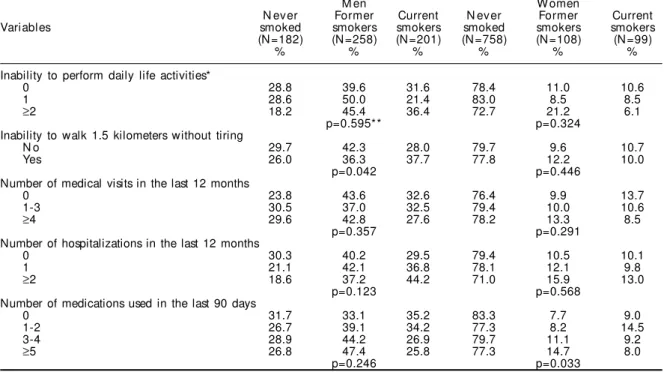
The distribution of the smoking habit among men and women, according to selected physical function-ing indicator, use of healthcare services and use of medication is shown in Table 4. Smoking habit was associated with the inability to walk 1.5 kilometers without tiring among men, and with the number of medicines taken in the past 90 days among women.
Table 5 presents the final results of multivariate analy-sis of smoking habit among older adults for both men and women. Among men, current smoking presents a negative and independent association with age group (≥80 years) and schooling (≥8 years), and a positive association with conjugal status (unmarried) and self-rated health (poor). None of the studied characteristics showed independent association with past smoking among men. Among women, current smoking showed independent and negative association with age group
Table 2 - Smoking habit among men and women older adults according to socio-demographic characteristics. Bambuí, Brazil, 1997.
M en W omen
N ever Former Current N ever Former Current
Variables smoked smokers smokers smoked smokers smokers
(N=182) (N=258) (N=201) (N=758) (N=108) (N=99)
% % % % % %
Age group (years)
60-64 26.6 38.7 34.7 77.7 10.2 12.1
65-69 30.1 42.3 27.6 78.0 8.4 13.6
70-74 28.6 38.6 32.8 75.7 14.6 9.7
75-79 21.6 41.9 36.5 83.2 12.4 4.4
≥80 37.2 41.4 21.4 82.1 13.4 4.5
p=0.401* p=0.035
Conjugal status
M arried 30.1 41.9 28.0 79.1 10.9 10.0
Others** 23.9 35.8 40.3 78.3 11.3 10.4
p=0.010 p=0.963
Number of residents in household
≤2 28.4 41.2 30.4 78.9 11.4 9.7
3-4 28.0 40.3 31.7 78.7 10.5 10.8
≥5 28.3 39.1 32.6 76.3 12.7 11.0
p=0.995 p=0.936
Schooling (years)
0 23.9 35.7 40.4 73.4 13.1 13.5
1-3 28.7 40.7 30.6 79.9 10.4 9.7
4-7 29.3 42.5 28.2 81.9 9.7 8.4
≥8 37.0 48.2 14.8 84.7 11.1 4.2
p=0.019 p=0.103
Monthly family income***
<2 18.4 41.1 40.5 77.1 11.3 11.6
2-3.99 31.4 36.0 32.6 74.9 12.8 12.3
≥4 32.2 44.9 22.9 84.4 9.2 6.4
p=0.001 p=0.040
*Pearson’s Chi-square test
% # Rev Saúde Pública 2005;39(5):745-53 www.fsp.usp.br/rsp
Smoking and associated factors among elderly Peixoto SV et al
(75-79 and ≥80 years) and schooling (4-7 and ≥8 years). Past smoking was negatively associated with school-ing (4-7 years) and positively associated with the pres-ence of intermittent claudication.
D ISCU SSIO N
The results of this study showed great differences in the smoking habit between men and women. The prevalence of current smoking was three times greater among men than among women. The preva-lence among aged males (31%) in Bambuí was much higher than that observed among men (≥65 years) in the United States (13%),8 United Kingdom (18%)4 and Canada (20%).19 Among women, this prevalence (10%) was fairly similar to that observed in the United States (11%)8 and slightly lower than the prevalence found in the United Kingdom (17%)4 and Canada (14%).19
In addition to the higher prevalence of smoking among men in the present study, they started to smoke earlier and consumed a larger number of cigarettes per day, which is similar to that observed in the North
American population.1 However, the daily consump-tion of cigarettes among the Bambuí elderly was lower than that reported in the United States1 and Canada.19 In three population-based studies carried out in Canada (1985, 1986 and 1989), the proportion of the elderly (≥65 years) who consumed more than 20 ciga-rettes per day varied from 52 to 61% among men and from 30 to 38% among women.19 In the Bambuí popu-lation, this proportion was 9% among men and 5% among women. Considering that a higher consump-tion of cigarettes is associated with higher risk of death,14 it may be suggested that the reduction in cigarette consumption may contribute to higher sur-vival of Bambuí elderly smokers, and have an impact on the prevalence of current smokers.
The reduction of smoking at increasing age was observed in both men and women, corroborating the results obtained in other studies.1,19 However, the re-duction of the prevalence of smokers with age does not mean that the absolute number of elderly smok-ers is reducing. Population aging leads to an increas-ing number of smokers, as observed in the United States in the period from 1965 to 1994.8
Table 3 - Smoking habit among men and women older adults according to health conditions indicators. Bambuí, Brazil, 1997.
M en W omen
N ever Former Current N ever Former Current
Variables smoked smokers smokers smoked smokers smokers
(N=182) (N=258) (N=201) (N=758) (N=108) (N=99)
% % % % % %
Self-rated health
Good/ very good 30.3 43.1 26.6 79.7 10.7 9.6
Reasonable 29.8 41.5 28.7 79.7 11.0 9.3
Poor 21.0 36.1 42.9 75.4 12.3 12.3
Proxy 30.8 32.7 36.5 81.6 7.9 10.5
p=0.030* p=0.648
Inability to perform routine activities due to health problems in past 2 weeks
Yes 22.0 41.4 36.6 74.4 13.6 12.0
N o 29.4 40.1 30.5 79.6 10.6 9.8
p=0.320 p=0.288
Prior medical diagnosis of myocardial infarction
Yes 27.3 39.4 33.3 78.0 12.2 9.8
N o 29.2 40.7 30.1 78.9 11.1 10.0
p=0.924 p=0.978
Prior medical diagnosis of hypertension
Yes 27.0 42.7 30.3 79.3 11.3 9.4
N o 29.6 38.0 32.4 77.2 11.0 11.8
p=0.484 p=0.471
Prior medical diagnosis of hypercholesterolemia
Yes 33.7 44.2 22.1 82.1 11.4 6.5
N o 27.6 39.6 32.8 77.8 11.1 11.1
p=0.129 p=0.177
Prior medical diagnosis of diabetes
Yes 29.8 49.1 21.1 80.6 14.0 5.4
N o 28.2 39.4 32.4 78.2 10.8 11.0
p=0.184 p=0.106
Prior medical diagnosis of Chagas’ disease
Yes 28.0 45.5 26.5 75.1 11.0 13.9
N o 28.5 38.9 32.6 79.9 11.3 8.8
p=0.306 p=0.062
Intermittent claudication
Yes 18.6 40.7 40.7 30.0 60.0 10.0
N o 29.5 40.5 30.0 79.2 10.7 10.1
p=0.361 p<0.001
Angina
Yes 30.6 44.4 25.0 84.4 9.4 6.2
N o 29.1 40.4 30.5 78.0 11.6 10.4
p=0.777 p=0.317
% #
Rev Saúde Pública 2005;39(5):745-53 www.fsp.usp.br/rsp
Smoking and associated factors among elderly Peixoto SV et al
The unmarried men of Bambuí had greater chance of being current smokers, but the same was not true for unmarried women. There is some controversy with re-spect to the influence of conjugal status on smoking among older adults. It has been shown that smoking was more frequent among unmarried men and women in the age group of 50 and 65 years in California.13 Also, there is a controversy regarding the influence of the conjugal status on quitting smoking. Another study conducted in four localities in the United States showed that in two of them quitting smoking was more frequent among older adults who had already been married, while in the other two, the opposite was found.1 Various hypotheses have been considered to explain the association be-tween smoking and conjugal status, such as the greater social support observed between couples favoring quit-ting smoking.13 Supporting this theory is the fact that married individuals are more likely to receive medical counseling to quit smoking compared to single ones.22
The association of smoking with lower socio-eco-nomic condition is well established. This association is explained by the high number of individuals who start smoking and the high level of dependence among this population, as well as the great difficulty to quit the habit, due to low motivation and the scarcity of resources.11 In the United States, the association of smoking and schooling was weaker among older adults, compared to younger people (18-64 years), showing differences only at the extremes of schooling (<9 and >15 years).8 An analysis of four population studies in
that country revealed that, while men with the highest level of education showed the lowest prevalence of smoking, this association was inverse for women.1 In the present study, schooling showed an independent and negative association with current smoking for both men and women. Among men the association was found only at the highest level of schooling (≥8 years), while among women it was not seen only for the highest but also for the intermediate (4-7 years) level of educa-tion. This is worth highlighting due to the low school-ing in the studied population.
Besides the increased risk of death,2,14 several stud-ies have shown that smoking reduces the quality of life of older adults, since it is associated to poorer health perception, emphysema, bronchitis, asthma, cardiovascular disease, infections, cough, chest and leg pain and limitations of daily life activities, diffi-culty in walking, climbing stars and carrying objects, hospitalizations, use of medication, as well as de-pressive symptoms, among others.1,2,6,19 In the present study, positive associations with current smoking and with past smoking were observed for poor health per-ception among men, and for the presence of intermit-tent claudication among women.
Self-perception of health is a robust and consistent indicator of mortality among the older adults.9 The present study confirms other studies5,19,23 by identify-ing that current male smokers perceive their health to be poorer than those who have never smoked. In line
Table 4 - Smoking habit among men and women older adults according to physical functioning indicator, use of healthcare services and use of medication. Bambuí, Brazil, 1997.
M en W omen
N ever Former Current N ever Former Current
Variables smoked smokers smokers smoked smokers smokers
(N=182) (N=258) (N=201) (N=758) (N=108) (N=99)
% % % % % %
Inability to perform daily life activities*
0 28.8 39.6 31.6 78.4 11.0 10.6
1 28.6 50.0 21.4 83.0 8.5 8.5
≥2 18.2 45.4 36.4 72.7 21.2 6.1
p=0.595** p=0.324
Inability to walk 1.5 kilometers without tiring
N o 29.7 42.3 28.0 79.7 9.6 10.7
Yes 26.0 36.3 37.7 77.8 12.2 10.0
p=0.042 p=0.446
Number of medical visits in the last 12 months
0 23.8 43.6 32.6 76.4 9.9 13.7
1-3 30.5 37.0 32.5 79.4 10.0 10.6
≥4 29.6 42.8 27.6 78.2 13.3 8.5
p=0.357 p=0.291
Number of hospitalizations in the last 12 months
0 30.3 40.2 29.5 79.4 10.5 10.1
1 21.1 42.1 36.8 78.1 12.1 9.8
≥2 18.6 37.2 44.2 71.0 15.9 13.0
p=0.123 p=0.568
Number of medications used in the last 90 days
0 31.7 33.1 35.2 83.3 7.7 9.0
1-2 26.7 39.1 34.2 77.3 8.2 14.5
3-4 28.9 44.2 26.9 79.7 11.1 9.2
≥5 26.8 47.4 25.8 77.3 14.7 8.0
p=0.246 p=0.033
% # Rev Saúde Pública 2005;39(5):745-53 www.fsp.usp.br/rsp
Smoking and associated factors among elderly Peixoto SV et al
Table 5 - Results of multivariate analysis of smoking habit among men and women older adults. Bambuí, Brazil, 1997. Men – OR (95% CI)* Women – OR (95% CI)* Variables Former smokers Current smokers Former smokers Current smokers
Age group (years)
60-64 1.0 1.0 1.0 1.0
65-69 0.94 (0.57-1.56) 0.64 (0.37-1.11) 0.81 (0.45-1.48) 1.01 (0.59-1.73) 70-74 0.94 (0.53-1.65) 0.77 (0.43-1.40) 1.26 (0.70-2.26) 0.77 (0.41-1.45) 75-79 1.29 (0.64-2.59) 1.05 (0.51-2.19) 0.95 (0.47-1.92) 0.26 (0.09-0.75)
≥80 0.73 (0.38-1.39) 0.32 (0.15-0.68) 1.00 (0.48-2.09) 0.37 (0.14-0.99) Conjugal status
M arried 1.0 1.0 – –
Others** 1.13 (0.71-1.79) 1.87 (1.16-3.00) – –
Schooling (years)
0 1.0 1.0 1.0 1.0
1-3 0.95 (0.57-1.57) 0.66 (0.39-1.11) 0.62 (0.37-1.05) 0.63 (0.37-1.06) 4-7 0.96 (0.57-1.64) 0.62 (0.35-1.09) 0.56 (0.32-0.99) 0.53 (0.29-0.94)
≥8 0.83 (0.40-1.73) 0.24 (0.09-0.62) 0.75 (0.33-1.69) 0.27 (0.08-0.92) Self-rated health
Good/very good 1.0 1.0 – –
Reasonable 0.95 (0.60-1.49) 0.95 (0.57-1.58) – –
Poor 1.19 (0.64-2.19) 1.95 (1.03-3.69) – –
Proxy 0.84 (0.37-1.92) 1.21 (0.52-2.82) – –
Intermittent claudication
N o – – 1.0 1.0
Yes – – 16.49 (3.96-68.55) 3.31 (0.33-33.24)
*Odds ratios adjusted for the variables listed in the table using multiple multinomial logistic regression. The reference category used was the “ never smoked” group. The final logistical model included 639 men and 905 women
**Single, divorced, separated and widowed
with other study,6 no association was observed between perception of self-rated health and past smoking, sug-gesting that the negative effect of smoking may be reversed by quitting smoking among older adults.
The main limitation of the present study is related to its cross-sectional design, which does not allow establishing temporal relationship. Nevertheless, it was not its objective to set up a cause-effect relation-ship. The study goal was to identify vulnerable groups, i.e., the characteristics that indicated the pres-ence of current and past smoking among older adults. Furthermore, survival bias must be highlighted, since it reduces the strength of association found. This is particularly important in studies about smoking be-cause the survival rate among smokers is lower than that among non-smokers.8
The results of the present study show that smoking is a public health concern among the older adults in the studied community, particularly for men. The re-porting of a range of illnesses or chronic conditions had no impact on the habit of smoking (current or past) among the study subjects. This highlights the difficulties which can be expected in a program for reducing the prevalence of smoking. The importance of low schooling should be emphasized in the main-tenance of the smoking habit among both elderly men and women. This finding is relevant since the level of schooling among the studied population is low, showing that even small differences in school-ing are sensitive to identify the elderly with a greater or lower likelihood of smoking. Programs for reduc-ing smokreduc-ing in the elderly population should take these findings into consideration.
REFEREN CES
1. Colsher PL, Wallace RB, Pomrehn PR, LaCroix AZ, Cornoni-Huntley J, Blazer D et al. Demographic and health characteristics of elderly smokers: results from established populations for epidemiologic studies of the elderly. Am J Prev Med 1990;6:61-70.
2. Cox JL. Smoking cessation in the elderly patient. Clin Chest Med 1993;14:423-8.
3. Desai MM, Zhang P, Hennessy CH. Surveillance for morbidity and mortality among older adults: United States, 1995-1996. MMWR CDC Surveill Summ 1999;48(8):7-25.
4. Gosney M. Smoking cessation. Gerontology 2001;47:236-40.
5. Hirdes JP, Brown KS, Vigoda DS, Forbes WF, Crawford L. Health effects of cigarette smoking: data from the Ontario Longitudinal Study on Aging. Can J Public Health 1987;78:13-7.
6. Hirdes JP, Maxwell CJ. Smoking cessation and quality of life outcomes among older adults in the Campbell’s Survey on Well-Being. Can J Public Health
1994;85:99-102.
% # !
Rev Saúde Pública 2005;39(5):745-53 www.fsp.usp.br/rsp
Smoking and associated factors among elderly Peixoto SV et al
8. Husten CG, Shelton DM, Chrismon JH, Lin YW, Mowery P, Powell FA. Cigarette smoking and smoking cessation among older adults: United States, 1965-94. Tob Control 1997;6:175-80.
9. Idler EL, Benyamini Y. Self-rated health and mortality: a review of twenty-seven community studies. J Health Soc Behav 1997;38:21-37.
10. Jajich CL, Ostfeld AM, Freeman DH. Smoking and coronary heart disease mortality in the elderly. JAMA 1984;252:2831-4.
11. Jarvis MJ, Wardle J. Social patterning of individual health behaviours: the case of cigarette smoking. In: Marmot M, Wilkinson RG. Social determinants of health. New York: Oxford University Press; 1999. p. 240-55.
12. Kamimoto LA, Eston NA, Maurice E, Husten CG, Macera CA. Surveillance for five health risks among older adults, United States (1993-1997). MMWR CDC Surveill Summ 1999;48(SS-8):89-130.
13. King AC, Taylor B, Haskell WL. Smoking in older women: is being female a ‘risk factor’ for continued cigarette use? Arch Intern Med 1990;150:1841-6.
14. LaCroix AZ, Lang J, Scherr P, Wallace RB, Cornoni-Huntley J, Berkman L et al. Smoking and mortality among older men and women in three communities. N Engl J Med 1991;324:1619-25.
15. Lima-Costa MF, Barreto SM, Uchôa E, Firmo JOA, Vidigal PG, Guerra HL. The Bambuí Health and Aging Study (BHAS): prevalence of risk factors and use of preventive health care services. Rev Panam Salud Publica 2001;9:219-26.
16. Lima-Costa MF, Veras R. Saúde pública e envelheci-mento [editorial]. Cad Saúde Pública 2003;19:700-1.
17. Lima-Costa MFF, Guerra HL, Barreto SM, Guimarães RM. Diagnóstico da situação de saúde da população idosa brasileira: um estudo da mortalidade e das internações hospitalares públicas. Inf Epidemiol SUS 2000;9(1):23-41.
18. Lima-Costa MFF, Uchôa E, Guerra HL, Firmo JOA, Vidigal PG, Barreto SM. The Bambuí Health and Ageing Study (BHAS): methodological approach and preliminary results of a population-based cohort study of the elderly in Brazil. Rev Saúde Pública
2000;34:126-35.
19. Maxwell CJ, Hirdes JP. The prevalence of smoking and implications for quality of life among the community-based elderly. Am J Prev Med 1993;9:338-45.
20. Ministério da Saúde. Secretaria de Informática. Departamento de Informática do Sistema Único de Saúde. Sistema de Informações sobre Mortalidade (SIM), 1996-2000. [CD-ROM]. Brasília (DF); 2002.
21. National Center for Health Statistics. Plan and operation of the Third National Health and Nutrition Examination Survey, 1988-1994. Series 1: programs and collection procedures. Vital Health Stat 1994;1(32): 1-407.
22. Ossip-Klein DJ, McIntosh S, Utman C, Burton K, Spada J, Guido J. Smokers ages 50+: who gets physician advice to quit? Prev Med 2000;31:364-9.
23. Ostbye T, Taylor DH, Jung SH. A longitudinal study of the effects of tobacco smoking and other modifiable risk factors of ill health in middle-aged and old Americans: results from the Health and Retirement Study and Asset and Health Dynamics among the Oldest Old Survey. Prev Med 2002;34:334-45.
24. Pudule I, Grinberga D, Kadziauskiene K, Abaravicius A, Vaask S, Robertson A, McKee M. Patterns of smoking in the Baltic Republics. J Epidemiol Community Health 1999;53:277-82.