Sandeep Kumar Int. Journal of Engineering Research and Applications www.ijera.com
ISSN: 2248-9622, Vol. 5, Issue 11, (Part - 2) November 2015, pp.104-107
www.ijera.com 104 | P a g e
A Robust Method for Image Watermarking Using Block
Differencing LSB Substitution
Sandeep Kumar*, Kulbhushan Singla**
* (Department of Electronics and Comm. Engg., MIT, Bikaner, INDIA) ** (Department of Electronics and Comm. Engg., GTBKIET, Chhapian Wali)
ABSTRACT
A robust watermark scheme for copyright protection is proposed in this paper. The present method selects the best block of image for watermark embedding by comparing luminance value of colored image and block. The watermark is embedded in the selected pixel blocks by using block pixel differencing LSB substitution method. The proposed approach overcomes the weak robustness problem of embedding the watermark in the spatial domain LSB substitution method. Further the watermark extraction does not require the original image as in the case of many digital watermarking methods. The experimental results indicate that the proposed system is better in terms of image quality and robustness against various attacks.
Keywords
- Digital Image, LSB Substitution, Luminance, MSE, PSNR, Watermarking TechniquesI.
INTRODUCTION
The recent advent in the field of multimedia proposed many facilities in transport, transmission and manipulation of data. Along with this advancement of facilities there are larger threats in authentication of data, its licensed use and protection against illegal use of data. The digital communication technology, like internet technology confronts various troubles related to the privacy and security of the data. Security techniques are required because of illegal access of data without permission. Therefore, it is necessary to protect data in the internet technology. For providing the security of digital data various techniques are used like encryption, decryption, cryptography, steganography and digital watermarking. Digital watermarking [1] have been proposed to discourage copyright infringement, tampering and unauthorized distribution of digital media (e.g. video, audio, and images). Digital watermarking [1] is a method for embedding some secret information and additional information in the cover image which can later be extracted or detected for various purposes like authentication, owner identification, content protection and copyright protection. In other words, a watermark is a pattern of bits inserted into multimedia data such as digital image, audio or video file that helps to identify the
file’s copyright information (author, rights etc.). A simple example of a digital watermark may be a visible signature or seal placed over an image to determine the owner of that image.
II.
L
ITERATURER
EVIEWDigital watermarking contains various techniques [2] for protecting the digital content. The entire digital image watermarking techniques always
works in two domains either spatial domain or transform domain. The spatial domain techniques works directly on pixels. It embeds the watermark by modifying the pixels value. Most commonly used spatial domain techniques are LSB [3] and PVD [4]. In LSB technique, the watermark data is embedded into least significant bits of pixels. In PVD method, the difference of nearby pixels is calculated to decide the amount of data to be embedded.
Transform domain techniques [5] embed the watermark by modifying the transform domain coefficients. Most commonly used transform domain techniques are DCT, DWT and SVD [6]. All these techniques work on frequency components of image to embed watermark data.
III.
B
LOCKP
IXELV
ALUED
IFFERENCINGLSB
S
UBSTITUTIONWe proposed a new technique for watermarking embedding in digital image. It is improved LSB substitution method [3]. The area for embedding is selected using luminance based location method [7]. J. Hussein [8], in his work had developed a method for selecting the embedding area in cover image using Luminance of image. The image of size 512X512 is divided into 8×8 blocks and the following operations are needed and must be performed to accomplish the embedding and extracting processes.
3.1 RGB TO YCbCrCONVERSION
The RGB color space is converted to YCbCr color space for each 8×8 block using the equations (1):
Y = 0.299 × R + 0.587 × G + 0.114 × B Cb = 0.596 × R - 0.275 × G - 0.321 × B
Sandeep Kumar Int. Journal of Engineering Research and Applications www.ijera.com
ISSN: 2248-9622, Vol. 5, Issue 11, (Part - 2) November 2015, pp.104-107
www.ijera.com 105 | P a g e
Cr = 0.212 × R - 0.523 × G - 0.311 × B (1) Where R, G and B are red, green and blue
components of RGB color space respectively.
3.2 LOG-AVERAGE LUMINANCE
The block selection criterion is dependent on average luminance for the entire image and log-average luminance for each block. The log-log-average luminance Yavg is calculated as shown in the equation (2):
(2)
Yavg: Log-average luminance Yx,y: Luminance Y of the pixel at x,y
A small value to avoid taking the log of a completely black pixel whose luminance is zero N: The number of pixels in the image
3.3BLOCK SELECTION CRITERION
After finding the log-average luminance for the entire image and for each block; the best blocks are chosen from the blocks that have log-average luminance closer to the log-average luminance of the entire image [8]. To do that we select the blocks with log average luminance in the range [Yavg-β, Yavg+β,] where Yavg is the log average luminance
of the image and β is the minimum floating-point value that is enough to determine adequate number of blocks.
When 512×512 host image is divided into 8×8 blocks, 4096 blocks are produced. If the watermark image size is 32×32 pixels and if we consider minimum embedding capacity of 1 bit per pixel, each color block consists of three color planes and we are using two color planes (red and blue) for embedding. In each block, we can embed minimum 60 x 2 bits and thus we require only 69 blocks to embed the entire watermark.
3.4EMBEDDING ALGORITHM
Now in selected blocks, separate RGB components of color image. We are embedding our watermark using Block Pixel Differencing LSB Substitution. As we are selecting the blocks for embedding on luminance basis, we have used only R and B components of color image for embedding, because G plane contributes most in the luminance value (equation 1) and change in G plane can change the luminance of block. The selected 8X8 block is further divided into four sub-blocks of size 4X4. In the sub-block, the average difference value d is calculated of the sub-block.
(3)
Where pmin - the minimum pixel value of block pi - i
th
pixel value of block
If d ≤ 7, then the sub-block belongs to lower-level and 1-bit LSB substitution is applied. If 8 ≤ d ≤
15, then the sub-block belongs to lower-middle level and 2-bit LSB substitution is applied. If 16 ≤ d ≤ 31, then the sub-block belongs to higher-middle level and 3-bit LSB substitution is applied. If d ≥ 32, then the sub-block belongs to higher level and 4-bit LSB substitution is applied.
Suppose n-bit LSB substitution is applied in a sub-block, where n value is 1, 2, 3 and 4 corresponding to lower, lower-middle, higher-middle and higher level respectively. The two bits of pixel p16 (last pixel of selected sub-block) are reserved to behave as an indicator of no. of bits substituted in sub-block pixels during the extraction. These least significant bits are set to 00 if the sub-block belongs to lower level. Similarly, these two bits are set to 01, 10, and 11 if the sub-block belongs to lower-middle, higher-middle and higher level respectively.
The process is applied on R and B planes of all sub-blocks of selected block and process is repeated for all other selected blocks until the embedding process is not completed.
3.5 EXTRACTION ALGORITHM
The watermarked image is received at receiver end and is processed in the same way as described in embedding phase. We select the blocks on the luminance basis. During the embedding process, the luminance value of selected block is not changed, because we have not used G plane for embedding and we got same blocks as selected on the embedding phase. The selected block is further divided into sub-blocks of size 4X4 and the two LSBs of p16 of selected sub-block are extracted first. These two bits are the indicators of the no. of data bits embedded in each pixel of selected sub-block and we extract the same amount of bits from LSB side of each pixel of block. This process is repeated for R and B planes of selected blocks separately. After that these binary information is converted in to watermark image.
IV.
P
ERFORMANCEA
NALYSISSandeep Kumar Int. Journal of Engineering Research and Applications www.ijera.com
ISSN: 2248-9622, Vol. 5, Issue 11, (Part - 2) November 2015, pp.104-107
www.ijera.com 106 | P a g e is compared against LSB method [2]. The results,
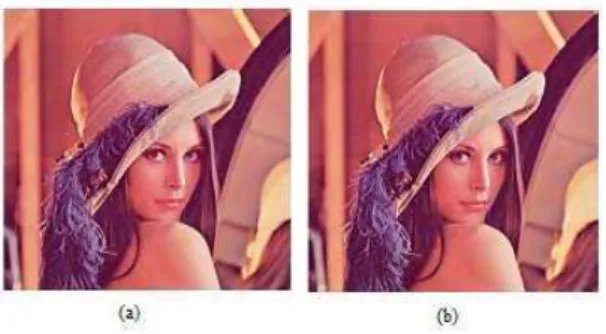
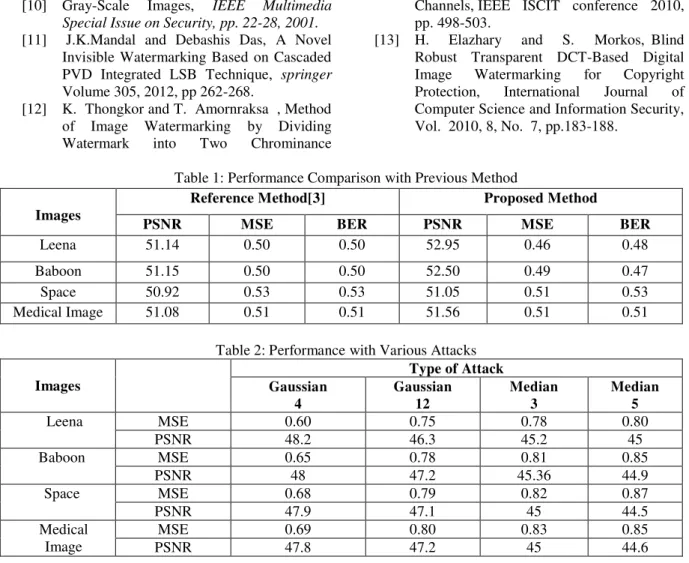
as presented in Table 1, shows good improvement in similarity between the original and the extracted watermark in comparison with the previous methods. The original images and corresponding watermarked images are shown.
V.
C
ONCLUSIONIn this research paper, a new approach has been proposed. The blocks for embedding are selected using luminance of the image. The watermark is embedded using block pixel value differencing LSB substitution, which is more effective than direct LSB substitution. This approach achieves high imperceptibility and robustness of the embedded watermark. Only the blocks with log-average luminance close to the log-average luminance of the entire image are used to embed the watermark. The test results show that these blocks do not degrade the
image when the pixels’ luminance value is increased
or decreased. Also, these blocks are less affected when various filters are applied to the image. The method is tested on various images and the results prove that the method is more effective and robust than previous method.
Figure 1 Original and Watermarked Image (Leena)
Figure 2 Original and Watermarked Image (Baboon)
Figure 3 Original and Watermarked Image (Space)
Figure 4 Original and Watermarked Image (Ultrasound)
R
EFERENCES[1] Shraddha S. Katariya, Digital Watermarking: Review, International Journal of Engineering and Innovative Technology (IJEIT) Volume 1, Issue 2, February 2012.
[2] Preeti Parashar and Rajeev Kumar Singh, A Survey: Digital Image Watermarking Techniques, International Journal of Engineering and Innovative Technology (IJEIT) Volume 1, Issue 2, February 2012.
[3] Amit K. Singh, Nomit Sharma,Mayank Dave and Anand Mohan,A Novel Technique For Digital Watermarking in Spatial Domain, 2nd IEEE International Conference on Parallel, Distributed and Grid Computing,212.
[4] J. K. Mandal and Debashis Das, Steganography Using Adaptive Pixel Value Differencing (APVD) of Gray Images through Exclusion of Overflow/Underflow.
CCSEA, SEA, CLOUD, DKMP, CS & IT 05, pp. 93–102, 2012.
[5] Radhika v. Totla, K.S.Bapat, Comparative Analysis of Watermarking in Digital Images Using DCT & DWT, International Journal of Scientific and Research Publications, Volume 3, Issue 2, February 2013.
[6] Md. Maklachur Rahman, A DWT, DCT and SVD based watermarking technique to protect the image piracy, International
Journal of Managing Public Sector
Information and Communication
Technologies (IJMPICT) Vol. 4, No. 2, June 2013.
[7] J.A.Hussein, Luminance-based Embedding Approach for Color Image Watermarking, I.J. Image, Graphics and Signal Processing, 2012, 3, 49-55.
[8] J. A. Hussein, Spatial Domain Watermarking Scheme for Colored Images Based on Log-average Luminance, Journal of Computing, vol. 2, No. 1,2010, pp. 100-103.
Sandeep Kumar Int. Journal of Engineering Research and Applications www.ijera.com
ISSN: 2248-9622, Vol. 5, Issue 11, (Part - 2) November 2015, pp.104-107
www.ijera.com 107 | P a g e [10] Gray-Scale Images, IEEE Multimedia
Special Issue on Security, pp. 22-28, 2001.
[11] J.K.Mandal and Debashis Das, A Novel Invisible Watermarking Based on Cascaded PVD Integrated LSB Technique, springer
Volume 305, 2012, pp 262-268.
[12] K. Thongkor and T. Amornraksa , Method of Image Watermarking by Dividing Watermark into Two Chrominance
Channels, IEEE ISCIT conference 2010, pp. 498-503.
[13] H. Elazhary and S. Morkos, Blind Robust Transparent DCT-Based Digital Image Watermarking for Copyright Protection, International Journal of Computer Science and Information Security, Vol. 2010, 8, No. 7, pp.183-188.
Table 1: Performance Comparison with Previous Method
Table 2: Performance with Various Attacks
Images
Type of Attack Gaussian
4
Gaussian 12
Median 3
Median 5
Leena MSE 0.60 0.75 0.78 0.80
PSNR 48.2 46.3 45.2 45
Baboon MSE 0.65 0.78 0.81 0.85
PSNR 48 47.2 45.36 44.9
Space MSE 0.68 0.79 0.82 0.87
PSNR 47.9 47.1 45 44.5
Medical Image
MSE 0.69 0.80 0.83 0.85
PSNR 47.8 47.2 45 44.6
Images
Reference Method[3] Proposed Method
PSNR MSE BER PSNR MSE BER
Leena 51.14 0.50 0.50 52.95 0.46 0.48
Baboon 51.15 0.50 0.50 52.50 0.49 0.47
Space 50.92 0.53 0.53 51.05 0.51 0.53