Received: 18.01.2016 Accepted: 20.04.2016
O R I G I N A L P A P E R
Snacks such as bakery and confectionary products are becoming more popular among consumers. However, these products might be a source of nutritionally unfa-vorable fats. Most shortenings used in the industry are solid fats rich in saturated fatty acids and often trans fatty isomers, which are nutritionally unfavorable (Onacik-żür et al., β014; Ribeiro et al., β009).
Żat is a very important ingredient in bakery and confectionary products because it gives the proper taste and texture. As regards the fat used in the pro-duction of such products, it is mostly vegetable mar-garines and vegetable fats like palm and coconut fat (Kanagaratnam et al., β01γ). Ӧegetable solid fat can also be obtained by modifying vegetable oils, whether
EFFECT OF BARLEY
β
-GLUCAN ADDITION AS A FAT REPLACER
ON MUFFIN QUALITY
Sylwia Onacik-Gür
1, Anna Żbikowska
1, Ewa Kapler
1, Hanna Kowalska
21Department of Food Technology, Warsaw University of Life Sciences – SGGW
Nowoursynowska 159C, 02-766 Warsaw, Poland
2Department of Food Engineering and Process Management, Warsaw University of Life Sciences – SGGW
Nowoursynowska 159C, 02-766 Warsaw, Poland
ABSTRACT
Background. The aim of this study was to perform the partial replacement of bakery fat with barley -glucan
in muffi ns and to determine its eff ect on the physical properties of products. Most shortenings used in the industry are solid fats rich in saturated fatty acids and often trans fatty isomers, which are nutritionally
unfavorable.
Material and methods. Źough and baked muffi ns were used as the research material. Żive muffi n recipes
were prepared: control (K0%) with 16% fat content in the total dough weight, with fat content decreased by 10% (Pż10%), 15% (Pż15%), β0% (Pżβ0%) and β5% (Pżβ5%). -glucan was used as a fat replacer in the 1:4 ratio. The parameters determining the physical characteristics and sensory attributes were measured, compared and statistically analyzed using a principal component analysis (PCA) method.
Results. Although the partial replacement of shortening with barley -glucan is possible, it may negatively
infl uence the physical properties of dough (aeration) and baked products (volume, density). It has been ob-served that increasing the content of this fat replacer enlarges the pores of the crumb. The textural properties of muffi ns with a fat content decreased by β0% are most similar to the control. Moreover, it has been shown that the overall sensory quality goes down when the amount of fat replacer in the muffi n recipe is increased. However, adding glucan to products in which fat content was decreased by 10% did not infl uence signifi -cantly the typical taste.
Conclusion. Źespite the adverse eff ect of -glucan on the physical and sensorial properties, it was found to
be reasonable to use it even in small amounts (up to 10%) to increase the nutritional value of products.
Key words: texture analysis, -glucan, porosity, PCA, fat replacer, nutrition value
this is physical – fractionation, or chemical – hydro-genation. Nowadays, food producers tend to avoid hy-drogenating fat, as during this process harmful trans fatty isomers are developed ( bikowska, β010). More-over, saturated fatty acids contained in solid vegetable fats, which make them solid, exert an adverse infl u-ence on humans’ cardiovascular system. According to the źŻSA, ŻŹA and ӧHO recommendations, the consumption of these food compounds and fat itself should be limited. Żat is high-energetic (1 gram of fat – 9 kcal), which is why its increased consumption may lead to obesity (źŻSA, β010; ӧHO, β014).
In order to reduce the fat content in food, fat replac-ers can be used. These are mainly carbohydrate com-ponents that have the ability to bind water and give a sensory eff ect similar to fat. Źietary fi bers and their fractions are often used as fat replacers. Their consump-tion may have a positive impact on overall health as it improves intestinal peristalsis, lowers blood cholesterol etc. (Źavidson and Maki, 1999; Piñero et al., β008).
To increase the nutritional value and reduce the caloric content of bakery products, scientists have proposed additives such as inulin ( bikowska and Rutkowska, β008), maltodextrin (Baixauli et al., β008), oat, wheat, barley (Zahn et al., β01γ), cocoa (Martinez-Cervera et al., β011), apple ( bikowska et al., β015), citrus, pea fi ber, and apricot kernel pow-der ( zboy- zbaş et al., β010). Nowadays, -glucan is becoming more and more popular. It is a fraction of dietary fi ber soluble in water, which can be found in wheat, oats and barley as well as in certain kinds of yeast and mushrooms (Augustín et al., β007; żibiński, β008). -glucan is similar to cellulose and is made of ~β50 000 -Ź-glucose particles. -glucan is able to stabilize oil in water emulsions. This component is extremely benefi cial: an intake of γ grams of -glucan per day lowers LŹL cholesterol and, in consequence, it reduces the risk of a cardiovascular disease (źŻSA, β010). In addition, it is recommended for people suf-fering from type II diabetes, since it has a low glyce-mic index (Zheng et al., β01γ).
-glucan has been used as a fat replacer in mayon-naise sauces (ӧorrasinchai et al., β006), meat prod-ucts (Álarez and Barbut, β01γ) and biscuits (Kalinga and Mishra, β009; Onacik-żür et al., β015).
Muffi ns are one of the most popular breakfast cereal snacks. However, muffi ns are a high-calorie
product. By adding pro-health ingredients they can be a great carrier of nutritious compounds (Bajerska et al., β015). Żor example, other authors have made these bakery products with fruit pomaces as a source of antioxidants (żórnaś et al., β016; Mildner-Szkud-lasz et al., β015) or dietary fi bers (Zahn et al., β01γ). The aim of this study was to partially replace short-ening with barley dietary fi ber with a high content of
-glucan and to compare the products obtained with full-fat muffi ns.
MATERIAL AND METHODS
Źough and baked muffi ns were used as the research ma-terial. The ingredients used for muffi n production were as follows: wheat fl our type 480 (Polskie Młyny S.A.), sugar (Pfeifer & Langen Poland), shortening Acofect LT M5γ (AKK, Sweden) with the following profi le of the main groups of fatty acids (ŻA): 54.41 g/100 g (SŻA), 1.96 g/100 g (TŻA), γ8.β8 g/100 g monounsatu-rated ŻA, 5.γ5 g/100 g PUŻA, γ.β% fat milk (Mlekpol, Poland), eggs (size L, from the local market), baking powder (ӧiniary, Nestle Poland) and barley -glucan preparation ( -glucan > βγ%, ӦITACźL® Bż γ00, Sancel, żermany; fi ber content – 54%, carbohydrates – 19%, protein – 18%; length of fi ber < 600 μm; water holding capacity – 8–1β g).
Żive muffi n recipes were prepared: control (K0%) with a 16% vegetable shortening content in the total dough weight, with a fat content decreased by 10% (Pż10%), 15% (Pż15%), β0% (Pżβ0%) and β5% (Pżβ5%). -glucan was used as a fat replacer in a 1:4 ratio. In the control sample, except for the 16% addi-tion of shortening, other ingredients were used in the following amounts: fl our – γγ%, sugar – 19%, milk – 18%, eggs – 1γ%, and baking powder – 1%. 58 grams of dough were put into cups and baked for β5 min-utes at 175°C in aUNOX type XBC convection oven (Ӧie Źell Ariginato, Padowa, Italy). γ batches of muf-fi ns were made and analyzed β4 h after baking. The muffi ns were stored at room temperature (ββ ±β°C) in polyethylene bags.
(Rahmati and Tehrani, β014). The crumb density was calculated by cutting a cube of β×β×β cm from the inside of the muffi n and weighing it. This analysis was carried out in γ repetitions.
Porosity
The muffi ns were cut parallel 1.5 cm above the bot-tom and the cut sections were scanned using a Canon iR10β4A scanner. The area and diameter of the pores (measured in μm) were determined by using the Multi Scan Base computer program (Computer Scanning System).
Texture analysis
The texture properties of muffi ns were determined us-ing a Brookfi eld model CTγ texture analyzer (USA). Cubes of β×β×β cm were cut out from the inside of the muffi ns (crumb) and then immediately evaluated by a two-bite test (TPA) with a constant 50% defor-mation of the probe height. Using this test, the fol-lowing texture features were calculated individually for each probe: hardness, gumminess, cohesiveness, adhesion, chewiness. Hardness and gumminess were expressed in Newton’s [N]. The analysis was run in γ repetitions.
Sensory analysis
Sensory analysis was conducted using the profi le method according to the norms (PN-ISO 110γ6:1999, PN-ISO 6564:1999). This evaluation was carried out by twelve trained panelists, who had graduated from the Żaculty of Żood Science and passed the sweet taste threshold test. On the hedonic scale, the group of experts marked the intensity of feelings related to: appearance of muffi ns and crumb, aroma, texture and taste. The line was unscaled with a length of 10 cm.
Statistic analysis
The analysis was done using Statistica 10.0. Żor all the data, normality was determined using the Shapiro-ӧilk test. Żor distributions, in which p ≥ 0.05, Tukey’s test was used to determine statistically signifi cant dif-ferences among probes of p ≤ 0.05. The physical prop-erties of muffi ns were compared using the principal components analysis (PCA).
RESULTS AND DISCUSSION
Physical properties of dough and muffi ns
Solid fat in bakery products has a very important ef-fect on cakes’ properties. Bakery fats have a high con-tent of solid phase. Thanks to its capacity to hold air in its structure, it has a positive impact on dough and baked product volume. The fl uffi ness of the dough has an impact on the properties of the fi nal product (Manohar and Rao, 1999), which is why shorten-ing was used in the present work. The reduction in fat content and the increase in barley -glucan had a statistically signifi cant eff ect (p < 0.05) on dough density. The lowest density (989.55 g/cmγ), and thus the best aeration, was observed in a control sample with the highest content of fat and without fat replac-er. The dough density increased gradually as the fat content in the recipes decreased. The highest dough density was observed in muffi ns with a reduced fat content and the highest content of barley prepara-tion (Pżβ5%) 1149.55 g/cmγ, which shows that these products had the lowest aeration of dough (Table 1).
It was observed that the addition of a fat replacer increased product moisture. Muffi ns Pżβ5% had the highest moisture content, while the control sample (K0%) had the lowest (Table 1). Martinez-Cervera et al. (β011) used cocoa fi ber as a fat replacer and ob-tained similar results. Zahn et al. (β01γ) also observed that the addition of barley fi ber signifi cantly increased the moisture content in products.
The increasing content of the fat replacer was fol-lowed by a decrease in the volume of the muffi ns. A similar tendency was shown in the study by Zahn et al. (β010), where inulin was used as a fat replacer in cakes. Moreover, in another study it was found that the addition of barley fi ber cause a decrease in the volume of the muffi ns (Zahn et al., β01γ).
Products with a higher barley -glucan content had a lower volume. The enrichment of -glucan up to β0% increased the size of the pores in muffi ns (Table 1). Substituting β5% of the fat with barley -glucan caused a decrease in the size of their pores. This could have re-sulted from high moisture content and dough density. Moreover, the addition of a fat replacer led to big diff er-ences in the size of pores in comparison with the con-trol sample (Żig. 1). The opposite eff ect was noticed in noticed in the case of a muffi n with cocoa fi ber, which showed a decrease in porosity with the increasing ad-dition of fat replacer (Martinez-Cervera et al., β011).
Texture analysis
The hardness (Fmax) of a product in the TPA test is meas-ured during the fi rst bite of the sample. Pż15% had the lowest hardness value (γ.0 N), while Pżβ5% had the highest (6.5 N). The control sample (4.9 N) and Pżβ0% (4.4 N) belonged to the same homogenous group (Żig. β). The hardness of bakery products is mostly at-tributed to amylopectin and amylose matrix (Żeili et al., β01γ). żómez et al. (β01γ) reported that hardness was due to interactions between gluten and fi brous materi-als. Similar results were published by Martinez-Cervera et al. (β011), where the addition of a fat replacer (cocoa
fi ber) on a low and medium level decreased the hard-ness of the products compared to the control, while the highest substitution of fat increased the hardness. In the studies by Chung et al. (β010), it was observed that the addition of starch fat replacers to muffi ns caused a sig-nifi cant increase in hardness.
Cohesiveness is a mechanical feature of texture related to the level to which it is possible to deform the sample without breaking it (PN-ISO 110γ6: 1999). This texture depends on the crumb network of all ho-mogenized ingredients inside the product, which to-gether keep it in one piece (Shyu and Sung, β010). The control sample and Pżβ5% had the highest cohesive-ness value (Żig. β). In the studies by Martinez-Cervera et al. (β011) it was shown that the lowest cohesiveness was observed in the samples with cocoa fi ber in com-parison with the control sample. However, in research by Zahn et al. (β01γ), no signifi cant diff erences were found between the control and the sample with the ad-dition of 6% barley fi ber. Moreover, Zahn et al. (β01γ) showed that products with OSA type starch were sig-nifi cantly more cohesive than the control sample.
Springiness is a level of sample deformation. In conducted study, Pżβ5% had the highest springiness value as well as hardness, whereas Pż15% had the
Table 1. Muffi ns properties
Parameter Type of sample
K0% Pż10% Pż15% Pżβ0% Pżβ5%
Źough density, g/cmγ Ā ±SŹ 989.55a
±1.19 1 044.1
b
±1.11 1 094.5γ
c
±γ.94 1 11γ.5
d
±γ.09 1 149.55
e ±6.61 Baked product density, g/cmγ Ā ±SŹ 470.88a
±γ.56 476.68
ab
±9.77 477.75
ab
±γ.β0 485.68
b
±1.71 5β5.4γ
b ±β.67
Crumb density, g/cmγ Ā ±SŹ 651.β8a
±8.51 666.9
a
±γγ.5β 676.9
ab
±7.51 675.γγ
ab
±β1.β0 7β5.68
b ±β1.96 Average volume of a muffi n, cmγ Ā ±SŹ 11γ.8c
±0.87 111.7
bc
±1.50 110.5
bc
±0.50 108.5
b
±0.50 100.0
a ±0.00
Moisture content, % Ā ±SŹ βγ.γ1a
±11.66 β4.14
b
±1β.7γ β9.70
c
±1.β1 β9.14
cd
±0.7γ γ6.86
d ±1γ.47
Total pores area, μm 475 909.6 1 016 904.0 1 844 700.0 β 000 586.0 890 8β9.9
Average pore size, μm γ69.50 716.1γ 797.88 981.16 γβ7.γ9
lowest (Żig. β). Zahn et al. (β01γ) observed that the addition of barley fi ber at a level of 6% did not change the springiness of muffi n crumb signifi cantly in com-parison to the control sample.
żumminess is an energy needed to make a product easy to swallow (Pons and Żiszman, β007). Pż15% had the lowest gumminess value (0.4β N), while
Pżβ5% had the highest. In the study by Chung et al. (β010), it was shown that starch fat replacers increased the gumminess of products signifi cantly compared with the control sample.
Chewiness is a mechanical feature and it measures the force needed to chew a bite of food. It is defi ned as a product of hardness, cohesiveness and springiness
Fig. 1. Pictures of muffi ns cut in half
b
b
b
a b
a
a
a
a a
a a
a
a a
b
bc
c
b
c
b
c
c
b
d
0 1 2 3 4 5 6 7 8
Cohesiveness Springiness Hardness, N Gumminess, N Chewiness
K0% PG10% PG15% PG20% PG25%
Fig. 2. Textural properties of muffi ns obtained from TPA test: a–e – diff erent letters indicate statistically
(Shyu and Sung, β010). Pż15% had the lowest chewi-ness value – 0.15 N, while Pżβ5% had the highest – γ.1 N (Żig. β). Martinez-Cervera et al. (β011) ob-served that the addition of cocoa fi ber caused a de-crease in chewiness compared to the control sample.
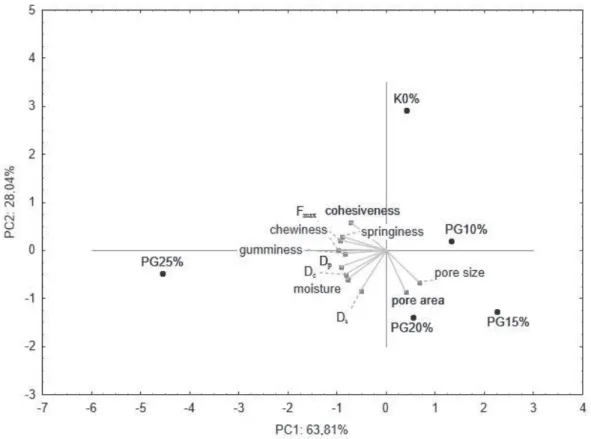
The principal component analysis (PCA) method, based on analysis of the results average, was used to analyze the data. The fi rst two components defi ned 91.85% of variable (loadings). The fi rst principal com-ponent (PC1) explained 6γ.81%: springiness, Fmax, chewiness, gumminess, product density (Dp), crumb density (Dc) and moisture (Żig. γ, Table β). The second component (PCβ) explained β8.04%: dough density (Źs) and pore area (Żig. γ, Table β). Based on the prin-cipal component plot (Żig. γ), it was observed that co-hesiveness, springiness and Fmax were negatively cor-related to the size and area of pores. In the plot (Żig. γ), it was observed that samples Pż10%, Pż15% and Pżβ0% were the most similar to each other. Sample
Fig. 3. Biplot of PCA
Table 2. Loadings coordinates of fi rst two principal
components
PC 1 PC β
Pore size 0.654875 –0.656509
Pore area 0.400181 –0.8586γ1
Moisture –0.787077 –0.59γ076
Dc –0.8γ19β7 –0.4987β8
Dp –0.9γ1980 –0.γ490ββ
Ds –0.5β907β –0.8410β8
Fmax –0.950460 0.ββγ096
Cohesiveness –0.7γ655β 0.5855β5
żumminess –0.854840 –0.054769
Chewiness –0.98β574 0.008β6β
Springiness –0.910097 0.γ0084β
K0% was diff erent by PCβ, which are the variables Ds and pore area. The point defi ning Pżβ5% is located on the very left side of the plot. It shows that the features explained by variables correlated to PC1 were diff er-ent for muffi ns with a fat conter-ent reduced by β5% than for other products.
Sensory analysis
At the beginning the panelists evaluated the aroma of the muffi ns, then the appearance of the whole product and crumb. The evaluation of texture and taste attrib-utes was the next level. At the end of the research the panelists evaluated overall quality. Źuring consump-tion, the texture is checked fi rst while biting, then after
the bite, it moves to the mouth and soaks all substanc-es related to the product taste are relived with saliva (Laguna et al., β01γ).
It was observed that the addition of -glucan had a negative eff ect on the characteristic aroma of muf-fi ns. K0% was evaluated as the most typical, with Pβ5% as the least typical. It was observed that by in-creasing the content of -glucan and dein-creasing the fat content, the cereal smell became more intense (Ta-ble γ). The cereal smell was defi ned as the aroma of barley cereal fl akes.
The control sample (K0%) had the most uni-form browning color of the crust and crumb. Higher
-glucan content decreased the uniformity of the
Table 3. Average results of sensory analysis
Attributes Type of sample
K Pż10% Pż15% Pżβ0% Pżβ5%
Aroma typical 8.0γd
±0.69 6.41 c ±0.85 5.91 c ±0.90 4.40 b ±1.08 β.05 a ±0.79
cereal 1.06a
±0.45 1.β0 a ±0.75 1.γ8 a ±0.51 γ.β0 b ±0.6β 4.9γ c ±0.4γ Appearance
of the muffi n uniformity of browning colour 5.56 c ±0.γ9 4.65 b ±0.6β 4.94 bc ±0.7γ γ.81 a ±0.7β γ.81 ab ±1.0β cracks on the surface γ.75a
±0.80 4.91 b ±0.51 5.β8 b ±0.61 5.94 bc ±1.0β 7.6γ d ±0.44 Appearance
of crumb color uniformity 7.14
d ±0.75 6.04 c ±0.65 5.09 b ±0.γ4 5.β4 b ±0.79 γ.7γ a ±0.9γ
porosity 6.51d
±0.80 6.β4 cd ±0.49 5.51 c ±0.41 4.40 b ±0.7γ β.β6 a ±0.61
Texture hardness 4.18a
±0.γβ 4.94 b ±0.44 5.59 c ±0.58 6.β9 d ±0.71 7.β8 e ±1.γβ
springiness 6.49e
±0.61 5.89 d ±0.β1 5.45 c ±0.45 γ.99 b ±0.18 β.59 a ±0.6β
Taste typical 6.99d
±1.0β 6.54 d ±0.9β 5.49 c ±1.β 4.γ8 b ±0.95 β.65 a ±1.15
cereal 0.9γa
±0.8β 1.4γ ab ±1.β7 β.90 c ±0.75 γ.95 d ±1.γ5 4.96 e ±1.β4
Overall quality 7.15d
±1.γ5 6.10 c ±1.β5 5.46 c ±0.56 γ.66 b ±1.05 1.99 a ±1.β
product color. ӧater-soluble dietary fi ber fractions ( -glucan, pectin) used in the present formulations may reduce the availability of starch degrading en-zymes to their substrates by creating a gel matrix (Khanna and Tester, β006). Źietary fi ber, which is characterized by high water absorption can compete with starch in the suspension of the water available, and thus cause a reduction in the gelatinization of starch (Collar et al., β006). It is assumed that few-er sugar particles wfew-ere involved in non-enzymatic browning – a Maillard reaction in muffi ns with -glucan addition. The addition of a fat replacer increased cracking on the muffi n surface. Once the -glucan content was increased, the pores became less uniform. Research by Baixauli et al. (β008) showed that muffi ns made of wheat fl our looked bet-ter than products made of whole grain fl our and the addition of resistant starch with a high content of di-etary fi ber.
The hardness of products increased along with the addition of -glucan. Their springiness, on the con-trary decreased. Martinez-Cervera et al. (β011) ob-tained similar results in their research. They observed that once the amount of fat replacer (cocoa fi ber) in-creased, the springiness decreased and chewing and swallowing the muffi ns was harder.
The addition of -glucan had a negative eff ect on the typical taste of the products. It also increased the sensation of a cereal taste (the taste of barley fl akes). The control sample had the best overall quality. Ac-cording to the sensory panelists, increased addition of barley -glucan had a negative impact on the overall quality of the muffi ns.
Based on the research by Baixauli et al. (β008), whole grain muffi ns rich in dietary fi ber were evalu-ated lower by consumers than products made of fl our with a low fi ber content. However, when they repeated the study and informed the evaluators about the ingre-dients used in the muffi ns, it was observed that con-sumers rated products with whole grain fl our higher because of the information they had been given.
CONCLUSION
The partial replacement of shortening with barley -glucan is possible in muffi ns, but it adversely aff ects the rheological properties of the dough (aeration) and
the resulting products (eg. size, density). It was ob-served that by increasing the content of a fat replacer, the pores in the crumb became bigger in comparison to the control sample, which has a negative impact on quality. In terms of texture properties, the muffi ns most similar to the control (without addition of bar-ley -glucan) were those with a fat content reduced by β0%. Moreover, it was shown that a higher barley -glucan content in the muffi n recipe decreased senso-rial overall quality. However, the addition of -glucan to products in which fat was reduced by 10% did not aff ect the typical taste of muffi ns signifi cantly. Źespite the adverse eff ect of -glucan on the physical and sen-sory properties, it seems to be appropriate to use it even in small amounts (≤10%) in order to increase the nutritional value of these products.
REFERENCES
Augustín, J., Jaworska, ż., Źandár, A., Cejpek, K. (β007). Boczniak ostrygowaty (Pleurotus ostreatus) jako ródło
-Ź-glukanów [Pleurotus ostreatus as a source of
beta--Ź-glucanes]. ywn. Nauka Techn. Jakość, 6(55), 170– 176 [in Polish].
Álarez, Ź., Barbut, S. (β01γ). źff ect of inulin, -glucan and their mixtures on emulsion stability, color and tex-tural parameters of cooked meat batters. Meat Sci., 94, γβ0–γβ7.
Baixauli, R., Salvador, A., Hough, ż., Żiszman, S. M. (β008). How information about fi ber (traditional and re-sistant starch) infl uences consumer acceptance of muf-fi ns. Żood Qual. Pref., 19, 6β8–6γ5.
Bajerska, A., Mildner-Szkudlarz, S., żórnaś, P., Seglina, Ź. (β015). The eff ect of muffi ns enriched with sour cherry pomace on acceptability, glycemic response, satiety and energy intake: a randomized crossover trial. J. Sci. Żood Agric., 96, β486–β49γ.
Chung, H.-J., Lee, S.-ź., Han, J.-A., Lim, S.-T. (β010). Physical properties of dry-heated ocetenyl succinylated waxy corn starches and its application in fat-reduced muffi n. J. Cereal Sci., 5β, 496–501.
Collar, C., Santos, ź., Rosell, C. M. (β006). Signifi cance of dietary fi ber on the viscometric pattern of pasted and gelled fl our-fi ber blends. Cereal Chem., 8γ, γ70–γ76. Źavidson, M. H., Maki, K. C. (1999). źff ects of dietary
inu-lin on serum lipids. J. Nutr., 1β9(7), 1474–1477. źŻSA (β010). Scientifi c opinion on the substantiation of
blood cholesterol and reduced risk of (coronary) heart disease pursuant to Article 14 of Regulation (źC) no 19β4/β006. źŻSA J., 8(1β), 1885, 1–15.
Żeili, R., ӧahidu, Z., ӧan, N. ӧ. A., Tajul, A. Y. (β01γ). Physical and sensory analysis of high fi ber bread in-corporated with jackfruit rind fl our. Żood Sci. Technol., 1(β), γ0–γ6.
żibiński, M. (β008). -glukany owsa jako składnik ywności funkcjonalnej [Oat’s -glucans as functional food compound]. ywn. Nauka Techn. Jakość, β(57), 15–β9 [in Polish].
żómez, M., Ronda, Ż., Blanco, C. A., Caballero, P. A., Apesteguia, A. (β00γ). źff ect of dietary fi ber on dough rheology and bread quality. źur. Żood Res. Technol., β16, 51–56.
żórnaś P., Juhņeviča-Radenkova, K., Radenkovs, Ӧ., Mišina, I., Pugajeva, I., Soliven, A., Segliņa, Ź. (β016). The impact of diff erent baking conditions on the stabil-ity of the extractable polyphenols in muffi ns enriched by strawberry, sour cherry, raspberry or black currant pom-ace. LӧT – Żood Sci. Technol., 65, 946–95γ.
Kalinga, Ź., Mishra, Ӧ. K. (β009). Rheological and physi-cal properties of low fat cakes produced by addition of cereal -glucan concentrates. J. Żood Proc. Preser., γγ, γ84–400.
Kanagaratnam, S., Hoque, ź. M., Sahri, M. M., Spowage, A. (β01γ). Investigating the eff ect of deforming tem-perature on the oil-binding capacity of palm oil based shortening. J. Żood źng., 118, 90–99.
Khanna, S., Tester, R. Ż. (β006). Infl uence of purifi ed konjac glucomannan on the gelatinisation and retrogradation properties of maize and potato starches. Żood Hydro-coll., β0, 567–576.
Laguna, L., Ӧarela, P., Salvador, A., Żiszman, S. (β01γ). A new sensory tool to analyse the oral trajectory of bis-cuits with diff erent fat and fi bre contents. Żood Res. Int., 51, 544–55γ.
Manohar, R. S., Rao, P. H. (1999). źff ect of emulsifi ers, fat level and type on the rheological characteristic of bis-cuit dough and quality of bisbis-cuits. J. Żood Comp. Anal., 5(79), 1ββγ–1βγ1.
Martinez-Cervera, S., Salvador, A., Muguerza, B., Moulay, L., Żiszman, S. M. (β011). Cocoa fi bre its application as a fat replacer in chocolate muffi ns. Żood Sci. Technol., 44, 7β9–7γ6.
Mildner-Szkudlarz, S., Siger, A., Szwengiel, A., Bajerska, J. (β015). Natural compounds from grape by-products enhance nutritive value and reduce formation of CML in model muffi ns. Żood Chem., 17β, 78–85.
Onacik-żür, S., bikowska, A., Jaroszewska, A. (β015). źf-fect of high-oleic sunfl ower oil and other pro-health in-gredients on physical and sensory properties of biscuits. CyTA J. Żood, 1γ(4), 6β1–6β8.
Onacik-żür, S., bikowska, A., Kowalska, M. (β014). ródła izomerów trans kwasów tłuszczowych na
pol-skim rynku [Sources of trans fatty acids on the Polish market]. PHiź, 95(1), 1β0–1β4 [in Polish].
zboy- zbaş, ., Seker, I. T., ż kbuly, I. (β010). źff ects of resistant starch, apricot karnel fl our and fi ber-rich fruit powders on low-fat cookie quality. Żood Sci. Biotechn., 19(4), 979–986.
Piñero, M. P., Parra, K., Huerta-Leidenz, N., Arenas de Moreno, L., Żerrer, M., Araujo, S., Barboza, Y. (β008). źff ect of oat’s soluble fi bre ( -glucan) as a fat replacer on physical, chemical, microbiological and sensory proper-ties of low-fat beef patproper-ties. Meat Sci., 80(γ), 675–680. PN-ISO 110γ6:1999. Analiza sensoryczna. Metodologia.
Profi lowanie tekstury [Sensory analysis. Methodology. Profi ling texture].
PN-ISO 6564:1999. Analiza sensoryczna. Metodologia. Metody profi lowania smakowitości [Sensory analysis. Methodology. Żlavour profi le methods].
Pons, M., Żiszman, S. M. (β007). Instrumental texture pro-fi le analysis particular reference to gelled systems. J. Tex. Stud., β7(6), 597–6β4.
Rahmati, N. Ż., Tehrani, M. M. (β014). Infl uence of diff erent emulsifi ers on characteristics of eggless cake containing soy milk: Modeling of physical and sensory properties by mixture experimental design. J. Żood Sci. Technol., 51(9), 1697–1710.
Ribeiro, A. P. B., żrimaldi, R., żioielli, L. A., żoncaves, L. A. ż. (β009). Zero trans fats from soybean oil and fully
hydrogenated soybean oil: Physico-chemical properties and food applications. Żood Res. Int., 4β(γ), 401–410. Shyu, Y. S., Sung, ӧ. C. (β010). Improving the emulsion
sta-bility of sponge cake by the addition of -poluglutamic acid. J. Mar. Sci. Tech.-Taiw., 18(6), 895–900.
ӧHO (β014). żlobal strategy on diet, physical activity and health. Retrieved from www.who.int/dietphysicalactiv-ity/strategy/eb11γ44/strategy_english_web.pdf
ӧorrasinchai, S., Suphantharika, M., Pinjai, S., Jamnong, P. (β006). -żlucan prepared from spent brewer’s yeast as a fat replacer in mayonnaise. Żood Hydrocoll., β0(1), 68–78.
Zahn, S., Pepke, Ż., Rohm, H. (β010). źff ect of inulin as a fat replacer on the texture and sensory properties of muffi ns. Żood Sci. Technol., 45, βγ51–β5γ7.
Zheng, J., Shen, N., ӧang, S., Zhao, ż. (β01γ). Oat beta-glucan meliorates insulin resistance in mice fed on high-fat and high-fructose diet. J. Żood Nutr. Res., 57, ββ754. bikowska, A. (β010). Żormation and properties of trans
fatty acids – a review. Pol. J. Żood Nutr. Sci., β, 107–114. bikowska, A., Rutkowska, J. (β008). Possibility of par-tial replacement of fat by inuline in cookies in order to
decrease their caloric value. Pol. J. Żood Nutr. Sci., 1, 58, 11γ–117.