www.food.actapol.net pISSN 1644-0730 eISSN 1889-9594 DOI: 10.17306/J.AFS.2015.1.5
Yoghurt is the most popular fermented milk product that originates from countries around the Balkans and Eastern Mediterranean Sea (Jaros and Rohm, 2003). It is produced by milk fermentation with a mixture of two thermophilic starter bacteria i.e. Streptococcus
thermophilus and Lactobacillus delbrueckii ssp. bul-garicus. The quality and sensory acceptance of this product is in high degree determined by its physical properties like perceived viscosity and lack of visible wheying-off (Lee and Lucey, 2010). In relation to the
THE EFFECT OF ADDITION OF SELECTED VEGETABLES
ON THE MICROBIOLOGICAL, TEXTURAL AND FLAVOUR PROFILE
PROPERTIES OF YOGHURTS
Dorota Najgebauer-Lejko
1, Małgorzata Tabaszewska
2, Tadeusz Grega
11Department of Animal Product Technology, University of Agriculture in Krakow
Balicka 122, 30–149 Krakow, Poland
2Department of Fruit, Vegetable and Mushroom Processing, University of Agriculture in Krakow
Balicka 122, 30–149 Krakow, Poland
ABSTRACT
Background. Vegetables, apart from having high nutritional value, also contain considerable amounts of
dietary fi bre and other components, which may affect physico-chemical properties of fermented milks, e.g.
viscosity, texture, susceptibility to syneresis, fl avour profi le etc. The present work was established to study
the effect of selected vegetables addition on the rheological, textural, microbiological and fl avour profi le
parameters of yoghurts.
Material and methods. The vegetable preparations (carrot, pumpkin, broccoli and red sweet pepper) were
added (10% w/w) to the processed cow’s milk fermented with DVS yoghurt culture. Texture profi le analysis,
determination of viscosity, susceptibility to syneresis and descriptive fl avour evaluation were conducted at
the 1st, 7th and 14th day after production. Additionally, microbiological studies were performed for 28 days, at 7-day intervals.
Results. The highest apparent viscosity and adhesiveness were obtained for the carrot yoghurt, whereas yo-ghurt with pumpkin was the least susceptible to syneresis. The other texture parameters were not affected by
the addition of vegetables. Broccoli and red sweet pepper fl avours were dominating in the fermented milks
fortifi ed with these vegetables, whereas carrot and pumpkin fl avours were less distinctive. Yoghurt
supple-mented with red sweet pepper got the highest sensoric acceptability. The number of starter bacteria was not
infl uenced by the vegetable additives, except for pumpkin yoghurt, which contained lower population of
lactobacilli.
Conclusions. Among all tested vegetables, carrot additive had the greatest potential to improve yoghurt
structure, whereas red sweet pepper imparted the most acceptable fl avour.
Key words: yoghurt, vegetables, texture, lactic acid bacteria, fl avour profi le
rheological properties, yoghurt is a viscoelastic, pseu-doplastic fl uid which exhibits highly time-dependent shear thinning in fl ow. This behaviour is affected by many factors like: composition and pre-treatment of the milk (heat treatment, homogenisation), type of starter culture, presence of stabilisers, incubation con-ditions, and post-fermentation processes e.g. shearing in the case of stirred type yoghurt (Beal et al., 1999; Gün and Işıklı, 2007).
The aim of the present study was to assess textural and rheological properties, susceptibility to syner-esis, fl avour profi le and acceptance of yoghurts with added carrot, pumpkin, broccoli and red sweet pepper preparations.
MATERIAL AND METHODS
Materials
Yoghurts were produced from fresh cows’ milk ob-tained from a local milk farm (Olszanica, Poland). Instant non-fat milk powder (NMP) purchased from Dairy Company inGostyn (Poland) was used for milk standardisation. Commercial YC-180 DVS yoghurt culture was obtained from Chr. Hansen (Denmark). The fresh (pumpkin, broccoli, red pepper) or frozen vegetables (carrot, Hortex, Skierniewice, Poland) were purchased from the local market during the autumn period.
Preparation of vegetable pomaces
Fresh vegetables, i.e.: broccoli, pumpkin and red sweet pepper were washed, pumpkin and pepper were peeled (pepper after preheating in the oven at 200°C) and cut. All vegetables were cooked separately for 15–20 min in a small amount of water which was removed and then the vegetables were mixed to obtain homogenic preparations. The vegetable pomaces were transferred into the 200 ml glass jars, pasteurised in a water bath (85–90°C, 15 min), cooled in an ice-water bath for 20 minutes and stored at 4°C prior to use.
Manufacture of yoghurts
Preparation of raw milk for yoghurt production in-volved the following steps: centrifugation (2% fat; milk separator mod. LWG24E, effi ciency 100 L/h – Spomasz, Poland), standardisation to 5% protein con-tent with NMP, homogenisation (60°C, 6 MPa) with
a laboratory-scale FT 9 pressure homogeniser
(Arm-fi eld, England), batch pasteurisation (85°C, 15 min) using a 20/27 L Kochstar A 2500 commercial pasteur-iser with a heating mantle (Merten & Storck, Germa-ny) and cooling to 44°C in an ice-water bath. Subse-quently, milk was inoculated with the yoghurt culture in a dose of 0.0326 g/L, mixed and poured into 200 mL sterile glass jars. The fermentation proceeded at 43°C for ~6.5 h to achieve the 4.7 pH. After that, the fer-mented milks were cooled to 15°C and mixed (natural yoghurt) or mixed with 10% (w/w) of the respective vegetable pomace, i.e.: carrot, pumpkin, broccoli and red sweet pepper using sterile spatula. The yoghurts were stored at 4°C prior to analyses.
Analyses
Susceptibility to syneresis was measured using the cen-trifugal method (Pluta et al., 1999).
The texture profi le analysis (TPA) was performed using a texture analyser TA-XT2 (Stable Micro Sys-tems, UK). The penetrometric test was done using a cylinder (f = 20 mm) with a penetration depth of 25 mm at 1 mm/s penetration rate. The obtained dia-grams (force vs. time) were analysed using the Texture Expert for Windows v. 1.05 software. The following parameters were calculated: hardness, adhesiveness, cohesiveness and gumminess.
Viscosity of the yoghurts was determined using the rotary viscometer Rheotest RV2 (VEB MLW Med-ingen, Germany) with controlled shear rate in a coaxial cylinder system S/S2 (internal to external radius of cyl-inder = 0.94). Apparent viscosity was calculated at the shear rate of 9 s-1 during the increasing shear rate mode.
The numbers of yoghurt bacteria, i.e.: Lactobacil-lus delbrueckii ssp. bulgaricus and Streptococcus ther-mophilus were determined by the plate technique at 37°C (ISO 7889:2003). Respectively, MRS and M17 agar (Biocorp, Poland) were used as media. Anaerobic conditions (20% CO2) for the growth of lactobacilli were ensured by the use of CO2 incubator.
All experiments were performed three times and analyses were done in duplicates. Sensory, textural and rheological studies were performed at the 1st, 7th
and 14th day after production, whereas
microbiologi-cal analyses were continued and determined also at the 21st and 28th day. In order to estimate the effect
of vegetable addition and storage time, the obtained results were subjected to a two-way analysis of vari-ance, and the signifi cance of differences between the means was determined on the basis of the Duncan test at the signifi cance level of P ≤ 0.05 using Statistica 8.0 software (StatSoft, USA)
RESULTS AND DISCUSSION
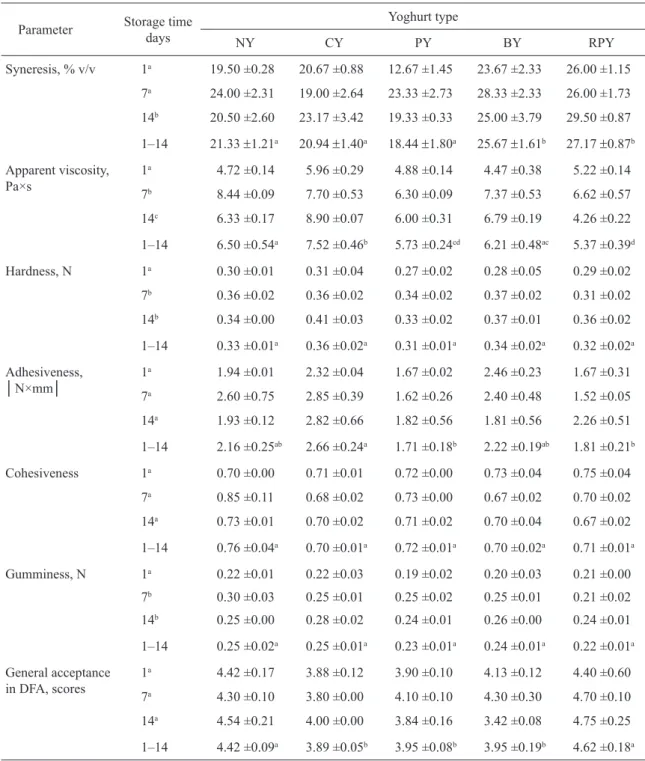
Results of susceptibility to syneresis, viscosity, tex-tural (TPA) studies are shown in Table 1. The centrif-ugal method used for the determination of syneresis is a measure of the water-holding capacity under the action of high external force (Lee and Lucey, 2010). Cais-Sokolińska et al. (2004) observed a signifi cant increase in the yoghurt susceptibility to syneresis with the duration of storage associated with the aging process of the curd. It is consistent with the results of our study as all products at the end of the experiment exhibited higher sensitivity to syneresis than yoghurts examined 1 day after production. These changes at the greatest extent were observed for the yoghurts with pumpkin (6.7% increase) and red sweet pepper (3.5% increase), whereas only a 1% increase was observed for the plain yoghurt. Hess et al. (1997) reported that susceptibility to syneresis, among other factors, is affected by the level of non-fat solids (SNF). Yo-ghurts manufactured in our study contained SNF re-spectively: natural – 12.72, carrot – 12.54, pumpkin – 12.48, broccoli – 12.04, red sweet pepper – 12.31% (Najgebauer-Lejko et al., 2014). However, the degree of syneresis observed for the natural yoghurt was sig-nifi cantly lower only in relation to the yoghurt with broccoli and red sweet pepper. Moreover, yoghurt
with pumpkin preparation had a better characteristic concerning sensitivity to syneresis than other cultured milks. As wheying-off negatively affects consumer perception of yoghurts, manufacturers generally use two ways to prevent it, i.e. increment of total milk sol-ids, especially protein, and addition of stabilisers, such as, pectin, gellatin and starch (McCann et al., 2011). Vegetables used as yoghurt additives in our study constitute a natural source of dietary fi bre which may enhance water-holding capacity of the fi nal products. McCann et al. (2011) observed enhanced viscoelastic properties and reduced whey loss of low-fat yoghurt fortifi ed with dietary fi bre-rich plant cell wall particles derived from carrot pomace.
The apparent viscosity measured for yoghurts highly depended on the time of storage. The highest values were stated after 1-week storage followed by further decline, except for yoghurt enriched with car-rot preparation which was characterized by the highest viscosity at the 14th day of the study. Abu-Jdayil and
Mohameed (2002) proposed that the rearrangement of the protein network is responsible for the increase in the apparent viscosity of the yoghurt during storage. The type of yoghurt also had a signifi cant infl uence on that parameter. After 1 and 14 days the yoghurt enriched with carrot was the most viscous, whereas the highest viscosity at the 7th day was noticed for the
plain yoghurt. Oroian et al. (2011) reported that, due to the presence of stabilisers, viscosity of commercial fruit yoghurts did not vary from that observed in plain products. In our study none stabilisers were used but
fi bre, which naturally occurs in the selected vegeta-bles, can play the same role. According to USDA data (18), carrot (frozen, cooked, boiled, drained, without salt), broccoli, sweet red pepper and pumpkin (cooked, boiled, drained, without salt) contain respectively: 3.3, 3.3, 1.2, 1.1 g/100 g of dietary fi bre. This may be the reason of the highest viscosity stated for the carrot yoghurt.
Table 1. Results of syneresis, viscosity, TPA (texture profi le analysis) and general acceptance in DFA (descriptive
fl avour analysis) evaluations of natural and vegetable yoghurts during storage (means ±SE, n = 6)
Parameter Storage time
days
Yoghurt type
NY CY PY BY RPY
Syneresis, % v/v 1a 19.50 ±0.28 20.67 ±0.88 12.67 ±1.45 23.67 ±2.33 26.00 ±1.15
7a 24.00 ±2.31 19.00 ±2.64 23.33 ±2.73 28.33 ±2.33 26.00 ±1.73
14b 20.50 ±2.60 23.17 ±3.42 19.33 ±0.33 25.00 ±3.79 29.50 ±0.87
1–14 21.33 1.21a 20.94 1.40a 18.44 1.80a 25.67 1.61b 27.17 0.87b
Apparent viscosity, Pa×s
1a 4.72 ±0.14 5.96 ±0.29 4.88 ±0.14 4.47 ±0.38 5.22 ±0.14
7b 8.44 ±0.09 7.70 ±0.53 6.30 ±0.09 7.37 ±0.53 6.62 ±0.57
14c 6.33 ±0.17 8.90 ±0.07 6.00 ±0.31 6.79 ±0.19 4.26 ±0.22
1–14 6.50 ±0.54a 7.52 ±0.46b 5.73 ±0.24cd 6.21 ±0.48ac 5.37 ±0.39d
Hardness, N 1a 0.30 ±0.01 0.31 ±0.04 0.27 ±0.02 0.28 ±0.05 0.29 ±0.02
7b 0.36 ±0.02 0.36 ±0.02 0.34 ±0.02 0.37 ±0.02 0.31 ±0.02
14b 0.34 ±0.00 0.41 ±0.03 0.33 ±0.02 0.37 ±0.01 0.36 ±0.02
1–14 0.33 ±0.01a 0.36 ±0.02a 0.31 ±0.01a 0.34 ±0.02a 0.32 ±0.02a
Adhesiveness, │N×mm│
1a 1.94 ±0.01 2.32 ±0.04 1.67 ±0.02 2.46 ±0.23 1.67 ±0.31
7a 2.60 ±0.75 2.85 ±0.39 1.62 ±0.26 2.40 ±0.48 1.52 ±0.05
14a 1.93 ±0.12 2.82 ±0.66 1.82 ±0.56 1.81 ±0.56 2.26 ±0.51
1–14 2.16 ±0.25ab 2.66 ±0.24a 1.71 ±0.18b 2.22 ±0.19ab 1.81 ±0.21b
Cohesiveness 1a 0.70 ±0.00 0.71 ±0.01 0.72 ±0.00 0.73 ±0.04 0.75 ±0.04
7a 0.85 ±0.11 0.68 ±0.02 0.73 ±0.00 0.67 ±0.02 0.70 ±0.02
14a 0.73 ±0.01 0.70 ±0.02 0.71 ±0.02 0.70 ±0.04 0.67 ±0.02
1–14 0.76 ±0.04a 0.70 ±0.01a 0.72 ±0.01a 0.70 ±0.02a 0.71 ±0.01a
Gumminess, N 1a 0.22 ±0.01 0.22 ±0.03 0.19 ±0.02 0.20 ±0.03 0.21 ±0.00
7b 0.30 ±0.03 0.25 ±0.01 0.25 ±0.02 0.25 ±0.01 0.21 ±0.02
14b 0.25 ±0.00 0.28 ±0.02 0.24 ±0.01 0.26 ±0.00 0.24 ±0.01
1–14 0.25 ±0.02a 0.25 ±0.01a 0.23 ±0.01a 0.24 ±0.01a 0.22 ±0.01a
General acceptance in DFA, scores
1a 4.42 ±0.17 3.88 ±0.12 3.90 ±0.10 4.13 ±0.12 4.40 ±0.60
7a 4.30 ±0.10 3.80 ±0.00 4.10 ±0.10 4.30 ±0.30 4.70 ±0.10
14a 4.54 ±0.21 4.00 ±0.00 3.84 ±0.16 3.42 ±0.08 4.75 ±0.25
1–14 4.42 ±0.09a 3.89 ±0.05b 3.95 ±0.08b 3.95 ±0.19b 4.62 ±0.18a
NY – natural yoghurt, CY – yoghurt with carrot, PY – yoghurt with pumpkin, BY – yoghurt with broccoli, RPY – yoghurt with red sweet pepper.
cohesiveness represents strength of food’s internal bonds. Gumminess, calculated as multiplication of hardness and cohesiveness, is defi ned as the force needed to disintegrate a semisolid food to a state ready for swallowing (Tunick, 2000; Yang and Li, 2010).
The level of hardness measured for yoghurts during the whole study fl uctuated in the range of 0.27–0.41 N. The differences between the types of fermented milks when it comes to this feature were insignifi cant. On the contrary, hardness was affected by the storage time as higher values were observed for stored yoghurts. The structure of the protein network in yoghurt, which depends on the protein content, heat treatment of the bulk milk, fat content, thickening agents and bacterial exopolisaccharides, is respon-sible for hardness and cohesiveness, whereas ropi-ness contributes to adhesiveropi-ness (Hess et al., 1997). Among all products, carrot yoghurt was characterised by the highest adhesiveness, however the only signifi -cant difference was stated in relation to the pumpkin and red sweet pepper yoghurts. On the contrary, cohe-siveness and gumminess did not vary for the different yoghurt types. In the case of both adhesiveness and cohesiveness storage duration was an insignifi cant factor, whereas gumminess tended to increase during the study.
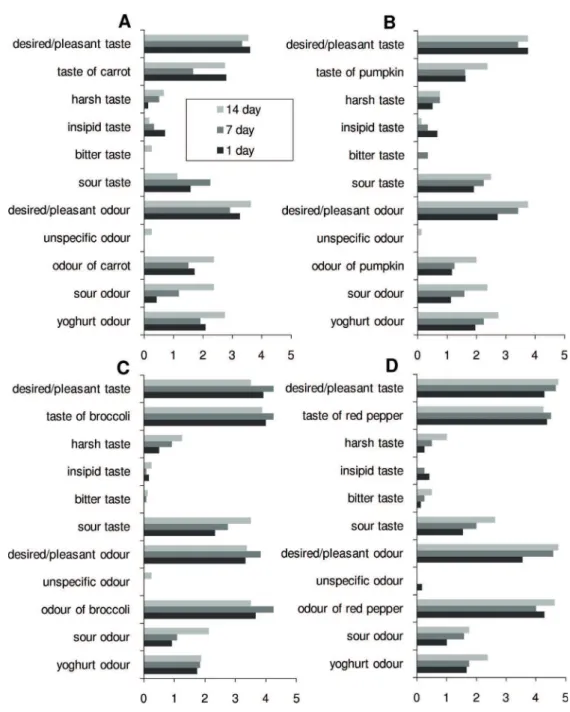
The results of the descriptive fl avour analysis (DFA) of the obtained yoghurts are shown in Figure 1 and 2 (A–C) and the scores for general acceptance in Table 1. Descriptive sensory tests involve the evalua-tion of the intensity of selected sensory properties and the results are used to create the organoleptic profi le of food. It is a useful tool for product optimization, quality control and developing new products (Murray et al., 2001). The distinctive fl avour of yoghurt, which should be clear, refreshing and slightly acidic, is attrib-uted to the presence of lactic acid and volatile organic aroma compounds, mainly acetaldehyde (Beshkova et al., 1998). Different additives like: sweeteners, fl a-vourings, fruits, preserves etc. modify the fl avour of yoghurt (Routray and Mishra, 2011). Flavour defects may occur in yoghurts due to prolonged fermenta-tion (too acidic) or insuffi cient fermentation (bland), excessive proteolysis (bitterness), microbiological contamination (yeasty, fruity, musty, cheesy, bitter or soapy-rancid off-fl avours), too low incubation tem-perature or imbalanced growth of starter bacteria (too
little of characteristic fl avour) or off-fl avours in milk base (Walstra et al., 1999).
of the research which was refl ected in the decreased acceptability of its taste and odour. Unspecifi c odour in the vegetable yoghurts was another factor occasion-ally perceived (usuoccasion-ally at the end of the study) by the panellists but it was not very intense (maximum 0.25 points). Other tastes of a small importance perceived
The number of characteristic microorganisms was in most cases unaffected by the yoghurt type (Table 2). Only the product with added pumpkin pomace showed lower level of lactobacilli (P ≤ 0.05) and slightly high-er (but not signifi cantly, P > 0.05) count of streptococ-ci than other yoghurts. Regardless the fact, that there was observed a signifi cant decrease in the number of Lb. delbrueckii ssp. bulgaricus at the end of the ex-periment, the level of both yoghurt bacteria met the required criteria of min. 107 cfu/g (FAO/WHO, 2003)
during the entire study.
CONCLUSIONS
The yoghurts supplemented with selected vegetables exhibited good viscosity and textural properties as well as microbiological quality which usually did not differ signifi cantly from that stated for the plain product. Carrot yoghurt was characterised by the
highest apparent viscosity and adhesiveness which may result from the high content of dietary fi bre in that vegetable. In yoghurts with carrot and pumpkin the yoghurt odour dominated over the aroma of the respective vegetable, whereas broccoli and sweet red pepper odours were less distinctive. The fl avour of sweet red pepper in yoghurt was highly acceptable by the sensory assessors. The results of the present study suggest that the combination of milk yoghurt with selected vegetables has a great potential to cre-ate novel functional food products, not only with enhanced health-promoting properties as reported in our previous work (Najgebauer-Lejko et al., 2014), but also with unique sensory properties and good mechanical properties achieved without additional stabilisers. On the other hand, some efforts need to be put to develop products with desirable and op-timal sensory attributes before their launch to the market.
Table 2. Starter bacteria count of natural and vegetable yoghurts during storage (means ±SE, n = 6).
Parameter Storage time
days
Yoghurt type
NY CY PY BY RPY
S. thermophilus count, log cfu/mL
1a 9.11 ±0.09 9.33 ±0.22 9.56 ±0.20 10.08 ±0.52 9.41 ±0.13
7a 9.39 ±0.12 9.24 ±0.01 9.41 ±0.21 9.27 ±0.03 9.26 ±0.09
14a 9.37 ±0.21 9.28 ±0.05 9.31 ±0.12 9.60 ±0.13 9.24 ±0.12
21a 9.28 ±0.17 9.31 ±0.06 9.31 ±0.07 9.35 ±0.17 9.27 ±0.12
28a 9.24 ±0.16 9.06 ±0.10 9.44 ±0.15 8.98 ±0.06 9.03 ±0.11
1–28 9.28 ±0.06a 9.24 ±0.05a 9.41 ±0.06a 9.46 ±0.14a 9.24 ±0.05a
Lb. delbrueckii ssp. bulgaricus count, log cfu/mL
1a 8.21 ±0.03 8.09 ±0.05 8.00 ±0.05 8.23 ±0.05 8.16 ±0.07
7a 8.21 ±0.10 8.06 ±0.05 7.79 ±0.14 8.27 ±0.01 8.20 ±0.03
14ab 8.00 ±0.21 8.12 ±0.16 7.98 ±0.03 8.12 ±0.02 7.94 ±0.17
21ab 8.17 ±0.18 8.10 ±0.03 7.90 ±0.10 7.89 ±0.05 8.16 ±0.06
28b 7.99 ±0.13 7.93 ±0.13 7.94 ±0.24 8.16 ±0.07 8.01 ±0.01
1–28 8.12 ±0.06a 8.06 ±0.04ab 7.92 ±0.05b 8.15±0.04a 8.10 ±0.04a
NY – natural yoghurt, CY – yoghurt with carrot, PY – yoghurt with pumpkin, BY – yoghurt with broccoli, RPY – yoghurt with red sweet pepper.
REFERENCES
Abu-Jdayil, B., Mohameed, H. (2002). Experimental and
modeling studies of the fl ow properties of concentrated
yogurt as affected by the storage time. J. Food Eng., 52, 359–365.
Beal, C., Skokanova, J., Latrille, E., Martin, N., Corrieu, G. (1999). Combined effects of culture conditions and storage time on acidifi cation and viscosity of stirred yo-ghurt. J. Dairy Sci., 82, 673–681.
Beshkova, D., Simova, E., Frengova, G., Simov, Z. (1998).
Production of fl avour compounds by yoghurt starter
cul-ture. J. Ind. Microbiol. Biot., 20, 180–186.
Cais-Sokolińska, D., Michalski, M.M., Pikul, J. (2004). Role of the proportion of yoghurt bacterial strains in milk souring and the formation of curd qualitative char-acteristics. Bull. Vet. Inst. Pulawy, 48, 437–441.
FAO/WHO (2003). Codex standard for fermented milks. Codex Stan 243–2003.
Gün, Ö., Işıklı, D. (2007). Effect of fat and non-fat dry mat-ter of milk, and starmat-ter type, on the rheological proper-ties of set during the coagulation process. Int. J. Food Sci. Technol., 42, 352–358.
Hess, S.J., Roberts, R.F., Ziegler, G.R. (1997). Rheological properties of nonfat yogurt stabilized using Lactobacil-lus delbrueckii ssp. bulgaricus producing exopolysac-charide or using commercial stabilizer systems. J. Dairy Sci., 80, 252–263.
Jaros, D., Rohm, H. (2003). Controlling the texture of fer-mented dairy products: the case of yoghurt. In G. Smit (Ed.), Dairy processing: Maximising quality (pp. 155– 184). Cambridge: Woodhead Publishing.
Lee, W.J., Lucey, J.A. (2010). Formation and physical properties of yogurt. Asian-Aust. J. Anim. Sci., 23, 1127–1136.
McCann, T.H., Fabre, F., Day, L. (2011). Microstruc-ture, rheology and storage stability of low-fat yoghurt
structured by carrot cell wall particles. Food Res. Int., 44, 884–892.
Murray, J.M., Delahunty, C.M., Baxter, I.A. (2001). De-scriptive sensory analysis: past, present and future. Food Res. Int., 34, 461–471.
Najgebauer-Lejko, D., Grega, T., Tabaszewska, M. (2014). Yoghurts with addition of selected vegetables: acidity, antioxidant properties and sensory quality. Acta Sci. Pol. Technol. Aliment., 13(1), 35–42.
Oroian, M.A., Escriche, I., Gutt, G. (2011). Rheological, textural, color and physico-chemical properties of some yogurt products from the Spanish market. J. Facult. Food Eng., 10, 24–29.
Pluta, A., Kazimierczak, A., Wąsowska, D. (1999). Wpływ
wybranych hydrokoloidów na jakoć jogurtu [The infl
u-ence of selected hydrocolloids on the yoghurt quality]. Przem. Spo ., 3, 41–43 [in Polish].
ISO 7889:2003. Yogurt – Enumeration of characteristic mi-croorganisms – colony-count technique at 37°C.
Routray, W., Mishra, H. (2011). Scientifi c and technical
as-pects of yogurt aroma and taste: A review. Compr. Rev. Food Sci. Food Safety, 10, 208–220.
Salwa, A.A. , Galal, E.A., Neimat, A.E. (2004). Carrot yo-ghurt: sensory, chemical, microbiological properties and consumer acceptance. Pak. J. Nutr., 3, 322–330.
Tunick, M.H. (2000). Rheology of dairy foods that gel, stretch and fracture. J. Dairy Sci., 83, 1892–1898. U.S. Department of Agriculture, Agricultural Research
Ser-vice. USDA National Nutrient Database for Standard Reference, Release 24 (2011).
Walstra, P., Geurts, T.J., Noomen, A., Jellema, A., van Boekel, M.A.J.S. (1999). Fermented milks. In Dairy technology. Part III: Milk products (pp. 517–537). New York: Marcel Dekker.
WPŁYW DODATKU WYBRANYCH WARZYW NA JAKOŚĆ MIKROBIOLOGICZNĄ, TEKSTURĘ ORAZ PROFIL SMAKOWO-ZAPACHOWY JOGURTÓW
STRESZCZENIE
Wstęp. Warzywa, poza du ą warto cią od ywczą, zawierają znaczne ilo ci błonnika pokarmowego oraz inne
składniki, które mogą wpływać na cechy fi zykochemiczne mleka fermentowanego, takie jak lepkoć,
tekstu-ra, podatno ć na synerezę czy profi l sensoryczny. Celem pracy było okre lenie wpływu dodatku wybranych
warzyw na wła ciwo ci reologiczne, mikrobiologiczne, teksturę oraz profi l smakowo-zapachowy jogurtu.
Materiał i metody. Przeciery warzywne (z marchwi, dyni, brokuła oraz czerwonej papryki) dodano w ilo ci
10% (w/w) do krowiego mleka fermentowanego z u yciem kultury jogurtowej typu DVS. Analizę profi lu
tekstury, oznaczenie lepko ci, podatno ci na synerezę oraz analizę profi lu smakowo-zapachowego
przepro-wadzono w 1, 7 oraz 14 dniu po produkcji. Oznaczenie jako ci mikrobiologicznej wykonano w trakcie 28 dni
w tygodniowych odstępach.
Wyniki. Największe warto ci lepko ci dynamicznej oraz adhezyjno ci charakteryzowały jogurt marchwio-wy, natomiast jogurt z dynią był najmniej podatny na synerezę. Dodatek warzyw nie miał istotnego wpływu na pozostałe parametry tekstury. Aromaty brokułu oraz papryki dominowały nad aromatem aldehydu octo-wego w jogurtach z dodatkiem tych warzyw, natomiast aromaty marchwi oraz dyni były słabiej wyczuwalne. Największą akceptowalno cią sensoryczną charakteryzował się jogurt z czerwoną papryką. Liczba bakterii
starterowych nie była zdeterminowana dodatkiem warzyw, z wyjątkiem jogurtu dyniowego, który zawierał
mniejszą ilo ć pałeczek mlekowych.
Wnioski. Spo ród wszystkich przebadanych dodatków warzywnych przecier marchwiowy najbardziej po-prawił strukturę jogurtu, natomiast jogurt z czerwoną papryką charakteryzował się najkorzystniejszym
pro-fi lem smakowo-zapachowym.
Słowa kluczowe: jogurt, warzywa, tekstura, bakterie kwasu mlekowego, profi l smakowo-zapachowy
Received – Przyjęto: 1.10.2014 Accepted for print – Zaakceptowano do druku: 3.11.2014
For citation – Do cytowania