NURSING COMPETENCES IN THE PREVENTION OF FALLS IN CHILDREN
IN LIGHT OF THE GALWAY CONSENSUS
Sabrina de Souza Gurgel1, Mayara Kelly Moura Ferreira2, Lilia Jannet Saldarriaga Sandoval3, Patrícia Rebouças Araújo4, Marli Teresinha Gimeniz Galvão5, Francisca Elisângela Teixeira Lima6
1 Masters student, Programa de Pós-Graduação em Enfermagem, Universidade Federal do Ceará (UFC). Fortaleza, Ceará, Brazil. E-mail:
2 Masters student, Programa de Pós-Graduação em Enfermagem, UFC. Fortaleza, Ceará, Brazil. E-mail: [email protected] 3 Doctoral student, Programa de Pós-Graduação em Enfermagem, UFC. Fortaleza, Ceará, Brazil. E-mail: [email protected] 4 Masters student, Programa de Pós-Graduação em Enfermagem, UFC. Fortaleza, Ceará, Brasil. E-mail: [email protected] 5 Ph.D. in Nursing. Professor, Departamento de Enfermagem, UFC. Fortaleza Ceará, Brazil. Email: [email protected] 6 Ph.D. in Nursing. Professor, Departamento de Enfermagem, UFC. Fortaleza, Ceará, Brazil. Email: [email protected]
ABSTRACT
Objective: to analyze nurses’ abilities regarding the prevention of falls in hospitalized children in light of the Galway Consensus. Method: a cross-sectional study was conducted with 40 nurses who worked in the open hospitalization units of a pediatric hospital. Data collection was performed through the application of a questionnaire with validated content. The actions performed by the nurses, according to the fall prevention protocol, were related to the eight domains of the Galway health promotion competency model. Statistical analysis and professional performance analysis were performed.
Result: the domain of competence leadership was present in all actions (15). The other areas of competence were presented in the following frequencies: advocacy (9 actions), catalyzing changes (6 actions), implementation (6 actions), planning (3 actions), partnerships (3 actions), needs assessment (2 actions) and impact assessment (2 actions).
Conclusion: the competence domains were considered in at least two fall prevention actions. The importance of the identiication of nurses’ competences in the prevention of falls of hospitalized children is highlighted, aiming to improve the quality of care and, consequently, to reduce unsafe actions.
DESCRIPTORS: Patient safety. Pediatric nursing. Health promotion. Professional competence. Accidental falls.
COMPETÊNCIAS DO ENFERMEIRO NA PREVENÇÃO DE QUEDAS EM
CRIANÇAS À LUZ DO CONSENSO DE GALWAY
RESUMO
Objetivo: analisar as competências do enfermeiro na prevenção de quedas de crianças hospitalizadas, à luz do Consenso de Galway. Método: estudo transversal, realizado com 40 enfermeiras que atuavam nas unidades abertas de internação de um hospital pediátrico. Coleta dos dados realizada mediante aplicação de um questionário com conteúdo validado. Foram relacionadas as ações executadas pelas enfermeiras, segundo o protocolo de prevenção de quedas, com os oito domínios do modelo de competências para promoção da saúde de
Galway. Procedeu-se à análise estatística e análise do desempenho dos proissionais.
Resultado: o domínio de competência liderança esteve presente em todas as ações (15). Os demais domínios de competência apresentaram-se na nas apresentaram-seguintes frequências: defesa (9 ações), catalisar mudanças (6 ações), implementação (6 ações), planejamento (3 ações), parcerias (3 ações), avaliação das necessidades (2 ações) e avaliação do impacto (2 ações).
Conclusão: os domínios de competência foram contemplados em pelo menos duas ações de prevenção de quedas. Destaca-se a importância
da identiicação das competências de enfermeiros na prevenção de quedas de crianças hospitalizadas, visando melhoria da qualidade
assistencial e, consequentemente, redução de atos inseguros.
COMPETENCIAS DEL ENFERMERO EN LA PREVENCIÓN DE CAÍDAS EN
NIÑOS A LA LUZ DEL CONSENSO DE GALWAY
RESUMEN
Objetivo: analizar las competencias del enfermero en la prevención de caídas de niños hospitalizados, a la luz del Consenso de Galway. Método: estudio transversal, realizado con 40 enfermeras que actuaban en las unidades abiertas de internación de un hospital pediátrico. La recolección de los datos realizada mediante la aplicación de un cuestionario con contenido validado. Se relacionaron las acciones ejecutadas por las enfermeras, según el protocolo de prevención de caídas, con los ocho ámbitos del modelo de competencias para la promoción de la salud de Galway. Se procedió al análisis estadístico y análisis del desempeño de los profesionales.
Resultado: el dominio de competencia líder estuvo presente en todas las acciones (15). Los demás ámbitos de competencia se presentaron
en las siguientes frecuencias: defensa (9 acciones), catalizar cambios (6 acciones), implementación (6 acciones), planiicación (3 acciones),
alianzas (3 acciones), evaluación de las necesidades (2 acciones) y evaluación del impacto (2 acciones).
Conclusión: los ámbitos de competencia se contemplaron en al menos dos acciones de prevención de caídas. Se destaca la importancia
de la identiicación de las competencias de enfermeros en la prevención de caídas de niños hospitalizados, buscando mejorar la calidad
asistencial y, consecuentemente, reducción de actos inseguros.
DESCRIPTORES: Seguridad del paciente. Enfermería pediátrica. Promoción de la salud. Competencia profesional. Accidentes por caídas.
INTRODUCTION
In the last few decades the quality of health care involving patient safety at a global level has been a relevant theme. It is evident that the guide-lines established by the National Patient Safety Program1 are closely related to the Health Promotion actions outlined in the Ottawa Charter, as their cre-ation consists of elaborating public policies capable
of altering a negative behavior that inluences the
state of health, stimulate the empowerment and participation of individuals in the creation and maintenance of a health-friendly environment, as well as reorienting health services with the aim of preventing injuries.2
Thus, the World Health Organization (WHO)
deines patient safety as minimizing the risk of un -necessary harm during health care.3
Falls in the hospital environment is highlight among the themes that involve the safety of the
pediatric patient. It is deined as the unintentional
falling and displacement of the body to a level lower than the initial position, resulting or not in injury. Therefore, it is considered a fall when the patient
is found on the loor or when upon movement the
patient needs support, even if they do not reach the ground. It is understood as injury or impairment of the structure or function of the body and/or any deleterious effect from it, which may be physical, social or psychological.4
The presence of a fall in pediatric patients in the hospital environment is more common among
boys and is mainly due to wet loors, tripping over equipment and other objects left on the loor.5 A study carried out in the city of Goiânia, in Brazil,
identiied 11 episodes of falls in a pediatric unit
between 2006 and 2013.6
In order to support this patient safety process, the protocol for the prevention of falls is used.4 In order to prevent the occurrence of damages the use of updated protocols by the health team is one of the necessary strategies for the inclusion of safe practices in the health services.7
As an integrative member of the health team, the nurse plays a fundamental role in the elaboration and implementation of measures aimed at the safety of hospitalized children, as the nursing practice is permeated by the experience and daily perception of risk situations that can support care management and decision-making in order to promote safety and minimize the repercussions of harm.8 Thus, nursing care should be strongly based on the perspective of health and safety promotion of children exposed to falls, and in doing so it is necessary that nurses have
speciic competences so that this care is effective.
These competences are to be used as a refer-ence point to: establish professional standards, create mechanisms to ensure the quality of work, professional selection for work, identify and struc-ture training programs and guide academic train-ing,9 in the area of patient safety, with emphasis on the prevention of falls.
According to the theme, this article uses the Galway Consensus as a theoretical reference, which aims to identify and construct fundamental compe-tences in health promotion and health education, as well as the development of workforce.10-11
Held in Ireland in June 2008, the Galway Con-sensus has set out values and principles, common
deinition and key competency domains required
However, the discussions about these profes-sional competences for health promotion in Brazil are still limited to certain professional practices,12 corroborating the need to broaden the discussion regarding nurses’ competences in the prevention of falls in pediatric patients.
In view of this context, the following question arose: In light of the Galway Consensus, what are the competencies of the nurse in the prevention of falls in children in the hospital environment? The response to this question could contribute to a
criti-cal relection that leads to the improvement of the
nursing care practice in the prevention of falls in children, aiming to improve nurses’ performance, as although there are intrinsic and extrinsic factors to the individual that are potential for falls occur-rences, prevention is directly related to the good practices of the nursing team. The health promotion competencies are aids for the integral and safe care of hospitalized children. Thus, the objective was to analyze the nurses’ competences in the preven-tion of falls in hospitalized children, in light of the Galway Consensus.
METHOD
A descriptive study, with a cross-sectional de-sign, developed in seven open hospitalization units of a reference pediatric tertiary hospital in Ceará, in which seven episodes of falls were reported in 2016, according to the Center for Patient Safety of the institution in question.
The sample consisted of 40 nurses who met the following criteria for inclusion: they had been working for at least six months in direct care with hospitalized children. Nurses who were on vacation, on leave or removed from activities during the data collection period, and did not respond to the study questionnaire were excluded. Non-probabilistic sampling was used for convenience of the consecu-tive type, in which the professionals were selected between February and March in 2016.
Data collection was performed using a ques-tionnaire developed according to the recommenda-tions of the Fall Prevention Protocol,4 and the con-tent was validated by a group of seven judges, who all had doctorate degrees in nursing and teachers of the child health discipline of one public university of Ceará. The questionnaire contained two parts, the
irst consisting of questions that enabled the charac -terization of nurses (age, training time, professional experience in pediatrics and weekly workload), and the second consisting of questions about the safety
actions of the children, whose variables referred to
the ifteen fall prevention actions recommended by
the Ministry of Health’s Fall Prevention Protocol.4 Each action contains answers using a Likert Scale: 1 (never performs the action), 2 (sometimes performs the action) and 3 (always performs the action).
The questionnaire was delivered to the profes-sional for it to be answered and returned at the end of the shift. The professionals who did not return the completed questionnaire within the recommended time were invited back to participate in the study, with the importance of collaboration reinforced and a new deadline established. Those who did not return the questionnaire after the second deadline were excluded from the sample.
Data were grouped and analyzed using the Statistical Package for Social Sciences (SPSS) ver-sion 20.0. The analysis was performed using the descriptive statistics approach, which includes the distribution of the absolute and relative frequencies for the categorical variables, the means, standard deviation (SD) and for the continuous variables, demonstrated in the characterization of the nurses.
The categorization of the actions of the ques-tionnaire in the health promotion competency domains established in the Galway Consensus was performed through discussion with the authors regarding the concept of each domain. The actions that had discordance were discussed on a case-by-case basis, until a common agreement was reached.
For data tabulation, the answers given by the nurses were grouped in a dichotomous manner, in which items 1 (never performs the action) and
2 (sometimes performs the action) were classiied
as unsatisfactory; and item 3 (always performs the action) was considered as satisfactory.13-14
A study on patient safety was considered for the analysis of the nurses’ performance, addressing drug administration, which considered the cutoff score > 70% as satisfactory.15 However, in order to prevent falls, it was decided to consider the cutoff point as > 80% of professionals who always stated that they were performed the action, in order to reduce the risks to the hospitalized child as much as possible.
The study was submitted to the Ethics Committee of the Federal University of Ceará,
according to opinion n. 1.376.514 and Certiicate
Informed Consent. As required by research ethics, the participants were guaranteed anonymity and
conidentiality.
RESULTS
All 40 participants were female. The nurses were between 25 and 59 years of age, with a mean of 34.7 (SD±8.04) years of age. All had been gradu-ated for two years or more, with an average of 8.8 (SD±6.67) years. Regarding the time of professional experience in pediatrics, the minimum performance was six months and the maximum was 34 years,
with an average of 7.4 (SD±7.46). The weekly work-load ranged from 12 to 66 hours, with a mean of 32.7 (SD±12.4). Regarding the participation in patient safety courses, 60% (n = 24) of the nurses did not have the training on this subject.
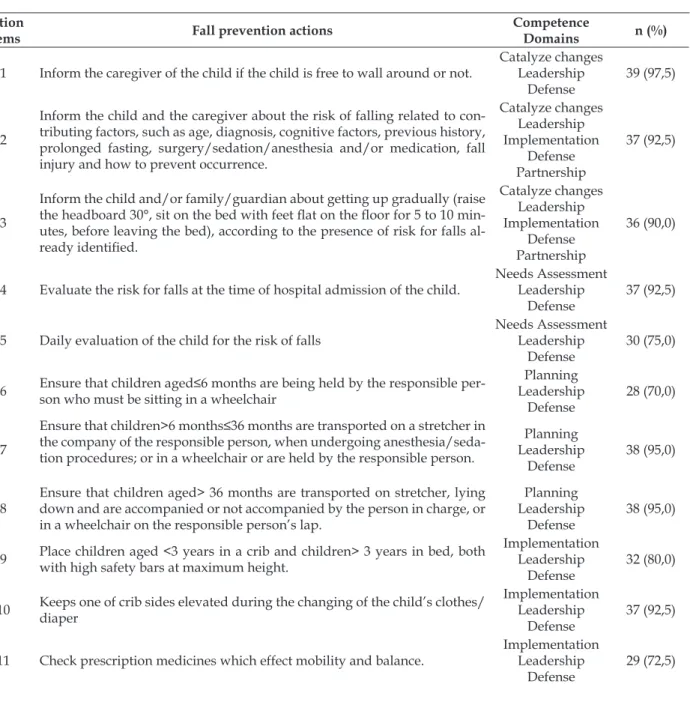
The actions scored in the questionnaire were categorized according to the health promotion competency domains established in the Galway Consensus, so that the same action corresponded to more than one domain. Table 1 shows the fall prevention actions, the corresponding competency domains and the respective frequency of nurses who always perform the action.
Table 1 - Distribution of fall prevention actions according to the competence domains. Fortaleza, CE, Brazil, 2016 (n=40)
Action
Items Fall prevention actions
Competence
Domains n (%)
1 Inform the caregiver of the child if the child is free to wall around or not.
Catalyze changes Leadership
Defense
39 (97,5)
2
Inform the child and the caregiver about the risk of falling related to con-tributing factors, such as age, diagnosis, cognitive factors, previous history, prolonged fasting, surgery/sedation/anesthesia and/or medication, fall injury and how to prevent occurrence.
Catalyze changes Leadership Implementation
Defense Partnership
37 (92,5)
3
Inform the child and/or family/guardian about getting up gradually (raise
the headboard 30°, sit on the bed with feet lat on the loor for 5 to 10 min
-utes, before leaving the bed), according to the presence of risk for falls
al-ready identiied.
Catalyze changes Leadership Implementation
Defense Partnership
36 (90,0)
4 Evaluate the risk for falls at the time of hospital admission of the child.
Needs Assessment Leadership
Defense
37 (92,5)
5 Daily evaluation of the child for the risk of falls
Needs Assessment Leadership
Defense
30 (75,0)
6 Ensure that children aged≤6 months are being held by the responsible per
-son who must be sitting in a wheelchair
Planning Leadership
Defense
28 (70,0)
7
Ensure that children>6 months≤36 months are transported on a stretcher in
the company of the responsible person, when undergoing anesthesia/seda-tion procedures; or in a wheelchair or are held by the responsible person.
Planning Leadership
Defense
38 (95,0)
8
Ensure that children aged> 36 months are transported on stretcher, lying down and are accompanied or not accompanied by the person in charge, or in a wheelchair on the responsible person’s lap.
Planning Leadership
Defense
38 (95,0)
9 Place children aged <3 years in a crib and children> 3 years in bed, both with high safety bars at maximum height.
Implementation Leadership
Defense
32 (80,0)
10 Keeps one of crib sides elevated during the changing of the child’s clothes/ diaper
Implementation Leadership
Defense
37 (92,5)
11 Check prescription medicines which effect mobility and balance.
Implementation Leadership
Defense
Action
Items Fall prevention actions
Competence
Domains n (%)
12 Place children with previous history of falls near the nursing station when possible
Implementation Leadership
Defense
30 (75,0)
13 Record the result of the falls risk assessment results and all the procedures performed for fall prevention in the child’s chart.
Impact assessment Catalyze changes
Leadership
29 (72,5)
14 Record the occurrence of falls, related factors and the damages generated in the medical records
Impact assessment Catalyze changes
Leadership
34 (85,0)
15 Notify falls incidents to the falls risk management and/or patient safety center (when available).
Catalyze changes Leadership
Defense Partnerships
29 (72,5)
The frequency of falls prevention actions was between 70% and 97.5%. In the majority of the ac-tions, the nurses obtained satisfactory performance, with a percentage > 80%. It should be noted that in actions 5, 6, 11, 12, 13 and 15, the nurses’ perfor-mance was unsatisfactory, i.e., having a percentage lower than 80%.
The competence leadership domain was pres-ent in all actions. The other most frequpres-ent compe-tences were: defense (9 actions), catalyze changes (6 actions) and implementation (6 actions). The skills needs assessment and impact assessment were the least predominant, with two actions for each domain.
DISCUSSION
Regarding the performance of nurses in fall prevention actions, six actions were not performed satisfactorily: risk assessment for falls on a daily ba-sis, provision of adequate transportation of children
less than or equal to six months of age, veriication
of the prescription of medications that alter mobility and balance, placing the child with a previous his-tory of falling near the nursing station; recording of the results of the evaluation and reporting incidents.
It is important to highlight that despite hav-ing a systematization of the implemented nurshav-ing assistance, the institution is in the process of im-proving the patient’s safety center and does not yet
have speciic protocols to prevent falls or guiding
instruments for risk assessment and planning of in-hospital transport of children.
This can be corroborated by the fact that 60% of the nurses did not participate in complementary patient safety training, revealing the need for falls prevention training for nurses, which may justify the fact that these actions do not achieve satisfactory performance. Thus, permanent education
associ-ated with the use of speciic protocols are effective
strategies for the prevention and reduction of risks and injuries, such as falls in the health services.16
In order for notiications of incidents to occur,
a non-punitive safety culture must be promoted in
institutions. In the health ield, the high-risk po -tential of the activities and the need to achieve safe practices require an environment free from blame, in which professionals are able to report errors without fear of being reprimanded or punished.17
To perform satisfactory care for the pediatric
patient, nurses need to have speciic skills that en -able them to ensure quality and resolutive services aimed at preventing falls. To assess the development of these competencies, actions guided by the Galway Consensus’s health promotion domains (catalyze change, leadership, needs assessment, planning, implementation, impact assessment, advocacy and partnership), strengthens and ensures professional practice.10
Leadership in the Galway Consensus is the direction of strategies and opportunities for partici-pation in the development of healthy public policies, mobilization and resource management for health promotion and capacity building.10-11 In this study,
this competence was identiied in all actions recom -mended by the protocol, recognizing that the ability to lead is an essential competency in the nurses’ work process, assisting in care management and in the construction of a satisfactory quality work environment.18
addition to interaction with other professionals of the health team through interdisciplinary practice.19
The defense competence aims at improving health and well-being by favoring important aspects of quality of life and health promotion.10-11 This competence is considered important, as it allows ac-tion that go beyond clinical intervenac-tion, involving the professional being proactive, together with the family and the community, with interdisciplinary and intersectoral actions.20
It is known that falls can occur during child hospitalization and the consequences of these can be permanent and irreversible. Therefore, it is the duty of the health professional to prevent these from occurring, and there must be constant vigilance and ability to anticipate the behavior of the child who is active and playing in the bed/crib.21 The consequences must be related to the context and mechanism of falls, the children’s clinical condition and medications, as it is known that continuous medications and falls are linked.22
Therefore, it is imperative that medication use is monitored, with involvement of all the health team in the accomplishment of the necessary treat-ment, in order to avoid falls.
Regarding the catalyze change competence, which refers to producing changes and empowering individuals and communities to improve health.10-11 Competency directed to this domain was present in six actions, noting that to avoid falls from oc-curring, it is necessary to promote empowerment and make those involved active in the process of health maintenance and/or rehabilitation, and that there is a need for convergent actions between health promotion and patient safety in the hospital context and recognizing these practices as essential elements for care.2
The assessment of needs motivates the
identi-ication and analysis of cultural, social, environmen -tal and organizational determinants that promote or compromise health.10 Thus, when identifying the risks that can result from a fall, the nurse can evaluate them, with a systematic process of
identi-ication, analysis and treatment of the causes.23 The risk assessment of the falls in hospital admission is a daily practice and aided by decision-making aiming to improve the clinical outcomes and allow
more patients to beneit from the knowledge of the
best available practices which favor care.24
Planning is aimed at the development of mea-surable and objective goals in response to needs
assessment and identiication of strategies based
on theory, evidence and practice.10-11 Regarding the
safety of the pediatric patient, the knowledge of the types of possible harms, such as falls, occurring in a pediatric unit, is critical in order to analyze the risks to which children are exposed to and in order to plan the priorities to be worked on in order to improve the care process.25 If planning is effective, it will result in the implementation of the profes-sionals in the fall prevention process.
Therefore, in relation to the actions of the protocol studied, using measures in relation to the ideal form of transportation, according to the child’s age group, reinforces the adoption of preventive measures, avoiding complications to the physical and emotional integrity of the patients.26 There-fore, the number of wheelchairs in the institution is questioned, which may corroborate the nurses’ unsatisfactory performance in planning to provide transportation for the children.
Implementation is the effective and eficient
implementation of culturally sensitive and ethical strategies to ensure the highest possible degree of health improvements, including human and mate-rial resource management.10 The performance of strategic health plans aims to ensure quality care and are recommendations which need to be devel-oped through this competency in order to prevent falls.27 Given the importance of adopting safe prac-tices, corrective and proactive measures must be taken, as well as developing strategies that reduce the occurrence of falls and the resulting harm in hospitalized patients.28
Impact assessment aims to determine the extent, effectiveness and impact of health promo-tion programs and policies. This includes using appropriate assessments and research methods to support improvement, sustainability and dissemi-nation programs.10-11
By evaluating the impact of fall prevention actions, it is possible to modify paradigms of the health management process, requiring nurses to be more creative and daring, to appropriate strategies that effectively reach the patient or family, and to
promote relection and change in practices.29 In view of the above, the records in the
medi-cal iles regarding the risk assessment for falls and
communica-tion is the most useful for inducing changes in safe practices.30 It is worth mentioning that due to the fact that the patient safety centre has recently been implanted in this institution, it is necessary to make the professionals aware about the importance of re-porting injuries and adverse events in patient care, in order to improve the quality of services provided, and to promote and improve the quality of records.31
According to the Galway Consensus, the part-nership, the cooperative work between disciplines, sectors and partners were also investigated in order to improve the impact and sustainability of health promotion programs and policies.10 Thus, the search for a an expanded approach to intersectoral care values the communication between professionals and services, and also creates work perspectives that avoid gaps in partnership relationships and broadens the integrality and intersectoriality of ac-tions aimed at fall prevention.
Therefore, intersectoriality allows the expan-sion of health care actions and management strate-gies which are fundamental in the consolidation of the integrality of preventive actions and services, especially in relation to the set of laws and programs aimed at achieving safe care for children32 who are exposed to the risk of falls, considering that having contact with an environment that is not familiar, arouses attention and curiosity, and can motivate the occurrence of such falls. Therefore, it is essential that partnership is strengthened between profes-sionals and the family while preserving the integrity of the child.
CONCLUSION
With the development of the present study, it was possible to analyze nurses’ competences in the prevention of falls in hospitalized children, in light of the Galway Consensus. Competence domains
were identiied in the study, with leadership being
the most predominant competence in all actions considered in the prevention of falls, followed by the defense, catalyzing changes and implementation competences. The other domains were also
identi-ied, however in fewer protocol actions.
By using a self-assessment questionnaire, the present study presented limitations in relation
to the fact that the nurse can be inluenced by the
presented alternatives, prompting them to select answers that indicate the continuous performance of the action
Considering this, it is suggested that an obser-vational study is performed as this method allows
detailed information of existing variables to be col-lected and also allows data to be used in order to justify and evaluate conditions and practices, as well as to plan improvements in health care practices.
Although the performance of fall prevention actions has been adequate for the most part, per-manent education regarding nursing care in the prevention of falls to the pediatric patient is funda-mental, mainly regarding the actions in which the performance proved to be unsatisfactory.
The results demonstrate that the issue of pa-tient safety in the hospital environment, regarding the prevention of falls, is developing and that nurses need to continue to develop the skills in order to perform safe actions.
The study contributed to the dissemina-tion of the topic, especially in view of the fact that investigations on the subject are new and scarce in Brazil. The results can be used by pediatric institutions to establish prospective plans for improvements in fall prevention care. To avoid the occurrence of risks and damages of falls, it is necessary to identify the nurse’s compe-tences in the prevention of hospitalized child falls, with the aim of improving the quality of care in the pediatric hospital environment.
REFERENCES
1. Ministério da Saúde (BR). Documento de referência para o Programa Nacional de Segurança do Paciente/ Ministério da Saúde; Fundação Oswaldo Cruz; Agência Nacional de Vigilância Sanitária. Brasília (DF): Ministério da Saúde; 2014.
2. Pereira FGF, Matias EO, Caetano JA, Lima FET. Segurança do paciente e promoção da saúde: uma
relexão emergente. Rev Baiana Enferm [Internet]. 2015 July [cited 2016 Jul 04]; 29(3):271-7. Available
from: http://www.portalseer.ufba.br/index.php/ enfermagem/article/view/12205/pdf_10
3. World Health Organization (CH). A world alliance for safer health care. More than words: conceptual framework for the international classification for patient safety, Final Technical Report January 2009. Geneva (CH): WHO; 2009.
4. Ministério da Saúde (BR). Portaria N. 1.377, de 9 de julho de 2013: aprova os protocolos de segurança do paciente. Brasilía (DF): MS; 2013.
5. Cooper CL, Nolt JD. Development of an evidence-based pediatric fall prevention program. J Nurs Care Qual. 2007; 22(2):107-12.
6. Rocha JP, Silva AEBC, Bezerra ALQ, Sousa MRG, Moreira IA. Eventos adversos identificados nos relatórios de enfermagem em uma clínica pediátrica.
11]; 20(2):53-63. Available from: http://www.
scielo.cl/scielo.php?script=sci_arttext&pid=S0717-95532014000200006&lng=es
7. Teixeira TCA, Cassiani SHB. Root cause analysis of falling accidents and medication errors in
hospital. Acta Paul Enferm [Internet]. 2014 Apr [cited 2016 Jun 27]; 27(2):100-7. Available from:
http://www.scielo.br/scielo.php?pid=S0103-21002014000200003&script=sci_arttext&tlng=en 8. Mello JF, Barbosa SFF. Patient safety culture in
intensive care: nursing contributions. Texto Contexto
Enferm [Internet]. 2013 Dec [cited 2016 May 01];
22(4):1124-33. Available from: http://www.scielo. br/scielo.php?script=sci_arttext&pid=S0104-07072013000400031&lng=en&nrm=iso&tlng=en 9. Morales AST, Battel-Kirk B, Barry MM, Bosker L,
Kasmel A, Grifiths J, et al. Perspectives on health
promotion competencies and accreditation in Europe. Glob Health Promot. 2009; 16(2):21-31.
10. Barry MM, Allegrante JP, Lamarre MC, Auld ME, Taub A. The Galway Consensus Conference: international collaboration of the development of core competencies for health promotion and health education. Glob
Health Promot [Internet]. 2009 Jun [cited 2016 May 01];
16(2):5-11. Available from: http://journals.sagepub. com/doi/pdf/10.1177/1757975909104097
11. Howze EH, Auld ME, Woodhouse LD, Gershick J, Livingood WC. Building health promotion capacity in developing countries: strategies from 60 years of experience in the United States. Health Educ Behav
[Internet]. 2009 Jun [cited 2016 May 01]; 36(3):464-75.
Available from: http://journals.sagepub.com/doi/ pdf/10.1177/1090198109333825
12. Pinheiro DGM, Scabar TG, Maeda ST, Fracolli LA, Pelicioni MCF, Chiesa AM, et al. Health promotion competencies: challenges of formation. Saude Soc
[Internet]. 2015 Mar [cited 2016 Jun 29];
24(1):180-8. Available from: http://www.scielo.br/scielo. php?pid=S0104-12902015000100180&script=sci_ arttext&tlng=en
13. Matias EO. Avaliação da prática de enfermagem no processo de administração de medicamento
intravenoso na pediatria [dissertação]. Fortaleza
(CE): Universidade Federal do Ceará, Programa de Pós-Graduação em Enfermagem; 2015.
14. Araújo PR. Construção e validação do instrumento de avaliação das ações para a promoção da segurança do paciente na administração de medicamentos em
pediatria [dissertação]. Fortaleza (CE): Universidade
Federal do Ceará, Programa de Pós-Graduação em Enfermagem; 2016.
15. Mota RO, Brito EAWS, Souza TLV, Farias LMVC, Matias EO, Lima FET. Preparation of intramuscular drugs in pediatrics: nursing team. Cogitare Enferm
[Internet]. 2016 [cited 2017 Apr 12]; 21(Spe):1-9.
Available from: http://revistas.ufpr.br/cogitare/ article/view/45619
16. Oliveira RM, Leitão IMTA, Silva LMS, Figueiredo SV, Sampaio RL, Gondim MM. Strategies for promoting
patient safety: from the identiication of the risks to the evidence-based practices. Esc Anna Nery [Internet]. 2014 Mar [cited 2016 Jul 12]; 18(1):122-9. Available
from: http://www.scielo.br/scielo.php?script=sci_ arttext&pid=S1414-81452014000100122&lng=en 17. Souza FT, Garcia MC, Rangel PPS, Rocha PK.
Percepção da enfermagem sobre os fatores de risco que envolvem a segurança do paciente pediátrico. Rev
Enferm UFSM [Internet]. 2014 Jan [cited 2017 Apr 11];
4(1):152-62. Available from: https://periodicos.ufsm. br/reufsm/article/view/8781
18. Amestoy SC, Backes VMS, Trindade LL, Canever BP.
The scientiic production regarding leadership in the context of nursing. Rev Esc Enferm USP [Internet]. 2012 Feb [cited 2016 Jul 04]; 46(1):227-33. Available
from: http://www.scielo.br/scielo.php?pid=s0080-62342012000100030&script=sci_arttext&tlng=en 19. Christovam BP, Porto IS, Oliveira DC. Nursing
care management in hospital settings: the building
of a construct. Rev Esc Enferm USP [Internet]. 2012 Jun [cited 2016 Jul 11]; 46(3):734-41. Available
from: http://www.scielo.br/scielo.php?script=sci_ arttext&pid=S0080-62342012000300028&lng=en&nr m=iso&tlng=en
20. Shilton T. Health promotion competencies: providing a road map for health promotion to assume a prominent role in global health. Glob Health Promot
[Internet]. 2009; June [cited 2016 Jul 04]; 16(2):42-6.
Available from: http://journals.sagepub.com/doi/ pdf/10.1177/1757975909104103
21. Wegner W, Pedro ENR. Patient safety in care circumstances: prevention of adverse events in the hospitalization of children. Rev Latino-Am
Enfermagem [Internet]. 2012 Jun [cited 2016 Jul 05]; 20(3):427-34. Available from: http://www.
scielo.br/scielo.php?script=sci_arttext&pid=S0104-11692012000300002&lng=en.
22. Valcarenghi RV, Santos SSC, Hammerschmidt KSA, Barlem ELD, Gomes GC, Silva BT. Institutional actions based on nursing diagnoses for preventing falls in
the elderly. Rev Rene [Internet]. 2014 Mar [cited 2017 Apr 11]; 15(2):224-32. Available from: http://
www.revistarene.ufc.br/revista/index.php/revista/ article/view/1583
23. Adhikari R, Tocher J, Smith P, Corcoran J, MacArthur J. A multi-disciplinary approach to medication safety and the implication for nursing education
and practice. Nurse Educ Today [Internet]. 2014 Feb [cited 2016 Jul 11]; 34(2):185-90. Available from:
http://www.sciencedirect.com/science/article/pii/ S0260691713003845
24. Santos MV, Cerqueira PV, Moura ECC, Silva GRF, Falcão LM. Satisfaction of nurses with a training course for the operationalization of protocol on
www.revistarene.ufc.br/revista/index.php/revista/ article/view/1964/pdf_1
25. Rocha JP, Silva AEBC, Bezerra ALQ, Sousa MRG, Moreira IA. Eventos adversos identificados nos relatórios de enfermagem em uma clínica
pediátrica. Cienc Enferm [Internet]. 2014 Ago [cited 2016 Jul 05]; 20(2):53-63. Available from:
http://www.scielo.cl/scielo.php?script=sci_ arttext&pid=S0717-95532014000200006.
26. Gabriel CS, Melo MRAC, Rocha FLR, Bernardes A, Miguelaci T, Silva MLP. Use of performance indicators in the nursing service of a public hospital. Rev
Latino-am Enfermagem [Internet]. 2011 Out [cited 2016 Jul 11]; 19(5):1247-54. Available from: http://www.
scielo.br/scielo.php?script=sci_arttext&pid=S0104-11692011000500024&lng=pt
27. Veras JEGLF, Rodrigues AP, Silva MJ, Aquino PS, Ximenes LB. Evaluation of nursing skills to promote health during pediatric consultations in
emergency rooms. Acta Paul Enferm [Internet]. 2015 Aug [cited 2016 Jul 11]; 28(5):467-74. Available
from: http://www.scielo.br/scielo.php?script=sci_ arttext&pid=S0103-21002015000500467&lng=en 28. Severo IM, Almeida MA, Kuchenbecker R, Vieira
DFVB, Weschenfelder ME, Pinto LRC, et al. Risk factors for falls in hospitalized adult patients: an
integrative review. Rev Esc Enferm USP [Internet]. 2014 June [cited 2016 Jul 11]; 48(3):540-54. Available
from: http://www.scielo.br/scielo.php?script=sci_ arttext&pid=S0080-62342014000300540&lng=en 29. Mariano MR, Pinheiro AKB, Aquino PS, Ximenes LB,
Pagliuca LMF. Jogo educativo na promoção da saúde de adolescentes: revisão integrativa. Rev Eletr Enferm
[Internet]. 2013 Jan [cited 2016 Jul 05]; 15(1):265-73.
Available from: https://www.fen.ufg.br/revista/ v15/n1/pdf/v15n1a30.pdf
30. Lorenzini E, Santi JAR, Báo ACP. Patient safety:
analysis of the incidents notiied in a hospital, in south of Brazil. Rev Gaúcha Enferm [Internet]. 2014 Jun [cited 2016 Jul 11]; 35(2):121-7. Available
from: http://www.scielo.br/scielo.php?script=sci_ arttext&pid=S1983-14472014000200121&lng=pt 31. Serra JN, Barbieri AR, Cheade MFM. The situation
of reference hospitals for the establishment and operation of patient safety center. Cogitare Enferm
[Internet]. 2016 [cited 2017 Apr 12]; 21(Spe):1-8.
Available from: http://revistas.ufpr.br/cogitare/ article/view/45925
32. Andrade RD, Santos JS, Pina JC, Furtado MCC, Mello DF. Integrality of actions among professionals and services: a necessity for child’s right to health.
Esc Anna Nery [Internet]. 2013 Dec [cited 2016 Jul 05]; 17(4):772-80. Available from: http://www.
scielo.br/scielo.php?script=sci_arttext&pid=S1414-81452013000400772&lng=en
Correspondence: Sabrina de Souza Gurgel Rua Coronel Nunes de Melo, 394,
60.430-270 Rodolfo Teóilo, Fortaleza, Ceará, Brasil
E-mail: [email protected]