http://dx.doi.org/10.1590/0104-07072017005360016
CASE STUDY AS A NURSING RESEARCH METHOD:
AN INTEGRATIVE REVIEW
Selma Regina de Andrade1, Andriela Backes Ruoff2, Talita Piccoli3, Márcia Danieli Schmitt4, Alexandra Ferreira5, Ana Cristina Ammon Xavier6
1 Ph.D. in Nursing. Professor, Programa de Pós-Graduação em Enfermagem, Universidade Federal de Santa Catarina (UFSC). Florianópolis,
Santa Catarina, Brazil. E-mail: [email protected]
2 Master’s Student, Programa de Pós-Graduação em Enfermagem, UFSC. Florianópolis, Santa Catarina, Brazil. E-mail: andriback@
gmail.com
3 Doctoral Student, Programa de Pós Graduação em Enfermagem, UFSC. Florianópolis, Santa Catarina, Brazil. E-mail: talitapiccoli@
gmail.com
4 Master’s Student, Programa de Pós-Graduação em Enfermagem, UFSC. Florianópolis, Santa Catarina, Brazil. E-mail: marciaschmitt@
hotmail.com
5 Undergraduate Nursing Student in UFSC. Florianópolis, Santa Catarina, Brazil. E-mail: [email protected] 6 Undergraduate Nursing Student in UFSC. Florianópolis, Santa Catarina, Brazil. E-mail: [email protected]
ABSTRACT
Objective: to analyze the application of the case study as a nursing research method in national and international scientiic publications.
Method: integrative literature review performed in the electronic bibliographic databases PubMed, CINAHL, LILACS and SciELO, using case study descriptors, research and nursing. Original articles were available in full online format, in Portuguese, English and Spanish, between 2010 and 2015.
Results: 624 studies were found, of which 50 met the objective. The authors Yin and Stake were the researchers whose methodological
case study frameworks stood out in the context of research in the nursing area. The application of the method covered the different ields
of activity of the profession: education, care/care and management/administration.
Conclusion: the case study as a research method has proved to be an important methodology that can be widely used by nursing in its
various ields of action when seeking to understand phenomena related to individuals, groups or organizations. DESCRIPTORS: Nursing. Search. Nursing research. Methods. Case studies.
O ESTUDO DE CASO COMO MÉTODO DE PESQUISA EM ENFERMAGEM:
UMA REVISÃO INTEGRATIVA
RESUMO
Objetivo: analisar a aplicação do estudo de caso como método de pesquisa pela enfermagem nas publicações cientíicas nacionais e
internacionais.
Método: revisão integrativa de literatura realizada nas bases bibliográicas eletrônicas PubMed, CINAHL, LILACS e SciELO, utilizando
os descritores estudo de caso, pesquisa e enfermagem. Foram incluídos artigos originais disponíveis na íntegra no formato on-line, nos idiomas português, inglês ou espanhol, no recorte temporal de 2010 a 2015.
Resultados: foram encontrados 624 estudos, dos quais 50 atenderam ao objetivo. Os autores Yin e Stake foram os pesquisadores cujos referenciais metodológicos de estudo de caso se destacaram no contexto da pesquisa na área da enfermagem. A aplicação do método
abrangeu os diferentes campos de atuação da proissão: educação, assistência/cuidado e gestão/administração.
Conclusão: o estudo de caso como método de pesquisa mostrou-se uma importante metodologia que pode ser amplamente utilizada pela
EL ESTUDIO DE CASO COMO MÉTODO DE INVESTIGACIÓN EN
ENFERMERÍA: UNA REVISIÓN INTEGRATIVA
RESUMEN
Objetivo: analizar la aplicación del estudio de caso como método de investigación por la enfermería en las publicaciones cientíicas
nacionales e internacionales.
Método: revisión integrativa de literatura realizada en las bases bibliográicas electrónicas PubMed, CINAHL, LILACS y SciELO, utilizando
los descriptores estudio de caso, investigación y enfermería. Se incluyeron artículos originales disponibles en su totalidad en formato on-line, en los idiomas portugués, inglés o español, en el recorte temporal de 2010 a 2015.
Resultados: se encontraron 624 estudios, de los cuales 50 atendieron al objetivo. Los autores Yin y Stake fueron los investigadores cuyos referenciales metodológicos de estudio de caso se destacaron en el contexto de la investigación en el área de la enfermería. La aplicación del método abarcó los diferentes campos de actuación de la profesión: educación, asistencia/cuidado y gestión/administración.
Conclusión: el estudio de caso como método de investigación se mostró una importante metodología que puede ser ampliamente utilizada por la enfermería en sus diversos campos de actuación al buscar comprender fenómenos relacionados a individuos, grupos u organizaciones.
DESCRIPTORES: Enfermería. Búsqueda. Investigación en enfermería. Métodos. Estudios de casos.
INTRODUCTION
The case study is a structured research me-thod that can be applied in different situations to contribute to the knowledge of individual or group phenomena. As it is a research method, case studies have their own characteristics and can be concep-tualized based on the positions of two of the most recognized experts in this method: Robert K. Yin1 and Robert R. E. Stake2.
Yin1 deines the case study as an empirical re -search, which investigates contemporary phenome-na within a real-life context, used especially when the boundaries between the phenomenon and con-text are barely evident. It gives purpose to exploring, describing and explaining the event, or providing a deep understanding of the phenomenon.
Stake2 presents the case study as a deli-mited system and simultaneously emphasizes the unity and globality of this system. It focu-ses attention on the aspects that are relevant to the research problem, to allow a clearer view of the phenomena through dense description. The case study as a research method requires the re-searcher to carefully design the protocol, explaining the formal procedures and recognizing strengths and limitations of the study. In general, the choi-ce of this method becomes appropriate when the researcher seeks to answer questions that explain current circumstances of some social phenomenon, in the formulation of how or why such a social phe-nomenon works.1
Although it is a method capable of producing evidence based on different quantitative and/ or qualitative techniques of data collection and analysis, its application in the social sciences re-mains challenging, since the term “case study” has also been used as a technique, an instrument or an
approach. For example, in the educational ield the case study can be used as a didactic approach to problematize a situation in order to approximate theory and practice. The term is also commonly used in medical and psychological studies to refer to a detailed analysis of an individual case that explains the dynamics and pathology of a given disease.1,3
The publication of studies using the term “case”, dissociated from the scientiic method, and its corresponding attributes, causes confusion and discredit. The inadequate use of the term, either by the lack of a research protocol or by criteria that justify the choice of method, leads to an erroneous perception of its applicability in scientiic research.4
This ambiguous way of using the terminology can also be seen in studies in the nursing area, when carried out without the proper rigor proposed by the method. This fact, together with the interest in scientiic production while using the case study as a research method, motivated us to identify its application in nursing in the literature. Therefore, this study aimed to analyze the application of the case study as a nursing research method in national and international scientiic publications.
METHOD
This is an integrative literature review, whose method allows the synthesis of several published studies based on the indings presented by the re-searches and resulting in an expanded analysis and visualization of existing gaps.5
research question; establishment of the inclusion and exclusion criteria; identiication of pre-selec -ted and selec-ted studies; categorization of selec-ted studies; analysis and interpretation of results; and the presentation of the review.
The question for the review question was deli-mited in the irst stage: how is the case study being applied as a nursing research method in national and international scientiic publications?
In the second stage, Portuguese, English and Spanish languages were used as ilters in the time period of 2010 to 2015. Original articles were available in full in the online format. Reports of experience, review studies, literature reviews,
edi-torial management reports, letters, opinion articles, comments, abstracts of essays, essays, duplicate publications, dossiers, oficial documents, theses, dissertations, books and articles were excluded which did not meet the scope of this review.
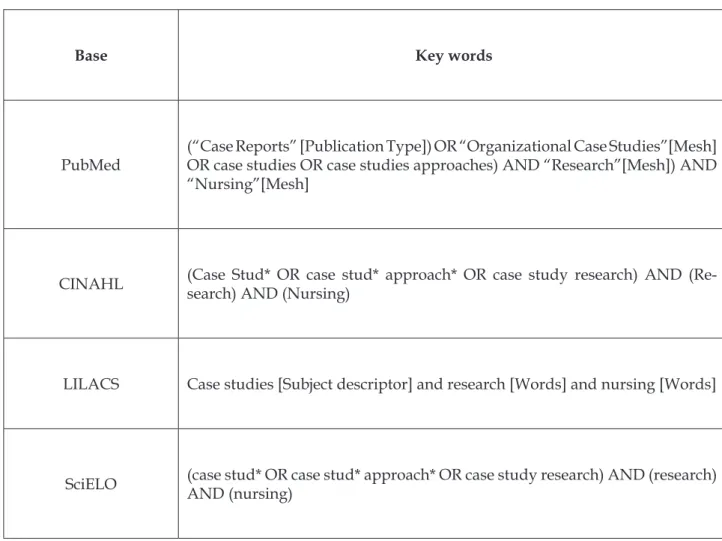
The electronic bibliographic bases were con-sulted on January 15, 2016 for literature, including: Public / PublishMedline (PubMed), Cumulative Index to Nursing & Allied Health Literature (CI-NAHL), Latin American and Caribbean Literature in Health Sciences (LILACS) and Scientiic Electronic Library Online (SciELO). To compose the search strategy, we selected keywords and combined des-criptors the following search keys were elaborated according to the database, according to table 1.
Table 1 - Database search strategy, 2015
Base Key words
PubMed
(“Case Reports” [Publication Type]) OR “Organizational Case Studies”[Mesh] OR case studies OR case studies approaches) AND “Research”[Mesh]) AND “Nursing”[Mesh]
CINAHL (Case Stud* OR case stud* approach* OR case study research) AND (Re-search) AND (Nursing)
LILACS Case studies [Subject descriptor] and research [Words] and nursing [Words]
SciELO (case stud* OR case stud* approach* OR case study research) AND (research) AND (nursing)
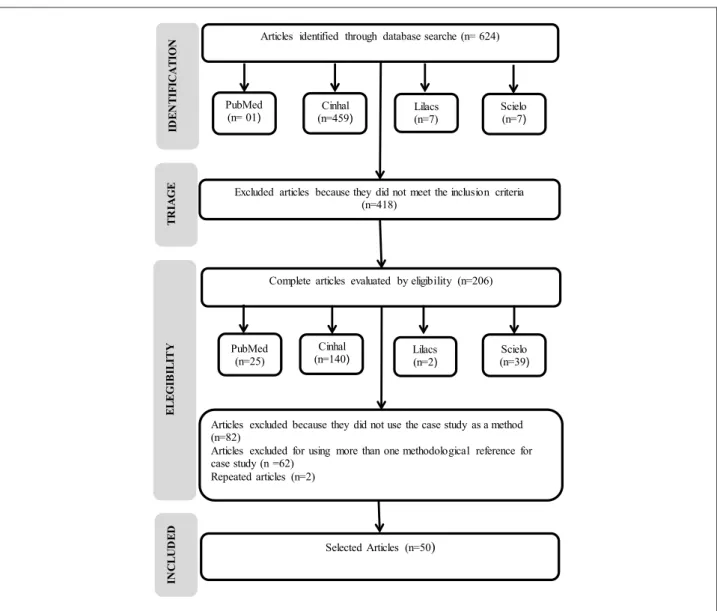
From the search strategy, 624 studies were identiied in the four searched electronic databases.
In the third stage, the identiied studies were pre-selected through the reading of the titles, abstracts, keywords or descriptors, excluding those that did not
I
D
E
N
T
I
F
I
C
A
T
I
O
N Articles identified through database searche (n= 624)
PubMed (n=25)
Cinhal (n=459)
Lilacs (n=7)
Scielo (n=7)
Complete articles evaluated by eligibility (n=206) Excluded articles because they did not meet the inclusion criteria
(n=418) PubMed
(n= 01)
Cinhal
(n=140) Lilacs(n=2)
Scielo (n=39)
ELEG
I
B
I
LI
T
Y
Selected Articles (n=50)
Articles excluded because they did not use the case study as a method (n=82)
Articles excluded for using more than one methodological reference for case study (n =62)
Repeated articles (n=2)
I
N
C
LU
D
ED
TR
I
A
G
E
Figure 1 - Flowchart of the method of searching and selecting studies, adapted from PRISMA
In the fourth step, the selected studies were categorized with the support of an instrument for recording information extracted from the articles, consisting of the following items: database, periodi-cal, year of publication, author, title, methodological reference and form of the case study application.
The ifth step provided the analysis, inter -pretation of the results and discussion, addressing the ways of applying the method according to the ields of nursing action: education, care/care and administration / management. The explicit ields of action of nursing, as categories for the merging of the studies of this review, took into consideration ields that involve the work process of the nurse, including: educate, care and administer.6
Finally, in the sixth stage, the review and syn-thesis of the knowledge produced in the application of the case study as a nursing research method in the
national and international scope was presented. The results were organized by ields of nursing practice.
RESULTS
The results of this study showed that 574 (92%) of the articles found use the term case study inappropriately in nursing research as they do not use the corresponding methodology. Although the terminology appears in the title, the summary and descriptors did not follow methodological rigor. Thus, of the 624 articles found, only 50 (8%) met the study objective and were selected. From these se-lected studies, 40 (80%) followed the methodological framework proposed by Yin1 and ten (20%) follow the methodological orientation of Stake.2
(12; 24%) and PubMed (4; 6%), distributed in 41 journals: Journal of Advanced Nursing (7%); Nursing Journal, Nursing School Magazine of the University of São Paulo and Latin American Journal of Nursing presented two (5%) studies each. The other studies were in different journals.
The year 2011 presented the most publications, with 14 (28%) studies, followed by 2012, with nine (18%), and 2015, with eight (16%), 2010 and 2013, with seven (14%), studies each year and 2014 with ive (10%).
The qualitative approach was used by 46 (92%) of the studies, followed by mixed methods with four (8%) publications. The case study may be of the single or multiple type containing analysis units. In
this review, 26 (52%) of the surveys were multiple cases and 24 (48%) were single case studies.
The grouping of the studies in this review took into account the ields that involve the nurses’ work process,6 notably education, care / care and mana-gement / administration. Based on this grouping, and for each ield, the themes that were studied with the case study application method emerged.
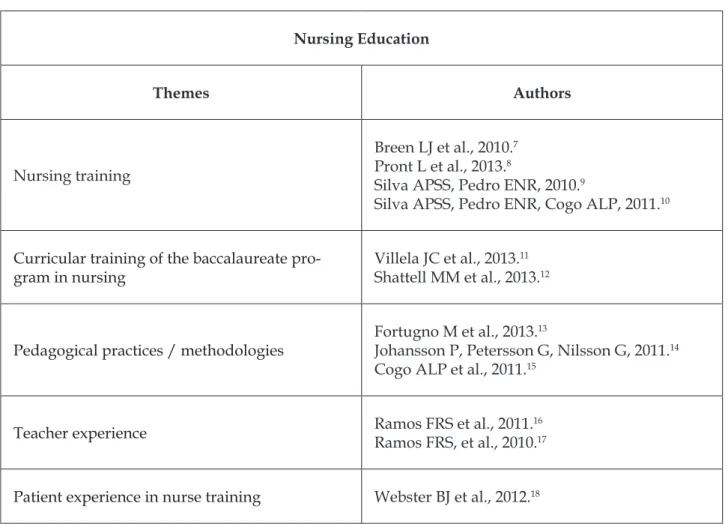
The education ield is directly related to the training of nurses, the curricular development that determines the foundation for the exercise of the profession, the pedagogical practices and metho-dologies focused on nursing. Table 2 presents the main themes of the studies analyzed in this review according to the ield of nursing education.
Table 2 - Subjects addressed in selected studies in the ield of nursing education
Nursing Education
Themes Authors
Nursing training
Breen LJ et al., 2010.7 Pront L et al., 2013.8
Silva APSS, Pedro ENR, 2010.9
Silva APSS, Pedro ENR, Cogo ALP, 2011.10
Curricular training of the baccalaureate pro-gram in nursing
Villela JC et al., 2013.11 Shattell MM et al., 2013.12
Pedagogical practices / methodologies
Fortugno M et al., 2013.13
Johansson P, Petersson G, Nilsson G, 2011.14 Cogo ALP et al., 2011.15
Teacher experience Ramos FRS et al., 2011.
16
Ramos FRS, et al., 2010.17
Patient experience in nurse training Webster BJ et al., 2012.18
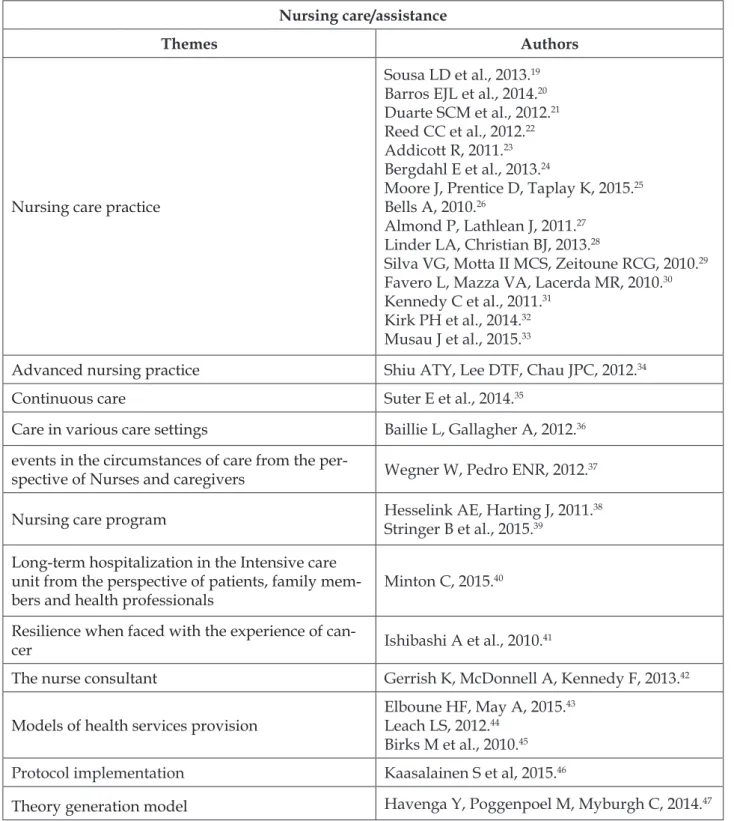
Regarding the ield of nursing care, the studies of this review focused on nursing care practices aimed at the prevention of falls, elderly health, emergency care, cancer patients and palliative care, psychological illness and primary health care
Table 3 - Subjects addressed in selected studies in the ield of nursing care
Nursing care/assistance
Themes Authors
Nursing care practice
Sousa LD et al., 2013.19 Barros EJL et al., 2014.20 Duarte SCM et al., 2012.21 Reed CC et al., 2012.22 Addicott R, 2011.23 Bergdahl E et al., 2013.24
Moore J, Prentice D, Taplay K, 2015.25 Bells A, 2010.26
Almond P, Lathlean J, 2011.27 Linder LA, Christian BJ, 2013.28
Silva VG, Motta II MCS, Zeitoune RCG, 2010.29 Favero L, Mazza VA, Lacerda MR, 2010.30 Kennedy C et al., 2011.31
Kirk PH et al., 2014.32 Musau J et al., 2015.33
Advanced nursing practice Shiu ATY, Lee DTF, Chau JPC, 2012.34
Continuous care Suter E et al., 2014.35
Care in various care settings Baillie L, Gallagher A, 2012.36
events in the circumstances of care from the
per-spective of Nurses and caregivers Wegner W, Pedro ENR, 2012. 37
Nursing care program Hesselink AE, Harting J, 2011. 38
Stringer B et al., 2015.39
Long-term hospitalization in the Intensive care unit from the perspective of patients, family mem-bers and health professionals
Minton C, 2015.40
Resilience when faced with the experience of
can-cer Ishibashi A et al., 2010.
41
The nurse consultant Gerrish K, McDonnell A, Kennedy F, 2013.42
Models of health services provision
Elboune HF, May A, 2015.43 Leach LS, 2012.44
Birks M et al., 2010.45
Protocol implementation Kaasalainen S et al, 2015.46
Theory generation model Havenga Y, Poggenpoel M, Myburgh C, 2014.47
The studies that dealt with the ield of nurs -ing management/administration are highlighted as they solely used the author Robert K. Yin1 as a methodological reference, revealing topics related to hospital services management, critical incident reports, workload, quality and nursing care planning. Table 4 presents the main themes
of the studies analyzed in this review, organized according to the application of the method in this ield.
Table 4 - Subjects addressed in the selected studies in management / administration in the nursing ield
Nursing management / administration
Themes Authors
Care management
Santos JLG, Lima MADS., 2011.48 Richards J, 2011.49
Fleiszer AR et al.,2015.50
Nursing workload Locke R et al, 2011.51
Organizational and extra-organizational factors Berta W, Laporte, Kachan N, 2010. 52
Harrington C, Ross L, Kang T, 2015.53
Nursing care planning Jeong SY, Higginns I, McMillan M, 2011. 54
Senna MH, Andrade SR, 2015.55
Table 5 - Case study development steps
1. Deinition of the research theme / problem1-2
2. Deinition of cases:
2.1 single, multiple, holistic and / or integrated1
2.2 single, intrinsic or instrumental2
Description of theoretical prepositions1
Elaboration of the case study protocol1
Data collection - use of multiple sources of evidence1-2
Analysis and interpretation of results1-2
Preparation of the report1-2
DISCUSSION
The analysis of the selected literature revealed the case study application method in nursing re-search, using the two main authors of this method, Yin and Stake as references1-2 Considering the prevalence of studies with a qualitative approach and practically proportional single cases (46%) and multiple (54%), it is important to clarify the bases with which the referenced authors use.
Yin1 proposes the single case study as an exploration of a limited system, through detailed analysis and systematic description to understand a speciic situation, an individual, a small group, an institution, a government program or an event. On the other hand, a multiple case study allows comparison, especially in several contexts. In both situations, the case study may be holistic or have integrated units of analysis, deining, in the latter, a central unit with subunits.
Stake2 outlines the case study as intrinsic,
instrumental or collective. The intrinsic case study seeks to obtain a better understanding of a particular case only by the interest aroused by that particular case. On the contrary, in the instrumental case study the interest in the case is due to the belief that it may facilitate the understanding of something broader, as it can serve to provide insights on a subject or to challenge a widely accepted generalization. The collective case study intends to offer a better un-derstanding, or even better theorization regarding a larger set of cases.
phenomenon, which constitutes a delimited system. This review revealed that the the case study application method in nursing research covered the different ields of activity of the profession, in particular education, care / care and administration / management.6
In the ield of nursing education, the selected studies addressed the evaluation of new teaching methodologies,13 the analysis of technological teach-ing tools,9-10,14-15 pedagogical practices,7-8,11-12 and the ethical dimension in the training of nurses.16-17
In addition to these, other areas can be deep-ened by the case study method, with research focused on educational policies, school and interme-diate management, climate, culture and leadership, supervision, continuous and specialized training, teacher satisfaction, professional identity, curricu-lum, didactic and pedagogical practices, educational projects, teaching-learning models and strategies, and evaluation.3
The studies developed in the area of educa-tion that used the single case study, deined by Yin, were performed with groups, which represented the unit of analysis within the studied phenomenon; or with a single individual indicating the case, being justiied as it represents a peculiar case which can be investigated. As an example of the method applica-tion considering the case as a group can be seen in a study conducted in Canada,13 which addressed a group of four students from different undergradu-ate courses and analyzed the inter-professional rela-tionship in an educational environment. In another study,11 conducted in Brazil, the case was a group of 60 nursing undergraduates, in the irst semester in the 4th academic year, during the teaching of the mental health discipline, and veriied how teaching in this area has inluenced nursing training. In the UK, the single case study consisted of a group of 18 volunteer patients and evaluated their experiences in providing feedback to students in a simulated learning environment.18
Regarding the studies that applied the method considering the case with a single individual, a survey conducted in Sweden, the study was a devel-oped by a nursing student in the course completion process and described his experience of using the personal digital assistant.14
Yin was also used in multiple case studies that sought to investigate the same phenomenon in different educational institutions.7,16-17 In studies conducted in Brazil, the cases were represented by six undergraduate nursing courses with the objec-tive of discussing the indicaobjec-tive changes identiied
by teachers in the nursing training scenario in rela-tion to their ethical dimension and to characterize the teachers regarding the experiences and motiva-tions for teaching ethics and bioethics in nursing courses.16-17 In Australia, the cases corresponded to six programs whose objective was to provide an indication of how future health professionals are prepared to deal with issues surrounding pain and loss issues in their practice.7
The case study method encourages the use of multiple sources of evidence through data trian-gulation, allowing the researcher to address wide variation in the same phenomenon.1-2 The case stud-ies that use the methodological framework of Yin in the ield of education used documental research as a source of evidence, through the analysis of teaching plans and the schedules of undergraduate disciplines,7,11 interviews,7-8,14 focus groups,13,16 and direct observation.11,18
The methodological framework proposed by Stake was used in the ield of nursing education, mostly with single case studies, which analyzed the use of virtual learning methodologies in under-graduate nursing teaching.10,15 In relation to multiple cases, a study conducted in the United States, exam-ined a baccalaureate pre-licensure nursing program at a public university.12
In the ield of nursing care, the case study method has been used in different areas, such as the health of the elderly,20,23,26,43 home care and palliative care,24 oncology,25,41 women and child health,28,36,38 surgical patients,19,21 mental health,39 and adverse events in care.37 According to the produced evi-dence, the method has contributed to the improve-ment of care practices when investigating nursing care from the perspective of patients,20 Families40 and professionals.19,21
It is observed that among the performed stud-ies , the single case study according to Yin’s meth-odological framework has been applied with groups of professionals, making it possible to describe the development of multi-professional teams in inter-mediate care,43 the nurse’s work in team leadership and collaboration among nurses working in speciic sectors and in order to understand the best way to support, promote and improve collaborative prac-tice among professionals.25
-ence for the service provided, such as hospitals,44 maternity hospitals,38 clinics,34 and long-term institu-tions.24 In the evaluation of the role, the case study has explored the role played by nurses as an agent of change in protocol implementation.46
The single case studies in the ield of nursing care / assistance which used the method proposed by Stake were used with groups of nurses and with a multi-professional team.32,38,45 In multiple cases,2 they consisted of nurses evaluating the impact of its performance on patients, professionals and the organization,42 other health professionals and pa-tients and their families.40
Finally, nursing research in the administration / management ield has only used the referential described by Yin, in single or multiple cases. This re-view identiied studies focused on care management, nursing workload,51 and nursing care planning.54
In care management, a single case study involv-ing nurses workinvolv-ing in the hospital service sought to foster discussion, relection and understanding of the importance of nurses’ managerial practices for the quality of care and the assistance provided by health services.48 The assessment of the nurse manager’s workload was also carried out with a pilot project that introduced administrative assistants to health facilities in England.51 The case study method has also been applied to evaluate care planning. In Australia this topic was explored focusing on advanced care planning and advanced home care guidelines for the elderly, focusing on the experiences of patients and families from three residences, and sought to plan the best care for the elderly in the inal stage of life.54
Studies related to health organizations analyzed the inluence exerted by the set of orga -nizational and extra orga-nizational factors on the operational eficiency and quality of care provided in long-stay homes. A multiple case study with 16 analysis units, identiied team characteristics and physical structure as well as extra organizational inluence as the main factors inluencing operational eficiency and quality of care.52 Another case study described, in a systematized manner, the experi-ences and the lows of institutions, identifying how adversities are recognized and resolved.57
Due to the diverse purposes and modalities of the application of the case study method, it is important to assess whether an investigation can be classiied as such. An investigation is characterized as a case study when there is a need to understand complex social phenomena of real-life events using a planning protocol , data collection and analysis.1,56 Not everything can be considered a case, because a
case is a speciic unit, or rather, a delimited system whose parts are integrated.2
CONCLUSION
This integrative review identified that the authors Yin and Stake were the researchers whose methodological frameworks of case studies were highlighted in the context of research in the ields of education, care / care and nursing management/ad-ministration. Yin’s methodological framework has been the most frequently used in nursing research that uses the case study as a method.
It can be emphasized that the references used are adequate for the nursing area, since the studies in this ield focus on the complex phenomena of life and allow the researchers to study them intensively and deeply, with multiple sources of evidence, in order to understand the facts related to individuals, groups or organizations. The case study as a research method is an important research resource, and it has been used by nursing in its various ields of activity.
REFERENCES
1. Yin RK. Estudo de caso: planejamento e métodos. 4ª ed. Porto Alegre (RS): Bookman; 2010.
2. Stake RE. Investigación com estúdio de casos. 4ª ed. Madrid (ES): Ediciones Morata; 2007.
3. Coimbra MNCT, Martins AMO. Estudo de caso como abordagem metodológica no ensino superior. Nuances [Internet]. 2013 Dec [cited 2016 Jun 10]; 24(3):31-46. Available from: http://revista.fct.unesp. br/index.php/Nuances/article/view/2696
4. Alves-Mazzotti AJ. Usos e abusos dos estudos de caso.
Cad Pesqui [Internet]. 2006 Dec [cited 2016 Jun 10]; 36(129):637-51. Available from: http://www.scielo. br/pdf/cp/v36n129/a0736129.pdf
5. M e n d e s K D S , S i l v e i r a R C C P , G a l v ã o C M . Revisão integrativa: método de pesquisa para a incorporação de evidências na saúde e na enfermagem. Texto Contexto Enferm [Internet]. 2008 Dec [cited 2015 Nov 20]; 17(4):758-64. Available from: http://www.scielo.br/scielo.php?script=sci_ arttext&pid=S0104-07072008000400018
6. Tanaka Luiza Hiromi; Leite Maria Madalena Janurio. Processo de trabalho do enfermeiro: visão de professores de uma universidade pública. Acta Paul Enferm [Internet]. 2008 Dec [cited 2015 Aug 01]; 21(3):481-6. Available from: http://www.scielo.br/ pdf/ape/v21n3/pt_16.pdf
2015 Nov 25]; 66(4):313-32. Available from: https:// www.ncbi.nlm.nih.gov/pubmed/23785983
8. Pront L, Kelton M, Munt R, Hutton A. Living and learning in a rural environment: a nursing student perspective. Nurse Educ Today [Internet]. 2013 Mar [cited 2015 Nov 10]; 33(3):281-5. Available from: https://www.ncbi.nlm.nih.gov/pubmed/22732124 9. Silva APSS, Pedro ENR. Autonomia no processo de
construção do conhecimento de alunos de enfermagem: o chat educacional como ferramenta de ensino. Rev Latino-Am Enfermagem [Internet]. 2010 Apr [cited 2015 Feb 10]; 18(2): [08 telas]. Available from: http:// www.scielo.br/pdf/rlae/v18n2/pt_11.pdf
10. Silva APSS, Pedro ENR, Cogo ALP. Chat educacional em enfermagem: possibilidades de interação no meio virtual. Rev Esc Enferm USP [Internet]. 2011 Dec [cited 2015 Feb 10]; 45(5):1213-20. Available from: http:// dx.doi.org/10.1590/S0080-62342011000500026 11. Villela JC, Maftum MA, Paes MR. The teaching of
mental health in a nursing undergraduate course: a case study. Texto Contexto Enferm [Internet]. 2013 Jun [cited 2015 Nov 15]; 22(2):397-406. Available from: http://www.scielo.br/pdf/tce/v22n2/v22n2a16 12. Shattell MM, Nemitz EA, Crosson N, Zackeru AR,
Starr S, Hu J, Gonzales C et al. Culturally competent practice in a pre-licensure baccalaureate nursing program in the United States: a mixed-methods study. Nurs Educ Perspect [Internet]. 2013 Nov [cited 2015 Nov 10]; 34(6):383-9. Available from: https://www. ncbi.nlm.nih.gov/pubmed/24475599
13. Fortugno M, Chandra S, Espin S, Gucciardi E. Fostering successful interprofessional teamwork through an undergraduate student placement in a secondary school. J Interprof Care [Internet]. 2013 Jul [cited 2015 Nov 15]; 27(4):326-32. Available from: https://www.ncbi.nlm.nih.gov/pubmed/23363312 14. Johansson P, Petersson G, Nilsson G. Experience of
using a personal digital assistant in nursing practice: a single case study. J Nurs Manag [Internet]. 2011 Oct [cited 2015 Nov 20]; 19(7):855-62. Available from: https://www.ncbi.nlm.nih.gov/pubmed/21988433 15. Cogo ALP, Pedro ENR, Silva APSS, Valli GP, Specht
AM. Tecnologias digitais no ensino de graduação em enfermagem: as possibilidades metodológicas por docentes. Rev Eletr Enf [Internet]. 2011 Dec [cited 2015 Nov 10]; 13(4):657-64. Available from: http://www. fen.ufg.br/revista/v13/n4/v13n4a09.htm.
16. Ramos FRS, Borges LM, Brehmer LCF, Silveira LR. Formação ética do enfermeiro: indicativos de mudança na percepção de professores. Acta Paul Enferm [Internet]. 2011 Feb [cited 2015 Nov 10]; 24(4):485-92. Available from: http://www.scielo.br/scielo.php?script=sci_ arttext&pid=S0103-21002011000400007
17. Ramos FRS, Schoeller SD, Brehmer LCF, Amaral RFC, Melo TAP. Motivações e experiências do ensino da ética/bioética em enfermagem. Av Enferm [Internet]. 2010 Dec [cited 2015 Nov 20]; 28(2):40-7. Available from:
http://www.scielo.org.co/scielo.php?script=sci_ arttext&pid=S0121-45002010000200004
18. Webster BJ, Goodhand K, Haith M, Unwin R. The development of service users in the provision of verbal feedback to student nurses in a clinical simulation environment. Nurse Educ Today [Internet]. 2012 Feb [cited 2016 Jan 05]; 32(2):133-8. Available from: https://www.ncbi.nlm.nih.gov/pubmed/22044767 19. Sousa LD, Filho WDL, Vaz MRC, Figueiredo PP.
A clínica como prática arboríica e rizomórica do trabalho em enfermagem cirúrgica. Rev Esc Enferm USP [Internet]. 2013 Aug [cited 2015 Nov 10]; 47(6):1389-96. Available from: http://www.scielo.br/ scielo.php?pid=S0080-2342013000601389&script=sci_ abstract&tlng=pt
20. B a r r o s E J L , S a n t o s S S C , G o m e s G C , Erdmann AL, Pelzer MT, Gautério DP. Ações e c o s s i s t ê m i c a s e g e r o n t o t e c n o l ó g i c a s n o cuidado de enfermagem complexo ao idoso estomizado. Rev Bras Enferm [Internet]. 2014 Fev [cited 2015 Nov 15]; 67(1):91-6. Available from: http://www.scielo.br/scielo.php?script=sci_ arttext&pid=S0034-71672014000100091
21. Duarte SCM, Stipp MAC, Mesquita MGR, Silva MM. O cuidado de enfermagem no pós-operatório de cirurgia cardíaca: um estudo de caso. Esc Anna Nery [Internet]. 2012 Dec [cited 2015 Nov 20]; 16(4):657-65. Available from: http://www.scielo.br/scielo.php?script=sci_ arttext&pid=S1414-81452012000400003
22. Reed CC, Gerhardt SD, Shaver K, Koebcke M, Mullins D. Case study: family presence in the OR for donation after cardiac death. AORN J [Internet]. 2012 Jul [cited 2015 Nov 10]; 96(1):34-44. Available from: https:// www.ncbi.nlm.nih.gov/pubmed/22742750
23. Addicott R. Supporting care home residents at the end of life. Int J Palliat Nurs [Internet]. 2011 Apr [cited 2015 Nov 10]; 17(4):183-7. Available form: http://www. kingsfund.org.uk/publications/articles/supporting-care-home-residents-end-life
24. Bergdahl E, Benzein E, Ternestedt BM, Elmbergerf E, Andershed B. Co-creating possibilities for patients in palliative care to reach vital goals: a multiple case study of home-care nursing encounters. Nurs Inquiry [Internet]. 2013 Jan [cited 2016 Jan 10]; 20(4):341-51. Available from: http://onlinelibrary.wiley.com/ doi/10.1111/nin.12022/abstract
25. Moore J, Prentice D, Taplay K Collaboration: what does it really mean to nurses? J Clin Nurs [Internet]. 2015 Jul [cited 2015 Nov 20]; 24(13-14):2052-4. Available from: https://www.ncbi.nlm.nih.gov/ pubmed/25959803
26. Bells A. Opinion piece: Australian residential aged care and the quality of nursing care provision. Contemp Nurse [Internet]. 2010 Apr [cited 2015 Nov 10]; 35(1):100-13. Available from: https://www.ncbi. nlm.nih.gov/pubmed/20636183
access to health visiting postnatal depression services. J Adv Nurs [Internet]. 2011 Nov [cited 2015 Nov 20]; 67(11):2350-62. Available from: https://www.ncbi. nlm.nih.gov/pubmed/21564204
28. Linder LA, Christian BJ. Nighttime sleep characteristics of hospitalized school-age children with cancer. J Spec Pediatr Nurs [Internet]. 2013 Jan [cited 2015 Nov 15]; 18(1):13-24. Available from: https://www.ncbi.nlm. nih.gov/pubmed/23289451
29. Silva VG, Motta MCS, Zeitoune RCG. A prática do enfermeiro na Estratégia Saúde da Família: o caso do município de Vitória/ES. Rev Eletr Enf [Internet]. 2010 [cited 2015 Nov 10]; 12(3):441-8. Available from: https://www.researchgate.net/ publication/47369017_A_pratica_do_enfermeiro_na_ Estrategia_Saude_da_Familia_o_caso_do_municipio_ de_VitoriaES
30. Favero L, Mazza VA, Lacerda MR. Vivência de enfermeira no cuidado transpessoal às famílias de neonatos egressos da unidade de terapia intensiva. Acta Paul Enferm. [Internet]. 2012 [cited 2015 Nov 25]; 25(4):490-6. Available from: http://www.scielo.br/scielo.php?script=sci_ arttext&pid=S0103-21002012000400002
31. Kennedy C, Harbison J, Mahoney C, Jarvis A, Veitch L. Investigating the contribution of community nurses to anticipatory care: a qualitative exploratory study. J Adv Nurs [Internet]. 2011 Jul [cited 2015 Nov 20]; 67(7):1558-67. Available from: https://www.ncbi.nlm. nih.gov/pubmed/21332574
32. Kirk PH, Boblin S, Ireland S, Robertson K. The nurse as bricoleur in falls prevention: learning from a case study of the implementation of fall prevention best practices. Worldviews Evid Based Nurs [Internet]. 2014 Apr [cited 2015 Jan 20]; 11(2):118-25. Available from: https://www.ncbi.nlm.nih.gov/pubmed/24612610 33. Musau J, Baumann A, Kolotylo C, O’shea T,
Biala-chowski A. Infectious disease outbreaks and in-creased complexity of care. Int Nurs Rev [Internet]. 2015 Sep [cited 2017 Mar 01]; 62(3):404-11. Available from: http://onlinelibrary.wiley.com/doi/10.1111/
inr.12188/abstract;jsessionid=C6BD0AAC3B
-04645DC164CCF78E62DAE5.f02t02
34. Shiu AT, Lee DT, Chau JP. Exploring the scope of expanding advanced nursing practice in nurse-led clinics: a multiple-case study. J Adv Nurs [Internet]. 2012 Aug [cited 2015 Dec 05]; 68(8):1780-92. Available from: https://www.ncbi.nlm.nih.gov/ pubmed/22118936
35. Suter E, Deutschlander S, Makwarimba E, Wilhelm A, Jackson K, Lyons SW. Workforce utilization in three continuing care facilities. Health Sociology Review [Internet] 2014 Oct [cited 2015 Nov 10]; 23(1):65-76. Available from: http://www.tandfonline.com/doi/ abs/10.5172/hesr.2014.23.1.65
36. Baillie L, Gallagher A. Raising awareness of patient dignity. Nurs Stand [Internet]. 2012 Oct [cited 2015
Nov 20]; 27(5):44-9. Available from: https://www. ncbi.nlm.nih.gov/pubmed/23256301
37. Wegner W, Pedro ENR. A segurança do paciente nas circunstâncias de cuidado: prevenção de eventos adversos na hospitalização infantil. Rev Latino-Am Enfermagem [Internet]. 2012 Jun [cited 2015 Dec 01]; 20(3):427-34. Available from: http://www.scielo.br/ scielo.php?pid=S0104-1692012000300002&script=sci_ abstract&tlng=pt
38. Hesselink AE, Harting J. Process evaluation of a multiple risk factor perinatal programme for a hard-to-reach minority group. J Adv Nurs [Internet]. 2011 Sep [cited 2015 Oct 18]; 67(9):2026-37. Available from: https://www.ncbi.nlm.nih. gov/pubmed/21496067
39. Stringer B, Meijel BV, Karman P, Koekkoek B, Kerkhof AJFM, Beekman ATF. Collaborative care for patients with severe personality disorders: analyzing the execution process in a pilot study (Part II). Perspect Psychiatr Care [Internet]. 2015 Oct [cited 2016 Feb 10]; 51(3): 220-7. Available from: http://onlinelibrary. wiley.com/doi/10.1111/ppc.12087/abstract
40. Minton C. Long-term ICU patients face many challenges. Nurs N Z [Internet]. 2015 Aug [cited 2015 Nov 18]; 21(7):18-9. Available from: https://www. ncbi.nlm.nih.gov/pubmed/26398995
41. Ishibashi A, Ueda R, Kawano Y, Nakayama H, Matsuzaki A, Matsumura T. How to improve resilience in adolescents with cancer in Japan. J Pediatr Oncol Nurs [Internet]. 2010 Apr [cited 2015 Nov 20]; 27(2):73-93. Available from: https://www.ncbi.nlm. nih.gov/pubmed/20176917
42. Gerrish K, McDonnell A, Kennedy F. The development of a framework for evaluating the impact of nurse consultant roles in the UK. J Adv Nurs [Internet]. 2013 Oct [cited 2015 Feb 10]; 69(10):2295-308. Available from: https://www.ncbi.nlm.nih.gov/ pubmed/23461489
43. Elbourne HF, May A. Crafting intermediate care: one team’s journey towards integration and innovation. J Res Nurs [Internet]. 2015 Feb [cited 2015 Nov 10]; 20(1): 56-71. Available from: http://jrn.sagepub.com/ content/20/1/56.abstract
44. Leach LS, Kagawa F, Mayo A, Pugh C. Improving patient safety to reduce preventable deaths: the case of a California safety net hospital. J Healthc Qual [Internet]. 2012 Apr [cited 2015 Dec 10]; 34(2):64-76. Available from: https://www.ncbi.nlm.nih.gov/ pubmed/23552203
45. Birks M, Mills J, Francis K, Coyle M, Davis J, Jones J. Models of health service delivery in remote or isolated areas of Queensland: a multiple case study. AJAN [Internet]. 2010 [cited 2015 Apr 20]; 28(1):25-34. Available from: http://researchonline.jcu.edu. au/11945/
and nurse practitioners as change champions to implement a pain protocol in long-term care. Pain Manag Nurs [Internet]. 2015 Apr [cited 2015 Dec 05]; 16(2):78-88. Available from: https://www.ncbi.nlm. nih.gov/pubmed/25439111
47. Havenga Y, Poggenpoel M, Myburgh C. Developing a model: an illustration. Nurs Sci Q [Internet]. 2014 Apr [cited 2015 Dec 05]; 27(2):149-56. Available from: https://www.ncbi.nlm.nih.gov/pubmed/24740950 48. Santos JLG, Lima MADS. Gerenciamento do cuidado:
ações dos enfermeiros em um serviço hospitalar de emergência. Rev Gaúcha Enferm [Internet]. 2011 Dec [cited 2015 Nov 08]; 32(4):695-702. Available from: http://www.scielo.br/scielo.php?script=sci_ arttext&pid=S1983-14472011000400009
49. Richards J. The risky business of supervision, 2: gaining skills and knowledge. Br J Midwifery [Internet]. 2011 Jul [cited 2015 Dec 10]; 19(7):449-52. Available from: http://web.a.ebscohost.com/ehost/ pdfviewer/pdfviewer?sid=be9fc613-72f8-41bd-b7a9-c0aaf0628aff%40sessionmgr4008&vid=0&hid=4106 50. Fleiszer AR, Semenic SE, Ritchie JA, Richer MC, Denis
JL. An organizational perspective on the long-term sustainability of a nursing best practice guidelines program: a case study. BMC Health Serv Res [Internet]. 2015 Dec 3 [cited 2017 Mar 01]; 15:535. Available from: https://bmchealthservres.biomedcentral.com/ articles/10.1186/s12913-015-1192-6
51. Locke R, Leach C, Kitsell, Griffith J.The impact on the workload of the ward manager with the introduction of administrative assistants. J Nurs Manag [Internet]. 2011 Mar [cited 2015 Nov 20]; 19(2):177-85. Available from: https://www.ncbi.nlm. nih.gov/pubmed/21375620
52. Berta W, Laporte A, Kachan N. Unpacking the relationship between operational efficiency and quality of care in Ontario long-term care homes. Can J Aging [Internet]. 2010 Dec [cited 2015 Nov 10];
29(4):543-56. Available from: https://www.ncbi.nlm. nih.gov/pubmed/21134304
53. Harrington C, Ross L, Kong T. Hidden owners, hidden proits, and poor nursing home care: a case study. Int J Health Serv [Internet]. 2015 Jul [cited 2017 Mar 01]; 45(4):779-800. Available from: http:// journals.sagepub.com/doi/abs/10.1177/0020731415 594772?url_ver=Z39.88-2003&rfr_id=ori:rid:crossref. org&rfr_dat=cr_pub%3dpubmed
54. Jeong SY, Higgins I, McMillan M. Experiences with advance care planning: older people and family members’ perspective. Int J Older People Nurs [Internet]. 2011 Sep [cited 2016 Feb 01]; 6(3):176-86. Available from: https://www.ncbi.nlm.nih.gov/ pubmed/21998863
55. Senna MH, Andrade SR. Indicators and information in local health planning: the perspective of the family health strategy nurses. Texto Contexto Enferm [Internet]. 2015 Oct-Dec [cited 2017 Mar 01]; 24(4):950-8. Available from: http://www.scielo.br/pdf/tce/ v24n4/pt_0104-0707-tce-24-04-00950
56. Caillag JM, Martins R, Primo MAM. Estudos de caso como opção de pesquisa empírica em operações. RAE [Internet]. 2012 Aug [cited 2016 Apr 01]; 52(4):380-5. Available from: http://rae.fgv.br/rae/vol52- num4-2012/estudos-caso-como-opcao-pesquisa-empirica-em-operacoes
57. Neves MF, Conejero MA. Uma contribuição empírica para geração de métodos de planejamento e gestão. Rev Adm [Internet]. 2012 [cited 2016 Oct 25]; 47(4):699-714. Available from: http://www.scielo.br/pdf/ rausp/v47n4/a14v47n4.pdf
Correspondence: Andriela Backes Ruoff Rua João Marçal, 69
88036-620 - Florianópolis, SC, Brasil. E-mail:[email protected]