Cop
yright
© ABE&M t
odos os dir
eit
os r
eser
vados
.
Correspondence to:
Fábio M. Montenegro Rua Apeninos, 1118-62 04104-021 − São Paulo, SP, Brazil [email protected]
Received on Jun/11/2010 Accepted on Jan/28/2011
Transitory increase in creatinine
levels after parathyroidectomy:
evidence of another action of
the parathyroid glands?
Alteração transitória da creatinina após paratireoidectomia: evidência de outra ação das glândulas paratireoides?
Fábio M. Montenegro1, Lenine G. Brandão1, Gustavo F. Ferreira2,
Delmar M. Lourenço Jr.3 , Regina M. Martin3, Malebranche B. Cunha-Neto3, Claudia B. Helou4, Sergio A. Toledo3, Anói C. Cordeiro1, Luiz E. Ianhez2
ABSTRACT
Objective: Little information is available on glomerular function changes after surgical treatment of primary hyperparathyroidism. The acute effects of some head and neck operations on renal function were studied. Materials and methods: Retrospective analysis of changes in creatinine levels and estimated glomerular filtration rate (eGFR) after surgery. Preoperative values were compared with values available until 72 hours after the operation. Results: In tertiary hyper-parathyroidism, mean preoperative and postoperative eGFR values were 57.7 mL/min and 40.8 mL/min (p < 0.0001), respectively. A similar decrease was observed after parathyroidectomy for primary hyperparathyroidism, from 85.4 mL/min to 64.3 mL/min (p < 0.0001). After major head and neck procedures, there was a slight increase in eGFR (from 94.3 mL/min to 105.4 mL/min, p = 0.002). Conclusions: Parathyroidectomy may be followed by a transient decrease in eGFR that is not often observed in other head and neck operations. Arq Bras Endocrinol Metab. 2011;55(4):249-55 Keywords
Creatinine; hyperparathyroidism; acute kidney failure; parathyroid hormone; parathyroidectomy
RESUMO
Objetivo: Há pouca informação sobre alterações da função glomerular após o tratamento cirúrgico do hiperparatireoidismo primário. O efeito agudo sobre a função renal foi estuda-do após algumas operações em cirurgia de cabeça e pescoço. Materiais e métodos: Análise retrospectiva dos níveis de creatinina e da taxa de filtração glomerular estimada (eGFR). Os valores pré-operatórios foram comparados aos valores disponíveis até 72 horas após a opera-ção. Resultados: No hiperparatireoidismo terciário, os valores médios pré e pós-operatórios da eGFR foram 57,7 mL/min e 40,8 mL/min (p < 0,0001), respectivamente. O decréscimo após paratireoidectomia por hiperparatireoidismo primário foi de 85,4 mL/min para 64,3 mL/min (p < 0,0001). Após operações maiores de cabeça e pescoço, houve leve elevação da eGFR (de 94,3 mL/min para 105,4 mL/min, p = 0,002). Conclusões: A paratireoidectomia pode ser seguida de uma redução transitória na eGFR que não é frequentemente observada após outras operações em cabeça e pescoço. Arq Bras Endocrinol Metab. 2011;55(4):249-55
Descritores
Creatinina; hiperparatireoidismo; falência renal aguda; hormônio paratireoideo; paratireoidectomia
1 Head and Neck Surgery, Department of Surgery, Faculdade de Medicina, Universidade de Sao Paulo (FMUSP), SP, Brazil 2 Renal Transplant Unit, Division of Urology, FMUSP, SP, Brazil 3 Endocrinology, Department of Internal Medicine, FMUSP, SP, Brazil 4 Laboratory of Basic Science in Nephrology, Department of Internal Medicine, FMUSP, SP, Brazil
INTRODUCTION
I
n hyperparathyroidism (HPT), hypocalcemia is themost frequently voiced concern after different mo-dalities of parathyroidectomy. In primary HPT, the
Cop
yright
© ABE&M t
odos os dir
eit
os r
eser
vados
.
However, in renal transplant patients with persis-tent HPT, acute and transient kidney injury has been described after parathyroidectomy (2). Chronic renal allograft damage was reported after subtotal (3) or total parathyroidectomy with autotransplantation (4).
In one study, there was a consistent correlation be-tween transient decrease in transplanted kidney func-tion and decrease in parathyroid hormone (PTH), shortly after parathyroidectomy (5).
Because of this, we reviewed our own cases of HPT. If creatinine increase is associated with PTH reduction, renal transplant patients who underwent operations not related to the parathyroid glands would exhibit a diffe-rent pattern. Indeed, while there was a mean increase of 39.5% in creatinine levels after parathyroidectomy, there was a mean decrease of 2.7% after other head and neck operations in renal transplant patients (6).
If the increase in creatinine levels is related to de-creases in PTH, a similar increase would be expected in patients with primary HPT undergoing parathyroi-dectomy. The aim of the present study was to evaluate changes in creatinine levels and in estimated glomerular iltration rates (eGFR) after parathyroidectomy or some other head and neck operations, in order to validate our previous observations in a larger number of patients.
MATERIALS AND METHODS
This retrospective study was approved by the research ethics committee of our institution. We analyzed acute creatinine changes in patients operated on for tertia-ry HPT after renal transplantation (tHPT) or primatertia-ry HPT (pHPT), from 1997 to 2007, at the Department of Head and Neck Surgery in the Faculdade de Medi-cina at Universidade de Sao Paulo. Acute change was deined as occurring in up to 72 hours of the operation.
Results of patients with tHPT and pHPT were com-pared with observations in random but non-consecutive patients submitted total thyroidectomy (TT), thyroid lobectomy (L), or other major head and neck proce-dures (MAJOR HNS), as well as kidney transplant pa-tients operated on for non-parathyroid head and neck tumours (NON PTX RENAL TX). MAJOR HNS in-cluded malignant and benign diseases (most cases were squamous cell carcinoma of the upper aerodigestive tract, but some cases included parotid tumours, mela-noma, skull base surgery, or angioibroma). For pre-operative evaluation, patients usually undergo serum creatinine test from days up to six months prior to the operation. On irst day after surgery, MAJOR HNS
pa-tients stay at the intensive care unit, and serum creati-nine is always included in routine laboratory work up. At our institution, creatinine is not always requested after thyroidectomy, but the test is carried out in some patients, in conjunction with calcium and/or PTH evaluation, as requested by endocrinologists in other studies. Thus, these results were available for our retro-spective analysis.
After our initial observation of a possible acute change in renal function, analysis of postoperative cre-atinine levels after parathyroidectomy or thyroidectomy became more frequent, but it is still not routine prac-tice. Serum creatinine after thyroidectomy or parathy-roidectomy is requested on the preference of the at-tending surgeon or endocrinologist.
The eGFR was calculated according to the Modiica-tion of Diet in Renal Disease (MDRD), using creatinine, age, gender and race, in an internet-based open resource at the National Kidney Foundation, available at http:// www.kidney.org/professionals/kdoqi/gfr_calculator.cfm. Percent creatinine variation (PCV) was calculated as follows: PCV=(Postoperative Creatinine - Preoperative Creatinine) x 100/(Preoperative Creatinine). A positi-ve value relects increased creatinine lepositi-vels and possible decrease in renal function. Percent change of creatinine is a widely accepted tool to evaluate changes in renal function in clinical studies (7). While PCV has its li-mitations, it prevents the inappropriate comparison of absolute changes in creatinine values between patients
with very different basal creatinine levels, i.e., it is not
appropriate to compare a 0.5 mg/dL increase in a pa-tient with basal creatinine level of 0.9 mg/dL (55.6% increase) with that of a patient with preoperative creati-nine level of 2.0 mg/dL (25% increase).
As a retrospective analysis, postoperative creatinine was not available for all patients on every postoperative day. In the present study, the highest value of serum creatinine was employed to calculate PCV only if the measurement was obtained up to the third postoperati-ve day. Tests obtained later were not considered in this study, and these cases were excluded. When available, calcium, phosphorus and PTH levels were included.
Statistical analysis included the Kolmogorov-Smir-nov test to assess the normality of distribution. Paired
Student’s t test was employed for normal distribution
Cop
yright
© ABE&M t
odos os dir
eit
os r
eser
vados
.
RESULTS
Gender distribution was not comparable in all groups. The proportion of males was higher in patients sub-mitted to major head and neck procedures, as show in table 1. Age distribution differed for MAJOR HNS and TT groups (p < 0.05, Tukey’s Multiple Comparison test). In all other situations, mean age was not signii-cantly different.
Mean of available values for total calcium before and after the operation, in patients undergoing total thyroi-dectomy, were 9.1 mg/dL and 7.8 mg/dL, respecti-vely. Preoperative and postoperative values were avai-lable for 17 cases Preoperative mean was 9.0 mg/dL and postoperative mean was 7.8 mg/dL (p < 0.0001,
paired t test). For lobectomy cases, paired values were
available for 7 situations. Their preoperative mean was 8.9 mg/dL and postoperative mean was 8.2 mg/dL
(p = 0.0482, paired t test).
Mean of available values for total calcium, phospho-rus and median of available PTH in patients with tHPT and pHPT are shown in table 2.
In pHPT, there were 75 cases of parathyroid ade-noma. Only one patient required a second operation to achieve success (1.33% of these cases). Creatinine values were available only for the irst procedure (when HPT persisted): preoperative level was 0.9 mg/dL and postoperative level, 0.8 mg/dL.
Of two patients with parathyroid carcinoma, the disease recurred in one of them, who was reoperated three years later. His creatinine values were available on both occasions. In 24 patients with Multiple Endocrine Neoplasia type 1 pHPT (MEN 1), two were reoperated
approximately fours years after the irst operation due to recurrent pHPT. Their creatinine levels were availa-ble in both operations. Thus, in the present study, the-re wethe-re 112 patients operated on for pHPT, but thethe-re were 115 cases for the comparison of creatinine values (112 patients plus three additional operations). Table 3 shows the distribution of pHPT cases.
Mean and SD of preoperative creatinine values are depicted in table 4. Distribution of all groups was normal, except for pHPT distribution. Kruskal-Wallis test showed a signiicant difference in preoperative cre-atinine values between groups (p < 0.0001). Dunn’s multiple comparison test showed that kidney trans-plant patients had a signiicantly higher preoperati-ve creatinine lepreoperati-vels compared with the other groups; however, mean preoperative creatinine level of tHPT (1.40 mg/dL) was not statistically different from the mean of the NON PTX TX RENAL group (1.69 mg/dL) (p > 0.05).
In the MAJOR HNS group, distribution of pre- and postoperative creatinine levels were normal, and
paired Student’s t test showed no difference
betwe-en preoperative and postoperative creatinine levels (p = 0.11). The same was true for the L group (p = 0.37), NON PTX RENAL TX patients (p = 0.46), and the TT group (p = 0.16).
In patients with pHPT, postoperative creatinine level was signiicantly higher than preoperative level (p < 0.0001). A similar result was observed in the tHPT group (p < 0.0001; Wilcoxon signed rank test). When all groups were compared by Kruskal-Wallis test, p va-lue was < 0.0001.
Preoperative eGFR of patients undergoing ma-jor head and neck surgery was not statistically diffe-rent from preoperative eGFR of thyroid operations or pHPT, but it was signiicantly higher than tHPT (p < 0.001) and NONPTX RENAL TX patients (p < 0.01) (Dunn’s Multiple Comparison test). Preopera-tive eGFR of thyroidectomy patients was higher than that of pHPT (p < 0.05) and renal transplant cases. The eGFR of patients before lobectomy was only diffe-rent from the eGFR of tHPT cases (p < 0.05). Table 5 shows preoperative and postoperative eGFR values.
Table 1. Age and gender distribution
n Mean age (range) Male:female
MAJOR HNS 54 57.3 (16-82) 40:14
TT 24 43.4 (12-72) 8:16
L 9 52.7 (28-86) 1:8
NON PTX RENAL TX 7 50.4 (17-76) 3:4
t HPT 41 48.8 (23-68) 15:26
pHPT 115 53 (17-83) 32:83
Table 2. Values of calcium, phosphorus (in mg/dL) and PTH (pg/mL) before and after the operation
Calcium, preoperative
Calcium, postoperative
Phosphorus, preoperative
Phosphorus, postoperative
PTH, preoperative
PTH, postoperative
tHPT 11.4 9.2 2.7 3.8 200 0
Cop
yright
© ABE&M t
odos os dir
eit
os r
eser
vados
.
Table 4. Pre-and postoperative creatinine levels (mg/dL)
Mean preoperative creatinine (SD)
Range
Mean postoperative creatinine (SD)
Range
p*
MAJOR HNS 0.88 (0.18)
0.54 -1.27
0.84 (0.26) 0.44 - 1.55
0.07
TT 0.77 (0.22)
0.45 - 1.45
0.80 (0.27) 0.48 – 1.54
0.30
L 0.83 (0.37)
0.51 - 1.75
0.90 (0.37) 0.57 - 1.70
0.37
NON PTX RENAL TX 1.69 (0.92) 0.86 - 3.10
1.57 (0.74) 0.80 - 2.90
0.46
t HPT 1.40 (0.55)
0.75 -3.30
1.92 (0.83) 0.80-4.38
< 0.0001
pHPT 1.04 (0.59)
0.30 - 3.76
1.38 (0.89) 0.40 - 6.80
< 0.0001
* Determined by paired t test, except in pHPT (Wilcoxon signed rank test).
Table 5. Pre- and postoperative Estimated Glomerular Function Rate (eGFR) in mL/min x 1.73 sqm
Mean preoperative
eGFR (SD)
Mean postoperative
eGFR (SD)
p*
MAJOR HNS 94.3 (25.1) 105.4 (37.2) 0.0021
TT 107.4 (35.7) 104.7 (35.7) 0.54
L 93.3 (29.4) 86.3 (30.5) 0.32
NON PTX RENAL TX 50.7 (26.5) 52.7 (27.2) 0.62
t HPT 57.7 (20.3) 40.8 (15.5) < 0.0001
pHPT 85.4 (49.1) 64.3 (34.0) < 0.0001
* Determined by paired t test, except in pHPT (Wilcoxon signed rank test).
Table 6. Percent change of creatinine levels
t HPT pHPT TT L MAJOR HNS
NON PTX RENAL TX
n 41 115 24 9 54 7
PCV*(%) mean +39.2 +33.1 +4.2 +11 -5.3 -2.7
PCV (%) median +30 +27 +1 -1 -8.3 -6.4
*PCV = (Postoperative Creatinine - Preoperative Creatinine) x 100/(Preoperative Creatinine).
Table 3. Distribution of pHPT cases
pHPT Number of patients
Number of situations when creatinine was
analyzed
Adenoma 75 75
MEN 1 HPT 24 26
Sporadic hyperplasia 8 8
Double adenoma 2 2
Carcinoma 2 3
MEN type 2A HPT 1 1
Total 112 115
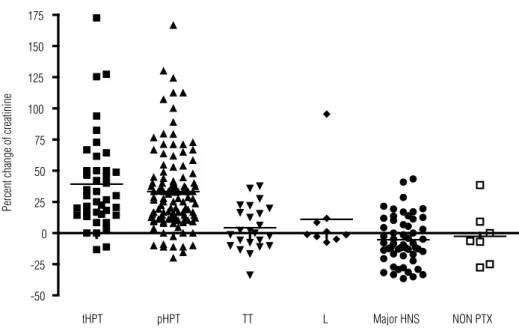
Figure 1 is a graphical depiction of eGFR distribu-tion in all groups, excluding cases with preoperative eGFR greater than 150 mL/min/1.73 sqm. Results were not affected by the exclusion of these individuals, and exclusion was done to improve data presentation. Values calculated for PCV of all groups are shown in table 6. Figure 2 shows that the distribution of PCV in the different groups was clearly different in patients undergoing parathyroid surgery.
preop postop preop postop preop postop preop postop preop postop preop postop
0 10 20 30 40 50 60 70 80 90 100 110 120 130 140 150 160 170 180 190
Major HNS TT L NON PTX
RENAL TX t HPT p HPT
p < 0.001 p < 0.001
eGFR
Cop
yright
© ABE&M t
odos os dir
eit
os r
eser
vados
.
tHPT pHPT TT L Major HNS NON PTX
-50 -25 0 25 50 75 100 125 150 175
Percent change of creatinine
Figure 2. Individual distribution of PCV in all groups (the bar indicates the mean).
DISCUSSION
Renal changes in HPT are largely and frequently attri-butable to acute and chronic excessive calcium in the circulation. Thus, resolution of hypercalcemia would theoretically be followed by kidney improvement, if ir-reversible kidney damage has not occurred.
More recently, however, a transient decrease in renal function after parathyroidectomy for tertiary HPT was correlated with a decrease in PTH levels (5). This led us to review cases of patients with primary HPT. Althou-gh resection was performed in only one gland in most cases, a similar acute rise of creatinine was observed. Analysis of this effect on other head and neck proce-dures showed that creatinine levels were more stable in patients without HPT, except those undergoing thyroi-dectomy (6). Although this is a retrospective study with many limitations (e.g., time span between sampling, time of day when the blood was obtained, diet or in-tervening medications), these results are in accordance with the 1958 observations of Edvall on renal function in primary HPT (8).
Acute elevation of creatinine levels after parathyroi-dectomy in pHPT was briely discussed by Peacock (9), who apparently demonstrated that this increase was more marked in patients with higher preoperative creatinine levels. However, in another study, we obser-ved that mean eGFR decrease occurred at similar ra-tes, irrespective to preoperative renal function in pHPT (-21.8% in patients with severe to moderate kidney
disease, -30.3% in mild kidney disease, and -21.8% in normal individuals) (10).
In fact, present observations suggest that a more complex pattern can be observed even in patients with lower creatinine levels before the operation. Changes in creatinine levels may be very small, within normal limits and transient, but in other cases, a more marked in-crease can be detected. It is remarkable that creatinine changes did not exhibit the same pattern in all patients after parathyroidectomy for pHPT. In some of them, it increased while in others it was unchanged, or apparen-tly decreased (10,11).
The retrospective nature of the present study may also interfere with these observations because prerative creatinine was not measured just before the ope-ration; in some cases, it was measured months prior to surgery. Another problem is the use of only a single postoperative value, which may obscure actual creati-nine patterns.
Cop
yright
© ABE&M t
odos os dir
eit
os r
eser
vados
.
halfway between pHPT and Major HNS. For academic purposes, a prospective study would clarify this issue.
Calcium and calcitriol are usually prescribed in hy-poparathyroid states. Excessive calcium replacement may have occurred in some cases, although mean post-operative calcium was normal in the present study. Excessive calcium in the circulation seems to cause va-soconstriction of the renal glomerular afferent arteri-ole. Thus, abrupt drop in PTH, when compared with the slow decrease of excessive calcium in the circula-tion (caused by natural slow decrease or calcium sup-plementation), could explain the transient decrease in renal function before normalisation of calcemia. How-ever, results of Lins do not favour this assumption; he observed that renal function does not improve signii-cantly after correction of calcemia following a parathy-roidectomy, although a notable improvement in renal function was observed after correction of hypercalce-mia in other causes, suggesting a different pattern of PTH-dependent hypercalcemia (12). It should be re-membered that changes in intracellular calcium are not currently monitored. Intracellular calcium may play an important, but yet undeined role. The same might be true for calcium-sensing receptors in the kidney.
An important point to be addressed is parathyroid secretion, which is abruptly changed by parathyroid-ectomy, as observed in the present series (Table 2). Is PTH itself directly affecting renal function? Do direct physiological actions of PTH on renal function clearly explain present observations? In one study, postopera-tive creatinine changes were only correlated to the de-gree of PTH decrease after parathyroidectomy in renal transplant patients (5).
In relation to circulatory or renal effects of active PTH fragments or parathyroid extract infusion, Massry and cols. noted that many contradictory results have been published (13). One possible clinical model to observe PTH action on renal function is its clinical use in osteoporosis treatment. In a randomised trial with subcutaneous injection of 1-34 PTH, a signiicant in-crease in serum creatinine was observed after the fourth month of treatment (14). It is curious that in a study with 1-84 PTH injection, measured creatinine clear-ance tended to increase in PTH-treated patients, but remained relatively stable in placebo patients (15). Considering these facts and the present observations, one may wonder if direct and indirect effects of differ-ent PTH fragmdiffer-ents on renal function deserve further basic research.
In the present series, postoperative creatinine changes could be, in part, related only to the use of drugs, such as nonsteroidal anti-inlammatory drugs (NSAIDs), during surgery, a rather common practice in anaesthesia (16). Indeed, Lee and cols. concluded that NSAIDs cause a clinically unimportant transient reduction in renal function in the early postoperative period (16). Another possibility would be that HPT patients are more sensitive to the nephrotoxic effects of a NSAID or other agents commonly employed in anes-thesia. Could a recent parathyroidectomy aggravate the nephrotoxicity of some drugs and affect present results? In experimental studies, parathyroidectomy was dem-onstrated to be associated with reduced nephrotoxicity of cisplatin (17) and gentamicin (18). The mechanism for this kind of protection was unclear.
Transitory creatinine increase may be clinically un-important, but its impact on long-term renal function is presently unknown. Until proven otherwise, how-ever, the present observation may point out that any potential nephrotoxic drug should be avoided or used judiciously during or early after parathyroidectomy. Perhaps a parallel with contrast induced nephropathy may be of value. Are we able to identify patients at risk or deine protective measures when planning the treat-ment of patients with acute reduction of parathyroid function? (19).
An increase in creatinine levels not relecting an actual reduction in glomerular renal function may be questioned in the present series. The possible interfer-ence on tubular secretion of creatinine should be taken into account (20). Thus, creatinine increase would not represent glomerular renal change, but only reduced tubular secretion of the marker. However, some pa-tients presented oliguria after parathyroidectomy in the middle of the last century, as noted by Fuller Al-bright (11). Another hint to a real renal dysfunction is the rare but alarming acute effect on chronic kidney injury that occurs in some patients immediately after parathyroidectomy (21,22). This problem may be un-derreported in the literature, as physicians may consider that other causes of acute kidney injury may lead to acute or chronic renal disease after parathyroidectomy, in primary HPT patients with some degree of chronic kidney disease.
pos-Cop
yright
© ABE&M t
odos os dir
eit
os r
eser
vados
.
sible that creatinine increases spontaneously in different measurements; however, a careful reading of the study shows that the authors are not saying that at all: they only demonstrate that creatinine may change due to other factors affecting renal function, besides radiologi-cal contrast. In their retrospective analysis, they could not rule out other potential risk factors to renal damage in the hospitalised population (23). The same criticism may be applied to the present study: as creatinine was not routinely requested, we may have included in the analysis patients presenting more risk factors.
The present data showed there was a signiicant improvement in eGFR in patients undergoing major head and neck operations. This may be explained by overhydration during the operation and early postop-erative period of these long operations. Low creatinine concentrations may be induced by overhydration (24).
In conclusion, a signiicant and transient change in creatinine levels may be observed right after parathy-roidectomy. The mechanism underlying this phenom-enon is apparently not yet understood. In our view, further basic research on the effects of different PTH fragments on renal function may be of scientiic interest.
Disclosure: no potential conlict of interest relevant to this article was reported.
REFERENCES
1. Sitges-Serra A, Bergenfelz A. Clinical update: sporadic primary hyperparathyroidism. Lancet. 2007;370:468-70.
2. Evenopoel P, Claes K, Kuypers D, Maes B, Vanrenterghem Y. Im-pact of parathyroidectomy on renal graft function, blood pressure and serum lipids in kidney transplant recipients: a single centre study. Nephrol Dial Transplant. 2005;20:1714-20.
3. Lee P, Schiffmann L, Offermann G, Beige J. Effects of parathyroi-dectomy on renal allograft survival. Kidney Blood Press Res. 2004:27:191-6.
4. Schlosser K, Endres N, Celik I, Fendrich V, Rothmund M, Fernán-dez E. Surgical treatment of tertiary hyperparathyroidism: the choice of procedure matters! World J Surg. 2007;31(10):1947-53. 5. Schwarz A, Rustien G, Merkel S, Rademacher J, Haller H.
Decre-ased renal transplant function after parathyroidectomy. Nephrol Dial Transplant. 2007;22(2):584-91.
6. Montenegro FLM, Ferreira GF, Lourenço Jr DM, Martin RM, Arap SS, Correa PH, et al. Transitory decrease of renal function after parathyroidectomy: a clinical observation indicating the renal he-modynamic effect of parathyroid hormone? Rev Bras Cir Cabeça Pescoço. 2007;36(4):196-201.
7. Solomon R, Segal A. Defining acute kidney injury: what is the most appropriate metric? Nat Clin Pract Nephrol. 2008;4(4):208-15. 8. Edvall CA. Renal function in hyperparathyroidism: a clinical study
of 30 cases with special reference to selective renal clearance and renal vein catheterization. Acta Chirur Scand Suppl. 1958;114(Su-ppl 229):1-56.
9. Peacock M. Primary hyperparathyroidism and the kidney: bio-chemical and clinical spectrum. J Bone Min Res. 2002;17(Suppl 2):N87-94.
10. Montenegro F, Martin RM, Lourenço Jr DM, Arap SS, Nascimen-to Jr CP, Brandão LG. Alteração transitória da taxa de filtração glomerular após paratireoidectomia independe da função renal pré-operatória. Rev Bras Cir Cabeça Pescoço. 2010;39(2):99-102. 11. Montenegro F, Martin R, Lourenço Jr D. The parathyroids and the
Kidney: Fuller Albright revisited. World J Surg. 2009;33:246-7. 12. Lins LE. Renal function in hypercalcemia. A clinical and
experi-mental study. Acta Med Scand Suppl. 1979;632:1-46.
13. Massry SG, Coburn JW, Friedler RM, Kurokawa K, Singer FR. Relationship between the kidney and parathyroid hormone. Ne-phron. 1975;15(3-5):197-222.
14. Hodsman AB, Fraher LJ, Watson PH, Ostbye T, Stitt LW, Adachi JD, et al. A randomized controlled trial to compare the efficacy of cyclical parathyroid hormone versus cyclical parathyroid hor-mone and sequential calcitonin to improve bone mass in post-menopausal women with osteoporosis. J Clin Endocrinol Metab. 1997;82:620-8.
15. Hodsman AB, Hanley DA, Ettinger MP, Bolognese MA, Fox J, Me-tcalfe AJ, et al. Efficacy and safety of human parathyroid hormo-ne-(1-84) in increasing bone mineral density in postmenopausal osteoporosis. J Clin Endocrinol Metab. 2003;88:5212-220. 16. Lee A, Cooper MG, Craig JC, Knight JF, Keneally JP. Effects of
nonsteroidal anti-inflammatory drugs on postoperative renal function in adults with normal renal function. Cochrane Database Syst Rev. 2007;(2):CD002765.
17. Capasso G, Giordano DR, Tommaso G, Santo NG, Massry SG. Pa-rathyroidectomy has a beneficial effect on experimental cisplatin nephrotoxicity. Clin Nephrol. 1990;33(4):184-91.
18. Bennet WM, Pulliam JP, Porter GA, Houghton DC. Modification of experimental gentamicin nephrotoxicity by selective parathyroi-dectomy. Am J Physiol. 1985;249(6Pt2):F832-5.
19. Montenegro F, Fernandes GF, Ianhez LE. Surgical treatment of tertiary hyperparathyroidism: the choice of procedure matters! [letter] World J Surg. 2008;32(8):1892-3.
20. Rodríguez-Iturbe B, Herrera J, Marín C, Mañalich R. Tubular stress test detects subclinical reduction in renal functioning mass. Kid-ney Int. 2001;59:1094-102.
21. Laroche M, Garrette F, Rostaing L, Catagrel A, Mazières B. End--stage renal failure following parathyroidectomy for advanced pri-mary hyperparathyroidism. Rev Med Interne. 1998;19(11):787-91. 22. Montenegro FL, Martin RM, Correa PH. Acute renal failure after
parathyroidectomy: is the reduction of parathyroid function a risk factor? Clinics. 2009;64(4):269-72.
23. Newhouse JH, Kho D, Rao QA, Starren J. Frequency of se-rum creatinine changes in the absence of iodinated contrast material: implications for studies of contrast nephrotoxicity. AJR.2008;191:376-82.