Sao Paulo Med J. 201X; XXX(X):xxx-xxx 1
CASE REPORT
DOI: 10.1590/1516-3180.2016.0333170217
Report of a rare case of histiocytic necrotizing lymphadenitis
with bilateral pleural efusion diagnosed via cervical lymph
node biopsy
Xuchun Liu
I, Shubin Huang
II, Guohua Jiang
IIIChizhou People’s Hospital, Chizhou, Anhui, China
ABSTRACT
CONTEXT: Histiocytic necrotizing lymphadenitis (HNL) is a rare disorder that is often benign and self-limiting. There have been reports of co-occurrence of HNL with other diseases, including systemic lupus erythematosus, hemophagocytic syndrome and antiphospholipid syndrome.
CASE REPORT: Here, we report a case in which a patient experienced unexplained fever, swelling of the cervical lymph node and bilateral pleural efusion and was ultimately diagnosed with HNL based on re-sults from a lymph node biopsy. After treatment with glucocorticoid, the patient regained normal body temperature, the swelling of the lymph nodes disappeared and the pleural efusion was reabsorbed.
CONCLUSIONS: The pathogenesis of HNL remains unclear, and pleural efusion is rarely reported in HNL patients. We presented this case to improve diagnostic awareness of this condition among clinicians and help reduce the likelihood of misdiagnosis.
IMD. Specialist, Department of Respiratory Medicine, Chizhou People’s Hospital, Chizhou, Anhui, China.
IIMD. Specialist, Department of Pathology, Chizhou People’s Hospital, Chizhou, Anhui, China. IIIMD, PhD. Professor, Department of Respiratory Medicine, Chizhou People’s Hospital, Chizhou, Anhui, China.
KEY WORDS:
Histiocytic necrotizing lymphadenitis. Pleural efusion.
Tuberculosis. Lymph nodes Biopsy.
PALAVRAS-CHAVE:
Linfadenite histiocítica necrosante. Derrame pleural.
Tuberculose. Linfonodos. Biópsia.
INTRODUCTION
Histiocytic necrotizing lymphadenitis (HNL) is a rare disorder, and its pathogenesis remains unclear. Some scholars believe that HNL is not an independent disease and that it may be a mani-festation of an underlying autoimmune disorder; as such, the diagnosis and treatment for HNL should be targeted to the underlying disease instead. here have been reports of co-occurrence of HNL with other diseases, including systemic lupus erythematosus (SLE), hemophagocytic syn-drome and antiphospholipid synsyn-drome.1,2
However, pleural efusion has rarely been reported in HNL patients. Here, we report a case in which the patient experienced unexplained fever, swelling of the cervical lymph node and bilateral pleural efusion and was ultimately diagnosed with HNL based on the results from a lymph node biopsy.
CASE REPORT
A 26-year-old woman was hospitalized due to anorexia and fatigue that had lasted one month. Ten days before admission, the patient began to experience intermittent chills and a fever between 38.5 and 40 °C. Physical examination on admission revealed that both cervical lymph nodes were swollen and tender, more obviously so on the let side. Double lung auscultation detected lower breathing sounds.
Laboratory examinations revealed the following: white blood cell count, 2.45 × 10⁹/l; neutrophils:
48.70%; lymphocytes: 42%; red blood cell count: 3.9 × 10¹²/l; hemoglobin: 101 g/l; platelets: 141 × 109/l;
erythrocyte sedimentation rate: 30 mm/h; procalcitonin: 0.095 ng/ml; and C-reactive protein: 19.11 mg/l. he results for tumor markers, autoimmune antibodies, anti-neutrophil cytoplasmic antibodies and blood cultures were normal. he T-SPOT and puriied protein derivative tests for tuberculosis were negative, as were tests for pleural tuberculosis antibodies. Bone marrow cyto-logical analysis revealed bone marrow hyperplasia.
CASE REPORT | LiuI X, Huang S, Jiang G
2 Sao Paulo Med J. 201X; XXX(X):xxx-xxx
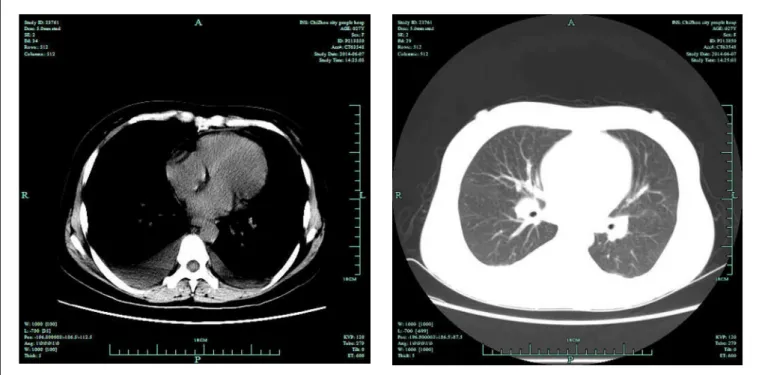
Computed tomography (CT) of the chest revealed slight swell-ing of the mediastinal lymph nodes and a small amount of bilateral pleural efusion, which was slightly more severe on the right side
(Figure 1). Ultrasonography of the neck revealed multiple
swol-len bilateral supraclavicular lymph nodes, with some as large as 16 × 7 mm. Ultrasonography of the upper abdomen and uterus did not reveal any anomaly.
he pleural puncture technique was applied to drain excessive luid, and Rivalta test results were positive. he pleural efusion pH was 7.35 (normal, 6.8-7.6), proteins were 32 g/l (normal, 0-30), and lactate dehydrogenase, adenosine deaminase and carcinoembryonic antigen levels were 2186 U/l (normal, 0-200), 30 U/l (normal, 0-40) and 1.64 ng/ml (normal, 0-6.5), respectively. he total number of nucleated cells in the pleural efusion was 3886 × 106/l (normal,
100-500 × 106/l). Repeated pleural luid cytological analysis revealed a
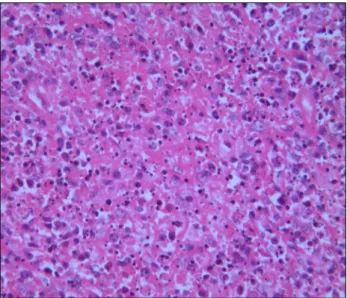
large quantity of lymphocytes. Pleural luid cultures were negative. he patient underwent two weeks of anti-inlammatory treat-ment with 0.2% levoloxacin, 300 ml daily administered by means of intravenous drip, which was inefective. She still experienced intermit-tent fever, and ultrasonography revealed continued pleural efusion. A biopsy on the let cervical lymph node showed scattered ibrin deposition, a large amount of nuclear debris and large mononuclear cell aggregates in the necrotic area (Figure 2). he pathological diagnosis was histiocytic necrotizing lymphadenitis.
Antibiotics were discontinued ater two weeks of treatment with intravenous infusion of levoloxacin, and 10 mg of oral prednisone
Figure 1. Computed tomography of the chest, revealing slight swelling of the mediastinal lymph nodes and a small amount of bilateral
pleural efusion, with slightly more on the right side than on the left.
was administered three times daily. Within three days, the patient’s body temperature gradually returned to normal. Ater general improvement during a one-week observation period, she was dis-charged and was prescribed a reduced dose of oral prednisone. hree months later, a chest radiograph showed that the double lung texture disorder and bilateral pleural efusion had disappeared (Figure 3).
DISCUSSION
Histiocytic necrotizing lymphadenitis is a rare inlamma-tory disease of the lymph nodes. It is more common in young women and has a natural course of 1-4 months,3 but relapse
may occur. he cause of HNL remains unclear, but it is probably associated with infections and autoimmune disorders. A variety of viruses, such as adenovirus, Epstein-Barr virus and herpes virus, are reportedly associated with the disease. HNL onset is commonly associated with acute or subacute clinical manifesta-tions, such as swollen lymph nodes, fever and neutropenia. he most commonly afected lymph nodes are cervical, followed by axillary. Intermittent fever, fatigue, joint pain, hepatospleno-megaly and skin rashes are also common symptoms. Rarely, HNL patients exhibit complex clinical manifestations involving multiple organ systems, similar to those for rheumatic diseases. It has been reported in the literature that the clinical mani-festations of HNL are similar to those of certain connective tissue diseases, such as adult-onset Still’s disease and SLE. here are also reports of HNL co-occurring with these diseases, with the strongest
Liu X, Huang S, Jiang G
Report of a rare case of histiocytic necrotizing lymphadenitis with bilateral pleural efusion diagnosed via cervical lymph node biopsy | CASE REPORT
Sao Paulo Med J. 201X; XXX(X):xxx-xxx 3
link to SLE. Reports have suggested that HNL can occur before, ater or concurrently with SLE pathogenesis.4 In particular,
anti-nuclear antibody-positive HNL is more likely to develop into SLE, and certain scholars even hold that HNL is a unique manifestation of SLE.5 Additionally, certain clinical manifestations of lymphoma
are very similar to those of HNL; as such, HNL patients are oten misdiagnosed as having malignant lymphoma.
Noninvasive diagnostic methods are limited in their efective-ness. At present, application of 18F-deoxyglucose (18F-FDG) pos-itron emission tomography (PET)/CT is widely used as a tumor metabolism imaging technique for determining lymph node malig-nancy. However, studies using FDG imaging and PET/CT have sug-gested that in HNL patients, lymph node uptake values ranged from 2.05 to 13.94, with an average of 6.25 ± 3.32. Cervical lymph nodes oten have a higher uptake value. Evidently, PET/CT scans alone are not suicient to diferentiate between HNL and lymphoma, but the biopsy site can be determined using the standard uptake value.6
Pathological and immunohistochemical examinations are impor-tant tools for diferential diagnosis. In 1995, Kuo7 further deined
HNL into three subtypes: proliferative, necrotic and xanthoma-like, which may relect the diferent stages of disease development, namely hyperplasia-necrosis-xanthoma or granulation-reabsorp-tion-recovery. he pathological characteristics of HNL include a patchy lymph node disorder, commonly found in the juxtacortical area with visible ibrinoid necrosis and a large amount of nuclear debris. Necrotic areas are surrounded by proliferative cells, but gran-ulocytes and plasma cells are rare or absent. Specialized or tuted CD68-positive and MPO-positive cells are important immunohis-tochemical features of HNL.8 T-cells are the most commonly found
Figure 2. Biopsy specimen from the left cervical lymph node.
Pathological manifestation showing ibrin deposition, a large amount of nuclear debris and large mononuclear cell aggregates within the necrotic regions (hematoxylin and eosin staining; magniication × 400).
Figure 3. Chest radiograph, showing that the double lung texture
disorder and bilateral pleural efusion had disappeared.
lymphocytes, while B-cells and natural killer cells are rarer. Using an electron microscope, a large number of apoptotic bodies surrounded by mononuclear histiocytes and scattered T-cells undergoing apop-tosis were found in the lymph nodes of HNL patients. hese three observations are closely related, and they suggest that T-lymphocyte apoptosis may play an important role in the pathogenesis of HNL.9
he incidence of pleural efusion in HNL is low and rarely reported clinically, so we cannot reach any conclusion regarding the likelihood that HNL patients might have pleural efusion. In the present case, the patient had an exudate. he mechanism of its occur-rence remains unclear, and it is possible that the disease itself may lead to pleural disruption, thus causing exudative pleurisy; however, there is a lack of histological evidence to support this concept. Pleural biopsies can easily miss the location of the lesion, since they can only collect a relatively small amount of the sample, and they may be prone to false negative results. On the other hand, thoracoscopy or thoracotomy examinations are highly invasive and are not very popular with most patients. Additionally, the possibility that HNL might be caused by an endogenous sex hormone dysfunction can-not be ruled out, since corticosteroid therapy has been observed to lead to complete reabsorption of pleural efusion. he mechanism of pleural efusion in HNL patients still need to be further investigated.
We searched for similar cases in diferent databases (PubMed, Embase and LILACS) using the following terms: “histiocytic necro-tizing lymphadenitis” AND “pleural efusion” or “Kikuchi-Fujimoto disease” AND “pleural efusion” (Table 1). We found that only one case had been published.10
Report of a rare case of histiocytic necrotizing lymphadenitis with bilateral pleural efusion diagnosed via cervical lymph node biopsy
CASE REPORT | LiuI X, Huang S, Jiang G
4 Sao Paulo Med J. 201X; XXX(X):xxx-xxx
The treatments for HNL include non-steroidal anti-inflam-matory drugs and corticosteroids; antibiotic treatment is often ineffective. Although non-steroidal anti-inflammatory drugs can elicit partial effects, there have been reports suggesting that this treatment may cause patients to be more prone to relapse.11 It has been suggested that early glucocorticoid
ther-apy should be used to treat HNL, and that the duration and intensity of the treatment should be based on the patient’s response to hormone therapy and the results from follow-up examinations.12
CONCLUSIONS
Pleural efusion is a very uncommon manifestation of HNL that has rarely been reported in these patients. We presented a case of HNL with bilateral pleural efusion that was diagnosed using cervical lymph node biopsy and which was successfully treated with prednisone.
HNL patients are oten admitted to a respiratory department, and it is easy to misdiagnose them as having tuberculous pleurisy or other diseases. We reported on this patient in order to improve clinicians’ understanding of such diseases and help reduce the like-lihood of misdiagnosis.
REFERENCES
1. Chen HC, Lai JH, Huang GS, et al. Systemic lupus erythematosus with
simultaneous onset of Kikuchi-Fujimoto’s disease complicated with
antiphospholipid antibody syndrome: a case report and review of the
literature. Rheumatol Int. 2005;25(4):303-6.
2. Papaioannou G, Speletas M, Kaloutsi V, Pavlitou-Tsiontsi A. Histiocytic
necrotizing lymphadenitis (Kikuchi-Fujimoto disease) associated with
antiphospholipid syndrome: case report and literature review. Ann
Hematol. 2002;81(12):732-5.
3. Bosch X, Guilabert A, Miquel R, Campo E. Enigmatic
Kikuchi-Fujimoto disease: a comprehensive review. Am J Clin Pathol.
2004;122(1):141-52.
4. Santana A, Lessa B, Galrão L, Lima I, Santiago M. Kikuchi-Fujimoto’s
disease associated with systemic lupus erythematosus: case report
and review of the literature. Clin Rheumatol. 2005;24(1):60-3.
5. Yu HL, Lee SS, Tsai HC, et al. Clinical manifestations of Kikuchi’s
disease in southern Taiwan. J Microbiol Immunol Infect.
2005;38(1):35-40.
6. Ito K, Morooka M, Kubota K. Kikuchi disease: 18F-FDG positron emission
tomography/computed tomography of lymph node uptake. Jpn J
Radiol. 2010;28(1):15-9.
7. Kuo TT. Kikuchi’s disease (histocytic necrotizing lymphadenitis).
A clinicopathologic study of 79 cases with an analysis of histologic
subtypes, immunohistology, and DNA ploidy. Am J Surg Pathol.
1995;19(7):798-809.
8. Pileri SA, Facchetti F, Ascani S, et al. Myeloperoxidase expression by
histiocytes in Kikuchi’s and Kikuchi-like lymphadenopathy. Am J Pathol.
2001;159(3):915-24.
9. Ohshima K, Shimazaki K, Kume T, et al. Perforin and Fas pathways of
cytotoxic T-cells in histiocytic necrotizing lymphadenitis. Histopathology.
1998;33(5):471-8.
10. Garcia-Zamalloa A, Taboada-Gomez J, Bernardo-Galán P, et al. Bilateral
pleural efusion and interstitial lung disease as unusual manifestations
of Kikuchi-Fujimoto disease: case report and literature review. BMC
Pulm Med. 2010;10:54.
11. Jun-Fen F, Chun-Lin W, Li L, et al. Kikuchi-Fujimoto disease manifesting
as recurrent thrombocytopenia and Mobitz type II atrioventricular block
in a 7-year-old girl: a case report and analysis of 138 Chinese childhood
Kikuchi-Fujimoto cases with 10 years of follow-up in 97 patients. Acta
Paediatr. 2007;96(12):1844-7.
12. Jang YJ, Park KH, Seok HJ. Management of Kikuchi’s disease using
glucocorticoid. J Laryngol Otol. 2000;114(9):709-11.
Sources of funding: None
Conflict of interest: The authors declare that they have no conflict
of interest
Date of irst submission: December 10, 2016
Last received: January 23, 2017
Accepted: February 17, 2017
Address for correspondence:
Xuchun Liu
Department of Respiratory Medicine, Chizhou People’s Hospital,
Chizhou, Anhui 247100, China
E-mail: [email protected]
Table 1. Results from a search of the literature in medical databases, for case reports on “histiocytic necrotizing lymphadenitis with bilateral pleural efusion diagnosed via cervical lymph node biopsy”. The search was conducted on December 22, 2016
Database Search strategies Papers found
Related papers
MEDLINE (via PubMed)
((histiocytic necrotizing lymphadenitis[Title]) AND pleural
efusion[Title])
0 0
MEDLINE (via PubMed)
((Kikuchi-Fujimoto disease[Title])
AND pleural efusion[Title]) 1 1
Embase (via Elsevier)
((histiocytic necrotizing lymphadenitis[Title]) AND pleural
efusion[Title])
0 0
LILACS (via BVS)
((histiocytic necrotizing lymphadenitis[Title]) AND pleural
efusion[Title])
0 0
Liu X, Huang S, Jiang G