CASE REPORT
DOI: 10.1590/1516-3180.2013.1315488Renal artery pseudoaneurysm after blunt renal trauma:
report on three cases and review of the literature
Pseudoaneurisma de artéria renal após trauma renal fechado: relato de três casos e
revisão da literatura
Kleiton Gabriel Ribeiro Yamaçake
I, Marcos Lucon
II, Antonio Marmo Lucon
III, José Luiz Borges Mesquita
II, Miguel Srougi
IVDivision of Urology, Hospital das Clínicas, Faculdade de Medicina da Universidade de São Paulo (FMUSP), São Paulo, Brazil
ABSTRACT
CONTEXT: Renal artery pseudoaneurysm is a rare complication after renal injury but should be suspected whenever there is recurrent hematuria after renal trauma.
CASE REPORTS: We present three cases of pseudoaneurysm after blunt renal trauma and a review of the literature. All patients underwent renal angiography. Two cases were diagnosed during the initial hospital stay due to hematuria, or in the follow-up period during recovery. One patient was hemodynamically unstable. Two patients successfully underwent coil embolization in a single session. In the other case, selective embolization was attempted, but was unsuccessful because artery catheterization was impos-sible. Procedural and medical success and complications were retrospectively assessed from the patients’ records. The clinical presentation, treatment options and clinical decisions are discussed.
CONCLUSIONS: Renal artery pseudoaneurysm may develop acutely or even years after the initial injury. Signs and symptoms may have a wide spectrum of presentation. Selective angiographic embolization is an efective treatment that reduces the extent of parenchymal infarction.
RESUMO
CONTEXTO: Pseudoaneurisma de artéria renal é uma complicação rara após lesão renal, mas deve ser suspeitada quando houver hematúria recorrente após trauma renal.
RELATO DE CASOS: Três casos de pseudoaneurisma após trauma renal fechado são apresentados, além de revisão da literatura. Todos os pacientes foram submetidos a angiograia renal. Dois dos casos foram diagnosticados durante a estadia hospitalar inicial, por hematúria ou no período de acompanhamento durante a recuperação. Um paciente estava hemodinamicamente instável. Dois pacientes foram subme-tidos a embolização com coil com sucesso em uma única sessão. No outro caso, a embolização seletiva foi tentada sem sucesso, devido à impossibilidade de cateterização da artéria. O sucesso médico e do procedimento e as complicações foram retrospectivamente avaliados a partir dos registros dos pacientes. A apresentação clínica, opções de tratamento e decisões clínicas são discutidas.
CONCLUSÕES: Pseudoaneurisma de artéria renal pode se desenvolver agudamente ou até mesmo anos após o trauma inicial. Sinais e sintomas podem ter um amplo espectro de apresentação. Embolização angiográica seletiva é um tratamento efetivo, reduzindo a extensão de infarto parenquimatoso.
IResident, Department of Urology, Hospital
das Clínicas (HC), Faculdade de Medicina da Universidade de São Paulo (FMUSP), São Paulo, Brazil.
IIMD. Attending Physician, Department of
Urology, Hospital das Clínicas (HC), Faculdade de Medicina da Universidade de São Paulo (FMUSP), São Paulo, Brazil.
IIIMD, PhD. Assistant Professor, Department of
Urology, Hospital das Clínicas (HC), Faculdade de Medicina da Universidade de São Paulo (FMUSP), São Paulo, Brazil.
VMD, PhD. Professor and Head, Department of
Urology, Hospital das Clínicas (HC), Faculdade de Medicina da Universidade de São Paulo (FMUSP), São Paulo, Brazil.
KEY WORDS: Hematuria. Renal artery.
Wounds, nonpenetrating. Aneurysm.
Embolization, therapeutic.
PALAVRAS-CHAVE: Hematuria. Artéria renal.
Ferimentos não penetrantes. Aneurisma.
INTRODUCTION
Pseudoaneurysm or false aneurysm is a confined accumu-lation of thrombus and blood associated with disruption of one or more layers of an artery wall. It differs from a true aneurysm in that the latter contains all three histological lay-ers of the arterial wall, whereas pseudoaneurysm contains less than three and often none of these layers.1
Renal artery pseudoaneurysm occurs most frequently as a complication of certain renal interventional procedures such as kidney biopsy, percutaneous nephrostomy, open or endo-scopic surgeries on the kidney, or as a consequence of penetrat-ing trauma. Occurrences followpenetrat-ing blunt abdominal trauma are rare.1 A few other cases that have been reported described pre-sentations with lank pain, pulsatile abdominal or lank masses, hypertension or hematuria, and ultimately resulted in life-threatening hemorrhage followed by nephrectomy or death.2,3
We retrospectively reviewed three cases of pseudoaneu-rysm after blunt renal trauma and conducted a review of the literature. These three cases were managed in our institution between 2008 and 2011.
CASE REPORTS
Case 1
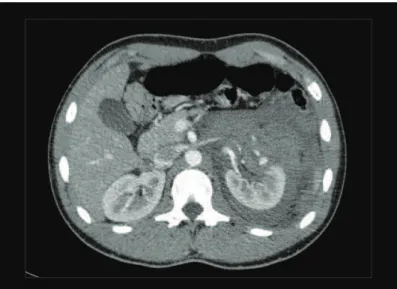
A healthy 16-year-old male was admitted to our emergency department after a fall during a soccer game, with gross hematuria 30 minutes afterwards. He did not have any sig-nificant medical history. On physical examination, his blood pressure was normal and left upper quadrant abdominal ten-derness was found. His hemoglobin was 11.6 g/dl and hema-tocrit was 28.8%. Grade 1 spleen rupture and grade 3 left renal injury with a large perirenal hematoma were revealed through abdominal computed tomography (Figure 1).
He was admitted to the intensive care unit for a careful check on vital signs, serial hematocrit monitoring and strict bed rest. Eight hours after admission to the intensive care unit, he presented tachycardia with normal arterial blood pressure. His hemoglobin level had dropped to 5.4 g/dl. He received 2000 ml of crystalloids and 3 U of packed red blood cells.
The patient was transferred to the intervention radiol-ogy suite 16 hours after admission, where renal angiography showed a renal pseudoaneurysm that was then successfully treated by means of selective coil embolization (Figure 2). His hemoglobin level then stabilized.
A repeat computed tomography scan performed seven days after admission showed complete remission of the pseu-doaneurysm and good kidney perfusion. The patient pre-sented normal blood pressure and normal renal function, as assessed through a dimercaptosuccinic acid (DMSA) renal scan, during the six-month follow-up period.
Case 2
A 25-year-old male patient was admitted to our emer-gency department after falling from a height of 15 meters. On admission, he presented a Glasgow coma score of 14, nor-mal arterial blood pressure and a pulse rate of 100. Physical examination revealed hematuria and pain on neck palpa-tion. Infusion of four liters of crystalloid was prompted. Computed tomography revealed a cervical vertebra fracture and hip dislocation in addition to grade 3 left renal trauma with perirenal hematoma (Figure 3).
Conservative treatment for renal trauma was started, closed reduction was performed on the hip dislocation, a rigid neck collar was fitted and the hemodynamics were monitored. The patient evolved with hemodynamic stability and remis-sion of the hematuria was observed four days later. A con-trol computed tomography scan produced five days after the trauma showed that significant reduction of the perirenal
Figure 2. Angiographic conirmation of renal artery
pseudoaneurysm (A) in Case 1 and result after embolization using microcoils (B).
Figure 1. Computed tomography (CT): grade III left renal injury with
large perirenal hematoma in Case 1.
CASE REPORT | Yamaçake KGR, Lucon M, Lucon AM, Mesquita JLB, Srougi M
hematoma had occurred and that there was a lesion suggestive of renal artery pseudoaneurysm (Figure 4).
he patient was then referred to the interventional radiol-ogy department and underwent angiography, which revealed a renal artery pseudoaneurysm that was successfully embolized using a coil. Information regarding follow-up was not available.
Case 3
A 27-year-old patient was admitted to our emergency department after falling to the ground in a motorcycle crash. On admission, the patient presented hemodynamic stabil-ity and gross hematuria. Physical examination revealed left lower-back bruising. Subsequent tests showed fractures of the iliac wing and left twelfth rib. His hemoglobin level was 12 mg/dl, with hematocrit of 35%. A computed tomography scan showed a grade 2 left renal injury.
Conservative management with monitoring and hydra-tion was started. Five days after the trauma, the patient was discharged home with mild hematuria that resolved sponta-neously two days later.
hirteen days ater the trauma, a new episode of hematuria with urinary retention due to blood clots reduced the hemo-globin level to 10 g/dl. Fiteen days ater the trauma, he under-went angiography, which showed a pseudoaneurysm. Selective embolization was attempted but was unsuccessful because artery catheterization was impossible. he patient was main-tained under conservative treatment, without any decrease in hemoglobin level, but with hemodynamic stability.
He presented resolution of the hematuria sixteen days after the trauma, with recurrence thirty days after the trauma. A computed tomography scan was subsequently performed and showed hematoma regression. The scan ruled out the presence of any other significant lesions. Forty days after the trauma, the patient presented resolution of the hema-turia and was discharged from the hospital. A computed tomography scan performed three months later was normal.
DISCUSSION
Renal artery pseudoaneurysm has most commonly been reported in relation to iatrogenic causes. Open and endo-scopic surgery, renal percutaneous surgery and renal biopsy are the most frequent causes. Renal pseudoaneurysms have only rarely been described after blunt renal trauma.1,4 In this type of trauma, pseudoaneurysm formation is the result from the effect exerted by the deceleration forces on the artery.
The first case of renal artery pseudoaneurysm was described by Rouppe (1770, apud Rashid, 2007),5,6 who reported the demise of a sailor who fell on his right flank. The autopsy showed a large false aneurysm with rupture.
Swana et al. reported on nine cases that had been published between 1770 and 1996.2 Few new cases have subsequently been reported.4,7,8
The clinical presentation includes hypertension, gross hematuria, lumbar pain and pulsating abdominal mass, but pseudoaneurysms may also be asymptomatic for a long time and develop spontaneous thrombosis.1 The average interval between injury and onset of the secondary renal hemorrhage is approximately 12 days (range: 2 to 36 days).9 Pseudoaneurysms are seen as thick-walled, well-defined accumulations adjacent to arteries, with an inner lumen that enhances after contrast
Figure 4. Three-dimensional reconstruction from computed
tomography of Case 3: left renal artery pseudoaneurysm.
Figure 3. Computed tomography (CT) in Case 2: grade III left
administration, similarly to arteries. In addition, pseudoaneu-rysm walls may be covered by thrombi.10
Color Doppler ultrasonography may also be useful in diagnosing pseudoaneurysms. It has been shown to have very high sensitivity and specificity for detecting post-catheteriza-tion pseudoaneurysms,11 although its use in relation to vis-ceral pseudoaneurysms is limited and depends on the lesion location and the operator’s experience. Pseudoaneurysms present characteristic signs such as two-directional flow in the pseudoaneurysm neck and a “ying-yang” color pattern inside the lesion, thus revealing the direction of blood flow entering and leaving the pseudoaneurysm.12
Ultrasonography and computed tomography are partic-ularly useful when renal vascular and parenchymal injuries are suspected. However, the ability to confirm the presence and anatomical location of renal artery pseudoaneurysms makes angiography the gold standard test of choice.13-16
We carried out a systematic analysis of indexed articles (Table 1). The search was performed using the terms listed in Table 1 in the Latin American and Caribbean Health Science Literature database (Literatura Latino-Americana e do Caribe em Ciências da Sáde, Lilacs), Excerpta Medica data-base (Emdata-base), Medical Literature Analysis and Retrieval System Online (Medline) and Cochrane Library database, using Health Science Descriptors (Descritores em Ciências da Sáde, DeCS) and Medical Subject Headings (MeSH).
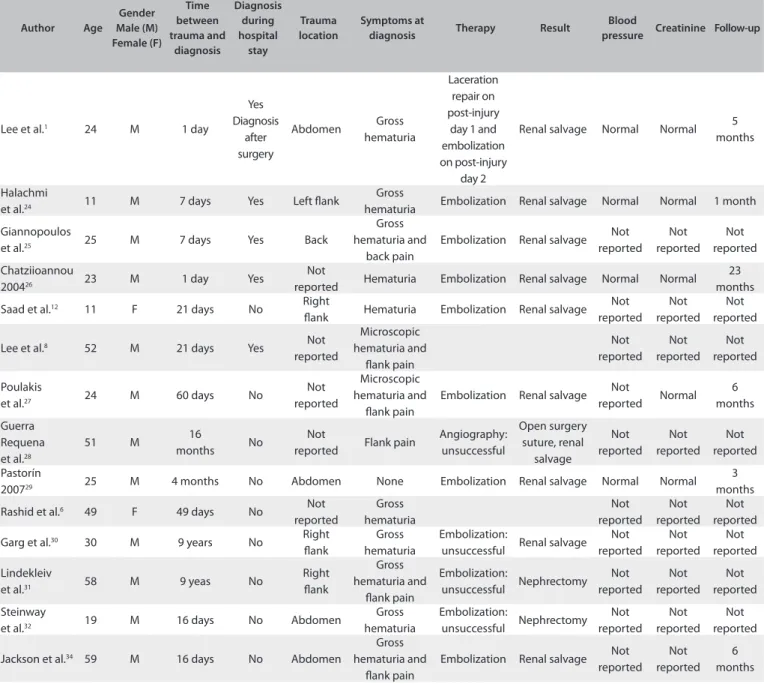
Thirty-five cases (Table 2) of renal pseudoaneurysm after blunt renal trauma, indexed in PubMed, have been described.1-4,6-8,12,17-34 The median age was 34.17 years (range: 11-79 years), and the majority were male (77.14%). The most common symptoms were abdominal/flank pain (11 out of 33 cases) and gross hematuria (23 out of 33 cases).
Nonetheless, renal artery pseudoaneurysm may be asymptomatic. Lee et al. described the case of a 38-year-old male whose pseudoaneurysm was diagnosed 45 days after trauma during computed tomography follow-up.1 Pastorín et al. described the case of a 25-year-old male with an asymp-tomatic renal artery pseudoaneurysm that was observed four months after injury.29 One of the three patients in our series was diagnosed as presenting an asymptomatic pseu-doaneurysm, during a follow-up examination four days after the trauma.
In the majority of the reports, the time that elapsed between the trauma and the diagnosis ranged from one day to 15 years (median of 28.4 months). In the literature, the lon-gest time taken to make the diagnosis was reported by Jebara et al., in the case of a 25-year-old female who developed abdominal pain and hypertension 15 years after trauma.21
Most of the cases remained undiagnosed during the ini-tial hospital stay (18 out of 31 cases). Two of our cases were diagnosed during the hospital stay due to hematuria or in the follow-up period during recovery.
Although clinically silent, small pseudoaneurysms may be managed conservatively. However, because of the risk of spontaneous rupture and mortality, many physicians recom-mend surgical management. In the past, surgical exploration or nephrectomy was used as the only treatment. However, recent advances in interventional radiological techniques have enabled superselective catheterization.1 Thus, nowa-days, pseudoaneurysms can be treated with minimally inva-sive procedures such as embolization using coils, either alone or in combination with other materials like non-resorbable glues or onyx, which result in rapid hemostasis and more effective preservation of kidney function.35
The complication rate from the selective radiological embolization procedure itself is relatively low. Since 2001, 23 cases have undergone embolization with successful renal salvage in 20 cases (86.9%). Our cases were also successfully treated with embolization. Renal artery dissection has been described in up to 7.5% of the cases,36 whereas the incidence of coil migration is less than 3%.23
Table 1. Complete literature database search (on July 29, 2012) using
terms corresponding to the main features of the patients reported
Database Strategy Related
Embase (via Ovid)
False aneurysm AND Renal artery AND Blunt trauma
Case reports: 11 Descriptive series: 1
Articles: 3
Medline (via Pubmed)
((“Aneurysm, False” [MeSH]) OR (Pseudoaneurysm) OR
(Pseudoaneurysms)) AND (“Renal Artery”[Mesh])
AND
((“Wounds, Nonpenetrating”[Mesh]) OR (Blunt Trauma) OR (Blunt Renal
Trauma))
Case reports: 15 Articles: 2
Descriptive series: 1
Lilacs (via Bireme)
(Aneurysm False) OR ( Aneurisma falso) OR Pseudoaneurysm
OR Pseudoaneurysms OR Pseudoaneurismas
AND
(Renal Artery) OR (Artéria Renal) OR (Arteria renal)
AND
(Wounds, Nonpenetrating) OR (Blunt Trauma) OR (Blunt Renal Trauma) OR (Ferida não penetrante) OR (Trauma Renal) OR (Heridas non penetrantes)
CASE REPORT | Yamaçake KGR, Lucon M, Lucon AM, Mesquita JLB, Srougi M
Table 2. Previously reported cases of renal artery pseudoaneurysms
Author Age Gender Male (M) Female (F) Time between trauma and diagnosis Diagnosis during hospital stay Trauma location Symptoms at
diagnosis Therapy Result
Blood
pressure Creatinine Follow-up
Chuang et al.17 35 M 7 days Yes Not
reported Gross hematuria and abdominal pain Selective injection Nephrectomy Not reported Not reported Not reported Lieberman
et al.18 21 M < 4 days Yes Left lank
Flank pain and gross hematuria Gelatin sponge Renal infarction Not reported Not reported Not reported
Testart et al.19 54 M 36
months No
Not reported
Abdominal
pain Bypass Renal salvage Not reported Not reported Not reported Aburano
et al.20 79 M 21 days No
Not reported
Gross
hematuria Nephrectomy Nephrectomy Not reported Not reported Not reported
Stefens et al.33 15 M 12 days Yes Left lank Gross
hematuria
Embolization (2 x)
Renal salvage and 2nd
embolization one year later
Normal Normal 36 months
Swana et al.2 49 F 45 days No Not
reported Flank pain Embolization Renal salvage Not reported Not reported Not reported
Farrel et al.3 27 M 9 days Yes Not
reported Hematuria Not reported Not reported Not reported Not reported Not reported
Jebara et al.21 25 F 15 years No Not
reported Hypertension Not reported Not reported Not reported Not reported Not reported
Jebara et al.21 17 F 8 years No Right
lank
Abdominal
pain Not reported Not reported Not reported Not reported Not reported
Han et al.7 50 M 21 days No Right
lank
Gross hematuria and
hypertension
Not reported Not reported Not reported Not reported Not reported Mizobata
et al.22 40 F 10 days Yes Left lank Not reported Embolization Renal salvage
Not reported Not reported Not reported Mizobata
et al.22 27 M 56 days Yes Back Not reported Embolization Renal salvage
Not reported Not reported Not reported
Dinkel et al.23 28 F 8 days Not
reported
Not reported
Gross
hematuria Embolization Renal salvage Normal Normal 2 years
Dinkel et al.23 34 F 3 years Yes Left lank Gross
hematuria Embolization Renal salvage Normal Normal 3 months
Dinkel et al.23 20 M 5 days Not
reported
Right lank
Gross
hematuria Embolization Renal salvage Normal Normal 4 years
Dinkel et al.23 32 M 8 days Not
reported
Not reported
Gross
hematuria Embolization Renal salvage Normal Normal 4 months
Miller et al.4 44 M 8 days Yes Not
reported
Gross
hematuria Embolization Renal salvage Normal Normal 3 months
Lee et al.1 32 M 18 days No Left lank Gross
hematuria Embolization Renal salvage Normal Normal 11 months
Lee et al.1 42 M 11 days No Left lank Gross
hematuria Embolization Renal salvage Normal Normal 9 months
Lee et al.1 38 M 45 days No Left lank
None (lesion discovered at follow-up by means of computed tomography)
Embolization Renal salvage
Lee et al.1 26 M 1 day Yes Abdomen Shock
Laceration repair on
post-injury day 1
Nephrectomy Normal Normal 6 months
Author Age Gender Male (M) Female (F) Time between trauma and diagnosis Diagnosis during hospital stay Trauma location Symptoms at
diagnosis Therapy Result
Blood
pressure Creatinine Follow-up
Lee et al.1 24 M 1 day
Yes Diagnosis after surgery Abdomen Gross hematuria Laceration repair on post-injury
day 1 and embolization on post-injury
day 2
Renal salvage Normal Normal 5 months
Halachmi
et al.24 11 M 7 days Yes Left lank
Gross
hematuria Embolization Renal salvage Normal Normal 1 month
Giannopoulos
et al.25 25 M 7 days Yes Back
Gross hematuria and
back pain
Embolization Renal salvage Not reported Not reported Not reported Chatziioannou
200426 23 M 1 day Yes
Not
reported Hematuria Embolization Renal salvage Normal Normal 23 months
Saad et al.12 11 F 21 days No Right
lank Hematuria Embolization Renal salvage Not reported Not reported Not reported
Lee et al.8 52 M 21 days Yes Not
reported Microscopic hematuria and lank pain Not reported Not reported Not reported Poulakis
et al.27 24 M 60 days No
Not reported
Microscopic hematuria and
lank pain
Embolization Renal salvage Not
reported Normal 6 months
Guerra Requena et al.28
51 M 16
months No
Not
reported Flank pain
Angiography: unsuccessful Open surgery suture, renal salvage Not reported Not reported Not reported Pastorín
200729 25 M 4 months No Abdomen None Embolization Renal salvage Normal Normal
3 months
Rashid et al.6 49 F 49 days No Not
reported Gross hematuria Not reported Not reported Not reported
Garg et al.30 30 M 9 years No Right
lank
Gross hematuria
Embolization:
unsuccessful Renal salvage Not reported Not reported Not reported Lindekleiv
et al.31 58 M 9 yeas No
Right lank Gross hematuria and lank pain Embolization: unsuccessful Nephrectomy Not reported Not reported Not reported Steinway
et al.32 19 M 16 days No Abdomen
Gross hematuria Embolization: unsuccessful Nephrectomy Not reported Not reported Not reported
Jackson et al.34 59 M 16 days No Abdomen
Gross hematuria and
lank pain
Embolization Renal salvage Not reported Not reported 6 months CONCLUSIONS
Renal artery pseudoaneurysm is a rare complication
follow-ing blunt renal injury. It may form acutely or may even be seen
days, weeks or years ater the initial injury. Although some
cases may develop symptoms, others may remain
asymptom-atic even over the long term. Computed tomography and
ultra-sound scans can provide the diagnosis; conirmation and
treat-ment are performed by angiography. he increasing use of
conservative management for renal trauma has led to a higher
rate of suspicion of renal artery pseudoaneurysm. his
diagno-sis should be considered whenever there is a recurrent bleeding
ater renal trauma.
REFERENCES
1. Lee RS, Porter JR. Traumatic renal artery pseudoaneurysm: diagnosis and management techniques. J Trauma. 2003;55(5):972-8.
2. Swana HS, Cohn SM, Burns GA, Egglin TK. Renal artery pseudoaneurysm after blunt abdominal trauma: case report and literature review. J Trauma. 1996;40(3):459-61.
3. Farrell TM, Sutton JE, Burchard KW. Renal artery pseudoaneurysm: a cause of delayed hematuria in blunt trauma. J Trauma. 1996;41(6):1067-8. 4. Miller DC, Forauer A, Faerber GJ. Successful angioembolization
of renal artery pseudoaneurysms after blunt abdominal trauma. Urology. 2002;59(3):444.
5. Rouppe DL. Renal artery aneurysm. Nova Acta Phys-Med Acad Nat Curios. 1770;iv:76.
CASE REPORT | Yamaçake KGR, Lucon M, Lucon AM, Mesquita JLB, Srougi M
6. Rashid M, Abbas SZ, Haque F, Rizvi SA, Ali WM. Intrarenal post-traumatic pseudoaneurysm-USG colour Doppler diagnosis: a case report with review of literature. Emerg Radiol. 2007;14(4):257-60. 7. Han Kr, Goldstein DW, Pantuck AJ, et al. Angiographic management of
pseudoaneurysm and arteriocalyceal istula following blunt trauma: case report and review of the literature. Can J Urol. 1998;5(5):654-7. 8. Lee DG, Lee SJ. Delayed hemorrhage from a pseudoaneurysm after
blunt renal trauma. Int J Urol. 2005;12(10):909-11.
9. Heyns CF, de Klerk DP, de Kock ML. Stab wounds associated with hematuria--a review of 67 cases. J Urol. 1983;130(2):228-31.
10. Kawashima A, Sandler CM, Corl FM, et al. Imaging of renal trauma: a comprehensive review. Radiographics. 2001;21(3):557-74.
11. Morgan R, Belli AM. Current treatment methods for postcatheterization pseudoaneurysms. J Vasc Interv Radiol. 2003;14(6):697-710. 12. Saad NE, Saad WE, Davies MG, et al. Pseudoaneurysms and the role of
minimally invasive techniques in their management. Radiographics. 2005;25 Suppl 1:S173-89.
13. Ulacker R, Paolini RM, Lima S. Management of traumatic hematuria by selective renal artery embolization. J Urol. 1984;132(4):662-7. 14. Hagiwara A, Sakaki S, Goto H, et al. The role of interventional radiology
in the management of blunt renal injury: a practical protocol. J Trauma. 2001;51(3):526-31.
15. Cinat M, Yoon P, Wilson SE. Management of renal artery aneurysms. Semin Vasc Surg. 1996;9(3):236-44.
16. Parildar M, Oran I, Memis A. Embolization of visceral pseudoaneurysms with platinum coils and N-butyl cyanoacrylate. Abdom Imaging. 2003;28(1):36-40.
17. Chuang VP, Reuter SR, Walter J, Foley WD, Bookstein JJ. Control of renal hemorrhage by selective arterial embolization. Am J Roentgenol Radium Ther Nucl Med. 1975;125(2):300-6.
18. Lieberman SF, Keller FS, Pearse HD, et al. Percutaneous vaso-occlusion for nonmalignant renal lesions. J Urol. 1983;129(4):805-9.
19. Testart J, Watelet J, Poels D. Pseudoaneurysm resulting from avulsion of the right renal artery: endoaneurysmal bypass. Eur J Vasc Surg. 1991;5(4):475-8.
20. Aburano T, Taniguchi M, Hisada K, et al. Renal artery pseudoaneurysm demonstrated on radionuclide scintiscan. Clin Nucl Med. 1994;19(1):25-7.
21. Jebara VA, El Rassi I, Achouh PE, et al. Renal artery pseudoaneurysm after blunt abdominal trauma. J Vasc Surg. 1998;27(2):362-5. 22. Mizobata Y, Yokota J, Fujimura I, Sakashita K. Successful evaluation of
pseudoaneurysm formation after blunt renal injury with dual-phase contrast-enhanced helical CT. AJR Am J Roentgenol. 2001;177(1):136-8. 23. Dinkel HP, Danuser H, Triller J. Blunt renal trauma: minimally invasive
management with microcatheter embolization experience in nine patients. Radiology. 2002;223(3):723-30.
24. Halachmi S, Chait P, Hodapp J, et al. Renal pseudoaneurysm after blunt renal trauma in a pediatric patient: management by angiographic embolization. Urology. 2003;61(1):224.
25. Giannopoulos A, Manousakas T, Alexopoulou E, et al. Delayed life-threatening haematuria from a renal pseudoaneurysm caused by blunt renal trauma treated with selective embolization. Urol Int. 2004;72(4):352-4. 26. Chatziioannou A, Brountzos E, Primetis E, et al. Efects of superselective embolization for renal vascular injuries on renal parenchyma and function. Eur J Vasc Endovasc Surg. 2004;28(2):201-6.
27. Poulakis V, Ferakis N, Becht E, Deliveliotis C, Duex M. Treatment of renal-vascular injury by transcatheter embolization: immediate and long-term efects on renal function. J Endourol. 2006;20(6):405-9. 28. Guerra Requena M, Galindo Garcia A, Núñez C, et al. Surgical
treatment of distal renal artery expansive pseudoaneurysm after blunt trauma. Minerva Urol Nefrol. 2006;58(4):347-50.
29. Pastorín R, Rodríguez N, Polo AM, Vicente JM, Luján M. Posttraumatic giant renal pseudoaneurysm. Emerg Radiol. 2007;14(2):117-21. 30. Garg A, Banait S, Babhad S, et al. Endovascular treatment of
pseudoaneurysm of the common hepatic artery with intra-aneurysmal glue (N-butyl 2-cyanoacrylate) embolization. Cardiovasc Intervent Radiol. 2007;30(5):999-1002.
31. Lindekleiv H, Haro S, Nordhus K, Eggen T, Due J. Renal artery pseudoaneurysm secondary to blunt trauma nine years earlier: case report and review of the literature. Scand J Urol Nephrol. 2008;42(5):488-91. 32. Steinway ML, Jankowski JT, Harkey PP, Spirnak JP. Renal artery
pseudoaneurysm from blunt abdominal trauma. J Urol. 2009;182(1):314. 33. Stefens MG, Bode PJ, Lycklama à Nijeholt AA, van Vugt AB. Selective
embolization of pseudo-aneurysms of the renal artery after blunt abdominal injury in a patient with a single kidney. Injury. 1996;27(3):219-20. 34. Jackson E, Ibrahim J, Herman J. Renal artery pseudoaneurysm
resulting from blunt trauma. Am Surg. 2012;78(2):57-8.
35. Teigen CL, Venbrux AC, Quinlan DM, Jefs RD. Late massive hematuria as a complication of conservative management of blunt renal trauma in children. J Urol. 1992;147(5):1333-6.
36. Corr P, Hacking G. Embolization in traumatic intrarenal vascular injuries. Clin Radiol. 1991;43(4):262-4.
Sources of funding: None
Conlict of interest: None
Date of irst submission: March 8, 2012
Last received: February 22, 2013
Accepted: March 6, 2013
Address for correspondence: Kleiton Gabriel Ribeiro Yamaçake Rua Professor Seraim Orlandi, 308 Vila Mariana — São Paulo (SP) — Brasil CEP 04115-090
Tel. (+55 11) 2661-8080 Fax. (+55 11) 2661-8081