ORIGINAL ARTICLE
DOI: 10.1590/1516-3180.2013.1315500Frequency of MTHFR G1793A polymorphism in individuals
with early coronary artery disease: cross-sectional study
Frequência do polimorismo MTHFR G1793A em indivíduos portadores de doença
arteriocoronariana precoce: estudo transversal
Antonio Ivo Moritz Neto
I, Joel Rolim de Moura Júnior
II, Darlene Camati Persuhn
IIIPrivate cardiology clinic, Florianópolis, and Universidade do Vale do Itajaí (Univali), Itajaí, Santa Catarina, Brazil
ABSTRACT
CONTEXT AND OBJECTIVE: Atherosclerotic disease is the leading cause of death in Brazil. It is a complex disease and its prevention involves identiication and control of risk factors. Moderately increased plasma homocysteine concentration (hyperhomocysteinemia) has been considered to be a risk factor for sev-eral vascular diseases. Mutations in the methylenetetrahydrofolate reductase (MTHFR) enzyme, which is involved in homocysteine metabolism, have been investigated as potential vascular disease risk factors. G1793A polymorphism was described in 2002 and there are few studies analyzing its involvement in dis-eases. The objective of this study was to investigate the prevalence of G1793A polymorphism in subjects with early coronary artery disease (CAD).
DESIGN AND SETTING: Cross-sectional study with control group conducted at a private cardiology clinic and a molecular biology laboratory (Universidade do Vale do Itajaí).
METHODS: We studied 74 early-onset CAD+ patients and 40 CAD- individuals with normal angiography results. DNA was extracted from blood samples. Molecular data were obtained via PCR/RFLP and agarose gel electrophoresis.
RESULTS: The occurrence of G1793A heterozygotes was similar in the control (5%) and test (6.25%) groups, thus showing that in the population studied there was no correlation between the marker and occurrences of early CAD. There was also no association between the polymorphism and the risk factors for atherosclerosis.
CONCLUSIONS: The frequency of the 1793A allele in the test group (3.4%) was similar to what was found in the control individuals (2.5%). There was no correlation between G1793A polymorphism and occur-rences of early CAD in this population.
RESUMO
CONTEXTO E OBJETIVO: A doença aterosclerótica é a principal causa de morte no Brasil. Trata-se de do-ença multifatorial e sua prevenção passa pela identiicação e controle dos fatores de risco. A concentração plasmática moderadamente aumentada de homocisteína (hiperhomocisteinemia) tem sido considerada importante fator de risco para várias doenças vasculares. Mutações na enzima metilenotetrahidrofolato re-dutase (MTHFR), envolvida no metabolismo de homocisteína, têm sido investigadas como fatores de risco para doenças vasculares. O polimorismo G1793A foi descrito em 2002 e existem poucos estudos sobre sua implicação em doenças. O objetivo do presente trabalho foi veriicar a prevalência do polimorismo MTHFR G1793A em indivíduos portadores de doença arteriocoronariana (DAC) precoce.
TIPO DE ESTUDO E LOCAL: Estudo transversal com grupo controle realizado em Clínica Cardiológica Particular e Laboratório de Biologia Molecular (Universidade do Vale do Itajaí).
MÉTODOS: Foram estudados 74 pacientes DAC+ precoce e 40 DAC- com resultado angiográico normal. O DNA foi extraído de amostras de sangue. Dados moleculares foram obtidos através de PCR/RFLP e ele-troforese em gel de agarose.
RESULTADOS: A ocorrência de heterozigotos G1793A foi similar em ambos os grupos controle (5%) e teste (6,25%), mostrando que na população estudada não existiu correlação entre o marcador e a ocorrên-cia de DAC precoce. Não houve assoocorrên-ciação entre o polimorismo e os fatores de risco para aterosclerose. CONCLUSÕES: A frequência do alelo 1793A no grupo teste (3,4%) foi parecida com a encontrada nos indivíduos do controle (2,5%). Não houve correlação entre o polimorismo G1793A e a ocorrência de DAC precoce na população estudada.
IMD. Physician, Ultratito Clinic, Florianópolis, Santa Catarina, Brazil.
IIIMD. Physician, Municipal Healthcare, Itajaí, Santa Catarina, Brazil.
IIIPhD. Biochemist and Assistant Professor I, Department of Molecular Biology, Universidade Federal da Paraíba, João Pessoa, Paraíba, Brazil.
KEY WORDS:
Atherosclerosis. Homocysteine. Cardiovascular diseases.
Polymorphism, restriction fragment length. Hyperhomocysteinemia.
PALAVRAS-CHAVE:
Aterosclerose. Homocisteína.
Doenças cardiovasculares.
F r e q u e n cy of MTHFR G1793A polymorphism in individuals with early coronary artery disease: cross-sectional study | OR IG IN A L A R T IC L E
INTRODUCTION
Genetic polymorphism of methylenetetrahydrofolate reductase (MTHFR) has been the subject of increasing attention as a poten-tial genetic marker associated with atherosclerosis.1-5 he human 5,10-MTHFR gene is located at the end of the short arm of chromo-some 1 (1p36.3), and the total length of the gene cDNA (complemen-tary DNA) is 2.2 kb. MTHFR plays a crucial role in the metabolism of folates and irreversibly converts 5,10-methylenetetrahydrofolate to 5-methyltetrahydrofolate. 5-methyltetrahydrofolate is the pre-dominant circulatory form of folates and donates a methyl group for remethylation of homocysteine to methionine. Consecutively, methi-onine is metabolized to yield S-adenosylmethimethi-onine (SAM), the main methyl donor for important methylation reactions that are required for DNA repair. Impaired MTHFR activity may lead to homocysteine accumulation in plasma, and this condition may contribute towards progressive atherosclerosis through several mechanisms, including arterial endothelial function impairment, oxidative stress induction and promotion of inlammation and thrombosis.6-9
Two common polymorphisms of the MTHFR gene have been detected: C677T and A1298C, which both result in some impair-ment of enzymatic activity. he 677C>T (Ala222Val) polymorphism occurs in exon 4 and results in alanine-to-valine substitution at codon 222. he 1298A>C (Glu429Ala) polymorphism occurs in exon 7 and results in glutamate-to-alanine substitution at codon 429. here is no consensus regarding the involvement of these polymorphisms as candidates for increasing the risk of vascular disease, although there is a vast body of literature on the subject.1-5,10-13
A third and novel polymorphic site of the MTHFR gene in exon 11 has been reported by Rady et al.14 he 1793G>A polymorphism results an arginine-to-glutamine change at codon 594, and no reports about its involvement in MTHFR activity have been published. he implications of G1793A as a genetic risk for non-syndromic clet lip and/or palate,15 prostate cancer16 and cardiovascular risk in end-stage renal disease17 have been reported.
OBJECTIVE
he objective of this study was to investigate whether there is any diference in allele prevalence in MTHFR G1793A polymorphism between subjects with early CAD and subjects without lesions, as evaluated by means of coronary catheterization.
METHODS
This cross-sectional study was conducted in a private cardi-ology clinic in Florianópolis, state of Santa Catarina, Brazil, and the Molecular Biology Laboratory of Universidade do Vale do Itajaí. The study protocol was approved by the uni-versity’s Ethics Committee (protocol 374/2003), and all sub-jects gave their written informed consent before participation in the study.
his study was conducted between August 2003 and December 2003. All patients under the age of 55 years (men) and 65 (women) who underwent coronary angiography between the years 2002 and 2003 were invited to participate. Patients were indicated to join the group test consequent to angiography results suggestive of myocar-dial ischemia. We excluded patients who had not undergone labo-ratory tests in the same week as their angiography examination. he angiographic and biochemical analyses were both performed in the same clinic. he inclusion criteria were met by 208 patients; 150 were CAD + and 58 were CAD-. he study population comprised 114 individuals who decided to participate: 74 CAD+ and 40 CAD- (8.5% sampling error; conidence level 95%).
he allocation to the groups depended on the angiography result: patients presenting stenosis in one or more coronary arteries were classiied as CAD+. CAD- was deined as absence of stenosis in any coronary artery. he degrees of stenosis were determined visually by an observer. he atherosclerotic lesions in the CAD+ group were classiied as mild when the obstruction was 30% (n = 6; 8.1%), mod-erate when the degree of arterial impairment was between 31 and 70% (n = 20; 27.4%) and serious when stenosis afected 70% or more (n = 48; 64.86%). his stratiication was ignored for the analysis on the molecular results and risk factors.
Leukocyte DNA extraction
Peripheral blood (5 ml) was collected from the subjects in a tube con-taining EDTA. he extraction of genomic DNA from leukocytes was performed in accordance with the method described by Miller et al.18
MTHFR G1798A genotyping
he presence of the G1798A mutation was determined by amplify-ing a fragment of exon 11 of the gene encodamplify-ing the enzyme MTHFR, by means of the polymerase chain reaction (PCR). he prim-ers used were: 5’CTCTGTGTGTGTGTGCATGTGTGCG3’ and 5’GGGACAGGAGTGGCTCCAACGCAGG3’. he parameters used in the reaction were: one initial step of two minutes at 94 °C, forty cycles of one minute of denaturation at 94 °C, one minute of anneal-ing at 66 °C and one minute of extension at 72 °C. he reaction had one extra step of extension for 10 minutes, at 72 °C. his process gen-erated a fragment of 310 base pairs.
he ampliied fragment was digested using the restriction enzyme BsrbI, in accordance with the supplier’s instructions,
fol-lowed by electrophoresis on 1.5% agarose gel (Gibco, Brazil), stained with ethidium bromide for viewing through an ultraviolet transillu-minator (Ultra Lum).
Digestion of the 310 base-pair fragment using the enzyme
BsrbI resulted in two bands of 233 and 77 base pairs in genotype
ORIGINAL ARTICLE | Moritz Neto A I , Moura Júnior JR, Persuhn DC
Data analysis
he data were tabulated in Microsot Excel sotware and the two groups (presence and absence of early CAD) were compared with regard to their biochemical proile, presence/absence of risk fac-tors and presence of the G1793A polymorphism. he allele fre-quency was calculated for both groups. he Hardy-Weinberg equi-librium was calculated by determining the frequency of genotypes expected from the allele frequency determined in the study popula-tion. To compare the genotypic groups, we used the test of diference between two proportions, with a tabulated Z value for a risk of error of 5%, thus giving a value of 1.96. In quantitative data, the statistical test was Mann-Whitney, with a signiicance level of P < 0.05.
RESULTS
Demographic and clinical data
he study was conducted on 74 CAD+ individuals and 40 CAD- indi-viduals (control group). he average ages were 52 ± 6 and 51 ± 6 in the CAD+ group (38 males and 36 females) and control group (9 males, 31 females), respectively. here was no statistical diference between the patients and controls in terms of age (P > 0.05).
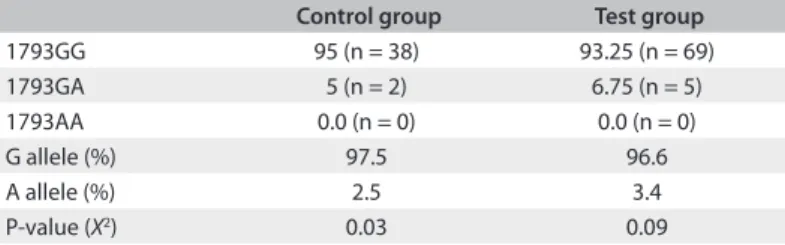
he genotype distributions of 1793GG MTHFR (95; 93.25%) and 1793GA (5; 6.75%) were similar in the two groups and were in Hardy-Weinberg equilibrium, as established using the chi-square test (X2) (Table 1).
Analysis on the genotypic groups
he genotypic groups 1793GG (n = 107) and 1793GA (n = 7) were compared regarding the presence of risk factors for athero-sclerosis (Table 2) and lipid proile (Table 3), and no signiicant diference was found.
DISCUSSION
Analysis on the molecular data showed that the numerical difer-ence between the allele frequencies found for the A allele of G1793A polymorphism in the groups studied was very small (Table 1). In the test group, the frequency was 3.4%, while in the control, the fre-quency was 2.5%. he rarity of the 1793A allele explains why both groups were in Hardy-Weinberg equilibrium even in the absence of AA homozygotes. he test of diference between two proportions showed Z = 0.39703467, while the tabulated Z value for a risk of error of 5% was 1.96. It was not possible to airm that there was increased occurrence of the G1793A mutation among the patients with early CAD, and in this case, the diference between the proportions would have occurred by chance. he frequency of the G1793A mutation in the control group was similar to that found in the Ashkenazi Jewish population,14 while in the test group, the frequency was closer to that found among African-Americans14(Table 1). here have been reports in which the 1793A frequency was signiicantly higher, as found in the mothers of non-syndromic clet lip and/or palate chil-dren (25.9%),15 and in end-stage renal disease patients presenting cardiovascular complications (15%).17 he frequency of heterozy-gous G1793A carrier detected in a Chinese population with gas-tric cancer was 14%, and this igure did not difer from the control group.19 hese numerical results were very signiicantly diferent to the data obtained from the population of the present study, and such diferences certainly relect the inluence of ethnic and geographical origin on the transmission of genetic traits.
It is interesting to note that in most studies that have ana-lyzed this polymorphism, it was rare to identify homozygotes. This may partly be explained by the low frequency in most ethnic groups.14
A comparison of the risk factors for atherosclerosis present in the patients with normal genotype and heterozygotes showed that there was no signiicant diference between the proportions
(Table 2). his suggests that the population in the G1793A
poly-morphism analysis did not predispose towards the atherosclero-sis risk factors investigated.
Comparison of the means and medians of the parameters of total cholesterol, LDL cholesterol, HDL cholesterol, triglycer-ides and glucose between normal homozygous and heterozygous
Table 1. Genotypic and allelic frequencies of the G1793A
polymorphism
Control group Test group
1793GG 95 (n = 38) 93.25 (n = 69)
1793GA 5 (n = 2) 6.75 (n = 5)
1793AA 0.0 (n = 0) 0.0 (n = 0)
G allele (%) 97.5 96.6
A allele (%) 2.5 3.4
P-value (X2) 0.03 0.09
Table 2. Distribution of risk factors for atherosclerosis between the
genotypic groups 1793GG and 1793GA
Risk factor 1793GG
n = 107
1793GA
n = 7 Z*
Hypertension 72 (67.28%) 6 (85.71%) 1.01
Diabetes 19 (17.75%) 2 (28.57%) 0.70
Dyslipidemia 63 (58.87%) 5 (71.42%) 0.65
Smoking 11 (10.28%) 0 (0%) 0.89
Sedentarism 38 (35.51%) 2 (28.57%) 0.37
Family history of myocardial infarction 76 (71.02%) 3 (42.85%) 1.57 Family history of stroke 41 (38.31%) 2 (28.57%) 0.51 Family history of sudden death 46 (42.99%) 3 (42.85%) 0.006 *The tabulated Z value for a risk of error of 5% was 1.96.
Table 3. Analysis of the concentrations of biochemical parameters
in the presence or absence of the G1793A polymorphism
1793GG n = 107
1793GA n = 7 P*
Mean Mean
Frequenc y of MTHFR G1 7 9 3 A polymorp h i s m i n i n d i v i d u a l s w i t h e a rly coronary artery disease: cross-sectional study | ORIGINAL ARTICLE
groups showed that the presence of the polymorphism did not afect these parameters (Table 3).
he low frequency of the polymorphism complicates the interpretation of Tables 2 and 3, since it was necessary to com-pare groups with very diferent numbers of individuals and also using very low total numbers (n = 7), which certainly hampered the statistical analysis. To circumvent this problem, we would need to extend the number of patients, thus increasing the popu-lation of heterozygotes in the analysis.
his study evaluated the frequency of MTHFR G1793A within the context of a limited population, which restricted the number of subjects in the experimental group and prevented the possibility of categorization of information regarding the patients’ gender.
Prevention of CAD is dependent on identifying risk fac-tors. he contribution of molecular biology in this ield is cru-cial, since the genetic markers can be identiied before the clini-cal manifestation occurs, thus making it possible to conduct risk analysis on healthy individuals. he MTHFR gene has been con-sidered as a candidate for contributing towards CAD risk. Case-control studies like this may identify targets for future diagnostic and therapeutic approaches.
Considering the low frequency of the 1793A allele, future research should explore the clinical implication of this polymor-phism in larger populations, taking into account the patients’ gender, since diferent clinical features diferentiate the male and female risk of CAD.
CONCLUSIONS
he frequency of the 1793A allele in the test group (3.4%) was similar to that of the control group (2.5%). No signiicant corre-lations were found between G1793A polymorphism and occur-rences of early coronary events in this population.
REFERENCES
1. Arruda VR, von Zuben PM, Chiaparini LC, Annichino-Bizzacchi
JM, Costa FF. The mutation Ala677-->Val in the methylene
tetrahydrofolate reductase gene: a risk factor for arterial disease and
venous thrombosis. Thromb Haemost. 1997;77(5):818-21.
2. Gülec S, Aras O, Akar E, et al. Methylenetetrahydrofolate reductase
gene polymorphism and risk of premature myocardial infarction. Clin
Cardiol. 2001;24(4):281-4.
3. Kerkeni M, Addad F, Chaufert M, et al. Hyperhomocysteinaemia,
methylenetetrahydrofolate reductase polymorphism and risk of
coronary artery disease. Ann Clin Biochem. 2006;43(Pt 3):200-6.
4. Alam MA, Husain SA, Narang R, et al. Association of polymorphism in
the thermolabile 5, 10-methylene tetrahydrofolate reductase gene
and hyperhomocysteinemia with coronary artery disease. Mol Cell
Biochem. 2008;310(1-2):111-7.
5. Tripathi R, Tewari S, Singh PK, Agarwal S Association of homocysteine
and methylene tetrahydrofolate reductase (MTHFR C677T) gene
polymorphism with coronary artery disease (CAD) in the population
of North India. Genet Mol Biol. 2010;33(2):224-8.
6. Castro R, Rivera I, Blom HJ, Jakobs C, Tavares de Almeida I.
Homocysteine metabolism, hyperhomocystenemia and vascular
disease: an overview. J Inherit Metab Dis. 2006;29(1):3-20.
7. Wald DS, Law M, Morris JK. Homocysteine and cardiovascular disease:
evidence on causality from a meta-analysis. BMJ. 2002;325(7374):1202.
8. Jakubowski H. Pathophysiological consequences of homocysteine
excess. J Nutr. 2006;136(6 Suppl):1741S-1749S.
9. Wald DS, Law M, Morris JK. The dose-response relation between serum
homocysteine and cardiovascular disease: implications for treatment
and screening. Eur J Cardiovasc Prev Rehabil. 2004;11(3):250-3.
10. Kluijtmans LA, van den Heuvel LP, Boers GH, et al. Molecular genetic
analysis in mild hyperhomocysteinemia: a common mutation in the
methylenetetrahydrofolate reductase gene is a genetic risk factor for
cardiovascular disease. Am J Hum Genet. 1996;58(1):35-41.
11. Freitas AI, Mendonça I, Guerra G, et al. Methylenetetrahydrofolate
reductase gene, homocysteine and coronary artery disease: the
A1298C polymorphism does matter. Inferences from a case study
(Madeira, Portugal). Thromb Res. 2008;122(5):648-56.
12. Kölling K, Ndrepepa G, Koch W, et al Methylenetetrahydrofolate
reductase gene C677T and A1298C polymorphisms, plasma
homocysteine, folate, and vitamin B12 levels and the extent of
coronary artery disease. Am J Cardiol. 2004;93(10):1201-6.
13. Szczeklik A, Sanak M, Jankowski M, et al. Mutation A1298C of
methylenetetrahydrofolate reductase: risk for early coronary disease
not associated with hyperomocysteinemia. Am J Med Genet.
2001;101(1):36-9.
14. Rady PL, Szucs S, Grady J, et al. Genetic polymorphisms of
methylenetetrahydrofolate reductase (MTHFR) and methionine
synthase reductase (MTRR) in ethnic populations in Texas: a report
of a novel MTHFR polymorphic site, G1798A. Am J Med Genet.
2002;107(2):162-8.
15. Bufalino A, Ribeiro Paranaíba LM, Nascimento de Aquino S, et al.
Maternal polymorphisms in folic acid metabolic genes are associated
with nonsyndromic cleft lip and/or palate in the Brazilian population.
Birth Defects Res A Clin Mol Teratol. 2010;88(11):980-6.
16. Safarinejad MR, Safarinejad S, Shaiei N. Role of
methylenetetrahydrofolate reductase gene polymorphisms
(C677T, A1298C, and G1793A) in the development of early onset
vasculogenic erectile dysfunction. Arch Med Res. 2010;41(6):410-22.
17. Poduri A, Mukherjee D, Sud K, et al. MTHFR A1298C polymorphism
is associated with cardiovascular risk in end stage renal disease in
North Indians. Mol Cell Biochem. 2008;308(1-2):43-50.
18. Miller SA, Dykes DD, Polesky HF. A simple salting out procedure for
extracting DNA from human nucleated cells. Nucleic Acids Res.
ORIGINAL ARTICLE | Moritz Neto AI, Moura Júnior JR, Persuhn DC
19. Shen H, Newmann AS, Hu Z, et al. Methylenetetrahydrofolate
reductase polymorphisms/haplotypes and risk of gastric cancer: a
case-control analysis in China. Oncol Rep. 2005;13(2):355-60.
Sources of funding: This project was supported by Universidade do Vale do Itajaí (Univali), Itajaí, Santa Catarina
Conlict of interest: None
Date of irst submission: April 9, 2012 Last received: September 17, 2012 Accepted: December 7, 2012
Address for correspondence: Darlene Camati Persuhn
Universidade Federal da Paraíba — Centro de Ciências Exatas e da
Natureza Departamento de Biologia Molecular
Campus I - Cidade Universitária
João Pessoa (PB) — Brasil
CEP 58059-900