Correspondence:
Sabrina Canhada Ferrari Prato Av. Canadá, 1188
86181-070 Cambé, PR, Brasil E-mail: [email protected]
Received: 22 Feb 2014
Approved: 19 Jul 2016
How to cite: PratoSCF, Andrade SM, CabreraMAS, DipRM, SantosHG, Dellaroza MSG, et al. Frequency and factors associated with falls in adults aged 55 years or more. Rev Saude Publica. 2017;51:37.
Copyright: This is an open-access article distributed under the terms of the Creative Commons Attribution License, which permits unrestricted use, distribution, and reproduction in any medium, provided that the original author and source are credited.
http://www.rsp.fsp.usp.br/
Frequency and factors associated with
falls in adults aged 55 years or more
Sabrina Canhada Ferrari PratoI, Selma Maffei de AndradeII, Marcos Aparecido Sarria CabreraIII, Renata Maciulis DipIII, Hellen Geremias dos SantosIV, Mara Solange Gomes DellarozaV, Arthur Eumann MesasII
I Secretaria Municipal de Saúde. Prefeitura do Município de Cambé. Cambé, PR, Brasil
II Departamento de Saúde Coletiva. Centro de Ciências da Saúde. Universidade Estadual de Londrina. Londrina, PR, Brasil
III Departamento de Clínica Médica. Centro de Ciências da Saúde. Universidade Estadual de Londrina. Londrina, PR, Brasil
IV Programa de Pós-Graduação em Epidemiologia. Faculdade de Saúde Pública. Universidade de São Paulo. São Paulo, SP, Brasil
V Departamento de Enfermagem. Centro de Ciências da Saúde. Universidade Estadual de Londrina. Londrina, PR, Brasil
ABSTRACT
OBJECTIVE: he objective of this study is to analyze the frequency and factors associated with falls in adults aged 55 years or more.
METHODS: his is a study inserted into another population-based study with representative sample of persons aged 40 years or more of the urban area in a medium-sized municipality of the State of Paraná, Brazil, in 2011. hat study obtained demographic and socioeconomic data and characteristics related to life habits, health conditions, and functional capacity (n = 1,180). In 2012, we selected all persons aged 55 years or more (n = 501). We have estimated grip strength and the occurrence of a fall since the last interview in 80.6% of the adults. he crude and adjusted odds ratios (OR) have been calculated by logistic regression according to a hierarchical model. RESULTS: he rate of fall was 24.3%. After adjustments, we could observe higher chances of falls among women (OR = 3.10; 95%CI 1.79–5.38), among persons aged 65 years or more (OR = 2.39; 95%CI 1.45–3.95), with poor sleep quality (OR = 1.78; 95%CI 1.08–2.93), and with low grip strength (OR = 2.31; 95%CI 1.34–3.97).
CONCLUSIONS: Poor sleep quality and low muscle strength can be indicators of increased risk of falls and need assessments and interventions aimed at preventing them.
INTRODUCTION
he occurrence of falls is related to a complex interaction of risk factors aggravated with aging. A literature review on the subject2 points as main risk factors: being female, age,
polypharmacy, use of psychotropic substances, previous history of falls, visual impairment, cognitive decline, and environmental factors, such as slippery loors and poorly positioned furniture and carpets. In addition, some conditions or chronic degenerative diseases are associated with higher incidence of falls, such as obesity26, hypertension2, diabetes28,
neoplasms24, neuropsychiatric diseases2,28, and osteomuscular diseases26. On the other hand,
the regular practice of physical activity stands out as a protective factor20.
Disability and serious injuries are among the main consequences of a fall. hey imply high economic and social costs, especially when there is impairment of the independence of the individual and the need for specialized care at home or in long-term institutions2.
Although there are several studies on falls in the elderly in the community, we can observe a concentration of studies among elderly persons with morbidities, weakened, and institutionalized5. he Diretrizes de Prevenção de Quedas em Idosos12 (Guidelines for Prevention of
Falls in the Elderly – 2010) demonstrate the importance of early identiication of older adults at risk. In this context, the objective of this study is to analyze the frequency and factors associated with falls in individuals aged 55 years or more. he knowledge on this proile can direct the eforts of primary care professionals in preventing falls and maintaining functional independence.
METHODS
his study is part of a larger population-based study (Doenças Cardiovasculares no Estado do
Paraná: mortalidade, peril de risco, terapia medicamentosa e complicações – VIGICARDIO)23,
with representative sample of residents aged 40 years or more in the urban area of Cambé, State of Paraná, Brazil. he municipality has a population of 96,735 inhabitants, according to the 2010 Censusa. he calculation of the sample of the study VIGICARDIO considered a
margin of error of 3.0%, 95% conidence interval, prevalence of outcome of 50.0%, and increase for losses and refusals of 25.0%, resulting in 1,322 persons to be interviewed. he eighty-six census tracts of the urban area of Cambé were selected and the number of persons to be interviewed in each tract was deined according to the proportional distribution of residents by gender and age group ( for every ive years). After drawing the initial block, we draw the corner of the block in which we would initiate the route, counterclockwise, with a sampling interval of 1.2, in order to ensure the representation of all census tracts. Details of the sampling calculation and the process of selection of interviewees can be found in another publication23.
he data were obtained using home interviews. We obtained information on life habits, health conditions, use of drugs (with the presence of inserts, prescriptions, or packages), activities of daily living (ADL), and instrumental activities of daily living (IADL), using the scales of Katz et al.10 and Lawton and Brody13, respectively, and also sleep quality using
the Pittsburgh index (PSQI)4. Weight and height were veriied using a portable electronic
scale and an inextensible measuring tape, respectively. We obtained three blood pressure measurements and considered the arithmetic average of the second and third measurements to deine hypertension (≥ 140 mmHg for systolic blood pressure and/or ≥ 90 mmHg for diastolic blood pressure and/or use of antihypertensive medication)23.
he VIGICARDIO data collection took place between February and June 2011, amounting to 1,180 participants. For logistical reasons, individuals aged 55 years or more were selected for this study, corresponding to 501 participants. Between April and August 2012, we conducted a second home interview. Among those participants aged 55 years or more in the irst study, 404 (80.6%) were located in the second survey. he losses occurred because of change of address (n = 51), hospitalization (n = 3), death (n = 11), refusal (n = 12), or they could not be located after three attempts (n = 20). he average time elapsed between the two data surveys a Instituto Brasileiro de Geografia
was fourteen months (minimum of eleven and maximum of eighteen months). here was no signiicant diference between interviewees and losses regarding age, race, marital status, educational level, economic class, or presence of chronic diseases. Only gender showed signiicant diference (p = 0.02), with greater loss of men.
he dependent variable corresponded to self-reported accidental fall after the irst home interview. he question used was: “Since the last interview, have you fallen?”
he following variables were obtained in the irst home interview:
• Demographic and socioeconomic characteristics: gender, age, marital status, race, education, and economic class.
• Characteristics related to life habits and health conditions: leisure-time physical activity, smoking, body mass index, use of psychotropic drugs, sleep quality, report of medical diagnosis for the following morbidities: congestive heart failure (CHF), diabetes mellitus (DM), depression, chronic obstructive pulmonary disease (COPD), neoplasm, and hypertension.
• Characteristics related to functional capacity: visual and/or hearing impairment (self-reported), diiculty to go up or down the stairs, and diiculty to perform activities of daily living (ADL)10 and instrumental activities of daily living (IADL)13.
In the second interview, we veriied grip strength using a hydraulic hand dynamometer, model SAEHAN SH5001, following the standards recommended by the American Society of Hand herapists7.
For the bivariate and multiple analyses, age was grouped into 55 to 64 years and 65 years or more, race was grouped into white or yellow and black/brown/indigenous, and marital status was grouped into with and without a partner.
Schooling was classiied by years of study (zero to three, four to seven, and eight years or more). Economic class was assessed according to the criteria of the Associação Brasileira
BMI: body mass index; CHF: congestive heart failure; DM: diabetes mellitus; COPD: chronic obstructive pulmonary disease; AH: arterial hypertension; ADL: activities of daily living; IADL: instrumental activities of daily living
Figure. Hierarchical conceptual model of the factors associated with a fall in persons aged 55 years or more. Cambé, State of Paraná, Southern Brazil, 2011 to 2012.
Distal level Intermediate
level
Proximal level
Demographic and socioeconomic
characteristics
Gender, age, marital status, race, education,
economic class
Life habits and health conditions
Physical activity, smoking, obesity, psychotropic drugs, sleep quality, medical
diagnosis of CHF, DM, depression, COPD, neoplasm,
and AH
Functional capacity
Visual impairment, hearing impairment,
difficulty going up/down the stairs,
grip strength, ADL, and IADL
de Empresas de Pesquisas (ABEP – Brazilian Association of Research Companies)b, grouped
into class A/B, C, and D/E.
he recommendations of Haskel et al.8 were followed for the assessment of leisure-time
physical activity. We considered as practitioners of physical activity those who reported to perform moderate-intensity physical activity (e.g., walking in fast pace, dancing) at least for 30 minutes, ive or more times a week, and/or vigorous-intensity physical activity (e.g., running, playing soccer) at least for 20 minutes, three or more times a week. he ones that did not it these criteria were considered as non-practitioners.
Visual impairment was divided into two categories: individuals without impairment or those who had some visual disorder that did not harm them in carrying out the activities of daily life, and individuals with exacerbated visual impairment (who only saw the outline of objects and needed to be guided on activities of daily living) or those who did not see.
We considered as dependent the persons who reported diiculty in performing two or more activities of daily living or two or more instrumental activities of daily living11.
he information related to the continuous use of drugs was collected using supporting elements (inserts, packages, bottles, boxes, or prescriptions) and questions related to the indication, location of where the drug was bought, and use of the drug. We used the Anatomical herapeutic Chemical classiication (N03-N07)c for the identiication of psychotropic drugs.
Sleep habits in the 30 days leading up to the irst home interview were assessed using the Pittsburgh sleep quality index (PSQI)4. Values greater than ive points were considered
indicative of poor quality of sleep.
Grip strength was analyzed according to percentiles, separately for men and women. Because there is no cutof point validated in the literature to deine low muscle strength, persons were classiied into: ≤ 25th percentile (low muscle strength) or > 25th percentile.
A portable electronic scale, Plenna brand, was used to measure weight, with a precision of 100 grams. Height was measured using an inelastic and inextensible measuring tape ixed at a wall without baseboard or door. We calculated the body mass index (BMI) for classiication of obesity, according to the criteria of the World Health Organization (BMI < 30 = no, ≥ 30 = yes)21.
Considering that the variable grip strength was obtained only in the second interview, we carried out a cross-sectional data analysis. he measure of association used was the odds ratio (OR) for the bivariate analysis, and the binary logistic regression was carried out by a conceptual hierarchical model, using the backward stepwise method (Likelihood Ratio).
Variables with p < 0.20 in the bivariate analysis were selected to compose the hierarchical conceptual model. The model was defined in three levels: distal (demographic and socioeconomic characteristics), intermediate (characteristics related to life habits and health conditions), and proximal (characteristics related to functional capacity), considering the temporal precedence of the factors for a fall (Figure). We decided to keep the economic class for adjustment in the distal level in the modeling, regardless of the statistical outcome.
he variables of the distal level were adjusted by those of the same level. he variables of the intermediate level were adjusted by the variables with p < 0.10 in the previous adjustment and by variables of the same level, and the variables of the proximal level were adjusted by the variables with p < 0.10 in the previous adjustment and by variables of the same level. We excluded from the multiple analysis individuals with any ield that was not informed or encoded as ignored. he level of signiicance adopted for the analyses was 5% (Wald test). For all variables, we established a reference category (OR = 1), considered as the lowest risk for a fall.
he statistical analyses were performed with the aid of the program SPSS 19.0. b Associação Brasileira de
his study was approved by the Research Ethics Committee of the Universidade Estadual de Londrina for the irst (CAAE 0192.0.268.000-10) and second research (CAAE 0021.0.268.000-11).
he participants signed the informed consent.
RESULTS
he average age of the 404 individuals assessed in the two studies was 65.5 years (standard deviation of 7.1 years). More than half (59.4%) of the interviewees were female, 66.6% reported being white or yellow, 67.1% were married or had a stable union, and 54.2% were considered as economic class C. Average education was 4.4 years (standard deviation of 4.2 years). Of the total, 22.8% regularly practiced some physical activity and 14.6% were smokers. he continued use of at least one psychotropic drug was mentioned by 19.6% of the interviewees. he sleep quality of 39.4% of the population was considered poor, 20.0% reported medical diagnosis of depression, 16.1% of diabetes mellitus, 12.1% of chronic obstructive pulmonary disease, 6.7% of neoplasm, 40.1% of hypertension, and 4.5% of heart failure.
Just over one third (36.6%) of the interviewees mentioned diiculty going up or down the stairs, 12.4% had hearing impairment, and 10.9% had visual impairment. Most of the population under study was considered as independent to carry out activities (98.5%) and instrumental activities (85.9%) of daily living.
Fall from the irst interview was mentioned by 24.3% of the individuals (95%CI 20.1–28.5) and, of this number, 64.3% (95%CI 54.8–73.8) reported a single fall. We observed an increase of falls according to an increase in age: 15.6% (95%CI 8.1–23.1) for individuals aged between 55 and 59 years, 19.0% (95%CI 11.9–26.1) for those aged between 60 and 64 years, and 31.3% (95%CI 24.8–37.8) for those aged 65 years or more.
In the bivariate analysis, we observed higher chances of falls (p < 0.05) among females, aged 65 years or more (Table 1), with poor sleep quality, diagnosis of depression (Table 2), diiculty
Table 1. Risk factors (not adjusted) for a fall, related to the demographic and socioeconomic characteristics. Cambé, State of Paraná, Southern Brazil, 2011 to 2012. (N = 404)
Variable Total Fall (yes) Not adjusted OR 95%CI pa
N n %
Gender
Male 164 24 14.6 1
-Female 240 74 30.8 2.60 1.56–4.34 < 0.001
Age (years)
55 to 64 206 36 17.5 1
-≥ 65 198 62 31.3 2.15 1.35–3.44 0.001
Marital status
With partner 271 63 23.2 1
-Without partner 133 35 26,3 1.18 0.73–1.90 0.449
Race
Black/Brown/Indigenous 135 28 20.7 1
-White/Yellow 269 70 26.0 1.34 0.82–2.21 0.244
Education level (complete years)b
0 to 3 88 22 25.0 1
-4 to 7 136 26 19.1 0.71 0.37–1.35 0.296
≥ 8 179 50 27.9 1.16 0.65–2.08 0.612
Economy class (ABEP)b
A/B 119 26 21.8 1
-C 219 54 24.7 1.17 0.69–1.99 0.562
D/E 65 18 27.7 1.37 0.68–2.75 0.375
ABEP: Associação Brasileira de Empresas de Pesquisa (Brazilian Association of Research Companies). a Wald Chi-square.
going up or down the stairs, considered as dependents to carry out activities of daily living, and with low grip strength (Table 3).
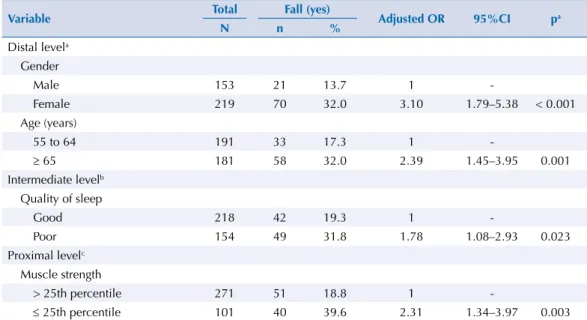
he adjustment of the variables of the distal level, in the hierarchical analysis, showed that being female and aged ≥ 65 years increase the chance of falls. At the intermediate level, poor sleep quality was the only statistically signiicant factor for a fall, regardless of the variables of that level and of the previous level. Only low muscle strength (≤ 25th percentile) was associated with a fall in the proximal level after adjusting for variables of the same level and of the previous levels (Table 4).
Table 2. Risk factors (not adjusted) for a fall, related to life habits and health conditions. Cambé, State of Paraná, Southern Brazil, 2011 to 2012. (N = 404)
Variable
Total Fall (Yes)
Not adjusted OR 95%CI pa
N n %
Practice of physical activity
Yes 75 18 24.0 1
-No 329 80 24.3 1.02 0.57–1.83 0.954
Smoking
No 345 84 24.3 1
-Yes 59 14 23.7 0.97 0.51–1.85 0.918
Use of psychotropic substancesb
No 271 70 25.8 1
-Yes 132 28 21.2 0.77 0.47–1.27 0.310
Quality of sleepc
Good 224 44 19.6 1
-Poor 157 49 31.2 1.86 1.16–2.98 0.011
Heart failured
No 386 96 23.8 1
-Yes 18 6 33.3 1.60 0.58–4.38 0.362
Diabetes mellitusd
No 339 83 24.5 1
-Yes 65 15 23.1 0.93 0.49–1.73 0.809
Depressiond
No 323 69 21.4 1
-Yes 81 29 35.8 2.05 1.21–3.48 0.007
COPDd
No 355 87 24.5 1
-Yes 49 11 22.4 0.89 0.44–1.82 0.753
Neoplasmd
No 377 88 23.3 1
-Yes 27 10 37.0 1.93 0.85–4.37 0.114
Hypertension
No 242 54 22.3 1
-Yes 162 44 27.2 1.30 0.82–2.06 0.265
Obesitye
No 262 58 22.1 1
-Yes 133 38 28.6 1.41 0.87–2.27 0.159
COPD: Chronic obstructive pulmonary disease a Wald Chi-square.
DISCUSSION
he report of a fall in the population studied (24.3%) was lower when compared to studies carried out with an older population, although the associated factors have been similar. In a cohort of 1,415 individuals aged 65 years or more, living in the city of São Paulo, State of São Paulo, 30.9% reported fall on the year previous to the interview16. In other population-based
studies in Brazil, the prevalence of falls over the past 12 months among the elderly aged 60 years or more was 27.6% in urban areas of one hundred municipalities of twenty-three States22, Table 3. Risk factors (not adjusted) for a fall, related to functional capacity. Cambé, State of Paraná, Southern Brazil, 2011 to 2012. (N = 404)
Variable Total Fall (Yes) Not adjusted OR 95%CI p*
N n %
Visual impairment
No 360 89 24.7 1
-Yes 44 9 20.5 0.78 0.36–1.69 0.534
Hearing impairment
No 354 81 22.9 1
-Yes 50 17 34.0 1.74 0.92–3.28 0.089
Difficulty of going up/down the stairs
No 256 46 18.0 1
-Yes 148 52 35.1 2.47 1.55–3.94 < 0.001
ADL
Independent 382 88 23.0 1
-Dependent 22 10 45.5 2.78 1.16–6.66 0.021
IADL
Independent 274 59 21.5 1
-Dependent 130 39 30.0 1.56 0.97–2.51 0.065
Grip strength
> 25th percentile 287 53 18.5 1
-≤ 25th percentile 117 45 38.5 2.76 1.71–4.45 < 0.001
ADL: Activities of daily living; IADL: Instrumental activities of daily living * Wald Chi-square.
Table 4. Hierarchical logistic regression of the factors associated with a fall in persons aged 55 years or more. Cambé, State of Paraná, Southern Brazil, 2011 to 2012. (N = 372)
Variable Total Fall (yes) Adjusted OR 95%CI pa
N n %
Distal levela Gender
Male 153 21 13.7 1
-Female 219 70 32.0 3.10 1.79–5.38 < 0.001
Age (years)
55 to 64 191 33 17.3 1
-≥ 65 181 58 32.0 2.39 1.45–3.95 0.001
Intermediate levelb Quality of sleep
Good 218 42 19.3 1
-Poor 154 49 31.8 1.78 1.08–2.93 0.023
Proximal levelc Muscle strength
> 25th percentile 271 51 18.8 1
-≤ 25th percentile 101 40 39.6 2.31 1.34–3.97 0.003
a Level adjusted for economic class, age, and gender.
b Level adjusted for age, gender, sleep quality, depression, neoplasm, and body mass index.
27.1% in Montes Claros, State of Minas Gerais17, and 30.3% in a municipality in the State of
Rio de Janeiro15. he lower frequency of falls identiied in this research may be related to the
composition of the sample, which includes adults aged from 55 years, and the predominance of individuals who are independent to carry out activities and instrumental activities of daily living.
his study has identiied a signiicant association between falls and being female and of old age, regardless of economic class. Authors highlight the more frequent execution of domestic activities16 and greater loss of lean mass and muscle strength14 as possible causes
of the higher incidence of falls among women. he advance of age leads to structural and functional changes that can reduce the ability to balance quickly and efectively, compromise the performance of motor skills, muscle strength, gait, and postural stability, and make an individual vulnerable to falls1.
Poor sleep quality has also been identiied as a risk factor for falls even after adjusting for variables such as gender, age, and depression. his result was similar to that presented by Stone et al.25 in a study in the United States with 3,101 individuals, in which poor sleep
quality assessed using the PSQI has been signiicantly associated with higher chance of falls. After adjustment, the variable depression has not been associated with falls in this study, but depression can be related to a reduction in the speed of gait and loss of muscle strength, characteristics that are related to the occurrence of a fall18. According to Ricci et al.19,
depressive symptoms deserve appropriate treatment and care, because of their debilitating consequences and association with falls, as they may have a devastating efect on the quality of life of the individual.
Low grip strength has also proved to be associated with falls, regardless of other variables such as sleep quality, depression, and diiculty going up/down the stairs. Visser et al.27 have
identiied higher risk of functional decline, falls, and mortality in older individuals with low muscle strength. he loss of muscle strength is considered an important indicator of frailty and is directly related with the increase in the number of falls, diiculty in going up or down the stairs, loss of agility, and fractures3.
Characteristics recognized as risk factors for falls, such as visual impairment, presence of other chronic diseases, and use of drugs2, have shown no association with this outcome in
this research. Falls in the elderly are a multicausal event with numerous factors that act together and interact with each other9. his contributes to make it less likely that a given
variable will stay associated with the event analyzed in the multiple model, in which other important factors were included.
his study has limitations. As this is a study developed in two moments, there were losses of individuals between the irst and the second home interviews, although we have searched for information with neighbors and community health agents (ACS) and also from phone contacts, as strategies to minimize the losses. Another limitation is related to the fact that the fall was self-reported, a condition subject to the recall bias of the interviewee. Important characteristics for understanding the outcome, as environmental obstacles, wet surfaces, inadequate footwear2,
among others, were not included in the analysis. Some health conditions, although included, did not make part of the multiple model, even though there was theoretical justiication (such as the use of psychotropic drugs, hypertension, and diabetes), because of the low sample size. Some diseases, such as osteoarthritis, were not analyzed. he variable related to obesity grouped persons with low weight to normal weight or on the overweight range in the same category, which may have reduced the frequency of falls in this group and the diference in relation to persons with obesity. Furthermore, as the data was analyzed cross-sectionally, we cannot rule out the possibility of reverse causality, particularly in the relationship between falls and muscle strength. Falls can cause fractures – in a large study conducted in Brazil22, 11.0% of the elderly
who sufered falls reported fractures – and, consequently, reduce muscle strength.
than that observed in the elderly. hese factors can be indicators of early loss of functional independence in this population. In addition, a hierarchical conceptual model was used for the study of factors associated with falls, and we have included demographic and socioeconomic characteristics related to lifestyle, presence of chronic diseases, and functional capacity. he results found in this research are important to guide the actions of professionals who work in Family Health Units and Centers of Support to Family Health, as well as public policies, such as: encouragement of the practice of physical activity to strengthen muscles6, expanding of
outdoor academies facilities, promotion of continuing education on environmental hazards and risk attitudes in the context of aging12, and identiication of individuals at risk for falls,
such as those with poor sleep quality, for proper care.
In summary, the frequency of falls identiied in this research was lower than that of studies carried out only with the elderly population. In addition to being female and of old age, modiiable factors, such as poor sleep quality and low muscle strength, stood out as risk for falls. he identiication of this proile may collaborate in directing health actions focused on the prevention of falls.
REFERENCES
1. Abreu S, Caldas C. Velocidade de marcha, equilíbrio e idade: um estudo correlacional entre idosas praticantes e idosas não praticantes de um programa de exercícios terapêuticos. Rev Bras Fisioter. 2008;12(4):324-30. https://doi.org/10.1590/S1413-35552008000400012
2. Ambrose AF, Paul G, Hausdorff JM. Risk factors for falls among older adults: a review of the literature. Maturitas. 2013;75(1):51-61. https://doi.org/10.1016/j.maturitas.2013.02.009
3. Bohannon RW, Bear-Lehman J, Desrosiers J, Massy-Westropp N, Mathiowetz V. Average grip strength: a meta-analysis of data obtained with a Jamar dynamometer from individuals 75 years or more of age. J Geriatr Phys Ther. 2007;30(1):28-30. https://doi.org/10.1519/00139143-200704000-00006
4. Buysse DJ, Reynolds CF, Monk TH, Berman SR, Kupfer DJ. The Pittsburgh Sleep Quality Index: a new instrument for psychiatric practice and research. Psychiatry Res. 1989;28(2):193-213. https://doi.org/10.1016/0165-1781(89)90047-4
5. Deandrea S, Lucenteforte E, Bravi F, Foschi R, La Vecchia C, Negri E. Risk factors for falls in community-dwelling older people: a systematic review and meta-analysis. Epidemiology. 2010;21(5):658-68. https://doi.org/10.1097/EDE.0b013e3181e89905
6. El-Khoury F, Cassou B, Charles MA, Dargent-Molina P. The effect of fall prevention exercise programmes on fall induced injuries in community dwelling older adults:
systematic review and meta-analysis of randomised controlled trials. BMJ. 2013;347:f6234. https://doi.org/10.1136/bmj.f6234
7. Fess EE. Grip strength. In: Casanova JS, editor. Clinical assessment recommendations. 2.ed. Chicago: American Society of Hand Therapists; 1992. p.41-5.
8. Haskell WL, Lee IM, Pate RR, Powell KE, Blair SN, Franklin BA, et al. Physical activity and public health: updated recommendation for adults from the American College of Sports Medicine and the American Heart Association. Med Sci Sports Exerc. 2007;39(8):1423-34. https://doi.org/10.1249/mss.0b013e3180616b27
9. Inouye SK, Studenski S, Tinetti ME, Kuchel GA. Geriatric syndromes: clinical, research, and policy implications of a core geriatric concept. J Am Geriatr Soc. 2007;55(5):780-91. https://doi.org/10.1111/j.1532-5415.2007.01156.x
10. Katz S, Ford AB, Moskowitz RW, Jackson BA, Jaffe MW. Studies of Illness in the aged: The Index of ADL: a standardized measure of biological and psychosocial function. JAMA. 1963;185(12):914-9. https://doi.org/10.1001/jama.1963.03060120024016
11. Katz S, Downs TD, Cash HR, Grotz RC. Progress in development of the index of ADL. Gerontologist. 1970;10(1):20-30.
13. Lawton MP, Brody EM. Assessment of older people: self-maintaining and instrumental activities of daily living. Gerontologist. 1969;9(3):179-86. https://doi.org/10.1093/geront/9.3_Part_1.179
14. Lebrão ML, Laurenti R. Saúde, bem-estar e envelhecimento: o estudo SABE no município de São Paulo. Rev Bras Epidemiol. 2005;8(2):127-41. https://doi.org/10.1590/S1415-790X2005000200005
15. Motta LB, Aguiar AC, Coutinho ESF, Huf G. Prevalência e fatores associados a quedas em idosos em um município do Rio de Janeiro. Rev Bras Geriatr Gerontol. 2010;13(1):83-91. https://doi.org/10.1590/S1809-98232010000100009
16. Perracini MR, Ramos LR. Fatores associados a quedas em uma coorte de idosos residentes na comunidade. Rev Saude Publica. 2002;36(6):709-16. https://doi.org/10.1590/S0034-89102002000700008
17. Ramos GCF, Carneiro JA, Barbosa ATF, Mendonça JMG, Caldeira AP. Prevalência de sintomas depressivos e fatores associados em idosos no norte de Minas Gerais: um estudo de base populacional. J Bras Psiquiatr. 2015;64(2):122-31. https://doi.org/10.1590/0047-2085000000067
18. Rao SS. Prevention of falls in older patients. Am Fam Physician. 2005;72(1):81-8.
19. Ricci NA, Gonçalves DFF, Coimbra IB, Coimbra AMV. Fatores associados ao histórico de quedas de idosos assistidos pelo programa de Saúde da Família. Saude Soc. 2010;19(4):898-909. https://doi.org/10.1590/S0104-12902010000400016
20. Silva RB, Eslick GD, Duque G. Exercise for falls and fracture prevention in long term care facilities: a systematic review and meta-analysis. J Am Med Dir Assoc. 2013;14(9):685-9.e2. https://doi.org/10.1016/j.jamda.2013.05.015
21. Silveira EA, Kac G, Barbosa LS. Prevalência e fatores associados à obesidade em idosos residentes em Pelotas, Rio Grande do Sul, Brasil: classificação da obesidade segundo dois pontos de corte do índice de massa corporal. Cad Saude Publica. 2009;25(7):1569-77. https://doi.org/10.1590/S0102-311X2009000700015
22. Siqueira FV, Facchini LA, Silveira DS, Piccini RX, Tomasi E, Thumé E, et al. Prevalence of falls in elderly in Brazil: a countrywide analysis. Cad Saude Publica. 2011;27(9):1819-26. https://doi.org/10.1590/S0102-311X2011000900015
23. Souza RKT, Bortoletto MSS, Loch MR. Prevalência de fatores de risco cardiovascular em pessoas com 40 anos ou mais de idade, em Cambé, Paraná (2011): estudo de base populacional. Epidemiol Serv Saude. 2013;22(3):435-44. https://doi.org/10.5123/S1679-49742013000300008
24. Stone C, Lawlor PG, Nolan B, Kenny RA. A prospective study of the incidence of falls in patients with advanced cancer. J Pain Symptom Manage. 2011;42(4):535-40. https://doi.org/10.1016/j.jpainsymman.2011.01.006
25. Stone KL, Blackwell TL, Ancoli-Israel S, Cauley JA, Redline S, Marshall LM, et al. Sleep disturbances and risk of falls in older community-dwelling men: the outcomes of Sleep Disorders in Older Men (MrOS Sleep) Study. J Am Geriatr Soc. 2014;62(2):299-305. https://doi.org/10.1111/jgs.12649.
26. Tas U, Verhagen AP, Bierma-Zeinstra SM, Hofman A, Odding E, Pols HA, et al. Incidence and risk factors of disability in the elderly: the Rotterdam Study. Prev Med. 2007;44(3):272-8. https://doi.org/10.1016/j.ypmed.2006.11.007
27. Visser M, Schaap LA. Consequences of sarcopenia. Clin Geriatr Med. 2011;27(3):387-99. https://doi.org/10.1016/j.cger.2011.03.006
28. Yu PL, Qin ZH, Shi J, Zhang J, Xin MZ, Wu ZL, et al. Prevalence and related factors of falls among the elderly in an urban community of Beijing. Biomed Environ Sci. 2009;22(3):179-87. https://doi.org/10.1016/S0895-3988(09)60043-X
Funding: National Council for Scientiic and Technological Development (CNPq – Process 150173/2013-0 – junior post-doc [PDJ]).
Authors’ Contribution: Planning of the study, data analysis, preparation, and critical review of the study: SCFP, SMA, MASC, RMD. Data analysis and critical review of the study: HGS, MSGD, AEM.