ISSN 0080-2107
Do papel à tela: as transformações e os desaios da indústria editorial brasileira
As novas tecnologias mudam drasticamente o modo como livros são produzidos e consumidos, evidenciando uma quebra de para-digma na indústria editorial. Neste estudo, procura-se compreender como a indústria editorial brasileira está enfrentando essas transfor-mações, capazes de alterar profundamente seu modelo de negócios. Entrevistas em profundidade com os principais executivos de alguns dos principais atores da indústria editorial foram realizadas a im de coletarem-se dados sobre como esses gestores percebem as mudanças em seu ambiente de negócios e como vão responder a essas transformações. Os resultados sugerem um panorama carac-terizado por novos players chegando ao mercado brasileiro e por grande ansiedade decorrente da chegada dos livros digitais, que podem alterar de forma signiicativa questões relativas à gestão de direitos autorais e à preciicação, potencialmente redeinindo o papel de um editor no processo de publicação. Como relexo, os editores vêm construindo alianças como uma tentativa de preser-var seu valor no mercado, ainda que se mantenham irmemente agarrados aos modelos de negócio tradicionais.
Palavras-chave: estratégia, plataformas, reconiguração de negócios,
indústria editorial.
From print to screen: changes and challenges
facing the Brazilian publishing industry
Marco Aurélio de Souza Rodrigues
Universidade Federal do Rio de Janeiro – Rio de Janeiro/RJ, Brasil
Paula Chimenti
Universidade Federal do Rio de Janeiro – Rio de Janeiro/RJ, Brasil
Antonio Roberto Ramos Nogueira
Universidade Federal do Rio de Janeiro – Rio de Janeiro/RJ, Brasil
Luiz Felipe Hupsel
Universidade Federal do Rio de Janeiro – Rio de Janeiro/RJ, Brasil
Andrea Repsold
LIDE – Rio – Rio de Janeiro/RJ, Brasil.
Recebido em 06/setembro/2012 Aprovado em 10/junho/2014 Sistema de Avaliação: Double Blind Review Editor Cientíico: Nicolau Reinhard DOI: 10.5700/rausp1163
R
eSu
Mo
Marco Aurélio de Souza Rodrigues, Mestre em Administração com ênfase em Estratégia pelo Instituto COPPEAD da Universidade Federal do Rio de Janeiro com MBA Extended Program da Wharton Business School, é Doutorando em Administração no Instituto COPPEAD de Administração da Universidade Federal do Rio de Janeiro (CEP 21941-918 – Rio de Janeiro/RJ, Brasil).
E-mail: [email protected] Endereço:
Universidade Federal do Rio de Janeiro Rua Pascoal Lemme, 355
Cidade Universitária
21941-918 – Rio de Janeiro – RJ
Paula Chimenti, Doutora em Administração pelo Instituto COPPEAD da Universidade Federal do Rio de Janeiro, é Professora de Estratégia, Organizações e Sistemas de Informação e Coordenadora do Centro de Estudos em Estratégia e Inovação do Instituto COPPEAD de Administração da Universidade Federal do Rio de Janeiro (CEP 21941-918 – Rio de Janeiro/RJ, Brasil).
E-mail: [email protected]
Antonio Roberto Ramos Nogueira, Doutor em Administração pela Universidade de São Paulo, é Professor de Estratégia, Organizações e Sistemas de Informação e Coordenador do Centro de Estudos em Estratégia e Inovação do Instituto COPPEAD de Administração da Universidade Federal do Rio de Janeiro (CEP 21941-918 – Rio de Janeiro/RJ, Brasil). E-mail: [email protected]
Luiz Felipe Hupsel é Mestre em Administração de Empresas pelo Instituto COPPEAD de Administração da Universidade Federal do Rio de Janeiro (CEP 21941-918 – Rio de Janeiro/RJ, Brasil), com ênfase em Estratégia, e possui Especialização em Marketing Metrics pela Wharton School of the University of Pennsylvania.
E-mail: [email protected]
1. IntroductIon
The publishing industry is facing the most signiicant change in its history since the 15th century, when Gutenberg unveiled the printing press to the world (Briggs & Burke, 2006). As new models of producing, distributing and con-suming books emerge, standards and market practices that have been around for the past ive centuries are currently being scrutinized (Bradley & Bartlett, 2012). As this article will address, the ways in which we understand a book and the societal roles of the written word are only a few of the con-cepts that are being radically challenged by these innovations. From a production perspective, new technologies now allow books to be written and produced in a fully digital process. By contrast, only a few years ago, paper was essential to the writing and publishing process. An entirely “born-digital” production changes the publishing business environment and its cost struc-ture. Thus, basic principles, such as economies of scale, which used to be a mantra for this sector, no longer reign absolute. Many changes have occurred as the publishing process evolved from the copyist monks (who literally handwrote every single page of the Bible to create a copy), through modern authors (who took inspiration from their Remingtons and Olivettis and addressed their typewritten manuscripts with affection), to con-temporary digital formats (Briggs & Burke, 2006).
From the distribution perspective, an industry reconiguration process seems to pose a threat to a seemingly stable business ecosystem. New entrants are now taking the place of formerly entrenched players in the industry, such as distributors and bookstores, and are struggling to dominate the industry. This phenomenon is perhaps best exempliied by the rise of Amazon.com as a key player. In certain cases, these changes can cause the bankruptcy of traditional companies, such as Borders (Moss, 2012).
With respect to changes in book consumption habits, Amazon’s Kindle may easily be recognized as a pioneer. Kindle was the irst successful commercial e-reader, and it revolutionized the way in which books are read and purchased. Several competitors have arisen since the Kindle (such as the Nook and the iPad), suggesting that electronic reading plat-forms are a major trend in the industry, instead of just a pass-ing fad. These platforms might redeine the industry’s rules and boundaries (Eisenmann, 2007).
For all these reasons, the publishing industry is a rich object of study. Scholars have neglected it over the past years, especially in Brazil, where studies with a strategic approach on this industry are rare. The literature also reveals that disruptive changes tend to be harsher to incumbents that choose to adopt a defensive stance instead of embracing these changes and preparing appropriately for them (Day, Schoemaker & Gunther, 2000).
This study seeks to understand the perceptions of Brazilian editors with respect to the aforementioned changes in the pub-lishing industry, which may have an enormous impact on the
industry’s structure, business models, proitability and even survival of its incumbents. This industry at this very moment presents a unique opportunity for the analysis and understand-ing of the incumbents’ perception and reaction to emergunderstand-ing and potentially disruptive technologies, faced for the irst time in centuries. Thanks to the delayed introduction in Brazil, incum-bents had seen how those innovations had impacted key for-eign markets (such as the US) and also knew in advance that the most relevant players of this new digital business, Amazon and Apple, are planning their entrance in the country. Motivated by this historical opportunity we strive to answer the follow-ing question: How are the incumbents in the Brazilian pub-lishing industry addressing and responding to those major potential changes?
2. InduStrY And contEXtuALIZAtIon
According to Shapiro and Varian (1999), books are quite the perfect example of information goods: i.e., they may be transformed into bits and bytes, and they possess speciic characteristics (e.g., their content can be replicated at a mar-ginal cost that is close to zero). Moreover, information goods are experience-driven goods, implying that it is necessary to read a book to evaluate its quality. Reviews and summaries may help the reader generate a primary evaluation of a book’s content, but the inal evaluation can only be formed after its consumption. Thus, companies are constantly facing the dilemma of whether they should iercely protect their intel -lectual property and the potential gains that may rise from it or instead opt to maximize the propagation of this content, a process that could generate greater buzz and interest about the books (Shapiro & Varian, 1999).
Another contemporary feature of books is that they are part of an industry in which boundaries are becoming luid, a phenomenon that is generally known as convergence (Jenkins, 2006). Bestselling books have generated movies and games (for instance, this process has occurred for the Harry Potter and Twilight book series), and the converse path has also been observed. For instance, the Assassin’s Creed game sequel has been transformed into a literary bestseller. Convergence also enhances the development of transmedia environments, which allow the offer of distinct parts of an imaginary universe through multiple media. From a busi-ness point of view, the exploration of these new markets and business models also creates business opportunities that occur simultaneously in otherwise different industries.
occurred in the publishing industry during the subsequent ive centuries may be regarded as purely incremental in nature. However, at the end of the twentieth century, signiicant shifts began to occur as a result of the Internet and it’s propagation to the wider public. Changes that not only offer new and chal-lenging business opportunities but also constitute threats to the incumbents. The Internet represents a critical sales medium that allows global access, scalability and the potential for exponen-tial growth. Digital content distribution is possible through a simple download process, which overcomes traditional industry limitations, such as inventory and logistics, which previously restrained publisher’s offerings bounded by the value chain perspective. With the advent of the Internet, books may easily be sold online and delivered physically, or the entire process of purchasing, delivering and reading a book may occur online (Sá Earp & Kornis, 2005).
The publishing industry may view the Internet as a continuous source of threats, particularly because it transformed it into a dynamic and competitive marketplace. Amazon may be regarded as the symbol of this transformation. Since its foun-dation by Jeff Bezos in 1995, Amazon became the largest vir-tual bookstore in the world and the market leader in the pub-lishing industry (Collura & Applegate, 2000). A new chapter has been recently added to this imbroglio, in which the main actor is the digital book (or e-book). A digital book can be broadly deined as the electronic version of a printed manu -script. Digital books can be read in desktops, laptops, tablets or electronic devices that have been designed for reading pur-poses (e-readers), thereby eliminating the need for printing the content (Bradley & Bartlett, 2012). It is worth mention-ing that the idea of an e-book is not clear to all consumers. The word book can mean both the message that is conveyed (words and images) and the medium that is used for this con-veyance (paper brochure or hardcover) because it is accept-able to state that there would be no book as we know it with-out the combination of both of these meanings. Therefore, the term ‘e-book’ is used to describe content, format, software and reading hardware (Rao, 2003).
Rao (2003) and Long (2003) note clear advantages of e-books relative to physical books: a faster and global pub-lication process, lower costs, greater convenience (because there is no need to store or to physically locate a product in order to sell it), simpler processes of content updating, and greater access to additional functionalities, such as manuscript searching and reader participation. Mobile e-reader devices are attractive to the consumer because they fulill the same purpose of physical books and allow a large title storage in an object that weighs no more than a single book. The cate-gory of mobile e-readers is typically divided into two types of devices: e-book readers, which primarily offer the ability to read e-books, and multipurpose devices, such as Apple’s iPad. It may be said that the combination of novel content (e-books), interface software (the app or website where this
content will be downloaded from) and hardware (the e-reader) has created an entirely new platform (Eisenmann, 2007) that has been transforming the industry and may be regarded as a point of no return (Bradley & Bartlett, 2012).
Several impacts of this innovation are evident in the North American market: during the 2009 Christmas season, e-book sales surpassed their physical counterparts. Although digital books represented less than 5% of total book sales in 2009, current estimates project that they will account for 25 to 50% of total book sales in the near future (Bradley & Bartlett, 2012). The most signiicant players in this ecosystem are:
• Amazon, which provided great impetus to the e-book mar-ket with its Kindle launch in 2007 and is the marmar-ket leader in book sales (both digital and physical);
• Apple, which entered the market in 2010 with the iPad, a device that brings the concept of convergence to consumers; • Barnes & Noble, a traditional bookstore chain in the US that
has recently made the physical-digital transition with the introduction of the Nook e-reader.
Certain threats to the traditional business model may be inferred from these recent changes: Online merchants are replacing traditional brick-and-mortar vendors. In the US mar-ket, this trend is most evident if one considers Borders’ recent bankruptcy and Amazon’s current hegemony. Purely online companies possess advantages over traditional irms, such as lower marginal costs, greater operational eficiency, greater lexibility, increased swiftness and the better understanding of their customers (Collura & Applegate, 2000; Sá Earp & Kornis, 2005). The problems for the traditional vendors that were exacerbated by the advent of the Internet include marketing channel conlicts and technological ineptitude. A multichannel approach has become a burden for many major traditional players. However, as Sá Earp and Kornis (2005) suggest, online sellers may be restricted with respect to their growth strategy, as only a handful of these merchants appear to be able to succeed, and it is therefore highly unlikely that small and medium-sized companies will survive as Internet retail-ers. Accordingly, e-commerce is a platform-mediated market that tends to present winner-take-all-dynamics (Eisenmann, 2007), with room for only a few players.
Third, control over a book’s distribution becomes greatly compromised in a virtual environment. Free public domain books are widely available now, and this availability may further threaten the traditional business model of the pub-lishing industry.
Fourth, the editor’s role in this new publishing ecosystem may be questioned because of the recent developments that have broken the traditional structure of the publishing pro-cess. At the present time, bestselling authors have the ability to directly address vendors. The advent of on-demand book printing and self-published titles force the editors to reas-sess their role in the publishing ecosystem and to innovate to remain relevant (Bradley & Bartlett, 2012).
Finally, e-book adoption by schools (and, in certain cases, government-sponsored schools) may drastically change the ways in which books will be consumed, allowing the emer-gence of disruptive scenarios in which editors are no longer necessary (Schoemaker, 1995).
With respect to the Brazilian market, few researchers have addressed how these new technologies affect readers and how editors are coping with the changes that have arisen in this new business environment (Salgado, Chimenti & Nogueira, 2009). At the present time, this topic is relevant and practical to the Brazilian context, primarily because of both the recent entry of Amazon.com and the cultural and historical relevance of the publishing industry to the Brazilian culture.
In 2010 the Brazilian editorial industry generated R$4.2 bil-lion (approx. US$2 bilbil-lion). Industry revenue grew 13.12% in 2010, although this growth was only of 8.3% if govern-ment and not-for-proit seggovern-ments are excluded (CBL, Snel & Fipe, 2011). Considering the speciic inlation index for this industry (IPCA Books, which for 2010 was 5.35%), the actual market grew only 2.63%. Furthermore, if government and non-proit contributions were excluded, revenues would decrease by 2.24%. Also, the average book price tag fell by 4.37% in 2010 (CBL, Snel & Fipe, 2011).
Tablets and digital books constitute major sources of uncertainty within this context. As of the first semester of 2011, there were only 196,000 tablet users in Brazil, and digital books figures were even lower. As an exam-ple, in the last semester of 2011, the Canadian bestseller “The Shack” (“A Cabana”, in Portuguese) had one thou-sand downloads, in comparison to the 200,000 printed books sold. “Eat pray love” (“Comer, amar e rezar”, in Portuguese) had just 75 downloads in April 2010, whereas 10,000 paper versions of this book were sold. By compar-ison, in the US, there were 13 million tablet users in 2010 (roughly 4.2% of the country’s population), and this fig-ure was predicted to rise to 33.7 million users in 2011, or 10.8% of the population (eMarketer, 2011). The share of digital books in the US market jumped from 0.6% in 2008 to 6.4% in 2010, which accounted for US$ 878 million in sales revenues and 114 million e-book sales (AAP, 2012).
3. thEorEtIcAL bAckground
The theoretical background of this article is based upon two major lines of research: Innovation studies, which consists on a traditional and broader topic, and Ecosystem Analysis, a more recent ield of study that had enlightened the Strategy and Information System ields in the recent years.
This choice is based upon the authors’ belief that the major changes that impact the publishing industry are the result of forces that rise from two different types of sources: innovation within the industry and a redeinition of the industry boundaries.
It is usually hard for established irms to adapt to changes in the technologies they employ. Frequently, incumbent irms do not manage the shift to the new technology, losing market share and giving room to new entrants (Cooper & Schendel, 1976; Tushman & Anderson, 1986; Utterback, 1994). Earlier scholars of technology change have argued that incumbent irms may stumble when technological change destroys the value of established technological competencies (Tushman & Anderson, 1986), or when new architectural technologies emerge (Henderson & Clark, 1990).
Christensen and Bower (1996) brought another perspec-tive by drawing upon resource dependency theory (Pfeffer & Salancik, 1978). This theory suggests that a irm’s freedom of action is controlled by actors outside the company, like customers and investors. Christensen (1997) distinguished innovations that sustained the industry’s rate of improve-ment in product performance from innovations that dis-rupted or redeined that performance trajectory. Through studies on the disk drive industry, Christensen and Bower (1996) showed that incumbents usually win sustaining bat-tles whereas entrants succeed in disruptive batbat-tles.
New technologies impact information-based industries, par-ticularly if they are considered disruptive (Christensen, Johnson & Rigby, 2002). They potentially alter current business mod-els, creating entirely new markets or allowing the creation of new business models. Day and Schoemaker (2000) categorise these as emerging technologies and analyse their drastic impact upon industry incumbents. For incumbents, even in the pres-ence of previous scale advantages and resources, emerging technologies are often traumatic. For example, attackers dis-lodged incumbents when ballpoints supplanted fountain pens, diesel electric locomotives prevailed over steam locomotives, and when vacuum tubes gave way to transistors.
Addressing these technologies therefore requires a change in strategy in order to enter in a very different market. The key issue appears to be irms’ disabilities in changing strategy, not technology (Christensen & Bower, 1996).
Already locked into traditional business models and part-ners, incumbent companies typically perceive new technol-ogies as threats rather than as opportunities. For Day and Schoemaker (2000), risk and conlict avoidance in the estab -lished companies make them vulnerable to four traps. Many of the authors already mentioned in this review explore spe-ciic pitfalls, so, we choose this framework to consolidate all the views encountered in the literature about how incum-bents can respond to disruptive technologies.
The irst trap is Delayed participation, meaning the approach chosen by many incumbents that decide to “wait and see” if a new technology will prevail or not, before adopting it. Delayed participation comes from a failure to consider broader applica-tions and from prevailing mental models that reject emerging technologies (Day & Schoemaker, 2000).
New business model adoption is confronted with multiple barriers, one of the most signiicant being managers’ cognitive barriers to change (Kim & Mauborgne, 2005; Voelpel, Leibold, Tekie & Von Krogh, 2005). Dewald and Bowen (2010) illustrate the importance of cognitive inertia in established irms, and how managers in corporate contexts are more conditioned to consolidate or exploit existing business models rather than create new markets. Floyd states that, while existing technologies have a critical mass of technology development and a large applications base to justify them commercially, new technologies lack both committed resources and commercial justiication. Their development is therefore a result either of an act of faith by management or of a need for a niche application. Initial development and commercialization are inevitably slow until you reach a critical mass of users and market need, at which point the new technology begins moving up the S curve (Floyd, 1996).
The second trap described by Day and Schoemaker (2000) is Sticking to the familiar, which describes the tendency to bet on the current technology instead of embracing the new one. Companies usually fall into this trap to avoid ambiguity, wars for standards and dominant designs, which leads to the main-tenance of the status quo, and prevents the detection of emerg-ing opportunities. Utterback (1994) notes that a technological innovation may not take hold in a market until standards are established. Shapiro and Varian (1999) have studied many cases in which standards wars took a long time, such as railways and color TV. Miller (1990; 1993) argues that companies tend to simplify their routines around the functions and competencies responsible for their success. Although such architecture sim-plicity might make sense in a stable environment, it can cause decline if the world changes.
The third trap is the Reluctance to fully commit, meaning that, even when the company overcome the tendency to delay
participation (trap one) and avoid sticking with the familiar (trap two), they may still make a half-hearted commitment (Day & Schoemaker, 2000). The lack of engagement and the imbalance between prudence and risk, lead to a modest initial investment, which can create a disadvantage in positioning. It may be caused by lack of capabilities, underestimation of the emerging technologies potential and new market needs, or by the dificulty of balancing the demands in the markets already known and the requests for emerging technologies.
Accordingly to Charitou and Markides (2003), the chal-lenge for incumbents is that in adopting a new business model, they might run the risk of damaging their existing business and undermine their existing business models (Charitou & Markides, 2003). Moreover, according to Gilbert, Newbery and Reinganun (1984), under conditions of uncertainty, incum-bent enterprises already enjoying a degree of market power will invest less in radical innovations fearing the cannibal-ization of the revenue streams of the existing products. This has also to do with the fact that usually new technologies seem applicable only to smaller market segments. Christensen (1997) argues that customers and many existing stakeholders, including employees, are embedded in the inertia of reliable but old ways and companies seeking to satisfy these stake-holders will dismiss disruptive technologies.
Large companies facing pressure for quarterly results soon lose patience with adverse results, leading to the fourth and last trap, Lack of persistence, meaning that, even when the irst three traps are overcome, incumbents might disinvest too soon in the new technology.
This mainly occurs due to the sunk cost fallacy and the pres-sure for short-term results that end up affecting the ability of companies to cope with initial negative results. But, as pointed by Tigre and Noronha (2013), incremental innovations devel-oped to slow down or even revert industrial change are not capa-ble to thrive. Hill and Rothaermel (2003) suggest that incum-bents must view emerging technology investments from a real options perspective.
According to the Day and Schoemaker (2000), those pitfalls can be avoided by widening the peripheral vision and creating a culture of learning and sharing information. Flexibility and organizational autonomy are also cited as essential in strategic decision making.
These perceived threats tend to generate passivity or mild reactions from incumbent companies, allowing the entry and growth of new participants in their ecosystems. Those new competitors are typically free from the ties that suffocate innovation, leading to a process that dramatically affects the industry’s nature and profitability. Recent history shows us examples of these inadequate managerial reac-tions in industries such as music (Rivkin & Meier, 2000) and newspaper (Anand & Hood, 2007).
incumbents’ survival. Doz and Hamel (1998) describe how alliances may be useful for companies that face urgent needs, as they enables learning about innovations and the creation of core competences. Alliances are also important for the estab-lishment of standards and the management of complementary offerings (Shapiro & Varian, 1999), which are critical aspects of making the inal product interesting to consumers. Adner (2006) states that innovation in ecosystems involves negotiation and collaborative agreements in which companies combine their individual offerings into a coherent consumer-oriented solution.
The responsiveness of an organization to the innovations is influenced by the scope of its peripheral vision (Day & Schoemaker, 2006). Therefore, a company should not just restrict its vision to its industry, monitoring adjacent industries to detect threats and opportunities outside its surroundings. We must understand how the exchange of resources between indus-tries composes a network of members from various sectors that compete and cooperate with each other, as an ecosystem (Iyer, Lee & Venkatraman, 2006). A business ecosystem perspec-tive appears to provide an adequate analytical perspecperspec-tive for information based industries. In contrast to a traditional value chain approach, an ecosystem addresses “industries” that are in a dynamic and borderless environment, thereby enhancing the perception of convergence and connection between ields that would otherwise be considered separated or unrelated (Iansiti & Levien, 2004; Iyer et al., 2006). An ecosystem analysis offers a comprehensive view of the links established between indus-tries, allowing the perception of sources of value creation and destruction that were previously ignored by traditional strate-gic monitoring systems (Day et al., 2000).
New ways of analyzing the business environment and outlining strategies have become a necessity (Hax & Wilde, 1999). Models such as Porter’s Five Forces (Porter, 1980), although important for manufacturing industries, might seem inadequate to analyze industry convergence phenomena, as they overlook possibilities that might be emerging in other sectors at an increasingly fast pace. Strategy should resort to tools that can monitor the exchange of informa-tion and resources among industries, perceiving eventual adversaries and possible allies ahead of time.
The Ecosystem Analysis (Iyer et al., 2006) tries to broadly map the networks comprised of players from several sectors that are inluenced by or that have direct business relations, produc -ing a large overview of competition and cooperation within and among industries and identifying the current and potential focuses of value creation and destruction. A company’s strategy should take into account the ecosystem to which it belongs, as well as its role in this ecosystem (Iansiti & Levien, 2004). Ecosystem evaluation can help irms with their positioning, strategies and innovations (Adner, 2006). For executives, ecosystem mapping is essential to broadly understand how resources and informa-tion travel within the system, supporting the development of a critical view based on threats and opportunities — within and
beyond the original sector of these irms — for the composition of future scenarios for the industry.
The charting of a irm’s ecosystem involves mapping all the enterprises with which the irm relates and is linked. Thus, it transcends the identiication of the value chain, and includes complementary elements, companies from other sectors and all their stakeholders. For a irm, the value of studying its eco -system lies in recording the links that make up its network. Generally, the larger the number of links of a given participant, the greater its inluence upon the other members of the network and the greater its potential for reconiguring its links and com -petencies in order to respond swiftly to environmental changes. The perception of potential links and absent links offers an overview of future relationships that might represent opportunities and threats. The ability to rapidly seek, choose, consolidate and reconigure links is essential for irms bent on growth.
As species in a biological system, each member of a business ecosystem shares the fate of the network as a whole, despite the soundness of this member. The strategy of a company should consider, therefore, the health of the entire ecosystem. A irm that acts without understanding the impact on the ecosystem as a whole is ignoring the reality of the networked environment in which it operates (Iansiti & Levien, 2004).
As an ecosystem evolves, organizations tend to occupy three possible positions: Keystone, Dominator or Niche. A Keystone company acts as a crucial hub and aims to pro-mote the performance of the ecosystem as a whole, not by an altruistic impulse, but to ensure their own prosperity. A Dominator uses its inluence to explore the ecosystem in an extractive way, capturing value without worrying about other participants. The Niche positioning is highly special-ized, performing complementary and different tasks from most of the other participants (Iansiti & Levien, 2004).
According to Iansiti and Levien (2004), keystone organizations play an important role in business ecosystems. Fundamentally, they aim to improve the overall health of their ecosystems by pro-viding a stable and predictable set of common assets. Keystones can create value for their ecosystems in numerous ways and the irst is usually the creation of a platform, an asset in the form of services, tools, or technologies that offers solutions to others in the ecosystem. The second requirement for keystones’ success is that they share throughout the ecosystem much of the value they have created, balancing their generosity with the need to keep some of that value.
one side in order to proit from the other, retaining users that interfere in the system’s network effect. Also, because of net-work effects, they usually present winner-take-all dynamics, in which the ecosystem will have a dominant hub. So an aspiring platform provider must consider whether to share its platform with rivals or ight to the death. The third challenge is the risk of envelopment, which happens when a hub company decides to offer a new functionality that envelops in its platform an adja-cent entire industry (Eisenmann, 2007).
Concluding, the literature review shows that:
• There is a gap in the literature since, despite the recent emer-gence of models that deal with strategic business ecosys-tems and converging industries, innovation is usually per-ceived within an industry’s boundaries. As recent studies focusing on ecosystem analysis show, this new environment requires a new set of strategic tools, for disruptive technol-ogies usually arrive from different industries and are intro-duced by new players from outside the industry’s scope. Therefore, it is important to understand how incumbents perceive and deal with emerging technologies in a conver-gent business ecosystem.
• The Brazilian publishing industry is experiencing for the irst time the introduction of a disruptive technology, the digital book, making it a perfect case for the study of the phenom-enon described above, in an environment that is not used to experiencing disruptive innovations.
4. MEthod
The most common purposes of social research are exploratory, descriptive and causal (Babbie, 2001). Costa Filho (2002) notes that exploratory studies are recommended when the researcher wants to become familiar with a theme or when this is a rela-tively new ield of study, allowing insights about a particular subject. Another categorization, by Gregor (2006), organizes theories in ive different possibilities: Analysis and Description, Explanation, Prediction, Prescription, and Design and Action. Due to the exploratory nature and recency of the phenomenon, the aim here is to promote greater understanding and insights into the phenomena of interest. So, it is Explanatory as the theory aims to provide an explanation of how, why, and when things happened, relying on varying views of causality and methods for argumentation. Although some insights are gath-ered and some propositions are made regarding the future of the industry, the gap perceived on the literature review showed that some steps must be built before prescriptive or predictive afirmatives can be made.
The current study focuses on a recent and on-going phe-nomenon that has rarely been studied in the Brazilian context. It is essentially exploratory and uses a qualitative approach to comprehend a social phenomenon, its characteristics and its intrinsic meanings (Denzin & Lincoln, 2006). It provides hints and information about interviewees’ motivations, beliefs
and values with respect to the chosen topic and also fosters an intense relationship with the ield allowing the emergence of a holistic and deep visualisation of the observed phenomena (Miles & Huberman, 1994; Stebbins, 2008). The researcher should listen to and conduct the interview towards the pro-posed theme (Mann, 1975). A script was used as a guide to ensure the coverage of the relevant issues highlighted by liter-ature review (Patton, 2002). Data collection was accomplished through in-depth interviews supported by the semi-structured script (Aaker, Kumar & Day, 2004).
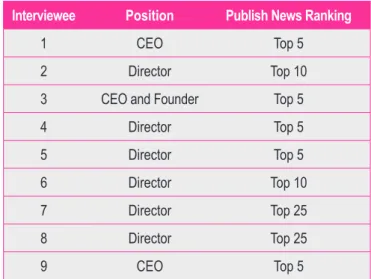
The participants were executives in key positions at major Brazilian book editors that specialise in mass market publica-tions. Figure 1 shows the list of interviewees as well as where the editor stands in the 2012 Brazilian biggest publishers rank-ing accordrank-ing to PublishNews (2012). The in-depth interviews lasted in average one hour, allowing the pertinent issues to emerge spontaneously throughout the sessions.
Interviewee Position Publish News Ranking
1 CEO Top 5
2 Director Top 10
3 CEO and Founder Top 5
4 Director Top 5
5 Director Top 5
6 Director Top 10
7 Director Top 25
8 Director Top 25
9 CEO Top 5
Figure 1: List of Interviewees
With respect to an adequate number of interviews, Eisenhardt (1989) suggests that four to ten should be suficient for gather -ing data in this instance (especially due to industry’s size and structure) and that ield research should be stopped if there are signs that the marginal contribution of each new interview has begun to decrease signiicantly. This viewpoint represents a perspective that is known as theoretical saturation. During the last interviews, the discourses became increasingly simi-lar, which suggested that saturation had occurred and implied that the search for new interviewees was unnecessary (Yin, 1989). With the participants’ authorisation, all interviews were recorded, and the resulting body of work comprised more than 12 hours and 200 transcribed pages.
Miles and Huberman (1994): coding (afixing codes or catego-ries to data drawn from interviews and notes), noting (relec -tions on the data), abstracting and comparing (materials are sorted and sifted to identify similar phrases and sequences, bringing the categorization into higher-order conceptual con-structs or patterns), checking and reinement, generalizing (not a population generalization, but a theoretical) and theorizing (confronting generalizations and building new knowledge). This process is not linear, happening with many points of return in which the researcher can analyse and confront data and theory, reining categories and propositions.
5. rESuLtS And dIScuSSIon
The research shows a very coherent and cohesive indus-try, with interviews presenting many similarities in the way that executives and owners (this is traditionally a family business in Brazil) perceive disruptive technologies. All the testimonies presented in the results section relect opinions that were consistently encountered during the research pro-cess. None represents isolated comments.
The analysis is presented around the four main topics that emerged both from the literature review and the content analy-sis, according to the Incumbents’ Traps: Delayed Participation, Sticking to the Familiar, Reluctance to Fully Commit and Lack of Persistence. Also, a new trap that emerged from the analy-sis will be proposed.
5.1. Delayed participation
The emergence of the e-books technology was no surprise for the publishing industry. However, according to the theory that describes the incumbents’ traps, most of the companies adopted a “wait and watch” approach. This behavior is called
Delayed Participation (Day & Schoemacker, 2000) and is motivated by two groups of distinct factors, as follows.
The irst factor to be considered is Mental Models. The research is plenty of rich testimonies that show how people tend to reject something new and unknown that it is hard to choose, a behav-ior that is aligned with the literature (Kim & Mauborgne, 2005; Voelpel et al., 2005). As stated by interviewee 4:
That’s a world I don’t know, I must confess, and I don’t even want to think about it. (Interviewee 4)
The publishing industry in Brazil is a unique case for the study of how incumbents perceive new technologies, because it has been for centuries a virgin territory for disruptive inno-vations. As stated by one participant:
Brazilian editors are family businesses that still use the same production methods of 30 years ago. The conception that productivity enhancements are not
compatible with quality is entrenched in their minds. Processes tend to be handcrafted. These are low-ef-iciency companies — and they’ve never really worried about that. The outcome is an expensive book, a luxury good. As the digital world forces prices down, these companies will have to change a lot. I think that’s the great threat: being unable to cope with these changes. (Interviewee 7)
In this sense, all the companies interviewed believe that printed books will remain important for years to come.
I don’t believe editors will perish, otherwise everyone would self-publish. […] In Brazil, digital books are not even 1%. How can the 1% lead the change process for the other 99%? It just can’t be. (Interviewee 2)
On the other hand, some participants recognize the poten-tial market changes brought with the e-books. Still, they per-ceive themselves unable to inluence those changes, which are not perceived as opportunities, but rather as disasters; just like the “Innovator Dilemma” described by Christensen (1997).
It’s sort of like asking a dinosaur: if you think there’s an asteroid on a collision course: what are you going to do? In my case, I’ve said to my family that “there’s an asteroid coming, and I don’t know what’s going to happen”. (Interviewee 4)
Some interviewees acknowledged the disruptive changes ahead, while suggesting a desire to slow down the e-books adoption rate. Some mention that they are trying to “buy some time”, postponing the major changes until their retirement. Here, it is worth citing Tigre and Noronha (2003), for whom incremental innovations developed to slow down industrial transformation will most likely succumb. The testimony from interviewee 1 is very illustrative.
answered, “In 10 years I might be dead, or the caliph might be dead, or the camel would be dead.” For me, the e-book is my camel, and what I really want is to get ten extra years. (Interviewee 1)
The second factor is Failure to Consider Broader
Applications (Day & Schoemacker, 2000). In the research, most of the interviewees, although familiar with the e-book technology, considered it less important than the current tech-nology (printed paper). None of the participant companies have created business models based on the e-book and they don’t seem open to the opportunities that might come from that, just as depicted by Charitou and Markides (2003).
Digital history itself in Brazil is still new, I mean, irrelevant. If you look at the Brazilian books sales ranking you’ll see one of our products occupying the second place. That book sells 152 e-books per month. (Interviewee 4)
Amazon has got working capital, know-how, and also some undecided issues, such as where to assemble e-readers and the price they can sell these e-readers in Brazil. […] The problem is that, sometimes, people don’t realize that there are tech-nologies that destroy an industry instead of building one. Then you’ve got several situations where a business model is not working anymore, but there are no alternatives on the horizon. (Interviewee 1)
It was interesting to perceive that even the only interviewed company that have a solid digital initiative was still operated on a paper-based mindset. All investments regarding digital tech-nologies targeted print-on-demand facilities, aiming at cost and inventory reduction. As a result, other possibilities that usually emerges from digitalization seem to be neglected.
A book’s sales margin is, in theory, huge. A book costs R$ 5.00 [approx. US$ 2.40] and sells for R$ 30.00 [approx. US$ 14.40]. See how much is wasted along the way?… That’s freight, returning goods, a lot of stuff […] For many years, I have perceived this working capital problem. This is the main issue, in my opinion. So on-demand printing is a solution that I’ve been monitoring. Amazon implemented this strategy 7 or 8 years ago. Amazon has 2 or 3 million iles… you think they’ve got the book, but they don’t. They print one book and deliver it. (Interviewee 5)
5.2. Sticking to the familiar
Managers facing disruptive innovation tend to have doubts regarding what technology will become the prevailing one,
around which new opportunities and threats will emerge. Such behavior usually fosters inertia among managers and is described by Day and Schoemaker (2000) as the Sticking to the Familiar trap, composed by two major aspects: War for Standards and Dominant Designs.
This research suggests that there is a War for Standards
being waged in Brazil’s publishing industry. The market has long ago established the current standards, throughout decades of practice and consolidation. Thus, the upcoming perspective of a new technology coming and changing not only the pric-ing structure, but also the business model as a whole, seems really frightening for the incumbents.
In this sense, the major publishing companies in Brazil have created a strategic alliance, denominated DLD (Digital Books Distributer, in portuguese). Shapiro & Varian (1999) argue that alliances are also important for the establishment of standards. According to some interviewees, DLD was created to help Brazilian incumbents protect their business, leveraging their bargaining power when negotiating with global players, such as Amazon, Apple and Google.
Amazon wants to rule the world? So, what do you think Brazilian natives would do, if they knew in advance that Portugal was going to invade Brazil? Maybe they could have created an alliance to negotiate. These guys will come here, and they want to change the traditional business model. So, the idea is to protect our industry from this new entrant. (Interviewee 2)
On the other hand, companies who do not participate in this alliance showed a more critical view about this initiative. Here, interviewees describe a reactive mindset thrusting DLD strategy.
DLD is a bunch of big publishers that gathered to-gether with a clear intention of holding the changes. They do not want to “surf” this “wave” of change… In fact, what they are really doing is telling to the market: “hold it!” (Interviewee 1)
On the Dominant Design perspective, one can analyze all the issues involved in a new production paradigm. Book printing and delivering is an expensive and intricate process, controlled by the incumbents. But, when they think about the digital pro-cess, it is plenty of uncertainties because none of those compa-nies control this new process and its aspects. As described by Day and Schoemaker (2000), a new technology has immature processes that might seem quite uncouth when compared with the established processes of the old technology.
to an end, this whole process must be fully integrated in databases […]. And I’m sure they won’t be able to upload 500,000 Excel spreadsheets manually, but that’s the current practice. (Interviewee 6)
5.3. Reluctance to fully commit
Managers dealing with new technologies usually face a tough decision: either reduce risk by making small invest-ments with smaller and slower return of investment or bet wholeheartedly in an unproven novelty to secure its lead-ership in the market. Day and Schoemaker (2000) describe an incumbent’s tendency to underestimate the potential improvements of disruptive technologies, discouraging man-agers to fully invest in innovations, enabling newcomers to quickly dominate the market. The authors named this behav-ior Reluctance to Fully Commit, and try to explain this behavior. The irst possible reason is Risk Aversion. In our research, all of the interviewees recognized that their current business model is threated by the e-book technology. Some have even cited the battered music industry as an example of what not to do. However, it is possible to perceive many common mistakes made by both music and book industries and we might see a similar course of events in the future.
E-books are a reality, and our major concern is that we’d face the same risks and make the same mistakes that the music industry did. So, we think we’ve al-ready had an example of failure and we don’t want to make the same mistakes. (Interviewee 3)
The fear of Cannibalization may explain the current course of actions. Gilbert, Newbery and Reinganun (1984) argue that market-share leaders will hesitate to invest in radical innovation fearing the potential cannibalization of their products. In this sense, respondents know that there is something new coming. Something with the potential to replace their main product.
Editors have been inluencing book value chains for a long time. But business models, objectives, and new players’ concerns are not always in line with authors’ and editors’ concerns. In the US, where (e-books) had a huge impact on the market, some bookstore chains went bankrupt as a direct consequence of how digital books were imple-mented there. (Interviewee 3)
Some will say that printed editions would never disappear. And I agree, some categories won’t disappear, art books will not end. But what about those book categories that have already vanished? Are there any encyclopedias? They were gone even before Amazon! […] I think they won’t
dis-appear, but in ten years, printed editions will be just 5% of the whole market. Everyone has to go digital, there is no other option. But it’s amazingly hard to manage physical and digital models at the same time. (Interviewee 6)
Thinking about the difficulties in dealing with digital technologies, a new set of reasons emerges. First, companies perceive their Lack of Capabilities to deal with the digital world as described by Cooper & Schendel (1976), Tushman & Anderson (1986) and Utterback (1994). Something they must know, but they don’t. Respondents have cited capa-bilities, such as e-commerce, digital rights management (to minimize piracy), the adaptation of files to digital for-mat and the knowledge required to think what a book should be in its digital form. The potential convergence of books, games and movies into an enhanced experience is taking place and editors perceive their absolute lack of capabili-ties to deal with this challenge.
We’ve just released our irst app, which is child-ori-ented, and we paid R$ 140,000 (US$ 70,000) for it. And we’re talking about a market where people usually download free or US$ 1.00 apps. Once I saw an app for a fairy tale book, a beautiful book. Then, I contacted the guy and asked, “Can you license it for us in Brazil?” He said, “So license me your translation rights and I’ll sell it on iTunes”. I have no interest in this deal. We must learn how to do it here. And I won’t sign this. (Interviewee 8)
Unclear Proits might be another reason of the low invest-ment in digital books by the incumbents. Nearly all respondents mentioned that, while proits are none, costs involved in dealing with this new technology are high. Such belief is coherent with Christensen and Bower’s (1996) point-of-view that incumbents will not commit to disruptive innovation because those technol-ogies are only saleable in markets with unfamiliar economics.
There’s a very high cost to digitize a book, begin-ning with adapting iles. Rights management is also a costly issue. While revenues are near zero, that becomes an issue. Another problem is: you release an e-book… how much will you charge for it? That certainly inluences physical books’ price. Will I charge the same? If I charge less, will it cannibalize sales? (Interviewee 6)
There’s a factor that alters the rules of the game, and that factor is Amazon. It has consolidated as the biggest book retailer in the US due to its exceptional service standards and also due to a signiicant price reduction. With Amazon, book prices became a huge issue for the current value chain, for bookstores. (Interviewee 7)
5.4. Lack of persistence
The last incumbent trap pointed by Day and Schoemaker (2000) is the Lack of Persistence. It means that even when incumbents try to explore a new technology, they might give up when the irst problems arise. And they sure will.
In our research, we have identified in all the interviews something that is called by the cited authors as the Sunk Cost Fallacy. Editors have a huge list of titles ready to be printed or reprinted as physical paper books. However, they do not have those books ready in the digital format, because of rights management and logistics. So, again, there is a huge perception that the extra investment (in digital) is too high and they will “miss” everything they already have and already know how to deal with. Such behavior is consistent with Miller’s (1990, 1993) argument that firms have the tendency to simplify their routines based on the competencies that enabled its past success.
The irst impact on an editor is much more related to rights management than production itself. And that’s because contracts signed twenty, ten or just three years ago didn’t even mention electronic publishing rights […]. That creates a burden on legal departments that will lead to complex ne-gotiations, in which each and every item has to be debated and may even have different royalties rates. (Interviewee 7)
There are lots of books that need to be scanned in order to become e-books… There could be some exceptions, but I don’t know them. (Interviewee 6)
5.5. The industry view trap
The last trap is a proposition from this study, which emerged from both the ield analysis and the literature review. Authors have been working with an ecosystem perspective (Iansiti & Levien, 2004; Adner, 2006; Iyer et al., 2006) for many years, identifying how the blurring of industries’ boundaries and the convergence of once distinct businesses create great challenges for established companies.
So, it is proposed that the inability to perceive that the very deinition of the industry they are part of might have changed, conigures an important trap for incumbents. A helpful
analogy is the already mentioned music industry. Back in 1999, BMG Records carefully analyzed Universal Music’s strategic movements (Rivkin & Meier, 2000), but the real game was being played somewhere else, in Apple’s research centers, where the real rival was being created. Going back to the early 80’s, we could see Steve Jobs at Apple aggres-sively aiming his guns at IBM, while Microsoft, the real rival, forged an alliance with Intel that controlled the whole PC market for more than two decades (Yofie & Rossano, 2012).
We have seen many examples in this research that deal with two different aspects: The Convergence Denial and The Value Chain Idealization.
The Convergence Denial is a process by which the indus-try participants tend to ignore or minimize the opportunities or threats that arise from the fact that the industry boundaries no longer exist. It is important to state that we are not talking about the simple threat of new entrants (Porter, 1980), but a complete reconiguration of an entire industry. Looking at recent research dealing with networked businesses (Eisenmann, 2007), the publishing industry might be enveloped by huge platforms, such as Amazon and Apple’s. But, publishing companies are still acting as Keystones, trying to organize strategic alliances to protect the industry. The neglected aspect is that this indus-try no longer has clear borders and its usual competitors. In the new dynamic ecosystem, publishing companies might be neither Keystones nor hubs (Iansiti & Levien, 2004).
For example, what will deine a book in 10 — 20 years? Will there be different names for a hybrid of things that today we call books, movies, cartoons or games? Are the current book publishing companies capable of dealing with those new formats? It is interesting to realize that, although mentioned by some of the research participants, this is clearly something that they don’t want to deal with. Companies seem to be pro-tecting their current territories and assets, ignoring the fact that the very nature of the business is changing.
If digital books become apps and lirt with cinema or other multimedia industries… that would be quite a threat. It would mean that a book would be no longer a book. The big threat is a book becoming something more and more expensive with fewer titles and production values. Another huge threat concerns reading. Literature, partic-ularly children’s literature, requires imagination. If you create real videogames, you just “kill” the imagination aspect of reading. (Interviewee 6)
So, although many participants already perceive those new movements, they still cloister themselves in the comfort zone of a once called publishing industry. It’s like playing chess with a familiar opponent, while an earthquake is destroying the building.
The Value Chain Idealization deines an incumbent
percep-tion that the current value chain must be preserved at all costs. As disruptive technologies emerge, opportunities abound and, one of the most common is the possibility to create the last mile and have seamless connection with the customer. This oppor-tunity, although technically feasible is strongly rejected by all research participants — they don’t want to foster poten-tial channel conlicts with their current partners in the value chain — distributors and retailers. In this case, incumbents are again behaving like Keystones (Iansiti & Levien, 2004) in a new ecosystem in which they may be not so relevant.
Selling directly to our inal customers is not an option. I’m sure that’s not what we want to do. We have to reinforce the chain, we have to support the bookstores. (Interviewee 3)
The underlying principle seems to be – protecting the book-store will ensure the endurance of the current value chain – Author > Editor > Distributor > Bookstore > Reader, thus assuring editor’s relevance in the business.
The chain — author, editor, distributor and book-store is a strong one, made up of strong links. Why would you depreciate one of those? It’s not good. Why would you downplay a business partner? It’s selish and stupid to do so, you’d kill your goose that lays the golden eggs. (Interviewee 3)
The problem with this approach is that disruptive innova-tion usually comes from players outside the current industry. If incumbents fail to deliver what customers want and someone else offers it, innovation will happen, despite the editor’s efforts.
You can notice a clear book industry verticalization process. Amazon is no longer just a retail company, it is also publishing books, and this changes everything because Amazon would eliminate the editing process as a necessary stage for publishing… The chain is author, editor, distributor, retailer and inal customer. Amazon would reduce this process. This raises the question: does an editor add value in this chain, or not? If the answer is no, then the editor will dis-appear. This will be the big battle. (Interviewee 7)
Authors come here and we tell them: “this character is not good, this chapter could be shorter”, that is something intangible. So, if you don’t have enough inluence to do so, authors will deliver their books
to Amazon and they will sell, but those certainly would be different kinds of book from what they are now. […] We’ve been editing books for several years, we know what may help the author, what may value the book. We also invest in author quality, we give them enough time to work, so the author may work at his pace. Retailers normally just don’t care about it. (Interviewee 7)
Thus, what we observe is also a discussion on the very nature of the editor’s job. What is the value of these players and what will it be in the future. We might not have the answer, but editors will surely beneit themselves from a broader view of the phenomenon and the ecosystem in which they are now.
6. concLuSIon
The publishing industry is currently experiencing a disrup-tive process that is affecting it’s market paradigms and busi-ness models for the irst time in centuries. The literature review indicated a gap in studies about the strategic challenges and implications faced by the publishing industry players and, so, this study aims to ill this gap, helping both academics and man -agers to better understand the publishing ecosystem in Brazil, the changes it’s been through and their impact on the industry’s structure, business models, proitability and even the survival of the incumbent companies. This study also helps the under-standing of the major traps faced by incumbents dealing with emerging technologies (Day & Schoemaker, 2000) in business ecosystems (Iyer et al., 2006). It points some traps that emerge from both Innovation and Ecosystem literature that may help executives and academics to understand why the history repeats itself constantly and why incumbents facing disruptive technolo-gies usually fail to react, leading their business to bankruptcy and opening spaces for new companies with innovative approaches, different mentality and new business models.
This research focused on the current changes induced by the entry of large international players into the Brazilian book market and the arrival of e-books. In accordance with their international counterparts in developed countries, Brazilian companies are concerned with the potential loss of relevance in the publishing industry’s value system. But, as proposed in this study, they might be failing in perceiving that both their industry and value system have changed into a networked mar-ket (Eisenmann, 2007) with ecosystem dynamics.
ecosystem and its platforms (Eisenmann, 2007). To assure their relevance as a hub in this ecosystem, editors must act together and attempt to establish standards (Hax & Wilde, 1999; Shapiro & Varian, 1999). Although partnerships such as DLD appear to be in accordance with this directive, it is limited by the industry view trap. In other words, DLD was created taking for granted that the publishers are hubs and that industry boundaries are clear and still the same. Recent busi-ness history and research indicates that this might not be true. Moreover, the research identiies DLD’s reactive character. Such alliance seems to be created to slow down disruptive changes in Brazil’s editorial market. According to Tigre and Noronha (2013), a reactive attitude towards innovative technolo-gies deems incumbent irms to failure. Conservative attitudes — which include holding irmly to established business models and establishing a reactive position towards new technologies (Day & Schoemaker, 2000) — may further diminish the ability of editors to lead or participate in the innovation processes. At the present time, these attitudes pose an important strategic threat to the publishing industry. The analyses showed the importance of the Incumbent’s Traps framework that connected with the current status of the Brazilian publishing industry.
From a managerial standpoint, this study can help editors to reevaluate their current approach towards new technologies, avoiding the usual traps and evolving towards an ecosystem perspective of their businesses (Iyer et al., 2006). As we’ve pointed out, large scale e-book adoption can help the indus-try in leveraging revenues while achieving cost reductions (Shapiro & Varian, 1999), offering a more convenient customer solution (Long, 2003; Rao, 2003; Anderson, 2007) as well as a direct relationship with its customers (Hax & Wilde, 1999), paramount to establish effective CRM strategies, connecting
with customers in a deeper level, learning what they want and increasing loyalty and brand equity.
From an academic viewpoint, the present study provides an unique contribution for researchers trying to understand the impact of emerging technologies on established businesses. Brazilian publishers are facing disruption for the irst time and the context is particularly rich because of the entry of major international digital players. Also, the study integrates two relevant lines of strategy investigation: Innovation and Business Ecosystem models. In this sense, it helps understand-ing how the incumbents’ traps manifest and also presents a new trap — the Industry View Trap, that emerged from the confront between the ield work and the literature.
Also, the study adds an exploratory step in the knowledge about strategy in the publishing industry in Brazil (Bento & Ferreira, 1982). This industry case can help academics to bet-ter understand the impacts of tech-based disruptive changes (Christensen, 1997) in information intensive environments and to analyse the incumbents’ perceptions and strategic responses in newly formed ecosystems (Iyer et al., 2006). In this sense, although we present some propositions regarding the future of the sector, this is not intended to be a conclusive study.
Despite the relevance and applicability in the broader Brazilian context, the results presented here should not be considered as representative of the entire population, given the methods used in this study. To the researchers who wish to further investi-gate this industry, we recommend the use of sampling tech-niques that allow statistical inferences. This research focused the so-called trade segment (general readers) of the publishing market. The study of textbooks, religious books or technical publications, would certainly contribute to a better compre-hension of the dynamics of the entire publishing industry.
R
eF
eR
eN
C
eS
Aaker, D., Kumar, V., & Day, G. (2004). Hoboken, NJ: Wiley. Marketing research.Adner, R. (2006) Match your innovation strategy to your innovation ecosystem. Harvard Business
Review. Boston, MA.
Anand, B., & Hood, S. (2007, April 16). Schibsted. Harvard Business School, Case 9-707-474.
Anderson, C. (2007). The long tail: how endless choice is creating unlimited demand. Random House Business Books: London.
Association of American Publishers (AAP). (2012).
BookStats publishing formats highlights. Retrieved April 16, 2012, from http://publishers.org/bookstats/formats/ 2012
Babbie, E. (2001). The practice of social research. Belmont, CA: Wadsworth.
Bento, A.M. & Ferreira, M.R.D. (1982). A prática da pesquisa em ciência social: uma estratégia de decisão e ação. Rio de Janeiro: COPPEAD/UFRJ, Relatório Técnico 54, p. 1-37. Bradley, S.P. & Bartlett, N. (2012, January 12). Book publishing in 2010. Harvard Business School, Case n711-419.
Briggs, Asa & Burke, Peter. (2006). Uma história social da mídia. Rio de Janeiro: Zahar.
CBL, SNEL & FIPE. (2011). O comportamento do setor editorial brasileiro em 2010 [In Portuguese. Publishing Industry Behaviour in Brazil, 2010].
Charitou, C.D., & Markides, C.C. (2003). Responses to disruptive strategic innovation. MIT Sloan Management Review, 44(2), 55-63.
Christensen, C.M., & Bower, J.L. (1996, March). Customer power, strategic investment, and the failure of leading irms.
Strategic Management Journal, 17(3), pp. 197-218. DOI: 10.1002/(SICI)1097-0266(199603)17:3<197::AID-SMJ804>3.3.CO;2-L
DOI: 10.1002/(SICI)1097-0266(199603)17:3<197::AID-SMJ804>3.0.CO;2-U
Christensen, C.M., Johnson, M.W., & Rigby, D.K. (2002, Spring). Foundations for growth: how to identify and build disruptive new businesses. Sloan Management Review, pp. 22-31.
Collura, M., & Applegate, L. (2000, September 5) Amazon. com: exploiting the value of digital business infrastructure.
Harvard Business School, Case 9-800-330.
Cooper, A., & Schendel, D. (1976). Strategic responses to technological threats. Business Horizon, 19, pp. 61–69. DOI: 10.1016/0007-6813(76)90024-0
Costa Filho, B. A. (2002). Modelo de inluências na adoção de
inovação: um estudo para Internet banking. Tese de Doutorado, Faculdade de Economia, Administração e Contabilidade da Universidade de São Paulo, São Paulo, SP, Brasil.
Day, G., & Schoemaker, P.J. (2000, Winter). Avoiding the pitfalls of emerging technologies. California Management Review, 42(2), 8-33.
DOI: 10.2307/41166030
Day, G., & Schoemaker, P.J. (2006). Peripheral vision: detecting the weak signals that will make or break your company.
Cambridge, MA: Harvard Business School Press Books.
Day, G., Schoemaker, P.J., & Gunther, R.E. (2000). Wharton on managing emerging technologies. Hoboken, NJ: John
Wiley & Sons.
Denzin, Norman K., & Lincoln, Yvonna S. (2006). O
planejamento da pesquisa qualitativa. Porto Alegre: Bookman.
Dewald, J., & Bowen, F. (2010, January). Storm clouds and silver linings: responding to disruptive innovations through cognitive resilience. Entrepreneurship Theory and Practice, Maiden, MA.
Doz, Y.L., & Hamel, G. (1998). Alliance advantage: the art of creating value through partnering. Boston, MA: Harvard Business School Press.
eMarketer. (2001). One in three online consumers to use a tablet by 2014. Retrieved April 16, 2012, from http://www. emarketer.com/Article.aspx?R=1008701 2012
Eisenmann, T.R. (2007, October). Platform mediated networks: deinitions and core concepts. Harvard Business School Module Note # 9-807-049.
Eisenhardt, Kathleen M. (1989). Building theories from case study research. Academy of Management Review, Stanford University.
Floyd, C. (1996). Managing technology discontinuities for competitive advantage. Prism Magazine, Issue 2.
R
eF
eR
eN
C
eS
Gilbert, R.J., Newbery, D.M.G., & Reinganun, J.F. (1984). Uncertain innovation and the persistence of monopoly.American Economic Review, 72 pp. 238-246.
Gregor, S. (2006). The nature of theory in information systems. MIS Quarterly, 30(3), 611-642.
Hax, A.C., & Wilde II, D.L. (1999, Winter). The delta model: adaptative management for a changing world. Sloan Management Review, 40(2), 11-28.
Henderson, R. M., & Clark, K. B. (1990). Architectural innovation: The reconiguration of existing systems and the failure of established irms’. Administrative Science Quarterly, 35, pp. 9-30.
DOI: 10.2307/2393549
Hill, C.W.L., & Rothaermel, F.T. (2003). The performance of incumbent irms in the face of radical technological innovation.
Academy of Management Review. 28(2), 257-274. DOI: 10.5465/AMR.2003.9416161
DOI: 10.2307/30040712
Iansiti, M., & Levien, R. (2004, March). Strategy as ecology.
Harvard Business Review, Boston, MA.
Iyer, B., Lee, C., & Venkatraman, N. (2006, Spring). Managing in a “Small World Ecosystem”: lessons from the software sector. California Management Review, 48(3). DOI: 10.2307/41166348
Jenkins, H. (2006). Convergence culture. (2nd ed.). New York: New York University.
Kim,W.C., & Mauborgne, R. (2005). Blue ocean strategy: how to create uncontested market space and make the competition irrelevant. Boston: Harvard Business School Press.
Long, S. A. (2003). The case for e-books: an introduction.
New Library World, 104(1184/1185), 29-32. DOI: 10.1108/03074800310458269
Mann, P.H. (1975). Métodos de investigação sociológica. (3a ed.). Rio de Janeiro: Zahar. Caps. 5 e 6, pp.91-138.
Miles, M., & Huberman, A. (1994). Qualitative data analysis: an expanded sourcebook (2nd ed.). United States of America: Sage Publications.
Miller, D. (1990). The Icarus paradox. New York: Harper
Business.
DOI: 10.1016/0019-1035(90)90207-P
Miller, D. (1993). The architecture of simplicity. Academy of Management Review, 18, pp. 116-137.
DOI: 10.5465/AMR.1993.3997509 DOI: 10.2307/258825
Moss, R. (2012). Does a failed borders presage a doomed bookstore business? Retrieved April 19, 2012, from http:// www.forbes.com/sites/retailwire/2011/07/20/does-a-failed-borders-presage-a-doomed-bookstore-business/print/ 2012