ISSN 1517-7076 artigo 11650, pp.779-786, 2015
Corresponding Author: María Celeste Gardey Received on: 29/12/2014 Accepted on: 12/11/2015
10.1590/S1517-707620150003.0083
Combustion synthesis of Co-Cu-Mn
oxides deploying different fuels
María Celeste Gardey Merino1, RominaArreche2, María Silvina Lassa3, Gustavo Enrique Lascalea4, Alfredo Estrella1, Mariana Estela Rodriguez1
1
CLIOPE Group, National Technological University - Regional Faculty Mendoza, Rodríguez 273, Mendoza (M5502AJE), Argentina.
e-mail: [email protected] 2
Research and Development Center of Applied Science "Dr. Jorge J. Ronco" (CINDECA) CCT CONICET - La Plata, National University of La Plata, 47 street No. 257, La Plata (B1900AJK), Buenos Aires, Argentina.
3
Electron Microscopy and Microanalysis Laboratory (MEByM)-IANIGLA - CONICET - Mendoza, Av. Ruiz Leal s/n Parque Gral. San Martín, Mendoza (M5501IRA), Argentina.
4
Environmental Chemistry Laboratory (LQA) -IANIGLA - CONICET - Mendoza, Av. Ruiz Leal s/n Parque Gral.San Martín, Mendoza (M5501IRA), Argentina.
e-mail others authors: [email protected], [email protected], [email protected], [email protected]; [email protected].
ABSTRACT
Ternary spinel-like oxides such as CuFeMnO4, CoCuMnOx and CuCr2O4 are attractive materials due to their absorbent properties when used as pigments for selective surfaces thus improving solar heaters efficiency. These materials are obtained through sol-gel and sol-gel-combustion methods. This work proposes the synthesis of mixed oxides of Co, Cu and Mn by means of original one-step stoichiometric combustion methods starting from Mn(NO3)2, Co(NO3)26H2O, Cu(NO3)23H2O and Aspartic acid (Asp) or Lysine( Lys) as fuels. The resulting ashes after the combustion were calcined at 500 °C. The obtained ashes and the calcined powders were characterized by X-ray diffraction (XRD), scanning electron microscopy (SEM), transmission electron microscopy (TEM), Fourier transform infrared spectroscopy (FTIR), and by Brunauer–Emmett– Teller method (BET), and TG-DTA analysis. In calcined powders obtained with Lys (CoCuMnOx-Lys), the phase corresponding to CoCuMnOx and others segregated phases were identified. However, in calcined powders obtained with Asp (CoCuMnOx-Asp) only the phase corresponding to CoCuMnOxwas identified. The sample CoCuMnOx-Lys presented an average crystallite size of 44 nm and a specific surface area of 23 m2/g while in CoCuMnOx-Asp, 54 nm and 13 m2/g values were obtained throughout FT-IR vibrational modes associated with spinel metallic oxides for both calcined powders (Asp and Lys) were observed. Additionally, by means of TEM, polyhedral particles with an average size of 20 to 100 nm were observed. In particular, it was determined in CoCuMnOx-Lys an average size of 44nm. According to the different fuels used (Asp and Lys), an evident variation in the obtained phases was observed. However, it was not obtained any difference in crystallite size and specific area surface values. It is of considerable importance the study of further syntheses processes to verify this trend.
Keywords: Combustion syntheses, spinel-like oxides, selective paints, pigments, nanostructured materials.
1. INTRODUCTION
In solar thermal conversions systems like solar heaters, the efficiency strongly depends on the materials used in absorbent coatings, particularly on their optical properties and thermal stability [1]. Ternary spinel-like oxides are very attractive as absorbent materials in photo-thermal conversion because they present a high solar absorption. Oxides like CuFeMnO4, CoCuMnOxyCuCr2O4 are used in selective surfaces for solar collectors. These surfaces present a high absorption () in solar spectrum and a low infrared emittance (). The ratio between and : is called optical selectivity.
780 of dipping techniques is almost a routine to get synthesized thin films and by means of sol-gel-combustion is possible to get powders to be used as absorbent pigments in selective paints. In the last decade, CuFeMnO4 was used like an absorbent pigment. However, the powders presented a red-brown color which decreased their absorption capability due to Fe2O3 segregation for thermal treatment. So that, it was decided to replace Fe for Co to obtain CoCuMnOx[2]by sol-gel methods [3] in which the oxide was frequently contaminated by metal oxides, chlorides and oxi-chlorides [2]. On the other hand, spinel-type pigments like CuCr2O4 and CoCuMnOx to be applied on solar selective surfaces, have been synthesized by sol-gel combustion deploying citric acid as fuel. The results reveal that selective surfaces composed of CoCuMnOx pigments show a better optical selectivity than those based on CuCr2O4 [1].
By combustion synthesis is possible to obtain nanoparticles with a homogenous crystalline structure by a one step and simple route. The parameters that influence on combustion reactions include: type of fuel, fuel to oxidizer ratio, use of excess oxidizer, ignition temperature, and water content of the precursor mixture [7]. The effect of fuel to oxidizer ratio in microstructure were studied in the synthesis of Co3O4 using urea as fuel [8], the influence of glycine and urea as fuels were studied to obtain Co3O4 by stoichiometric combustion synthesis and in studies for optimized combustion reaction to obtain Al2O3 with eight different fuels as lysine, glutamine, arginine, among others [9].
This work is aimed to the study of combustion synthesis to obtain absorbent pigments for solar selec-tive paints and to evaluate the influence of fuels used in obtained pigments. The production of Co, Cu, Mn mixed oxides by means of original one-step stoichiometric combustion methods starting from Mn(NO3)2, Co(NO3)26H2O, Cu(NO3)23H2O and Aspartic acid (Asp) or Lysine (Lys) as fuels were performed. The ob-tained ashes after combustion were exposed to a two-hour-calcination at 500 °C. The ashes and resulting powders were characterized by X-ray diffraction (XRD), scanning electron microscopy (SEM), transmission electron microscopy (TEM), Fourier transform infrared spectroscopy (FTIR), and by Brunauer–Emmett– Teller method (BET) and thermal analysis like DTA and TGA.
2. MATERIALS AND METHODS
CoCuMnOxpowders have been obtained by stoichiometric syntheses using two different fuels; Asp whose molecular formula is C4H7NO4 and Lys, C6H14N2O2.
2.1 Synthesis with aspartic acid
Firstly, it was dissolved 5g of Co(NO3)2.6H2O (Aldrich) and 1,43 g de Asp (C4H7NO4, Aldrich) in distilled water, in a 1L precipitation glass, getting a first solution with a pH = 3. Then, it was prepared a second solu-tion dissolving 2 g de Cu(NO3)2.3H2O (Aldrich) and 0,8 g de Asp in distilled water, with a pH=2. A third solution was made dissolving 5g of Mn(NO3)2 (10 mL) and 2,48 g of Asp whose pH was also equal 2.
Finally, the tree solutions were mixed achieving a base solution not showing precipitation. This solu-tion was concentrated on a hot plate (HP) at 250 °C. When there was little remaining liquid, the combussolu-tion ignited with sparks and flame. The resulting ashes were placed one hour at 200 °C in a furnace to complete the reaction. Then, the black ashes were exposed to a two-hour-calcination at 500 °C in air resulting in a sample labeled as CoCuMnO-Asp.
The selection of quantities was carried out based on the stoichiometric reactions for the obtention of Co3O4, MnO and CuO shown in reactions 1, 2 and 3 respectively.
� � + � � → � + + � + � O (1)
+ � � → + + � + � (2)
�� � + � � → �� + + � + � (3)
2.2 Synthesis with lysine
781 pH=2. Finally, the tree solutions were mixed achieving a base solution not showing precipitation. After HP heating, when there was little remaining liquid, the combustion ignited without sparks and flame. Afterwards, the process followed the same procedure described.
The resulting powders after calcination are labeled CoCuMnO-Lys. The selection of quantities was-carried out based on stoichiometric reaction for the obtention of Co3O4, MnO and CuO shown in reactions 4, 5 and 6 respectively.
� � + � � → � + + � + � (4)
+ � � → + + � + � (5)
�� � + � � → �� + + � + � (6)
2.3 Characterization of materials
The phases contained in the ashes and powders were identified by XRD using a Philips PW 1710 with a copper anode and a curve graphite monochromator. Additionally, it was determined the average crystallite size from the breadth of Bragg peaks using the Scherrer equation with the peak at 2 36°. The morphology of the powders was observed through SEM with a Philips 505 microscope. The shape and size of the particles were observed by TEM with a JEOL 100 CX II (JAPAN, 1983) microscope using a voltage of 100 kV. FTIR of powders were obtained by a Bruker IFS 66. Textural properties were obtained by BET technique with a MicromeriticsAccusorb 2100. The Thermal analysis DTA and TGA were performed in a thermal balance Shimadzu DTG-60 model with air at 20mL/ min, with a rate of 10 °C/ min between 25 and 850 °C.
3. RESULTS AND DISCUSSION
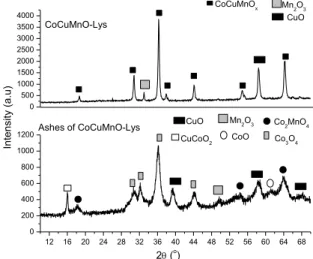
Diffraction diagrams for ashes and calcined powders obtained with Lys and Asp are shownin Figs. 1 and 2 respectively.
The phases identified in ashes of CoCuMnO-Lys obtained after combustion were diverse, among them the corresponding to the main peak was Co3O4, being the rest of the phases specified in Fig 1. After 500 °C-calcination, the desired phase of CoCuMnOx are formed in the sample CoCuMnO-Lys, corresponding to card PDF N° 47-0324 together with other segregated phases like Mn2O3 and CuO shown in Fig. 1. The same occurs in sol-gel combustion synthesis of CoCuMnOx using citric acid as fuel where the desired phase only appears above 500 °C equally mixed with other phases [2], and in the powders obtained by sol-gel synthesis apart from the CoCuMnOxphase, it appears segregated other phases like Mn2O3 after calcined at 500 °C [4]. In the case of ashes of the sample CoCuMnO-Asp a similar situation to that described for Lys occurred: It was identified more than one phase as in Co2MnO4 associated to the main peak being tenorite (CuO) [4] among other phases observed. After calcination, the desired phase of CoCuMnOxwas identifiedin the CoCuMnO-Asp sample apparently pure, as the peaks shown in Fig. 2 (see above) evidenced.
Figure 1: Diffraction diagrams for ashes (down) and calcined powders (up) obtained with Lys.
12 16 20 24 28 32 36 40 44 48 52 56 60 64 68
0 200 400 600 800 1000
1200Ashes of CoCuMnO-Lys
CuO
CoCuMnOx Mn2O3
Co3O4 CoO
Co2MnO4 CuO
CuCoO2 Mn2O3 0
500 1000 1500 2000 2500 3000 3500 4000
In
te
n
si
ty
(a
.u
)
2 (o
)
782
Figure 2: Diffraction diagrams for ashes (down) and calcined powders(up) obtained with Asp.
Regarding the crystallite sizes, the average values obtained for ashes in calcined powders associated with a main peak of around 36° are listed in Table 1. The sample CoCuMnO-Asp exhibited a size of 44nm, smaller than the sample CoCuMnO-Lys, of 54 nm. For powders obtained by sol-gel synthesis, the crystallite was smaller than or equal to 14nm [2]. The values of crystallite size for ashes of both samples were smaller compared with the corresponding calcined powders, and under 20nm. On the other hand, the surface specific area (Table 1) determined by BET technique of CoCuMnO-Lys sample was 23 m2/g and bigger than the CoCuMnO-Asp sample of 13 m2/g. The area of the ashes was bigger than the corresponding powders. Ac-cording to the different fuels used (Asp and Lys), an evident variations in the obtained phases is observed, being these differences probably related with the observed particularities of the combustion processes.
However, it was not obtained any difference in crystallite size and specific area surface values.
Table 1: Average crystallite size and surface specific areas determined by BET for all samples
ROUTE CRYSTALLITE
SIZE (nm)
SURFACE SPECIFIC AREA
(m2/g)
Ashes ofCoCuMnO-Lis 10 35
CoCuMnO-Lis 54 23
Ashes of CoCuMnO-Asp 13 24
CoCuMnO-Asp 44 13
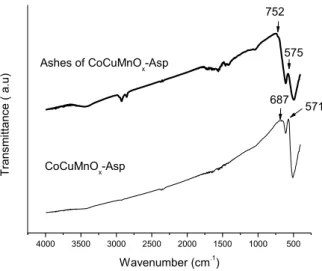
According to scientific, specialized bibliography, the bands of spinel type oxide in FTIR plots should be found in a region comprised between 400 and 700 cm-1 corresponding to the vibration produced by unions between metal and oxygen. The bands around 500 cm-1 is assigned to a vibration of the metallic atom in the tetrahedral environment of oxygen atom (A-O) and the band around 600 cm-1 correspond to a vibration of B atom in octahedral site (oh) of a spinel structure [5]. In Figs 3 and 4 it can be observed the FTIR spectra for ashes and powders for Lys and Asp respectively.
In the ashes of CoCuMnO-Lys and CoCuMnO-Asp samples, the bands are located at 574 and 575 cm-1 respectively and others at 714 and 752 cm-1. These values are assigned to vibrations between metallic
12 16 20 24 28 32 36 40 44 48 52 56 60 64 68
0 200 400 600 800 1000 1200 1400
1600 Ashes of CoCuMnO-Asp
CuMn2O4 CoO
2 (o
)
MnO 0
1000 2000 3000 4000 5000
CuO
Co2MnO4
CoCuMnO-Asp
In
te
n
si
ty
(a
.u
)
783 and oxygen atoms [5]. In the spectrum of ofCoCuMnO-Lys sample bands at 567 cm-1 and 673 cm-1 are ob-served, meanwhile for the spectrum of CoCuMnO-Asp they are located at 571 and 687 cm-1. In pertinent bibliography is reported also that CoCuMnOxpowders have been synthesized by the sol-gel route with cha-racteristic bands between 511 and 599 cm-1 [4]. In brief, CoCuMnO-Asp and CoCuMnO-Lys samples show vibrations associated to tetrahedral and octahedral sites in the range of the bands of metallic oxides [5]. These vibrations can be surely associated with the presence of CoCuMnOx phase in good accord with phase as-sessment from XRD plotted in Fig. 1 up (Lys) and Fig. 2 (Asp) (see above).
Figure 3: FT-IR of ashes (up) and calcined powders (down) obtained with Lys
Figure 4: FT-IR of ashes (up) and calcined powders (down) obtained with Asp
By SEM, it was observed that all samples exhibited a high degree of agglomeration, as displayed in
Fig. 5 (“a” to “d”). In particular, in CoCuMnO-Lys-ashes (Fig 5(a), it can be observed polyhedral particles. Once calcined this particles growth are more clearly observed as distinct, octahedral particles (Fig 5(b)). Similar polyhedral shapes were observed in CuCrMnO4 powders synthesized by sol-gel routes [1]. With
4000 3500 3000 2500 2000 1500 1000 500
567 673
CoCuMnOx-Lys Ashes of CoCuMnOx-Lys
Wavenumber (cm-1)
T
ra
n
smi
tt
a
n
ce
(
a
.u
)
714
574
4000 3500 3000 2500 2000 1500 1000 500
571 687
575 752
CoCuMnOx-Asp Ashes of CoCuMnOx-Asp
T
ra
n
smi
tt
a
n
ce
(
a
.u
)
784 regards on the influence of fuels, CoCuMnO-Asp-ashes and CoCuMnO-Asp-calcined powders evidence a lower size of particle and a more open structure than CoCuMnO-Lys-ashes and CoCuMnO-Lys-calcined respectively, probably caused by the different characteristics of the combustion processproduced in the syn-thesis with Asp fuel where sparks and flame occur. Powders obtained from both syntheses growth after calci-nation, as is evidently observed, too, in TEM micrographs of Fig. 6.
Figure 5: SEM Micrograph of: a) Ashes of CoCuMnO-Lys, (b) CoCuMnO-Lys, (c) Ashes of CoCuMnO-Asp and (d)
CoCuMnO-Asp.
As estimated through TEM observations, the particle size ranges from 20 to 100 nm, (scale line = 20 nm), as shown in Fig. 6, where are displayed TEM micrographs of all obtained powders. The polyhedral shape of particles is also evidenced. The average size of particle for CoCuMnO-Lys resulted in 44 nm. In gel combustion synthesis of CuCr2O4 powders calcined at 500°C were reported a similar average particle size of 80nm [6]. Additionally these authors studied the influence of calcination temperature on optical properties of pigments [1].
(a)
(b)
(c) (c) (d)
785
Figure 6: TEM Micrograph of: a) Ashes of CoCuMnO-Lys-ashes, (b) CoCuMnO-Lys-calcined, (c)
CoCuMnO-Asp-ashes and (d) CoCuMnO-Asp.
Ashes obtained by synthesis with aspartic acid were studied by TGA and DTA analysis. The plots are shown in Fig. 7. At 227 and 313 °C were evident two exothermic peaks. At 227 °C the peak could be explained as a release of H2O, CO2 y N2 gases with a loose of weight of 1.5% aprox. Similar peaks were observed in xerogels precursors for CuCrMnO4 gels at 227°C too [1]. With respect to the 313°C peak, it could be associated with a phase transformations from the different spinels detected in ashes ((CoMn, CuO, MnO, Co2MnO4 y CuMn2O4) to CoCuMnOxin good accord with the phases evolution observed from DRX diagrams. These transformations involved a loose of weight of 2% aprox.
Figure 7: DTA and TGA curves of Asp of CoCuMnO-Asp-ashes between 25°C and 850°C in air
(a) (b)
(c)
(a)
(d)
100 200 300 400 500 600 700 800 900
-10 0 10 20 30 40 50 60 70 80 90 100 110
DTA TGA
Temp (C)
D
T
A
(u
V)
TGA DTA
227 313
-3,5 -3,0 -2,5 -2,0 -1,5 -1,0 -0,5 0,0 0,5
T
G
A
(%
)
786
4. CONCLUSIONS
This work puts forward the synthesis of Co, Cu, Mn mixed oxides- for solar selective paints- by means of original stoichiometric one-step combustion methods starting from Mn(NO3)2, Co(NO3)26H2O, Cu(NO3)23H2O and Aspartic acid (Asp) or Lysine (Lys) as fuels. After combustion, the resulting ashes were calcined at 500 °C. Both oxides present the CoCoMnOx crystalline phase, wherever for Lys powders appear segregated phases. The average crystallite size calculated with Scherrer equation was 44 nm for Lys powders and 54 nm for Asp, meanwhile, the specific surface areas were 23 and 13 m2/g respectively. Throughout FTIR, it appeared vibrations associated with spinel metallic oxides for both calcined powders (Asp and Lys). Additionally, it was observed, by means of TEM, polyhedral particles with an average size of 20 to 100 nm. In particular, an average size of 44nm in CoCuMnOx-Lys was determined. According to the differ-ent fuels used (Asp and Lys), an eviddiffer-ent variations in the obtained phases and surface morphology were observed. Probably these differences are related with the particular characteristics observed in each combus-tion processes. However, it was not obtained any significant difference in crystallite size and specific area surface values. It is of considerable importance the study of further syntheses processes to verify this trend.
5. ACKNOWLEDGMENTS
Authors thank founds received from NTU, Regional Faculty Mendoza,through the PID INN1342 Project.
6. BIBLIOGRAPHY
[1] GENG, Q., ZHAO, X., GAO, X., et al., “Optimization design of CuCrxMn2-xO4-based paint coatings used
for solar selective applications”, Solar Energy Materials & Solar Cells, v.105, pp. 293-301, Jul.2012. [2] GENG, Q., ZHAO, X., GAO, X., et al., “Sol–Gel Combustion-Derived CoCuMnOx Spinels as Pigment
for Spectrally Selective Paints”, Journal of the American Ceramic Society, v. 94, n.3, pp. 827-832, 2011.
[3] VINCE, J., ŠURCA VUK, A., OPARA KRAŠOVEC, U.,et al., “Solar absorber coatings based on CoCuMnOx spinels prepared via the sol–gel process: structural and optical properties”, Solar Energy Materials & Solar Cells, v. 79, pp. 313-330, 2003.
[4] KALUŽA, L., OREL, B., DRAŽIČ, G.,et al., “Sol–gel derived CuCoMnOx spinel coatings for solar absorbers: Structural and optical properties”., Solar Energy Materials & Solar Cells, v. 70, pp. 187-201, 2001.
[5] HOSSEINI, S.A., ALVAREZ-GALVAN, M.C., FIERRO, J.L.G., et al., “MCr2O4 (M = Co, Cu, and Zn) nanospinels for 2-propanol combustion: Correlation of structural properties with catalytic performance and
stability”, Ceramics International, v. 39, pp. 9253, 2013.
[6] GENG, Q., ZHAO, X., GAO, X., et al., “Low-temperature combustion sinthesys of CuCr2O4 spinel powder for spectrally selective paints”,Journal of Sol-Gel Science and Technology, v. 61, I 1, pp. 281-288, 2012.
[7] TONIOLO J, C., LIMA, M.D., TAKIMI, A. S., et al., “Synthesis of alumina powders by the glyc
ine-nitrate combustion process”, Materials Research Bulletin, v. 40, pp. 561-571, 2012.
[8] RAO K. V., SUNANDANA, C. “Co3O4 nanoparticles by chemical combustion: Effect of fuel to oxidizer ratio on structure, microstructure and EPR”, Solid State Communications, v. 148, pp.32–37, 2008.
[9] TONIOLO, J., TAKIMI, A., BERGMANN, C. “Nanostructured cobalt oxides (Co3O4 and CoO) and metallic Co powders synthesized by the solution combustion method”. Materials Research Bulletin, v 45, pp 672–676, 2010.