RBRH, Porto Alegre, v. 22, e12, 2017 Scientiic/Technical Article
http://dx.doi.org/10.1590/2318-0331.011716079
Proposal of a methodology for pre-selection of sewage treatment systems within
watersheds
Proposta metodológica para pré-seleção de sistemas de tratamento de esgoto no âmbito de bacias hidrográficas
Lucas Luiz Dall’Orto Fantin1, José Antonio Tosta dos Reis1 and Antonio Sérgio Ferreira Mendonça1
1Universidade Federal do Espírito Santo, Vitória, ES, Brazil
E-mails: [email protected] (LLDOF), [email protected] (JATR), [email protected] (ASFM)
Received: June 14, 2016 - Revised: October 19, 2016 - Accepted: October 19, 2016
ABSTRACT
The selection of sewage treatment plants within watersheds is a complex process when there are multiple outlows presenting different loads and watercourses presenting different assimilation capabilities. In this context, the present study aims to establish a methodology for pre-selection of wastewater treatment alternatives within watersheds. The methodology involves the combined use of water quality model, optimization technique and a set of technical and economic criteria associated with different wastewater treatment systems. To evaluate the proposed methodology there were considered different efluent disposal scenarios in the Pardo river watershed. Pardo is a major tributary of the Itapemirim river, watercourse located in the southern portion of Espírito Santo State, Brazil. The results indicated that the optimization model, that aimed to minimize wastewater treatment eficiencies within the watershed, considering watercourses self-puriication capacities, selected treatment systems ranging from the combination of UASB and polishing lagoons systems to slow iniltration, treatment alternatives that presented the lowest net cost estimates. The incorporation of equity perspective between treatment systems increased the total present net cost associated with wastewater treatment within the watershed.
Keywords: Water quality model; Optimization; Genetic algorithm; Wastewater treatment.
RESUMO
O processo de seleção de uma estação de tratamento de esgoto é complexo quando observado do ponto de vista de uma bacia hidrográica, onde existem múltiplos lançamentos apresentando diferentes cargas e corpos d’água com diferentes capacidades de assimilação. Neste contexto, a presente pesquisa tem como objetivo estabelecer metodologia para a pré-seleção de alternativas de tratamento de esgoto no âmbito de bacias hidrográicas. A proposta metodológica envolve o uso combinado de modelo de qualidade de água, técnica de otimização e um conjunto de critérios de natureza técnica e econômica associados aos diferentes sistemas de tratamento de esgotos. Para avaliação da metodologia proposta foram considerados diferentes cenários de disposição de eluentes na bacia hidrográica do rio Pardo, importante aluente do rio Itapemirim, curso d’água da porção sul do estado do Espírito Santo. Os resultados indicaram que o modelo de otimização que buscou a minimização das eiciências de tratamento no âmbito da bacia, permitindo uso da capacidade e de autodepuração dos cursos d’água, selecionou sistemas de tratamento que variaram da combinação de reatores UASB e lagoas de polimento a sistemas de iniltração lenta, alternativas de tratamento que apresentaram menores estimativas de custos presentes líquidos. A incorporação da equidade entre os sistemas de tratamento aumentou signiicativamente os custos presentes líquidos totais associados ao tratamento de esgoto no âmbito da bacia hidrográica.
INTRODUCTION
Urban areas population concentration is one of the main aspects to be considered in water resources management. Densely occupied regions usually present high water demands, both for public and industrial supply, as well as for dilution and removal of pollutant loads. In Brazil, increasing urban and industrial pollution loads, associated with inadequate land use, erosion, deforestation, indiscriminate use of agricultural inputs and mining have made water supply and water quality conditions severe in many places. Among water quality control measures, individual or collective sewage treatment before inal disposal is usually the main - and often the only - control strategy through which it is sought released pollutants concentrations reduction to enable compliance with the watercourses quality standards recommended by Brazilian environmental legislation (VON SPERLING, 2005).
The sewage treatment system selection process should be based on the analysis of technical, economic and environmental criteria, taking into account treatment alternatives qualitative and quantitative aspects (VON SPERLING, 2005). Cost, however, is usually considered the most relevant aspect for the selection of treatment plants (TCHOBANOGLOUS; BURTON, 1991).
The sewage treatment plant selection problem becomes more complex when observed from point of view of a river watershed, where there are multiple releases presenting different loads and water bodies presenting different quality conditions and assimilation capacities (REIS; VALORY; MENDONÇA, 2015).
In this context, the use of water quality simulation models can support sewage treatment systems selection processes. Park and Lee (2002), Paliwal, Sharma and Kansal (2007), Zhu et al. (2008), Zhang et al. (2012), Salla et al. (2013) and Calmon et al. (2016) works, for example, illustrate how water quality mathematical models can support the evaluation of raw or treated efluents inal disposal effects on surface watercourses. However, water quality mathematical simulation alone does not indicate the optimal solutions for sewage treatment systems deinition problems. Through integration of water quality models and optimization techniques it is possible to achieve the optimal combination of treatment systems to be adopted within a basin when systems deinition involves multiple objectives (ANDRADE; MAURI; MENDONÇA, 2013).
According to Cho, Seok Sung and Ryong Ha (2004) and Aras, Togan and Berkun (2007), mathematical programming conventional methods (Linear Programming, Nonlinear Programming, Dynamic Programming) have been used repeatedly to solve problems associated with the selection of sewage treatment systems. In addition, these authors note that, due to the limitations of conventional methods and the rapid development of computers and software, new optimization methods such as Genetic Algorithm, Fuzzy Logic and Artiicial Neural Networks have been progressively more employed for solving sewage treatment plants selection problems.
The Genetic Algorithm, a search algorithm that seeks to solve optimization problems, based on the Evolution of Species Theory (theory originally established by the English physiologist Charles Darwin), has as basic foundation that the evolution of individuals (solutions of the optimization problem) occurs by stochastic in nature genetic operators application. These search strategies for the best optimization problems solutions have been
eficient, usually leading to the global optimal value (NICKLOW; KAINI; ARTITA, 2012).
Burn and Yulianti (2001), Aras, Togan and Berkun (2007), Nicklow, Kaini and Artita (2012), Cho and Lee (2014) and Valory, Reis and Mendonça (2015) works employed water quality models and Genetic Algorithm for selecting sewage treatment systems within watersheds. The optimization models proposed by these authors, structured from the combination of different functions and objectives, were established with the incorporation of aspects such as implementation and treatment costs minimization, loads maximization, numbers of environmental quality standards violations and/or violations magnitudes minimization.
The main objective of this work is to establish a methodological proposal for pre-selection of sewage treatment processes within a river basin. The proposal involves the combined use of water quality model and Genetic Algorithm, similar to the works conducted by the authors indicated in the previous paragraph. However, it covers technical criteria and incorporates economic analysis associated with operation and implementation costs for different sewage treatment options. The proposed methodology, even intended to be generic for application in any river basin, will be applied in this study considering different sanitary efluent disposal conditions in the Pardo river basin. This river is located in the Espírito Santo State, in Brazil.
STUDY AREA
The study area considered in this study is the Pardo river catchment area, an important tributary of the Itapemirim river. This river is the main watercourse in the southern portion of the Espírito Santo State. The Pardo river basin drainage area, maximum altitude and perimeter are approximately 611 Km2, 1,580 m and
114 km, respectively.
The region economy relies heavily on marble and granite extraction and processing. There are also alcoholic beverage industries and agricultural production, as well as slaughterhouses and dairy cooperatives. Existing and potential conlicts are concentrated on the need to preserve rivers water quality in order to obtain potable water by treatment, considering the existence of these potentially polluting activities (IEMA, 2015).
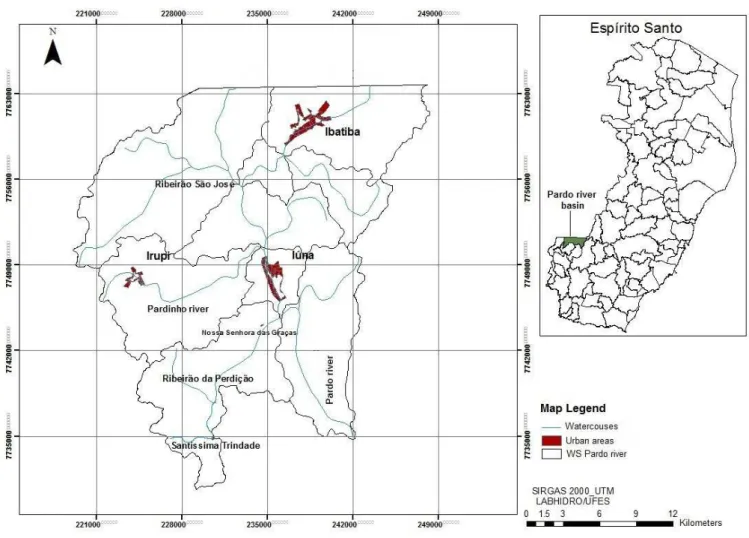
Pardo river basin (Figure 1) includes Pardo river and three main tributaries (Ribeirão São José, Pardinho and Ribeirão Perdição rivers). The Pardo river receives domestic sewage outlows from Ibatiba and Iúna municipalities. The Pardinho river, in turn, receives domestic sewage outlows from Irupi municipality. Perdição river receives domestic sewage produced by Santíssima Trindade and Nossa Senhora das Graças villages, settlements located in Iúna municipality rural area. There is no sewage treatment plant installed in any of the domestic waste disposal points.
Figure 2 shows, schematically, the modeled water system, indicating the main watercourses, their extensions by segments (from segment 1 to 8) and the different raw domestic sewage outlow points associated with the Pardo river basin. Pardo river total extension under analysis corresponds to 57.9 km.
Figure 1. Pardo river basin water system.
water quality classes uses deinition for the same rivers. From these authors, information was obtained concerning Pardo River and its main tributaries minimum reference lows and quality conditions, efluent lows produced by the different population nuclei, expressions used for kinetic constants appropriation and expressions used for relations between low variables, velocities and depths watercourses mean variables and other expressions necessary for the water quality model application.
MATERIALS AND METHODS
Water quality modeling
For water quality simulation, the computational model developed by Valory (2013) was utilized. This model reproduces, in a MatLab software environment, the mathematical functions used by QUAL-UFMG model to simulate DO spatial variation and BOD concentrations. In Brazil, the use of the QUAL-UFMG model - which has its functional and computational representations detailed by Von Sperling (2007) - has become frequent, as shown by Teodoro et al. (2013), Salla et al. (2013), Von Sperling and Von Sperling (2013) and Calmon et al. (2016). In the simulated sections, the mass balance was made by considering the contribution of point and distributed sources. Point sources were constituted by Pardo river tributaries (Pardinho, Perdição and São José rivers) and the ive domestic efluents outlows from the urban nuclei located in the Pardo river basin (Ibatiba, Iúna, and Santíssima Trindade and Nossa Senhora das Graças districts). The distributed sources, in turn, were composed by incremental lows and BOD loads associated with rural population sewage.
Calmon et al. (2016) estimated the incremental low for watercourses located in the Pardo river basin by means of mass balance, considering the difference between the lows in the inal section of the simulated reaches and the low in their headwaters. For simulations, carried out in the Pardo river basin, the incremental low rate 3.53 L/s was assumed, presenting 5 mg/L and 2 mg/L DO and BOD concentrations, respectively. These DO and BOD concentration values were assumed according to Von Sperling (2007).
Pardo river basin watercourses lows, domestic sewage lows, depths, temperatures and kinetic coeficients were those adopted by Calmon et al. (2016).
For low values, 50% of the reference lows used in the granting process in the State of Espírito Santo (Q90) were considered. All low values were estimated from low measurements performed at the Terra Corrida - Montante station, a low gauging station installed and operated by the Brazilian National Water Agency (ANA).
Calmon et al. (2016) indicated a 20.6 °C average temperature and an 846 meters average altitude for the Pardo river basin. This information supported water body oxygen saturation concentration. determination. In this work, 8.11 mg/L saturation concentration was assumed considering value estimated by using expression proposed by Popel (1979).
The functional relations between low and velocity and between low and depth (potential functions in the QUAL-UFMG model) were established from records of low measurements
performed at the Terra Corrida - Montante low gauging station, operated in the Pardo river. Equations 1 and 2, also appropriated from Calmon et al. (2016), allowed estimates of watercourses velocities and depths as a function of low rates.
0.6305
0.1433
=
U x Q (1)
0.2566
0.6076
=
H x Q (2)
In Equations 1 and 2, U represents the mean velocity (m/s), H the mean depth (m) and Q the low (m3/s).
The average domestic sewage lows values relative to Pardo river basin urban populations are presented in Table 1.
Considering EPA (1985) and Thomann and Mueller (1987), BOD oxidation coeficient in watercourses (Kd) was assumed to be 0.5 d-1, a conservative value in terms of organic loads reduction
in the receiving bodies, consistent with current technical literature typical values.
The kinetic constant that regulates the atmospheric redox process (K2) was estimated by the original expression deined by O’Connor and Dobbins, in 1958, considering relations between lows and speeds (Equation 1) and lows and depths (Equation 2). Equation 3 deines the kinetic constant that regulates the atmospheric re-reaction process.
(
) (
0.5)
1.50.63 0.26
2 3.73 0.1433 0.6076
−
=
K x x Q x x Q (3)
According to Von Sperling (2007), processes involving algal interrelations with other constituents are quite complex and coeficients are not easily determined. In addition, interactions with algae present are more important for lentic environments. Therefore, for DO proiles simulation, the DO production (Photosynthesis) and consumption (Breathing) rates associated with algal biomass were disregarded in the present study.
The inversion of the bottom sludge layer, which is not normally fully stabilized, can be considered a source of BOD, compensating its decay due to the sedimentation processes. Thus, BOD decay coeficients related with sedimentation and oxygen demand associated with sediments were not considered. This disregard of the organic matter sedimentation phenomenon is in favor of safety, considering inal disposal of raw sewage, since in BOD modeling it is not considered the BOD decrease resulting from sedimentation. Additionally, it is important to observe that the amount of sedimentable solids present in the inal treated sewage efluent is usually very low, with less inluence
Table 1. Domestic sewage average lows and urban populations in the Pardo river basin for the analysis time horizon.
Urban nucleus Urban population (in habitants)
Urban outlow (L/s)
Ibatiba 18125 24.33
Irupi 4918 5.24
Iúna 14821 19.90
N. Sa das Graças 600 0.64
Sta. Trindade 301 0.32
of sedimentation and possibility of formation of bottom sludge in the water body (VON SPERLING, 2007).
The raw domestic sewage BOD5,20 concentration adopted was 400 mg/L. This value corresponds to an upper limit for this kind of efluent, as indicated by Von Sperling (2005) and Jordão and Pessoa (2005). DO concentration for the raw domestic sewage was assumed to be null. It is important to note that the zero value assumed for the raw and, consequently, treated sewage DO concentration was adopted in order to simulate more rigorous scenarios than some of those that happen in practice, since some treatment plants generate efluent releases presenting DO concentrations that can reach 2 mg/L, as in activated sludge processes cases.
In the present study, due to the lack of consistent information about sanitary sewage in the Pardo river basin rural areas, it was assumed, in safety favor, that any BOD load from the sewage generated by the rural population would reach the water bodies with no reduction caused by individual systems treatments or soil raw sewage disposal, generating direct incremental BOD loads throughout all the Pardo and Pardinho rivers and Perdição and São José creeks extensions. The adopted BOD incremental load was 9.35 g DBO/day.m, as assumed by Calmon et al. (2016).
Optimization technique
The optimization technique employed in the present study is the Genetic Algorithm (GA), a direct search optimization stochastic population method inspired by the mechanisms of evolution of the species, which comprise population genetics processes and individuals survival and adaptation. The works of Holland (1975), Holland and Goldberg (1989), Michalewicz (1994) and Lacerda and Carvalho (1999) discuss the different conceptual aspects associated with GA use.
Water quality model and GA were jointly used to determine the minimum treatment eficiencies associated with each efluent disposal point, that is a primary information for pre-selection of sewage treatment systems. This determination precedes the consideration of other technical and economic criteria.
The GA operators and parameter values employed in the optimization procedure reproduced those used by Valory (2013), when assessing sewage treatment eficiencies for hypothetical efluent releases in Santa Maria da Vitória river basin upper portion, also located in Espírito Santo State, Brazil. In this way, the following operators and corresponding parameters were assumed:
• Initial population presenting 20 (twenty) individuals, suficient for convergence to solve the optimization problem without relevant demands regarding processing times;
• The selection was applied to create an intermediate population, submitted to the crossing and mutation processes to deine the next generation. Tournament selection was used and 10 (ten) individuals from the initial population were randomly selected to participate in the process; • The individual who presented the highest itness was
chosen to compose the intermediate population;
• From the intermediate population, the selected individuals were crossed with each other, and then the mutation operators were applied. For the crossover, a 50% rate was assumed;
• For the mutation - operator whose purpose is to ensure the diversity of individuals - it was adopted an adaptive mutation, a type that randomly generates mutations in the genes so that individuals adhere to the objective function and established restrictions;
• Elitism was used to preserve and refer the most adapted individual from each generation to the next generation. This individual was not modiied by the different genetic operators employed in this study.
The GA is a Metaheuristic optimization technique. Its application, therefore, does not guarantee the achievement of global optimum. Genetic Algorithms, while not necessarily providing the overall optimal solution, are capable of providing reasonable solutions with processing time considered feasible. In order to alleviate the problem of failure to obtain the global optimum, ive (5) simulations were conducted for each employed optimization model. The appropriation of equal or close solutions indicated that the global optimum was obtained or approached.
Optimization models
In this work, the main objective of optimization models application is to minimize the sum of treatment eficiencies or inequity between different sewage treatment plants associated to the Pardo river basin, imposing as restrictions the maintenance of quality standards required by CONAMA Resolution Number 357/2005 (BRASIL, 2005) for all water bodies reaches analyzed. Different optimization models for sewage treatment systems in river basins selection processes can be found in Mulligan (1991), Marsh and Schilling (1994), Burn and Yulianti (2001), Reis, Valory and Mendonça (2015) and Santoro (2016) works.
Equation 4 and Inequalities from 5 to 8 form the irst optimization model (optimization model 1), assuming Pardo river basin watercourses as class 2. It is important to note that the Pardo river and its tributaries have not undergone water uses classes deinition. In this context, the water quality standards indicated for DO and BOD in class 2 rivers have shaped the constraints established by Inequalities 7 and 8.
( )
∑
n i i=1
Minimize f E = E (4)
( ) ≥ 0
Ei Efficiency (5)
( ) ≤ 90
Ei Efficiency (6)
5.0
≤
Watercourse BOD (7)
5.0
≥
The second optimization model (optimization model 2), originally proposed by Burn and Yulianti (2001), presents the objective function equation (9). This model presents as main objective the determination of treatment eficiencies in a context of inequality between systems minimization. The Inequalities 5 to 8 also represent optimization model 2 constraints.
=
−
∑n Raw sewage (i) Raw sewage
i 1 (i)
Load Load
Minimize f(E) =
E E (9)
In Equations 4 and 9 and in inequalities from 5 to 8, Ei represents ith sewage treatment system BOD removal eficiency
considered for the basin, Watercourse BOD the Biochemical Oxygen Demand value for the treated sewage and Watercourse DO the Dissolved Oxygen concentration in the watercourse.
In Equation 9, the relationship established by LoadDischargei (raw sewage organic load from the i-th efluent discharge in the basin) and Ei (BOD removal eficiency from the ith treatment system in
the water system) represents equity among different considered outlows. Thus, the greater the raw organic load associated with a particular outlow, the greater the estimated BOD removal eficiency at that efluent discharge point.
According to CONAMA Resolution Number 430/2011, Article 21, the maximum permitted treated efluents BOD concentration is 120 mg/L. However, the same Resolution indicates that such concentration may be exceeded in those situations where the treatment system presents a minimum BOD removal eficiency 60% or when the receiving body self-puriication capacity is suficient to keep DO and BOD concentrations inside limits corresponding to the watercourses water use classes objectives (BRASIL, 2011). In this context, an additional constraint associated to the BOD removal was added to the optimization model 1, establishing three different optimization groups for each of the efluent disposal scenarios object of simulation. Additional restrictions admitted the following forms:
• Ei ≥ 0: raw sewage is admitted, considering that all organic matter will be assimilated by the watercourses self-puriication capacities, with the BOD values within the limits established by CONAMA Resolution 357 for all water systems;
• Treated BOD ≤ 120 mg/L: observing the maximum BOD value in treated sewage, as established by CONAMA Resolution 430/2011;
• Ei ≥ 60%: According to the minimum BOD removal eficiency value established by CONAMA Resolution 430/2011, it is accepted the release of treated sewage presenting BOD concentration values higher than 120 mg/L.
Technical criteria and costs for the implementation and operation of sewage treatment systems
The different technical criteria and implementation and operation costs associated to different sewage treatment systems, necessary for the pre-selection process, were obtained from Von Sperling (2005), Jordão and Pessoa (2005) and USP (2004) works.
Economic analysis
For economic analysis, it was employed the Net Present Value Method (NPV), which consists of determining a value at an instant considered as initial, from a cash low formed by a series of revenues and expenditures (HIRSCHFELD, 2012).
Considering the existence of cash low beneits and costs, the sum of all beneits (positive) and costs (negative) values produces the cash low net present value. Thus, if the net cash low present value is positive, there is predominance of the present beneits values in relation to the costs. On the other hand, if the net cash low presents negative value, there is predominance of costs present values in relation to the beneits, both obtained with the application of a characteristic interest rate. Equation 10 shows that a given alternative net present cash low value is therefore the algebraic sum of the various present values involved.
(1 )−
=
∑ + n
n
NPL F i (10)
In Equation 10:
• NPL: net cash low present value for a given alternative; • n: number of periods involved in each element of the
revenues and cash low expenditures series;
• Fn: each of the various amounts involved in the cash low; • i: comparative interest rate or minimum attractiveness rate, also known as the equivalence, expectation or discount rate.
When there is expenditures predominance, or for cases where they make up the entire cash low, it is made signals conversion, meaning that the beneits become negative and the costs positive. In order to avoid confusion, the net present cost (CPL) is presented as the net present value with negative sign:
= −
CPL NPL (11)
In this work, a 5% discount rate (i) and a 20 year period sewage treatment systems useful life were considered for the CPL calculation. As the present work covers the pre-selection of sewage treatment systems, the economic analysis objective is to indicate the alternative that would offer the lowest cost. In this context, the CPL of all the sewage treatment options are calculated and those that present the lowest net present cost values are chosen as the best treatment alternatives, for each efluent disposal point.
Sewage treatment systems pre-selection for the Pardo river basin
according to the interest rate and the estimated useful life. At the end of the process, sewage treatment systems are ordered considering increasing CPL values.
In order to demonstrate the application of the procedure for treatment systems pre-selection, different hypothetical scenarios were considered, based on different technical criteria combinations. Although the best understanding of the study area could lead to a more consistent selection of technical criteria to be met at the different disposal points for the villages located in the rural area of Iúna municipality (Santíssima Trindade and Nossa Senhora das Graças villages) there were prioritized non-mechanized systems, associated with low energy consumption. In this way, different scenarios were deined as follows:
• Scenario 1: only the minimum treatment eficiencies were considered, not requiring attendance of any other technical nature condition;
• Scenario 2: no mechanized systems were allowed in any of the efluent disposal points, in order to limit the energy consumption. In this case, only systems that do not require power for operation could be chosen in the pre-selection process. In addition, soil treatment and inal disposal systems were not allowed;
• Scenario 3: Only in the Santíssima Trindade and Nossa Senhora das Graças villages treatment systems that require electric energy for operation were not admitted. In these localities, soil treatment and inal disposal systems were accepted, an alternative not considered for the Ibatiba, Iúna and Irupi municipal nucleus.
In the different simulation scenarios setup, three different sewage treatment conditions were considered, according to additional restrictions indicated in the “Optimization Models” section: a) Condition 1: raw sewage disposal, considering that all organic matter would be assimilated by the watercourses self-puriication capacities, ensuring the maintenance of the DO and BOD concentrations within class 2 limits, as established by the CONAMA Resolution 357/2005, in all watercourses reaches; b) Condition 2: maximum 120 mg/L BOD values for treated sewage outlows, according to CONAMA Resolution 430/2011; and c) Condition 3: imposition of BOD removal treatment eficiency greater than or equal to 60%, in accordance with CONAMA Resolution 430/2011, admitting treated sewage BOD concentration values higher than 120 mg/L.
It is important to note that the use of optimization model 2 aims to evaluate the variation of eficiencies with treatment systems equity perspective introduction. Considering this aspect, the optimization model 2 was only used for inal efluents disposal Condition 1.
RESULTS AND DISCUSSION
Water quality modeling considering inal disposal of raw efluents
A irst simulation conducted with the help of the water quality model considered the disposal of raw domestic sewage in ive disposal points. This simulation allowed the evaluation of Pardo
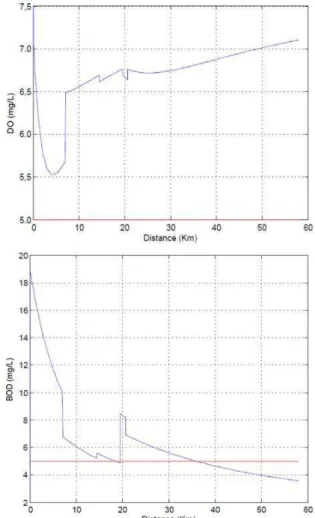
river basin watercourses dilution and self-puriication capacities through the analysis of DO and BOD concentration proiles. Figure 3 shows the DO and BOD concentration proiles along the entire Pardo river simulated extension, considering different inlows produced by tributaries and raw domestic efluents. In this igure (and in the others that are presented in this section) the red lines refer to the quality standards for class 2 rivers uses, according to CONAMA Resolution 357/2005.
BOD concentration peaks are associated to the efluent inputs produced by Ibatiba (beginning of the simulated section), Irupi (km 14.5) and Iúna (km 19.6) municipalities. The highest BOD concentration estimated with quality model aid resulted from Ibatiba (most populous municipality located in the basin) municipality efluents disposal, approximately 18.8 mg/L. In the stretch between Ibatiba municipality and the conluence with the São José stream (km 7.1) the BOD concentration slightly decreased to values little higher than 10.0 mg/L. The São José stream, which does not receive domestic sewage inputs, produced a signiicant dilution of the domestic sewage produced by Ibatiba population. It is important to note that the efluents produced by Irupi municipality (located in the Pardinho river basin), one of the three municipalities that most contribute to BOD load generation in the Pardo river watershed, did not produce signiicant increase in the Pardo river BOD concentration. This is due to the fact that, along the Pardinho river, the efluent BOD concentration
produced by Irupi municipality was substantially reduced by the self-puriication process.
The second highest concentration peak estimated by the water quality model (8.5 mg/L) was due to the inal disposal of the sewage produced by Iúna municipality, the second most populous municipality located in the basin. The raw sewage load associated with the Iúna municipality presented a small decay up to kilometer 20.7, where tributary Ribeirão Perdição discharge the occurs. This watercourse, even receiving sewage from Iúna villages (Santíssima Trindade and Nossa Senhora das Graças), contributes to the dilution of the Iúna municipality efluents. It is important to note that, with the help of the water quality model, it was possible to observe that the BOD concentrations along the Pardo river would remain above the corresponding environmental quality standard for class 2 rivers uses, if established the boundary conditions that conform the simulations.
The DO concentration reductions along the Pardo river are related to the BOD concentration peaks, since the oxidation of organic matter in the raw sewage requires DO for decomposing microorganisms, mainly composed by aerobic heterotrophic bacteria, respiration maintenance.
Due to the discharge of the raw sewage generated in the Ibatiba municipality, the DO concentrations decay in the irst 10 kilometers was signiicant, starting from 7.5 mg/L and reaching approximately 5.6 mg/L. The remaining DO reductions were small (approximately 0.10 mg/L). Ribeirão São José tributary inlow, due to its reduced organic load, produced a signiicant increase in the Pardo river DO concentrations, to approximately 6.5 mg/L. It is important to note that, even though DO concentrations remained above the environmental quality limit established for class 2 rivers uses, the reduction of DO concentrations may affect the aquatic community, mainly due to the extinction of species more sensitive to oxygen concentrations variations.
Figure 4 shows the DO and BOD concentration proiles for the Pardinho river, which receives raw efluents from Irupi municipality. The BOD concentration peak, related to the inal disposal of cited efluent, reaches 13.0 mg/L, substantially higher than the quality standard for rivers class 2 uses (5.0 mg/L). As a consequence, there is DO consumption, producing, approximately, 6.1 mg/L minimum concentration.
Figure 5 presents the DO and BOD concentration proiles for the tributary Ribeirão Perdição, considering the efluents releases produced by Santíssima Trindade and Nossa Senhora das Graças, rural villages that belong to Iúna municipality. DO and BOD concentrations did not change signiicantly, as these settlements present small populations. In addition, it is important to note that the standards set for DO and BOD for class 2 rivers uses have been met along the entire length of the Ribeirão Perdição tributary.
Minimum efluent treatment eficiencies
Table 2 summarizes the treatment eficiencies generated for all efluent disposal points in the Pardo river basin, estimated by using the water quality model and the different optimization models considered (optimization models 1 and 2, according to the section Models Optimization).
Figure 4. DO and BOD concentration proiles for the Pardinho river.
According to Von Sperling (2007), secondary sewage treatment systems present a minimum BOD removal eficiency corresponding to approximately 25%. From this perspective, in the subsequent table, all estimated eficiencies presenting values less than 25% were presented in parentheses, next to the symbol “<25”. In Table 2, the highlights represent the eficiencies, per sewage disposal point, that led to the lowest sum of eficiencies in the Pardo river basin.
Figure 6 shows the DO and BOD concentration proiles for the Pardo river after the incorporation of the efluent treatment eficiencies estimated by using the optimization model 1, assuming the inal disposal of raw efluents (condition 1 of inal efluents disposal). In this case, according to Table 2, Ibatiba and Irupi municipalities sewage treatment eficiencies 82% and 73%, respectively, were assumed. For the other urban areas (Iúna city and Santíssima Trindade and Nossa Senhora das Graças districts), release of raw sewage was considered.
At the conluence of the São José tributary with the Pardo river a signiicant dilution of domestic sewage was observed, since the cited tributary does not receive any sewage discharge. Pardo River BOD concentrations reached maximum values 4.9 mg/L (due to Ibatiba sewage inal disposal) and 3.3 mg/L (function of Iúna sewage inal disposal) immediately after the sewage disposal points. As a consequence of the self-puriication process, the BOD concentration was reduced to 2.3 mg/L.
For the DO proile, Pardo river showed little variations, with concentration reduction to a minimum approximately 7.0 mg/L, due to the discharge of domestic efluent from Ibatiba district. The inlux of the São José tributary, as a function of dilution processes, produced an increase in the Pardo river DO concentration to approximately 7.3 mg/L.
Table 2. Minimum sewage treatment eficiencies estimated by the optimization model applied to the Pardo river basin. Efluent
disposal condition
SOLUTIONS
LOCALITY
Ibatiba Irupi Nossa Senhora das Graças
Santíssima
Trindade Iúna
Optimization Model 1 Sum
1
1 82 73 0 0 0 155
2 82 74 0 0 0 156
3 82 73 0 0 0 155
4 82 73 0 0 0 155
5 82 73 0 0 0 155
2
1 84 73 71 71 71 370
2 82 73 70 70 70 365
3 83 73 70 70 71 367
4 84 73 71 70 71 368
5 83 73 71 71 71 369
3
1 82 74 60 61 60 337
2 82 74 61 61 62 340
3 82 73 60 60 60 335
4 82 73 60 61 62 338
5 83 73 61 60 62 339
Optimization Model 2
1
1 95 73 (4)* (2)* 94 264
2 95 73 (4)* (2)* 95 269
3 95 73 (4)* (2)* 95 269
4 94 73 (4)* (2)* 95 269
5 95 73 (8)* (3)* 95 274
* Notes: Treatment eficiencies generated by the optimization model. Von Sperling (2007) suggested that for secondary sewage treatment systems, the minimum eficiency of BOD removal should be approximately 25%.
The Pardinho river DO and BOD concentration proiles are presented in Figure 7. The BOD peak concentration, related to the cited efluent inal disposal, reached 4.85 mg/L, concentration close to the maximum limit established by CONAMA Resolution 357/2005. In the DO proile, estimated variations were not relevant.
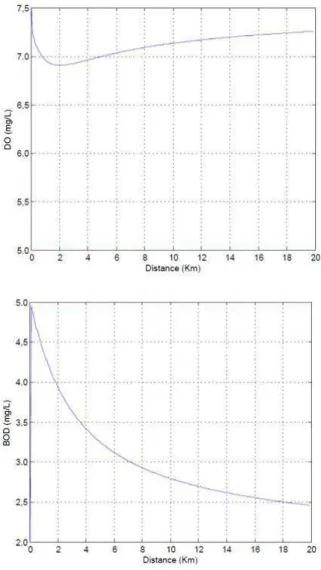
Figure 8 shows the DO and BOD concentration proiles for the Ribeirão Perdição tributary, considering the releases of efluents produced by Santíssima Trindade and Nossa Senhora das Graças, rural villages that belong to Iúna municipality. DO and BOD concentrations did not change signiicantly, since these villages present small numbers of inhabitants. In addition, it is important to note that the standards set for DO and BOD for class 2 rivers use have been met along the entire length of the Ribeirão Perdição tributary, even assuming the prospect of raw sewage inal disposal.
Graphs similar to those presented in Figures 6, 7 and 8 were produced for the other inal efluents disposal conditions and optimization models employed.
Efluent treatment systems
Table 3 shows the pre-selected efluent treatment systems for the perspective in which minimum BOD removal eficiency is the only technical criterion, considering the inal disposal and increasing CPL values, being considered Condition 1 efluents disposal and eficiencies estimated with the aid of optimization model 2. Tables similar to Table 3 were produced for the other scenarios and efluents disposal conditions.
Table 4 presents, by disposal point, scenario and treatment condition, the sewage treatment system that presented the lowest CPL. Table 5, in turn, shows referred treatment systems CPL values and total CPL for the Pardo river watershed.
When Pardo river basin watercourses self-puriication capacities were ignored (restriction imposed by conditions 2 and 3, optimization model 1), the slow iniltration systems resulted as sewage treatment alternatives for different localities, considering a simulation scenario in which eficiency was the only technical criterion (scenario 1).
Figure 7. DO and BOD concentration proiles for the Pardinho river - results associated to optimization model 1, efluent disposal condition 1.
rto
A
le
gr
e, v
. 2
2, e
12
, 2
01
7
F
an
tin
e
t a
l.
Treatment Systems Ord. Treatment Systems Ord. Treatment Systems Ord. Treatment Systems Ord. Treatment Systems Ord.
Conventional activated
sludge + tertiary iltration 1 Slow iniltration 1 Slow iniltration 1 Primary treatment (septic tanks) 1
Primary treatment (septic
tanks) 1
Fast iniltration 2 Septic tank + iniltration 2 Conventional primary
treatment 1
Conventional primary
treatment 1
Anaerobic pond +
facultative pond 3
Convencional activated
sludge + tertiary ilter 3 Slow iniltration 1 Slow iniltration 1
UASB + polishing ponds 4 UASB Reactor 2 UASB Reactor 2
UASB + iltro anaeróbio 5 Fast iniltration 3 Fast iniltration 3
Facultative pond 6 Anaerobic pond +
facultative pond 4
Anaerobic pond +
facultative pond 4
Surface runoff 6 UASB + polishing ponds 5 UASB + polishing ponds 5
Wetlands 7 Advanced Primary
Treatment 6
Advanced Primary
Treatment 6
UASB + aerated lagoon complWWT misture+ decantation pond
8 UASB + anaerobic ilter 7 UASB + anaerobic ilter 7
Anaerobic lagoon + optional lagoon + lagoon high rate
9 Facultative pond 8 Facultative pond 8
Anaerobic lagoon + facultative lagoon + algae removal
9 Surface runoff 8 Surface runoff 8
UASB + Surface runoff 10 Wetlands 9 Wetlands 9
Aerated facultative pond 11
UASB + aerated lagoon complWWT mixture+ decantation pond
10
UASB + aerated lagoon complWWT misture+ decantation pond
10
ComplWWT mixture aerated lagoon + sedimentation pond
11
Anaerobic lagoon + optional lagoon + lagoon high rate
11
Anaerobic lagoon + optional lagoon + lagoon high rate
11
Anaerobic lagoon + facultative lagoon + maturation lagoon
12
Anaerobic lagoon + facultative lagoon + algae removal
11
Anaerobic lagoon + facultative lagoon + algae removal
11
UASB + high load
biological ilter 13 UASB + Surface runoff 12 UASB + Surface runoff 12
UASB + Dissolved Air
Flotation 14 Aerated facultative pond 13 Aerated facultative pond 13
Septic tank + iniltration 15
ComplWWT mixture aerated lagoon + sedimentation pond
13
ComplWWT mixture aerated lagoon + sedimentation pond
RB
RH
, P
o
rto
A
le
gr
e, v
. 2
2, e
12
, 2
01
7
P
ro
p
o
sa
l o
f a
me
th
o
do
lo
gy
f
o
r p
re
-s
ele
ct
io
n
o
f s
ew
ag
e t
re
atme
n
t s
ys
te
ms
w
it
h
in
w
ate
rs
h
eds
UASB + submerged
aerated bioilter 16
Anaerobic lagoon + facultative lagoon + maturation lagoon
14
Anaerobic lagoon + facultative lagoon + maturation lagoon
14
UASB + activated sludge 17 UASB + high load biological ilter 15 UASB + high load biological ilter 15
Submerged aerated bioilter
with nitriication 18 UASB + Dissolved Air Flotation 16
UASB + Dissolved Air
Flotation 16
Septic tank + anaerobic
ilter 19 Septic tank + iniltration 17 Septic tank + iniltration 17
Submerged aerated bioilter with biological N removal
20 UASB + submerged aerated bioilter 18 UASB + submerged aerated bioilter 18
Activated sludge prolonged
aeration 21 UASB + activated sludge 19 UASB + activated sludge 19
Batch activated sludge 21 Submerged aerated bioilter with nitriication 20 Submerged aerated bioilter with nitriication 20
Convencional activated
sludge 22
Septic tank + anaerobic
ilter 21 Septic tank + anaerobic ilter 21
Low load biological ilter
percolator 23
Submerged aerated bioilter with biological N removal
22
Submerged aerated bioilter with biological N removal
22
High load bioilter
percolator 23
Activated sludge
prolonged aeration 23
Activated sludge
prolonged aeration 23
Septic tank + biodisc 23 Batch activated sludge 23 Batch activated sludge 23
Conventional activated sludge with biological N removal
24 Conventional activated
sludge 24
Conventional activated
sludge 24
Conventional activated sludge with biological N / P removal
When the boundary conditions associated to scenario 2 (use of systems that do not demand electrical energy and non-admissibility of soil treatment and inal disposal systems) were assumed, the combination of UASB reactors and polishing ponds composed the system that presented lower CPL for Ibatiba municipality (most populous municipality located in the basin).
For Irupi and Iúna municipalities, the lower CPL were associated to the combination of anaerobic pond and facultative pond (Irupi and Iúna municipalities, efluent treatment condition 2 and Irupi, efluent treatment condition 3) or UASB reactors (Iúna municipality, efluent treatment condition 3).
For Nossa Senhora das Graças and Santíssima Trindade villages, when the maximum efluent BOD could not exceed 120 mg/L (condition 2), the lower cost systems corresponded to the conventional primary treatment or the use of septic tanks. When 60% minimum BOD removal eficiency was required
(condition 3) the system presenting the lowest CPL for the referred villages was the UASB reactor.
For the third simulation scenario (scenario in which treatment systems that demand energy would not be accepted for the villages, although soil disposal constituted an alternative), slow iniltration was presented as an alternative of lower CPL for Nossa Senhora das Graças and Santíssima Trindade. For Ibatiba, Irupi and Iúna municipalities, treatment alternatives presenting lower CPL were the same as those suggested for scenario 2, regardless the efluent treatment condition.
Due to the similarity between the suggested treatment systems, the total CPL values for the Pardo river basin for the efluent treatment conditions 2 and 3 were equal or very close, regardless of the scenario chosen for the systems selection.
When the inal disposal of raw efluents (condition 1), in which sewage could be assimilated by the watercourses self-puriication Table 4. Pre-selected sewage treatment alternatives according to simulation panoramas.
SCENARIOS
TREATMENT CONDITIONS
Condition 1 Condition 2 Condition 3
Optimization Model 1 Optimization Model 2 Optimization Model 1 Optimization Model 1
Scenario 1
WWT 1 - Slow iniltration activated sludge + tertiary WWT 1 - Conventional
iltration WWT 1 - Slow iniltration WWT 1 - Slow iniltration WWT 2 - Slow iniltration WWT 2 - Slow iniltration WWT 2 - Slow iniltration WWT 2 - Slow iniltration - WWT 3 - Slow iniltration WWT 3 - Slow iniltration WWT 3 - Slow iniltration
-WWT 4 - Primary treatment (septic tanks), Conventional
primary treatment
WWT 4 - Slow iniltration WWT 4 - Slow iniltration
-WWT 5 - Primary treatment (septic tanks), Conventional
primary treatment
WWT 5 - Slow iniltration WWT 5 - Slow iniltration
Scenario 2
WWT 1 - UASB + Polishing
ponds Not selected
WWT 1 - UASB + Polishing ponds;
WWT 1 - UASB + Polishing ponds
WWT 2 - Anaerobic pond+ Facultative pond
WWT 2 - Anaerobic pond+ Facultative pond
WWT 2 - Anaerobic pond+ Facultative pond
WWT 2 - Anaerobic pond+ Facultative pond
- Not selected WWT 3 - Anaerobic pond+
Facultative pond WWT 3 - UASB Reactor
- WWT 4 - Primary treatment
(septic tanks)
WWT 4 - Primary treatment (septic tanks), Conventional
primary treatment
WWT 4 - UASB Reactor
- WWT 5 - Primary treatment
(septic tanks)
WWT 5 - Primary treatment (septic tanks), Conventional
primary treatment
WWT 5 - UASB Reactor
Scenario 3
WWT 1 - UASB + Polishing ponds
WWT 1 - Conventional activated sludge + tertiary
iltration
WWT 1 - UASB + Polishing ponds;
WWT 1 - UASB + Polishing ponds
WWT 2 - Anaerobic pond+ Facultative pond
WWT 2 - Anaerobic pond+ Facultative pond
WWT 2 - Anaerobic pond+ Facultative pond
WWT 2 - Anaerobic pond+ Facultative pond
-WWT 3 - Conventional activated sludge + tertiary
iltration
WWT 3 - Anaerobic pond+
Facultative pond WWT 3 - UASB Reactor
-WWT 4 - Primary treatment (septic tanks), Conventional
primary treatment
WWT 4 - Slow iniltration WWT 4 - Slow iniltration
-WWT 5 - Primary treatment (septic tanks), Conventional
primary treatment
capacities, was admitted, treatment systems were only suggested for Ibatiba and Irupi municipalities. The systems with lower CPL were slow iniltration (Ibatiba and Irupi municipalities, scenario 1), UASB associated with polishing ponds (Ibatiba, scenarios 2 and 3) or anaerobic lagoons combined with facultative lagoons (Irupi, scenarios 2 and 3). In addition, an increase of more than 50% (ifty percent) was observed in the total sewage treatment costs for the watershed, when the inal disposal of efluents condition 1 was replaced by efluent treatment conditions 2 and 3, regardless of the systems selection criteria combination.
The equity perspective for the treatment systems, established by using optimization model 2, increased the minimum treatment levels for Ibatiba and Iúna municipalities (according to minimum eficiencies presented in Table 2). Hence, there were demanded more sophisticated treatment alternatives for these municipalities - systems produced by combination of conventional activated sludge and tertiary iltration. As a consequence, the Pardo River watershed total CPL values were increased by approximately four times. It is important to note that optimization model 2 was used only for the condition by which raw efluents inal disposal was admitted (condition 1).
The simulation scenario that did not admit the use of mechanized systems and the use of soil treatment and inal disposal systems (scenario 2), did not allow identiication of sewage treatment systems for Ibatiba and Iúna municipalities. According to Table 2, the estimated treatment eficiencies for Ibatiba and Iúna were 95% and 94%, respectively. From the analysis of the sewage treatment alternatives considered in this study, none of the non-mechanized systems present average BOD removal eficiency compatible with the treatment eficiencies demanded for Ibatiba and Iúna municipalities.
CONCLUSIONS
The present study main conclusions can be summarized as follows:
• Water quality model combined with the optimization technique allowed the appropriation of the minimum BOD removal eficiencies for the different Pardo river basin efluent disposal points. When not considered the equity perspective between treatment systems (optimization model 1), eficiencies ranged from zero to 82% (assuming the possibility of raw sewage inal disposal), between 70% and 82% (when established maximum 120 mg/L BOD for treated efluent) and between 60% and 82% (when imposed minimum treatment eficiency 60%). The highest sum of eficiencies in the Pardo river basin was obtained for the efluent treatment condition that imposed maximum 120 mg/L BOD value for treated efluent;
• Equity perspective between treatment systems, incorporated by optimization model 2, required higher BOD removal eficiencies for Ibatiba and Iúna municipalities (95% and 94%, respectively). In addition, the incorporation of equity consideration increased the sum of eficiencies within the basin, when considering the eficiencies estimated by the optimization model 1 for the same inal efluents disposal condition;
• When equity between treatment systems (optimization model 1) was not considered, the selected treatment systems ranged from slow iniltration (a system often indicated when minimum treatment eficiency is the only technical selection criterion), and associations between reactors UASB Table 5. CPL values por pre-selected sewage treatment alternatives according to simulation panoramas.
SCENARIOS
TREATMENT CONDITIONS
Condition 1 Condition 2 Condition 3
Optimization Model 1 Optimization Model 2 Optimization Model 1 Optimization Model 1
Scenario 1
WWT 1 - R$ 1,861,512.99 WWT 1 - R$ 7,977,912.81 WWT 1 - R$ 1,861,512.99 WWT 1 - R$ 1,861,512.99 WWT 2 - R$ 769,289.46 WWT 2 - R$ 769,289.46 WWT 2 - R$ 769,289.46 WWT 2 - R$ 769,289.46
- WWT 3 - R$ 1,233,304.30 WWT 3 - R$ 1,233,304.30 WWT 3 - R$ 1,233,304.30
- WWT 4 - R$ 159,064.83 WWT 4 - R$ 159,064.83 WWT 4 - R$ 159,064.83
- WWT 5 - R$ 180,230.19 WWT 5 - R$ 180,230.19 WWT 5 - R$ 180,230.19
TOTAL = R$ 2,630,802.45
TOTAL = R$ 10,319,801.54
TOTAL = R$ 4,203,401.77
TOTAL = R$ 4,203,401.77
Scenario 2
WWT 1 – R$ 2,692,545.57 Not selected WWT 1 - R$ 2,692,545.57 WWT 1 - R$ 2,692,545.57 WWT 2 – R$ 1,025,719.28 WWT 2 - R$ 1,025,719.28 WWT 2 - R$ 1,025,719.28 WWT 2 - R$ 1,025,719.28
- Not selected WWT 3 - R$ 1,644,405.73 WWT 3 - R$ 1,262,668.68
- WWT 4 - R$ 159,064.83 WWT 4 - R$ 159,064.83 WWT 4 - R$ 162,852.09
- WWT 5 - R$ 180,230.19 WWT 5 - R$ 180,230.19 WWT 5 - R$ 184,521.39
TOTAL = R$ 3,718,264.86
- TOTAL = R$
5,701,965.60
TOTAL = R$ 5,328,307.01
Scenario 3
WWT 1 - R$ 2,692,545.57 WWT 1 - R$ 7,977,912.81 WWT 1 - R$ 2,692,545.57 WWT 1 - R$ 2,692,545.57 WWT 2 - R$ 1,025,719.28 WWT 2 - R$ 1,025,719.28 WWT 2 - R$ 1,025,719.28 WWT 2 - R$ 1,025,719.28
- WWT 3 - R$ 5,285,589.84 WWT 3 - R$ 1,644,405.73 WWT 3 - R$ 1,262,668.68
- WWT 4 - R$ 159,064.83 WWT 4 - R$ 159,064.83 WWT 4 - R$ 159,064.83
- WWT 5 - R$ 180,230.19 WWT 5 - R$ 180,230.19 WWT 5 - R$ 180,230.19
TOTAL = R$ 3,718,264.86
TOTAL = R$ 14,628,516.95
TOTAL = R$ 5,701,965.60
and polishing lagoons, and between anaerobic lagoons and facultative lagoons;
• The incorporation of the equity perspective among treatment systems, due to the increase of the minimum levels of treatment for Ibatiba and Iúna municipalities, indicated for these localities the combination of conventional activated sludge with tertiary iltration processes. As a consequence, the CPL values derived from the systems selected from the incorporation of equity were substantially higher, approximately four times greater than the estimated without consideration of equity perspective between systems. For the selection scenario where mechanized systems were not allowed, the incorporation of equity perspective did not allow selection of treatment systems for Ibatiba and Iúna municipalities.
REFERENCES
ANDRADE, L. N.; MAURI, G. R.; MENDONÇA, A. S. F. A general multiobjective model and a simulated annealing algorithm for waste-load allocation. Journal of Water Resources Planning and Management, v. 139, n. 3, p. 339-344, 2013. http://dx.doi.org/10.1061/ (ASCE)WR.1943-5452.0000257.
ARAS, E.; TOGAN, V.; BERKUN, M. River water quality management model using genetic algorithm. Enviromental Fluidic Mechanical, v. 7, n. 5, p. 439-450, 2007. http://dx.doi.org/10.1007/ s10652-007-9037-4.
BRASIL. Resolução CONAMA nº 357, de 17 de março de 2005. Dispõe sobre a classificação dos corpos de água e diretrizes ambientais para o seu enquadramento, bem como estabelece as condições e padrões de lançamento de efluentes, e dá outras providências. Diário Oficial [da] República Federativa do Brasil, Brasília, DF, 17 mar. 2005.
BRASIL. Resolução CONAMA nº 430, de 13 de maio de 2011. Dispõe sobre as condições e padrões de lançamento de efluentes, complementa e altera a Resolução no 357, de 17 de março de 2005, do Conselho Nacional do Meio Ambiente-CONAMA. Diário Oficial [da] República Federativa do Brasil, Brasília, DF, 13 maio 2011.
BURN, D. H.; YULIANTI, J. S. Waste-load allocation using genetic algorithms. Journal of Water Resources Planning and Management, v. 127, n. 2, p. 121-129, 2001. http://dx.doi.org/10.1061/(ASCE)0733-9496(2001)127:2(121).
CALMON, A. P. S.; SOUZA, J. C. S.; REIS, J. A. T.; MENDONÇA, A. S. F. Uso combinado de curvas de permanência de qualidade e modelagem da autodepuração como ferramenta para suporte ao processo de enquadramento de cursos d’água superficiais. Revista Brasileira de Recursos Hídricos, v. 21, n. 1, p. 118-133, 2016. http:// dx.doi.org/10.21168/rbrh.v21n1.p118-133.
CHO, J. H.; LEE, J. H. Multi-objective waste load allocation model for optimizing waste load abatement and inequality among waste
dischargers. Water, Air, and Soil Pollution, v. 225, n. 3, p. 1-17, 2014. http://dx.doi.org/10.1007/s11270-014-1892-2.
CHO, J. H.; SEOK SUNG, K.; RYONG HA, S. A river water quality management model for optimising regional wastewater treatment using a genetic algorithm. Journal of Environmental Management, v. 73, n. 3, p. 229-242, 2004. PMid:15474740. http:// dx.doi.org/10.1016/j.jenvman.2004.07.004.
EPA – UNITED STATES ENVIROMMENTAL PROTECTION AGENCY. Rates, constants and kinetics formulations in surface water quality modeling. Athens: EPA, 1985.
HIRSCHFELD, H. Engenharia econômica e análise de custos. São Paulo: Atlas, 2012.
HOLLAND, J. H. Adaptation in natural and artiicial systems. Michigan: University of Michigan Press, 1975.
HOLLAND, J. H.; GOLDBERG, D. E. Genetic algorithms in search, optimization, and machine learning. Massachusetts: Addison-Wesley, 1989.
IEMA – INSTITUTO ESTADUAL DE MEIO AMBIENTE E RECURSOS HÍDRICOS. Cariacica, 2015. Disponível em: <http://www.meioambiente.es.gov.br/>. Acesso em: 20 fev. 2015.
JORDÃO, E. P.; PESSOA, C. A. Tratamento de esgotos domésticos. Rio de Janeiro: ABES, 2005.
LACERDA, E. G. M.; CARVALHO, A. C. P. L. F. Introdução aos algoritmos genéticos. In: GALVÃO, C. O.; VALENÇA, M. J. S. (Ed.). Sistemas inteligentes: aplicações a recursos hídricos e ciências ambientais. Porto Alegre: UFRGS, 1999. p. 99-150.
MARSH, M. T.; SCHILLING, D. A. Equity measurement in facility location analysis: a review and framework. European Journal of Operational Research, v. 74, n. 1, p. 1-17, 1994. http://dx.doi. org/10.1016/0377-2217(94)90200-3.
MICHALEWICZ, Z. Genetic algorithms + Data structures = Evolution programs. Berlin: Springer Berlin Heidelberg, 1994.
MULLIGAN, G. F. Equality measures and facility location. Regional Science, v. 70, n. 4, p. 345-365, 1991. http://dx.doi.org/10.1007/ BF01434593.
NICKLOW, J. W.; KAINI, P.; ARTITA, K. Optimizing structural best management practices using SWAT and genetic algorithm to improve water quality goals. Journal of Water Resources Planning and Management, v. 26, n. 7, p. 1827-1845, 2012. http://dx.doi. org/10.1007/s11269-012-9989-0.
PARK, S. S.; LEE, Y. S. A water quality modeling study of the Nakdong River, Korea. Ecological Modelling, v. 152, n. 1, p. 65-75, 2002. http://dx.doi.org/10.1016/S0304-3800(01)00489-6.
POPEL, H. J. Aeration and gas transfer. Delft: Delft University of Technology, 1979. 169 p.
REIS, J. A. T.; VALORY, J. P. L.; MENDONÇA, A. S. F. Seleção de eficiências de tratamento de esgotos a partir da manutenção de equidade entre sistemas de tratamento: uma abordagem para o gerenciamento de bacias hidrográficas. Revista Brasileira de Recursos Hídricos, v. 20, n. 4, p. 862-871, 2015. http://dx.doi.org/10.21168/ rbrh.v20n4.p862-871.
SALLA, M. R.; PEREIRA, C. E.; ALAMY FILHO, J. E.; PAULA, L. M.; PINHEIRO, A. M. Estudo da autodepuração do Rio Jordão, localizado na bacia hidrográfica do Rio Dourados. Revista Engenharia Sanitária e Ambiental, v. 18, n. 2, p. 105-114, 2013. http://dx.doi. org/10.1590/S1413-41522013000200002.
SANTORO, M. C. Modelos de otimização para dWWTrminação de eiciências de sistemas de tratamento de eluentes domésticos no âmbito de uma bacia hidrográica. 2016. 128 f. Dissertação (Mestrado em Engenharia Ambiental) - Universidade Federal do Espírito Santo, Vitória, 2016.
TCHOBANOGLOUS, G.; BURTON, F. L. Wastewater engineering: treatment and reuse. New York: McGraw-Hill, 1991.
TEODORO, A.; IDE, C. N.; RIBEIRO, M. C.; BROCH, S. A. O.; SILVA, J. B. Implementação do conceito Capacidade de Diluição de Efluentes no modelo de qualidade da água QUAL-UFMG: estudo de caso no Rio Taquarizinho (MS). Engenharia Sanitária e Ambiental, v. 18, n. 3, p. 275-288, 2013. http://dx.doi.org/10.1590/ S1413-41522013000300010.
THOMANN, R. V.; MUELLER, J. A. Principles of surface water quality modeling and control. New York: Harper & Row, 1987.
USP – UNIVERSIDADE DE SÃO PAULO. Núcleo de Pesquisa em Informações Urbanas. Esgotamento sanitário: URBAGUA: limites técnicos e econômicos de alternativas de tratamento de esgoto. São Paulo: Sistema de Apoio à Decisão SAD URBAGUA, 2004. Relatório.
VALORY, J. P. L. Aplicação combinada de método de otimização e modelo de qualidade de água na dwwtrminação de eiciências de sistemas de tratamento de eluentes domésticos: uma abordagem para gerenciamento de bacias hidrográicas. 2013. 90 f. Dissertação (Mestrado em Engenharia Ambiental) - Universidade Federal do Espírito Santo, Vitória, 2013.
VALORY, J. L.; REIS, J. A. T.; MENDONÇA, A. S. F. Combining genetic algorithms with a water quality model to dwwtrmine efficiencies of sewage treatment systems in watersheds. Journal of Environmental Engineering, 2015. http://dx.doi.org/10.1061/ (ASCE)EE.1943-7870.0001048.
VON SPERLING, M. Princípios do tratamento biológico de águas residuárias: introdução à qualidade das águas e ao tratamento de esgotos. Belo Horizonte: DESA/UFMG, 2005.
VON SPERLING, M. Princípios do tratamento biológico de águas residuárias: estudos e modelagem da qualidade da água de rios. Belo Horizonte: DESA/UFMG, 2007.
VON SPERLING, M.; VON SPERLING, E. Challenges for bathing in rivers in terms of compliance with coliform standards. Case study in a large urbanized basin (das Velhas River, Brazil). Water Science and Technology, v. 67, n. 11, p. 2534-2542, 2013. PMid:23752386. http://dx.doi.org/10.2166/wst.2013.145.
ZHANG, R.; QIAN, X.; LI, H.; YUAN, X.; YE, R. Selection of optimal river water quality improvement programs using QUAL2K: a case study of Taihu Lake Basin, China. The Science of the Total Environment, v. 431, p. 278-285, 2012. PMid:22687438. http:// dx.doi.org/10.1016/j.scitotenv.2012.05.063.
ZHU, Y. P.; ZHANG, H. P.; CHEN, L.; ZHAO, J. F. Influence of the South-North Water Diversion Project and the mitigation projects on the water quality of Han River. The Science of the Total Environment, v. 406, n. 1-2, p. 57-68, 2008. PMid:18799199. http:// dx.doi.org/10.1016/j.scitotenv.2008.08.008.
Authors contributions
Lucas Luiz Dall’Orto Fantin: water quality simulation, determination of treatment eficiencies, economic analysis, analysis and interpretation of results, drafting of manuscript and critical revision.
José Antonio Tosta dos Reis: Analysis and interpretation of results, drafting of manuscript and critical revision.