Sezai Sen
Dr., Dokuz Eylul University, Faculty of Engineering, Department of Mining Engineering, Division of Mineral Processing, Turkey Email: [email protected]
Mineração
Gold recovery by KC from grinding
circuit of Bergama CIP plant
Recuperação de ouro via Concentrador Knelson na moagem
do circuito CIP da Usina de Bergama-Turquia
Resumo
Na última década, numerosas pesquisas foram executadas com o intuito de aumentar os métodos de recuperação de ouro e encontrar tecnologias mais limpas para tal propósito. Seguindo essa vertente, esse trabalho estuda a viabilidade técnica do uso de uma centrífuga Knelson para ser utilizada em substituição ou complementação aos tradicionais processos de cianetação utilizados para recuperação de ouro. Nesse estudo, instalou-se um separador Knelson modelo KC-MD7.5 no circuito de moagem do circuito CIP da usina Bergama/Ovacik (Turquia) para operar em paralelo com a cianetação, realizando-se análise comparativa que demonstra a viabilidade do uso de um método mais limpo (separação gravítica) para auxiliar os processos tradicionais de recuperação de ouro, como a cianetação.
Palavras-chave: Concentração gravítica, concentrador Knelson, recuperação
de ouro.
Abstract
Numerous research studies have been done to improve the gold recovery methods and to fi nd alternative processing techniques in the last decade. The main goal in this search has become to design an effi cient plant employing environmentally acceptable processes today. For this purpose, the application of environmentally friendly, no chemical included techniques like centrifugal gravity separators are preferably used in gold recovery plants prior to or in place of cyanidation. In this study, the recovery of the gold particles accumulated in the grinding circuit of a CIP plant was investigated by using Knelson centrifugal separator. A KC-MD7.5 Knelson concentrator was installed in the grinding circuit of Bergama/Ovacik CIP plant. The concentrator was operated while the Mastra gold ore cyanidation tests were running on the plant.
1. Introduction
G o l d r e c o v e r y b y g r a v i t y concentrators is the most cost effective and environmentally friendly method available. Particles are classifi ed based on their specific density difference in gravity concentration. Gold has a specifi c gravity of 15.0 - 19.3, and a typical ore usually has a specifi c gravity of about 2.6 (e.g. quartz is 2.7, Pyrite 5.0, Magnetite 5.3 and Feldspar 2.6). Only free gold particles can be recovered by gravity concentration, particles should be liberated by crushing and grinding before gravity processing (Stewart, 1984). Sluices, jigs, spirals and tables have been used for a long time for free gold recovery from placer or free milling ores in the past. Nowadays many new generation gravity processing devices using the same operational principle (centrifugal gravity) are still being developed such as Knelson centrifugal gravity concentrator (KC), Mozley MGS, Falcon gravity separator and Kelsey jig.
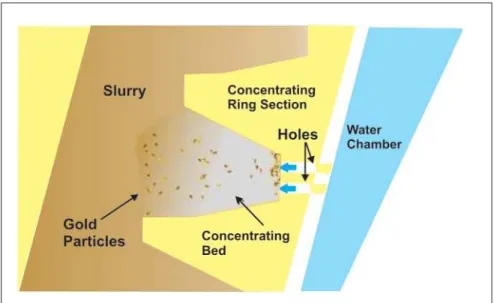
Knelson centrifugal gravity concentrator is an effective machine to obtain better metallurgical performance than other wet gravity concentrators due to its ability to recover coarse and fi ne gold from primary and placer deposits (Stewart, 1990; Knelson and Jones, 1994; Coulter and Subasinghe, 2005). Knelson separator has a concentration cone carrying the water injection holes inside the rings that rotates about a vertical axis and develops an enhanced gravitational force. Process water is fed into the cone through the water injection holes and feed slurry is then introduced into the cone (Figure 1). The slurry is forced outward and up the cone wall under the infl uence of centrifugal force. The feed slurry fi lls the rings and creates a concentrating bed which is fl uidized by the water injected through the holes inside the each ring. Heavy particles are retained in the concentrating cone and light particles are drifted out of the cone by process water (Knelson & Jones, 1994; Coulter & Subasinghe, 2005; Knelson, 2009).
Concentrates are fl ushed from the cone at the end of a concentration period in batch type Knelson concentrators. This type of concentrator has a limited mass yield capacity. The CVD (continuous variable-discharge) type concentrator was developed recently, CVDs can deliver a continuous stream of concentrate and this feature makes them useful in the processing of metallic ores.
A method for the determination of the gravity recoverable gold content (GRG) of the ores using Knelson concentrators was developed by the researchers (Woodcock & Laplante, 1993; Laplante et al., 1996; Laplante et al., 1996b). The Knelson concentrators are commonly used in the gold industry due to their ability to recover gold from alluvial and primary ore deposits, old tailings or pre-concentrates. They can be employed in small scale mining operations, gravity processing plants or grinding circuits of gold recovery plants to recover gold or other heavy minerals (Knelson, 2009; Turner, 1991; Knelson and Edwards, 1990; Burt et al., 1995; Dandois et al., 1998; Burt, 1999; Chernet et al., 1999).
The latest studies show that Turkey has a gold endowment, including reserves/resources of approximately 979 tons in 51 deposits (Yigit, 2006).
Mastra gold ore deposit is one of the biggest gold deposits of Turkey. Mastra Gold Mine project considers the recovery of gold by cyanidation mainly, but additional research studies are still underway to minimize the amount of cyanide by recovering a part of gold by gravity process. The alternative gold processing routes for this ore include the application of gravity concentration and CIP process. A preliminary cyanidation study was conducted by the company in Bergama/Ovacik CIP plant recently. 5000 t of Mastra gold ore was fed to the CIP plant to reveal the cyanidation characteristics of the ore and a KC-MD7.5. Knelson centrifugal gravity concentrator was installed on the grinding circuit. This study presents the results of the experimental studies done by using a KC-MD7.5 Knelson centrifugal gravity concentrator to recover gravity recoverable gold from the grinding circuit of Bergama/Ovacik CIP plant.
2. Materials and
methods
Gumushane-Mastra ore is an epithermal type gold ore deposit having less than 5% sulphide and about 85 % SiO2, The gold ore contains Cu (0.12%)
and Pb (0.28%) as noteworthy heavy minerals. Average gold and silver grade of the ore is about 6.5 g/t and 4 g/t respectively. The gold content of the ore consists of relatively coarse and mostly native particles allowing them to be recovered by Knelson centrifugal gravity concentrator prior to cyanidation.
Gold particles are generally accumulated in the grinding circuits due to their malleability and high specifi c gravity properties. That is why; these particles are ground slower and have smaller cut size in cyclones than the other minerals associated with gold ores. In this study, screen/metal analysis of the cyclone underfl ow was performed to determine the accumulated gold and its fractional distribution in the circulating load of the grinding circuit. The results are presented in Table 1.
Gold grade of the cyclone underfl ow is determined to be 56.79 g/t. It can be seen from Table 1 that about 67.27 % of total gold content of cyclone underfl ow material is below 75 microns showing that the most of the gold particles in the circulating load is in 0/75 micron fraction. The gold grade of this size fraction is about 244.48 g/t. The material
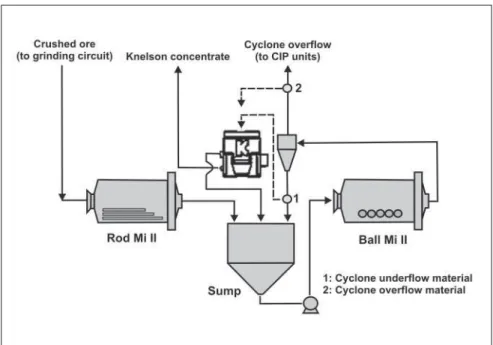
contains metallic iron particles resulting mainly from the abrasion of the grinding media. Gravity tests were performed by using a KC-MD7.5 Knelson centrifugal gravity concentrator installed on the grinding circuit of Bergama/Ovacik CIP plant. The installation scheme is given in Figure 2.
3. Results and
discussions
The effect of using different water back pressure (WBP) values on the gold recovery was investigated in the first group of experiments. Knelson concentrator was run for 15 minutes
Table 1 - The results of the screen/metal analyses of cyclone underfl ow.
in all tests; with a cyclone underfl ow feed rate of app. 730 kg/h. The results are presented in Table 2. A concentrate assaying 4339 g/t was obtained with about 75.88 % gold recovery using 8 psi WBP. Silver recovery was about 59% and silver grade of the concentrate was determined to be 701 g/t Ag. The use of 10 psi WBP value results in a gold recovery of 72.83% at a grade of 4304 g/t Au. Silver grade and recovery of the Knelson concentrate remained almost the same (Table 1).
Increasing the WBP values further to 12 psi led to decrease of the grade and recovery values of gold. The success of the gold recovery by Knelson concentrators is somewhat affected by the coarse grained gold content of the ore. At high WBP values, fi ne gold particles may be pushed out from the concentrating bed by the coarse grained gangue minerals and metallic Fe coming from the grinding media. Process water drifts fi ne gold out from the concentration cone along with the other light particles resulting lower gold recovery (Figure 3).
Knelson concentrator was operated at a feed rate of 730 kg/h and 12 psi of WBP value in the second group of experiments. Knelson concentrator was used as primary concentration gravity
device and the concentrate produced from this primary gravity recovery operation was upgraded using a shaking table. The gold content of the gravity concentrate of primary gravity recovery
Table 2 - The effect of different WBP values on the grade and recovery of Knelson concentrate.
operation reached about 13196 g/t after 90 minutes of cycle time (Table 3). However, the use of such a long time period in a concentration cycle with KC resulted in lower gold recovery
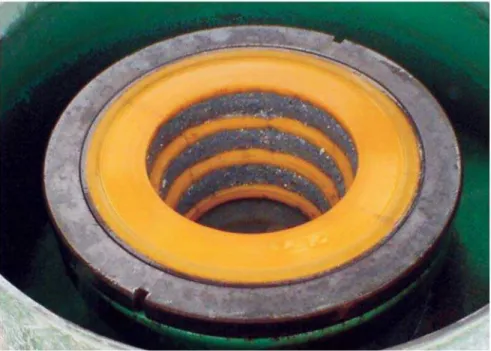
Figure 4 compares the fractional gold recoveries of the Knelson concentrate. As can be seen from Figure 4, the recovery values are lower for coarse particles (+180 micron) denoting insuffi cient liberation. The highest gold recovery was obtained for 75-106 micron size fraction (50.64 %). It is interesting to note that fractional gold recovery decreases for the particles below 75 micron. Fine gold particles seem to be pushed out from the concentrating bed by the coarse gangue and heavy mineral/ metal particles in the concentrating rings (Figure 5).
The primary gravity recovery concentrate (KC concentrate) upgrading test was carried out using a laboratory
Table 3 - The results of gold recovery test using 90 min. of concentration in a cycle.
Figure 4 - Fractional gold recoveries in Knelson concentrate. Figure 5 - The picture of the KC concentrate (after panning).
size Wilfl ey shaking table. The discharge of the table was divided into 3 sectors (concentrate, middling and tailing) and separate samples were taken from these sectors during the test.
The sample was screened using a 1.7 mm sieve before using in the experiment. The test conditions were as follows:
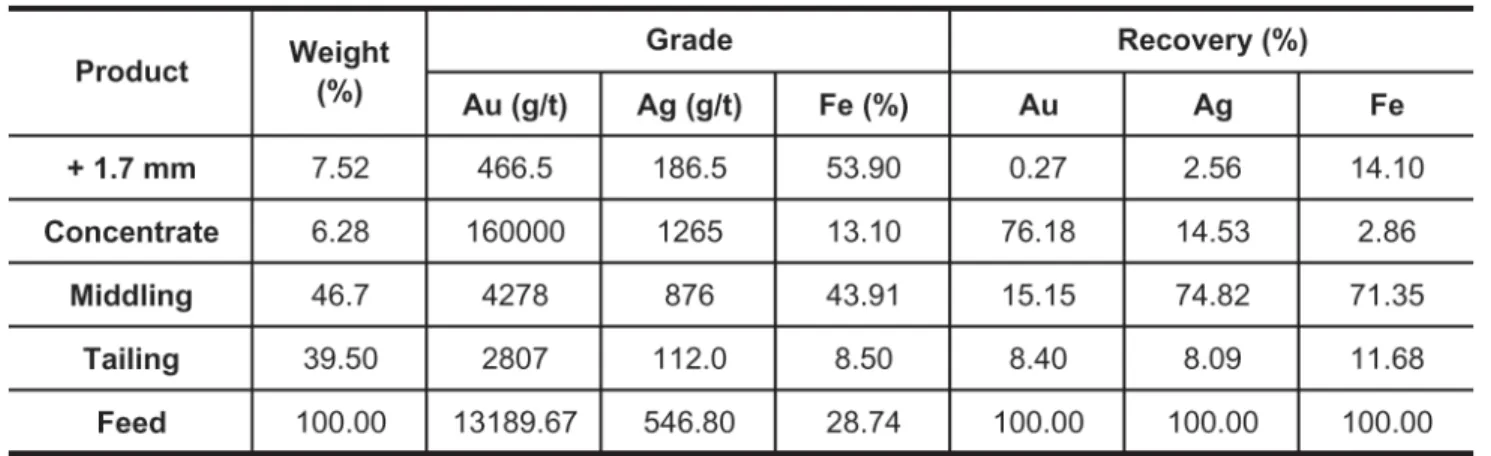
Table size: 1270 x 480 mm Stroke: 12 mm Tilt angle: 3° Water: 10 l/min Speed: 500rpm The samples were weighted and analyzed to establish the upgrading performance of the table. The results are presented in Table 4.
The test showed that it is possible to upgrade the KC concentrate by using a shaking table. A concentrate assaying 160 kg/t Au was obtained with 76.18 % gold recovery (Figure 6). Silver grade
of the concentrate is about 1.27 kg/t and concentrate contains about 13 % Fe. It is interesting to note that 7.52 % of the Knelson concentrate is above 1.7 mm particle size. Metallic iron content of this fraction of the concentrate was found to be very high (53.9 %).
The objective of the last test was to investigate the applicability of a gravity-only process to recover gold particles using a KC. For this purpose, Cyclone overfl ow stream was directly fed to the Knelson concentrator. KC was operated at a feed rate of about 500kg/h and at 5 psi of WBP in this test. 15 min. of concentration time in a cycle was applied. The results are presented in Table 5.
were also very low. The results indicate that the application of gravity alone concentration by using KC on this ore can produce a gold concentrate with low recovery values.
4. Conclusions
The tests showed that a KC unit can be installed on the grinding circuit of Mastra gold mine to recover the gold accumulated in the circulating load. This unit can process about 20-30 % of the circulating load (at 400 % circulating load equaling to 50-75 t/h), which would suffi ce according to similar applications of KC.
The KC recovers free gold particles without any diffi culty. It performs well with the coarse and fi ne gold particles; however, the operating conditions strongly affect the efficiency. The optimal cycle time - water back pressure (WBP) combination should be chosen
Table 4 - The results of the concentrate upgrading test.
Figure 6 - Different heavy mineral layers on the table surface.
Table 5 - The results of the extreme gravity concentration test.
to maximize the gold recovery. Extending the cycle time and/or using the high WBP (water back pressure) values may cause overloading which would result in a loss of recovery due to the rejection of the fi ne gold from the concentrating bed by coarse and heavy gangue particles. Pre-screening of the KC feed at about 1 mm sieve can increase the capacity of the machine and prevent from negative effects of coarse grained gangue particles and metallic Fe resulted from the abrasion of the grinding media.
5. Acknowledgments
The author would like to thank Koza Gold Operations Company/ Turkey, Dr. Tayfun Cicek and Dr. Mehmet Tanriverdi.
6. References
BURT, R.O., KORINEK, G., YOUNG, S. R. , DEVEAU, D. Ultrafi ne tantalum recovery strategies. Minerals Engineering, v. 8, n. 8, p. 859-870, 1995.
BURT, R. The role of gravity concentration in modern processing plants. Minerals Engineering, v.12, n. 11, p. 1291-1300, 1999.
COULTER, T.G., SUBASINGHE, K.N. A mechanistic approach to modelling Knelson concentrators. Minerals Engineering, v. 18, n. 1, p. 9-17, 2005. CHERNET, T., MARMO, J., NISSINEN,
A. Signifi cantly improved recovery of slightly heavy minerals from quaternary samples using gtk modifi ed 3’’ Knelson preconcentrator. Minerals Engineering, v. 12, n. 12, 1521-1526, 1999.
DANDOIS, P., CÁCERES, G., JOLY P., FRENAY, J. Development of a pilot plant using clean technology for the recovery of gold from small scale mines. Minerals Engineering,
v. 11, n. 5, p. 453-455, 1998.
KNELSON B., EDWARDS, R. Development and economic application of Knelson concentrators in low grade alluvial deposits. The AusIMM Annual Conference, New
Zealand, p. 123-128, 1990.
KNELSON B., JONES, R. A new generation of Knelson concentrators a totally secure system goes on line. Minerals Engineering, v. 2/3, n. 7, p. 201-207, 1994.
KNELSON Gravity Solutions. Knelson concentrators. http://www.knelsongravitysolutions. com, 2009.
LAPLANTE, A.R., SHU, Y., MAROIS, J. Experimental characterization of a laboratory centrifugal separator. Canadian Metallurgical Quaterly, v. 35, n. 1, p. 23-29, 1996a. LAPLANTE, A. R., VINCENT, F. and LUINSTRA, W. A laboratory procedure to determine
the amount of the gravity recoverable gold. Proceedings of 28th Annual Canadian Mineral Processors Conference, Canada (1996b).
STEWART, A.L. Gold Ore Processing Today-Part I. International Mining, n. 4, p. 21-31, 1984.
STEWART, A. L. Non-toxic Recovery. Mining Engineering, n. 11, p. 8-11, 1990.
TURNER, J.F. Gravity concentration, past, present and future. Minerals Engineering, v. 3/4, n. 4, p. 213-223, 1991.
WOODCOCK F., LAPLANTE, A.R. A laboratory method for determining the amount of gravity recoverable gold. Randol Gold Forum, Beaver Creek, p. 151-155, 1993. YIGIT, O. Gold in Turkey-a missing link in Tethyan metallogeny. Ore Geology Reviews,
v. 28, n. 2, p. 147-179, 2006.
Artigo recebido em 05/08/2009 e aprovado em 14/07/2010.