FREE THEMES
1 Departamento de Prática, Faculdade de Saúde Pública, Universidade de São Paulo. Av. Dr. Arnaldo 715, Cerqueira Cesar. 01246-904 São Paulo SP Brasil. [email protected]
Health as science and the biological body as an artifact:
the case of Brazil’s national TV news program Jornal Nacional
Abstract This article presents the findings of a study of the coverage of health, science and tech-nology during 2012 by the Jornal Nacional, a national television news program in Brazil pro-duced by the Rede Globo de Televisão. A total of 246 news stories addressing health-related topics were analyzed, half of which addressed scientific research, technological innovation and hospital care, and were shown to represent a doctor-cen-tered discourse. The findings also show that 82% of the news stories concerning science and technol-ogy advertise products that are about to be intro-duced onto the market, illustrating the commer-cial nature of this research. The article discusses two aspects portrayed by these news stories that characterize the biological body as an artifact: the construction of a virtual and fragmented body through the diffusion of images of the inside of the body; and the importance of biotechnological issues, which leaves life processes open to molecu-lar manipulation and alteration. The study also questions the nature-culture hybridization pres-ent in biotechnological objects.
Key words Biotechnology, Medicalization, Me-dia
Eduardo Caron 1
Aurea Maria Zöllner Ianni 1
C
ar
Introduction
The impacts of the advances in biomedical sci-ences and of the centrality of media space on ev-eryday life has marked political, ethical, and epis-temological implications for the healthcare field in the twenty-first century. Benchmarks in the field of medical sciences inform regulatory norms in various social spheres and drive advances in the medicalization of everyday life. In a social context in which everyday life has become increasingly “mediatized” and social identities and integra-tion are produced through consumpintegra-tion, the media has become a critical space in the process of subjectivation and in the production of ways of thinking and behavior. Despite being limited by self-referentiality and the underlying incom-pleteness and speed of the modes of production of mass media, concepts of increasing complexity are translated and incorporated into the market.
In this respect, Castiel et al.1 discuss the
emer-gence of regimes of truth grounded in contem-porary technoscientific rationality arranged as biopolitical apparatuses imbricated within health communication processes that produce the spec-tacularization and moralization of lifestyles.
The classical notion of communication as an unidirectional process has been overtaken by the idea of networks. Emitters and receivers are not autonomous, but rather part of a multipolar communication network in which communi-cation is not so much the transfer of meaning, but rather a web of meaning forming a
“sym-bolic market”2 that permits the production,
cir-culation and consumption of symbolic goods. Problematizing the enunciation of risks, forms of reductionism, discredit and beliefs portrayed through media channels, Vasconcellos-Silva et
al.3 suggest that:
unlike Frankfurtian primordial logic, process-es involving the production of meaning are inter-linked at various levels through which the ideas and representations that sustain communication and group identity circulate; the cultural-historical level of the imaginary as the cumulative produc-tion of ideas that circulate as references that are always susceptible to resignification.
The television news program Jornal Nacional
occupies a critical position in this network and is therefore both influential and strongly influ-enced by multiple linkages. As such, the topics, discourses, images, content, languages and reper-toires featured in news stories concerning health
science and technology aired by the Jornal
Na-cional constitute the imaginary of this program’s
audience. We therefore discuss a set of notions of health that shape contemporary society. It is worth highlighting that 50% of the science and
technology news stories aired by the Jornal
Na-cional in 2012 were produced and broadcast in Europe, Asia, and North America. We therefore aim to use this media space to problematize how “breakthroughs” in healthcare science and technology are constructed in relation to health needs, based on knowledge of which health sci-ence and public health are an intrinsic part.
The average viewer in Brazil watches approx-imately four hours of television a day. In 2013, 98% of households, including many without basic infrastructure and facilities such as a
re-frigerator, had a television4. Between 2012 and
2015, the average audience of the Jornal Nacional
varied between 22 and 25 million viewers a day, which is equivalent to between 25 and 33
tele-vision ratings points as measured by the Painel
Nacional de Televisão – IBOPE5 (the National Television Panel of the Brazilian Institute of Pub-lic Opinion and Statistics). These totals represent over 6.3 million households in the country’s 14 major metropolitan areas.
Theoretical and conceptual frameworks: the consumer society, reflexivity, biopower and nature-culture hybrids
As will be seen, the analysis of scientific and technological knowledge about the human body, life, and health – generator of widely consumed television news stories – calls into question con-temporary society. We chose the following set of theoretical-conceptual frameworks to contextu-alize this discussion: the consumer society and individualization, reflexivity and the risk society, and biopower and nature-culture hybridization.
It could be said that the impacts of the con-sumer society range from the biomolecular level to the wider geophysical aspects of global climate change. What is centrally at stake here are hu-man beings, who are becoming increasingly in-dividualized and whose existence is sustained by the market. They in turn depend on this market to offer themselves as a “human resource” and
produce identities. Ultimately, individualization
means market dependency in all dimensions of hu-man conduct6 and is a core element of the organi-zation of a society dictated by the supremacy of the market, where the individual-consumer him/
herself is a good7
.
aúd
e C
ole
tiv
a,
23(4):1333-1342,
2018
production and consumption of health goods lies in the concept of reflexive modernization. Modernity is grounded in a view of the world that sees the sciences as a knowledge paradigm: reflexivity leads to the diffusion of scientifici-ty and technological incorporation throughout everyday life, which, among a broad range of other effects, entails the reification of health. Once objectified, health ceases to be an inner value and becomes incorporated into the goods (medication, health facilities and services) that people depend on to attain their full health
po-tential8. The dissemination of huge amounts of
technoscientific health information by the media homogenizes the supply of health products and procedures, massifying and standardizing not only health needs, but also those related to beau-ty, hygiene, diet and mood. As such, by incorpo-rating technology into everyday life, reflexivity in the age of modernity powers an ever faster engine
of needs. According to Giddens9:
It is often said that modernity is marked by an appetite for the new, but this is not perhaps com-pletely accurate. What is characteristic of moderni-ty is not an embracing of the new for its own sake, but the presumption of wholesale reflexivity.
One of the consequences of the success and crisis of modernity is manufactured risk. Risk is not pre-given, but rather produced. Every day we are faced with the unintended consequences of reflexively applied scientific and technologi-cal knowledge, ranging from climate change and nuclear accidents, to multiresistant bacteria and financial crises. Apart from a world crisscrossed by uncertainties, reflexive modernization pro-duces and widens not only knowledge zones, but also lack of knowledge. Lack of knowledge resulting from the incapacity to know, inaccessi-bility, knowledge selection, and concealing lack
of knowledge itself10
. There is constant tension
between scientific soundness and reflective lique-faction. Within this context, health is threatened on several fronts, including unknown sources, creating and stimulating a culture of risk manage-ment. Paradoxically, in a social context that values individual performance, dealing with risk requires constant advances, as in the case of extreme sports
and other social practices that involve risk11. This
process of manufacturing uncertainty, lack of knowledge, and risk is underpinned by a search for control in order to intensify the medicalization of society through increasing the incorporation of technology into health and body interventions. Television is one of the spaces in which this pro-cess of medicalization is manufactured.
Looking at the world and narrating what one sees, while producing and defining objects pro-duces us as subjects. Though invisible, regimes of visibility and enunciation and processes of objectification and subjectivation are created and triggered through apparatuses, lending the
latter a dimension of power and strength12. The
doctor-centered apparatus views the generic biological body as the only true object of med-ical knowledge, where medicine is a hegemonic practice capable of defining what is “normal”
and pathological13. In these terms,
medicaliza-tion results from a perspective that defines pa-thologies and patients based on the general laws of biomedical science that in turn constitute the knowledge base that sustains and shapes this ap-paratus.
The medicalization of society is one form of biopolitics, that is, a strategy of power for con-trolling life processes such as birth, morbidity, and behaviors, through prescriptions of conduct, medication and medical interventions in the body, urban settings, and people’s living
condi-tions14. Throughout the twentieth century,
med-icalization transcended purely medical issues re-lated to salubrity and disease, taking on a regula-tory role through which the limits between nor-mal and abnornor-mal were defined in various fields.
According to Zorzanelli et al.15, transformations
at the turn of the twenty-first century led to the emergence of new social and technoscientific consequences associated with medicalization:
comprising a new biopolitical economy of med-icine, health and disease, changes in ways of living and dying, the formation of a complex arena in which biomedical knowledge, services and technol-ogy are increasingly intricate, and a new and in-creasingly tight focus on optimization and individ-ual improvement by technoscientific means.
Biopower penetrates not only behaviors, the disposition of subjects to living, and culture, but also organic, intracellular, and biomolecular life. A bioeconomy develops in its wake, which funds research, creates biovalue and a market for goods and technology aimed at the control and produc-tion of tissues, cells, genes, viruses, and beings,
hybrids of nature and culture16. Biotechnology
syn-C
ar
anthropic organisms, insects, viruses, bacteria, vaccines, etc..) that are apparently natural, but whose existence is coemergent with or produced by human activity. In this way, modernity itself
jeopardizes nature in the context of
contempo-rary society17. The environmental crisis does not
differ from a society in crisis. There is no un-touched wilderness; nothing may be exclusively
limited to the natural world18.
Material and methods
This study analyzed 246 news stories addressing
health topics presented by the Jornal Nacional
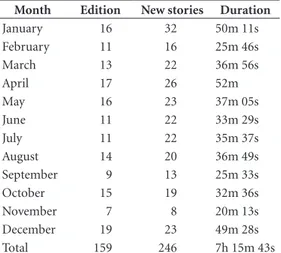
during all 12 months of 2012, comprising seven hours and 15 minutes of video made available at http://g1.globo.com/jornal-nacional/videos and accessed using the keyword SAUDE (health, Table 1). The 246 stories were presented in 159
editions of the Jornal Nacional, which means that
the topic of health was featured in half of the editions presented throughout the year. Further-more, health was the topic of the opening story of nine editions of the program. Health science and technology was the central theme of 49 sto-ries, comprising a total of one hour and 33 min-utes of programming and accounting for 20% of the stories and two opening stories.
Thematic categories
An analysis of the central themes of the 246 stories showed that 87% of the sample featured
the following themes (Table 2): hospitals (28%),
health science and technology (20%), habits and behavior (12%), the health products and services market (11%), epidemiology (10%), and the med-ical profession (6%). Apart from being the most
common theme, hospitals was the secondary
top-ic in 13 stories concerning research and techno-logical advances and in 13 stories about market regulation, healthcare plans, and consumer pro-tection.
Results
Disease control
Health science and technology was the most common theme and received the most extensive
coverage alongside hospitals, another core
ele-ment in the organization of the doctor-centered apparatus. The news stories tend to regard sci-entific research as a means of developing biolog-ical, physical and pharmacological intervention tools aimed at domination, power, and control over disease and the body. In 80% of the stories, the theme is approached by way of disease, or physical or sensory disability. Even the stories about research, which do not mention consum-able products, refer to diseases and products. For example, a story about the Nobel Prize in Chemistry awarded for research on cell receptors featured on 10 October 2012 mentioned the
fol-lowing: Half of the drugs work using g-protein
cou-pled receptors; greater understanding of how these receptors work will greatly help the production of medicines for diseases such as diabetes, cancer, and depression, which are more efficient and have fewer side effects. By treating disease as nature and placing it at the center of work and knowledge, the idea of health as the denial of
dis-ease becomes a naturalized concept19.
With respect to the diseases most frequently addressed by the news, 23% of the stories were about neurosciences, with emphasis on Alzhei-mer’s disease, 19% were about neoplasm treat-ment innovations, and 30% dealt with the fol-lowing: heart disease (8%); infectious diseases (8%), with emphasis on HIV; endocrine diseases (6%); bone tissue diseases (6%); and respiratory diseases (2%). The most frequent topic was neu-rological disorders, which accounted for 25% of the sample, demonstrating the huge interest in the brain in search of neuronal and biomolecular explanations and solutions in response to mem-ory function and dysfunction, sense, speech and mental disorders, and mobility impairments.
Table 1. Number of editions, news stories and
duration per month.
Month Edition New stories Duration
January 16 32 50m 11s
February 11 16 25m 46s
March 13 22 36m 56s
April 17 26 52m
May 16 23 37m 05s
June 11 22 33m 29s
July 11 22 35m 37s
August 14 20 36m 49s
September 9 13 25m 33s
October 15 19 32m 36s
November 7 8 20m 13s
December 19 23 49m 28s
aúd
e C
ole
tiv
a,
23(4):1333-1342,
2018
June 4
24 drug users (cocaine) were treated at the In-stitute of Psychiatry at the University of São Pau-lo using transcranial magnetic stimulation …a technique recognized by the Federal Council of Medicine as a treatment for depression.
Cancer research and treatment innovations were the second most featured topic among the
science stories presented by the Jornal Nacional,
including new chemotherapy techniques, nan-odrugs, and inoculable proteins and genes for various types of illnesses, including bone metas-tasis, ovarian, breast, pancreatic, and skin cancer, and leukemia. Apart from pharmaceutical drugs, these stories also featured new ultrasound and robotic surgical procedures.
Pharmaceutical and hospital products
The analysis of the stories about this type of research showed that there were a number of recurring themes: 43% of the stories about research in health sciences and technology field addressed drug manufacturing, including nano-drugs, enzymes, synthetic genes and DNA, anti-bodies, vaccines, contraceptives, hormones, and diagnostic tests; 39% were about procedures, techniques, products, and equipment, such as the production and use of stem cells, embryo selec-tion and transfer, stent manufacturing, soluble chips, vitreous bone graft, products for people with a visual impairment, neurosurgery, high in-tensity focused ultrasound, transcranial magnet-ic stimulation, deep brain stimulation, and ro-botic surgery. In other words, 82% of the content
focused on successfully tested products and pro-cedures or promising new drugs and techniques that would soon to be available on the market.
It is as if these “breakthroughs” were not de-termined by the object of the research, the meth-odology used, the interest in and search for given results, and validation criteria. What is observed is the “breakthrough” myth, when the naviga-tor’s mission and route is already determined before setting out: numerous pharmaceutical drugs manufactured for other purposes or with-out any clinical use are later discovered to have a desired effect for a given disease.
February 9
American scientists today announced a breakthrough in the fight against Alzheimer’s disease and the researchers used a drug that already exists [...]. The researchers discovered that bexarotene stimulates the production of another protein, APOE, which the study showed was capable of dissolving the platelets that lead to the symptoms of the disease.
The quest for advancing medical science us-ing the product of new knowledge renders older knowledge outdated. This cycle reinforces the need for new “breakthroughs”. This incessant de-mand for new knowledge is apparent in a large
majority of the stories presented by the Jornal
Nacional.
Virtual corporality
Through the television screen, we enter into a meticulous creation of a wondrous universe that becomes visible, aided by graphic animated
illus-Table 2. Weight of categories by news stories and duration.
Category New stories % Duration %
Hospital 68 27.6 107m36s 24.7
Science and technology 49 20.0 93m2s 21.3
Behavior 31 12.5 63m59s 14.7
Market 28 11.2 49m52s 11.3
Epidemiology 24 9.7 34m31s 7.9
Corporação Médica 14 5.7 32m30s 7.5
International 16 6.5 23m26s 5.4
Police 9 3.6 13m5s 3.0
Society 5 2.4 14m55s 3.5
Health Budget 2 0.8 1m9s 0.3
C
ar
trations of organs, nerves, cells, molecules, and particles. The futuristic images of equipment and intervention rooms illustrate this universe de-signed by innovations in health care technology processed in laboratories that are special places apart from the everyday world.
What is the point of a television company presenting a whirlwind of images of equipment, instruments, and screens displaying various electronic forms and images of the inside of the body? The story is certainly not concerned with explaining what these instruments are. Such a setting confers extraordinary legitimacy to the knowledge produced in these settings: knowledge gestated in a nonhuman environment, tested on artificially modified life forms, strains of mice with disorders, such as diabetes or melanoma, and cultures of selected cells. These procedures are tardily applied to human beings, approxi-mating the wondrous universe built elsewhere. Another side of the virtual corporality manufac-tured in this scientific environment are electronic images of the inside of the body. When broadcast to a mass audience through television they pro-vide a certain degree of visibility that virtualizes corporality and deprives it of its subjectivity as
a lived body. According to Ortega20, The virtual
appears as an expansion of the real and the materi-ality of the body image is presented to us as the ma-teriality of the physical body. It is a manufactured body, stripped of subjective dimension and gaunt.
The production of concepts and needs
The news stories reveal the capillarization of “reflexive modernization” into less rational levels and the extent to which this process condenses desire and mobilizes actions guided by ideas that are manufactured in the wondrous world of the biomedical sciences. With regard to the science stories, health needs seem to arise out of the “nat-ural” nature of the body. However, if we turn our attention to the elaboration of the news story, we observe a process of symbolic production of con-cepts and needs.
The most frequently used settings in the news stories were laboratories and hospitals: 47% re-ported research conducted in laboratories (ani-mal/in vitro studies), while 29% addressed hospital procedures where patients recount their personal experiences. Watching someone on the screen re-counting his/her experiences transforms the dis-ease from a question of science into an everyday
part of life, which permits a pathos of closeness
that evokes empathy and interest in the medical
explanations. Personal drama creates an environ-ment that enhances the value of the technological procedure that is the focus of the story. Accounts indicate these people’s health needs, which, as a rule, are reduced to the diagnosis of an illness. The fabrication of the procedures used to meet these needs are explained in the news story using specific language. A given vocabulary is taught in a meticu-lous effort to educate the television audience. The
“expert system”9 gains codes - statements, images,
and names – by which specific knowledge is ex-tended throughout everyday life. It is evident that the process of manufacturing “breakthroughs” simultaneously produces phenomena that are de-pendent on this form of knowledge, thus creating a conceptual repertoire that gains concreteness in bodies, molecules, cells, tissues, and organs. Ulti-mately, the initial need is transformed into another that includes new knowledge wrapped in the hope that these new drugs and procedures will be made available to society.
The body as a construct
One the most striking aspects of this theme is the extreme fragmentation of the body. The high success rate of procedures can be put down to the extreme particularity of the intervention. A body composed of particles is accessed, and the greater the precision of biochemical, biophysical, and mechanical instrumentation, the greater the success of the intervention.
March 31
The new technology can be used for tumors in the abdomen, prostrate, head, and neck and for gy-necologic cancer. […] with surgery performed by this robot there are no cuts: the three mechan-ical arms access the tumor, which is removed through the mouth.
aúd
e C
ole
tiv
a,
23(4):1333-1342,
2018
In addition to the construct of extreme frag-mentation of the body, the news stories treat the body as if its life can be captured. The life present in the stem cells, genes, embryos, and in parts of the body such as the umbilical cord, dental pulp in milk teeth, and bone marrow, can be removed from the body, transferred to another body or other parts of the body, and stored for use in another time and space. The fragmented body gains increasing plasticity through sophisticated biophysical and chemical processes. As a conse-quence, a series of actions and manipulations through which life itself is objectified and reified can be observed.
February 14
The baby was generated with the aid of a
procedure that is unprecedented in Brazil and which selected embryos based on DNA analysis, and the cells from the baby’s umbilical cord will be used in a future transplant. Cells taken from 10 embryos were analyzed. Two were compatible and one ended up being successful.
Other broad themes were addressed by 30% of the news stories, which can be grouped into the following three categories:
a) The human microbiome, intercellular
communication and cell receptors.
b) Human reproduction – reports on
as-sisted reproduction, fertilization and embryol-ogy. There is an interface between this category and the group that addresses themes linked to stem cells and the creation of genetically modi-fied embryos to supply biological material.
c) Biomedical engineering and
genom-ic medgenom-icine accounts for 16% of programming involving science and technology and addresses topics linked to the human genome, genetic se-lection, producing isolated genes, synthetic DNA, stem cells, and repair or replacement of heart muscle fibers and tissues.
These news stories are of particular interest in so far as they provide visibility to a frontier cur-rently explored by the biosciences and biopower, which has implications for various dimensions of human existence, and where life processes can be reversed, rebuilt and modified in the laboratory. On this ground, natural life no longer serves as the norm against which decisions may be judged
and health concepts enunciated21.
Conclusions
The findings suggest that news stories about sci-entific research and innovations in health care
technology overlap with those about hospital care and the health products and services market,
ac-counting for 59% of the Jornal Nacional’s health
programming, and constitute means of pro-duction and access to health goods. On the one hand, 80% of the news stories about science and technology feature diseases and physical disor-ders, 39% of which focus on hospital procedures, which characterizes the doctor-centered appa-ratus and commands the means of health pro-duction. On the other, 82% of news stories about scientific research focused on the introduction of new drugs and procedures to the market. In these stories health as a business area is a component of the same apparatus that underpins the medi-cal sciences, which converges with the concept of
bioeconomy coined by Nikolas Rose22.
The way in which the body is dealt with by these news stories is characterized by two factors: imaging technology and the molecularization of interventions. Viewing of biomolecular func-tions and processes using computerized imaging techniques, plus the range of intervention possi-bilities afforded by biotechnological techniques, radically change the notion of body and biology itself. On the one hand, these processes lead to the progressive objectification, fragmentation, and virtualization of the body, while the biolog-ical space becomes increasingly open to manip-ulation and change. The constitutive of nature of the body is no longer pre-given and as such it becomes subject to engineering and manufac-turing. These changes have sparked an extensive ethical debate in an attempt to regulate the limits of interventions in the processes of life.
Considerations on advances in bioscience and biotechnology, nature and culture
This discussion strips away certain aspects that naturalize biomedicine and, consequently, health. The radical nature of the appropriation of life at the molecular level destabilizes the dis-tinction between natural and social, human and nonhuman and calls into question the
dichoto-mies that underpin the episteme of modern
sci-entific rationality23. This nature, introduced into
an objective and distant world, that in order to be known depends on the methodological me-diation of scientific reasoning, tends to become
denatured. Latour24 compares this episteme of the
C
ar
laws that men can only attain to through science. According to the writer, this objectivity of the natural world falls into crisis as humanity inces-santly creates the nature of which it is part and in which it reproduces and recreates itself.
The natural truths formulated by modern sci-entificity become a problem, while the laws of an external and unified nature may be understood as constructs affiliated with a form of historicity.
Minayo25 problematizes this reflexive movement,
which includes a notion of complexity, the plu-rality of subjects and rationality, multiple and simultaneous temporalities and causalities, the crisis of certainties and regularities, bearing in mind the opaque dimension of language and the partial and unfinished nature of reflexive pro-cesses in search of truth.
The social changes that have taken place over the last 50 years have led the majority of the fields of science to question its univocal rationality, which is illustrated by the proliferation of superla-tive semantics incorporated into the dictionaries of practitioners and researchers: comprehensiveness, interdisciplinarity, interface, multidisciplinarity, multiprofessionality, transdisciplinarity, interrela-tions, interinstitutionality, and many others. This language movement suggests disquiet and a search for more broad-ranging and interconnected analy-sis and actions and reflects the inadequacy of uni-directional and univocal proposals.
In this field of tension, subject and subjectiv-ity take center stage. Touching on these tensions
in the health field, Castiel26 asks which
subjectiv-ities are produced within the context of technol-ogy incorporation:
That is to say, what role do advances in biosci-ence and biotechnology (such as positron and sin-gle photon emission tomography of the brain) play in the production/change of our own person and ‘human nature’ and, also, of the sense of what is normal and pathological?
In search of a conception of nature that is not
dissociated from the human construction,
Czeres-nia27 calls for a “conception of reality that is at the
same natural and sociocultural [...] the construc-tion of a new episteme that succeeds in integrating the natural and human sciences. A new basis for revisiting the synthetic and comprehensive spirit of physis.
Viveiros de Castro28 suggests that Amerindian
cosmology serves to ground a rigorous ethnolog-ical critique that shifts and reorders:
two paradigms that are traditionally opposed under the labels of nature and culture: universal and private, objective and subjective, physical and
moral, fact and value, given and established, ne-cessity and spontaneity, immanence and transcen-dence, body and spirit, animality and humanity, and so on.
In “Amerindian perspectivism”, unlike West-ern naturalist monism, the foundation of the world is subjectivity itself: a generic background of “humanity” is dispersed throughout the real. A subjectivity immanent in all things, of which all things are constituted, humans and nonhu-mans, contrary to our conception that professes animal or natural origin, and where “humaniza-tion” is a late event that is the conquest of nature. Hence, cultural otherness as a modern soul that separates humans from other entities. In Amer-indian thought, entities are distinguished by their distinctive natures and distinctive bodies, unlike Western multicultural relativism that:
supposes a diversity of subjective and partial representations, each striving to grasp an exter-nal and unified nature, which remains perfectly indifferent to those representations; Amerindian thought proposes the opposite: representational or phenomenological unity… indifferently applied to a radically objective diversity. One single ‘culture’, multiple ‘natures’; constant epistemology, variable ontology - the perspectivism is multinaturalism.
From another perspective, Rabinow29
prob-lematizes the notion of artificiality in opposition to nature, which permeates the biotechnology discussion. Unlike naturalist monism, this per-spective holds that nature is malleable and open
to an infinity of potential differences. These
differ-ences are not prefigured by final causes and there is no latent perfection seeking homeostasis. If the word ‘nature’ is to retain a meaning, it must signify an uninhibited polyphenomenality of display.
As we can see, current biotechnological pro-duction begs reflection on the social propro-duction of health that goes way beyond the classical for-mulation of social determinants of health, re-stricted to a purely social critique that sustains the dichotomy of the nature and culture par-adigms. Indeed, schools of thought in the field of health have not touched upon the supposed naturalism of the biomedical sciences. The uni-versal biological body, the foundation of the doc-tor-centered apparatus, continues to be held as the hegemonic regime that guides practices, clin-ics, technical healthcare models, organizations, public policy, systems and the health products
and services market30,31.
aúd
e C
ole
tiv
a,
23(4):1333-1342,
2018
containing. Life control strategies, which are in-creasingly molecular and genomic-based – prod-ucts of the biotechnology age – highlight the role of biopower, biomedical rationality, and the social production of the biological body, which
undermines the objective “purity” of the natural
world and models that promote the containment of subjectivity.
Collaborations
C
ar
References
1. Castiel LD, Bagrichevsky M, Vasconcellos-Silva PR, Estevão A. Discursos sobre comportamento de risco à saúde e a moralização da vida cotidiana. Cien Saude Colet 2010; 15(1):1699-1708.
2. Araújo I. Cartografia da Comunicação. In: Lefèvre F, Lefèvre AMC, Ignarra R, organizadores. O Conheci-mento de Intersecção. São Paulo: IPDSC; 2007. p. 43-60. 3. Vasconcellos-Silva PR, Castiel LD, Griep RH. A socie-dade de risco midiatizada, o movimento antivacinação e o risco do autismo. Cien Saude Colet 2015; 20(2):607-616.
4. Pesquisa Nacional por Amostra de Domicílios (PNAD). Volume 33. 2013 [Internet] Rio de Janeiro: IBGE c2014 [acessado 2015 Ago 20] Disponível em: http://bibliote-ca.ibge.gov.br/visualizacao/periodicos/59/pnad_2013_ v33_br.pdf
5. Instituto Brasileiro de Opinião Pública e Estatística (IBOPE). [Internet] São Paulo: IBOPE c2005-2012 [acessado 2015 Ago 28]. Disponível em: http://www. ibope.com.br/pt-br/conhecimento/TabelasMidia/au- dienciadetvsp/Paginas/TOP-5-S%C3%83O-PAULO-SEMANA-44_2014.aspx
6. Beck U. Sociedade de Risco: Rumo A Uma Outra Moder-nidade. São Paulo: Editora 34; 2010.
7. Bauman Z. Vida para consumo A transformação das pes-soas em mercadoria. Rio de Janeiro: Jorge Zahar; 2008. 8. Lefèvre F. O medicamento como mercadoria simbólica.
São Paulo: Cortez; 1991.
9. Giddens A. As Consequências da Modernidade. São Pau-lo: Editora Unesp; 1991.
10. Beck U. La sociedad del riesgo global. Madrid: Siglo XXI; 2002.
11. Castiel LD. Ariadne, Dédalo e os bondes do tigrão. Cad Saude Pública 2001; 17(6):1292-1295.
12. Deleuze G. ¿Que es un dispositivo? In: Deleuze G. Mi-chel Foucault, filósofo. Barcelona: Gedisa; 1990. p. 155-161.
13. Mehry EE, Feuerwerker LCM. Novo olhar sobre as tec-nologias de saúde: uma necessidade contemporânea. In: Andarino ACS, Gomberg E, organizadores. Leituras de novas tecnologias e saúde. Aracaju: Universidade Fe-deral Sergipe; 2009. p. 29-56.
14. Foucault M. Microfísica do poder. São Paulo: Graal; 2012.
15. Zorzanelli RT, Ortega F, Bezerra Júnior B. Um pano-rama sobre as variações em torno do conceito de me-dicalização entre 1950-2010. Cien Saude Colet 2014; 19(6):1859-1868.
16. Rose N, Rabinow P. O Conceito de Biopoder Hoje.
Política & Trabalho Revista de Ciências Sociais 2006; 24:27-57.
17. Ianni AMZ. Desafios para um novo pacto sanitário: biotecnologia e risco. Cien Saude Colet 2011; 16(l):837-846.
18. Latour B. Jamais fomos modernos. Ensaio de antropolo-gia simétrica. Rio de Janeiro: Editora 34; 1994. 19. Lefèvre F, Lefèvre AMC. Saúde como Negação da
Nega-ção: uma perspectiva dialética. Physis Rev Saude Colet
2007; 17(1):15-28.
20. Ortega F. Corporeidade e biotecnologias: uma crítica fenomenológica da construção do corpo pelo cons-trutivismo e pela tecnobiomedicina. Cien Saude Colet
2007; 12(2):381-388.
21. Rose N. The Politics of Life Itself. Theory, Culture & So-ciety 2001; 18(6):1-30.
22. Rose N. A biomedicina transformará a sociedade? O impacto político, econômico, social e pessoal dos avanços médicos no século XXI. Psicologia & Sociedade
2010; 22(3):628-638.
23. Luz MT. Natural, racional, social.Razão médica e ra-cionalidade científica moderna. Rio de Janeiro: Campus; 1988.
24. Latour B. Why Political Ecology has to let go of nature. In: Latour B. Politics of Nature: how to bring the scienc-es into democracy. London: Harvard University Prscienc-ess; 2004. p. 9-32.
25. Minayo MCS. A busca da verdade no campo científico da saúde. Cien Saude Colet 2012; 18(10):2806-2812. 26. Castiel LD. A palavra – subjetividade e as coisas –
sub-jetividade. In: Goldenberg P, Marsiglia RMG, Gomes MHA, organizadores. O Clássico e o Novo:tendências, objetos e abordagens em ciências sociais e saúde. Rio de Janeiro: Fiocruz; 2003. p. 95-99.
27. Czeresnia D. Categoria Vida, reflexões para uma nova biologia. São Paulo, Rio de Janeiro: Editora UNESP, Editora Fiocruz; 2012. p. 63.
28. Castro EV. Perspectivismo e multinaturalismo na Amé-rica indígena. In: Castro EV. A Inconstância da Alma Selvagem. São Paulo: Cosac Naify; 2011. p. 347-399. 29. Rabinow P. Artificialidade e Iluminismo. In Rabinow P.
Antropologia da Razão. Rio de Janeiro: Relume Duma-rá; 2002. p. 154
30. Ianni AMZ. Saúde Pública e Colonização da Natureza.
Physis 2009; 19(4):1029-1050.
31. Ianni AMZ. Questões Contemporâneas sobre Natureza e Cultura: notas sobre a Saúde Coletiva e a Sociologia no Brasil. Saude Soc 2011; 20(1):32-40.
Article submitted 02/02/2016 Approved 11/07/2016
Final version submitted 13/07/2016
This is an Open Access article distributed under the terms of the Creative Commons Attribution License BY