Abstract
Objective: To compare the frequency of exclusive breastfeeding using two different interview approaches. Methods: This was a cross-sectional study of 309 mothers of children aged 0 to 6 months, with a median age of 11 days. Mothers were interviewed at the Instituto de Medicina Integral Prof. Fernando Figueira during November and December of 2009. Two approaches to the interview were tested: irstly, the mother was asked if complementary foods had been given during the preceding 24 hours. Secondly, they were asked if at any point during the child’s life any other foods had been given. The marginal homogeneity test was applied and the signiicance level was 5%.
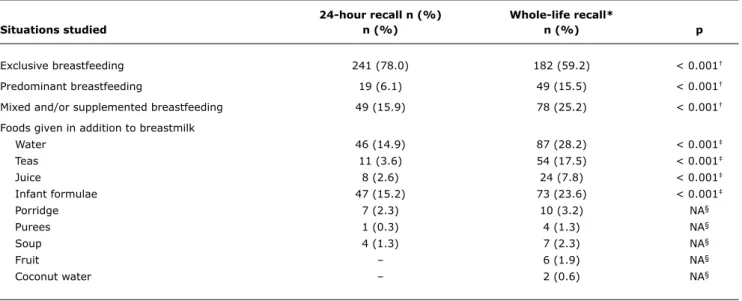
Results: According to the 24-hour recall, the frequency of exclusive breastfeeding was 78.0%. According to the wider-ranging recall period, the frequency was 59.2% (p < 0.001).
Conclusions: The frequency of the exclusive breastfeeding is overestimated using the 24-hour recall compared with the whole-life recall.
J Pediatr (Rio J). 2011;87(4):364-368: Breastfeeding, methods, evaluation.
364 Introduction
When it is the only source of energy and nutrients,
breastmilk guarantees healthy growth and development for the irst 6 months of life1 and also confers protection against many different diseases that cause death, such as respiratory infections, diarrheal disease and diseases
caused by deiciencies, particularly in poorer countries.2-4 The beneicial effects of breastfeeding last for the whole of the lifecycle, reducing the risk of occurrence and the
severity of problems that have late onset, such as non-transmissible chronic diseases.5
B
RIefC
OMMunICAtIOnJornal de Pediatria
Copyright © 2011 by Sociedade Brasileira de Pediatria
Results of research into the frequency
of exclusive breastfeeding
vary depending on the approach taken in the interview
Marcela M. Belo,1 Gabriel B. Serva,2 Vilneide B. Serva,3Malaquias Batista filho,4 José n. figueiroa,5 Maria de fátima C. Caminha4
1. Enfermeira residente, Saúde da Criança, Instituto de Medicina Integral Prof. Fernando Figueira (IMIP), Recife, PE, Brazil. 2. Acadêmico, Departamento de Medicina, Faculdade Pernambucana de Saúde (FPS), Recife, PE, Brazil.
3. Mestre. Coordenadora, Banco de Leite Humano, IMIP, Recife, PE, Brazil. 4. Doutor(a). Diretoria de Pesquisa, IMIP, Recife, PE, Brazil.
5. Mestre. Diretoria de Pesquisa, IMIP, Recife, PE, Brazil.
No conflicts of interest declared concerning the publication of this article.
Financial support: Conselho Nacional de Desenvolvimento Científico e Tecnológico (CNPq) and Fundo de Apoio à Pesquisa do Instituto de Medicina Integral Prof. Fernando Figueira (FAPE/IMIP).
Suggested citation: Belo MM, Serva GB, Serva VB, Batista Filho M, Figueiroa JN, Caminha MF. Results of research into the frequency of exclusive breastfeeding vary depending on the approach taken in the interview. J Pediatr (Rio J). 2011;87(4):364-8.
Manuscript submitted Oct 25 2010, accepted for publication Mar 21 2011
Bearing in mind the primordial importance of exclusive
breastfeeding (EBF) and the large variations in results when it is evaluated, in 1991 the World Health Organization (WHO)
proposed a set of criteria and indicators for analyzing infant feeding with the objective of standardizing data collection and
analysis, making comparisons between different national and
international studies possible.6 One of the recommendations was to use a 24-hour recall to collect data on breastfeeding categories.6 However, in 2007, the WHO itself warned that using the previous day’s intake could be overestimating the
proportion of children being exclusively breastfed,7 thereby making estimates of exclusive breastfeeding frequency
biased. From this perspective, the 24-hour method may act as a source of variation in results for duration and type of breastfeeding.
Considering these conlicting issues and their conceptual,
normative and pragmatic implications, the objective of this study is to compare two approaches to collecting information on breastfeeding, drawing on the experience of a Brazilian Ministry of Health regional center of excellence for mother and baby care.
Methods
This was a cross-sectional study conducted in the childcare clinic at Instituto de Medicina Integral Prof.
Fernando Figueira (IMIP). The institute is situated in Recife, PE, Brazil, and the majority of patients come from the
maternity unit at the same hospital.
Sample size was calculated using the StatCalc module in
EPI-Info 6.04, adopting a 95% conidence interval (95%CI) and an error of 4% and assuming a 15% prevalence of EBF
with a minimum duration of 4 months, as indicated by data from the III National Census of Women’s and Children’s
Demographics and Health (Pesquisa Nacional de Demograia e Saúde da Criança e da Mulher [PNDS]).8 The estimated sample size was 306 children. The inal sample was 309
mothers of children aged 0 to 6 months, recruited to the study consecutively between November and December of
2009 after agreeing to take part and providing a signed
free and informed consent form. Mothers were not included if their children had never been exclusively breastfed and the mothers of twins and other multiple births were excluded.
Data was collected by two researchers using a structured interview covering sociodemographic variables, to build
up a proile of the mothers, and supplemented with
questions about the conditions during pregnancy and birth and about the children and their feeding habits. In order to be in a position to describe the situation in relation to
EBF, the dependent variable of central interest, mothers were asked whether they had fed their children anything other than breastmilk – water, water with sugar, teas, fruit juices, infant formulae, porridge (milk-based semi-liquid
preparations containing lours, starches and/or cereals), purees (preparations with a pasty consistency made from fruit or vegetables or milk-based preparations with a pasty consistency containing lours, starches and/or cereals), soups, pan-cooked food, fruit or other foods on the previous day. The second approach asked the mothers whether at
any point in their children’s lives they had eaten other foods
than breastmilk, noting the age (months and days) of the
child being investigated on the whole-life recall.
Breastfeeding types were classiied according to the
following categories proposed by the WHO6:
– Exclusive breastfeeding: child fed only on human milk
directly from the breast or pumped, with the exception of medications, vitamins and minerals prescribed by
physicians. Water and tea are excluded whether drunk
occasionally or routinely.
– Predominant breastfeeding: child fed on breastmilk supplemented only with water (sweetened or not), teas,
other infusions and fruit juices.
– Mixed and/or complemented breastfeeding: child
breastfed, but neither exclusively or predominantly, i.e.
child fed breastmilk in addition to any type of solid or semisolid complementary foods or non-breastmilk.
Statistical analysis was conducted using SPSS for Windows, version 13.1. Categorical data were summarized and grouped according to their distribution in simple frequencies and tabulated. Numerical data are represented
in terms of measures of central tendency (means and medians) and of variability (standard deviation and interquartile range). The frequencies of the three categories
of breastfeeding according to the 24-hour recall and according to the whole-life recall were compared using the
marginal homogeneity test (Stuart-Maxwell). The McNemar
test was used to compare the frequency of introduction of other foods into the children’s diets according to the two
maternal recalls. The signiicance level was set at 5%. This project was approved by the IMIP Human Research Ethics Committee (protocol number 1492, 12 August, 2009).
Results
The children’s ages varied from 2 to 180 days, with a
median of 11 days (1st quartile = 7 days and 3rd quartile = 39.5 days); 51.5% were male. Maternal characteristics were as follows: 75.4% were in the 20 to 34 year range, with a mean age of 26.4 years (SD = 6.3 years); 49.8% of the mothers lived in a consensual relationship; the majority (73.2%) had successfully completed nine or more school years; 57.7% had a family per capita income of less than
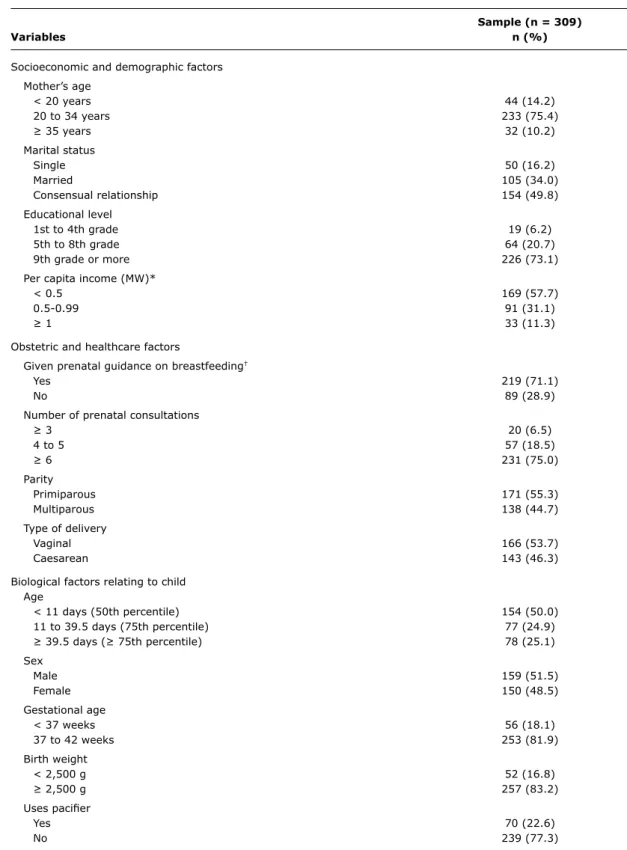
half the minimum wage. The sample characteristics are shown in Table 1.
With relation to EBF frequency, 78.0% were on exclusive
Sample (n = 309)
Variables n (%)
Socioeconomic and demographic factors Mother’s age
< 20 years 44 (14.2)
20 to 34 years 233 (75.4)
≥ 35 years 32 (10.2)
Marital status
Single 50 (16.2)
Married 105 (34.0)
Consensual relationship 154 (49.8)
Educational level
1st to 4th grade 19 (6.2)
5th to 8th grade 64 (20.7)
9th grade or more 226 (73.1)
Per capita income (MW)*
< 0.5 169 (57.7)
0.5-0.99 91 (31.1)
≥ 1 33 (11.3)
Obstetric and healthcare factors
Given prenatal guidance on breastfeeding†
Yes 219 (71.1)
No 89 (28.9)
Number of prenatal consultations
≥ 3 20 (6.5)
4 to 5 57 (18.5)
≥ 6 231 (75.0)
Parity
Primiparous 171 (55.3)
Multiparous 138 (44.7)
Type of delivery
Vaginal 166 (53.7)
Caesarean 143 (46.3)
Biological factors relating to child Age
< 11 days (50th percentile) 154 (50.0)
11 to 39.5 days (75th percentile) 77 (24.9)
≥ 39.5 days (≥ 75th percentile) 78 (25.1)
Sex
Male 159 (51.5)
Female 150 (48.5)
Gestational age
< 37 weeks 56 (18.1)
37 to 42 weeks 253 (81.9)
Birth weight
< 2,500 g 52 (16.8)
≥ 2,500 g 257 (83.2)
Uses paciier
Yes 70 (22.6)
No 239 (77.3)
table 1 - Characteristics of the sample of mothers and children evaluated with relation to breastfeeding practices, Recife, PE, 2009
MW = minimum monthly wage. * Figure at time of study: R$ 465.00. † One mother had no prenatal care.
by the WHO.6 In the results from the second approach (covering the period since birth), EBF frequency (59.2%) was signiicantly lower (p < 0.001).
Table 2 shows the distribution of breastfeeding types according to the two approaches and the foods given
24-hour recall n (%) Whole-life recall*
Situations studied n (%) n (%) p
Exclusive breastfeeding 241 (78.0) 182 (59.2) < 0.001†
Predominant breastfeeding 19 (6.1) 49 (15.5) < 0.001†
Mixed and/or supplemented breastfeeding 49 (15.9) 78 (25.2) < 0.001†
Foods given in addition to breastmilk
Water 46 (14.9) 87 (28.2) < 0.001‡
Teas 11 (3.6) 54 (17.5) < 0.001‡
Juice 8 (2.6) 24 (7.8) < 0.001‡
Infant formulae 47 (15.2) 73 (23.6) < 0.001‡
Porridge 7 (2.3) 10 (3.2) NA§
Purees 1 (0.3) 4 (1.3) NA§
Soup 4 (1.3) 7 (2.3) NA§
Fruit – 6 (1.9) NA§
Coconut water – 2 (0.6) NA§
table 2 - Distribution of breastfeeding types among children ≤ 6 months, assessed using two different approaches, at a regional center of excellence in mother and baby care, Recife, PE, 2009
NA = not applicable.
* Covering the child’s entire dietary history. † Test of marginal homogeneity.
‡ McNemar test.
§ Not applicable because of the low number of cases.
were most often mentioned, with occurrences that were statistically different for the two approaches.
Discussion
The results of this research are a good illustration of the relevance of the question raised by the WHO7 about the possibility that there is an overestimation bias caused by its proposal6 for assessing breastfeeding, particularly in relation to EBF, when a 24-hour recall is used. Indeed,
when this instrument was used in practice, the prevalence
of EBF (78.0%) differed signiicantly from the results for
the same sample using the wider-ranging recall method
(59.2%), covering the children’s entire lives up to the interview date. Taken as a relative proportion (18.9 x 100÷59.2), the difference of 18.9% increases to 31.9%,
which is a very large margin of overestimation. Of course
this large difference cannot be taken a priori, since the whole-life recall is subject to memory bias, with a potential
risk of underestimation. These unresolved questions may
explain the great variation in results between studies, because of the variation in methods employed by different authors.8-10
It should be stressed that it is very probable that the
elevated frequencies of EBF reported here are the result
of the majority of the sample being very young children
(39.5 days at the 75th percentile), since recent data from the city of Recife indicate an EBF frequency of 18.6% at 4 months and 6.1% at 6 months.11
Although the basic question that most affected the study centered on the possibility of distortions due to two different
approaches to EBF, it appears relevant to test, with both
models, possible interference from events that have an implication for the results of both methods of assessment, i.e., the different foods that modify orthodox exclusive
breast-feeding status, producing other classiications and
types. This study showed that four items were statistically
relevant to non-EBF outcomes: water, teas, juices and
infant formulae. Many of these reports are of circumstantial, random occurrences of short duration, which is the cause of the concerns of many authors about its effective validity for classifying different types of breastfeeding and, particularly,
for ruling pout EBF.12,13 This is not the appropriate place to go deeper into this discussion, since the intention is to illustrate the frequent occurrence of this difference between the results of the two approaches. Nevertheless, even more important that the differences between the two methodologies and the conceptual differences with relation to a child’s health, is the context of each case, which should
be taken into consideration. There would be, for example, a
large difference between the consequences of feeding babies water in poor sanitary conditions and doing the same in a situation in which hygiene is guaranteed.
In conclusion, it was observed that the two approaches
result in very signiicant differences in EBF frequency
References
1. Marques RF, Lopez FA, Braga JA. O crescimento de crianças alimentadas com leite materno exclusivo nos primeiros 6 meses de vida. J Pediatr (Rio J). 2004;80:99-105.
2. Victora CG, Smith PG, Vaughan JP, Nobre LC, Lombardi C, Teixeira AM, et al. Evidence for protection by breast-feeding
against infant deaths from infectious diseases in Brazil. Lancet.
1987;2:319-22.
3. Betrán AP, de Onís M, Lauer JA, Villar J. Ecological study of effect of breast feeding on infant mortality in Latin America. BMJ. 2001;323:303-6.
4. Caminha MF, Serva VB, Arruda IK, Batista Filho M. Aspectos históricos, científicos, socioeconômicos e institucionais do aleitamento materno. Rev Bras Saude Matern Infant. 2010;10:25-37.
5. Alves JG, Figueira F. Doenças do adulto com raízes na infância. 2ª ed. Recife: MedBook; 2010.
6. World Health Organization. Indicators for assessing breastfeeding practices. Geneva: WHO; 1991. http://whqlibdoc.who.int/ hq/1991/WHO_CDD_SER_91.14.pdf. Access: 28 Mar 2009. 7. World Health Organization. Indicators for assessing infant and
young child feeding practices. Washington: WHO; 2007. http:// whqlibdoc.who.int/publications/2008/9789241596664_eng.pdf. Access: 28 Mar 2009.
Correspondence:
Maria de Fátima Costa Caminha Diretoria de Pesquisa, IMIP Rua dos Coelhos, 300 – Boa Vista CEP 50070-550 – Recife, PE – Brazil Tel.: +55 (81) 2122.4702
Fax: +55 (81) 2122.4722
E-mail: [email protected]
8. Brasil, Ministério da Saúde. Centro Brasileiro de Análise e Planejamento. Pesquisa Nacional de Demograia e Saúde da Criança e da Mulher (PNDS): relatório inal. Brasília: Ministério da Saúde; 2008. http://bvsms.saude.gov.br/bvs/pnds/img/ relatorio_inal_pnds2006.pdf. Access: 26 Jun 2009.
9. Caminha Mde F, Batista Filho M, Serva VB, Arruda IK, Figueiroa JN, Lira PI. Tendências temporais e fatores associados a duração do aleitamento materno em Pernambuco. Rev Saude Publica.
2010;44:240-8.
10. Vieira GO, Martins CC, Vieira TO, de Oliveira NF, Silva LR. Factors
predicting early discontinuation of the breastfeeding in the irst
month of life. J Pediatr (Rio J). 2010;86:441-4.
11. Brasil, Ministério da Saúde. Secretaria de Atenção à Saúde. Departamento de Ações programáticas e Estratégicas. II Pesquisa de prevalência de aleitamento materno nas capitais brasileiras e Distrito Federal (Série C. Projetos, Programas e Relatórios). Brasília: Ministério da Saúde; 2009.
12. Vieira GO, Glisser M, Araújo SP, Sales Ado N. Indicadores do aleitamento materno na cidade de Feira de Santana, Bahia. J Pediatr (Rio J). 1998;74:11-6.
13. Bittencourt LJ, Oliveira JS, Figueiroa JN, Batista Filho M. Aleitamento materno no estado do Pernambuco: prevalência e possível papel das ações de saúde. Rev Bras Saude Matern Infant. 2005;5:439-48.
Acknowledgements
Thanks are due to the IMIP Fundação de Apoio à Pesquisa (FAPE) and the Conselho Nacional de Desenvolvimento Científico e Tecnológico (CNPq) for financing this