J Bras Pneumol. 2013;39(4):521-522 J Bras Pneumol. 2013;39(4):521-522
Visual scale for the quantification of hyperhidrosis
Escala visual para a quantificação da hiper-hidroseRoberto de Menezes Lyra
To the Editor:
In most cases, patients with hyperhidrosis have unpleasant sensory and emotional experiences in the social sphere, experiences that are difficult to express to physicians in a simple way and to be understood by society. In contrast, assessing and quantifying
hyperhidrosis clinically is not an easy task; therefore, I have read with great enthusiasm the study by Sakiyama et al. describing a quantitative assessment of the intensity of palmar and plantar sweating in patients with primary palmoplantar hyperhidrosis.(1)
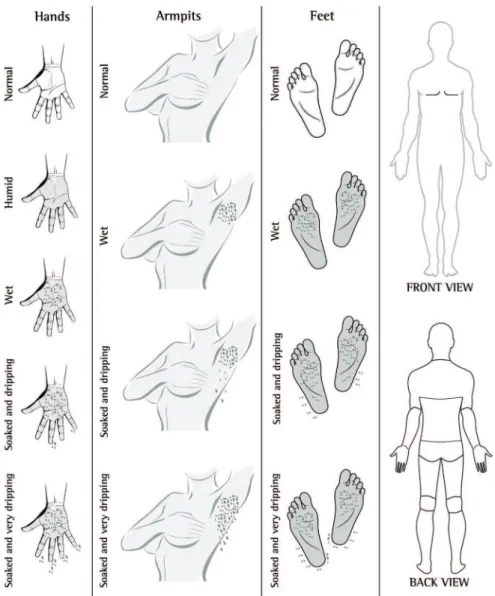
Figure 1 - Visual scale for the quantification of hyperhidrosis.
522 Lyra RM
J Bras Pneumol. 2013;39(4):521-522 J Bras Pneumol. 2013;39(4):521-522
A measuring device will certainly add to improving the quantification of hyperhidrosis during clinical assessment. This is because the clinical presentation of hyperhidrosis varies widely from person to person, although there is a certain pattern of presentation in localized hyperhidrosis. It is assumed that this is due in part to the large anatomical variation in the sympathetic chain and also to the fact that the sympathetic nervous system shows a metameric distribution that is not so precise, which makes it difficult to be mapped as dermatomes.(2,3)
Formerly, in order to quantify hyperhidrosis, we had no other way but to measure it clinically with a visual scale by means of which the patient was asked to grade the intensity of hyperhidrosis on the basis of drawings in the scale, ranging from being normal to having the worst possible level of hyperhidrosis. Therefore, the intensity of hyperhidrosis at the initial assessment, as well as at each assessment and, if necessary, also in the postoperative period, can be recorded on the medical charts.(4)
In addition, we quantify the presentation of hyperhidrosis, whether it is generalized or localized, and the type of body distribution (Figure 1). We use hachures to demarcate the areas of excessive sweating on the drawings of the human body. Subsequently, using the visual scales shown in Figure 1, we determine the amount of sweat produced and the type of localized hyperhidrosis (palmar, axillary, plantar, or any combination of the three) presented by the patient.
Physiologically, there is great variability in sweat production, which depends on environmental
heat, seasons, physical exertion, stress, and even circadian cycle. Therefore, it is of the utmost importance that the patient guide us and quantify the areas that should be demarcated, thereby providing a strong foundation for reasoning about the choice of clinical or surgical treatment of hyperhidrosis.(5)
Roberto de Menezes Lyra Thoracic Surgeon,
Hospital do Servidor
Público Estadual de São Paulo
– HSPE/SP, São Paulo Hospital for State Civil Servants – São Paulo, Brazil
References
1. Sakiyama BY, Monteiro TV, Ishy A, de Campos JR, Kauffman P, Wolosker N. Quantitative assessment of the intensity of palmar and plantar sweating in patients with primary palmoplantar hyperhidrosis. J Bras Pneumol. 2008;38(5):573-8. http://dx.doi.org/10.1590/ S1806-37132012000500006
2. Zhang B, Li Z, Yang X, Li G, Wang Y, Cheng J, Tang X, Wang F. Anatomical variations of the upper thoracic sympathetic chain. Clin Anat. 2009;22(5):595-600. http:// dx.doi.org/10.1002/ca.20803 PMid:19418453 3. Schünnke M, Schulte E, Schumacher U. Dores viscerais. In:
Prometheus, atlas de anatomia: cabeça e neuroanatomia. Rio de Janeiro: Guanabara Koogan; 2007. p. 322-3 4. Lyra Rde M, Campos JR, Kang DW, Loureiro Mde P,
Furian MB, Costa MG, et al. Guidelines for the prevention, diagnosis and treatment of compensatory hyperhidrosis. J Bras Pneumol. 2008;34(11):967-77. PMid:19099105 5. Boscardim PC, Oliveira RA, Oliveira AA, Souza JM, Carvalho
RG. Thoracic sympathectomy at the level of the fourth and fifth ribs for the treatment of axillary hyperhidrosis. J Bras Pneumol. 2011;37(1):6-12. http://dx.doi.org/10.1590/ S1806-37132011000100003 PMid:21390426