SY
STEMA
TIC REVIEW
Corresponding author: Luciana Protásio de Melo – Rua Dr. Hernani Hugo Gomes, 90, Capim Macio – Natal (RN), Brazil – CEP 59082-270 – E-mail: [email protected] – Financing source: CNPq – Conlict of interest: Nothing to declare – Presentation: Dec. 2015 – Accepted for publication: Sept. 2016 – Approved by Ethics Committee 783.189/2014. 1Student of the Physical Therapy course. Faculdade Estácio do Rio Grande do Norte (FATERN) – Natal (RN), Brazil.
2Master’s in Physical Therapy. Universidade Federal do Rio Grande do Norte (UFRN) – Natal (RN), Brazil. 3PhD in Physical Therapy (UFRN). Faculdade Estácio Rio Grande do Norte – Natal (RN), Brazil. ABSTRACT | After a stroke upper limbs may display
motor deicits that could lead to functional disability. Mirror therapy (MT) is a therapeutic tool in the rehabilitation of upper limbs (UL). This study aimed to bring together evidence to show the main efects of MT in the motor recovery of paretic upper limbs after a stroke. An electronic search on the Lilacs, Scielo, PubMed, PEDro and ScienceDirect databases was performed, in accordance with the inclusion criteria: clinical trials, in which individuals should have had a stroke of any etiology and in any stage of recovery, with UL impairment, published in full in journals indexed in those databases, between 2010 and 2015, in English or Portuguese, using MT for the rehabilitation of these patients’ UL, with motor function and functional independence as main outcomes. The remaining articles were evaluated with the PEDro scale to assign their methodological quality a score. Thirteen clinical studies evaluated the efects of MT in the motor function and functional independence of the upper limbs after a stroke. Fugl-Meyer scale and the Functional Independence Measure were frequently used in the studies, which showed that MT is eicient in upper limb motor recovery and functional independence, especially concerning transferring and self-care. Regarding the methodological evaluation, the articles were considered as having moderate or high quality. In conclusion, MT promotes signiicant improvement of the motor function and functional independence of paretic upper
431
limbs after a stroke, regardless of the time elapsed after the encephalic lesion.
Keywords | Stroke; Upper Extremity; Motor Skills; Physical Therapy Modalities; Sensory Feedback.
RESUMO | Após um acidente vascular cerebral (AVC), o membro superior pode apresentar déicits motores que podem levar a incapacidades funcionais. A terapia espelho (TE) é uma possibilidade terapêutica na reabilitação do membro superior (MS). Este estudo objetivou reunir evidências que pudessem mostrar quais são os efeitos da TE na recuperação motora e funcional do MS com paresia pós-AVC. Foi realizada uma busca eletrônica nas bases de dados SciELO, LILACS, PubMed, PEDro e ScienceDirect, utilizando como critérios de inclusão: ensaios clínicos, nos quais os indivíduos acima de 18 anos apresentassem AVC de qualquer etiologia e em qualquer tempo após a lesão encefálica, com sequela no MS; estudos publicados na íntegra em revistas indexadas nas bases supracitadas entre 2010 e 2015, nos idiomas inglês e português, que utilizassem a TE para reabilitação do MS de pacientes com AVC, apresentando como desfechos função motora e independência funcional. Os artigos resultantes foram avaliados pela escala PEDro quanto à qualidade metodológica. Treze ensaios clínicos avaliaram efeitos da TE no MS parético. Os testes mais utilizados foram escala de Fugl-Meyer e Medida de Independência Funcional. Nesses estudos, a TE foi eicaz na recuperação motora do MS e na independência funcional dos pacientes, especialmente
Efects of mirror therapy on the motor and functional
recovery of post-stroke paretic upper limbs:
a systematic review
Efeitos da terapia espelho na recuperação motora e funcional do membro superior com paresia
pós-AVC: uma revisão sistemática
Los efectos de la terapia del espejo en la rehabilitación motora y funcional del miembro
superior con paresia pos-ACV: revisión sistemática
nos quesitos transferências e autocuidados. Os artigos foram considerados de moderada a alta qualidade metodológica. Conclui-se que a TE promoveu melhora signiicativa da função motora e da independência funcional do MS parético pós-AVC independente do tempo decorrido após a lesão encefálica. Descritores | Acidente Vascular Cerebral; Extremidade Superior; Destreza Motora; Modalidades de Fisioterapia; Retroalimentação Sensorial.
RESUMEN | Debido al accidente cerebrovascular (ACV), los miembros superiores pueden presentar problemas motores, que pueden llevar a incapacidades funcionales. La terapia del espejo (TE) presenta una posibilidad terapéutica de rehabilitar los miembros superiores (MS). El propósito de este estudio es reunir evidencias que muestran cuáles son los efectos de la TE en la rehabilitación motora y funcional de MS con paresia pos-ACV. Se buscó en las bases de datos SciELO, LILACS, PubMed, PEDro y ScienceDirect, empleando los siguientes criterios de inclusión: estudios clínicos, en los cuales los sujetos de más de 18 años presentaron ACV de cualquier etiología y
de cualquier tiempo tras la lesión cerebral, con secuela en MS; textos publicados integralmente entre 2010 y 2015 en revistas cientíicas de las citadas bases de datos, en lengua inglesa y en portugués brasileño, que empleasen la TE en la rehabilitación de MS de pacientes con ACV y presentasen como resultados función motora e independencia funcional. Los textos recolectados fueron evaluados por la escala PEDro en función de la calidad metodológica. Trece estudios clínicos evaluaron los efectos de la TE en MS parético. Las pruebas más empleadas fueron la escala Fugl-Meyer y la Medida de Independencia Funcional. En estos estudios se comprobó la eicacia de la TE en la rehabilitación motora de MS y en la independencia funcional de los pacientes, especialmente en los aspectos transferencia y autocuidado. Se evaluaron los textos como de moderada a alta calidad metodológica. Se concluye que la TE mejora signiicativamente la función motora y la independencia funcional de MS parético pos-ACV independiente del tiempo transcurrido de la lesión cerebral. Palabras clave | Accidente Cerebrovascular; Extremidad Superior; Destreza Motora; Modalidades de Fisioterapia; Retroalimentación Sensorial.
INTRODUCTION
he Cerebral Vascular Accident (CVA) is deined as a hemorrhagic or ischemic vascular dysfunction that can reach diferent regions of the brain and result in neurological damage and sensorimotor deicits. he most frequent consequences are hemiparesis or hemiplegia and sensitivity and coordination disorders1. he upper limbs (UL) are compromised due to weakness and/ or spasticity2. Such deicits may lead to the restriction of activities of daily living (ADL) and to functional disabilities, restricting the patient’s social participation3.
he neurorehabilitation of the UL with paresis after a stroke includes methods and techniques aimed at the reduction of functional impairments and recovery of the individual’s abilities so that he can achieve the highest degree of functional independence possible. Mirror herapy (MT), one of these methods, uses visual feedback to stimulate neuronal plasticity in the primary motor area and cortical reorganization, the mechanisms responsible for the therapeutic results obtained by this therapy4,5. In addition, other mechanisms have been suggested, such as the stimulating of certain areas of the primary motor cortex and the activation of mirror neurons, induced by the MT6,7.
he technique consists in the performing of bimanual activities with the use of a box with an one-sided mirror placed in the sagittal plane (in relation to the patient). his way, the patient visualizes the relection of his healthy upper limb as if it were the impaired member8. For the application of the technique, two protocols are proposed, namely, the performing of isolated movements of the shoulders, elbows, wrists and ingers, or functional tasks of the upper limbs9,10.
Although there are a few studies which assess the efects of MT, as indicated by the reviews of Toh and Fong11 and hieme et al.12, more homogenous clinical studies with larger samples and with improved methodological quality have been carried out in recent years. hese studies have more robust results, which can support the use of the technique in the functional recovery of patients with stroke sequelae. he aim of this study was to gather evidence that could show the efects of MT on the motor and functional recovery of upper limbs with post-stroke paresis.
METHODOLOGY
PEDro and ScienceDirect electronic databases was held in the period from September to October 2015, using an advanced integrative search strategy, with the combination of the four terms connected by the Boolean operator “and”. he following search terms were used, in Portuguese: Terapia Espelho, Reabilitação, Membro
Superior, Acidente Vascular Cerebral and in English:
Mirror herapy, Rehabilitation, Upper Limb, Stroke. he search for and selection of the articles was performed by four researchers and held according to the following inclusion criteria: randomized controlled trials, in which individuals above 18 years old were assigned a clinical diagnosis of stroke of any etiology and at any stage, and with sequelae in the upper limbs; studies published in full in scientiic journals indexed in the aforementioned databases, in English and Portuguese, with publication date between 2010 and 2015 and which used MT for the rehabilitation of the UL of these patients, having as outcomes motor function and functional independence. Articles
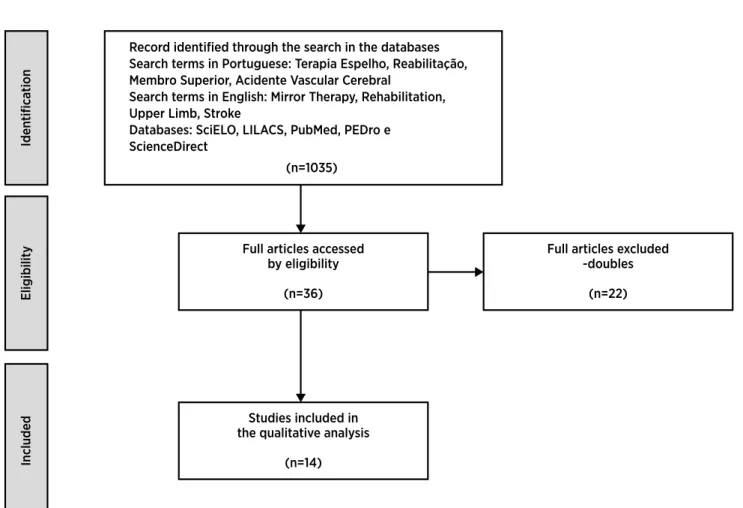
identiied as duplicates were excluded. he proceedings of this research were summarized in accordance with the PRISMA criteria13 and can be seen in Figure 1.
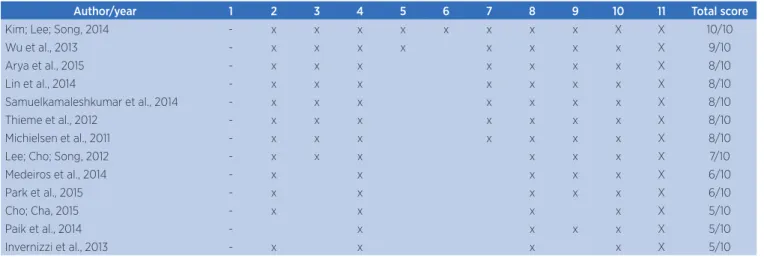
hus, the inal sample of this review consisted of 13 articles, which had their methodological quality evaluated in accordance with the PEDro scale14 and were assessed independently by two researchers. In the absence of consensus, a new evaluation was carried out by a third party. his scale is made up of eleven items, each item is equivalent to one point when the criterion is obeyed, except item one, which should not be assigned a score. hus, the score ranges from zero to ten. he items are: eligibility criteria, random allocation, secret allocation, homogeneity of the sample, blind sample, blind therapist, blind appraiser, outcome in 85% of the subjects initially distributed among the groups, treatment or control according to allocation, statistical comparison between the groups for at least one key outcome and precision and variability measures for at least one key outcome.
Iden
tifica
tion
Record identified through the search in the databases Search terms in Portuguese: Terapia Espelho, Reabilitação, Membro Superior, Acidente Vascular Cerebral
Search terms in English: Mirror Therapy, Rehabilitation, Upper Limb, Stroke
Databases: SciELO, LILACS, PubMed, PEDro e ScienceDirect
(n=1035)
Full articles accessed by eligibility
(n=36)
Full articles excluded -doubles
(n=22)
Studies included in the qualitative analysis
(n=14)
Eligibilit
y
Included
RESULTS
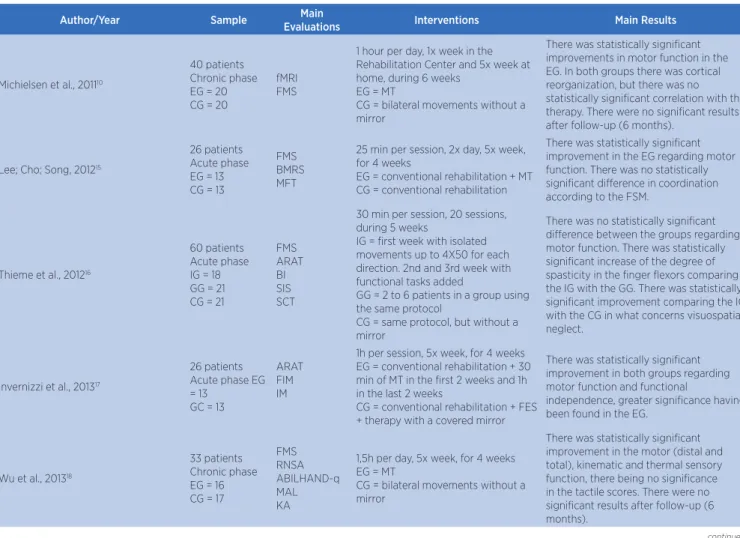
hirteen clinical studies with a total sample of 368 individuals were part of this research. hese studies were characterized according to the analyzed variables, type of intervention and main results, as shown in Table 1.
Generally these studies evaluate motor function, sensory function and functional independence. A few of them included some method for measuring strength, muscle spasticity and kinematics, in addition to electroencephalographic and functional magnetic resonance analyses. he variables which were most studied were the motor function of paretic UL, through the Fugl-Meyer (FMS) (eight studies), Brunnstrom Motor Recovery Stage (BMRS) (four studies), Manual
Function Test (MFT) (three studies) and Box and Block Test (BBT) (four studies) scales. Functional independence was evaluated through the Functional Independence Measure (FIM) (four studies). Most of these studies demonstrated the efectiveness of MT on the motor recovery of UL, compared to the control therapy.
In general terms, it was observed that MT signiicantly improves the gross and ine motor function of the paretic UL. With regard to functional independence, it was observed that the MT provided signiicant changes especially concerning the transfer and self-care items of the FIM. he articles were grouped according to their methodological quality, analyzed through the PEDro scale. he results of this analysis can be seen in Table 2.
Table 1. Characterization of the studies regarding the sample, main evaluations, interventions and main results
Author/Year Sample EvaluationsMain Interventions Main Results
Michielsen et al., 201110
40 patients Chronic phase EG = 20 CG = 20
fMRI FMS
1 hour per day, 1x week in the Rehabilitation Center and 5x week at home, during 6 weeks
EG = MT
CG = bilateral movements without a mirror
There was statistically signiicant improvements in motor function in the EG. In both groups there was cortical reorganization, but there was no statistically signiicant correlation with the therapy. There were no signiicant results after follow-up (6 months).
Lee; Cho; Song, 201215
26 patients Acute phase EG = 13 CG = 13
FMS BMRS MFT
25 min per session, 2x day, 5x week, for 4 weeks
EG = conventional rehabilitation + MT CG = conventional rehabilitation
There was statistically signiicant improvement in the EG regarding motor function. There was no statistically signiicant diference in coordination according to the FSM.
Thieme et al., 201216
60 patients Acute phase IG = 18 GG = 21 CG = 21
FMS ARAT BI SIS SCT
30 min per session, 20 sessions, during 5 weeks
IG = irst week with isolated movements up to 4X50 for each direction. 2nd and 3rd week with functional tasks added
GG = 2 to 6 patients in a group using the same protocol
CG = same protocol, but without a mirror
There was no statistically signiicant diference between the groups regarding motor function. There was statistically signiicant increase of the degree of spasticity in the inger lexors comparing the IG with the GG. There was statistically signiicant improvement comparing the IG with the CG in what concerns visuospatial neglect.
Invernizzi et al., 201317
26 patients Acute phase EG = 13
GC = 13
ARAT FIM IM
1h per session, 5x week, for 4 weeks EG = conventional rehabilitation + 30 min of MT in the irst 2 weeks and 1h in the last 2 weeks
CG = conventional rehabilitation + FES + therapy with a covered mirror
There was statistically signiicant improvement in both groups regarding motor function and functional
independence, greater signiicance having been found in the EG.
Wu et al., 201318
33 patients Chronic phase EG = 16 CG = 17
FMS RNSA ABILHAND-q MAL KA
1,5h per day, 5x week, for 4 weeks EG = MT
CG = bilateral movements without a mirror
There was statistically signiicant improvement in the motor (distal and total), kinematic and thermal sensory function, there being no signiicance in the tactile scores. There were no signiicant results after follow-up (6 months).
Author/Year Sample Main
Evaluations Interventions Main Results
Kim; Lee; Song, 201419
27 patients Acute phase EG = 14 CG = 13
FMS BMRS MFT BBT
30 min per session, 5x week, for 4 weeks
EG = MT + FES + conventional rehabilitation
CG = therapy with non-relective side of the mirror + FES + conventional rehabilitation
There was statistically signiicant improvement in the motor function (FSM) for both groups, in hand motor function (BMRS) for both groups with the highest result belonging to the EG and in the motor function of shoulder and hands (MFT) for both groups with greater signiicance of the hand motor function in the EG. There was satistically signiicant improvement of manual dexterity (BBT) in both groups.
Lin et al., 201420
16 patients Chronic phase CG = 8 EG = 8
MAS BBT ARAT FIM
1,5h per day, 5x week, for 4 weeks EG = Electro-MeshGlove (somatosensorial electrical stimulation) + MT + conventional rehabilitation
CG = MT + conventional rehabilitation
There was improvement in the spasticity of the distal region (MAS) and in manual dexterity (BBT) in the EG. There was statistically signiicant improvement in motor function (ARAT) in the total score for both groups and improvement in the sub-tests in the CG. There was statistically signiicant improvement of functional independence (FIM) in what concerns transfer and no signiicant improvement in the motor sub-scale in the EG.
Medeiros et al., 201421
6 patients Chronic phase IMG = 3 FTG = 3
FMS MAS FIM
50 min per session, the 10 initial minutes being of IM and stretching + 30 min of MT with 1-2 minutes of rest between activities, 3x week, 15 sessions, during 5 weeks
IMG: MT with isolated movements FTG MT with functional tasks
There was statistically signiicant improvement in functional independence (FIM) in the cognitive domain and in total in both groups.
Paik et al., 201422
4 patients Chronic phase IMG = 2 FTG = 2
FMS BBT BMRS MFT CCT CTT
30 min per session, 15 sessions, during 15 days
IMG: MT with isolated movements (10 repetitions for each movement) FTG: MT with functional tasks
There was improvement of functional manual tasks with respect to the increasing of the speed of execution of inger and wrist movements in both groups (CTT). There was improvement of the motor function (FSM) in both groups.
Samuelkamaleshkumar et al., 201423
20 patients Chronic phase EG = 10 CG = 10
FMS BMRS BBT MAS
1h per day divided into 2X30min being the irst 15 min of isolated bilateral movements and the last 15 min of functional tasks, 5x week for 3 weeks
EG = conventional rehabilitation + MT CG = conventional rehabilitation
There was statistically signiicant improvement of manual dexterity (BBT) in the EG. As for the motor function (FSM) and hand and arm motor recovery scores (BMRS) there was statistically signiicant improvement in both groups with the highest result in the EG. No signiicant diference was found for spasticity (MAS) between the groups.
Arya et al., 201524
33 patients Acute phase EG = 17 CG = 16
BMRS FMS
90 min per session, 5x week, 40 sessions, during 8 weeks EG = Occupational Therapy + MT CG = Occupational Therapy
There was statistically signiicant improvement in the motor function of the wrist, hand and arm in the EG, but this improvement was not seen in the shoulder. As for motor recovery, statistically signiicant improvement was observed in the EG.
Cho; Cha, 201525
27 patients Acute phase EG = 14 CG = 13
BBT HD JTT FMS tDCS
20 min per session, 3x week for 6 weeks
EG = MT
CG = therapy with the non-relective side of a mirror
There was statistically signiicant improvement in grip strength (HD) and in the performance of functional manual tasks (JTT) in both groups. As for motor function and manual dexterity (BBT), there was statistically signiicant improvement only in the EG. There were more signiicant increases of BBT and HD in the EG.
Park et al., 201526
30 patients Chronic phase EG = 15 CG = 15
FIM MFT
5x week for 6 weeks EG = MT
CG = therapy with the non-relective side of a mirror
There was statistically signiicant improvement in the scales in both groups, with greater signiicance in the EG in the self-care domain of the FIM and MFT.
EG: experimental group: CG: control group; fMRI: functional magnetic resonance; FMS: Fugl-Meyer scale; MT: mirror therapy; MFT: manual function test; BMRS: Brunnstrom motor recovery stage; IG: individual MT group; GG: group MT group; ARAT: action research arm test; BI: Barthel index; SIS: stroke impact scale; SCT: star cancellation test; MI: motricity index; FES: functional electrical stimulation; RNSA: revised Nottingham sensory assessment; ABILHAND-q: ABILHAND questionnaire; MAL: motor activity log; KA: kinematic analysis; BBT: box and block test; MAS: modiied Ashworth scale; FIM: functional independence measure; IMG: isolated movements group; FTG: functional tasks group; IM: intrarticular mobilization; CCT: cube carry test; CTT: card turning test (JTT sub-score); HD: hand dynamometer; JTT: Jebsen-Taylor test; tDCS: transcranial direct current stimulation
Table 2. Methodological evaluation of the studies in accordance with the PEDro scale.
Author/year 1 2 3 4 5 6 7 8 9 10 11 Total score
Kim; Lee; Song, 2014 - x x x x x x x x X X 10/10
Wu et al., 2013 - x x x x x x x x X 9/10
Arya et al., 2015 - x x x x x x x X 8/10
Lin et al., 2014 - x x x x x x x X 8/10
Samuelkamaleshkumar et al., 2014 - x x x x x x x X 8/10
Thieme et al., 2012 - x x x x x x x X 8/10
Michielsen et al., 2011 - x x x x x x x X 8/10
Lee; Cho; Song, 2012 - x x x x x x X 7/10
Medeiros et al., 2014 - x x x x x X 6/10
Park et al., 2015 - x x x x x X 6/10
Cho; Cha, 2015 - x x x x X 5/10
Paik et al., 2014 - x x x x X 5/10
Invernizzi et al., 2013 - x x x x X 5/10
DISCUSSION
he literature includes some studies that support the use of MT in post-stroke rehabilitation, although many of them are inconclusive11,12. However, researches involving MT have evolved over the past years, acquiring better methodological quality.
he studies found in this review assessed individuals in the acute and chronic phases post-stroke and showed similar efects concerning the efectiveness of MT on the recovery of the motor function (the acute phase being understood as the period of up to six months after a stroke and the chronic phase the period that follows). Two of these studies16,21 did not present signiicant results, when compared to the control therapy. However, in the study by Medeiros et al.21 the absence of efects can be attributed to the small sample of only six patients, not being thus possible to generalize their results, and to the fact that these researchers compared two groups that used diferent MT protocols. On the other hand, the study by hieme et al.16 used relatively low frequency and intensity, with less than 10 total hours of MT.
he studies involving functional independence assessed patients predominantly in the chronic phase. As an exception, the study by hieme et al.16 evaluated patients in the acute phase, with the Barthel Index (BI), but showed no signiicant result. On the other hand, Invernizzi et al.17 assessed functional independence with FIM and showed statistically signiicant results in the acute phase. he studies that evaluated functional independence in patients in the chronic phase, with FIM20,21,26, observed statistically signiicant improvement of functional independence after the intervention.
he studies that used FIM observed statistically signiicant improvement especially in the categories of transfer and self-care17,20,21,26. Two studies evaluated functional independence with the BI and ABILHAND16,18, however they did not report signiicant diference between the experimental and control groups. Some methodological limitations may explain this absence of diference. Firstly, the sample size was relatively small to detect the size of the efect, with a high rate of loss of the sample in one of them16. Secondly, the irst study did not use blinding in the evaluation through the BI, which may have lead to some bias; also, it used patients in the subacute phase in the sample, with severe distal impairment, and admittedly poor prognosis for recovery16. Additionally, the ABILHAND questionnaire evaluates the patient’s diiculty in performing ADL23 which require bimanual manipulation, thus it is possible that the efects on the motor and kinematic functions observed in that same study18 were not relected in activities that require simultaneous and joint use of the hands and therefore require speciic training.
he most widely used instruments for motor function were FMS10,15,18,19,22-25, BMRS15,19,23,24, MFT15,19,26 and BBT19,20,23,25, which assess the gross and ine motor function of the UL. In general, the studies that used these tests showed statistically signiicant results, with improvement of the group that received MT, in comparison to the control group. Some studies used the Action Research Arm Test, the Jebsen-Taylor Test and the Motricity Index instruments and also veriied improvements in the experimental group, compared to the control group17,20,22,23.
kynematics18 and spasticy16,20, with varied instruments. In these studies MT had signiicant results, with the exception of the studies by Lin et al.20 and hieme et al.16, who observed non-signiicant spasticity improvement and spasticity increase in the inger lexor muscles, respectively, after the intervention. here was disparity in the results of the studies that use diferent assessment instruments for the same outcome, while some showed signiicant results, others did not show any statistically signiicant clinical improvement. his may be explained by the variety of the aspects that are evaluated within each test, mainly in the scales that assess together the gross and ine motor function based on various movements and in diferent ways.
Only two of the 13 studies evaluated the maintenance of the efects of MT, with a six-month follow-up. Both reported that there was no maintenance of the efects obtained with MT after six months10,18.
hree intervention protocols with MT have been identiied, namely, isolated bilateral movements (ive studies), unilateral or bilateral functional tasks (three studies) or the combination of the two protocols (four studies). In relation to the improvement of motor function and functional independence, there was improvement of these outcomes with each of the protocols. In two studies, two modalities of MT were compared with each other. he study by Paik et al.22 compared MT with isolated movements with MT with functional tasks. Improvement was observed in both groups, with no signiicant diference regarding motor function. he study by Medeiros et al.21, who made the same comparison, observed statistically signiicant improvement in the total FIM and cognition scores, without reporting, however, diference between the groups. In the study by Samuelkamaleshkumar et al.23 MT and conventional rehabilitation were compared. hey found that there was signiicant improvement of manual dexterity (BBT), motor recovery of the hands and arms (assessed through BMRS) and of the motor function (assessed through FSM) compared to the control group.
Most of them used an intervention period of four to six weeks, with a frequency of ive times a week, in 30-minute sessions. In what concerns series and repetitions, there was not much homogeneity, with some studies ranging from one to four series of 10 to 100 repetitions for each movement or motor standard used.
In the assessment of methodological quality (through the PEDro scale) seven studies had scores between 8
and 10 (good quality) and six had scores from 5 to 7 (moderate quality). he biggest limitation of the works with moderate quality was the absence of blinding (or information about the blinding) on the part of the appraisers, researchers and participants.
CONCLUSION
It is concluded that MT promotes the clinically signiicant improvement of the motor function and functional independence of the upper limb with post-stroke paresis, regardless of the recovery phase. Such improvements, highlighted by studies of moderate to high methodological quality, strengthen the indication of MT as therapeutic measure in rehabilitation. he efects of MT on functional independence in the acute phase are not fully established yet, therefore, it becomes necessary to carry out a greater number of studies with good methodological quality, to test this hypothesis. In addition, studies that investigate the duration of the efects of the improvement in the motor function of the UL and in functional independence through the monitoring of these patients after the end of the treatment are necessary. he only two studies that conducted the monitoring after the intervention showed that the efects remained.
REFERENCES
1. Martin ST, Kessler M. Neurologic interventions for physical therapy. 2. ed. Missoure: Saunders, 2007.
2. Bhakta BB. Management of spasticity in stroke. Br Med Bull. 2000;56(2):476-85.
3. World-Health-Organization. ICF: International Classiication of Functioning, Disability and Health. Geneva: World Health Organization, 2001.
4. Tominaga W, Matsubayashi J, Deguchi Y, Minami C, Kinai T, Nakamura M, et al. A mirror relection of a hand modulates stimulus-induced 20-Hz activity. Neuroimage. 2009;46(2):500-4. doi: 10.1016/j.neuroimage.2009.02.021. 5. Rossiter HE, Borrelli MR, Borchert RJ, Bradbury D, Ward
NS. Cortical mechanisms of mirror therapy after stroke. Neurorehabil Neural Repair. 2015;29(5):444-52. doi: 10.1177/1545968314554622.
7. Kho AY, Liu KPY, Chung RC. Meta-analysis on the efect of mental imagery on motor recovery of the hemiplegic upper extremity function. Aust Occup Ther J. 2014; 61(2):38-48.
8. Dohle C, Püllen J, Nakaten A, Küst J, Rietz C, Karbe H. Mirror therapy promotes recovery from severe hemiparesis: a randomized controlled trial. Neurorehabil Neural Repair. 2009;23(3):209-17. doi: 10.1177/1545968308324786.
9. Cacchio A, De Blasis E, De Blasis V, Santilli V, Spacca G. Mirror therapy in complex regional pain syndrome type 1 of the upper limb in stroke patients. Neurorehabil Neural Repair. 2009;23(8):792-99. doi: 10.1177/1545968309335977.
10. Michielsen ME, Selles RW, van der Geest JN, Eckhardt M, Yavuzer G, Stam HJ, et al. Motor recovery and cortical reorganization after mirror therapy in chronic stroke patients: a phase II randomized controlled trial. Neurorehabil Neural Repair. 2011;25(3):223-33.doi: 10.1177/1545968310385127. 11. Toh SF, Fong KN. Systematic review on the efectiveness
of mirror therapy in training upper limb hemiparesis after stroke. Hong Kong J Occup Ther. 2012;22(2):84-95. doi: http://dx.doi.org/10.1016/j.hkjot.2012.12.009.
12. Thieme H, Mehrholz J, Pohl M, Behrens J, Dohle C. Mirror therapy for improving motor function after stroke. Cochrane Database Syst Rev. 2012;14(3):CD008449. doi: 10.1002/14651858.CD008449.pub2.
13. Moher D, Liberati A, Tetzlaf J, Altman DG, PRISMA Group. Preferred reporting items for systematic reviews and meta-analyses: the PRISMA statement.PLoS Med. 2009;6(7):e1000097. doi: 10.1371/journal.pmed.1000097. 14. Physiotherapy Evidence Database. Escala PEDro em português.
[Internet]. [acesso em 15 set. 2015]. Disponível em: http://www. pedro.org.au/portuguese/downloads/pedro-scale/
15. Lee MM, Cho HY, Song CH. The mirror therapy program enhances upper-limb motor recovery and motor function in acute stroke patients. Am J Phys Med Rehabil. 2012;91(8):689-700. doi: 10.1097/PHM.0b013e31824fa86d.
16. Thieme H, Bayn M, Wurg M, Zange C, Pohl M, Behrens J. Mirror therapy for patients with severe arm paresis after stroke: a randomized controlled trial. Clin Rehabil. 2013;27(4):314-24. doi: 10.1177/0269215512455651.
17. Invernizzi M, Negrini S, Carda S, Lanzotti L, Cisari C, Baricich A. The value of adding mirror therapy for upper limb
motor recovery of subacute stroke patients: a randomized controlled trial. Eur J Phys Rehabil Med. 2013;49(3):311-7. 18. Wu CY, Huang PC, Chen YT, Lin KC, Yang HW. Efects of
mirror therapy on motor and sensory recovery in chronic stroke: a randomized controlled trial. Arch Phys Med Rehabil. 2013;94(6):1023-30. doi: 10.1016/j.apmr.2013.02.007.
19. Kim H, Lee G, Song C. Efect of functional electrical stimulation with mirror therapy on upper extremity motor function in poststroke patients. J Stroke Cerebrovasc Dis. 2014;23(4):655-61. Doi: 10.1016/j.jstrokecerebrovasdis.2013.06.017.
20. Lin KC, Chen YT, Huang PC, Wu CY, Huang WL, Yang HW, et al. Efect of mirror therapy combined with somatosensory stimulation on motor recovery and daily function in stroke patients: a pilot study. J Formos Med Assoc. 2014;113(7):422-8. doi: 10.1016/j.jfma.2012.02014;113(7):422-8.002014;113(7):422-8.
21. Medeiros CSP, Fernandes SGG, Lopes JM, Cacho EWA, Cacho RO. Efects of mirror therapy through functional activities and motor standards in motor function of the upper limb after stroke. Fisioter Pesqui. 2014;21(3):264-70. doi: 10.590/1809-2950/87821032014.
22. Paik YR, Kim SK, Lee JS, Jeon BJ. Simple and task-oriented mirror therapy for upper extremity function in stroke patients: a pilot study. Hong Kong J Occup Ther. 2014;24(1):6-12. doi: http://dx.doi.org/10.1016/j.hkjot.2014.01.002.
23. Samuelkamaleshkumar S, Reethajanetsureka S, Pauljebaraj P, Benshamir B, Padankatti SM, David JA. Mirror therapy enhances motor performance in the paretic upper limb after stroke: a pilot randomized controlled trial. Arch Phys Med Rehabil. 2014;95(11):2000-5. doi: 10.1016/j. apmr.2014.06.020.
24. Arya KN, Pandian S, Kumar D, Puri V. Task-based mirror therapy augmenting motor recovery in poststroke hemiparesis: a randomized controlled trial. J Stroke Cerebrovasc Dis. 2015;24(8):1738-48. doi: 10.1016/j. jstrokecerebrovasdis.2015.03.026.
25. Cho HS, Cha HG. Efect of mirror therapy with tDCS on functional recovery of the upper extremity of stroke patients. J Phys Ther Sci. 2015;27(4):1045-47. doi: 10.1589/jpts.27.1045. 26. Park Y, Chang M, Kim KM, An DH. The efects of mirror