Body image, nutrência abdominal itional status, abominal strength,
and cardiorraticantes espiratory fitness in children and
adolescents practicing sports
Imagem corporal, estado nutricional, forç a de resistê ncia abdominal e aptidãoo cardiorrespirató ria de crianç as e adolescentes praticantes de esportes
Imagen corporal, estado nutricional, fuerza de resistencia abdominal y aptitud cardiorrespiratoria de niños y adolescentes practicantes de deportes
Alexandre Schubert1, Renata Selvatici B. Januário2, Juliano Casonatto2, Christi Noriko Sonoo3
Instituição:Universidade Norte do Paraná (Unopar), Londrina, PR, Brasil
1Mestre em Educação Física pela Universidade Estadual de Maringá (UEM);
Docente da Unopar, Londrina, PR, Brasil
2Mestre em Educação Física pela Universidade Estadual de Londrina (UEL);
Docente da Unopar, Londrina, PR, Brasil
3Doutora em Filosofia e Ciência da Educação pela UEM; Docente da UEM,
Maringá, PR, Brasil ABSTRACT
Objective: To verify the association between nutritional status, physical fitness, and body image in children and adolescents.
Methods: This cross-sectional study included 401 stu-dents (236 boys and 165 girls) aged between 8 and 16 years that were regularly enrolled in sports in the local clubs. The nutritional status was evaluated by the body mass index. Students were assessed for satisfaction with body image, abdominal strength resistance, and cardiorespiratory fitness. The variables were assessed on the same day following a standardized order. In order to verify relationships between variables, the chi-square test was used. Afterwards, the bina-ry logistic regression was applied to identify the magnitude of the associations, considering p<0.05 as significant.
Results: Association was found between body image and body mass index (p=0.001), abdominal strength resistance (p=0.005) and cardiorespiratory fitness (p=0.001). The Odds Ratio for presenting the body image insatisfaction for those who have not achieved the expected values for the health criteria in abdominal strength resistance and cardiorespira-tory fitness were 2.14 and 2.42 times respectively, and for those with overweight and obesity, 2.87 times.
Conclusions: Insatisfaction with body image is associated with body mass index and also with physical fitness, abdomi-nal strength resistance, and cardiorespiratory fitness variables.
Key-words: physical fitness; body mass index; body im-age, children; adolescents.
RESUMO
Objetivo: Verificar se há associação entre estado nutricio-nal, nível de aptidão física e imagem corporal em crianças e adolescentes.
Métodos: Participaram deste estudo transversal 401 estudan-tes (236 meninos e 165 meninas) com idades entre 8 e 16 anos, praticantes de esportes nos clubes locais. Para o estado nutricio-nal calculou-se o índice de massa corpórea. Foram avaliadas a satisfação com a imagem corporal, a força de resistência abdomi-nal e a aptidão cardiorrespiratória. As variáveis foram aabdomi-nalisadas no mesmo dia, seguindo ordem padronizada. Para verificar as associações entre as variáveis foi utilizado o teste do qui-qua-drado. Posteriormente, a regressão logística binária foi aplicada para identificar a magnitude das associações, considerando-se significante p<0,05.
Resultados: Foi constatada associação entre imagem corporal e índice de massa corpórea (p=0,001), força de re-sistência abdominal (p=0,005) e aptidão cardiorrespiratória (p=0,001). A razão de chances para os participantes que não atingiram os valores esperados para os critérios de saúde na força de resistência abdominal e na aptidão cardiorrespirató-ria de apresentarem insatisfação com a imagem corporal foi
Endereço para correspondência: Alexandre Schubert
Rua Ana Neri, 23 – Jardim Petrópolis CEP 86015 610 – Londrina/PR E-mail: [email protected] Conflito de interesse: nada a declarar Recebido em: 1/6/2012
de 2,14 e 2,42 vezes, respectivamente, e para aqueles com sobrepeso e obesidade, de 2,87 vezes.
Conclusões: A insatisfação com a imagem corporal está associada ao índice de massa corpórea e também às variáveis de aptidão física, força de resistência abdominal e aptidão cardiorrespiratória.
Palavras-chave: aptidão física; índice de massa corporal; imagem corporal; crianças; adolescentes.
RESUMEN
Objetivo: Verificar si hay asociación entre estado nutri-cional, nivel de aptitud física e imagen corporal en niños y adolescentes.
Métodos: Participaron de este estudio transversal 401 estudiantes (236 muchachos y 156 muchachas) con edades entre 8 y 16 años. Para el estado nutricional se calculó el índice de masa corporal. Se evaluaron la satisfacción con la imagen corporal, la fuerza de resistencia abdominal y la ap-titud cardiorrespiratoria. Las variables fueron analizadas en el mismo día, siguiendo orden estandarizado. Para verificar las asociaciones entre las variables se utilizó la prueba del chi-cuadrado. Posteriormente, se aplicó la regresión logís-tica binaria para identificar la magnitud de las asociaciones, considerando como significante p<0,05.
Resultados: Se constató asociación entre imagen corporal e índice de masa corporal (p=0,001), fuerza de resistencia abdominal (p=0,005) y aptitud cardiorrespiratoria (p=0,001). La razón de chances para los participantes que no alcanzaron los valores esperados para los criterios de salud en la fuerza de resistencia abdominal y en la aptitud cardiorrespiratoria de presentar insatisfacción con la imagen corporal fue de 2,14 y 2,42 veces, respectivamente, y para aquellos con sobrepeso y obesidad, de 2,87 veces.
Conclusiones: La insatisfacción con la imagen corporal está asociada al índice de masa corporal y también a las va-riables de aptitud física, fuerza de resistencia abdominal y aptitud cardiorrespiratoria.
Palabras clave: aptitud física; índice de masa corporal; imagen corporal; niños; adolescentes.
Introduction
Several studies have been shown that obesity has reached epidemic proportions in the last decades in most developed
and developing countries(1-3). Additionally, it is well
docu-mented in literature that its effects reach all ages indistinc-tively(4-10), so that the prevalence of overweight and obesity
has been growing in children and adolescents and is directly associated with higher risks for morbidity and mortality in adulthood(11). In this sense, the signiicant increase in body
mass combined with a sedentary lifestyle is associated with decreased physical itness, leading to impairments in car-diorespiratory function and muscle resistance. Conversely, although obesity is a highly prevalent disease, its psycho-social determinants have not been totally understood yet(12).
Studies approaching the psychological effects of obesity in adults have been widely explored; however, the indings are not consistent in children and adolescents, possibly because these periods are marked by development and by signiicant physical and psychological changes. Alterations in morphology and physical appearance seem to be the most evident concerns among the population in question and, for this reason, obesity may predispose to dissatisfaction with body image(13).
Moreover, studies that examined the association between body image and physical itness are still inconsistent, and those aiming to associate body image dissatisfaction and low physical itness in children are scarce. Thus, the aim of this study was to identify the possible association between body image, nutritional status, abdominal strength/resistance (ABD) and cardiorespiratory itness (CF) in children and adolescents practicing sports.
Method
A descriptive exploratory research with cross-sectional design was conducted, whose study population was selected by convenience sampling at the main sports clubs in the city of Londrina, state of Paraná, Brazil. The sample was selected using a table of random numbers and included 401 children and adolescents of both genders (236 boys and 165 girls) aged between 8 and 16 years and who had participated in schools of individual and team sports for at least one year and had Physical Education classes at school two or three times a week.
its procedures, legal guardians of the subjects investigated signed a free and informed consent form.
Data from each individual were collected on the same day, according to the following sequence: irstly, the tests related to subjects’ anthropometric data, i.e., body mass and height. Then body image was assessed and inally the ield tests were performed in the following order: ABD and CF tests.
Body mass was measured by a Filizola digital platform scale (S.A Pesagem e Automação, São Paulo, Brazil), model ID110, and height was determined by a wooden stadiom-eter accurate to 0.1cm. Nutritional status was evaluated by the body mass index (BMI), calculated as the ratio between body mass and height squared. An international nutritional status chart widely used in national studies was adopted as a reference(14). After BMI was assessed, subjects were
strati-ied into two groups, one comprising eutrophic individuals and the other comprising overweight and obese individuals. The battery of tests and the classiication criteria proposed by Projeto Esporte Brasil (PROESP) were used as indicators of health-related physical itness (HRPF)(15). Subjects were
divided into two groups: those who had met health indica-tors and those who had not. Individuals classiied as having very poor, poor and fair physical itness(15) were reclassiied as
not meeting health indicators, and those classiied as having good, very good and excellent physical itness, according
to the same authors, were reclassiied as meeting health in-dicators. The tests used to evaluate HRPF were: ABD and nine-minute walk test for CF.
Body image satisfaction was identiied as the agreement between self-reported current and ideal silhouettes, both of them selected by the participants from a scale showing different silhouettes of human igures(16).
The sample was characterized using descriptive statistics. In parallel, data were dichotomously categorized and then the chi-square test(17) was used to identify possible
associa-tions. Secondly, the binary logistic regression was applied to identify the magnitude of the associations(18). Univariate
analysis were performed and subsequently the adjusted model was applied to those variables that remained signii-cant (p<0.05). Afterwards, the binary logistic regression was used again, adjusted for BMI, considering body image as a dependent variable. The signiicance level was set at p<0.05. Data were calculated with Statistical Package for the Social Sciences (SPSS) software,version 17.0.
Results
Boys represented 59% of the total sample (401 children and adolescents), and girls, 41%. Table 1 shows the general characteristics of the sample. There was signiicant difference
Table 1 - General characteristics of the sample, described as mean±standard deviation
Boys
(n=236)
Girls
(n=165) p-value
Age (years) 11.95±2.34 12.20±2.06 <0.001
Height (cm) 1.56±0.16 1.53±0.12 <0.001
Body mass (kg) 52.45±18.51 48.02±14.51 <0.001
BMI (kg/m2) 20.76±4.1 19.90±3.97 <0.001
BMI: body mass index
Table 2 - Prevalence and association of body image with nutritional status, abdominal strength/resistance, and cardiorespiratory resistance
Body image
p-value Satisied
n (%)
Dissatisied n (%)
Eutrophy 151 (64) 85 (36)
<0.001
Excess weight 63 (38.2) 102 (61.8)
Met ABD criteria 185 (56.9) 140 (43.1)
0.005 Did not meet ABD criteria 29 (38.2) 47 (61.8)
Met CF criteria 140 (63.1) 82 (36.9)
<0.001 Did not meet CF criteria 74 (41.3) 105 (56.1)
among sexes for age, height, body mass and BMI, with boys presenting the highest values for height, body mass and BMI. Girls had a higher mean age.
Table 2 displays the values for the chi-square test, iden-tifying an association between nutritional status and body image, in the sense that those individuals classiied as hav-ing excess weight reported dissatisfaction with body image. Low performance in the motor test, which is an indicator of muscle strength/resistance, was also associated with body image disorders. A similar association was found for motor capacity and cardiorespiratory resistance.
The univariate model for association between anthropo-metric variables and body image (Table 3) presents odds ratio values and their respective conidence intervals. Subjects with excess weight had a 187% higher chance of developing body weight dissatisfaction compared to eutrophic subjects. As for the association with the abdominal strength/resistance variable, subject who did not meet the health criteria for this motor capacity had a 114% higher chance of presenting body image dissatisfaction compared to those who met the criterion. Likewise, subjects with low CF showed a 142% higher chance of body image dissatisfaction compared to those who had met health criteria for this motor capacity.
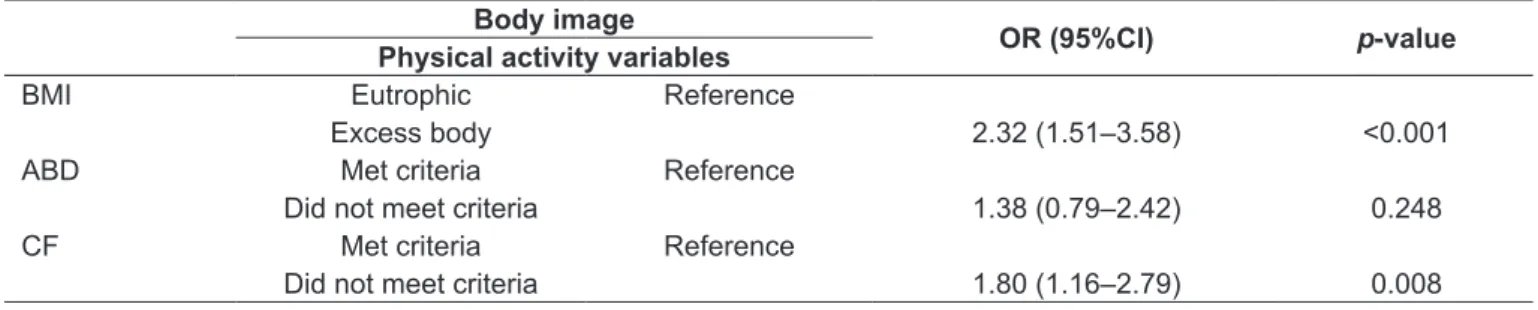
In the values presented using the adjusted model (Table 4), the association between abdominal strength/resistance and
body image disorder loses statistical signiicance. Conversely, the associations of BMI and CF with body image dissatisfac-tion remained statistically signiicant.
Discussion
The present study investigated the existence of possible associations between body image, nutritional status, ABD and CF in children and adolescents of both sexes participat-ing in schools of individual and team sports in the main sports clubs from the city of Londrina, Brazil.
It was observed that there was a greater proportion of children and adolescents classiied as eutrophic by BMI, and a signiicant difference was found between boys and girls. Nutritional status showed to be associated with body image, since overweight and obese subjects had a 2.87 times higher chance of being dissatisied with their body image. This dissatisfaction is part of a subcomponent of the attitudinal dimension of body image, and concerns to how subjects depreciate their own physical appearance(19,20).
Petroski et al(20), in a study involving a sample of
school-children, showed that individuals with excess weight, ac-cording to BMI, have a 8.45 times higher chance of being dissatisied with their body image, a value much higher than that of the present study.
Table 4 - Adjusted model for association between physical activity variables and body image
Body image
OR (95%CI) p-value
Physical activity variables
BMI Eutrophic Reference
Excess body 2.32 (1.51–3.58) <0.001
ABD Met criteria Reference
Did not meet criteria 1.38 (0.79–2.42) 0.248
CF Met criteria Reference
Did not meet criteria 1.80 (1.16–2.79) 0.008
BMI: body mass index; ABD: abdominal strength/resistance; CF: cardiorespiratory itness, OR: Odds Ratio
Table 3 - Univariate model for association between physical activity variables and body image
Body image
OR (95%CI) p-value
Physical activity variables
BMI Eutrophic
Reference
Excess body 2.87 (1.90–4.34) <0.001
ABD Met criteria
Reference
Did not meet criteria 2.14 (1.28–3.57) 0.004
CF Met criteria
Reference
Did not meet criteria 2.42 (1.61–3.62) <0.001
However, although the results from the present inves-tigation were lower than those of the above mentioned study, they are still worrying, because the most common practices of weight control among dissatisied adolescents are usually associated with strenuous physical exercises and inappropriate eating behavior, suggesting the pres-ence of eating disorders(21). Additionally, it was observed
that the majority of eutrophic subjects (64%) were satis-ied with their body image. However, in the case of over-weight or obese subjects, only 38.2% of them reported to be satisied with their body image. Likewise, other authors(22) found that most overweight and obese
adoles-cents were more dissatisied with their body image than eutrophic adolescents. Conversely, in another study(23),
82% of the sample of schoolchildren aged between 8 and 12 years-old reported to be dissatisied with their body image, regardless of BMI classiication, which shows that, in this case, body image dissatisfaction was not associated with nutritional status.
Although obese children were more dissatisied with their body image than their eutrophic counterparts, their concept on their bodies is not totally negative. It means, although they agree that they are bothered by their physi-cal appearance, some positive features about certain parts of their body, such as eyes and a pretty face, can mitigate dissatisfaction(24). Others authors who also analyzed
school-children(25) showed that most eutrophic children evaluated
(58.2%) were dissatisied with their body image, results that differ from those presented herein.
Thus, some studies point out that BMI is one of the main determinants of body satisfaction(26,27), while other studies
argue that this indicator is little important compared to the psychological characteristics that inluence dissatisfac-tion with body image(21,28). In this sense, it is observed that
body dissatisfaction rates diverge considerably among the studies. However, it is consensus in literature that body dis-satisfaction is highly prevalent during adolescence, especially among girls(29).
As for the association between physical itness and body image, it was observed that there was a greater proportion of subjects satisied with their body image among those who had met the established criteria for HRPF, both for ABD and CF, 56.9 and 63.1%, respectively. However, when physical itness levels had not met these criteria, there was a greater proportion of subject dissatisied with their body image for the same capacities (61.8 and 56.1%). In a study with older adults(30), it was found that physical activity
improves not only physiological but also psychological aspects, such as body image satisfaction.
The literature presents univariate models of boys and girls who ind themselves “very fat”, being remarkably inluenced by a high risk for physical inactivity. Thus, the association between body image dissatisfaction and low physical activity levels is well established in both sexes(31); however, no study
on the association between physical itness and body image was found for any age.
As for the physical itness components, it was observed that the greater proportion of individuals satisied with their body image was found among those who had met the health criteria for ABD and CF, 56.9 and 63.1% respectively. In turn, the greater proportion of dissatisied individuals had not met these criteria for both variables. This inding is emphasized by the observation that the Odds Ratios for presenting body image dissatisfaction for those who had not met the health criteria for ABD and CF were 2.14 and 2.42 times, respectively.
A study(32) with college students found that they reported
better body image after undergoing a strength training program for six weeks. These results are similar to those from another study(33), which also showed that there was an
improvement in the body image of female college students after a 12-week strength training program. Therefore, evidence shows that the practice of physical exercises and the improvement in some physical itness components can inluence the improvement in body image. Conversely, a longitudinal analysis has not revealed any association be-tween changes in body perception and alteration in physical activity level over 12 months(34). In addition, other authors(35),
when analyzing female athletes, observed that 33% of them presented body image distortion even though having body fat compatible for age and sex.
It is also important to highlight that a possible limitation of this study was the fact that it did not control for physical activity levels at leisure times, which could have inluenced the results found, depending on the activity. Another factor to be considered is that the research did not examine the activities proposed during Physical Education classes, which
may also have had an inluence on the results from this study. Anyway, these results point out the existence of an associa-tion between body image and nutriassocia-tional status and between body image and physical itness variables, such as ABD and cardiorespiratory resistance, in children and adolescents participating in schools of individual and team sports.
References
1. Kimm SY, Obarzanek E. Childhood obesity: a new pandemic of the new millennium. Pediatrics 2002;110:1003-7.
2. Repetto G, Rizzolli J, Bonatto C. Prevalência, riscos e soluções na obesidade e sobrepeso: here, there, and everywhere [editorial]. Arq Bras Endocrinol Metabol 2003;47:633-5.
3. Marchi-Alves LM, Yagi CM, Rodrigues CS, Mazzo A, Rangel EM, Girão FB. Infant obesity in the past and nowadays: the importance of anthropometric assessment by nurses. Esc Anna Nery 2011;15:238-44.
4. Da Cruz IB, Almeida MS, Schwanke CH, Moriguchi EH. Prevalência de obesidade em idosos longevos e sua associação com fatores de risco e morbidades cardiovasculares. Rev Assoc Med Bras 2004;50:172-7. 5. Pitanga FJ, Lessa I. Anthropometric indexes of obesity as an instrument of
screening for high coronary risk in adults in the city of Salvador, Bahia. Arq Bras Cardiol 2005;85:26-31.
6. Diniz IM, Lopes AS, Dummel CC, Rieger T. Physical growth and body adiposity of students. Rev Bras Cineantropom Desemp Hum 2006;8:32-8.
7. Sampaio HA, Silva BY, Sabry MO, Almeida PC. Glycemic index and glycemic load of diets consumed by obese individuals. Rev Nutr 2007;20:615-24. 8. Souza FI, Amâncio OM, Sarni RO, Pitta TS, Fernandes AP, Fonseca FL
et al. Nonalcoholic fatty liver disease in obese children. Rev Paul Pediatr 2008;26:136-41.
9. Brandalize M, Leite N. Orthopedic alterations in obese children and adolescents. Fisioter Mov 2010;23:283-8.
10. Fernandes RA, Christofaro DG, Casonatto J, Codogno JS, Rodrigues EQ, Cardoso ML et al. Prevalence of dyslipidemia in individuals physically active during childhood, adolescence and adult age. Arq Bras Cardiol 2011;97: 317-23.
11. Baker JL, Olsen LW, Sorensen TI. Childhood body mass index and the risk of coronary heart disease in adulthood. N Engl J Med 2007;357:2329-37. 12. Epstein LH, Paluch RA, Kilanowski CK, Raynor HA. The effect of reinforcement
or stimulus control to reduce sedentary behavior in the treatment of pediatric obesity. Health Psychol 2004;23:371-80.
13. Dilek O, Erol O, Dilek E, Aynur CC, Nesrin S, Pinar ED et al. The association
of self-esteem, depression and body satisfaction with obesity among Turkish adolescents. BMC Public Health 2007;7:80.
14. Cole TJ, Bellizzi MC, Flegal KM, Dietz WH. Establishing a standard deinition for child overweight and obesity worldwide: international survey. BMJ 2000;320:1240-3.
15. Projeto Esporte Brasil [homepage on the Internet]. Normas e critérios [cited 2011 Jul 09]. Available from: www.proesp.ufrgs.br
16. Collins ME. Body igure perceptions and preferences among preadolescent children. Int J Eat Disord 1991;10:199-208.
17. Vincent WJ. Statistics in Kinesiology. 3rd ed. Champaign: Human Kinetics;
2005.
18. Hosmer DW, Stanley L. Applied logistic regression. 2nd ed. New York: Wiley;
2000.
19. Lepage ML, Crowther JH. The effects of exercise on body satisfaction and affect. Body Im 2010;7:124-30.
20. Petroski EL, Pelegrini A, Glaner MF. Body image dissatisfaction among rural and urban adolescents. Motricidade 2009;5:13-25.
21. Shefield JK, Tse KH, Sofronoff K. A comparison of body-image dissatisfaction and eating disturbance among Australian and Hong Kong women. Eur Eat Disord Review 2005;13:112-24.
22. Branco LM, Hilário MO, Cintra IP. Perception and satisfaction with body image in adolescentes and correlations with nutrition status. Rev Psiquiatr Clin 2006;33:214-23.
23. Pinheiro AP, Giugliani ER. Body dissatisfaction in Brazilian schoolchildren: prevalence and associated factors. Rev Saude Publica 2006;40:489-96. 24. Carvalho AM, Cataneo C, Galindo EM, Malfará CT. Self concept and body
image in obese children. Paideia 2005;15:131-9.
25. Triches RM, Giugliani ER. Body dissatisfaction in school children from two cities in the South of Brazil. Rev Nutr 2007;20:119-28.
26. Neighbors LA, Sobal J. Prevalence and magnitude of body weight and shape dissatisfaction among university students. Eat Behav 2007;8:429-39. 27. Eisenberg ME, Neumark-Sztainer D, Paxton SJ. Five-year change in body
satisfaction among adolescents. J Psychosom Res 2006;61:521-7. 28. Canpolat BI, Orsel S, Akdemir A, Ozbay MH. The relationship between dieting
and body image, body ideal, self-perception, and body mass index in Turkish adolescents. Int J Eat Disord 2005;37:150-5.
29. Ballester Ferrando D, De Gracia Blanco M, Patiño Masó J, Suñol Gurnés C, Ferrer Avellí M. Eating attitudes and body satisfaction in adolescents: a prevalence study. Actas Esp Psiquiatr 2002;30:207-12.
30. Mazo GZ, Mota JAPS, Cardoso AS, Prado APM, Antunes G. Qualidade de vida de mulheres idosas: comparação entre o nível de atividade física. Arqu Mov 2009;5:30-44.
31. Finne E, Bucksch J, Lampert T, Kolip P. Age, puberty, body dissatisfaction, and physical activity decline in adolescents. Results of the German health interview and examination survey (KIGGS). Int J Behav Nutr Phys Act 2011;8:119. 32. Williams PA, Cash TF. Effects of a circuit weight training program on the body
images of college students. Int J Eat Disord 2001;30:75-82.
33. Ahmed C, Hilton W, Pituch K. Relations of strength training to body image among a sample of female university students. J Strength Cond Res 2002;16:645-8.
34. Knowles AM, Niven AG, Fawkner SG, Henretty JM. A longitudinal examination of the inluence of maturation on physical self-perceptions and the relationship with physical activity in early adolescent girls. J Adolesc 2009;32:555-66. 35. Oliveira FP, Bosi ML, Vigário PS, Vieira RS. Comportamento alimentar e