Revista Gaúcha
de Enfermagem
How to cite this article:
Oliveira FP, Oliveira BGRB, Santana RF, Silva BP, Candido JSC. Nursing interventions and outcomes classifi cations in patients with wounds: cross-mapping. Rev Gaúcha Enferm. 2016 jun;37(2):e55033. doi: http://dx.doi.org/10.1590/1983-1447.2016.02.55033.
DOI: http://dx.doi.org/10.1590/1983-1447.2016.02.55033
Nursing interventions and outcomes classii cations
in patients with wounds: cross-mapping
Classifi cações de intervenções e resultados de enfermagem em pacientes com feridas: mapeamento cruzado
Clasifi caciones de intervenciones y resultados de enfermería en pacientes con heridas: mapeamento cruzado
a Universidade Federal Fluminense (UFF), Escola de Enfermagem Aurora de Afonso Costa (EEAAC), Niterói, Rio de Janeiro, Brasil.
Fernanda Pessanha de Oliveiraa
Beatriz Guitton Renaud Baptista de Oliveiraa
Rosimere Ferreira Santanaa
Bruna de Paula Silvaa
Jessica de Souza Carvalho Candidoa
ABSTRACT
Objective: Cross-mapping of terms referring to nursing interventions and outcomes in the medical records of patients with wounds compared to nursing interventions and nursing outcomes classifi cations.
Method: An observational retrospective study based on cross-mapping. The sample consisted of 81 outpatients treated in a uni-versity hospital in Rio de Janeiro. Data was collected from medical records between May and July of 2013. The analysis was done in four steps: search for phrases used to describe interventions and outcomes; setting the frequency of occurrence of phrases; grouping synonyms; comparison of terms with taxonomies.
Results: 13 interventions were mapped and the most frequent was “Care with wounds” (47.23%). Also, 6 results were mapped and the priority was “Wound healing: secondary intention” (45%).
Conclusions: The use of cross-mapping of terms referring to interventions and nursing outcomes in patients with wounds suggested additions to the taxonomies for adaptation to outpatient care.
Keywords: Ulcer. Wound healing. Nursing process. Nursing care.
RESUMO
Objetivo: Realizar o mapeamento cruzado dos termos referentes às intervenções e aos resultados de enfermagem nos prontuários dos pacientes com feridas em comparação às classifi cações de intervenções e aos resultados de enfermagem.
Método: Pesquisa observacional, retrospectiva, realizada através de mapeamento cruzado. A amostra foi de 81 pacientes, atendidos no ambulatório de feridas de um hospital universitário do Rio de Janeiro. Os dados foram coletados em prontuários, entre maio e julho de 2013. As etapas de análise foram: busca por frases descritivas de intervenções e resultados; defi nição das frequências de aparecimento das frases; agrupamento por sinônimos; comparação dos termos com as taxonomias.
Resultados: Mapearam-se 13 intervenções, destacando-se “Cuidados com lesões” (47,23%), bem como 6 resultados, e o prioritário foi “Cicatrização de feridas: segunda intenção” (45%).
Conclusões: O mapeamento cruzado de intervenções e de resultados de enfermagem em pacientes com feridas sugeriu a realização de inclusões nas taxonomias para adequação à assistência ambulatorial.
Palavras-chave: Úlcera. Cicatrização de feridas. Processos de enfermagem. Cuidados de enfermagem.
RESUMEN
Objetivo: Hacer mapeo cruzado de términos relacionados a intervenciones y resultados de enfermería en pacientes con heridas en comparación con las Clasifi caciones de Intervenciones y Resultados de Enfermería.
Método: Estudio observacional retrospectivo, realizado por mapeo cruzado. La muestra consistió en 81 pacientes atendidos en un ambulatorio de un hospital universitario en Río de Janeiro. Los datos se obtuvieron entre mayo y julio de 2013 de los registros médicos. El análisis se realizó en cuatro etapas: búsqueda de frases descriptivas de intervenciones y resultados; frecuencia de aparición de frases; agrupación en sinónimos; comparación de términos con las taxonomías.
Resultados: Fueron mapeadas 13 intervenciones, la más frecuente fue Cuidado con lesiones (47,23%), y 6 resultados, el prioritario fue Curación de heridas: segunda intención (45%).
Conclusiones: El mapeo cruzado de intervenciones y resultados de enfermería en pacientes con heridas, sugirió que se hagan inclu-siones en las taxonomías para adaptación a la atención en ambulatorio.
INTRODUCTION
Wounds are a serious problem worldwide responsible for significant morbidity and mortality rates. In the United States, around 6.5 million people have wounds and approx-imately 25 billion dollars are annually spent in the treatment of wound-related health complications(1). Besides, they have
a significant impact on patients’ lives(2), as they result in pain,
immobility, disability, psycho-emotional changes related to self-esteem and self-image, social changes resulting from hospitalizations and social withdrawal(3-5).
Care to patients with wounds involves from bio-physi-ological to emotional issues, and should be provided in a comprehensive manner, which is possible through system-atization of nursing care(6).
Standardized nursing diagnoses have been developed by NANDA International since 1973, though the Nursing In-terventions Classification (NIC) project began only in 1987 with the purpose of constructing a standardized language to describe the activities performed by nurses in their nurs-ing care activities. The NOC (Nursnurs-ing Outcomes Classifica-tion), in turn, is a comprehensive list of standardized defini-tions and measures that describe the outcomes observed in the patient’s health status(7).
Nursing intervention is any treatment based upon clinical judgment and knowledge, that a nurse performs to enhance patient/client outcomes(8) and nursing
out-come is an individual, family or community state, behav-ior or perception that can be measured during a response to one or more interventions. The identification and mea-surement of the impact of care through the assessment of outcomes is essential to demonstrate the importance of the nursing team(7).
Several scientific studies focused on nursing diagnoses of patients with wounds have been identified(9-10), but
stud-ies on the cross-mapping of interventions or outcomes of this clientele have not been found. Research on diagno-ses must be complemented by studies on NIC and NOC to support the construction of comprehensive care protocols. The outpatient wound healing service where the out-patients whose records were collected for this study are treated does not use standardized protocols for recording nursing care or assessments. Thus, the lack of standardiza-tion in nursing care records was found to be a complicat-ing factor in the assessment of care plans.
Thus, the guiding question of this study was as follows: Are nursing interventions and outcomes documented in the records of patients with wounds in accordance with the stipulations of Nursing Interventions and Outcomes Classifications (NIC and NOC)?
The present study aimed to cross-mapping terms refer-ring to nursing interventions and outcomes in the records of patients with wounds comparing them to Nursing Inter-ventions and Outcomes Classifications.
METHOD
Retrospective observational study based on documen-tary evidence, which uses cross-mapping. It is a strategy that makes is possible to compare languages used in the routine of health services with existing standardized clas-sification systems(11).
The target population of this study consisted of 190 pa-tients monitored in 2012 in an outpatient wound healing service of a university hospital in the state of Rio de Janeiro. In this unit, 200 outpatients are assisted per year, mostly women over 50 years, with chronic venous ulcers and hy-pertension as the main comorbidity(12).
The sample observed the following inclusion criteria: subjects aged over 18 years with tissue injuries of any eti-ology who attended at least five nursing appointments in 2012,and whose medical records were available in the archive section. Also, 109 patients were excluded due to absence of nursing documentation in the patients’ records related to wounds. Thus, 81 patients’ records were includ-ed, and these were assessed for the five most recent docu-mentations of patients’ progress by nurses in each record, totaling 405 documentations of progress. We decided to assess nursing documentation of patients’ progress be-cause these are the only written records made by nurses regarding patients treated for wounds in the setting of the study. There were no records of nursing prescriptions.
Data collection was performed from May to July 2013 through analysis of terms used in interventions and out-comes found in nursing documentations of patients’ prog-ress, in their denotative (literal) meanings, during the year of 2012, which were transcribed to a form using Microsoft Office Word 2007 software, in a personal computer.
The form had two parts: 1 – patient identification, includ-ing data such as age, gender, underlyinclud-ing diseases, wound etiology and dressing used in the treatment; 2 – nursing documentation with patients’ progress transcribed exactly as it was written in the patients’ medical records, followed by specific columns for nursing care and assessments, where phrases related to nursing interventions and outcomes, re-spectively, in their denotative meanings, where copied.
Data analysis was performed in three stages. In the first stage, nursing documentation of patients’ progress were read, and the parts referring to interventions and assess-ments (outcomes) were transcribed from the forms used in data collection to a database in Microsoft Office Excel 2007 software.
In the second stage, phrases with the same semantic content were counted to measure the number of repeti-tions of a phrase in all nursing documentarepeti-tions of patients’ progress assessed. The percentage values corresponding to the absolute values obtained were calculated for all the mapped phrases using database software. Subsequently, the phrases were organized in groups of synonyms or re-lated words. Eight groups were established for nursing in-terventions: wound cleansing; types of debridement; types of dressing; continued treatment; comorbidities: wound size measures; use of products for enzymatic debridement; and factors that motivated nursing guidance. Also, three groups were created for nursing outcomes: clinical, satis-faction and monitoring assessments.
In the third step, cross-mapping was performed by comparing interventions and outcomes with the activities (NIC) and indicators (NOC). Mapping was done based on the similarity between the item, the definition of the inter-vention or outcome and the corresponding activities and indicators. The words and their meanings were mapped.
This research was subjected to appreciation of the Re-search Ethics Committee of the institution under number CAAE 13452713.3.0000.5243, and exemption from
obtain-ing free informed consent signed by patients was request-ed, since the study is based on documentary evidence. The protocol of the research was approved under no 219.752, in accordance with the stipulations of Resolution no 466/12 of the National Health Council (CNS).
Article extracted from the term paper: “Classificações de Intervenções e Resultados de Enfermagem: Estudo de Mapeamento Cruzado em Pacientes com Feridas”(13)
(Nurs-ing interventions and outcomes classifications in patients with wounds: cross-mapping).
RESULTS
Nursing interventions
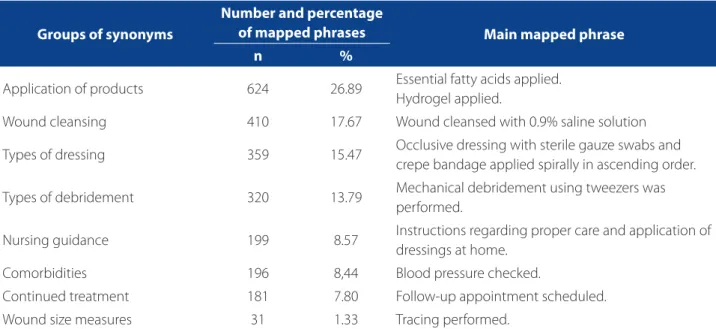
In the 405 nursing documentation records of pa-tients’ progress assessed, 2,320 phrases that expressed nursing interventions were identified, indicating the occurrence of 5.72 interventions per patient’s progress record. These were arranged in groups of synonyms ac-cording to Table 1.
Identification of phrases related to the application of products for wound care and cleansing was given priority. The number of phrases related to these groups identified in the patients’ medical records exceeded the total nursing documentations of patients’ progress assessed, which were 405, indicating that that phrases related to these groups were recorded more than once during each record of pa-tient’s progress.
Groups of synonyms
Number and percentage
of mapped phrases Main mapped phrase
n %
Application of products 624 26.89 Essential fatty acids applied. Hydrogel applied.
Wound cleansing 410 17.67 Wound cleansed with 0.9% saline solution
Types of dressing 359 15.47 Occlusive dressing with sterile gauze swabs and crepe bandage applied spirally in ascending order.
Types of debridement 320 13.79 Mechanical debridement using tweezers was performed.
Nursing guidance 199 8.57 Instructions regarding proper care and application of dressings at home.
Comorbidities 196 8,44 Blood pressure checked.
Continued treatment 181 7.80 Follow-up appointment scheduled. Wound size measures 31 1.33 Tracing performed.
Table 1 – Frequencies of phrases mapped according to groups of synonyms of nursing interventions – Niterói/RJ – 2013
In total, 13 nursing interventions and 32 nursing ac-tivities were mapped, according to the NIC, based on the medical records of patients with wounds (chart 1).
The intervention “Wound care” had the highest number of mapped activities (n=1.093, 47.23%). Activities of interven-tions “Wound cleansing” (n=310, 13.39%) and “Topical admin-istration of medications” (n=288, 12.44%) were also prevalent.
No synonym expressions were obtained in NIC for the phrase “Return visit scheduled” of the group of synonyms: Treatment continued. This phrase was mapped 164 times in the assessed records (7.08%). Likewise, the NIC has no synonyms for performing mechanical or surgical debride-ment. There is only the description of the use of drug agents for debridement, in the intervention “Topical ad-ministration of medications”.
Nursing Outcomes
Regarding nursing outcomes, 80 phrases with deno-tative meanings were identified; however, most of them described the same subjects in different ways. Thus, they were arranged in three groups of synonyms: clinical ments, satisfaction assessments and monitoring assess-ments, according to Table 2.
Priority was given to clinical assessments involving wound-related outcomes.
Also, 6 nursing outcomes and 19 indicators were mapped according to the NOC, based on the medical re-cords of patients with wounds (chart 2).
The outcome “Wound healing: secondary intention” was the most prevalent (n=36, 45%), followed by “Treat-ment behavior: disease or injury” (n=16, 20%) and “Pain control” (n=8, 10%).
No synonym expressions were found in NOC for the phrases of the group “Monitoring assessments” that
in-cluded “Outpatient discharge” (n=10, 12.5%) and “Death at home” (n=3, 3.75%).
DISCUSSION
The priority nursing intervention was “Wound care”. In this regard, it should be stressed that activities related to would cleansing with saline solution (0.9% sodium chlo-ride), the use of aseptic procedures during application of dressing, measurement of wound bed, documentation of wound size, site and aspect are nursing interventions es-sential to the appropriate treatment of tissue injuries(12).
Likewise, assessments of drainage (exudates), color, size and odor, use of proper dressing and guidance on proper wound care at home are also important(12).
Wound cleansing with 0.9% saline solution is es-sential. According to some studies an ideal solution for cleaning wounds should not be toxic to human tissues, keep viable granulation tissue, reduce the number of microorganisms, not trigger sensitive responses, and be widely available and inexpensive. The use of 0.9% saline solution meets these requirements as it is an isotonic solution, does not interfere with the healing process and does not damage tissue. Therefore, it is the best choice to irrigate wounds(14).
Nursing guidance during outpatient care is very sig-nificant, particularly regarding wound care. In outpatient services where patients are assisted once a week, or ev-ery fortnight, guidance on the use of appropriate dress-ing at home is a responsibility of the nursdress-ing team. Such guidance stimulates self-care and empowers patients by providing them with the necessary tools to care for them-selves. Aspects related to the frequency of dressing change according to the product used, and wound infection con-trol measures should also be stressed(15).
Intervention NIC Activity n %
Wound care
Apply dressing to the skin/wound, if appropriate; 341 14.74 Administer care to skin ulcers, as needed; 273 11.79 Cleanse wound with saline solution or non-toxic product, when
appropriate; 207 8.94
Guide the patient or family members regarding wound care procedures; 146 630 Use aseptic procedures during application of dressing, as appropriate; 47 2.03 Measure wound bed, where appropriate; 30 1.29 Encourage liquid intake, as appropriate; 24 1.03
Chart 1 – Nursing interventions and activities according to NIC in the medical records of individuals with wounds treated in outpatient facilities. Niterói/RJ, 2013 (conclusion)
Source: Research data, 2013.
Intervention NIC Activity n %
Wound care
Reinforce bandage, if necessary; 23 0.99
Guide the patient and family on storage and disposal of dressings and
materials; 1 0.04
Document wound site, size and aspect. 1 0.04
Wound cleansing Wrap wound with the appropriate type of sterilized bandage; 309 13.35 Wash and dry the area around the wound after the procedure. 1 0.04
Topical
administration of medications
Apply debridement agent to the affected area, as appropriate; 234 10.11
Apply topical antibiotic to the affected area, as appropriate; 43 1.85
Apply topical anti-inflammatory agent to the area, as appropriate; 8 0.34
Teach and monitor self-administration of medication; 2 0.08
Apply topical antifungal agent to the affected area, as appropriate. 1 0.04
Skin care: topical
treatments Clean the skin with antibacterial soap, as appropriate. 202 8.72
Monitoring vital signs
Monitor blood pressure, pulse, temperature and respiratory pattern, as
appropriate. 139 6.00
Control high blood
glucose levels Monitor blood glucose levels, as indicated. 55 2.37
Bleeding control Apply compression bandage, as indicated. 27 1.16 Medication control Monitor patient adherence to medication regimen. 12 0.51
Supervision Arrange a medical appointment when patient data suggest the need for
change in medical therapy. 11 0.47
Nutritional control Weigh patient at appropriate intervals. 2 0.08
Teaching: foot care
Describe the appropriate shoes (i.e., low heels, with mold suitable to the foot shape, appropriate thickness of leather for the upper of the shoe, shock absorbing insole material adjustable closure (shoelaces or no-tie straps), leather made of soft and flexible material that allows perspiration, causes no disturbance in gait and in limb length, with potential for changes, if necessary;
2 0.08
Recommend thorough drying of feet after washing them, especially
between the toes; 2 0.08
Instruct the individual to hydrate the skin every day, through short immersions or bathing the feet in water at room temperature, followed by the use of a moisturizer;
2 0.08
Explain the relationship between neuropathy, injury and vascular disease and risk of ulceration and lower extremity amputation in diabetic individuals;
2 0.08
Describe the appropriate socks (i.e., absorbent and comfortable material). 1 0.04
Foot care Monitor swelling in legs and feet (edema). 1 0.04 Promotion of
physical exercises
Guide the individuals on the type of physical exercise suitable for their
The intervention “Wound cleansing” was a frequent intervention activity, especially “wrap wound with the ap-propriate type of sterilized bandage”. The use of dressing with sterile gauze and bandage is preferred in wounds in the lower limbs, as it prevents direct contact with the skin, whose removal could result in new lesions(15).
The ideal dressing should ensure impermeability to wa-ter and other fluids, promote a wet environment, maintain
proper temperature, protect wound from mechanic trauma and infections and limit tissue movement around the wound. Besides, it should also allow gas exchanges, absorb exudates and promote debridement, mitigating pain and providing fa-vorable conditions for the patient’s’ daily activities(15).
Regarding the intervention “Topical administration of medications”, essential fatty acids (EFA) had a high frequen-cy of use, because it is sold at a low price and has many
Groups of synonyms
Amounts of
mapped phrases Main mapped phrase
n %
Clinical assessments 61 76.25 Improvement of wound tissues Satisfaction assessments 6 7.5 Satisfaction with treatment Monitoring assessments 13 16.25 Outpatient discharge
Table 2 – Frequencies of phrases mapped according to groups of synonyms of nursing outcomes – Niterói/RJ – 2013
Source: Research data, 2013.
NOC outcome Indicators n %
Wound healing: secondary intention
Granulation tissue 13 16.25
Necrotic tissue formation 6 7.50
Scar tissue formation 4 5.00
Serous exudate 4 5.00
Sanguineous exudate 3 3.75
Macerated skin 2 2.50
Decrease in wound size 1 1.25
Irregular edges 1 1.25
Odor 1 1.25
Redness (erythema) around the wound 1 1.25
Treatment behavior: disease or injury
Monitors the effects of treatment 12 15.00 Compliance with recommended treatment regimen 3 3.75 Performs the prescribed health behavior, when indicated 1 1.25
Pain control
Reports pain control 7 8.75
Reports changes in symptoms or in sites of pain to the health
professional 1 1.25
Tissue integrity: skin and mucosae
Peeling of skin 3 3.75
Hydration 2 2.50
Mobility Deambulation 1 1.25
Self-control of diabetes Treats hypoglycemia symptoms 1 1.25
Chart 2 – Nursing outcomes and indicators according to the NOC mapped in the medical records of outpatients with wounds. Niterói/RJ, 2013
benefits. It is originated from polyunsaturated vegetable oils such as linoleic acid, caprylic acid, capric acid, vitamins A, E and soybean lecithin. Helps maintaining the integrity of the epidermal water permeability barrier, and is used in the prevention and treatment of dermatitis, pressure ul-cers, venous lesions and neurotrophic ulcers with or with-out infection(15).
Also, carboxymethyl cellulose gel (2% weight), de-scribed as hydrogel in the medical records, was the poly-mer most widely applied (31%) in patients whose progress was assessed. It is made of insoluble polymers and has high water content. It can be used in various types of wounds and can absorb exudate and moisturize dry wounds, as in necrotic lesions, stimulating debridement(15).
Debridement is generally defined as removal of non-vi-able tissues and bacteria from wounds to allow regenera-tion of the underlying healthy tissue(16-17), given the need to
prevent damage to the newly formed granulation tissue. There are four main types of debridement: mechanical, sur-gical, chemical and autolytic.
Mechanical debridement consists in the direct applica-tion of mechanical force on the necrotic tissue; and the con-cept of force is related to changes in the number of move-ments made. In surgical debridement, sharp instrumove-ments are used in the removal of non-viable tissues, and strength is related to the efficiency of the referred instrument(17).
In chemical or enzymatic debridement, in turn, proteo-lytic enzymes remove devitalized tissue through collagen degradation. Topical dressing with enzymatic components is used. Finally, autolytic debridement occurs by autolysis, i.e. self-degradation of necrotic tissue by the action of lysosomal enzymes released by macrophages in the wound bed(17).
Analysis of these concepts comparatively to the docu-mentation in the medical records of the patients who at-tended the nursing appointments shows inconsistency in the records. This occurs because a debridement that uses a sterile technique and sharp tools is considered a surgi-cal debridement (even without anesthesia), although it is referred to as “mechanical debridement” in nursing doc-umentations of patients’ progress in the medical records. This inappropriate nomenclature has been frequently used in nursing documentation of patients’ records to describe the use of different tools, such as anatomical tweezers and scalpel blade, ratifying the importance of standardization of nursing language in patients’ medical records.
In the NIC activities described, there were no activities that specifically addressed the different types of debride-ment. Thus, it is recommended that health professionals that provide care to patients with wounds include the type of debridement used in their records.
Regarding the care provided to subjects with wounds in outpatient facilities, we stress the need for a continued care plan, allowing patients periodical access to nursing appointments.
Since leg ulcers are usually long-lasting, chronic sores(18),
which is corroborated by the fact that the population treat-ed in these facilities is mostly compostreat-ed of women over 50 years, with chronic venous ulcers and hypertension(12),
it is essential to schedule return visits for periodical reas-sessments of the care. Nevertheless, no NIC activities were observed for the phrase “Return visit scheduled” found in the medical records, which is a limitation of this taxonomy in the daily activities of outpatient care.
In general, a large number of records related to nurs-ing interventions were observed, demonstratnurs-ing signif-icant concern with doing and executing. This stresses the importance of the role of nursing professional in the health care team, focused on comprehensive human care, aimed to minimize the biopsychosocial impacts on patients with wounds.
The main nursing outcome identified was “Wound healing: secondary intention”. The type of wound healing is closely related to the healing time. Acute or saturated wounds are generally repaired by primary intention. How-ever, wounds where there is delayed tissue repair process, whose edges are pulled apart because of surgical dehis-cence, venous or arterial failure, infections or other fac-tors, may become chronic, that is, tissue repair may take more than six weeks(19), healing by secondary intention.
In the outpatient wound healing service where the present study was conducted, there is a prevalence of patients with chronic wounds.
Thus, it is expected that nurses are attentive to the characteristics of tissues in the bed or edges of wounds, such as the presence or absence of granulation tissue and necrotic tissue, maceration, scaling or crusts on the edges, moisturizing of perilesional skin and fetid odor, as well as type of exudate, location, depth and measurement of inju-ry size(12). Assessment of these aspects makes it possible to
determine the type of wound, healing stage, most appro-priate products to accelerate the tissue repair process and occurrence of infection.
The outcome “Treatment behavior: disease or injury” referring to personal actions aimed to reduce or eliminate a pathology(5), describing the reports of patients about the
physiopa-thology of the disease(20), so that they express confidence
in the care provided.
The outcome “Pain control” is defined as the series of personal actions to control pain(5) and denotes reports
of pain resulting from wounds made by the patients. It is known that during nursing appointments of patients with wounds there are frequent assessments of pain. However, this outcome is not suggested by the Nursing Outcomes Classification (NOC) in association with diag-noses “Impaired tissue integrity” or “Impaired skin integri-ty”. This is an inconsistency, since a patient with wounds faces pain conditions.
Interestingly, the activities related to the intervention “Pain control” were not detected among the phrases of nursing documentations in patients’ records. This occurred because the level of pain was assessed in nursing outcomes, but the care specifically provided to achieve this outcome was not recorded, showing a gap in the recording of the actions taken and stressing the need for standardization of the language used in nursing documentation..
The management of pain in patients with wounds in-volves, among other things, monitoring the level of pain using the Visual Analogue. Scale for Assessment of Pain In-tensity (EVA); start dressing the wound after topical, oral, subcutaneous or intravenous analgesia, remove the ban-dages of the previous dressing, irrigate the wound bed with distilled water or 0.9% saline solution and reconsider the need to change the prescribed analgesic scheme(15).
No nursing outcomes were found in the NOC for out-patient discharge or death at home. Only the outcomes “Preparation for discharge: life with support”, defined as the preparation of a patient to be transferred from a health institution to a place where life will have lower level of sup-port(5), and “Preparation for discharge: independent life”,
which is defined as the preparation of a patient for trans-feral from a health institution to independent life(5). Both
are more related to discharge in inpatient units, indicating, thus, the need for development of a nursing outcome spe-cifically tailored to outpatient units .
Within the context of the nursing outcomes for patients with wounds, the documentation of conducts adopted in care plans is essential to ensure the delivery of high quality care to the patients. Only through the records of the clinical conditions of a subject in the different steps of treatment it will be possible to measure changes in health status, either positive or negative(5).
Thus, it can be said that the outcomes obtained cannot be measured without the appropriate record of the initial health status of the patient and the measures implement-ed. Based on this data, the nursing team will be able to
de-velop clinical protocols to ensure the standardization and improvement of care, as well as to insert nursing data in standardized databases to facilitate the exchange of infor-mation between professionals and scholars.
CONCLUSION
The objective of this study was achieved, since nursing interventions and outcomes were mapped based on the medical records of patients with wounds. The most prev-alent nursing intervention was “Wound care” and the most priority nursing outcome was “Wound healing: secondary intention”.
No synonym expressions were found in the NIC for the expressions that indicated that return visits (subsequent nursing appointments) were scheduled, showing that this classification is more focused on care plans in the hospital setting, at the expense of outpatient services. Likewise, no synonym expressions were identified in the NOC for the expression “outpatient discharge”, corroborating the need for adaptation of this classification to contemplate the care provided to these individuals.
Retrospective data collection and the records of differ-ent professionals are methodological limitations intrinsic to cross-mapping. Besides, generalizations can be made to other outpatient wound healing services, particularly regarding the interventions identified in this study, given the large number of phrases mapped in the patients’ re-cords assessed.
It should be stressed that a much larger number of records of nursing interventions than nursing outcomes was observed. This does not necessarily indicate that nursing outcomes are not assessed, but rather that in practice such assessments have not been properly reg-istered. Therefore, the present study provides significant contributions to nursing by identifying bias in clinical practice that should be reduced to favor a more sci-ence-based nursing profession.
REFERENCES
1. Wong VW, Gurtner GC. Tissue engineering for the management of chron-ic wounds: current concepts and future perspectives. Exp Dermatol. 2012;21(10):729-34.
2. Zaho G, Hochwalt PC, Usui ML, Underwood RA, Singh PK, James GA, et al. De-layed wound healing in diabetic (db/db) mice with Pseudomonas aeruginosa biofilm challenge: a model for the study of chronic wounds. Wound Repair Re-gen. 2010; 18(5):467-77.
3. Charlesworth B, Pilling C, Chadwick P, Butcher M. Dressing-related trauma: clini-cal sequelae and resource utilization in a UK setting. Clinicoecon Outcomes Res. 2014; 6:227-39.
4. Soares PPB, Ferreira LA, Gonçalves JRL, Zuffi FB. Impacto das úlceras arteriais na qualidade de vida sob a percepção dos pacientes. Rev Enferm UFPE on line. 2013; 7(8):5225-31.
5. Lara MO, Pereira Júnior AC, Pinto JSF, Vieira NF, Wichr P. Significado da ferida para portadores de úlceras crônicas. Cogitare Enferm. 2011;16(3):471-7.
6. Conselho Federal de Enfermagem (BR). Resolução Cofen 358/2009. Dispõe sobre a Sistematização da Assistência de Enfermagem e a implementação do Processo de Enfermagem em ambientes, públicos ou privados. Brasília; 2009. 7. Moorhead S, Johnson M, Meridean MAAS. Classificação dos resultados de
en-fermagem (NOC). 3. Ed. Porto Alegre: Artmed; 2010.
8. Dochterman JMC, Bulechek GM. Classificação das intervenções de enfermagem (NIC). 4. ed. Porto Alegre: Artmed; 2010.
9. Lima MSFS, Carvalho ESS, Silva EA, Gomes WS, Passos SSS, Santos LM. Diag-nósticos de enfermagem evidenciados em mulheres com feridas crônicas. Rev Baiana Enferm. 2012;26(3):585-92.
10. Cavalcante AMRZ, Moreira A, Azevedo KB, Lima LR, Coimbra WKAM. Diagnós-tico de enfermagem: integridade tissular prejudicada identificado em idosos na Estratégia de Saúde da Família. Rev Eletr Enf. 2010;12(4):727-35.
11. Luciano TS, Nóbrega MML, Saparolli ECL, Barros ALBL. Mapeamento cru-zado de diagnósticos de enfermagem em puericultura utilizando a Clas-sificação Internacional de Práticas de Enfermagem. Rev Esc Enferm USP. 2014;48(2):250-6.
12. Pessanha FS, Oliveira BGRB. Perfil sociodemográfico e clínico de pa-cientes ambulatoriais com úlceras da perna. Rev Enferm UFPE on line. 2015;9(7):8551-60.
13. Pessanha FS. Classificações de intervenções e resultados de enfermagem: es-tudo de mapeamento cruzado em pacientes com feridas [trabalho de conclusão de curso]. Niterói (RJ): Universidade Federal Fluminense; 2013.
14. Queirós P, Santos E, Apóstolo J, Cardoso D, Cunha M, Rodrigues M. The ef-fectiveness of cleansing solutions for wound treatment: a systematic review protocol. JBI Database of Systematic Reviews & Implementation Reports. 2013;11(5):169-81.
15. Sood A, Granick MS, Tomaselli NL. Wound dressings and comparative effective-ness data. Adv Wound Care (New Rochelle). 2014 Aug 1;3(8):511-29. 16. Azoubel R, Torres GV, Silva LWS, Gomes FV, Reis LA. Efeitos da terapia física
descongestiva na cicatrização de úlceras venosas. Rev Esc Enferm USP. 2010;44(4):1085-92.
17. Santos ICRV, Oliveira RC, Silva MA. Desbridamento cirúrgico e a competência legal do enfermeiro. Texto Contexto Enferm. 2013;22(1):184-92.
18. Martins MA, Tipple AFV, Reis C, Santiago SB, Bachion MM. Úlcera crônica de perna de pacientes em tratamento ambulatorial: análise microbiológica e de suscetibilidade antimicrobiana. Cienc Cuid Saude. 2010;9(3):464-70. 19. Scotton MF, Miot HA, Abbade LPF. Factors that influence healing of
chronic venous leg ulcers: a retrospective cohort. An Bras Dermatol. 2014;89(3):414-22.
20. Melo EM, Teles MS, Teles RS, Barbosa IV, Studart RMB, Oliveira MM. Avaliação dos fatores interferentes na adesão ao tratamento do cliente portador de pé diabético. Rev Enf Refer. 2011;3(5):37-44.
Corresponding author:
Fernanda Pessanha de Oliveira
E-mail: [email protected]