Revista Gaúcha
de Enfermagem
How to cite this article:
Silva GWS, Souza EFL, Sena RCF, Moura IBL, Sobreira MVS, Miranda FAN. Cases of violence involving transvestites and trans-sexuals in a northeastern Brazilian city Rev Gaúcha Enferm. 2016 jun;37(2):e56407. doi: http://dx.doi.org/10.1590/1983-1447.2016.02.56407.
DOI: http://dx.doi.org/10.1590/1983-1447.2016.02.56407
Cases of violence involving transvestites and
transsexuals in a northeastern Brazilian city
Situações de violência contra travestis e transexuais em um município do nordeste brasileiro
Situaciones de violencia contra travestis y transexuales en una ciudad en el noreste de Brasil
a Universidade Federal do Rio Grande do Norte, Progra-ma de Pós-graduação em EnferProgra-magem, Departamento de Enfermagem. Natal, Rio Grande do Norte, Brasil.
b Faculdade Santa Maria, Departamento de Enferma-gem. Cajazeiras, Paraíba, Brasil.
c Universidade do Estado do Rio Grande do Norte, Departamento de Enfermagem. Caicó, Rio Grande do Norte, Brasil.
Glauber Weder dos Santos Silvaa
Emanoel Fhilipe Leite Souzab
Romeika Carla Ferreira de Senaa
Izabella Bezerra de Lima Mouraa
Maura Vanessa Silva Sobreirac
Francisco Arnoldo Nunes de Mirandaa
ABSTRACT
Objective: To analyze cases of violence against transvestites and transsexuals based on their sociodemographic profile.
Method: Cross-sectional, descriptive research performed in Cajazeiras / Paraíba, consisting of 16 transvestites and transsexuals. Data collection took place in April 2014 and was analyzed descriptively.
Results: The typology of violence that victimized transvestites and transsexuals were: verbal (91.96%), psychological (58.33%) and physical (33.33%), often between 24 hours and six months preceding the survey. Regarding the spatiality: the street, school and health services were all scenarios of aggression. With respect to the offending agent, the findings point towards neighbors, family members and health professionals. All forms of violence happened between agents and spaces of aggression.
Conclusions: Violence among this population, silence around the situations of abuse became more pronounced as did its invisibility in the social and institutional context, reflecting the inhibition of human rights and concealment of reality.
Keywords: Transgender people. Violence. Social vulnerability.
RESUMO
Objetivo: Analisar a partir do perfil sociodemográfico as situações de violência contra travestis e transexuais.
Método: Pesquisa transversal, descritiva, composta por 16 travestis e transexuais, realizada em Cajazeiras (PB). A coleta de dados ocorreu em abril de 2014 e os mesmos foram analisados de forma descritiva.
Resultados: A tipologia das violências que vitimaram travestis e transexuais foram: verbal (91,96%), psicológica (58,33%) e física (33,33%), com frequência entre 24 horas e seis meses anteriores à pesquisa. Quanto à espacialidade: a rua, a escola e os serviços de saúde configuraram os cenários das agressões. No que diz respeito ao agente agressor, os achados apontaram para vizinhos, membros da família e profissionais de saúde. Todas as formas indistintamente aconteceram entre os agentes e espaços da agressão.
Conclusões: Na violência efetuada nesta população, acentuou-se o silenciamento das agressões sofridas e sua invisibilidade no contexto social e institucional reflete a inibição dos direitos humanos e ocultamento da realidade.
Palavras-chave: Pessoas transgênero. Violência. Vulnerabilidade social.
RESUMEN
Objetivo: Analizar las situaciones sociodemográficas de la violencia contra travestis y transexuales.
Método: Se trata de un estudio transversal, descriptivo, compuesto por 16 travestis y transexuales, que se celebró en Cajazeiras/PB. La recolección de datos se llevó a cabo en abril de 2014 y se analizó descriptivamente.
Resultados: La tipología de la violencia que victimizaba travestis y transexuales era verbal (91,96%), psicológica (58,33%) y física (33,33%) a menudo entre las 24 horas y seis meses anteriores a la investigación. Cuanto a la espacialidad: la calle, los servicios esco-lares y de salud escenarios de agresión configurados. Con respecto al agente agresor, los resultados apuntaron a vecinos, familiares y profesionales de la salud. Todas las formas indistintamente ocurridas entre agentes y espacios de agresión.
Conclusión: En esta población se acentuó la violencia compuesta por el silenciamiento de estos abusos y su invisibilidad en el contexto social e institucional refleja la inhibición de los derechos humanos y la ocultación de la realidad.
INTRODUCTION
Studies on gender and sexuality have long denoted heterosexuality as something essential, biologically deter-mined and conditioned in the order of values and morals, constructed socially and historically by a network of mean-ings, which were naturalized, excluding other forms of ex-periencing sexuality (1).
Two concepts are often misinterpreted through this scope. On the one hand, the sexual orientation of an in-dividual relates to the sense of sexual desire, be it with people of the opposite sex, the same sex or both; thus, a person can be considered heterosexual, homosexual or bisexual. Through another perspective, gender identity is usually less understood, and often confused with the concept of sexual orientation. However, the term refers to how individuals recognize themselves within the gen-der patterns that are socially established. This means that besides the existent rooted concepts of man and woman, the trans population can also be included, and is concep-tually defined as people with genders opposite to their biological gender, as are transvestites and transsexuals. Trans people are, in majority, individuals who live experi-ences between genders (2-3).
It is noteworthy that among the population of Lesbian, Gay, Bisexual and Transgender persons (LGBT), transvestites and transsexuals are the most affected by prejudice and dis-crimination within the family and social environment, and by extension, the health services, among others, in which the difficulty of acceptance and employment predomi-nates. They are left, therefore, with informal work, such as that of sex workers, resorting to prostitution, a space recog-nized as one of aggression in general, and where there are multiple forms of violence highlighted routinely (4).
The violence to which they are subjected, whether psychological or physical, is considered naturalized in the social imaginarium, formulated through meanings of what it is to be a transvestite or transsexual and generalized based on the prejudice and discrimination in this catego-ry’s universe (5-6). This statement can be confirmed through the data on violence suffered by this group in Brazil, where 10% of the interviewees declared in an investigation (7) that they feel hatred and disgust for trans people, with a higher number of confessions coming from men. When consid-ering only the dislike of the public, the figures rise to 46%.
Analogous to an escape route for survival, people with transgender identities are “not visible” in the social and corporate experiences, escaping the social norm and therefore being renounced to a hidden subsistence, vic-timized by prejudice imposed by social norms. This means
that despite constitutional guarantees and achievements and other rights obtained by the LBGT population, Brazil appears as one of the countries with the strongest intol-erance towards this segment. The typological diversity of intolerance and violence vary increasingly from bullying, discrimination to death (4).
Based on what is hereby exposed, and the necessary equity in health, the following is questioned: (1) What are the main types of violence suffered by the transvestite and transsexual population? (2) What are the spaces in which aggression occurs? (3) Who are the main perpetrators of this community?
Faced with the concealment of forms of violence, the silence imposed on trans individuals in their daily experi-ences, the lack of health strategies directed towards this population and their vulnerability, their inclusion in risk groups regarding violence, sexually transmitted diseases and crime, this study is presented as an approximation of the social condition of transvestites and transsexuals with-in this complex phenomenon, considerwith-ing the lack of with- in-formation and precise data in this area of knowledge.
It intends, therefore, to contribute to the formation of a corpus of knowledge that is able to support and expand the visibility and theoretical-practical discussion on the subject.In this sense, this article aims to analyze situations of violence against transvestites and transsexuals based on their sociodemographic profile.
METHODS
A cross-sectional descriptive study, with a quantitative approach, developed with 16 transvestites and transsexu-als living in the midsize city of Cajazeiras, located in the high backlands of Paraiba, Brazil, and as the research site has as a defining characteristic, in addition to resident researchers, an organized LGBT Social Movement funded by communi-ty leaders. Subjects were randomly, although intentionally selected, from a network of contacts provided by the social movement, according to the following criteria: inclusion – be a transvestite or transsexual, over 18 years of age and a citizen of the study area; exclusion – in transit through the city or in the process of moving to another location at the time of data collection during the month of April, 2014.
ar-ticle; semi-structured questions based on the questioning and objectives proposed under review.
The computer program Microsoft Office Excel 2013® with descriptive statistics was used for the database and statistic treatment, in order to describe and summarize the data, allowing the researchers to summarize, organize and inter-pret numerical information through percentage rates (8).
The study followed the recommendations contained in Resolution 466/12 of the National Health Council, with approval through Opinion No. 615 770 of April 14, 2014 ap-proved by the Research Ethics Committee of the Santa Ma-ria College (FSM), CAAE No 30333514.3.0000.5180. Further-more, it should be emphasized that this article originated from the Final Paper (TCC) entitled “TransPopulation and violence: a study from the user’s perspective”(9), contemplated through a scholarship included in the Scientific Initiation Scholarships Institutional Program of the Santa Maria Col-lege (FSM).
RESULTS
Analysis was performed descriptively, using both ab-solute and percentage frequencies and parametric mea-surement (mean and median) for quantitative variables and presented through tables. The discussion of the results took into account results from other regional, national and international studies with the same theme.
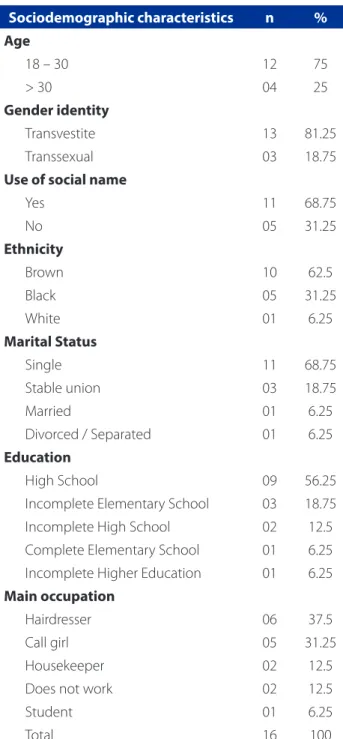
The data highlights the profile of the 16 participants, identifying elements that contribute to the discussion and reflection related to violence that transvestites and trans-sexuals suffered and that were identified in this study, such as age, gender identification, use of a social name, ethnici-ty, marital status, education and main occupation (Table 1). Regarding the age of the participants, 75% (n = 12) were in the age group between 18 and 30 years old, rep-resenting the highest percentage, the mean age was 23.5 years and the median 23 years, with a variance covering 18-34 years. It was observed that there was a predominance of a transvestite gender identity with a frequency of 81.25% (n = 13). Regarding the use of a social name, 68.75% (n = 11) used a social name that corresponded to their declared, not biological gender.
It was observed that, regarding ethnicity, 62.5% (n = 10) stated that they were brown and 31.25% (n = 05) black, according to their sense of belonging. Regarding marital status, 68.75% (n = 11) were unmarried at the time of data collection, and 6.25% (n = 1) separated / divorced, which resulted in a sum of 75%, and may indicate a pref-erence. As for schooling, 56.25% (n = 09) had only finished high school. The sum of years of education among those
who have not completed high school corresponded to 31.25% (n = 05). Pertaining to the main labor occupa-tion of the subjects, 37.5% (n = 06) were hairdressers and 31.25% (n = 05) were call girls during the period of inves-tigation, where 68.75% is the sum of those who did not have a regulated occupation.
Sociodemographic characteristics n %
Age
18 – 30 12 75
> 30 04 25
Gender identity
Transvestite 13 81.25
Transsexual 03 18.75
Use of social name
Yes 11 68.75
No 05 31.25
Ethnicity
Brown 10 62.5
Black 05 31.25
White 01 6.25
Marital Status
Single 11 68.75
Stable union 03 18.75
Married 01 6.25
Divorced / Separated 01 6.25
Education
High School 09 56.25
Incomplete Elementary School 03 18.75 Incomplete High School 02 12.5 Complete Elementary School 01 6.25 Incomplete Higher Education 01 6.25
Main occupation
Hairdresser 06 37.5
Call girl 05 31.25
Housekeeper 02 12.5
Does not work 02 12.5
Student 01 6.25
Total 16 100
Table 1 – Subject distribution according to sociodemo-graphic characteristics. Cajazeiras-Paraíba, 2014
Data relating to the violence and the frequency of the event, as shown in Table 2, respectively, can be found below.
It was found that 75% (n = 12) of the subjects had fered some kind of violence. On the violence typology suf-fered by these individuals, 91.96% (n = 11) reported hav-ing suffered verbal violence, followed by psychological at 58.33% (n = 07), 33.33% physical (n = 04), 25% sexual (n = 03) and, less often, neglect 8.33% (n = 01).
Regarding the space where this violence occurred, the street was the most frequent, with 75% (n = 09) of cases. The sum of institutionalized spaces such as schools, health services, other public services and residences amounted to 199.98% (n = 24). Neighbors and strangers amounted to 75% of assaults, and members of the family to 41.66%, followed by 33.33% on the part of health professionals, and 33.33% of other public service professionals.
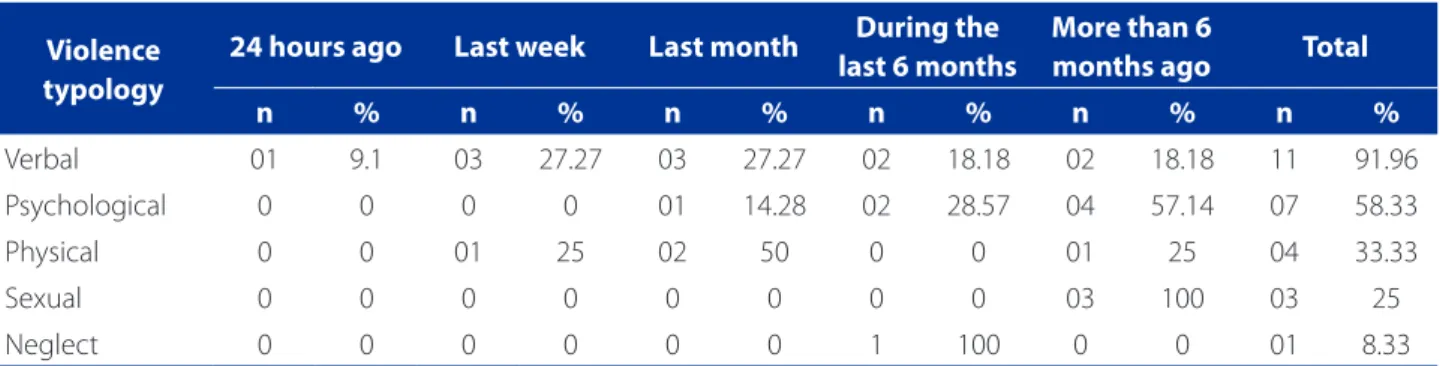
The data pertinent to the frequency of occurrence of victimization by their attackers were intentionally high-lighted and presented in view of the Likert Scale (Table 3) for better visualization of the findings and depth of the is-sue, now in focus.
Regarding the types (Table 3), it was observed that ver-bal violence occurred throughout the period prior to the survey among the listed possibilities, i.e. 24 hours prior and more than six months ago, with 91.96% (n = 11) of cas-es, followed by 58.33% (n = 07) of cases of psychological violence that occurred between the previous month and more than six months prior to the data collection, with physical violence present in 33.33% (n = 04) of the epi-sodes, and occurred between the previous week and more than six months preceding the survey.
DISCUSSION
With respect to age, the subjects were considered as being within a productive age when considering the work
Violence typology
24 hours ago Last week Last month During the last 6 months
More than 6
months ago Total
n % n % n % n % n % n %
Verbal 01 9.1 03 27.27 03 27.27 02 18.18 02 18.18 11 91.96
Psychological 0 0 0 0 01 14.28 02 28.57 04 57.14 07 58.33
Physical 0 0 01 25 02 50 0 0 01 25 04 33.33
Sexual 0 0 0 0 0 0 0 0 03 100 03 25
Neglect 0 0 0 0 0 0 1 100 0 0 01 8.33
Table 3 – Frequency of the event violence among transvestites and transsexuals. Cajazeiras-Paraíba, 2014
Source: Survey data, 2014.
Vulnerability to violence n %
Have experienced violence
Yes 12 75
No 04 25
Type of violence*
Verbal 11 91.96
Psychological 07 58.33
Physics 04 33.33
Sexual 03 25
Neglect 01 8.33
Site of the event*
Street 09 75
School 08 66.66
Health Care Services 06 50
At home 05 41.66
Other Public Services 05 41.66
Other environments 02 16.66
Ofenders*
Neighbor or stranger 09 75
Family members 05 41.66
Healthcare professional 04 33.33
Other public officials 04 33.33
Others 01 8.33
Table 2 – Distribution of subjects according to character-istics of vulnerability to violence. Cajazeiras-Paraíba, 2014
Source: Survey data, 2014.
market, corroborating another study that traced the pro-file of transvestites regarding vulnerability to HIV / AIDS by identifying a population mostly under 40 years of age with a range of variation of 39 years of age, attributing the fact that many die early due to AIDS infection and violence (10) to this profile.
Transvestites were considered as individuals who mod-ify their body and behavior so that it resembles the oppo-site sex, without, however, claiming the subjectivity of this sex (11). Transsexuals were considered as those who do not identify with their biologically assigned gender, with a lack of adaptation of the body to the way they think and feel. For transsexuals, it is essential to fully live with gender iden-tification and its subjectivities, be it in the social and profes-sional acceptance of the social name by which one identi-fies them self, or in the use of the bathroom corresponding to their declared identity, among other things (12-13).
It is noteworthy that the social name is to be under-stood as the name by which transvestites and transsexuals prefer to be identified, as opposed to the name registered on their birth certificate, ensuring the fundamental right to respect and the particularity of each individual in how they wish to be recognized (4).
The importance of using a social name in the recogni-tion of the individual in relarecogni-tion to the way he or she per-ceives him or herself according to the person’s presumed body image is observed. This right also contributes to their reintegration and recognition in society, included and en-sured in health care by the SUS (Unified Public Health sys-tem) Users’ Bill of Rights, which ensures that users should be treated and registered under their name of choice (14).
This study recognizes the limitations of the instruments adopted since it was not possible to identify the reason for 31.25% of individuals to choose not to use a social name, which gives rise to further study. However, it appears that the stigma they face when they are presented with a name that refers to their gender identity and is at odds with their sex in various social sectors generates the possibility for these persons to fall victims to embarrassing situations and violence, such as those identified in this study, and also to the non-acceptance / recognition of the community of this social and gender identity argument. In this case, individ-uals may feel more comfortable giving in to a social impo-sition of gender norms and introduce one’s self according to a birth certificate, reducing the embarrassment and the types of alleged violence they may suffer.
Regarding ethnicity, brown and black individuals pre-sented themselves as those most representative in the group studied, and although both ethnicities present Afri-can descent, a question is found in health services by
fail-ing to recognize their very own origin, since some diseases are most evident in the five ethnic groups established in the country. In this sense, this study generates more infor-mation about the principle of equality advocated by the National Health System.
The associative evidence of social determinants is made evident, in this case the prejudice against transves-tites and transsexuals and racism – one of the main struc-tural factors of inequality that affect society and, hence, is elected as a designer / legitimating factor for other forms of prejudice either by gender, social class or other forms of discrimination. Thus, an alert is made to the planning and implementation of policies and actions that should con-sider ethnic determinants of transvestites and transsexuals and their interaction with prejudice (10).
Regarding marital status, the number of single (68.75%) and separated / divorced (6.25%) transvestites and transsexuals, which together (75%) may indicate a preference, therefore, a personal choice, but also a means or mechanism of survival in face of social prejudice in re-lation to homoaffective marriages, in which, often, for fear of oppression, a relationship is sustained before society. Thus, individuals opt for the concealment of this relation-ship as a mechanism of protection against victimization in the areas of social circulation, or because they are sex workers, having a partner could compromise their surviv-al and decrease profits (11).
The extent of education in which high school or in-complete high school predominate are highlighted, pointing to the type of work and occupation held by the individuals involved in this study. It is inferred, there-fore, that a low level of education is related to prejudice and discrimination, experienced at an early age through
school bullying, an act that redefines the space in which transgendered people live and that leads to school eva-sion through everyday exclueva-sion technologies, either by
transphobic or homophobic violence or the inadequacy of educational planning, experimenting daily massacres whilst attempting to survive school (15).
On the main labor occupation of the interlocutors, they were mostly hairdressers and call girls. Transvestites and transsexuals have been considered in Brazil as the main targets of violence on the streets, combined with low skills and the lack of opportunity in the formal work market, with a large number having found a means of income in prostitution, making themselves a target for deaths from external factors (10).
death, identifying, in turn, that the main victims were the ones who prostituted themselves, followed by hairdress-ers, and the streets and residence were the predominant sites (16).
Regarding the experience of violence, most of the in-terviewees declared that they had been the victim of some kind of violence. These data confirm the strong intolerance against transgender people and the numerous cases of
transphobic violence reported daily in the media.
The data mentioned above are added to the report that continually points to Brazil as the world champion “ho-mo-transphobic” crimes. The report states that, according to international agencies, 40% of murders of transsexuals and transvestites in 2013 around the world happened in Brazil, with the Northeast region being the one considered most violent, with 43% of homicides (17).
The figures show the immediate need for the criminal-ization of “lgbtphobia” as a protective measure to all those who are in vulnerable situations. Homophobia is connect-ed to the way people perceive the differences between men and women. Regardless of sexual orientation, it is the clothes, the gestures and the male and female stereotypes that arouse prejudice (18).
Focusing on the type of violence suffered because of their gender identity, the participants revealed verbal vio-lence at some point in their lives, but also psychological, physical, sexual violence and neglect, which can also be considered a form of aggression, and becomes more com-mon in when accessing public services. Acom-mong the con-sequences of this violence are damages to self-esteem, identity or the person’s full development. A striking charac-teristic of violence is the ability it has to spread and impose worldviews (10.16).
The frequency of the verbal, psychological and phys-ical violence had greater constancy, being present from 24 hours prior to data collection to more than 6 months prior, suggesting that violence is crystallized as an every-day life situation for these individuals, so ordinary and ba-nal that it falls in the dimension of inequalities, since it is unmistakably always presented as an essential variable in other studies to understanding the universe of relation-ships that impose limitations to the life of transvestites and transsexuals (10.19).
Violence against the transgender public happens in various spaces. The street can be found in this study as the place where violence occurs more frequently, a space traditionally designed for those who are social-ly invisible and a main zone for prostitution. However, institutional violence, including among family, schools, health care and other services is observed, subject to
the possibilities of multiple choice as a danger zone for transvestites and transsexuals.
Regarding the spatiality of violence, it is observed that on the one hand, violence that occurs on the streets is a given common denominator in the daily lives of transgen-der individuals. On the other hand, the social / institution-al facilities are sources of violence. Also noteworthy is the school as a great intermediate of practices that reduce the field of sexuality to the heterosexual experience. The manifestations of sexuality, in particular of transvestites and transsexuals, is a subject usually treated with some dis-comfort. Discriminatory actions directed at students that distance themselves from the ideal of masculine or fem-inine normality are abundant in the school environment, and some of the consequences are school evasion or ex-pulsion, factors that contribute to the lack of professional-ization and the marginalprofessional-ization of the segment (15).
Little publicized by the media, cases of violence and discrimination against transvestites and transsexuals occur in health services and by the professionals working in the sector. Based on empirical data, they are not accepted in a humane way, and do not have their needs met. There-fore, the bias of health professionals regarding transgender people disqualifies health care in this population’s perspec-tive, showing that discriminatory processes permeate the health care system (4).
There is a gap found in this study due to the lack of information about Police Reports or notification in data-bases. However, the various forms of violence experienced in the trajectory of transvestites and transsexuals are per-petuated as symbolic manifestations in places where they should be defended and protected, such as among fami-ly, health services and the police, where, according to the study, when in need of such services, forms of violence are replicated by the exact services they seek, aggravating the suffering, which, simultaneously implies less demand for these services (19).
It is added that neighbors and strangers and family members are the main aggressors identified by the study group, followed by health care workers and other public officials, befitting the local results with those contained in annual homophobic violence report in Brazil (20).
FINAL CONSIDERATIONS
The profile of transvestites and transsexuals who suf-fer violence in the city studied is young, with a prevalence among the transvestite genre that makes use of a social name, with brown or black ethnicity, single, low level of ed-ucation, who are mostly call girls and hairdressers. These individuals faced verbal, psychological, physical and sex-ual violence, accentuated on the street, at schools and in health services, with main aggressors being their neighbors and strangers, family members and health professionals.
Considering the data and facts analyzed, there is a growing need to organize health care networks for the mentioned group, aiming at an equitable and healthy inte-gration into the community, which would favor a valuation of sexual diversity and the deconstruction of stigmatizing standards where transvestites and transsexuals can be the protagonists of their choices.
Furthermore, the limitations of the study are recognized in the small number of participating subjects, which does not make the study any less relevant, for it still brings this group into social visibility and makes this cutout a scientific element that comprises individuals who are part of a wider group of transvestites and transsexuals, and are routinely silenced and neglected by the same indexes, relegated to a culture of hor-ror. Therefore, the investigation becomes relevant to identify-ing patterns of inequities and aimidentify-ing to end them.
In this sense, the study aims to highlight the impor-tance and relevance of the results to Nursing as a profes-sion where the care processes are combined with doctrinal and operational principles of the Unified Health System, particularly as a fruitful field to ensuring actions for equali-ty, integrality and universality.
REFERENCES
1. Martins-Silva PO, Souza EM, Silva Júnior A, Nascimento BD, Balbi Neto RRQ. Adolescentes e homossexualidade: representações sociais e identidade social. Cad Pesqui. 2012;42(146):474-93.
2. Geovanini T. Gênero, sexualidade e saúde: um olhar da enfermagem. São Paulo: Girancor; 2010.
3. Maranhão Filho EMA. “Inclusão” de travestis e transexuais através do nome social e mudança de pronome: diálogos iniciais com Karen Schwach e outras fontes. Oralidades. 2012;6(11):89-116.
4. Silva GWS, Sena RCF, Santos QG, Sobreira MVS, Miranda FAN. The said and the done: the nurse and the knowing/doing health for transvestites. J Nurs UFPE On line. 2014;8(10):3347-57.
5. Carrara S. Discrimination, policies, and sexual rights in Brazil. Cad Saúde Pública. 2012;28(1):184-9.
6. Aguinsky BG, Ferreira GG, Rodrigues MC. Travestis e segurança pública: as performances de gênero como experiências com o sistema e a políti-ca de segurança no Rio Grande do Sul. Textos Contextos (Porto Alegre). 2013;12(1):47-54.
7. Carrara S, Lacerda P. Vivir bajo amenaza: prejuicio, discriminación y violencia homofóbica en Brasil. Debate Feminista. 2011;22(43):133-48.
8. Polit DF, Beck CT, Hungler BP. Fundamentos de pesquisa em enfermagem: méto-dos, avaliação e utilização. 7. ed. Porto Alegre: Artmed; 2011.
9. Souza EFL. População trans e violência: um estudo sob a perspectiva do usuário [monografia]. Cajazeiras (PB): Departamento de Enfermagem, Faculdade Santa Maria; 2014.
10. Sousa PJ, Ferreira LOC, Sá JB. Estudo descritivo da homofobia e vulnerabilidade ao HIV/aids das travestis da região metropolitana do Recife, Brasil. Ciênc Saúde Coletiva. 2013;18(8):2239-51.
11. Kulick D. Travesti: prostituição, sexo, gênero e cultura no Brasil. Rio de Janeiro: Ed. Fiocruz; 2008.
12. Matão MEL, Miranda DB, Campos PH, Teles MNA, Mesquita LB. Representações sociais da transexualidade: perspectivas dos acadêmicos de enfermagem e me-dicina. Rev Baiana Saúde Pública. 2010;34(1):101-18.
13. Mueller A, Zollver H, Kronawitter D, Oppelt PG, Claassen T, Hoffmann I, et al. Body composition and bone mineral density in male-to-female transsexuals during cross-sex hormone therapy using gonadotrophin-releasing hormone agonist. Exp Clin Endocrinol Diabetes. 2011;119(2):95-100.
14. Ministério da Saúde (BR). Portaria Nº 1.820, de 13 de agosto de 2009. Dispõe sobre os direitos e deveres dos usuários da saúde. Diário Oficial da União [da] República Federativa do Brasil. 2009 ago 14 [cited 2015 jul. 13];146(155 Seção 1):80-1. Available at: http://bvsms.saude.gov.br/bvs/saudelegis/gm/2009/ prt1820_13_08_2009.html.
15. Cruz EF. Banheiros, travestis, relações de gênero e diferenças no cotidiano esco-lar. Rev Psicol Polít. 2011;11(21):73-90.
16. Cabral V, Ornat MJ, Silva JM. As relações entre espaço, violência e a vivência travesti na cidade de Ponta Grossa – Paraná – Brasil. Cad Prudentino Geografia. 2013;(35 esp):118-35.
17. Grupo Gay da Bahia. Assassinato de homossexuais (LGBT) no Brasil: relatório 2014. Salvador; 2015.
18. Borrillo D. Homofobia: história e crítica de um preconceito. Belo Horizonte: Au-tentica Editora; 2010.
19. Souza MHT, Malvasi P, Signorelli MC, Pereira PPG. Violência e sofrimento social no itinerário de travestis de Santa Maria, Rio Grande do Sul, Brasil. Cad Saúde Pública. 2015;31(4):767-76.
20. Presidência da República (BR), Secretaria de Direitos Humanos. Relatório sobre violência homofóbica no Brasil: ano de 2012. Brasília (DF); 2012.
Corresponding author: Glauber Weder dos Santos Silva E-mail: [email protected]