r e v b r a s o r t o p . 2013;48(5):438–440
w w w . r b o . o r g . b r
Original
Article
Injury
of
the
knee
ligaments
associated
with
ipsilateral
femoral
shaft
fractures
夽
Marco
Tulio
Lopes
Caldas
a,∗,
Dorotea
Starling
Malheiros
b,
Angelo
Paulo
Lazzaroni
c,
Eduardo
Axer
Avelino
d,
Anderson
José
Santos
daOrthopedistandTraumatologist;HeadoftheMedicalResidenceService,HospitalMariaAméliaLins,Fundac¸ãoHospitalardoEstadode
MinasGerais(FHEMIG);MemberoftheKneeGroupofHospitalMariaAméliaLins,FHEMIG,BeloHorizonte,MG,Brazil
bOrthopedistandTraumatologist;SpecialistinPediatricOrthopedicsatHospitalMariaAméliaLins,FHEMIG,BeloHorizonte,MG,Brazil
cOrthopedistandTraumatologist;MemberoftheKneeGroupofHospitalMariaAméliaLins,FHEMIG,BeloHorizonte,MG,Brazil
dResidentPhysicianinOrthopedicsandTraumatology,HospitalMariaAméliaLins,FHEMIG,BeloHorizonte,MG,Brazil
a
r
t
i
c
l
e
i
n
f
o
Articlehistory:
Received19October2012 Accepted6November2012
Keywords: Fractures Femur Ligaments Knee
a
b
s
t
r
a
c
t
Objective:Withtheobjectiveofidentifyingtheincidenceofipsilateralkneeligamentinjury, thirty-sixpatientswithfemoralshaftfractureswereevaluated.
Methods:Duringtheosteosynthesisproceduretorepairthefemurwhileunderanesthesia, allpatientsunderwentaphysicalexaminationandX-rayexamination.
Results:Themostcommonmechanismofinjuryobservedwasmotorcycleaccidents.Ofthe thirty-sixpatientsthatwerestudied,elevenpatients(30.5%)hadakneeligamentinjury.Of theelevenpatients,64%hadacruciateligamentinjury.Theligamentinjurywasnottreated atthetimeoftheosteosynthesisprocedure.
Conclusion:Wehighlightthedifficultyofdiagnosisatthetimeofadmissionandtheneedfor systematicphysicalexaminationbeforeandaftersurgicaltreatmentoffemoralfracture.
©2013SociedadeBrasileiradeOrtopediaeTraumatologia.PublishedbyElsevierEditora Ltda.Allrightsreserved.
Lesão
ligamentar
do
joelho
associada
à
fratura
diafisária
do
fêmur
ipsilateral
Palavras-chave: Fratura Fêmur Ligamentos Joelho
r
e
s
u
m
o
Objetivo:Determinaraincidênciadelesãoligamentardojoelhoempacientescomfratura diafisáriadefêmuripsilateral.
Métodos:Foramavaliados36pacientes.Todosforamsubmetidosaexamefísicoeradiológico sobanestesianomomentodaosteossíntesedofêmur.
Resultados:Omecanismodetraumamaiscomumfoioacidentecommotociclistas. Apresen-taramlesãoligamentardojoelho11(30,5%)pacienteseforamencontradaslesõescentrais (64%)eperiféricas(36%).Nenhumadaslesõesfoitratadanomomentodafixac¸ãodafratura.
夽
StudyconductedattheHospitalMariaAméliaLins,Fundac¸ãoHospitalardoEstadodeMinasGerais,BeloHorizonte,MG,Brazil.
∗ Correspondingauthorat:RuadosOtoni,772,SantaEfigênia,BeloHorizonte,MG,CEP:30150-270,Brazil.
E-mail:[email protected](M.T.L.Caldas).
2255-4971/$–seefrontmatter©2013SociedadeBrasileiradeOrtopediaeTraumatologia.PublishedbyElsevierEditoraLtda.Allrightsreserved.
rev bras ortop.2013;48(5):438–440
439
Conclusão: Ressalta-seadificuldadedodiagnósticonoatodaadmissãoeanecessidadede examefísicosistematizadoanteseapósotratamentocirúrgicodafraturafemoral.
©2013SociedadeBrasileiradeOrtopediaeTraumatologia.PublicadoporElsevier EditoraLtda.Todososdireitosreservados.
Introduction
Femoralfracturesaresevereinjuriesthatquicklydraw physi-cians’attentionandareoftenassociatedwithotherfractures. Ipsilateralkneeligamentinjuriesmayalsobeassociatedwith suchfactures,andmostofthesearediagnosedatalatestage. WalkerandKennedy1 reportedthattheseligament injuries weresilentoroccultandthatupto78%ofthemprogressed undiagnosedatthis stage, withnegativeconsequences for patientsandorthopedists.
In the literature, there are references to an association betweenthese injuriesand increased occurrencesof high-energyaccidents.2,3 Trickey4 reportedthat traffic accidents werethe mostfrequenttypeoftraumaforthisassociation ofinjuries.
Incidencesof32%5to48%6havebeenreportedforligament injuriesamongindividualswithipsilateralfemoralfractures. VanRaayetal.6reportedthattimethatelapsedbetweenthe initialtraumaandthediagnosiswasupto12.8months.
Todiagnoseligamentinjurieswithinthisassociation, sev-eralmethodshavealreadybeenreported.Esmaeilijahetal.3 used physical examination under anesthesia, De Campos etal.2usedarthroscopy,WalkerandKennedy1useddistal fix-ationofthefemurinassociationwithkneeradiographsunder stress, and Dickson et al.7 performed magnetic resonance imagingontheirpatients.Inreferralcarecentersfor orthope-dictrauma,establishmentofaprotocolforidentifyingthese casesisfundamental,withaviewtodeterminingthecorrect treatmentwithintheproperwindowofopportunity.4,7–9For multipletraumapatientswhopresentfemoralshaftfractures, kneeligamentinjuriesareadiagnosticchallengebecauseof thedifficultycreatedinthephysicalexamination,although suchexaminationisfundamentalfordefiningthetreatment andprognosis.4,6–8,10
Materials
and
methods
BetweenMarch1,2011andMarch1,2012,the kneesofall patients with ipsilateral femoral shaft fractures who were attendedatourserviceandwho underwentosteosynthesis usinganymethodwereevaluatedwiththeaimofassessing theprevalenceofligamentinjuries.
Theroutineexaminationwasperformedduringthesame induction of anesthesia as for the osteosynthesis on the femoralfracture.Thisdidnotgenerateanyrisks,discomfort oradditionalcostsforthepatientorfortheinstitution.Inall cases,thesemiologicalexaminationwasconductedbymore thanoneprofessionalandwasalwaysconfirmedbya profes-sionalwithexperienceofkneesurgery.
Thedataweregatheredintoadatabaseandwereevaluated lateronusingtheEpi-Infosoftware.
It is known that in evaluating acute knee injuries, the goldstandardisphysicalexamination,sometimesdoneunder anesthesia,inassociationwithmagneticresonanceanalysis.7 Inourinstitution,magneticresonanceimagingisdifficultto obtain,whichhasmadephysicalexaminationunder anesthe-siaandradiographsunderstressfundamentallyimportantfor thediagnosis.
Patientswithfemoralshaftfracturesbutwithoutany his-toryofotheracuteorchronicinjuriestotheipsilaterallower limbwereincluded.Patientswithpreviousinjuriestotheknee investigatedandthosewithotherfracturesintheipsilateral lowerlimbwereexcluded.
Thepatientssignedafreeandinformedconsentstatement atthetimeoftheirownhospitaladmissionoratasubsequent outpatientconsultation.Theresearchprojectwasapprovedby theResearchEthicsCommittee.
Results
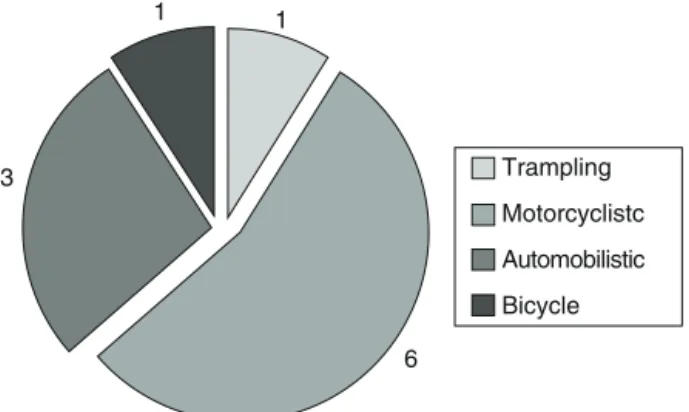
Our sample comprised 36 femoral shaft fractures, among whichtherewere 11cases(30.5%)withipsilateral knee lig-amentinjury(sixleft-sideandfiveright-side).
The trauma mechanism was a traffic accident in most cases. Of these, three involved cars and six, motorcyclists (Fig.1).
Thepatients’agesrangedfrom16to45years,withamean of27.5years,andonlyonepatientwasfemale.
The fractures were identified in accordance with the ArbeitsgemeinschaftfürOsteosynthesefragen(AO) classifica-tion.SixweretypeA,fourweretypeBandonewastypeC.
The distribution according to injury type is shown in
Table1.Therewerethreecasesofinjurytobothcruciate
lig-aments(oneassociatedwiththelateralandmedialperiphery and two associatedonly withthe medialperiphery), three cases ofposterior cruciate ligament injury (twoassociated withthelateralperipheryand onewiththemedial periph-ery),onecaseofanteriorcruciateligament(associatedwith
Trampling 1
1
6 3
Motorcyclistc
Automobilistic
Bicycle
440
rev bras ortop.2013;48(5):438–440Table1–Frequenciesofligamentinjurytypesobserved in36casesofipsilateralfemoralfractures.
Ligamentinjurytype Numberofcases Percentage
ACL+PCLinjurya 3 27%
PCLinjurya 3 27%
ACLinjurya 1 9%
Peripheralinjuryalone 4 36%
a Associatedwiththeperiphery.
Table2–Frequenciesofcentralligamentinjurieswithor withoutassociations.
Injurytype Associations Numberofcases
ACLinjury Withoutperiphery 0
Withperiphery 1
PCLinjury Withoutperiphery 0
Withperiphery 3
ACL+PCLinjury Withoutperiphery 0
Withperiphery 3
themedialperiphery)andfourcasesofperipheralinjuryalone (twomedialandtwolateral).
Theligamentinjuriesidentifiedhadnotbeendiagnosedor reportedinthemedicalfilespreviously.
Noneoftheligamentinjuriesweretreatedatthetimeof fracturefixation.
Discussion
Regardingtheincidenceofkneeligamentinjuriesassociated withipsilateral femoralshaft fractures,some studies have shownresultssimilartoours.Szalayetal.9foundthatamong 114patientswithkneefractures,27%presentedknee insta-bility.Facciniet al.11 reevaluated97knees ofpatients with femoralfracturesanddiagnosedthat26.7%hadkneeligament injuries.Bragaetal.5foundthat31%outof29caseshadknee ligamentinjuries.
Otherstudieshaveshownlowerincidence.Mooreetal.10 observedthatonly5.3%outof320fracturesreviewedshowed kneeligamentinjuries.DickobandMommsen12reviewed59 femoralshaftfracturesandfoundthat18.6%hadknee liga-mentinjuries.
High-energy trauma capable of fracturing the femur increasestheincidenceofotherassociatedinjuriesandthe kneeisoneoftheregionsmostfrequentlyaffected.
Weemphasizethatthegreaterincidenceofposterior cruci-ateligamentinjuries,inrelationtoanteriorcruciateligament injuries,wasprobablyduetoinvolvementoftraumaofthe anteriorregionofthekneeandalsotoassociationswith cen-tralligamentinjury,whichinallcaseswasassociatedwitha peripheralinjury(Table2).
With almost one-third of the patients affected by this association, greater frequency of early diagnosis would be expected. However, what happens is that because of difficultyinperformingligamentexaminationduringthe pre-osteosynthesisstage,manycasesareonlydiagnosedlateron
and,insomecases,theopportunityofundertakingasurgical approachduringtheacutephaseislost.
Conclusion
Associationsbetweenkneeligamentinjuriesand ipsilateral femoralfracturesoccurfrequentlyandaffectalmostone-third ofthecasesrecorded.Attentiondirectedtowardfemoral frac-turesandthedifficulty inperformingphysicalexamination beforethefracturehasbeenstabilizedmayexplainthehigh proportionofcasesthatarediagnosedatalatestage.Physical examinationperformedjustafterfracturefixation,withthe patientanesthetizedandwiththeaidofstressradiographs, mayhelptoexplainthemajorityofthediagnosesandenable earlytreatment,whichwouldbemoreappropriate.
Conflicts
of
interest
Theauthorsdeclarethattherewerenoconflictsofinterest.
r
e
f
e
r
e
n
c
e
s
1.WalkerDM,KennedyJC.Occultkneeligamentinjuries
associatedwithfemoralshaftfractures.AmJSportsMed.
1980;8:172–4.
2.DeCamposJ,VangsnessJrCT,MerrittPO,SherJ.Ipsilateral
kneeinjurywithfemoralfracture.Examinationunder
anesthesiaandarthroscopicevaluation.ClinOrthopRelat
Res.1994:178–82.
3.EsmaeilijahAA,HeidaryH,ShakibaM.Associationofknee
ligamentinjurywithipsilateralfemoralshaftfractures.IrJ
OrthopSurg.2004;2:37–9.
4.TrickeyEL.Ruptureoftheposteriorcruciateligamentofthe
knee.JBoneJointSurgBr.1968;50:334–41.
5.BragaGF,CunhaFM,LazaroniAP.Instabilidadedojoelho
associadaàfraturadofêmur.RevBrasOrtop.1999;34:329–32.
6.VanRaayJJ,RaaymakersEL,DupreeHW.Kneeligament
injuriescombinedwithipsilateraltibialandfemoral
diaphysealfractures:thefloatingknee.ArchOrthopTrauma
Surg.1991;110:75–7.
7.DicksonKF,GallandMW,BarrackRL,NeitzschmanHR,Harris
MB,MyersL,etal.Magneticresonanceimagingoftheknee
afteripsilateralfemurfracture.JOrthopTrauma.
2002;16:567–71.
8.AuffarthA,BognerR,KollerH,TauberM,MayerM,ReschH,
etal.Howsevereareinitiallyundetectedinjuriestotheknee
accompanyingafemoralshaftfracture?JTrauma.
2009;66:1398–401.
9.SzalayMJ,HoskingOR,AnnearP.Injuryofkneeligament
associatedwithipsilateralfemoralshaftfracturesandwith
ipsilateralfemoralandtibialshaftfractures.Injury.
1990;21:398–400.
10.MooreTM,PatzakisMJ,HarveyJrJP.Ipsilateraldiaphyseal
femurfracturesandkneeligamentinjuries.ClinOrthopRelat
Res.1988:182–9.
11.FacciniR,SartoriE,BiscioneR,LupiL.Associationbetween
fractureofthediaphysisofthefemurandlesionofthe
ligamentsoftheknee.ChirOrganiMov.1993;78:177–82.
12.DickobM,MommsenU.Damagetothekneeligamentasa
concomitantinjuryinfemoralshaftfractures.