ORIGINAL ARTICLE
Prevalence of and factors associated with antipsychotic
polypharmacy in patients with serious mental illness:
Findings from a cross-sectional study in an
upper-middle-income country
Kerryn S. Armstrong, Henk Temmingh
Department of Psychiatry and Mental Health, University of Cape Town, Valkenberg Hospital, Observatory, Cape Town, South Africa.
Objective: The aim of our study was to examine the prevalence of and factors associated with antipsychotic polypharmacy (APP) among patients with serious mental illness in the current South African health care context.
Methods:We collected data on patient, illness, and treatment characteristics of patients discharged on one or more antipsychotic agents from January to June 2014. We analyzed the associations of APP with demographic and clinical variables using hierarchical multivariable logistic regression, and examined prescription patterns.
Results:The prevalence of APP in our study population of 577 patients was 28.4%. Demographic and clinical characteristics significantly associated with APP included age 429, male sex, diagnosis of
schizophrenia, comorbid intellectual disability, comorbid substance use, greater number of hospital admissions, and high-dose prescribing. First-generation antipsychotics and long-acting injectable preparations were prominent in APP combinations. Co-prescription of anticholinergic agents and sodium valproate demonstrated a significant association with APP.
Conclusion:APP appears common in our population, despite lack of evidence for the practice and possible risk of harm. Our findings suggest a complex interplay among patient, illness, and treatment factors relevant to APP in our setting that could be targeted for intervention.
Keywords: Antipsychotic agents; polypharmacy; mental illness
Introduction
Antipsychotic agents form the mainstay of treatment for many patients with serious mental illness. These agents are used in a range of psychiatric disorders, including the schizophrenia spectrum, bipolar disorder, and substance-induced disorders. Local and international clinical practice guidelines for the treatment of schizophrenia1,2 advo-cate antipsychotic monotherapy as the routine approach. Guidelines recommend avoiding antipsychotic polyphar-macy (APP), which can be defined as co-prescription of more than one antipsychotic drug for a given patient.3 Exceptions to this may be when APP is required for short periods when switching agents or in treatment-resistant cases, when augmentation of clozapine with another anti-psychotic agent may be considered, although supporting evidence for this remains weak.4,5 Treatment guidelines recommend use of antipsychotics as part of treatment options in bipolar disorder, but do not advocate an APP approach.6,7Use of antipsychotic agents in the treatment of psychosis with coexisting substance misuse is advised
in accordance with individual guidelines on schizophrenia or bipolar disorder.8
The motivation behind these guideline recommenda-tions is the lack of robust evidence to support the routine use of combined antipsychotics.3-5,9,10In addition, there is evidence for harm associated with APP. Research has shown an association of APP with increased adverse effects, including extrapyramidal effects,11-13 hyperprolac-tinemia,14-16sexual dysfunction,17hypersalivation,18 seda-tion,14cognitive impairment,19and diabetes.20,21Possible increased risk of sudden cardiac death22and mortality23,24 has been suggested. Additional concerns include drug-drug interactions, problems in determining cause and effect of different treatments, complex drug regimens resulting in decreased compliance, and greater cost.25
Despite these adverse aspects, APP appears to be a common practice worldwide. A recent systematic review found a global median prevalence of APP of 19.6% over time, with factors such as clinical setting, geographical location, and time of study influencing prevalence rates.26 In contrast to the fairly substantial international litera-ture on APP, there is a paucity of research on APP from Africa, with only one previous study examining rates of APP in a South African setting, conducted in 2008.27 There is clearly a need for investigation into this practice in the current South African health care context.
Correspondence: Kerryn Sian Armstrong, Education Centre, Valkenberg Hospital, Private Bag X1, Observatory, Cape Town, 7935, South Africa.
E-mail: [email protected]
Submitted Jun 04 2016, accepted Nov 07 2016, Epub Feb 06 2017.
Associac¸a˜o Brasileira de Psiquiatria
Research into factors contributing to the practice of APP has shown that antipsychotic prescription patterns reflect complex interplay among patient, illness, treat-ment, and prescriber factors.25However, inconsistencies and gaps in the evidence remain. The patient character-istics age, sex, and marital status have received most attention, with a lack of information on other patient factors possibly associated with APP. APP is generally examined in the context of schizophrenia/schizoaffective disorders, with fewer studies investigating APP in other conditions. Few studies have explored the relationship of APP with comorbidities and co-prescription of other psychotropic medications. Moreover, there have been no previous studies examining patient, illness, and treatment charac-teristics associated with APP in South Africa.
Our study aimed to address some of these deficiencies in local and international research. We examined antipsy-chotic prescription patterns among patients with a variety of psychiatric disorders at discharge from an inpatient psy-chiatric unit in Cape Town, South Africa. We investigated a broad range of patient, illness, and treatment character-istics that may be associated with APP, including comor-bidities and co-prescriptions. This allowed us to assess whether current local practice is comparable with standard treatment guidelines, and provided insight into the com-plexities of the practice of APP in our setting.
Methods
Sample and setting
We conducted our study at Valkenberg Hospital, a large, government-funded psychiatric hospital in the suburb of Observatory, Cape Town, South Africa. The hospital provides psychiatric services to the Cape Peninsula and is a major specialist referral centre of the Western Cape Province. It is the principal teaching hospital for the University of Cape Town’s Department of Psychiatry. The hospital currently comprises 340 inpatient beds, of which 200 are dedicated to acute psychiatric services, 125 to forensic psychiatric services, and 15 to a smaller psycho-therapeutic component catering for people with mood, somatization, anxiety, and personality disorders in a life skills-based ward program. Patients admitted to the acute psychiatric units are almost exclusively involuntary admis-sions under the Mental Health Care Act (2002) with severe mental illness, posing a risk to themselves or others, and unable to be managed on an outpatient basis. We performed a cross-sectional study of discharge records retrieved from the Valkenberg Hospital electronic patient record database (Clinicom). The study was appro-ved by the University of Cape Town’s Human Research Ethics Committee, the Faculty of Health Sciences, and the Department of Health. Data were collected for patients with serious mental illness prescribed one or more antipsychotic agents at the time of discharge from Valken-berg Hospital’s acute and psychotherapeutic units. Serious mental illness can be defined as any mental, behavioral, or emotional disorder, diagnosable currently or in the past year according to DSM criteria, that results in serious functional impairment, substantially interfering with or limiting one or
more major life activities.28 We extracted discharge information for patients with diagnoses including schizo-phrenia (F20), acute and transient psychotic disorder (F23), delusional disorder (F22), schizoaffective disorder (F25), substance-induced mood and psychotic disorders (F10-F19), bipolar disorder (F31), and major depressive disorder (F32). We excluded patients with primary diagnoses relating to a medical condition, dementia, anxiety disorder, intellectual disability, or personality disorder, as these diagnoses were unlikely to feature significantly in our study population or contribute meaningfully to rates of APP in our setting. We examined the time period of January to June 2014.
Data and variables extracted
We used an electronic data extraction form to retrieve data from Clinicom. Variables including age, gender, marital status, and occupation for patients discharged on one or more antipsychotic agent were collected. These variables were routinely documented in the database at time of admission.
The illness-related variables retrieved from the data-base were length of hospital stay (measured in days from admission to discharge date), number of Valkenberg Hospital admissions, and time from first hospitalization at Valkenberg to most recent discharge (as approximate indicator of illness duration or time in treatment).
Patient diagnoses recorded in the database using ICD-10 coding methods were collected. Data on comorbid psychiatric conditions were gathered both from ICD-10 coding and from information contained in discharge summaries completed electronically for each patient by their attending psychiatric registrar at time of discharge. Where the attending case manager commented on the presence of significant coexisting depressive symptoms, anxiety symptoms, evidence of personality disorder or traits, or mild intellectual disability, these were captured as psychiatric comorbidities. Diagnoses and associated clinical features are discussed routinely (typically over four to eight clinical case discussion ward rounds, on average, during the admission period) by the members of a multidisciplinary team under consultant psychiatrist supervision, and include multiple sources of information. All diagnoses are confirmed by a consultant psychiatrist in charge of each multidisciplinary team. Discharge records are routinely audited by consultant psychiatrists. Data on comorbid substance use was likewise gathered from ICD-10 coding and clinical descriptors within patient discharge summaries. These included comorbid alcohol (F10), cannabis (F12), methamphetamine (F15), metha-qualone (F13), heroin (F11), and cocaine (F14) misuse.
was captured as oral or long-acting injectable (LAI). APP was defined as the prescription of any two or more anti-psychotics to the same patient on discharge from hospital. To compare doses of different antipsychotic drugs, the prescribed daily dose (PDD) in milligrams was divided by the defined daily dose (DDD) to give a PDD:DDD ratio. The DDD is defined as the assumed average maintenance dose per day for a drug used for its main indication in adults.29 For LAIs, the DDD is based on the average recommended dose divided by the dosing interval.29This is the standard international unit recommended by the World Health Organization for drug utilization studies.29 In keeping with previous studies, the PDD:DDD ratio for APP was calculated as the sum of the individual PDD:DDD ratios of all antipsychotics prescribed to a patient; high-dose prescribing was defined as a PDD:DDD of greater than 1.5.30-32 In addition to antipsychotic agents, data on co-prescription of anticholinergic agents, mood stabilizers, antidepressants, and benzodiazepines were captured.
Statistical analysis
For categorical variables, we used chi-square tests to analyze data, with Fisher’s exact test where appropriate. Confidence intervals for prevalence rates were calculated using the normal approximation of the binomial distribu-tion. The main outcome of interest was the presence of APP, as previously defined. We coded a positive outcome (i.e., the presence of APP) as 1 and a negative outcome (no APP) as 0. To model the response variable of APP as a function of demographic and clinical variables, we conducted a hierarchical multivariable logistic regression analysis. We used penalized maximum likelihood estima-tion to handle sparse data with complete separaestima-tion issues. Independent (predictor) variables were categor-ized into multilevel categorical variables using dummy
coding to obtain reference-level categories. Cutoff points for continuous variables were decided on the basis of what constituted meaningful clinical categorizations. We followed a forward selection and backward elimination procedure and determined model fit using a combination of Likelihood-ratio chi-square tests and the Akaike information criterion (AIC). We entered each variable into the model one at a time, starting with demographic and then clinical variables. We removed variables one at a time if model fit was not improved by their addition, based on likelihood chi-square tests and AIC. The final model included all variables except reported symptoms of anxiety and depression. Model fit for the final model was determined using the Pearson chi-square goodness-of-fit test and Nagelkerke’s pseudo R2. The final model was checked for multicollinearity using variance inflation factors and tolerance measures. Statistical significance was set at p o 0.05. We used Stata version 13 for Windows to
analyze the data.
Results
Antipsychotic polypharmacy: prevalence and clinical and demographic associations
A total of 579 patient records met criteria for inclusion. We excluded two records of patients diagnosed with acute and transient symptoms of psychosis (F23) and delu-sional disorder (F22), as these patients were low in number, resulting in a final sample of n=577. Overall, 59.6% of patients were male, and the median age was 32 years (interquartile range [IQR] = 25-42).
The prevalence of APP among our study population was 28.4% (95% confidence interval [95%CI] 24.7-32.2). The demographic and clinical characteristics of patients discharged on APP and antipsychotic monotherapy (APM) are shown in Table 1 and Table 2 respectively, with results
Table 1 Logistic regression model comparing demographic characteristics of patients discharged on antipsychotic polypharmacy (APP) and antipsychotic monotherapy (APM) (n=577)
Variable Total sample APP APM Adjusted OR 95%CI p-value
Age
18-29 242 (41.9) 52 (31.7) 190 (46.0) 1.0 1.0 1.0
30-44 223 (38.6) 81 (49.3) 142 (34.3) 2.81 1.61-4.89 o0.001
45-60 112 (19.4) 31 (18.9) 81 (19.6) 2.20 1.04-4.62 0.037
Sex
Female 233 (40.3) 38 (23.1) 195 (47.2) 1.0 1.0 1.0
Male 344 (59.6) 126 (76.8) 218 (52.7) 1.86 1.07-3.23 0.027
Marital status
Single 505 (87.5) 151 (92.0) 354 (85.7) 1.0 1.0 1.0
Married 39 (6.7) 3 (1.8) 36 (8.7) 0.53 0.15-1.86 0.328
Divorced 26 (4.5) 9 (5.4) 17 (4.1) 2.05 0.68-6.18 0.200
Widowed 7 (1.2) 1 (0.6) 6 (1.4) 0.57 0.06-4.91 0.612
Employment
Employed 26 (4.5) 1 (0.6) 25 (6.0) 1.0 1.0 1.0
Unemployed 551 (95.4) 163 (99.3) 388 (93.9) 5.69 0.59-54.81 0.132
Data presented as n (%).
95%CI = 95% confidence interval; AIC = Akaike information criterion; APM = antipsychotic monotherapy; APP = antipsychotic polypharmacy; OR = odds ratio.
Final model: Pearsonw2goodness-of-fit test = 541.99, degrees of freedom = 540, p = 0.322; likelihood ratiow2= 62.9, po0.001, AIC = 457.6, Nagelkerke’s pseudo R2= 0.47. Model with only age fitted: likelihood ratio
of multivariable analysis examining associations between these characteristics and the likelihood of receiving APP reported as adjusted odds ratios (AOR). Patients in the age categories 30-44 and 45-60 were significantly more likely to receive APP compared to those in age category 18-29. The odds of receiving APP were significantly higher in males. There were no significant associations between marital status or occupational status and APP.
Patients with schizophrenia were significantly more likely to receive APP when compared to patients with bipolar disorder. Intellectual disability and substance use were both associated with significant increased odds of APP. Comorbid depressive and anxiety symptoms occur-red in a small proportion of patients in the total sample, and were not significantly associated with APP on biva-riate analyses (Table 2).
There was no significant association between illness duration and APP (measured as time from first admission to most recent discharge). Likewise, length of hospital stay was not significantly associated with APP. Compa-red to patients with fewer than three prior admissions to Valkenberg Hospital, there was a nonsignificant trend towards increased APP in those with three to six admis-sions, and significantly increased odds of APP for patients with more than six admissions.
Frequency, dosing, and different combinations of antipsychotics
Of the 164 participants who were prescribed two or more antipsychotics, the majority (n=161, 98.1%) were pre-scribed two antipsychotics; only three patients (1.9%) were prescribed three different antipsychotics. Table 3 Table 2 Logistic regression model comparing clinical characteristics of patients discharged on antipsychotic polypharmacy (APP) and antipsychotic monotherapy (APM) (n=577)
Variable Total sample APP APM Adjusted OR 95%CI p-value
Diagnosis
Bipolar disorder 132 (22.8) 20 (12.2) 112 (27.1) 1.0 1.0 1.0
Schizophrenia 238 (41.2) 93 (56.7) 145 (35.1) 2.79 1.39-5.57 0.004
Schizoaffective disorder 79 (13.6) 36 (21.9) 43 (10.4) 1.59 0.69-3.66 0.274
Substance-induced disorder 116 (20.1) 15 (9.1) 101 (24.4) 1.30 0.53-3.19 0.561
Major depressive disorder 12 (2.0) 0 (0) 12 (2.9) 0.30 0.01-7.44 0.470
Psychiatric comorbidities Depression
No 543 (94.1) 156 (95.1) 387 (93.7) - -
-Yes 34 (5.8) 8 (4.8) 26 (6.3) - -
-Anxiety
No 570 (98.7) 161 (98.1) 409 (99.0) - -
-Yes 7 (1.2) 3 (1.8) 4 (0.9) - -
-Personality disorder
No 547 (94.8) 152 (92.6) 395 (95.6) 1.0 1.0 1.0
Yes 30 (5.2) 12 (7.3) 18 (4.3) 2.48 0.92-6.67 0.071
Intellectual disability
No 554 (94.8) 152 (92.6) 395 (95.6) 1.0 1.0 1.0
Yes 30 (5.2) 12 (7.3) 18 (4.3) 3.52 1.27-9.73 0.015
Substance use
No 252 (43.6) 58 (35.3) 194 (46.9) 1.0 1.0 1.0
Yes 325 (56.3) 106 (64.6) 219 (53.0) 1.8 1.03-3.14 0.039
Illness duration (years)
0-1 year 257 (44.5) 39 (23.7) 218 (52.7) 1.0 1.0 1.0
1-3 years 101 (17.5) 26 (15.8) 75 (18.1) 0.83 0.37-1.86 0.666
43 years 219 (37.9) 99 (60.3) 120 (29.0) 1.04 0.44-2.41 0.924
Length of hospitalization (months)
o1 164 (28.4) 30 (18.2) 134 (32.4) 1.0 1.0 1.0
1-4 376 (65.1) 110 (67.0) 266 (64.4) 1.36 0.77-2.41 0.284
44 37 (6.4) 24 (14.6) 13 (3.1) 1.8 0.67-5.08 0.230
Number of prior admissions
o3 325 (56.3) 53 (32.3) 272 (65.8) 1.0 1.0 1.0
3-6 142 (24.6) 50 (30.4) 92 (22.2) 2.06 0.96-4.40 0.062
46 110 (19.0) 61 (37.2) 49 (11.8) 2.64 1.07-6.51 0.034
High-dose prescribing
No 470 (81.4) 81 (49.3) 389 (94.1) 1.0 1.0 1.0
Yes 107 (18.5) 83 (50.6) 24 (5.8) 8.99 4.97-16.29 o0.001
Data presented as n (%).
95%CI = 95% confidence interval; AIC = Akaike information criterion; APM = antipsychotic monotherapy; APP = antipsychotic polypharmacy; OR = odds ratio.
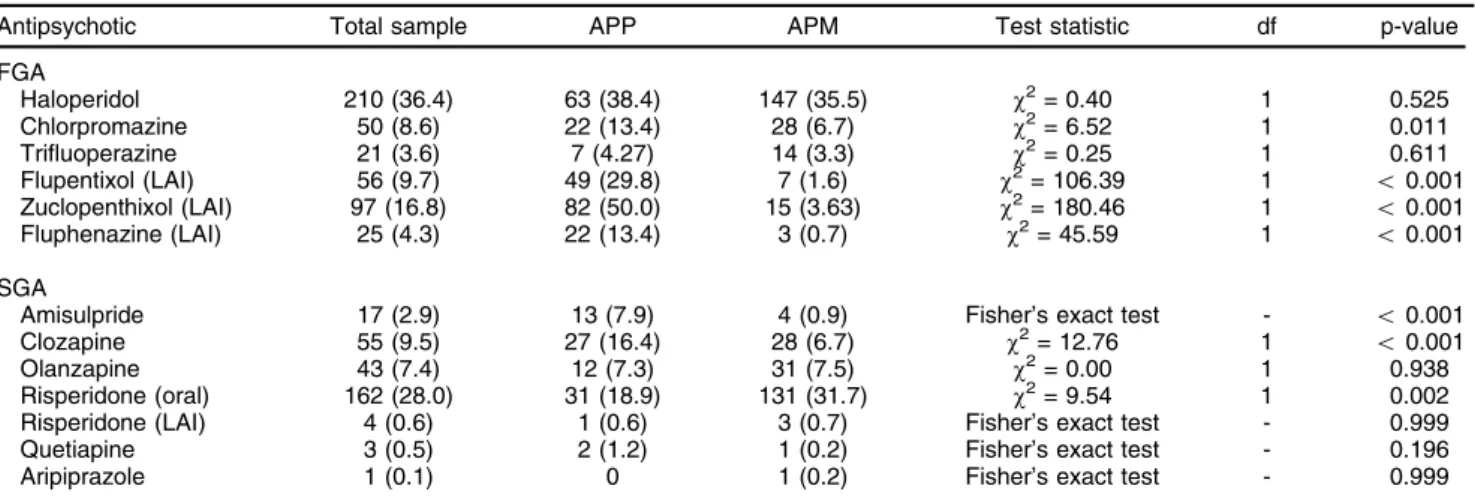
contains a summary of the frequency of the different types of antipsychotic medications prescribed in the total sample. The most commonly prescribed agent among all patients discharged was haloperidol, followed by risperidone (oral preparation) and zuclopenthixol LAI. The most common agents among patients discharged on APM were haloper-idol, risperidone (oral), and olanzapine. In those discharged on APP, zuclopenthixol LAI was most frequently prescribed, followed by haloperidol, flupentixol LAI, oral risperidone, and clozapine. When associations were examined, APP was found to be significantly associated with use of flupentixol LAI, zuclopenthixol LAI, fluphenazine LAI, amisulpride, clo-zapine, chlorpromazine, and oral risperidone. The odds of APP were significantly higher in patients with high-dose prescribing (Table 2).
The frequency of antipsychotic combinations prescri-bed at discharge is demonstrated in Table 4. The most common combination of antipsychotics was that of halo-peridol and zuclopenthixol LAI, which was found in a large proportion of APP prescriptions. This was followed by the combinations of haloperidol and flupentixol LAI, chlorpromazine and zuclopenthixol LAI, risperidone oral and flupentixol LAI, and risperidone oral with zuclo-penthixol LAI.
Regarding the nature of combinations according to antipsychotic agent class and route of administration, oral FGA + LAI FGA combinations predominated, being found in 55.49% of patients discharged on APP, followed by oral SGA+LAI FGA in 35.97% and a combination of two oral SGA agents in 5.49%.
Co-prescriptions of other psychotropic medications with antipsychotic polypharmacy
Psychotropic co-prescriptions are displayed in Table 5. Anticholinergic agents were significantly associated with APP. Sodium valproate and lithium were also significantly more commonly co-prescribed among patients on APM compared to patients on APP. An additional subgroup
exploratory analysis confined to patients with APP (n=164) demonstrated a significant association between diagnosis and valproate co-prescription (po0.001), with
as many as 40.2% of sodium valproate co-prescriptions occurring in patients with diagnosis of schizophrenia, followed by 34.4% in schizoaffective disorder, only 17.2% in bipolar disorder, and 8.0% in substance-induced dis-orders. Exploratory analysis in this group revealed that valproate co-prescriptions were not significantly asso-ciated with intellectual disability or clozapine treatment. Lithium co-prescriptions in those receiving APP occurred only in patients with diagnoses of bipolar and schizoaffective disorder, each contributing 50% of the total. Fluoxetine was Table 3 Antipsychotics prescribed to patients discharged on antipsychotic polypharmacy (APP) and antipsychotic
monotherapy (APM) (n=577)
Antipsychotic Total sample APP APM Test statistic df p-value
FGA
Haloperidol 210 (36.4) 63 (38.4) 147 (35.5) w2= 0.40 1 0.525
Chlorpromazine 50 (8.6) 22 (13.4) 28 (6.7) w2= 6.52 1 0.011
Trifluoperazine 21 (3.6) 7 (4.27) 14 (3.3) w2= 0.25 1 0.611
Flupentixol (LAI) 56 (9.7) 49 (29.8) 7 (1.6) w2= 106.39 1 o0.001
Zuclopenthixol (LAI) 97 (16.8) 82 (50.0) 15 (3.63) w2= 180.46 1 o0.001
Fluphenazine (LAI) 25 (4.3) 22 (13.4) 3 (0.7) w2= 45.59 1 o0.001
SGA
Amisulpride 17 (2.9) 13 (7.9) 4 (0.9) Fisher’s exact test - o0.001
Clozapine 55 (9.5) 27 (16.4) 28 (6.7) w2= 12.76 1 o0.001
Olanzapine 43 (7.4) 12 (7.3) 31 (7.5) w2= 0.00 1 0.938
Risperidone (oral) 162 (28.0) 31 (18.9) 131 (31.7) w2= 9.54 1 0.002
Risperidone (LAI) 4 (0.6) 1 (0.6) 3 (0.7) Fisher’s exact test - 0.999
Quetiapine 3 (0.5) 2 (1.2) 1 (0.2) Fisher’s exact test - 0.196
Aripiprazole 1 (0.1) 0 1 (0.2) Fisher’s exact test - 0.999
Data presented as n (%).
APM = antipsychotic monotherapy; APP = antipsychotic polypharmacy; df = degrees of freedom; FGA = first-generation antipsychotic; LAI = long-acting injectable; SGA= second-generation antipsychotic.
Table 4 Antipsychotic combinations in patients with antipsychotic polypharmacy (APP) at discharge (n=164)
Antipsychotic combination n (%)
Haloperidol+zuclopenthixol (LAI) 37 (22.5)
Haloperidol+flupentixol (LAI) 16 (9.7)
Chlorpromazine+zuclopenthixol (LAI) 14 (8.5)
Risperidone (oral)+flupentixol (LAI) 13 (7.9) Risperidone (oral)+zuclopenthixol (LAI) 12 (7.3)
Amisulpride+clozapine 9 (5.4)
Haloperidol+fluphenazine (LAI) 9 (5.4)
Clozapine+zuclopenthixol (LAI) 7 (4.2)
Olanzapine+zuclopenthixol (LAI) 7 (4.2)
Chlorpromazine+flupentixol (LAI) 6 (3.6)
Olanzapine+flupentixol (LAI) 5 (3.0)
Clozapine+flupentixol (LAI) 4 (2.4)
Clozapine+fluphenazine (LAI) 4 (2.4)
Risperidone (oral)+fluphenazine (LAI) 4 (2.4)
Trifluoperazine+fluphenazine (LAI) 3 (1.8)
Trifluoperazine+zuclopenthixol (LAI) 2 (1.2)
Trifluoperazine+flupentixol (LAI) 2 (1.2)
Chlorpromazine+fluphenazine (LAI) 2 (1.2)
Haloperidol+risperidone (oral) 1 (0.6)
Amisulpride+zuclopenthixol (LAI) 1 (0.6)
Quetiapine+flupentixol (LAI) 1 (0.6)
Quetiapine+zuclopenthixol (LAI) 1 (0.6)
Risperidone (oral)+risperidone (LAI) 1 (0.6) Amisulpride+clozapine+flupentixol (LAI) 2 (1.2) Amisulpride+clozapine+zuclopenthixol (LAI) 1 (0.6)
the most frequently co-prescribed antidepressant, but no significant associations between antidepressant co-prescriptions and APP were found. Benzodiazepine co-prescription was also associated, though not sig-nificantly, with APP.
Discussion
The APP prevalence rate of 28.4% found in our study is fairly high in comparison to international rates, with a recent systematic review of studies reporting on APP across decades and regions finding a global median prevalence of APP of 19.6% across time.26 In this systematic review, which examined studies of patients with a diagnosis of schizophrenia from inpatient, out-patient, urban and rural settings, the prevalence of APP varied across different regions, being higher in Europe (23%) and Asia (32%) compared to North America (16%) and Oceania (16.4%). The relatively high APP prevalence of 28.4% found in our sample is similar to that of regions such as Asia and is almost identical to that of an earlier South African study published in 2008. The latter study reviewed data on antipsychotic drug prescriptions for Xhosa patients with schizophrenia and schizoaffective disorder, particularly in terms of clozapine use, and found an overall low rate (10%) of clozapine use and a relatively high frequency of APP (28.6% of patients).27 The study suggested that high rates of APP may have been partially explained by high rates of LAI use (49.4% of patients), with the most frequently used antipsychotic combination used being haloperidol and an LAI (54.2% of combina-tions). While this study investigated APP in a limited population, our study examined the practice among all patients discharged on antipsychotic agents, without restricting race or diagnosis. Although findings were similar, our analysis of antipsychotic drug prescriptions examined prescription patterns in greater detail and included several additional SGAs that were not widely available in the South African public sector at the time of
the previous study. In addition, we examined APP in the context of a range of patient, illness, and treatment factors, increasing understanding of the complexity of the practice of APP in our setting.
Our study thus provides insight into various aspects that require consideration in relation to our relatively high rate of APP. The associations of APP with clinical and demographic characteristics was statistically signifi-cant for age 429, male sex, diagnosis of schizophrenia compared to bipolar disorder, comorbid intellectual dis-ability, comorbid substance use, and greater number of hospital admissions (more than six). The positive asso-ciation of APP with increased age is of interest in that it contrasts with data from several international studies that have showed an association of APP with younger age.25 It is possible that older patients hospitalized in our setting are those with greater illness severity, complexity, chroni-city, and treatment resistance, factors which have been found to be associated with APP,25,26 with additional antipsychotics possibly added as a result of poor response on monotherapy. Likewise, the associations of APP with male sex and greater number of hospital admissions could also be linked to greater illness severity, complexity, chronicity, and refractoriness in these patients,25as could the association with intellectual disability, given similar findings in previous studies and the suggestion that indi-viduals suffering from intellectual disability may be poorly responsive to antipsychotic treatments.33
While higher rates of APP in patients with diagnoses of schizophrenia and schizoaffective disorder were anticipated, it was of interest that APP was also observed in a fair number of patients with bipolar disorder and several patients with substance-induced disorders. Co-prescription of sodium valproate showed a significant positive association with APP, occurring significantly more often in APP patients with diagnoses of schizo-phrenia and schizoaffective disorders. No association between mild intellectual disability or clozapine prescrip-tion and co-prescripprescrip-tion of sodium valproate in patients Table 5 Psychotropics co-prescribed to patients discharged on antipsychotic polypharmacy (APP) and antipsychotic monotherapy (APM) (n=577)
Psychotropic co-prescription Total sample APP APM Test statistic df p-value
Anticholinergic 185 (32.0) 73 (44.5) 112 (27.1) w2= 16.30 1 o0.001
Mood stabilizer
Sodium valproate 252 (43.6) 87 (3.0) 165 (39.9) w2= 8.18 1 0.004
Lithium 84 (14.5) 16 (9.7) 68 (16.4) w2= 4.24 1 0.039
Lamotrigine 3 (0.5) 1 (0.6) 2 (0.4) Fisher’s exact test - 0.999
Carbamazepine 3 (0.5) 1 (0.6) 2 (0.4) Fisher’s exact test - 0.999
Topiramate 1 (0.1) 0 (0) 1 (0.2) Fisher’s exact test - 0.999
Antidepressant
Amitriptyline 1 (0.1) 0 (0) 1 (0.2) Fisher’s exact test - 0.999
Clomipramine 1 (0.1) 0 (0) 1 (0.2) Fisher’s exact test - 0.999
Citalopram 11 (1.9) 2 (1.2) 9 (2.1) Fisher’s exact test - 0.737
Fluoxetine 21 (3.6) 6 (3.6) 15 (3.6) w2= 0.00 1 0.988
Venlafaxine 2 (0.3) 1 (0.6) 1 (0.2) Fisher’s exact test - 0.488
Benzodiazepine 41 (7.1) 8 (4.8) 33 (7.9) w2= 1.72 1 0.189
Data presented as n (%).
with APP was found. Patients with moderate or severe intellectual disability are managed at a separate institution in our setting and were not included in our sample. We were thus unable to investigate the association of val-proate co-prescription with more severe forms of mental retardation or epilepsy. One reason for higher valproate co-prescription in APP may be that, in addition to its mood-stabilizing action, this agent may be used to treat residual psychotic symptoms and aggression in some cases of schizophrenia.11 A previous systematic review demonstrated higher rates of mood stabilizer co-prescrip-tion in North America compared to Asia and Europe. This may reflect North American practice of treating symptoms of aggression in schizophrenia with mood stabilizers.26
There was a significant positive association between comorbid substance use and APP, on a background of high rates of substance use in our population. Research on this association is lacking, with only a few previous studies examining APP in patients with comorbid sub-stance use.11,33,34 These studies have produced mixed results, showing both higher and lower APP prevalence in such patients. Reasons for conflicting findings remain unclear, but could result from differences in disclosure or methods of assessing substance use. Previous studies have shown that lower remission rates of positive psy-chotic symptoms and poorer adherence are associated with co-occurring substance misuse in patients with psy-chotic disorders.35One could speculate that the positive association between comorbid substance use and APP found in our study could result from additional antipsy-chotics being added in an attempt to treat higher levels of positive symptoms or to provide better compliance (i.e., the addition of depot antipsychotics to oral medication). It is evident that APP is a practice that warrants further investigation across diagnoses, with careful attention to various contributing factors that could be targeted for intervention, including comorbid substance use.
Analysis of prescription patterns in our sample demon-strated the prominent use of FGAs and LAI formulations in APP combinations, which is in keeping with previous local and international literature.26,27However, our finding that oral FGA and LAI FGA formulations were predomi-nantly used together in combinations differed from international trends, which have demonstrated a move from FGA-FGA combinations to more FGA-SGA combi-nations over time, with FGA-SGA combination treat-ment being most common in recent studies.26 FGAs remain common first-line prescriptions in our population, their lower cost making them particularly attractive in a resource-limited setting. SGA agents remain second-line choices in many cases, with restricted availability of certain agents including quetiapine and aripiprazole. LAIs are commonly used. They may frequently be added to existing regimens where concerns over compliance exist, contributing to their significant association with APP. In other cases, the positive association of APP with use of LAIs may result from the difficulty performing fine adjustments with LAIs alone, leading to oral medication being added for this purpose.25Often, oral medication is used as initial lead-in dosing for the first few weeks after LAI initiation while waiting for LAI plasma levels to reach
steady state. As there is evidence that eventual dis-continuation of the oral medication in such cases is often deferred and may even continue beyond its original purpose as lead-in medication,36an important implication for clinical practice and treatment planning would include instructions to community clinics to taper and stop such medications, as well as audits of whether such processes are in fact carried out. The majority of combinations found in our study remain unsupported by strong evidence, with the possible exception of clozapine augmentation stra-tegies.3,4
The positive association of APP with clozapine, and the use of clozapine with amisulpride among the combina-tions recorded in our sample, demonstrates attempts by some prescribers to follow treatment guidelines in mana-ging treatment-resistant patients. However, the rates of clozapine use in our study population (9.7%) remain relatively low in comparison to international rates.37-40 Possible reasons for this include clinician concerns about treatment adherence, the side-effect profile of clozapine treatment, the need for regular follow-up for monitoring of leukocyte counts, and difficulties related to reintroduc-tion of clozapine after discontinuareintroduc-tion for longer than 48 hours.27
The results of our study also contribute to concern over the safety of APP. There was a significant positive asso-ciation of APP with high-dose prescribing, as well as with co-prescription of anticholinergic medication. This may suggest risk for increased extrapyramidal side effects with APP, which in turn raises concerns about potential additional adverse effects possibly resulting from excess dopamine D2 blockade, including akathisia, tardive dyskinesia, and hyperprolactinemia.11 In addition, antic-holinergic agents themselves may produce adverse effects, such as sedation, cognitive impairment, and peri-pheral side effects. A previous systematic review demon-strated higher anticholinergic use in the context of APP in Asia compared to North America and Europe. As in our study, FGA +FGA polypharmacy predominated in Asia compared to North America and Europe, where SGA + SGA polypharmacy was more common.26
the variables of interest being limited to administrative data and information contained in discharge summaries completed electronically for each patient by their attend-ing psychiatric registrar at time of discharge. In some cases, the attending clinician may have failed to document comorbid psychiatric symptoms or substance use. We did not extract information from case files on sequential antipsychotic medications used or reasons for medication changes during hospital stay, making it uncertain whether prescribing of given combinations was preceded by failure of monotherapy trials in hospital. Certain relevant variables were not directly recorded; we attempted to overcome this problem by examining related variables. Length of time from first hospitalization to most recent discharge was used to provide some indication of duration of illness or time in treatment, although we acknowledge that the patient may have been diagnosed with mental illness prior to first hospital admission. Number of previous admissions and length of stay were recorded as indicators of illness seve-rity and possibly treatment resistance, although we realize that these are not direct substitute measures.
Our study suggests that current local practice in South Africa deviates from standard local and interna-tional guidelines in that combination antipsychotic agents are prescribed for a number of patients with a wide range of psychiatric diagnoses, without evidence to support this practice and at the possible cost of increased adverse effects. Our findings indicate that antipsychotic prescrip-tion patterns reflect a complex interplay among patient, illness, and treatment characteristics in our population. Additional research is needed to examine the practice of APP across diagnoses, focusing on the multiple aspects affecting local practice and the various contributing factors that could be targeted for intervention. This would be a positive step towards improving the quality of our service, advancing mental health care practice, and providing optimal patient management in a resource-limited setting.
Disclosure
The authors report no conflicts of interest.
References
1 Emsley R, Colin F, Flisher AJ, Grobler G, Hawkridge S, Potocnik F, et al. The South African Society of Psychiatrists (SASOP) treatment guidelines for psychiatric disorders: schizophrenia. S Afr J Psychiatr. 2013;19:153-6.
2 National Institute for Clinical Excellence (NICE). Psychosis and schizophrenia in adults: prevention and management. Clinical guideline 178. 2014 Feb [cited 2016 Nov 30]. nice.org.uk/guidance/ cg178.
3 Sagud M, Vuksan-Cusa B, Zivkovic M, Vlatkovic S, Kramaric M, Bradas Z, et al. Antipsychotics: to combine or not to combine? Psychiatr Danub. 2013;25:306-10.
4 Correll CU, Rummel-Kluge C, Corves C, Kane JM, Leucht S. Anti-psychotic combinations vs monotherapy in schizophrenia: a meta-analysis of randomized controlled trials. Schizophr Bull. 2009;35: 443-57.
5 Barbui C, Signoretti A, Mule S, Boso M, Cipriani A. Does the addition of a second antipsychotic drug improve clozapine treatment?. Schi-zophr Bull. 2009;35:458-68.
6 National Institute for Clinical Excellence (NICE). Bipolar disorder: assessment and management. Clinical guideline 185. 2016 Feb [cited 2016 Nov 30] https://www.nice.org.uk/guidance/cg185.
7 Colin F. Bipolar disorder: The South African Society of Psychiatrists (SASOP) treatment guidelines for psychiatric disorders. S Afr J Psychiatr. 2013;19:164-71.
8 National Institute for Clinical Excellence (NICE). Psychosis with coexisting substance misuse, assessment and management in adult and young people. Clinical Guideline 120.2011 Mar [cited 2016 Nov 30] https://www.nice.org.uk/guidance/cg120.
9 Taylor D, Paton C, Kapur S. Combined antipsychotic drugsIn:Taylor D, Paton C, Kapur S. The Maudsley prescribing guidelines in psychiatry. 12th ed. Chichester: Wiley-Blackwell; 2015. p. 37-40. Chapter 2: Schizophrenia.
10 Ballon J, Stroup TS. Polypharmacy for schizophrenia. Curr Opin Psychiatry. 2013;26:208-13.
11 Kreyenbuhl JA, Valenstein M, McCarthy JF, Ganoczy D, Blow FC. Long-term antipsychotic polypharmacy in the VA health system: patient characteristics and treatment patterns. Psychiatr Serv. 2007;58:489-95.
12 Centorrino F, Goren JL, Hennen J, Salvatore P, Kelleher JP, Baldessarini RJ. Multiple versus single antipsychotic agents for hospitalized psychiatric patients: case-control study of risks versus benefits. Am J Psychiatry. 2004;161:700-6.
13 Sweileh WM, Odeh JB, Zyoud SH, Sawalha AF, Ihbeasheh MS. Conformance to schizophrenia treatment guidelines in North West-Bank, Palestine: focus on antipsychotic dosing and polytherapy. BMC Psychiatry. 2013;13:179.
14 Anil Yagcioglu AE, Kivircik Akdede BB, Turgut TI, Tumuklu M, Yazici MK, Alptekin K, et al. A double-blind controlled study of adjunctive treatment with risperidone in schizophrenic patients partially res-ponsive to clozapine: efficacy and safety. J Clin Psychiatry. 2005;66: 63-72.
15 Montgomery J, Winterbottom E, Jessani M, Kohegyi E, Fulmer J, Seamonds B, et al. Prevalence of hyperprolactinemia in schizo-phrenia: association with typical and atypical antipsychotic treatment. J Clin Psychiatry. 2004;65:1491-8.
16 Zink M, Kuwilsky A, Krumm B, Dressing H. Efficacy and tolerability of ziprasidone versus risperidone as augmentation in patients partially responsive to clozapine: a randomised controlled clinical trial J Psychopharmacol. 2009;23:305-14.
17 Brooks JO 3rd, Goldberg JF, Ketter TA, Miklowitz DJ, Calabrese JR, Bowden CL, et al. Safety and tolerability associated with second-generation antipsychotic polytherapy in bipolar disorder: findings from the systematic treatment enhancement program for bipolar disorder. J Clin Psychiatry. 2011;72:240-7.
18 Naber D, Holzbach R, Perro C, Hippius H. Clinical management of clozapine patients in relation to efficacy and side-effects. Br J Psy-chiatry Suppl. 1992;17:54-9.
19 Elie D, Poirier M, Chianetta J, Durand M, Gregoire C, Grignon S. Cognitive effects of antipsychotic dosage and polypharmacy: a study with the BACS in patients with schizophrenia and schizoaffective disorder. J Psychopharmacol. 2010;24:1037-44.
20 Kessing LV, Thomsen AF, Mogensen UB, Andersen PK. Treatment with antipsychotics and the risk of diabetes in clinical practice. Br J Psychiatry. 2010;197:266-71.
21 Jerrell JM, McIntyre RS. Adverse events in children and adolescents treated with antipsychotic medications. Hum Psychopharmacol. 2008;23: 283-90.
22 Ray WA, Chung CP, Murray KT, Hall K, Stein CM. Atypical anti-psychotic drugs and the risk of sudden cardiac death. N Engl J Med. 2009;360:225-35.
23 Waddington JL, Youssef HA, Kinsella A. Mortality in schizophrenia. Antipsychotic polypharmacy and absence of adjunctive antic-holinergics over the course of a 10-year prospective study. Br J Psychiatry. 1998;173:325-9.
24 Joukamaa M, Heliovaara M, Knekt P, Aromaa A, Raitasalo R, Leh-tinen V. Schizophrenia, neuroleptic medication and mortality. Br J Psychiatry. 2006;188:122-7.
25 Correll CU, Gallego JA. Antipsychotic polypharmacy: a comprehen-sive evaluation of relevant correlates of a long-standing clinical practice. Psychiatr Clin North Am. 2012;35:661-81.
meta-regression of global and regional trends from the 1970s to 2009. Schizophr Res. 2012;138:18-28.
27 Koen L, Magni P, Niehaus DJ, le Roux A. Antipsychotic prescription patterns in Xhosa patients with schizophrenia or schizoaffective dis-order. Afr J Psychiatry (Johannesbg). 2008;11:287-90.
28 Hedden SL, Kennet J, Lipari R, Medley G, Tice P, Copello EAP, et al. Behavioral health trends in the United States: Results from the 2014 National Health Survey on Drug Use and Health. 2015 Sep [cited 2016 Nov 30]. https://www.samhsa.gov/data/sites/default/files/ NSDUH-FRR1-2014/NSDUH-FRR1-2014.pdf.
29 World Health Organization Collaborating Centre for Drug Statistics Methodology (WHOCC). Guidelines for ATC classification and DDD assignment. 17th ed.Oslo: WHOCC; 2014 [cited 2016 Nov 30]. http:// www.sifac.it/sites/default/files/dice1838.pdf.
30 Sweileh WM, Odeh JB, Shraim NY, Zyoud SH, Sawalha AF, Al-Jabi SW. Evaluation of defined daily dose, percentage of British national formulary maximum and chlorpromazine equivalents in antipsychotic drug utilization. Saudi Pharm J. 2014;22:127-32.
31 Barbui C, Nose M, Mazzi MA, Thornicroft G, Schene A, Becker T, et al. Persistence with polypharmacy and excessive dosing in patients with schizophrenia treated in four European countries. Int Clin Psychopharmacol. 2006;21:355-62.
32 Roh D, Chang JG, Kim CH, Cho HS, An SK, Jung YC. Antipsychotic polypharmacy and high-dose prescription in schizophrenia: a 5-year comparison. Aust N Z J Psychiatry. 2014;48:52-60.
33 Iasevoli F, Buonaguro EF, Marconi M, Di Giovambattista E, Rapag-nani MP, De Berardis D, et al. Efficacy and clinical determinants of antipsychotic polypharmacy in psychotic patients experiencing an
acute relapse and admitted to hospital stay: results from a cross-sectional and a subsequent longitudinal pilot study. ISRN Pharmacol. 2014;2014:762127.
34 Leslie DL, Rosenheck RA. Use of pharmacy data to assess quality of pharmacotherapy for schizophrenia in a national health care system: individual and facility predictors. Med Care. 2001;39: 923-33.
35 Lambert M, Conus P, Lubman DI, Wade D, Yuen H, Moritz S, et al. The impact of substance use disorders on clinical outcome in 643 patients with first-episode psychosis. Acta Psychiatr Scand. 2005;112: 141-8.
36 Doshi JA, Pettit AR, Stoddard JJ, Zummo J, Marcus SC. Concurrent oral antipsychotic drug use among schizophrenia patients initiated on long-acting injectable antipsychotics post-hospital discharge. J Clin Psychopharmacol. 2015;35:442-6.
37 Covell NH, Jackson CT, Evans AC, Essock SM. Antipsychotic pre-scribing practices in Connecticut’s public mental health system: rates of changing medications and prescribing styles. Schizophr Bull. 2002;28:17-29.
38 Lopez de Torre A, Lertxundi U, Hernandez R, Medrano J. Anti-psychotic polypharmacy: a needle in a haystack? Gen Hosp Psy-chiatry. 2012;34:423-32.
39 Wheeler A, Humberstone V, Robinson G. Trends in antipsychotic prescribing in schizophrenia in Auckland. Australas Psychiatry. 2006;14:169-74.