Corrigendum
On behalf of Maria Augusta B. dos Santos, Luciane B. Ceretta, Gislaine Z. Re´us, Helena M. Abelaira, Luciano K. Jornada,1 Ma´gada T. Schwalm, Morgana V. Neotti, Cristiane D. Tomazzi, Karina G. Gulbis, Renan A. Ceretta, and Joa˜o Quevedo, authors of the paper entitled ‘‘Anxiety disorders are associated with quality of life impairment in
patients with insulin-dependent type 2 diabetes: a case-control study,’’ published in this journal in 2014, volume 36, issue 4, pages 298-304, we hereby inform that the figures originally published in ahead of print mode were wrong. Below please find new versions for the four figures included in the manuscript.
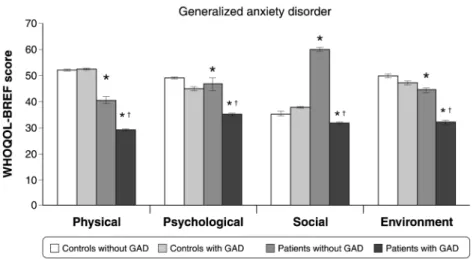
Figure 1 Relationship between generalized anxiety disorder (GAD) and quality of life scores in patients with insulin-dependent type 2 diabetes.*p,0.005 vs. controls without generalized anxiety disorder;{p
,0.005 vs. patients without generalized anxiety disorder.
Figure 2 Relationship between panic disorder (PD) and quality of life scores in patients with insulin-dependent type 2 diabetes.*p,0.005 vs. controls without panic disorder;{p,0.005 vs. patients without panic disorder.
Revista Brasileira de Psiquiatria. 2015;37:88–89
ß2015 Associac¸a˜o Brasileira de Psiquiatria
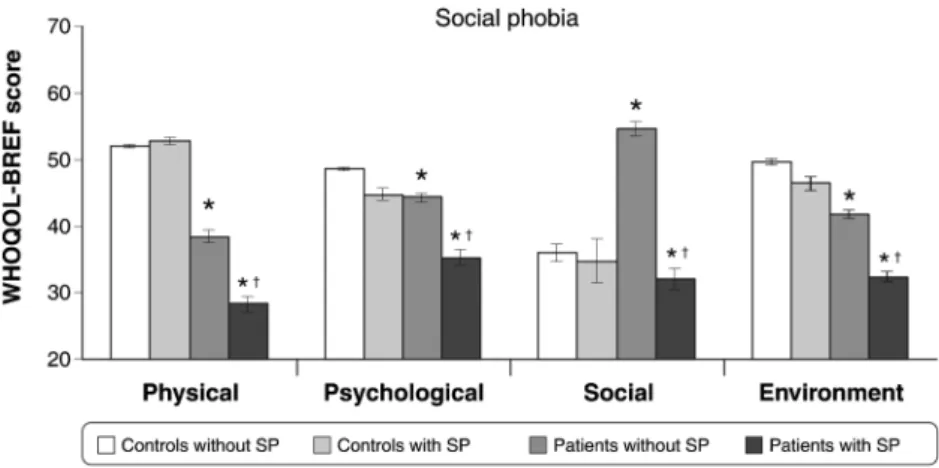
Figure 3 Relationship between social phobia (SP) and quality of life scores in patients with insulin-dependent type 2 diabetes. *p,0.005 vs. controls without social phobia;{p
,0.005 vs. patients without social phobia.
Figure 4 Relationship between obsessive-compulsive disorder (OCD) and quality of life scores in patients with insulin-dependent type 2 diabetes.*p,0.005 vs. controls without obsessive-compulsive disorder;{p,0.005 vs. patients without obsessive-compulsive disorder.
89