312
Rev Dor. São Paulo, 2015 oct-dec;16(4):312-15
ABSTRACT
BACKGROUND AND OBJECTIVES: Auriculotemporal neuralgia is an uncommon condition. Symptoms are brief se-vere pain attacks, especially in the temporal region. Although many cranial neuralgias are related to nervous compression, they may be present without identiiable etiologic factors. his study aimed at describing a case of primary auriculotemporal neuralgia and respective therapeutic approach.
CASE REPORT: Male patient, 72 years old, presented for as-sistance reporting severe pain in left temporal region, described as shock and of very short duration. After clinical evaluation and imaging exams, no signiicant changes were detected. Patient has satisfactorily responded to carbamazepine.
CONCLUSION: his case shows that auriculotemporal neural-gia has clinical presentation similar to other neuralneural-gias. Diagno-sis is primarily obtained by pain characteristics evaluation and exclusion of possible secondary causes.
Keywords: Auriculotemporal nerve, Auriculotemporal neural-gia, Neuropathic pain.
RESUMO
JUSTIFICATIVA E OBJETIVOS: A neuralgia do aurículotem-poral é uma condição rara. Os sintomas consistem em ataques de dor intensa, de curta duração, sobretudo na região temporal. Embora muitos casos de neuralgias cranianas sejam relacionados à compressão nervosa, podem ocorrer sem fatores etiológicos identi-icáveis. O objetivo deste estudo foi descrever um caso de neuralgia auriculotemporal primária e respectiva conduta terapêutica.
RELATO DO CASO: Paciente do gênero masculino, 72 anos, compareceu para atendimento relatando dor intensa em região temporal esquerda, descrita como choque, de curtíssima dura-ção. Após avaliação clínica e exames de imagens, não foram de-tectadas alterações signiicativas. O paciente respondeu de forma satisfatória à carbamazepina.
Primary auriculotemporal neuralgia. Case report
Neuralgia do aurículotemporal primária. Relato de caso
Maurício Kosminsky1, Michele Gomes do Nascimento1
1. Universidade de Pernambuco, Recife, PE, Brasil.
Submitted in July 16, 2015.
Accepted for publication in October 23, 2015. Conlict of interests: none – Sponsoring sources: none.
Correspondence to: Michele Gomes do Nascimento R. Artur Coutinho, 143 - Santo Amaro 50100-280Recife, PE, Brasil. E-mail: [email protected]
© Sociedade Brasileira para o Estudo da Dor
CONCLUSÃO: O caso descrito mostra que a aurículotempo-ral possui apresentação clínica semelhante àquela de outras neu-ralgias. O diagnóstico é obtido principalmente pela análise das características da dor e exclusão de possíveis causas secundárias.
Descritores: Dor neuropática, Nervo aurículotemporal, Neural-gia do aurículotemporal.
INTRODUCTION
Neuropathic pain results from a primary nervous system in-jury or disorder, triggered by local trauma or systemic dis-eases and afecting peripheral or central nervous structures. Considering the symptom, orofacial neuropathic pain may be classiied in two categories: episodic or continuous. Epi-sodic neuropathic pain is characterized by pain paroxysms described as electric shock or twinge, similar to what hap-pens with trigeminal neuralgia (TN)1. Pain paroxysms are in
general followed by remission periods, known as refractory periods. Pain may be classiied in primary (classic) or second-ary (symptomatic) and the diference between them is im-portant for adequate diagnosis and management. While the vast majority of patients have brief, severe and paroxysmal pain, continuous pain may also be present2,3. Most common
neuralgias are trigeminal, post-herpetic, glossopharyngeal and occipital. Less frequent are supraorbital and intermedi-ate nerve neuralgia. hese disorders may underlie infectious and/or inlammatory neurologic diseases, in addition to other primary headaches3.
he auriculotemporal nerve (n.AT) is a sensory branch orig-inating from mandibular nerve posterior trunk. Due to its pathway, there is major risk for compression and irritation. Its nervous roots form a short trunk, which supplies several branches and innervates temporomandibular joint (TMJ), temporal region, pinna and external acoustic meatus. It con-ducts sympathetic ibers to the scalp and parasympathetic ibers to the parotid gland4. Anatomic relationship between
n.AT and masticatory muscles, TMJ and surrounding vessels in the infra temporal fossa region, creates favorable condi-tions for compressive syndromes5,6.
Auriculotemporal neuralgia (NAT) is an uncommon condi-tion. In a tertiary center, reported frequency was just 0.4%7.
It seems to be more prevalent in middle-aged females. Symp-toms are excruciating pain attacks, especially in the temporal region. Pain in TMJ, parotid and ear, with irradiation to tem-poral region is also described and may be relieved by auricu-lotemporal nerve anesthetic block8,9. Although not having its
own classiication, the name epicranial neuralgias has been suggested, including neuralgias of other peripheral
branch-CASE REPORT
313
Primary auriculotemporal neuralgia. Case report Rev Dor. São Paulo, 2015 oct-dec;16(4):312-15es10,11, such as supraorbital, supratrochlear, nasal, greater and
lesser occipital nerves12.
Although many cranial neuralgias are primary, other etiologic factors may be involved. Refractory cases or with paresthe-sia may indicate the presence of expansive injuries. Although mechanisms of such conditions are not totally explained, non-odontogenic toothache7, refractory facial pain8, as well as
NAT secondary to synovial cyst in the condyle13 are reported
by the literature.
his study aimed at reporting a case of NAT where underly-ing secondary factors were not found, and which has favor-ably responded to low dose of carbamazepine.
CASE REPORT
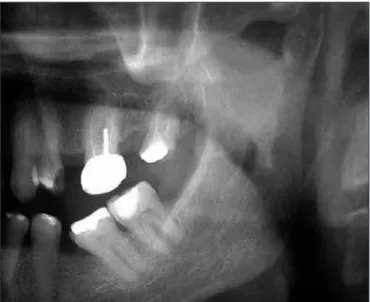
Male patient, 72 years old, who came for assistance complain-ing of severe left temporal region pain, described as shock. First crisis had been 5 years ago with spontaneous remission. Two months ago pain reappeared, with very short duration, with several episodes varying from 1 to 2 minutes. hese epi-sodes were repeated three to four times a day and did not wake up patient at night. At physical evaluation, no pain trigger-zone was found. Patient had controlled diabetes and referred having been submitted to prostatectomy due to can-cer. Brain magnetic resonance was normal. Panoramic X-rays of jaws and computerized tomography of temporomandibular joints had not shown signiicant changes (Figures 1, 2 and 3). Diagnostic hypothesis was NAT. Carbamazepine (200mg) was prescribed during the irst two days, continuing with 400mg for the following 15 days. In the irst week using the drug, patient was revaluated and reported lower frequency of shocks (2 to 3 per day), which he deined as “pinching”. In the following week, patient referred symptoms remission. Maintenance dose of 200mg was then kept and 4 months later there has been total symptoms control.
Figure 3. Ultrasound of left temporal region
Figure 1. Panoramic X-rays approximate left side view
There were no signiicant changes.
Figure 2. Computerized tomography of temporomandibular joint (open mouth)
There were no temporomandibular joints expansive injuries.
DISCUSSION
Due to its rarity, the International Classiication of Headache Disorders (ICHD-II) does not have a speciic category for NAT, being it classiied as “neuralgia of other terminal branch-es”. Diagnostic criteria are: 1) Pain in the distribution of a trigeminal nerve peripheral branch, except nasociliary and supraorbital nerves; 2) Sensitivity on afected nerve; 3) Pain is eliminated with anesthetic block or nerve ablation11. In the
new ICHD-III classiication, however, this category was not included10. Diferential NAT diagnosis should be obtained to
rule out other disorders, including temporomandibular dis-orders, toothache, continuous migraine, earache, trigeminal neuralgia, temporal arteritis, myofascial pain and atypical fa-cial pain2-7.
Primary diagnosis of our patient was obtained by means of pain characteristics, such as location, quality, intensity, fre-quency and duration. Imaging exams (panoramic X-rays, TMJ tomography and temporal region ultrasound) were asked to exclude possible secondary causes of the disease. Masticatory muscles palpation has not shown relevant changes. For be-ing a well located pain in temporal region without irradia-tion patterns, in shock, we have considered initial diagnosis of NAT.
314
Kosminsky M and Nascimento MG
Rev Dor. São Paulo, 2015 oct-dec;16(4):312-15
between 23 and 65 years. he interval between beginning of symptoms and diagnosis has varied from 1 month to 20 years. Pain was moderate to severe, located around the ear, and ir-radiating to condyle and temporal region in all patients. Pain was continuous in 5 cases and associated with stabbing-type exacerbation in three. One patient had pre-auricular trigger-point.
One patient has reported this symptom triggered by gustatory stimulation causing diet limitations. Pain was unilateral, not involving the opposite side. For all patients, pain was trig-gered or worsened by pressure in the pre-auricular region or slightly above it2. In our case, patient has referred beginning
of symptoms two months ago, had severe, spontaneous and brief pain episodes which were repeated at few minutes in-tervals.
n.AT trunk has close anatomic relationship with condyle and TMJ capsule region, which may contribute to sensory disor-ders in this site. In several studied cases, nerve was in direct contact with the medial aspect of the capsule or of the neck of the condyle. Studies have not observed anatomic corre-spondences between right and left sides, so just one side can be afected. n.AT may also be in direct contact with lateral pterygoid muscle14. Findings support the hypothesis that the
anatomic relationship between n.AT and condyle, articular fossa and lateral pterygoid muscle might be associated to its compression and irritation, thus contributing to neuropathic pain in its innervated regions15.
To investigate n.AT compression mechanism, Komarkitki et al.5 have studied the infratemporal fossa in 16 specimens
and have found that the number of n.AT roots varied be-tween 1 and 5. hey have observed that, in variations where n.AT had 4 to 5 roots, there were complex connections. In ive cases, lowest n.AT roots started in the inferior alveolar nerve instead of in the mandibular nerve. his study ind-ings point to two major factors which may be involved with auriculotemporal nerve compression in its pathway inside the infratemporal fossa. he irst is anatomic variation while the second is the presence of masticatory muscles disorder, es-pecially lateral pterygoid muscle. According to the authors, even minor structural or functional changes may lead to pain-ful syndromes. In fact, our patient complained of shock and unilateral pain in temporal region. However, there were no trigger-points related to jaw functional demands in this case. Pharmacological treatment is still the irst line to control sev-eral neuralgias. It may be obtained with the association of classic analgesics and anticonvulsant or antidepressant drugs. In patients with classic trigeminal neuralgia, carbamazepine is considered the irst choice drug. However, several adverse efects are associated to its use, among them skin erythema, negative efect on bone density, liver changes and pharmaco-logical interaction. Oxcarbazepine may be used in patients nor responding to carbamazepine. Second line drugs are ba-clofen, lamotrigine, pregabalin and gabapentin16.
Anesthetic blocks, surgery and other procedures may be nec-essary for refractory cases3. Literature states that n.AT
anes-thetic block is diagnostic and therapeutic. It is performed
with 0.5mL 2% lidocaine without vasoconstrictor and dexamethasone (2.5mg/0,5 mL), being described successful reports in symptoms control2,7,8. Anesthetic block induces
immediate pain relief in patients with diferent types of head-aches. In addition, its analgesic efect is longer as compared to anesthesia, so that patients have pain relief for weeks or even months. his prolonged anesthetic efect after peripheral block may be related to efect on central pain modulation. Anesthetic blocks are indicated for some primary headaches, secondary headaches and cranial neuralgias. One must take care with certain populations of patients, including pregnant women, elderly, those allergic to substances used, with history of previous vasovagal episodes and in use of anticoagulants. Described peripheral anesthetic blocks involve injections in greater and lesser occipital nerves, supratrochlear, supraor-bital and auriculotemporal nerves17. Reported complications
include pain, bleeding, infection an intravascular injection3.
To investigate analgesic eicacy and tolerability to pharma-cological treatment, 200 patients with classic trigeminal neu-ralgia (TN) were selected. Carbamazepine (CBZ) was pre-scribed for 100 individuals and oxcarbamazepine (OXC) was prescribed for the other 100. Response to CBZ was found in 98%, with mean dose of 600mg (200-1200), and response to OXC has been 94%, with mean dose of 1200mg (600-1800). In a period of approximately 8.6 months, 27% of patients responding to CBZ had major adverse efects, being neces-sary to discontinue the drug or to decrease it to unsatisfactory levels. After 13 months, the same has happened with 18% of respondents to OXC. Among patients with good initial response, only 3 individuals using CBZ and 2 using OXC have developed late resistance. During the course of disease, paroxysms have worsened in 3% of patients and their dura-tion has increased 2%. In a 7-year period, no clinical sensory deicit manifestations were observed for all patients. Based on available evidences, CBZ or OXC are considered irst thera-peutic option18,19.
In a retrospective study with 72 classic TN patients, CBZ was highly efective in 60.8% of cases in the long term with maintenance dose. Other drugs were used in more refractory cases, including gabapentin, which has relieved symptoms with mean duration of 18 months. Peripheral neurectomy was needed for 23% of patients20.
Considering our case report, where there were no second-ary underlying etiologic factors, we decided for CBZ as irst therapeutic option. In addition, although literature states that anesthetic block may be considered initial clinical decision, factors such as pain characteristics, patient’s age and the pos-sibility of response to conservative therapy were taken into consideration
CONCLUSION
315
Primary auriculotemporal neuralgia. Case report Rev Dor. São Paulo, 2015 oct-dec;16(4):312-15REFERENCES
1. Benoliel R, Eliav E. Neuropathic orofacial pain. Oral Maxillofac Surg Clin North Am. 2008;20(2):237-54.
2. Speciali JG, Gonçalves DA. Auriculotemporal neuralgia. Curr Pain Headache Rep. 2005;9(4):277-80.
3. Gadient PM, Smith JH. he neuralgias: diagnosis and management. Curr Neurol Neurosci Rep. 2014;14(7):459.
4. Janis JE, Hatef DA, Ducic I, Ahmad J, Wong C, Hoxworth RE, et al. Anatomy of the auriculotemporal nerve: variations in its relationship to the supericial temporal artery and implications for the treatment of migraine headaches. Plast Reconstr Surg. 2010;125(5):1422-8.
5. Komarnitki I, Andrzejczak-Sobocińska A, Tomczyk J, Deszczyńska K, Ciszek B. Clini-cal anatomy of the auriculotemporal nerve in the area of the infratemporal fossa. Folia Morphol. 2012;71(3):187-93.
6. Dias GJ, Koh JM, Cornwall J. he origin of the auriculotemporal nerve and its rela-tionship to the middle meningeal artery. Anat Sci Int. 2015;90(4):216-21. 7. Murayama RA, Stuginski-Barbosa J, Moraes NP, Speciali JG. Toothache referred from
auriculotemporal neuralgia: case report. Int Endod J. 2009;42(9):845-51. 8. Stuginski-Barbosa J, Murayama RA, Conti PC, Speciali JG. Refractory facial pain
attributed to auriculotemporal neuralgia. J Headache Pain. 2012;13(5):415-7. 9. Levin M. Nerve Blocks in the treatment of headache. Neurotherapeutics.
2010;7(2):197-203.
10. he International Classiication of Headache Disorders, 3rd ed. (beta version).
Cepha-lalgia. 2013;33(9):629-808.
11. Olesen J, Marie-Germaine B. he International Classiication of Headache Disorders 2nd ed. ICHD-ll. Headache. 2004;48(5):691-3.
12. Pareja JA, Pareja J, Yangüela J. Nummular headache, trochleitis, supraorbital neural-gia, and other epicranial headaches and neuralgias: the epicranias. J Headache Pain. 2003;4(3):125-31.
13. Ansari H, Robertson CE, Lane JI, Viozzi CF, Garza I. Auriculotemporal neural-gia secondary to TMJ synovial cyst: A rare presentation of a rare entity. Headache. 2013;53(10):1662-5.
14. Shimokawa T, Akita K, Sato T, Ru F, Yi SQ, Tanaka S. Penetration of muscles by branches of the mandibular nerve: a possible cause of neuropathy. Clin Anat. 2004;17(1):2-5.
15. Schmidt BL, Pogrel MA, Necoechea M, Kearns G. he distribution of the auricu-lotemporal nerve around the temporomandibular joint. Oral Surg Oral Med Oral Pathol Oral Radiol Endod. 1998;86(2):165-8.
16. Lemos L, Fontes R, Flores S, Oliveira P, Almeida A. Efectiveness of the association between carbamazepine and peripheral analgesic block with ropivacaine for the treat-ment of trigeminal neuralgia. J Pain Res. 2010;3:201-12.
1. Parte superior do formulário
17. Blumenfeld A, Ashkenazi A, Napchan U, Bender SD, Klein BC, Berliner R, et al. Expert consensus recommendations for the performance of peripheral nerve blocks for headaches--a narrative review. Headache. 2013;53(3):437-46.
18. Di Stefano G, La Cesa S, Truini A, Cruccu G. Natural history and outcome of 200 outpatients with classical trigeminal neuralgia treated with carbamazepine or oxcar-bazepine in a tertiary centre for neuropathic pain. J Headache Pain. 2014;15(1):34. 19. Cruccu G, Truini A. Refractory trigeminal neuralgia: non-surgical treatment options.
CNS Drugs. 2013;27(2):91-6.