www.reumatologia.com.br
REVISTA BRASILEIRA DE
REUMATOLOGIA
Original article
Otorhinolaryngological indings in a group of patients with
rheumatic diseases
Reinaldo Jordão Gusmão
a, Fernando Lafitte Fernandes
a, Alexandre Caixeta Guimarães
a,
Lutiane Scaramussa
a, Zoraida Sachetto
b, Henrique Furlan Pauna
a,*,
Guilherme Machado de Carvalho
aa Otorhinolaryngology, Head and Neck Discipline, Faculdade de Ciências Médicas, Universidade Estadual de Campinas, Campinas, SP, Brazil b Rheumatology Discipline, Faculdade de Ciências Médicas, Universidade Estadual de Campinas, Campinas, SP, Brazil
a r t i c l e i n f o
Article history:
Received on 26 July 2013 Accepted on 13 October 2013
Keywords:
Autoimmune diseases Otorhinolaringology Rheumatology
a b s t r a c t
Introduction: Otorhinolaryngological manifestations of rheumatologic diseases represent a great challenge not only to the generalistphysician but also to the ENT doctor andrheu-matologist. They often represent early manifestations of an autoimmune disorder which requires prompt and aggressive immunosuppressive treatment. Auditory, nasal, laryngeal and eye symptoms can be the irst manifestation of rheumatic diseases and their proper assessment helps the doctor to identify signs of disease activity. The objective of this study is to identify the ENT manifestations in patients with rheumatic diseases in a high comple-xity hospital, regarding facilitating an early diagnosis and treatment.
Methods: We performed clinical and complete otorhinolaryngological evaluations in pa-tients selected from the outpatient rheumatology in a standardized manner by the use of a standardized form illing during the secondhalf of 2010.
Results: In the study group, systemic lupus erythematosus (SLE) patients had predomi-nantly laryngeal manifestations, while patients with Sjögren’s syndrome showed a higher prevalence of otologic manifestations. Changes in audiometric tests were found in 53% of Wegener’s granulomatosis (WG) patients, 80% of relapsing polychondritis (RP), 33% of systemic lupus erythematosus (SLE) and 50% of Churg-Strauss syndrome (SCS). Regarding nasal alterations, these were found so prevalent in all conditions, especially Churg-Strauss syndrome.
Discussion and conclusion: This study demonstrated that most patients treated in our hospi-tal has the ENT signs and symptoms commonly associated in previous studies on rheuma-tic diseases, but further studies with a larger number of patients must be made to establish such relations.
© 2014 Sociedade Brasileira de Reumatologia. Published by Elsevier Editora Ltda. All rights reserved.
* Corresponding author.
E-mail: [email protected] (H.F. Pauna).
Achados otorrinolaringológicos em um grupo de pacientes com doenças reumatológicas
Palavras-chave:
Reumatologia Otorrinolaringologia Doenças autoimunes
r e s u m o
Introdução: As manifestações otorrinolaringológicas de doenças reumáticas representam um grande desaio não só ao médico generalista, mas também ao otorrinolaringologista e ao reumatologista. Frequentemente representam manifestações iniciais de uma desor-dem autoimune que exige um tratamento imunossupressor imediato e agressivo. Sinto-mas auditivos, nasais, laríngeos e oculares podem ser a primeira manifestação de doenças reumáticas, e sua correta avaliação auxilia o médico a identiicar sinais de atividade da doença. O objetivo deste trabalho foi identiicar as manifestações otorrinolaringológicas em pacientes com doenças reumáticas em um hospital de alta complexidade, no que se refere a facilitar diagnóstico e tratamento precoces.
Métodos: Foram realizadas avaliações clínicas e otorrinolaringológicas completas em paci-entes selecionados no ambulatório de reumatologia, no segundo semestre do ano de 2010, de forma padronizada e com utilização de um formulário de preenchimento normatizado.
Resultados: No grupo estudado, pacientes com LES apresentaram predominantemente manifestações laríngeas, enquanto pacientes com síndrome de Sjögren apresentaram pre-domínio das manifestações otológicas (100% dos casos). As alterações de exames audiomé-tricos são encontradas em 53% dos casos portadores de GW, 80% de PR, 33% de LES e 50% de SCS. Quanto às alterações nasais, estas foram encontradas de forma prevalente em todas as patologias, principalmente a síndrome de Churg-Strauss.
Discussão e conclusão: Este estudo demonstrou que a maioria dos pacientes em seguimento em nosso serviço apresenta os sinais e sintomas otorrinolaringológicos comumente rela-cionados em trabalhos prévios sobre doenças reumáticas, porém novos estudos com um número maior de pacientes devem ser feitos para comprovar tais relações
© 2014 Sociedade Brasileira de Reumatologia. Publicado por Elsevier Editora Ltda. Todos os direitos reservados.
Introduction
Rheumatic diseases have a high prevalence rate worldwide and a representative functional disability index.1 These
con-ditions comprise a heterogeneous group of entities that produce systemic changes involving the connective tissue throughout the body. For this reason they may involve blood vessels and serous and mucous membranes of all the aerodi-gestive tract.2 The treatment itself of such diseases with
non-steroidal anti-inlammatory drugs can cause symptoms in many patients.3 In this sense, much has been discussed
about the current ENT manifestations in patients with rheu-matic diseases.4
Ear, nasal, laryngeal and ocular symptoms may be the irst manifestations of various rheumatic diseases, as re-lapsing polychondritis (RP), systemic lupus erythematosus (SLE), Wegener’s granulomatosis (WG), Sjögren’s syndrome (SS) and Churg-Strauss syndrome (CSS),5,6 and this
combi-nation is described in several trials. As an example, there are some case reports of patients with RP in which changes in pinna, nasal cartilage, nasal septum, larynx and trachea were found, causing dysphonia, dyspnea and cosmetic de-formities.7,8 Allergic rhinitis, chronic sinusitis and serous
oti-tis media are commonly found in patients with CSS,9 while
immunological abnormalities are frequently found in pa-tients with Menière’s disease.10 Sensorineural hearing loss
may be the irst manifestation of polyarteritis nodosa,11 as
well as recurrent parotitis for SS12 and chronic otitis media
for ankylosing spondylitis.13
Given the global growth of rheumatic diseases, driven by population ageing and exposure to a larger number of induc-ers of autoimmune changes,14 the identiication of ENT
symp-toms in these patients can become an important tool for the diagnosis and, consequently, for the early treatment of such diseases. The correct evaluation of rheumatic conditions, par-ticularly in SLE, helps the physician to identify signs of dis-ease activity, which directly affects the patients’ quality of life and their prognosis.15-17
Thus, the objective of this work is to identify ENT mani-festations in patients with rheumatic diseases in a hospital of high complexity. As this trial was conducted in 2010 and considering the fact that the old nomenclature for rheuma-tologic diseases is more widespread in our environment, we used this nomenclature in the present trial. In the new no-menclature established by the Chapel Hill Consensus in 2012, Wegener’s granulomatosis became known as granuloma-tous with polyangiitis, and Churg-Strauss syndrome became known as eosinophilic granulomatous with polyangiitis.18
Materials e methods
nasoiberlaryngoscopy were performed. Sensorineural hearing loss or sound discrimination impairment with bilateral and symmetrical occurrence and with subacute evolution were considered as audiometric alterations.
The assessment was fully standardized, and a normatized illing form was used during the second half of 2010.
For the selection of patients, we requested from the De-partment of Rheumatology a random referral of patients for specialized ENT evaluation, but some speciic outpatient ser-vices contributed more to the project (such as vasculitis and Wegener’s granulomatosis outpatient services).
The irst ive patients in each outpatient rheumatology should have been referred for a period of 15 days.
Every patient evaluation was performed at the otorhinolar-yngology ambulatory of our national reference, tertiary care, university hospital. The patients were attended and evaluated by two otolaryngologists randomly selected among the profes-sionals who participated in this trial.
The criteria used were those of the Otorhinolaryngologist available at the time and who would perform the patient’s as-sessment.
This trial was evaluated and approved by the Research Ethics Committee from our institution (Opinion CEP/FCM nº 1187/2011).
Results
Thirty-two selected patients of Rheumatology Discipline Out-patient Clinic (HC/FCM/UNICAMP) were evaluated. In the eval-uated sample , the patients were diagnosed as deined by the criteria of Medical Guidelines of the Brazilian Society of Rheu-matology19 for SLE and by the American College of
Rheumatol-ogy20,21,22,23 for other diseases, with a diagnosis established for
one from ive rheumatic diseases: Wegener’s granulomatosis (WG), Churg-Strauss syndrome (CSS), relapsing polychondritis (RP), Sjögren’s syndrome (SS) and systemic lupus erythemato-sus (SLE).
The mean age of the participants was 41.7 years (range 22-70 years) and the mean disease duration was 9.12 years (range 1-40 years).
1 – Wegener’s granulomatosis (n = 17)
Among WG patients, nine (53.1%) reported hearing loss and had low tone threshold results at audiometry. The most
fre-quent type of reduction was that of a bilateral sensorineu-ral pattern, present in ive patients (55.6%). In the context of rhinologic symptoms, nasal obstruction in 11 (64.8%) and rhinorrhea in ten (58.8%) patients were the most prevalent symptoms, with compatible changes present in the rhino-scopic exam in 12 (70.2 %) of these patients, and the most frequent symptoms were coryza, septal perforations, muco-sal oedema and turbinate hypertrophy. Complaints related to the larynx, dyspnea and raucousness were found in six (35.2%) and seven (41.2%) patients, respectively, being the most prevalent complaints. Of these, seven (41.2%) patients had an abnormal physical examination, for instance, hyper-aemia of posterior pharynx, inter-arytenoidal oedema and relative degrees of subglottic stenosis (Table 1).
2 – Recidivant polychondritis (n = 5)
In patients with RP, among the otologic symptoms, the most frequent complaint was ear itching in three patients (60%), followed by tinnitus, hearing loss and ear fullness in two (40%). The changes more often found during the physical examination were pinna oedema and opacity of the tym-panic membrane. The main nasosinusal symptoms were: presence of nasal obstruction, rhinorrhea and sneezing, re-ported by two patients (40%), and coryza, mucosal oedema, pale mucosa, granulation of the turbinates and turbinate hypertrophy were the primary indings. As to laryngeal complaints, cough, foreign body sensation, raucousness and choking were present in two cases (40%). The chang-es found on physical examination were inter-arytenoidal oedema, paresis of vocal folds and laryngeal hyperaemia (Table 2).
3 – Sjögren’s syndrome (n = 5)
For patients with SS, tinnitus and ear fullness were present in three and four of the ive patients, respectively; the most fre-quent changes were in conductive hearing loss and presence of a large amount of desquamation in the external auditory ca-nal. Nasal obstruction was present in all patients. In the rhino-scopic examination, hyperaemia and oedema of mucosa were the observed indings. Dysphonia and raucousness were the only reported laryngeal symptoms; and the signs found were salivary gland hypertrophy, dry mouth and inter-arytenoidal oedema (Table 3).
Table 1 – Presence of otological signs and symptoms Wegener’s
granulomatosis n = 17
Relapsing Polychondritis n = 5
Syndrome of Sjögren n = 5
Systemic Lupus Erythematosus n = 3
Syndrome of Churg-Strauss n = 2
Otalgia 8 (47%) 1 (20%) 0 0 0
Otorrhea 4 (23%) 0 1 (20%) 0 0
Tinnitus 7 (41%) 2 (40%) 3 (60%) 1 (33%) 1 (50%)
Ear fullness 3 (18%) 2 (40%) 4 (80%) 0 1 (50%)
Hearing loss 9 (53%) 2 (40%) 2 (40%) 1 (33%) 1 (50%)
Hyperacusis 0 0 0 0 0
Ear pruritus 3 (18%) 3 (60%) 5 (100%) 0 0
4 – Systemic Lupus Erythematosus (n = 3)
Among SLE patients, tinnitus and hearing loss were reported by one patient (33%), with presence of left ear sensorineural hearing loss and right ear conducive hearing loss. Among nasal symptoms, nasal obstruction and rhinorrhea were also present in one patient, and edema and coryza were the signs most often found . Dysphonia was present in two cases (67%), and the presence of glottic cleft during phonation and inter-arytenoidal oedema were the changes observed.
5 – Churg-Strauss syndrome (n = 2)
One patient (50%) with Churg-Strauss reported tinnitus, ear fullness and hearing loss, with conductive hearing loss at audiometry. At rhinoscopy, pale mucosa, turbinate hypertro-phy and coryza were observed in patients. The complaints of dysphonia, cough, dyspnea, haemoptysis, and raucousness were compatible with the presence of oedema of laryngeal mucosa, glottic cleft and secretion, observed during the ex-amination of the larynx.
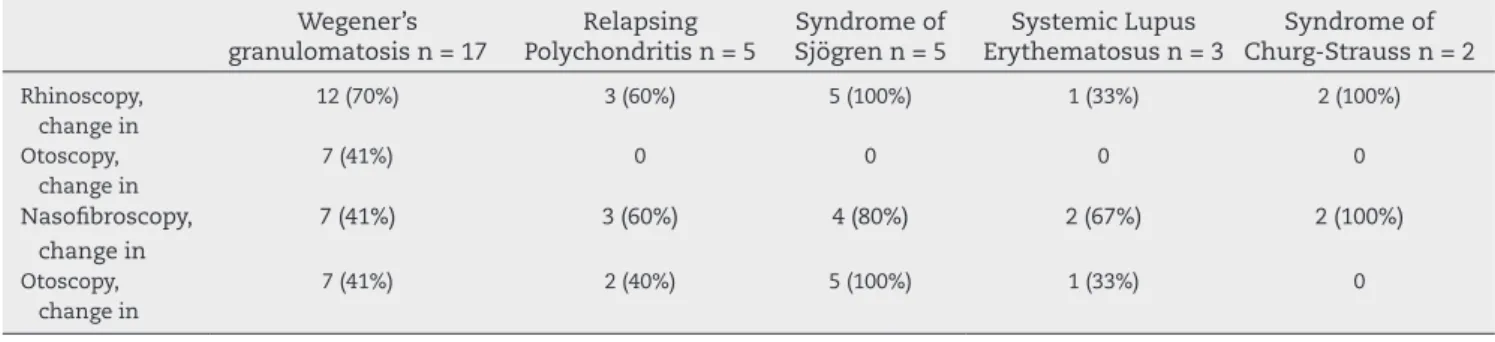
In the evaluation of all the symptoms studied by region, all SS patients reported the presence of at least one otologic or nasal symptom, and also had audiometric change. Laryn-geal symptoms were more frequent in patients with SLE, being present in two patients (66%) (Table 4); however, patients with SLE were those with fewer ear and nasal symptoms, or with
audiometric changes. These conditions were present in only one patient (33%) (Tables 5 and 6).
The audiometric changes (indicated in Table 6) found were de-scribed as sensorineural hearing loss (SNHL), conductive hearing loss (CHL) or mixed hearing loss (MHL). In the case of SNHL, the following distribution was observed: 29% of WG, 60% of PR, 20% of SJ, 33% of SLE and 0% of CSS. With MHL, no cases were observed. On the other hand, for CHL another distribution was observed: 23% of WG, 20% of PR, 80% of SJ, 33% of SLE and 50% of CSS.
Discussion
ENT manifestations in autoimmune diseases represent a di-agnostic challenge for the rheumatologist, otolaryngologist and clinician.1,5,15,24,25 Generally, ENT symptoms may represent
an early sign of an undiagnosed autoimmune disorder that often requires an immediate and aggressive immunosup-pressive treatment.25-29 There are diseases of systemic action
that present themselves with localized manifestations, and the region of the head and neck is an important site of these manifestations.5
Ear damage have been occasionally reported as a com-plication in the course of several rheumatic diseases.8,30 It is
common, for example, to ind sensorineural hearing loss with decreased hearing acuity or discrimination of sounds. Uni- or bilateral sensorineural hearing loss affecting medium and high frequencies have been reported in patients with SLE, and there is evidence of a strong association between hearing loss and Table 2 – Presence of nasal signs and symptoms
Wegener’s granulomatosis n = 17
Relapsing Polychondritis n = 5
Syndrome of Sjögren n = 5
Systemic Lupus Erythematosus n = 3
Syndrome of Churg-Strauss n = 2
Relapsing polychondritis
11 (65%) 2 (40%) 5 (100%) 1 (33%) 1 (50%)
Nasal obstruction
10 (59%) 2 (40%) 2 (40%) 1 (33%) 1 (50%)
Rhinorrhea 6 (35%) 0 4 (80%) 0 1 (50%)
Nasal itching 6 (35%) 0 2 (40%) 0 1 (50%)
Hyposmia 2 (12%) 0 0 0 0
Anosmia 1 (6%) 0 0 0 0
Cacosmia 5 (29%) 0 1 (20%) 0 1 (50%)
Postnasal drip 7 (41%) 2 (40%) 1 (20%) 0 2 (100%)
Table 3 – Aerodigestive pathways/pharyngal symptoms Wegener’s
granulomatosis n = 17
Relapsing Polychondritis n = 5
Syndrome of Sjögren n = 5
Systemic Lupus Erythematosus n = 3
Syndrome of Churg-Strauss n = 2
Dysphonia 3 (14%) 1 (20%) 2 (40%) 2 (67%) 1 (50%)
Cough 4 (23%) 2 (40%) 0 0 1 (50%)
Snoring 0 0 0 0 0
Foreign body sensation
1 (6%) 2 (40%) 0 0 0
Dysphagia 0 0 0 0 0
Odynophagia 0 0 0 0 0
Dyspnea 6 (35%) 1 (20%) 0 1 (33%) 1 (50%)
Hemoptysis 1 (6%) 0 0 0 1 (50%)
Hawk 7 (41%) 2 (40%) 3 (60%) 0 1 (50%)
Heartburn 1 (6%) 1 (20%) 2 (40%) 0 0
elevated titres of anticardiolipin antibodies. A sensorineural hearing loss in the course of Sjögren’s syndrome (SS) is partly attributed to the presence of high titres of those antibodies.4
A sudden or gradual hearing loss may occur in about 50% of patients with recidivant polychondritis, and both in these as in patients with WG, a conductive hearing loss is the main oto-logic damage. According to literature, audiovestibular deicits are uncommon in patients with CSS.4 According to the indings
of this trial, ear manifestations in the patients studied conirm the literature data, maintaining statistical similarity.
In literature we ind data on vestibulocochlear system in-volvement by vascular lesions in the internal auditory artery, causing sensorineural dysacusis in addition to symptoms such as dizziness and tinnitus. According to the authors, the little mention of vestibular symptoms is due to the fact that the gradual involvement of the vestibular system promotes labirynthic compensation.31
Laryngeal involvement is extremely rare and the symp-toms can range from hoarseness to respiratory distress.32
Smith et al. published two cases with cricoarytenoid ulcer-ation, stenosis and oedema. Kraus and Guerra-Bautista pub-lished a case with complete vocal fold paralysis in 1990. Tietel et al. published, in 1997, a review of cases of laryngeal involve-ment in SLE, in which laryngeal oedema occurred in 28% of cases and vocal paralysis in 11%.32
Allergic rhinitis is often present in patients with Churg-Strauss syndrome.4 Symptoms such as nasal itching, airlow
obstruction, coryza and recurrent sinusitis are common man-ifestations in CSS, GW and PR.9,33 In general, Churg-Strauss
syndrome is characterized by asthma, eosinophilia, and ex-travascular eosinophilic granulomata. Also, as part of the clin-ical manifestations of CSS, the irst phase of this syndrome is characterized by asthma possibly associated with allergic rhi-nitis, and often complicated by nasal polyposis and recurrent rhinosinusitis.9 The other phases are manifestations of
eo-sinophilia and/or eosinophilic iniltrates in the tissues (lungs, gastrointestinal tract) or of systemic vasculitis.
In the available literature, three stages of the natural his-tory of CSS are described: (1) prodromal stage, characterized by asthma and allergy for several years, (2) eosinophilic stage with peripheral blood eosinophilia and an organic iniltrate that can decrease or increase over several years, and (3) sys-temic vasculitis stage, that can be life threatening.30 Still, the
main feature of ENT manifestations in this disease is an al-lergic rhinitis associated with nasal polyposis.30,33 According
to Bacciu et al., allergic rhinitis is present in 42.8% of CSS pa-tients studied.9
According to literature, in patients with GW, the respira-tory tract is involved in 70-100 % of cases, with nasal and pa-ranasal involvement in 80-90 % of cases.4,25,33,34 Chronic nasal
obstruction with a clear rhinorrhea, nasal ulceration and oe-dema of the mucosa, besides perforation, erosion of the vo-mer and nasal deformity with “saddle nose” are classic signs of the disease. We can also observe cases of chronic secretory otitis media and tympanic membrane perforation, in addi-tion to the cases described of sensorineural dysacusis, vertigo and tinnitus.4,25,33,34 The prevalence of otologic involvement is
around 35 %, being related to vasculitis and blockage of the Table 4 – Other head and neck signs and symptoms
Wegener’s granulomatosis n = 17
Relapsing Polychondritis n = 5
Syndrome of Sjögren n = 5
Systemic Lupus Erythematosus n = 3
Syndrome of Churg-Strauss n = 2
Conjunctivitis 0 1 (20%) 2 (40%) 0 1 (50%)
Headache 3 (18%) 1 (20%) 0 0 1 (50%)
Facial paralysis 0 0 0 0 0
Table 5 – Findings of ENT physical examination Wegener’s
granulomatosis n = 17
Relapsing Polychondritis n = 5
Syndrome of Sjögren n = 5
Systemic Lupus Erythematosus n = 3
Syndrome of Churg-Strauss n = 2
Rhinoscopy, change in
12 (70%) 3 (60%) 5 (100%) 1 (33%) 2 (100%)
Otoscopy, change in
7 (41%) 0 0 0 0
Nasoibroscopy, change in
7 (41%) 3 (60%) 4 (80%) 2 (67%) 2 (100%)
Otoscopy, change in
7 (41%) 2 (40%) 5 (100%) 1 (33%) 0
Table 6 – Otologic, nasal, and laryngal symptoms and audiometric change in the studied diseases Otologic symptoms Nasal
symptoms
Laryngeal symptoms
Audiometric change
Wegener’s Granulomatosis 9 (53%) 11 (65%) 7 (41%) 9 (53%)
Relapsing Polychondritis 3 (60%) 2 (40%) 2 (40%) 4 (80%)
Sjögren’s Syndrome 5 (100%) 5 (100%) 3 (60%) 5 (100%)
Systemic Lupus Erythematosus 1 (33%) 1 (33%) 2 (67%) 1 (33%)
Eustachian tube due to the involvement of nasopharynx.4,25,33,34
Facial palsy is found in 8-10% of cases and results from vascu-litis offacial nerve vasa-vasorum, granulomatous invasion of middle ear tissue, primary granulomatous lesion of the nerve, or a combination of these factors.4,25,33,34 Dysphonia, larynx
stridor, wheezing, oral ulceration and oedema and gingivitis complement the picture of ENT manifestations.4,25,33,34
It is also worth remembering the important complica-tions and cardiovascular events in SLE, with risk of fatal complications.35 In a transversal trial conducted at Hospital
Universitário Barros Barreto (HUJBB/UFPA) during 1997-2006, the main complication in SLE patients was the infectious syndrome (76.4%), followed by renal (33.8%) and thromboem-bolic (4.2%) events.36 The main sites of infection were pleura
and lungs (45.4%). The middle ear infection represented 1.8% of the cases.36 On the other hand, as a well-documented
com-plication, we can ind nasal septum perforation (which can manifest with nasal obstruction , epistaxis, posterior nasal discharge or crust formation into the nasal cavity), being at-tributed to local inlammation or ischemia.1 Upper airway
obstruction due to laryngeal involvement is a rare, but well documented, complication of SLE, which usually occurs in association with other signs and symptoms that indicate ac-tive disease.1
Data from the literature show auricular chondritis as the most frequent and characteristic inding of the disease, pres-ent in 85% of cases, and in 40% of them as the initial mani-festation.8 This condition may be uni- or bilateral, causing
phlogistic signs, with swelling of the external ear canal, and that may lead to conductive hearing loss. Vasculitis of the in-ternal auditory artery may cause cochlear and/or vestibular involvement by cochlear infarct or ischemia, resulting in sen-sorineural dysacusis.8 Moreover, among the seven diagnostic
criteria established by McAdam et al., four of them involve the presence of symptoms that affect the upper respiratory tract or vestibulocochlear system.37
Nasal compromise, arising from nasal chondritis, can re-sult in a “saddle nose” in up to 50% of patients. The diagnosis of laryngo-tracheo-bronchial chondritis is also crucial due to its high morbidity and mortality.8
Xerostomia is a common feature of Sjögren’s syndrome, being usual in patients with primary and secondary syn-drome.38 It is the most obvious symptom of this syndrome.36
Patients often exhibit dryness of lips, tongue and pharynx and consequent painful burning sensation and of mucosa, accompanied by speech, chewing, swallowing and digesting food dificulty.32 More than one third of patients present
sys-temic manifestations that can include vasculitis, cryoglobu-linemia, autoimmune hepatitis, pulmonary ibrosis, central nervous system involvement, renal tubular acidosis, B-cell lymphomas and multiple myeloma.33
Other trials showed oral symptoms of dry mouth in 86% and eye symptoms in 53% of patients.39 In the same trial,
46% of patients exhibited ocular involvement, demonstrated by Schirmer test or by Rose Bengal staining; and in 85.7% of studied cases an involvement of the salivary gland (by scin-tigraphy, sialography or sialometry) was evidenced.39 The
lit-erature review shows that the most obvious oral symptom is xerostomia, with dryness of lips, tongue and pharynx and with chewing, swallowing and speech dificulty, as well
as increased susceptibility to dental caries and periodontal disease.36 About a third to half of patients display an usually
symmetrical and recurrent parotid gland hypertrophy.40
Finally, we must consider the large time lag between com-plaints of rheumatology patients and the correct diagnosis, already described. The vasculitis involving the airways, for example, is a common presentation of a vascular disease involving ANCA (anti-neutrophil cytoplasmic antibody) and can precede by several years the diagnosis of the disease.33
One should keep in mind that the referral of patients for this trial occurred unevenly among speciic rheumatology outpatient clinics, according to the aforementioned rheu-matologic diseases; then, the patients’ distribution does not represent the overall distribution of patients with rheumatic diseases.
Conclusion
This trial demonstrated the various ENT manifestations of a group of patients with rheumatologic diseases that common-ly can be related to rheumatic diseases, according to other trials. The early identiication of these symptoms as a mani-festation of such diseases, both by the otolaryngologist as by the rheumatologist, is critical to the early implementation of an immunosuppressive treatment, thereby reducing the mor-bidity and mortality of these conditions.
Conlicts of interest
The authors declare no conlicts of interest.
Acknowledgements
We thank all who contributed to the development of our proj-ect at the Rheumatology and Otorhinolaryngology, Head and Neck disciplines at HC/FCM/UNICAMP.
R E F E R E N C E S
1. Riera R, Ciconelli RM, Ferraz MB. COPCORD studies. Acta Reumatol Port. 2006;31:119-23.
2. Gonzalez-Gay MA, García-Porrua C. Etiopatogenia y clasiicación e las vasculitis sistémicas. In: Alonso Ruiz A,
Alvaro-Gracia Alvaro JM, Blanch i Rubio J et al. (Ed.) Manual
SER de enfermedades reumáticas. 3 ed., Madrid: Médica Panamericana. 2000. p. 349-54.
3. Bogas M, Afonso MC, Araújo D. Non-steroidal anti-inlammatory drugs and lower intestinal tract toxicity.Acta Reumatol Port. 2006;31:227-35.
4. Pereira DB, Amaral JLA, Szajubok JCM, Lima SMAL, Chahade WH. Otorhinolaryngologic manifestations of autoimmune rheumatic diseases. Rev Bras Reumatol. 2006;46:118-25. 5. Papadimitraki ED, Kyrmizakis DE, Kritikos I, Boumpas DT.
Ear-nose-throat manifestations of autoimmune rheumatic diseases. Clin Exp Rheumatol. 2004; 22:485-94.
6. Oliveira R, Banha J, Martins F, Paixão E, Pereira D, Barcelos F
7. Mosiniak-Trajnowicz K, Lis-Ritkiewicz M, Rutkiewicz B, Ginter K. Polychondritis relapsans – a case report. Otolaryngol. Pol. 2006;60:951-53.
8. Carvalho GM, Sachietto Z, Bertolo MB, Gusmão RJ.
Policondrite recidivante e dispneia. Relato de caso. Rev Bras Clin Med. 2011;9:451-54.
9. Bacciu A, Bacciu S, Mercante G, Ingegnoli F, Grosseli C, Vaglio A et al. Ear, nose and throat manifestations of Churg-Strauss syndrome. Acta Otolaryngol. 2006;126:503-09.
10. Ruckenstein MJ, Prasthoffer A, Begelow DC, Von Feldt JM, Kalasinski SL. Immunologic and serologic testing in patients with Ménière’s disease. Otol. Neurotol. 2002;23:517-20. 11. Tsunoda K, Akaogi J, Ohya N, Murofushi I. Sensorineural
hearing loss as the initial manifestation of polyarteritis nodosa. J. Otolaryngol. 2001;115:311-12.
12. Hearth-Holmes M, Baethge BA, Alreo F, Wolf RE. Autoimmune exocrinopathy presenting as recurrent parotitis of childhood. Arch. Otolaryngol Head and Neck Surgery.1993;119:347-49. 13. Camilleri AE, Swan IR, Murphy E, Sturrock RD. Chronic otitis
media: a new extra-articular manifestation in ankylosing spondylitis? Ann Rheumatol. Disease. 1992;51:655-57. 14. Tutuncu Z, Kavanaugh A. Rheumatic disease in the elderly:
rheumatoid arthritis. Rheum Dis Clin N Am. 2007; 3:57-70. 15. Silva C, Canhão H, Barcelos A, Miranda L, Pinto P, Santos MJ.
Protocol for evaluation and monitoring of Systemic Lupus Erythematosus (PAMLES). Acta Reumatol Port. 2008;33:210-18. 16. Vinagre F, Santos MJ, da Silva JC. Systemic lupus
erythematosus and weakness. Acta Reumatol Port. 2006;31:167-72.
17. Silva L, Sampaio L, Terroso G, Almeida G, Lucas R, Rios E et al. Amyloidosis secondary to rheumatic diseases - 16 cases. Acta Reumatol Port. 2010;35:518-23.
18. Jennete JC, Falk RJ, Bacon PA, Basu N, Cid MC, Ferrario F et al. 2012 Revised International Chapel Hill Consensus Conference Nomenclature of Vasculitides. Arthritis Rheum. 2013;65:1-11. 19. http://www.projetodiretrizes.org.br/projeto_diretrizes/073.
pdf. Acessado em 28 de janeiro de 2011.
20. Masi AT, Hunder GG, Lie JT, Michel BA, Bloch DA, Arend WP
et al. The American College of Rheumatology 1990 criteria for the classiication of Churg-Strauss syndrome (allergic
granulomatosis and angiitis). Arthritis Rheum. 1990;33:1094-100.
21. Leavitt RY, Fauci AS, Bloch DA, Michel BA, Hunder GG, Arend WP et al. The American College of Rheumatology 1990 criteria for the classiication of Wegener’s granulomatosis. Arthritis Rheum. 1990;33:1101-7.
22. Vitali C, Bombardieri S, Jonsson R, Moutsopoulos HM,
Alexander EL, Carsons SE et al. Classiication criteria for
Sjögren’s syndrome: a revised version of the European criteria proposed by the American-European Consensus Group. Ann Rheum Dis. 2002;61:554-8
23. Gergely P Jr, Poor G. Relapsing polychondritis. Best Pract Res Clin Rheumatol. 2004 Oct;18:723-38
24. Mourão AF, Oliveira I, Pinheiro MN, da Graça JP. Stroke as the dramatic presentation of infectious endocarditis: the
importance of the clinical history.Acta Reumatol Port. 2006;31:341-47.
25. Gomes JM, Gomes SM, Conde M. Autoinlammatory syndromes. Acta Reumatol Port. 2010; 35:146-54.
26. Graca L. CTLA4Ig and the therapeutic potential of T cell co-stimulation blockade.Acta Reumatol Port. 2008;33:267-76. 27. Mourão AF, Santos FP, Falcão S, Barros R, Pinto TL, Mendes A
et al. Is the response to anti-TNFalpha treatment inluenced by the presence of IgM rheumatoid factor, in Rheumatoid Arthritis patients?. Acta Reumatol Port. 2008;33:430-34. 28. Carmona L, Ortiz A, Abad MA. How good is to switch between
biologics? A systematic review of the literature. Acta Reumatol Port. 2007;32:113-28.
29. Gómez-Reino J, Carmona L. Recommendations to lower the risk of tuberculosis in patients treated with tumour necrosis factor alpha antagonists. Acta Reumatol Port. 2006;31:201-03. 30. George DL, Pradhan S. Idiopathic sensorineural hearing
disorders in adults – a pragmatic approach. Nat Rev Rheumatol. 2009; 5:505-12.
31. Zeigelboim BS, Jurkiewicz AL, Palmonari A, Alberti A, Filho AR, Ferrari KA. Otoneurological evaluation in women with systemic lupus erythematosus: a preliminary study. Arq. Int. Otorrinolaringol. 2006;10:126-31.
32. Palombo AAK, Nascimento GM, Filho FAS, Neto JC. Atroia de pregas vocais em paciente com lúpus eritematoso sistêmico: relato de caso. ACTA ORL/Técnicas em Otorrinolaringologia. 2010;2879-80.
33. Del Pero MM, Sivasothy P. Vasculitis of the upper and lower airway. Best Practice & Research Clinical Rheumatology. 2009;23:403-17.
34. Rezende CEB, Rodrigues REC, Yoshimura R, Uvo IP, Rapoport PB. Granulomatose de Wegener: relato de caso. Rev Bras Otorrinolaringol. 2003;69:261-65.
35. Santos MJ, Vinagre F, Silva JJ, Gil V, Fonseca JE. Cardiovascular risk proile in systemic lupus erythematosus and rheumatoid arthritis: a comparative study of female patients.Acta Reumatol Port. 2010;35:325-32.
36. Conde SRSS, Marçal AS, Tavares GF, Souza HCB, Vasconcelos VC. Complicações clínicas em pacientes portadores de lúpus eritematoso sistêmico. Rev. Para. Med.; 23, 2009.
37. Guimarães VC, Nery GV, Araújo FGM, Barbosa MA, Ferreira JB. Clinical manifestations of Relapsing Polychondritis: case report. Rev. Eletr. Enf. 2008;10:823-7.
38. Barcelos F, Patto JV, Parente M, Medeiros D, Sousa M,
Figueiredo R et al. Applicability of syalometry and other
instruments to evaluate xerostomia and xerophtalmia in a Sjögren’s Syndrome outpatient clinic.Acta Reumatol Port. 2009;34:212-18.
39. Liquidato BM, Filho IB, Camargo ACK, Soler RC. Aspectos do diagnóstico da Síndrome de Sjögren. Rev. Bras. Otorrinolaringol. 2002;68:363-67.