Verbal fluency in older
adults with low educational
level: what is the role of
executive functions and
processing speed?
Rev Bras Psiquiatr. 2013;35:440––442 doi:10.1590/1516-4446-2013-1118
Neuropsychological tests related to verbal fluency para-digms are among those most frequently used to assess executive functions in older adults. These tasks are quick and easy to administer and widely used for clinical assessment. However, despite their apparent simplicity, these tests involve different cognitive demands and are influenced by sociodemographic factors.1Two cognitive domains are particularly related to verbal fluency perfor-mance: executive functions and processing speed. Performance on these two cognitive domains declines with age and mediates the effect of other cognitive and demographic factors on verbal fluency scores.2 The objective of the present report is to investigate the contribution of executive functions and processing speed on category fluency performance. We hypothesize that these two cognitive domains will be related to test performance, suggesting that verbal fluency may not be used as a unidimensional measure of executive functions.
Letters to the Editor
440
Sixty older adults (37 women), with a mean age (standard deviation) of 74.08 (6.51) years and a mean duration of formal schooling of 4.42 (2.60) years took part in this study. Inclusion criteria included a Mini-Mental State Examination (MMSE) score above the cutoff for cognitive impairment based on education,3 a Geriatric Depression Scale score below the cutoff for depression, a Clinical Dementia Rating below 1, no history of psychia-tric disorders according to a clinical interview, and no severe perceptual or motor impairments. The participants provided informed consent for participation, and the study was approved by the university’s ethics committee (COEP-334/06).
The subjects completed a Category Fluency Test (‘‘Fruits’’, duration = 1 minute) and the Five Digit Test,4 a Stroop-like paradigm designed to avoid the effect of educational background. From this test, number-reading time (first test component) was used as a measure of processing speed, while errors on an inhibition/shifting task (fourth test component) were used as a measure of executive functions. Previous studies suggest this test is adequate for assessment of older adults.5,6
For statistical analyses, nonparametric data were normalized by logarithmic transformation. Partial correla-tions (controlling for age, gender, and education) were used to assess the relationship between cognitive measures. A stepwise multiple linear regression analysis assessed contributions of sociodemographic (age, edu-cation, and sex) and cognitive (executive functions and processing speed) factors on category fluency performance.
The mean five-digit reading time was 37.38 (14.18) seconds, and the mean number of five-digit shifting errors was 7.36 (7.19). Significant partial correlations were found between processing speed and category fluency (r = -0.427, p , 0.001) and executive functions and category fluency (r = -0.368, p = 0.005), but not between processing speed and executive functions (r = 0.166, p = 0.217). The MMSE total score was correlated with category fluency (r = 0.402, p = 0.002), executive functions (r = -0.330, p , 0.012), and processing speed (r = -0.313, p = 0.018). Geriatric Depression Scale scores were not associated with any cognitive
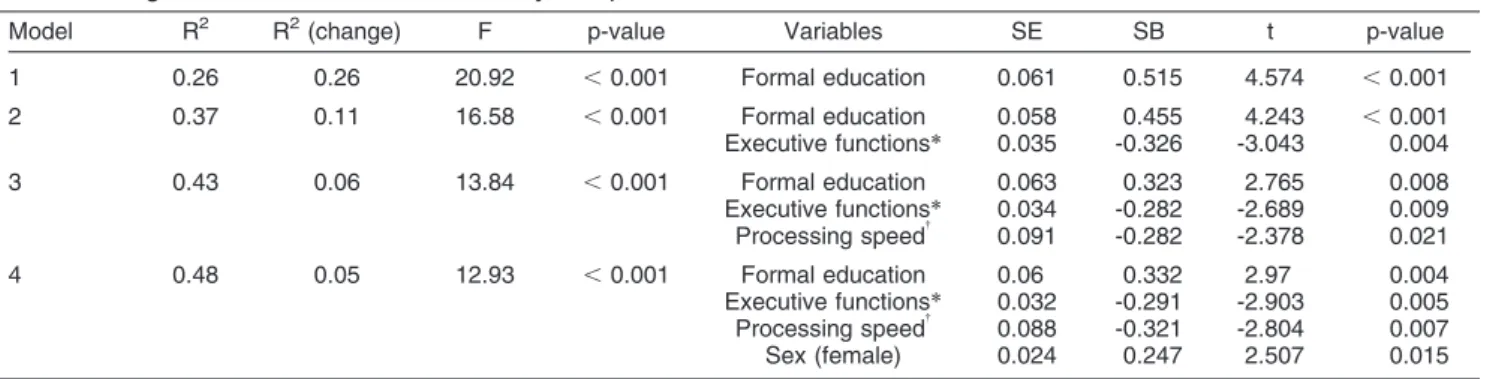
measure (all p.0.05). The stepwise regression model (Table 1) suggested four steps, with the best model involving formal education, executive functions, proces-sing speed, and sex (female), explaining 48% of total test variance. Age was not a significant predictor (p = 0.674). Figure 1 shows the standardized predictors of verbal fluency performance. A competing model designed to compare the step 2 (education + executive functions) was built with education and processing speed. This compet-ing model was significant (F = 11.84, p , 0.001, R2 = 27%), with education (b = 0.278, p = 0.028) and processing speed (b= -0.360, p = 0.005) as significant and independent predictors.
The results indicate that specific cognitive processes may contribute to verbal fluency test performance. In this sense, the test may be best suited as a general screening or global cognitive measure, and its adoption as a measure for executive functions must be approached cautiously, while estimating the effects of processing speed on test performance. Interestingly, age was not a significant predictor of performance in the model,
Figure 1 Scatterplot of predictors of verbal fluency test performance
Table 1 Regression models of verbal fluency test performance
Model R2 R2(change) F p-value Variables SE SB t p-value
1 0.26 0.26 20.92 ,0.001 Formal education 0.061 0.515 4.574 ,0.001
2 0.37 0.11 16.58 ,0.001 Formal education 0.058 0.455 4.243 ,0.001 Executive functions* 0.035 -0.326 -3.043 0.004
3 0.43 0.06 13.84 ,0.001 Formal education 0.063 0.323 2.765 0.008 Executive functions* 0.034 -0.282 -2.689 0.009 Processing speed{ 0.091 -0.282 -2.378 0.021
4 0.48 0.05 12.93 ,0.001 Formal education 0.06 0.332 2.97 0.004 Executive functions* 0.032 -0.291 -2.903 0.005 Processing speed{ 0.088 -0.321 -2.804 0.007 Sex (female) 0.024 0.247 2.507 0.015
SB = standard beta; SE = standard error.
*Measured by the Five Digit Test reading time.
{Measured by the Five Digit Test shifting errors.
Letters to the Editor 441
contradicting previous studies1. We hypothesize that this may reflect the cognitive aging theory,7 where age-related cognitive changes might be mediated by execu-tive functions and processing speed, a pattern corrobo-rated by our results. However, this hypothesis must be better investigated in larger and heterogeneous samples. Although the inclusion criteria minimize the risk of cognitively impaired participants, the present study did not use refined clinical or cognitive assessment to exclude other mild cognitive conditions, which may have influenced the results.
Jonas Jardim de Paula,1,2Danielle de Souza Costa,1,2 Laiss Bertola,1,2De´bora de Miranda,2,4 Leandro Fernandes Malloy-Diniz1,2,3
1Laboratory of Neuropsychological Investigations (LIN), School of
Medicine, Universidade Federal de Minas Gerais (UFMG), Belo
Horizonte, MG, Brazil.2National Science and Technology Institute
for Molecular Medicine, School of Medicine, UFMG, Belo Horizonte,
MG, Brazil.3Department of Mental Health, School of Medicine,
UFMG, Belo Horizonte, MG, Brazil.4Department of Pediatrics,
School of Medicine, UFMG, Belo Horizonte, MG, Brazil
Submitted Feb 24 2013, accepted Mar 27 2013.
Acknowledgements
De´bora Marques Miranda received a grant from the National Science and Technology Institute for Molecular Medicine (Fundac¸a˜o de Amparo a` Pesquisa do Estado de Minas Gerais [FAPEMIG] grant no. CBB-APQ-00075-09 and Conselho Nacional de Desenvolvimento Cientı´fico e Tecnolo´gico [CNPq] grant no. 573646/2008-2). Fernando Fernandes Malloy-Diniz received a grant from FAPEMIG (grant no. APQ-01972/12-10, APQ-02755-10).
Disclosure
The authors report no conflicts of interest.
References
1 Knight RG, McMahon J, Green TJ, Skeaff CM. Regression equations for predicting scores of persons over 65 on the Rey Auditory Verbal Learning Test, the mini-mental state examination, the trail making test and semantic fluency measures. Br J Clin Psychol. 2006;45: 393-402.
2 Salthouse TA. Decomposing age correlations on neuropsychological and cognitive variables. J Int Neuropsychol Soc. 2009;15:650-61. 3 Brucki SM, Nitrini R, Caramelli P, Bertolucci PH, Okamoto IH.
[Suggestions for utilization of the mini-mental state examination in Brazil]. Arq Neuropsiquiatr. 2003;61:777-81.
4 Sedo´ MA. FDT –– Test de los cinco digitos. Madrid: TEA Ediciones; 2007.
5 de Paula JJ, Costa DS, Moraes EN, Nicolato R, Sedo´ M, Malloy-Diniz LF. Automatic and controlled attentional processes in amnestic mild cognitive impairment: the use of a mini-verbal test. Psych. 2012;3:379-83.
6 de Paula JJ, de Avila RT, de Souza Costa D, de Moraes EN, Bicalho MA, Nicolato R, et al. Assessing processing speed and executive functions in low educated older adults: the use of the Five Digits Test in patients with Alzheimer’s disease, mild cognitive impairment and major depressive disorders. Clin Neuropsychiatry. 2011;8:339-46. 7 Salthouse T. Consequences of age-related cognitive declines. Annu
Rev Psychol. 2012;63:201-26. Letters to the Editor
442