THE VALUE OF A PERSONAL BRAND IN THE ELECTIONS. THE
QUANTITATIVE ANALYSIS FOR ELECTION LAWS APPLIED IN LOCAL
ELECTIONS IN ROMANIA
GHIU
ȚĂ
OVIDIU-AUREL
PhD Senior Lecturer
Ș
tefan cel Mare University of Suceva, România
[email protected]
Abstract
This paper analyses the concepts of brand equity and brand value as found in the professional scientific literature and proposes an innovative research approach of the brand value of uninominal candidates running in the local elections in Romania in 2012 or of any other candidates that run in similar elections in terms of voting procedures.
The originality of the paper consists in the fact that we have created a formula that will be used to measure the brand equity of these candidates depending on the results obtained by the party whose candidate is running in the elections, as compared to the other candidates and the other parties.
This paper presents the methodology used to validate these formulae for measuring the theoretical score that should have been reached by a party’s candidate whose brand equals zero. In order to identify the contribution of the candidate’s brand to the respective result in our future research, we will make the difference and calculate the ratio between the real score and this theoretical score for a null personal brand.
The present research, conducted from a positive perspective, resorts to a behavioural approach that allowsfor the measurement of the personal brand of candidates running for elections in certain electoral systems. This research is valuable for professionals as well as one can identify the candidates that are unsuitable for future elections, since a negative brand equity, accompanied by increased awareness (reached during the most recent elections, at the latest) can hardly be turned into a positive image. Moreover, this analysis can be used in the internal assessments conducted by each political party after elections.
Key words:brand value, brand equity, brand value in politics, political brand
Clasificare JEL:
1.
Introduction
“In today’s competitive world, brands are tools for promoting adding values to products and also are one of the most valuable assets of an enterprise. Brand aid create value for customers and organizations, and illustrate reasons why of paying more for purchasing goods or services.” [1].
At present, the market value of a company does not consist in the book value of the investments made, of the plant, machinery or employees, but in the value of its shares on the Stock Exchange (immediate term), and particularly in the value of that company’s brand (average term). One example is the market capitalization of Nokia when it was purchased by Microsoft ($ 7.46 bill.), which was almost identical to the Nokia brand evaluation (in the Interbrand top $ 7.444 bill.).One of the objectives of this research is to calculate the brand equity of a candidate, a variable that influences the value of a brand (highly strong positive correlation between brand equity and brand value).
Social sciences use three main epistemological paradigms: the positivist paradigm, the interpretive paradigm and the constructivist one. The clear distinction between the three is made by Thiétard: “The positivist project is to explain reality; for interpretive systems it is to understand it most of all and, for constructivists, the construction of this reality would be essential” [13]. If reality is objective for positivists, for interpretive and constructivist researchers, “the social world is made up of interpretations. These interpretations are built on the interactions between the actors, always in particular contexts. (...) Therefore, in a positivist approach, the researcher will unveil the laws governing social actors. In an interpretive approach, researchers will try to understand how these actors build the meaning they give to social realities. In a constructivist approach, researchers will contribute to the construction of social reality alongside the actors.” [13].
candidates that have benefitted from the support of a political party.
2.
The concept of brand equity and brand value
Researchers have different interpretations for the concept of brand equity. Some define it as added value, brand loyalty, assisted awareness, brand awareness, added utility, attitude changes caused by the brand and so on [1].
The definitions of this relatively new concept may sometimes appear heterogamous at first glance, but they encompass several common standpoints and have a high level of complementarity. The differences we are referring to are rather technical than conceptual and they refer to measuring brand equity: “... however, this research is far from being unanimous. The main disagreement is to be found in terms of abstraction and measuring brand values” [4].
We will further discuss two important concepts: brand equity and measuring it in terms of brand value. The concept of “brand value” is an extremely important current concern, not only for researchers, but particularly for professionals in the field. This standpoint can be backed by a paper published in August 2014 in The Economist, which makes reference to the different outcomes obtained as brand value measurements depending on the technical differences and also how brands can be interpreted as intangible asset in accounting. The paper focuses on the value of such brands listed in the annual rankings published by Brand Finance, Interbrand and Milord Brown [16].
Brand equity is a consequence of the brand, and band value refers to its financial value i.e. its market value. As stated above, the current brand value can equal the market value of the entire company (share value). However, the market capitalization of a company also takes into account other tangible and intangible assets. An article in The Economist also made reference to including brand value in accounting as intangible asset, but it also mentioned the difficulties met in implementing this idea on a global scale. The main weakness that has not yet been addressed is the high volatility of this brand equity.
The first definition if brand equity is provided by the Marketing Science Institute in 1988, according to (Leuthesser, 1988): “the set of associations and behaviours on the part of the brand’s consumers, channel members, and parent corporation that permits the brand to earn greater volume or greater margins than it would without the brand name and that gives the brand a strong, sustainable, and differentiated advantage over competitors”[apud 8] and brand equity is the “added value that a brand conveys to a products” (Farquhar, 1990) [apud 8].
Keller’s point of view is also important in terms of brand equity. Keller is a world renowned researcher and practitioner in the field who suggested the following definition in 1993: brand equity is a set of associations created between the characteristics of a brand and the benefits perceived by its customers [10]. However, in 2009, he mentions the various standpoints related to the concept: brand equity “has been defined in various ways, according to the targeted objective, thus creating certain confusion. A common vision could not be formulated in terms of its conceptualization and measurement” [10].
“The different meanings of the concept that are present in the MSI definition are integrated in all approaches, but are conceptualized in different ways, either as brand equity per se, or as its precedent or consequence. However, the relationships between these concepts are the object of a consensus. Thus, it appears that brand equity is actually not a specific concept, but a general conceptual framework of the value of a brand” [2]. The approach we have chosen to analyse the results of the elections urges us to consider brand equity as a consequence of the brand that will convey value to it. Thus, we will briefly analyse the conceptof brand value as well.
Aaker and Joachimsthaler (2000) believe that brand equity consists of for large dimensions: perceived quality, brand loyalty, brand awareness and brand associations [apud 1].
Brand value consists in its input or how brand equity turns into financial value: “Brand value and brand equity represent two different, yet intricately linked, concepts. Brand value is the net present value of future cash flows from a branded product minus the net present value of future cash flows from a similar unbranded product—or, in simpler terms, what the brand is worth to management and shareholders. Brand equity is a set of perceptions, knowledge and behaviour on the part of customers that creates demand and/or a price premium for a branded product—in other words, what the brand is worth to a customer. Brand equity may also be defined as a set of elements such as brand associations, market fundamentals and marketing assets that help distinguish one brand from another. While measuring brand value has its usefulness, the act of measurement by itself will not make a brand more valuable or less risky. Quantifying and managing brand equity, however, using a customized measurement model, is critical to transferring value to the corporation’s shareholders” [15].
It is very important to make a difference between the terms of brand equity and brand value, because there are researchers and practitioners who use these terms interchangeably. Brand equity can be defined as a consumer’s behaviour towards one brand as compared to a products that lacks a brand image(Faircloth et al., 2001 apud [12]) or the effects or results a branded product has as opposed to an unbranded product (Simon and Sullivan, 1993, apud [12]) while Raggio and Leone define brand equity as “theperception or desire that a brand will meetits promise of benefits.” [13]. Raggio and Leone believe that brand value is close to its financial value. [12].
are precedents of brand equity, while the consumer’s general attitude towards the brand, the purchase intention and brand loyalty are its consequences [9].
The value of brand equity is important for companies from several standpoints: “Brand value is important at two levels. At the macro or firm level, it affects the perception of investors and financial analysts, and subsequently plays a role in determining the stock prices of firms (Simon and Sullivan, 1993). At the micro or consumer level, it positively affects behavioural outcomes, including purchase intent (Cobb-Walgren et al., 1995). As such, brand building has received urgent attention in many firms and attracted a substantial share of corporate resources in the process (Keller, 2003)” [3].
There is no consensus in the technical appraisal of brand value and as proof we have the simultaneous and notable presence of several financial rankings of the most valuable brands in the world.
In the present political context, we are not concerned with financial objectives or any measurement of the disclosed financial gains. Moreover, in terms of personal branding, it cannot be purchased or turned into a financial value in the political arena. Since voters have the same purchasing power that equals one vote, we can argue that the brand value in politics is expressed in votes, rather than financial capital. Each candidate has a brand equity and this can be turned into votes or not. The candidate may have a high brand equity, but if they fail to mobilize their voters, then the latter will not vote in the elections and the candidate will then fail to benefit from their brand equity. And, since the voter/consumer has a very short period during the elections to dispose of their financial capital (the vote), the candidate who fails to mobilize his/her voters will have to wait for the next elections in order to turn their brand equity into brand value. Thus, the analysis we will conduct in the following pages refers to brand equity value.
3.
Methodology and constraints
During the same election process, the elector in the voting booth will be given 4 ballots for: electing the mayor, the city council, the chairman of the county council and the county council.
In terms of constraints, our analysis cannot be applied to all election systems, but it can be applied to elections that take place simultaneously: votes cast on the same day for the party and for the party candidate. Therefore, the method used for calculating the brand equity of a uninominal candidate can be applied to other electoral systems that have the same type of elections.
As reference, we have selected the annual rankings made by Interbrand and Millword Brown Optimor for the brands with the highest value on an international scale. If the methodology provides that each ranking has its own variables with distinct weight factors, in our research we will use a single variable, the market share (percentage in the elections).
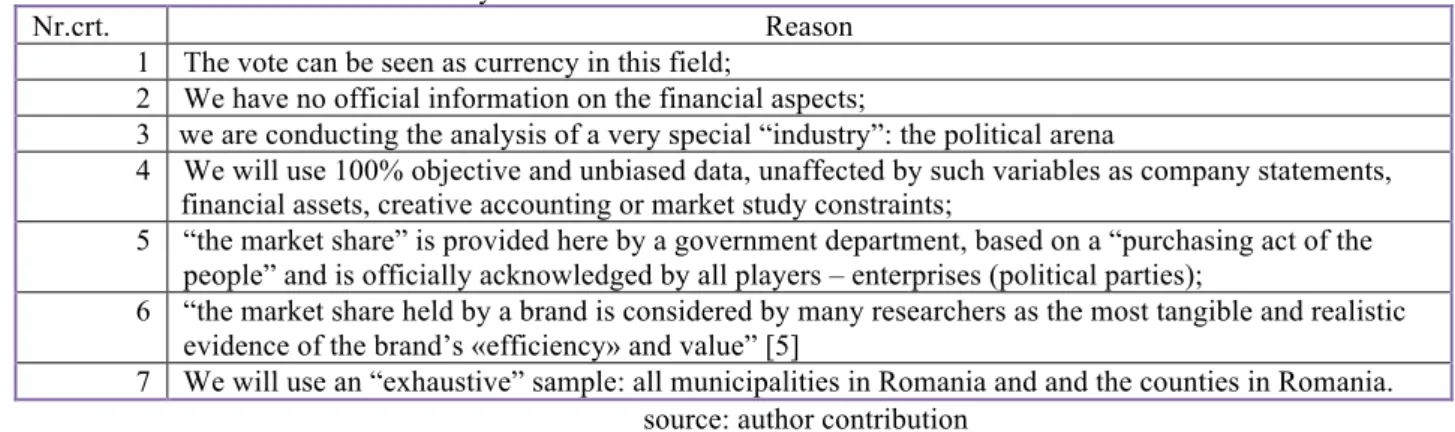
The reasons why we have selected only the results in the elections as a variable for calculating a candidate’s brand value are listed in Table 1:
Table 1. Reasons why the brand value is calculated based on the results in the elections
Nr.crt. Reason
1 The vote can be seen as currency in this field;
2 We have no official information on the financial aspects;
3 F we are conducting the analysis of a very special “industry”: the political arena
4 We will use 100% objective and unbiased data, unaffected by such variables as company statements, financial assets, creative accounting or market study constraints;
5 “the market share” is provided here by a government department, based on a “purchasing act of the people” and is officially acknowledged by all players – enterprises (political parties);
6 “the market share held by a brand is considered by many researchers as the most tangible and realistic evidence of the brand’s «efficiency» and value” [5]
7 We will use an “exhaustive” sample: all municipalities in Romania and and the counties in Romania. source: author contribution
The selection criteria for assessing a candidate’s brand: ‐ Participant in the local elections in Romania in 2012;
‐ The candidate’s party has earned more than 10% on a national level and we are here referring to USL [USL – the Liberal Social Union made up of PSD (Social Democrat Party), PNL (Liberal National Party)], PDL (as part of ARD or alone) [PDL (Liberal Democrat Party); ARD (Right Romania Alliance)]and PPDD (Dan Diaconescu People’s Party).
Mention must be made of the fact that the value of a brand is volatile (and here we have consensus among researchers in the field). The values that will be shown in our analysis are only valid for the time when the elections took place.
would be the equivalent of a trade mark. There are no direct sales and purchases of the brand in this case, since there are no trademarks here in terms of legal concerns.
We will measure the brands of the candidates for the first three parties, but we will also take into account the brand of the candidates from the other parties or the brands of independent candidates. The results of the candidates from the other parties have a direct impact on the measurement of the brands of candidates from the important parties, but the results of independent candidates are not included in this analysis. We will not analyse the brand of the candidates belonging to the parties that have had a percentage lower than 10% in the national elections or the brands of independent candidates, but the results of the other candidates or parties are, however, used in this analysis, as can be seen in the employed formulae.
Four local elections have taken place on the same day in Romania: for mayor, for chairman of the county council, for the city council and for the county council. Elections for councillors are on party lists or individual lists for independent candidates. In contrast, elections are uninominal for the mayor and for the chairman of the county council. Candidates generally benefit from the support of a party or of a group of parties. Elections for Mayor and those for chairman of the county council are won by the best result in the uninominal elections with a single round (exhaustive ballot). All the terms of these elections extend for a period of four years.
On June 10th, 2012, each voter in Romania received four ballots. We are talking here about the same voters who went to voting booths and voted in all elections. Technically speaking, there was a single voters list for all elections, and the voter signed once for his presence and for receiving the four ballots.
We have measured the value of a candidate’s brand as individual value (the results of the elections already gave us the aggregate value of the elected “finished product/service”), from the consumer’s standpoint and behaviour. We opted for a behavioural approach due to the difficulties we have encountered in collecting attitude related data and especially in order to remove the bias from the respondent’s statements, thus working with 100% objective data. Note that perception and attitude related data are very costly (in terms of human and financial resources). Moreover, an attitude and perception based approach would have certain weaknesses, such as response honesty, since the vote and the political attitudes and preferences are still a taboo subject for most citizens.
It is important to mention that there is a very strong direct relationship between perceptions and choice; the behavioural or attitude based approach used to measure brand equity is to be preferred, depending on the targeted objective [10].
However, there is an important difference between the two approaches: if measuring brand value through attitudes is relevant for a long period of time, the behavioural approach will convey the value of a brand at a certain moment. However, in politics, and for at least four years, attitude (which is a more stable variable that choice) can undergo important changes. In this particular field – politics – behaviour is the one that matters on a specific day which is elections day. This is another reason why we have embraced a behavioural approach in order to measure a candidate’s brand value.
We believe that the behavioural approach provides a measurement basis for brand value in politics, while an attitude and perception based approach can provide information on a candidate’s brand equity.
Thus, we would like to stress again the idea that the present research conducts the measurement of a candidate’s brand value and not of their brand equity.
Table2. Research strengths and constraints
Strengths Constraints
The analysis is innovative in politics and the field of human brands
The research is based on decisions (purchase choice), even though most studies are based on preferences, thus measuring the brand equity before the consumer’s purchasing decision.
The data collection costs are null
There are no samples (this is an exhaustive study), even though most researchers have applied the model of formal samples, consisting of students and professors [4]
The analysis cannot be generalised for all elections, but only applied to elections being held simultaneously under the same system (vote for uninominal candidate of a party and vote for the party at the same time)
source: author contribution
4.
Analysis
The measurement of a candidate’s brand equity has been conducted in relation to the brand of the party. The party brand was taken into consideration because:
Party awareness is usually higher than candidate awareness;
The party brand is older (sustainability is one of the brand’s eight components) [6 and 7];
Elections for Mayors and chairman of the county council are uninominal, but the candidates are representatives of the parties, and the party has submitted their candidateship at the Electoral Board;
The party manages the candidates’ electoral campaign, even if the voting system is uninominal;
Each party already has its electoral pool;
We measure the value of a candidate’s brand, his personal contribution to the elections, and this input is believed to be the candidate’s brand equity value on the day of the elections.
Working hypotheses were needed in the analysis of a candidate’s brand value:
Working hypotheses(the candidate’s brand is the difference between the party co-brand plus candidate and party brand)
Working hypothesis 1. The measurement of the brand is based on the following hypothesis: a candidate that represents the party for uninominal elections will have the same score as the party (s)he represents in the case of a personal brads that equals zero.
Thus, we would be tempted to calculate directly the value of the candidate’s brand as the difference between their results and the results of the party. Unfortunately, this calculation would be erroneous, because:
A. Even though the number of voters is the same (even their identity), the total number of valid votes cast is different. We have noted a higher number of valid votes cast in uninominal elections (Mayor and chairman of the county council) as compared to the ones cast on the lists (city council and county council) Therefore, we should not relate to the votes but to the obtained electoral result.
B. There are parties or independent candidates who only ran for city or county council elections.
C. There are parties or independent candidates who only ran for Mayor’s office or county council. Therefore, even if voters who take part in these elections and receive four ballots are the same, the possible choices made by a voter are not the same.
Thus, in order to calculate the candidate’s brand value in the local elections of 2012 in Romania, we will have to introduce a theoretical variable called a theoretical result that is the result a uninominal candidate with a zero brand value should have reached. We will subsequently compare the real result obtained by a candidate with the theoretical one.
In order to calculate this theoretical result, we will have to correct the errors caused by the actual presence of the situations mentioned in B and C. We will therefore need a second working hypothesis:
Working hypothesis 2. The candidate for Mayor’s office will attract the voters of the parties that have ran for municipal elections but did not have a candidate for Mayor’s office, to the same extent as the result obtained by his/her party in relation to the other parties that did not have a running candidate for Mayor’s office. (similarly for the candidate running for chairman of the county council)
Working hypothesis 3. A candidate running for Mayor’s office and representing a political party, will not attract a share of the total valid votes cast but of the total valid votes cast for Mayor, minus the votes for independent candidates and other parties that have run only for Mayor’s office. (similarly for the candidates running for chairman of the county council)
* There are parties that have had a candidate for the Mayor’s office without presenting a list for the county council, but these are singular and arising from procedural errors (administrative or juridical) occurring when the lists for county council are submitted; the result is obtained by a candidate who has no equivalent in the list for county council. Therefore, we have considered that these candidates belong in the same category as independent candidates.
According to the above hypotheses, we can formulate the following equation:
1
1
(1
)
k m
c m
c q
j j
i
a
b
TVP
a
=
=
=
−
∑
∑
(1) c ∈ {1, 2, 3, ..., q}
where:
TVP – total votes for Mayor
ac – number of votes obtained by the party (with the candidate c for Mayor’s office) for local council aj – number of votes obtained by a party who had also candidate for Mayor’s office
im – result obtained by an independent candidate m or by a candidate m whose party did not have a list for council, running for Mayor’s office
c – are candidates from a party for the Mayor’s office,
m – are independent candidates or candidates whose party did not have a list for council, running dor Mayor’s office.
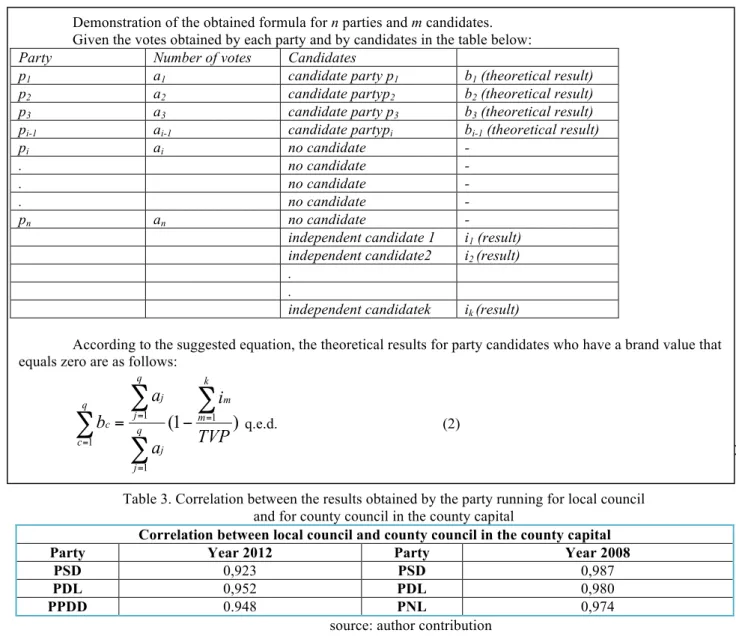
In order to select the result for the party as basis for the expected result of the candidate, we have moved beyond the logical explanations presented at this point and have also conducted statistical analyses of the available data. A strong correlation between the results of the party running for local council and for county council in the county capital is more than relevant, both for local elections in 2008 and for those that have taken place in 2012:
Table 3. Correlation between the results obtained by the party running for local council and for county council in the county capital
Correlation between local council and county council in the county capital
Party Year 2012 Party Year 2008
PSD 0,923 PSD 0,987
PDL 0,952 PDL 0,980
PPDD 0.948 PNL 0,974
source: author contribution
This also indicates that the citizens’ vote is not random and that they maintain their preference for a particular party both for the local council and for the county council.
5. Conclusions
The present research, conducted in a positivist paradigm, enables the measurement of the personal brand of the candidates running for elections in certain electoral systems. The created mathematical formula enables the measurement of the brand equity value for these candidates; this original research study is also valuable for practitioners as well, as it enables one to identify the unsuitable candidates for the next elections, since a negative brand equity, accompanied by high awareness (earned during the last elections, at the latest) can hardly be turned into a positive image. Moreover, this analysis can also be used in the internal assessment procedures run by political parties after the elections.
In order to identify the weight of the candidate’s brand in the obtained result in future research studies, we will make the difference and calculate the ratio between the real result and that theoretical result for a null personal brand.
In subsequent research endeavours, we will analyse the candidates’ personal brand equity value at the latest local elections in Romania in 2012. The research hypotheses include:
H1: The candidates’ personal brand weighs less in the result of the elections than the party brand. Demonstration of the obtained formula for n parties and m candidates.
Given the votes obtained by each party and by candidates in the table below:
Party Number of votes Candidates
p1 a1 candidate party p1 b1 (theoretical result)
p2 a2 candidate partyp2 b2 (theoretical result)
p3 a3 candidate party p3 b3 (theoretical result)
pi-1 ai-1 candidate partypi bi-1 (theoretical result)
pi ai no candidate -
. no candidate -
. no candidate -
. no candidate -
pn an no candidate -
independent candidate 1 i1 (result)
independent candidate2 i2 (result)
. .
independent candidatek ik (result)
According to the suggested equation, the theoretical results for party candidates who have a brand value that equals zero are as follows:
1 1
1
1
(1
)
q k
j m
q
j m
c q c
j j
a
i
b
TVP
a
= =
=
=
=
−
∑
∑
∑
∑
H2: The candidates’ brand weighs more in the elections for Mayor than in the elections for chairman of the county council.
H3: The candidate’s brand weighs more in the result in urban areas as compared to rural areas, where the weight of the political vote is higher.
H4: There are candidates who have won the elections for Mayor’s office in county capitals despite having a negative brand equity.
H5: There are candidates who have won elections for chairman to the county council despite their negative brand equity.
The results of the subsequent research will be important to see if a candidate with a very strong brand value will be enough to win the elections. Especially in the case of Romania, where now are developing two electoral blocks (right and left) the personal brand value of the candidate will be decisive in confrontations between the uninominal candidates of two electoral parties/alliances with strength almost equal.
ACKNOWLEDGMENT
This paper has been financially supported within the project entitled „SOCERT. Knowledge society, dynamism through research”, contract number POSDRU/159/1.5/S/132406. This project is co-financed by European Social Fund through Sectoral Operational Programme for Human Resources Development 2007-2013. Investing in people!
6. References
[1] Agahei, Mohammad et al., An examination of the relationship between Services Marketing Mix and Brand Equity Dimensions, 2nd World Conference on Business, Economics And Management – WCBEM 2013, Procedia – Social and Behavioral Sciences, 109, 2014, pp. 865-869;
[2] Changeur, Sophie, Le capital-marque: concepts et modèles, Cahier de recherché n°648, CEROG-IAE Aix-en-Provence, 2002, 28 pages;
[3] Chu, Singfat, Keh, Hean Tat, Brand value creation: Analysis of the Interbrand-Business Week brand value rankings, Market Lett, n°16, 2006, pp. 323-331;
[4] Czellar, Sandor et Denis, Jean-Emile, Un modèle intégrateur du capital-client de la marque: une perspective psycho-cognitive, Recherche et Applications en Marketing, vol. 17, n°1, 2002, pp. 43-56;
[5] Dimitriadis, Serge, Le management de la marque, Les Editions d’Organisation, Paris, 1994, p. 36
[6] Ghiuță, Ovidiu-Aurel, L’influence du brand sur le comportement de l’électeur, Éditions Universitaires Européennes, 2011;
[7] Ghiuță, Ovidiu-Aurel, Le « brand » n’est pas l’équivalent de la marque: essai sur des concepts majeurs en marketing, Les Annales Scientifiques de l’Université Valahia de Târgovişte, section sciences économiques, n°24, 2009, pp. 157-172;
[8] Jourdan, Philippe, Le capital marque: proposition d’une mesure individuelle et essai de validation, Recherche et Application en Marketing, vol.16, n°4, 2001, pp. 3-23;
[9] Kaouther, Znaidi, Chokri, El Fidha, A new formative measure of brand equity, Journal of Business Studies Quarterly, vol.3, n°1, 2011, pp.85-97;
[10] Keller, Kevin et alii, Management stratégique de la marque, 3e édition, Pearson Education, Paris, 2009, p. 30; [11] Keller, Kevin Lane, Conceptualizing, Measuring, and Managing Customer-Based Brand Equity, Journal of Marketing,vol.57, n°1, January 1993, pp.1-22;
[12] Raggio, Randle, Leone, Robert, Chasing brand value Fully leveraging brand equity to maximise brand value,
Brand Management, vol.16, n°4, January-February 2009, pp. 248-263;
[13] Raggio, Randle, Leone, Robert, The theoretical separation of brand equity and brand value: Managerial implications for strategic planning, Journal of Brand Management, vol.14, n°5, 2007, pp.380-395;
[14] Thiétart, Raymon-Alain et coll., Méthodes de recherche en management, 3e édition, Dunod, Paris, 2007, p. 14; [15] Tiwar, Munish Kumar, Separation of Brand Equity and Brand Value, Global Business Review, 2010, vol.11, n°3, pp.421-434;