1. Physical Education Department – Gama Filho University (RJ). 2. Exercise Physiology Laboratory – Gama Filho University (RJ). 3. CEPAC – Gama Filho University (RJ).
4. LABSAU (UERJ).
5. Stricto Sensu Post-Graduation Program in Human Motricity – Castelo Branco University (RJ).
Received in 16/3/04. 2nd version received in 1/7/04. Approved in 4/7/04.
Correspondence to: Roberto Simão, Universidade Gama Filho – CEPAC, Rua Olegário Maciel, 451, sl. 210 – Barra da Tijuca – 22621-220 – Rio de Janeiro, RJ. E-mail: [email protected]
Analysis of the oxygen intake, cardiac frequency
and energetic expenditure during Jump Fit lessons
Elen Furtado1,2,3, Roberto Simão3,4 and Adriana Lemos3,5
O
RIGINALA
RTICLEKey words: Cardiorespiratory variables. Exercise physiology. Physical conditioning.
Training. Physical fitness. ENGLISH VERSION
ABSTRACT
Jump Fit lessons further the improvement of the general phys-ical fitness through choreographies performed on an elastic sur-face with rhythm and movements variation with intervals and low impact. However, not much is known about the actual energetic expenditure and the behavior of the metabolic variables related to Jump Fit lessons. The objective of this study was to identify and to evaluate the behavior of the functional variables such as: heart rate
(HR), oxygen intake (VO2), metabolic equivalent (MET) and
ener-getic expenditure through routine spirometry measurement of a Jump Fit lesson. The tests were performed in four visits by 10 women who practice Jump Fit with age of 26.8 (± 7.2), body mass of 57.6 kg (± 6.8) and height of 162.2 cm (± 3.9). The spirometric evaluation of the several stages of the lesson revealed the follow-ing average results: HR of 160.3 bpm (± 8.9), VO2 of 1.59 L.min-1
(± 0.45), RQ 0.87 (± 0.10) and total energetic expenditure of 386.4 kcal (± 13.8). The Jump Fit lesson average intensity corresponded
to 75% (± 7.7) of the VO2peak. For the analysis of the metabolic
variables behavior in the different stages of the lessons, the re-sults were treated through ANOVA for repeated measures with Bonferroni verification. The t-test was used to identify if differenc-es between the functional rdifferenc-esponsdifferenc-es in rdifferenc-est and EPOC phasdifferenc-es occurred. The level of significance of p < 0.05 was adopted. It was concluded that from the magnitude of the functional responses, the Jump Fit lesson provides increase on the cardiorespiratory re-sistance, thus contributing effectively for the maintenance and improvement of the physical fitness and health in quality of life.
INTRODUCTION
The employment of physical exercise programs for health pro-motion in quality of life sends us to ancient times. Epidemiological studies have demonstrated that the regular practice of physical exercises is related to the decrease on the causes of mortality influenced by the reduction on the main risk factors involving health of individuals(1).
Moderated exercises have always been recommended for tributing and improving health, however, there are recent and con-sistent evidences that the high intensity exercises present signifi-cant and important effects on health and provide higher daily energetic expenditure(2). Intense exercises also contribute positively
for health, especially those related to the increase of the energetic expenditure, increase of lean body mass, increase in the
post-ex-ercise energy expenditure, reduction in the lipidic profile,
influenc-ing reductions of up to two times the mortality rates(3-6). On the
other hand, low daily levels of physical activity produce small re-ductions in the risk factors, besides not guaranteeing the physical conditioning required for the individual to improve his general phys-ical fitness(7).
Jump Fit is a program of rhythmic exercises performed on a mini springboard and its effects have been considered as benefi-cial as those achieved by the regular practice of aerobic exercises. The success of this program is mainly related to pleasure and motivation that this activity provides, besides the attainment or maintenance of adequate levels of physical conditioning for the performance of daily tasks.
The equipment used in a Jump Fit lesson allows the performance of exercises that involve the gravity force and acceleration and deceleration due to its elastic surface and a system of special-resistance springs fixation that allows reaching high performance on the execution of exercises. The exercises proposed are pre-sented as preestablished choreographies modified each period of three months. Each choreographic routine involves simple and easy-to-perform movements, what enables the participation of all types of individuals. The lessons are assembled with the use of nine melodies divided in form of intervals, starting with a warm-up ex-ercise followed by a pre-training stage, following a more intense rhythm with five melodies that correspond to the cardio-training. Its final stage is composed of two melodies with slower rhythm for the cool down phase and another for abdominal exercises.
The Jump Fit practice has grown more and more in bodybuild-ing academies. However, not much is known about the actual be-havior of the heart rate (HR), the oxygen intake and its energetic demands in a pre-choreographed training methodology. Thus, the objective of this study was to identify and to evaluate the behavior of the functional variables such as: oxygen intake, HR and energet-ic expenditure during the number-five Jump Fit lesson methodolo-gy through spirometric evaluation.
MATERIAL AND METHODS
Subjects
As exclusion criterion were adopted: a) use of remedies that could influence the behavior of the functional responses, especial-ly the cardiac frequency; b) osteomyoarticular problems that could limit the performance of the proposed exercises; c) lack of famil-iarization with the Jump Fit lesson. All volunteers signed the con-sent form according to Resolution number 196/96 of the Brazilian Health National Council.
Procedure for data collecting
The study was performed in four visits at the Functional Evalua-tion Laboratory from the Physical EducaEvalua-tion Course – Gama Filho University (Jacarepaguá Campus). In the first visit, the body com-position and the cardiorespiratory fitness were evaluated. The vol-unteers were informed about the objectives of the study and pro-cedures of tests that they would be submitted to. Right next, the volunteers were oriented not to practice high intensity physical activity 48 hours before tests.
Evaluation of the body composition
The checking of the anthropometrical measures followed the procedures recommended by the Society for the Advance of
Ki-nanthropometry (ISAK)(9). The body mass was determined from
balance model Filizola with resolution of 100 grams and a fixed stadiometer was used for the height measurements. The flexible metallic tape measure model Sanny (Starrett), used for the deter-mination of the body circumferences measure and the caliper rule model Mitutoyo, used for the determination of the bone diame-ters. The triceps, biceps, pectoral, subscapular, abdominal, thigh and leg skin folds checking was performed with the skin folds cal-ipers model Harpenden (London). The body density was estimat-ed through the Jackson and Pollock(10) equation; the calculation of
the fat percentile was obtained from the Siri(11) equation and the
somatotype was calculated through the Heath-Carter(9)
anthropo-metric method.
After anthropometric measurements the volunteers were sub-mitted to a maximal ergospirometric test in treadmill according to recommendations of the Bruce protocol, aiming at the determina-tion of the maximal oxygen intake (VO2peak) and maximal heart rate. During ergospirometric test, the volunteer were connected to the gases analyzer Aerosport TEEM 100 (USA) through mouthpiece and nasal clip. The HR was verified in the rest phase with duration of three minutes at the end of each minute of the test stages with duration of three minutes each and in all recovery phase with dura-tion of three minutes, using frequencimeter Polar model Accurex Plus (USA). The test was considered as maximal when the volun-teer presented at least three of the following criteria: the oxygen intake reached a constant level even with the increase on the ef-fort intensity, the respiratory exchange ratio around 1.10, small variation of the HR in maximal effort and when volunteers reached maximal fatigue, voluntarily disabling to continue exercise.
In the second and third visits, a familiarization and training of the Jump Fit lesson 5 choreography occurred using a mini springboard
label Jump Fit®. The choreography was followed through
video-tape, where all stages of the lesson 5 were performed, except for the abdominal exercises. The visits occurred with minimum inter-val of 48 hours, thus avoiding the possibility of fatigue at the spiro-metric evaluation day.
During the fourth visit, the volunteers performed the spiromet-ric evaluation in the mini springboard with the measurement of the energetic expenditure and oxygen intake, production of carbon di-oxide, ventilation and respiratory quotient through the gases ana-lyzer TEEM 100, followed by HR evaluation in all stages of the Jump Fit lesson.
Characteristics of the Jump Fit lesson 5
The Jump Fit lesson 5 is composed of nine melodies as follows: warm-up exercises, pre-training stage, five cardio-training stages
(stages one, two, three, four and five), the cool down period and the abdominal exercises. Each one of these stages presents dura-tion of approximately five minutes and six short pauses of 30 sec-onds between them and two long pauses of 90 secsec-onds, perform-ing a total time of approximately 50 minutes.
For this study, the characteristics of stages warm-up, pre-train-ing, cardio-training(s) 1, 2, 3, 4, 5, cool down, short and long paus-es were maintained. 15 minutpaus-es of rpaus-est and 15 minutpaus-es of recov-ery were added.
Collecting of variables during Jump Fit lesson
In the present study, the functional responses related to the nine melodies of the lesson 5 were verified, rejecting the last mel-ody related to the abdominal exercises, once the performance of these exercises was not feasible with volunteer connected to the spirograph. Before data collecting in the Jump Fit lesson 5, the functional variables of the 15 minutes of rest were checked with volunteer sitting down, performing the lesser movement as possi-ble, aiming at reaching stable values in this period of HR, oxygen intake and energetic metabolism. Shortly after rest, the volunteers performed the warm-up and pre-training stages, five cardio-train-ing melodies and cool down without final abdominal exercises. After cool down, the volunteers performed the recovery stage, sitting down for 15 minutes, following the same procedures as the rest phase. During all test stages the volunteers remained connected to the gases analyzer TEEM 100. The environment remained cooled with temperature ranging from 18o to 21oC and air relative
humid-ity between 43 to 65% during all test stages.
For the calculation of the energetic expenditure in the Jump Fit lesson 5, the average reached in the Jump Fit test, where higher contribution of the carbohydrate as energetic substrate occurred
was adopted and the value of 5 kcal.LO2-1 was considered, also
applied in rest or recovery situations(5).
Procedure of data analysis
The data analysis was performed descriptively with the objec-tive to identify and to characterize the sample and the metabolic and cardiovascular responses related to the values of the oxygen intake (VO2), production of carbon dioxide, respiratory quotient (RQ), ventilation (VE), HR and energetic expenditure (kcal) in stages of the Jump Fit lesson 5. In order to determine the group’s homoge-neity in relation to body composition, maximal HR and maximal oxygen intake obtained in the ergospirometric test, the Kolmogor-ov-Smirnov test was used, indicating that the sample presents normal data distribution. For the behavior analysis of the oxygen intake (VO2), energetic expenditure and HR in the different lesson stages, the ANOVA for repeated measures with Bonferroni verifi-cation was used. The t-test was used to identify differences be-tween functional responses in rest and EPOC phases. The level of significance of p < 0.05 was adopted in all cases.
RESULTS
The sample composed for this study was characterized as ho-mogeneous, presenting normal distribution in relation to values of the following variables: age 26.9 years (± 7.2), body mass 58.6 kg (± 6.4), height 162.2 cm (± 6.5), fat percentile 19.2% (± 3.9), lean
body mass 47.1 kg (± 3.7) and BMI 22.2 kg/m2 (± 2.0). Both the
BMI and the fat percentile values found in the group evaluated indicate that the sample presents adequate values, in other words, suitable with active and healthy life-style for both variables consid-ering gender, age range and physical activity level. The fat percen-tile average values suit the percenpercen-tile 70(2).
According to classification of the ACSM(12) physical fitness level,
we verified that the group evaluated presents good general phys-ical fitness considering average VO2max of 2.61 L.min-1 (± 0.38) and
through the spirometric analysis during the Jump Fit lesson 5, ex-cluding rest, warming-up, pre-training, cool down and recovery phases, we have found average oxygen intake during stages
cor-responding to cardio-training of 1.80 L.min-1 (± 0.19), being the
highest value 2.04 L.min-1 (± 0.25) found in the cardio-training stage
one and the lowest value 1.50 L.min-1 (± 0.53) found in the
cardio-stage four. The VO2 average values for the descriptive statistics are presented in figure 1.
0 ,0 0 0 ,5 0 1 ,0 0 1 ,5 0 2 ,0 0 2 ,5 0 3 ,0 0
1 3 5 7 911 1315 17 1 9 2 1 2 3 2 5 27 29 31 33 35 37 39 414 3 4 5 4 7 4 9 5 1 5355 57 5961 6365 6 7 6 9 7 1 7 3 75
m in uto s
L.m
in
-1
Oxygen intake average behavior (L.min) during stages of rest, warm-up, cardio 1,2,3,4,5, cool down
and recovery of the Jump Fit lesson (n = 10)
Fig. 1 – Oxygen intake average values obtained in rest in stages of the Jump Fit lesson 5 and in recovery
Minutes
The absolute oxygen intake obtained during Jump Fit lesson 5 ranged from 0.56 to 2.12 L.min-1 (1.59 ± 0.45), representing a total
energetic expenditure of 386.4 kcal in all stages of the lesson in-cluding rest and recovery periods. Comparing the oxygen intake
average values of all stages of the lesson 5 to average VO2peak
reached in the ergospirometric test (2.61 ± 0.38 L.min-1), one may
conclude that the volunteers performed the Jump Fit lesson at 81.2% of the VO2peak with a respiratory quotient response between 0.74 and 0.90 and average value of 0.86. Such results represented physical activity with intensities from moderate to intense (figure 2).
0,00 0,20 0,40 0,60 0,80 1,00 1,20
1 2 3 4 5 6 7 8 9 10 11
Etapas
Fig. 2 – Analysis of the average percentile values of the respiratory quo-tient during the following stages: warm-up, pre-training, cardio-training 1, 2, 3, 4, 5, cool down and recovery
Stages
Figure 3 shows the HR behavior in rest situations during lesson methodology and in the recovery stage. As observed, the average cardiac frequency during lesson 5, excluding values recorded in rest and recovery stages, ranged from 113 and 171.2 bpm (160.3 ± 8.9). Considering 183.9 bpm (± 7.59) as the maximal average cardiac frequency obtained by volunteers in the maximal ergospiro-metric test, we concluded that the average physical work intensity related to HR during the Jump Fit lesson 5 represented 87.1% of the maximal average HR reached by volunteers, emphasizing the characteristic intense physical activity.
Behavior of HR during all stages of Jump Fit lesson 5 (n = 10)
0 25 50 75 100 125 150 175 200
1 6 11 16 21 26 31 36 41 46 51 56 61 66 71
minutos
Fig. 3 – Average values of HR in rest, warm-up, pre-training, cardio-training 1, 2, 3, 4, 5, cool down and recovery
Minutes
The HR average percentile values in the lesson 5 ranged from 63.6 to 91.3% when compared to the maximal average HR reached in the ergospirometric test. During cardio-training melodies we verified that the average percentile corresponded to 91.3, 86.8, 89.8, 85.1 and 89.5% respectively, being 88.2% (± 2.5) the gener-al average of the cardio-training stages (figure 3). Significant differ-ences were found in HR responses between cardio-training stag-es one and four, three and five and cardio-training stagstag-es four and five, demonstrating that the cardio-training stages provided differ-ent requiremdiffer-ents from the cardiovascular system.
We have verified that in the Jump Fit lesson 5 that includes the warm-up, pre-training, cardio-training and cool down and recovery phases that the highest energetic expenditure values are mainly related to the cardio-training stages and the minimal value of 37.52 kcal (± 4.05) was observed in the cardio-training stage four and the maximal value of 52.52 kcal (± 11.9) was reached at the cardio-training stage one. When we compare the average energetic ex-penditure between the cardio-training stages, we verify that the cardio-training stages one and four, one and five, two and four, two and five, three and four and three and five present significant dif-ferences.
With the objective of verifying if the lesson furthered significant changes related to the energetic expenditure in the recovery phase, we compared the energetic expenditure between rest and recov-ery phases and verified significant difference between measures. In this lesson methodology, the average energetic expenditure fur-thered great alteration on the magnitude of the effort post oxygen consumption (EPOC).
Considering all cardio-training stages in the Jump Fit lesson in-cluding warm-up, cool down and recovery, the total energetic ex-penditure was of 386.4 kcal (± 13.8). Figure 3 presents the total energetic expenditure of all stages of the Jump Fit lesson 5.
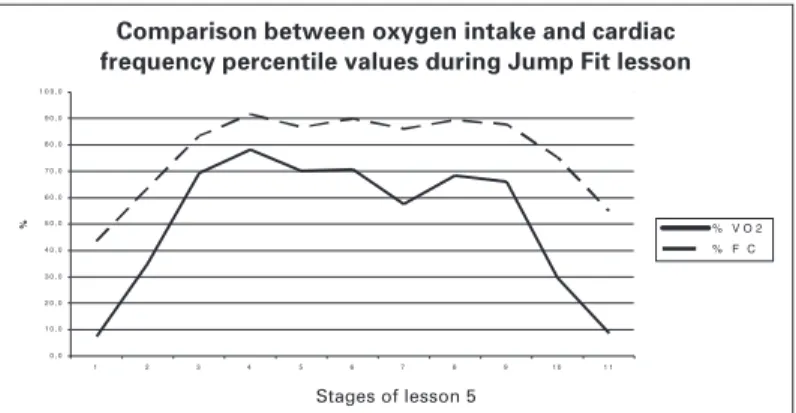
As demonstrated in figure 4, when average values of HR and
VO2 were transformed into average percentile values and the
be-havior of both variables were compared in all stages of the Jump
Comparison between oxygen intake and cardiac frequency percentile values during Jump Fit lesson
0 , 0 1 0 , 0 2 0 , 0 3 0 , 0 4 0 , 0 5 0 , 0 6 0 , 0 7 0 , 0 8 0 , 0 9 0 , 0 1 0 0 , 0
1 2 3 4 5 6 7 8 9 1 0 1 1
%
Fig. 4 – Analysis of the average percentile values of HR and VO2 during Jump Fit lesson 5 (r = 0.94; r2 = 0.88)
Stages of lesson 5
Fit lesson 5, we find linear behavior between responses of HR and
VO2. The Pearson correlation test presented r = 0.94 and r2 = 0.88,
indicating that, for the group analyzed, the HR and VO2 responses presented linear behavior even when arm movements concurrent-ly with leg movements were performed.
DISCUSSION
Scientific evidences have emphasized the importance of inten-sity, duration and frequency of physical activities as components of an aerobic exercises program for the improvement of the phys-ical fitness and benefits associated to health(13). The ACSM(12)
rec-ommendations include intensities of 50% to 85% of the VO2max,
frequency of three to five times a week and duration of 20-60 min-utes per session. Among factors that compose the overload, the intensity seems to be the most important factor, furthering adap-tations that will occur according to training methodology used(14,15).
Although the cardiorespiratory evaluation has been applied to sev-eral activities such as running and cycling(16) and lessons of
local-ized physical exercises and step training(15), its measurement in
the Jump Fit lessons is not scientifically reported. The cardiorespi-ratory increment phenomenon is empirically observed in this les-son methodology applied in bodybuilding academies.
The maximal aerobic power represents the maximal rate that energy can be produced in muscle by the oxidative metabolism, where the gold standard method is considered among all existing methods(17).The VO
2max is the component of the aerobic fitness
that best represents the organism capacity to transport and to re-lease oxygen into the muscle, directly influencing on the adaptive responses of the cardiorespiratory system (central component) and on adaptations occurring at tissue level (peripheral component). The central component effectiveness depends on the pulmonary diffusion, the cardiac debt and on the hemoglobin affinity. The fac-tors that influence the peripheral adaptations, increasing the ab-sorption and the utilization of the oxygen by the musculature in-volved, are related to the muscular glycogen supply, to the capillary density, to the mitochondrial density and volume, to the oxidative
enzymes and to the muscle myoglobin content(18).
We emphasize that the average VO2 reached in this study is in
agreement with scientific recommendations for the development of the aerobic fitness, according to ACSM(12,22) physical fitness
lev-el classification. We verified that the individuals evaluated presented good general physical fitness(12,22), considering the average VO
2max
of 2.61 L.min-1 (± 0.38).
According to the average VO2 obtained in the several stages of
the lesson methodology applied and according to the individuals’ physical fitness level, we classify a Jump Fit lesson as an aerobic exercise from moderate to high intensity(1), being its training
meth-odology the number five, a good proposal for increment and im-provement of the cardiorespiratory condition both for trained as for untrained individuals.
The average HR behavior during the number five lesson stages was of 155.6 bpm (± 16.2), which represented 85% (± 8.9) of the maximal average HR obtained in the maximal test, seems to indi-cate that such methodology may be considered as an activity with moderate to intense intensity(12,22). The ACSM(12,22)
recommenda-tions suggest that the training intensity suitable to increase the cardiorespiratory conditioning in active individuals may range from 60 to 85% of the maximal HR. Comparing our results to the scien-tific recommendations(3,12,22), we can infer that the HR response in
the Jump Fit activity may be considered as a physical activity able to promote positive effects on health improvement.
With regard to the HR response during physical exercises, some
studies have demonstrated no linear relation between HR and VO2
in physical exercises with concurrent requirement of arms and legs, as example, the aerobic gymnastics and the step training(15,23-25).
However, in cyclic activities, running or walking that use lower limbs
predominantly, the linear relation existing between HR and oxygen intake increases significantly, depending on several anatomical and
physiological considerations(26-28). However, the Jump Fit lesson
methodology used in this study also recommends the use of low-er limbs concurrently with upplow-er limbs and the HR progressively followed the physical exercise intensity, thus forming a linear rela-tion between HR and oxygen intake during activity.
The total average energy expenditure of the current study was of 386.4 kcal (± 13.9), being found within range recommended by
ACSM(2), which determines that the exercise sessions must present
energy expenditure of 300-500 kcal. However, the Jump Fit les-sons, in their different training methods, present variations that may be applied to increment the energetic expenditure such as: higher legs and arms movement intensity, higher strength when pushing the springboard canvas, utilization of movements involv-ing larger muscular groups, increase on the melody’s rhythm, chang-es on choreography’s sequencchang-es. Such increments may provide higher energetic activity, thus reflecting in improvements on the esthetic components and health.
Data based on literature(5,6) consider that the energy used during
physical effort and recovery demonstrates that high-intensity or moderate exercises have significant influence on the EPOC mag-nitude, especially at the first minutes of the recovery phase. In our study, when we compared the energetic expenditure of the rest and recovery phases, a significant difference was found. Such fact indicates higher EPOC magnitude in function of the Jump Fit les-son intensity. It is important to emphasize that the EPOC elevation may be influenced by the lesson methodology and by the physical fitness level of the individuals.
In short, the results obtained in the methodology number five of the Jump Fit lesson suggest that the responses of HR, oxygen intake and energetic expenditure are in agreement with the
ACSM(2,12,22) and AHA(28) recommendations in relation to the ideal
zone of a physical exercise training (60 to 90% of the maximal HR and 50 to 85% of the VO2max), providing increases in the cardiores-piratory resistance and it should be indicated as a lesson modality in bodybuilding academies with the objective of improving the aer-obic condition and contributing effectively for the maintenance and improvement of the physical fitness, health and quality of life.
ACKNOWLEDGMENTS
We acknowledge the Physical Education Professor Cida Conti (creator of the Jump Fit program) for allowing, supporting and stimulating our re-search.
All the authors declared there is not any potential conflict of inter-ests regarding this article.
REFERENCES
1. Lee M, Skerrett P. Physical activity and all-cause mortality: what is the dose-response relation? Med Sci Sports Exerc 2001;6:459-71.
2. American College of Sports Medicine. Appropriate intervention strategies for weight loss and prevention of weight regain for adults. Med Sci Sports Exerc 2001;12:2145-56.
3. Almeida MB, Araújo CGS. Efeitos do treinamento aeróbico sobre a freqüência cardíaca. Rev Bras Med Esporte 2003;9:104-12.
4. Tanesescu M, Leitzmann MF, Rimm EB, Willet WC, Stampfer MJ, Hu FB. Exer-cise type and intensity in relation to coronary disease in men. JAMA 2000;288: 1994-2000.
5. Thornton MK, Potteiger JA. Effects of resistance exercise bouts of different intensities but equal work on EPOC. Med Sci Sports Exerc 2002;4:715-22.
6. Hardman AE. Issues of fractionization of exercise (short vs. long bouts). Med Sci Sports Exerc 2001;6:S421-S427.
8. American College of Sports Medicine. Recommendations for cardiovascular screening, staffing and emergency policies at health/fitness facilities. Med Sci Sports Exerc 1998;6:1009-18.
9. Norton K, Olds T. Antropométrica: libro de referência sobre mediciones corpora-les humanas para la educación en deportes y salud. Rosário: Biomsystem, 2000.
10. Jackson AS, Pollock ML, Ward A. Generalized equations for predicting body density of women. Med Sci Sports Exerc 1980;12:175-82.
11. Siri WE. Body composition from fluid spaces and density. Techniques for mea-suring body composition. Washington: National Academy of Science, 1961.
12. American College of Sports Medicine. The recommended quantity and quality of exercise for developing and maintaining cardiorespiratory and muscular fit-ness, and flexibility in healthy adults. Med Sci Sports Exerc 1998;6:975-91.
13. Oja P. Dose response total volume of physical activity and health and fitness. Med Sci Sports Exerc 2001;6:S428-S437.
14. Philips WT, Ziuraitis JR. Energy cost of the ACSM single-set resistance training protocol. J Strength Cond Res 2003;17:350-55.
15. Martinovic NVP, Marques MB, Novaes JS. Respostas cardiovasculares e meta-bólicas do step training em diferentes alturas de plataforma. Rev Bras Ativ Físi-ca Saúde 2002;7:5-13.
16. Caputo F, Stella SG, Mello MT, Denadai BS. Índices de potência e capacidade aeróbia obtidos em cicloergômetro e esteira rolante: comparações entre corre-dores, ciclistas, triatletas e sedentários. Rev Bras Med Esporte 2003;4:223-30.
17. Weltman A, Seip RL, Snead D, Weltman JY, Haskvitz EM, Williford HN, et al. Is low-impact aerobic dance an effective cardiovascular workout? Phys Sports Med 1989;17:95-109.
18. Harms CA. Effect of skeletal muscle demand on cardiovascular function. Med Sci Sports Exerc 2000;1:94-9.
19. Achten J, Gleeson M, Jeukendrup AE. Determination of the exercise intensity that elicits maximal fat oxidation. Med Sci Sports Exerc 2002;1:92-7. 20. Docherty D, Sporer B. A proposed model for examining the interference
phe-nomenon between concurrent aerobic and strength training. Sports Med 2000; 6:185-394.
21. Simão R. Fisiologia e prescrição de exercícios para grupos especiais. São Paulo: Editora Phorte, 2004.
22. American College of Sports Medicine. Guidelines for exercise testing and pre-scription. 6th ed. Philadelphia: Williams and Wilkins, 2000.
23. Keogh JWL, Wilson GJ, Weatherby RPA. Cross-sectional comparison of differ-ent resistance training techniques in the bench press. J Strength Cond Res 1999; 3:247-58.
24. Olson MS, Williford HN, Blessing DL, Brown JA. The physiological effects of bench/step exercise. Sports Med 1996;1:1311-17.
25. Pearson TA, Blair SN, Daniels SR, Eckel RH, Fair JM, Rupp JC, et al. Bench step activity: effects of bench height and hand held weights. Med Sci Sports Exerc 1992;5:S12.
26. Monteiro WD, Araújo CGS. Transição caminhada-corrida: considerações fisioló-gicas e perspectivas para estudos futuros. Rev Bras Med Esporte 2001;6:207-22.
27. Parker SB, Hurley BF, Hanlon DP, Vaccaro P. Failure of target heart rate to accu-rately monitor intensity during aerobic dance. Med Sci Sports Exerc 1989;1: 230-4.