Disponible en castellano/Disponível em língua portuguesa SciELO Brasil www.scielo.br/rlae 1 Article extracted from Doctoral Dissertation; 2 RN, Doctoral student in Health Sciences, Adjunct Professor, e-mail: [email protected]; 3 RN, PhD in Nursing, Adjunct Professor, e-mail: [email protected]; 4 Nursing Undergraduate student, e-mail: [email protected]. Rio Grande do Norte Federal University, Brazil
NON-PHARMACOLOGICAL STRATEGIES ON PAIN RELIEF DURING LABOR: PRE-TESTING
OF AN INSTRUMENT
1Rejane Marie Barbosa Davim2 Gilson de Vasconcelos Torres3 Eva Saldanha de Melo4
Davim RMB, Torres GV, Melo ES. Non-pharmacological strategies on pain relief during labor: pre-testing of an instrument. Rev Latino-am Enfermagem 2007 novembro-dezembro; 15(6):1150-6.
This descriptive study aimed to evaluate the effectiveness of Non-Pharmacological Strategies (NFS) on pain relief of parturients as part of a research instrument to be utilized in a Doctoral Dissertation. In order to evaluate the NFS, the Analogous Visual Scale (AVS) was used on 30 parturients attended at the Humanized Labor Unit of a school-maternity hospital in Natal, RN, Brazil. Of the six NFS (respiratory exercises, muscular relaxation, lumbossacral massage, shower washing, deambulation and pelvic swing), two were excluded post-test (deambulation and pelvic swing) for not being accepted by the parturients. The remaining NFS (respiratory exercises, muscular relaxation, lumbossacral massage, and shower washing) which reached satisfactory acceptation and applicability rates, were found to be effective in relieving pain of these parturients, and thus deemed adequate for use in the Doctoral Dissertation data collection process.
DESCRIPTORS: pain; strategies
ESTRATEGIAS NO FARMACOLÓGICAS EN EL ALIVIO DEL DOLOR DURANTE EL TRABAJO
DE PARTO: PRE-TEST DE UN INSTRUMENTO
Estudio descriptivo, objetivizando evaluar la efectividad de Estratégias No Farmacológicas (ENF) en el alivio del dolor de parturientas para hacer parte de un instrumento de investigación a ser utilizado en la preparación de Tesis de Doctorado. Para evaluar las ENF, utilizamos la Escala Analógica Visual (EAV), con 30 parturientas, teniendo como local de la investigación la Unidad de Parto Humanizado de una Maternidad Escuela en Natal/RN. Verificamos que, de las seis ENF (ejercicios respiratorios, relajamiento muscular, masaje lombo-sacra, baño de lluvia, deambulación y balance pélvico), dos fueron excluidas después del Pre-Test (deambulación y balance pélvico), por presentar dificultades en su aplicación. Los demás (ejercicios respiratorios, relajamiento muscular, masaje lombo-sacra y baño de lluvia) tuvieron índices satisfactorios de aceptación y aplicación, demostrando ser efectivas en el alivio del dolor de esas parturientas, siendo por lo tanto adecuadas su utilización como instrumento de recolecta de datos en la Tesis de Doctorado.
DESCRIPTORES: dolor; estrategias
ESTRATÉGIAS NÃO FARMACOLÓGICAS NO ALÍVIO DA DOR DURANTE O TRABALHO DE
PARTO: PRÉ-TESTE DE UM INSTRUMENTO
Estudo descritivo objetivando avaliar a efetividade de Estratégias Não Farmacológicas (ENF) no alívio da dor de parturientes para fazerem parte de um instrumento de pesquisa a ser utilizado em tese de doutoramento. Para avaliar as ENF, utilizou-se a Escala Analógica Visual (EAV) com 30 parturientes, tendo como local de pesquisa a unidade de parto humanizado de uma maternidade escola em Natal, RN. Verificou-se que, das seis ENF (exercícios respiratórios, relaxamento muscular, massagem lombossacral, banho de chuveiro, deambulação e balanço pélvico), duas foram excluídas após o pré-teste (deambulação e balanço pélvico), por apresentarem dificuldades de aceitação pelas parturientes. As demais (exercícios respiratórios, relaxamento muscular, massagem lombossacral e banho de chuveiro), com índices satisfatórios de aceitação e efetividade, demonstraram ser efetivas na redução da dor dessas parturientes, sendo, portanto, adequadas para a utilização no instrumento de coleta de dados na tese de doutoramento.
INTRODUCTION
T
he Taxonomy Committee of theInternational Association for the Study of Pain (IASP)
has, since 1986, attributed a concept to the word pain
as a sensorial, emotionally unpleasant experience,
associating it to actual or potential tissue lesions. It is
involved by unpleasant, subjective sensations and
each individual uses the word in accordance with his/
her previous experiences, in a certain way
representing an emotional experiment.(1) The word
pain can further be described as a complex, individual
and multifactor phenomenon, influenced by several
factors, namely: psychological, biological, sociocultural
and economic. In a way, pain can be shared from the
reports by those who feel it, characterized by normal
transformations, such as menstrual pain and labor
pain for example.(2)
For most women, labor pain is considered the
worst experience of their lives. The pain of uterine
contractions is a complex process involving
interactions between central and peripheral
mechanisms, as well as the continuous interchange
of information by ascending and descending
nociceptive channels. In this context, we understand
that labor pains involve emotional, sensorial,
environmental and existential factors.(3)
Therefore, we must understand how the
physiology of pain is processed, which is not the same
throughout labor, varying in accordance with its
evolution. During the first stage, i.e. dilation, pain is
visceral, arising due to uterine contractions and
dilation of the cervix, transmitted by the sympathetic
efferent fibers. In this stage, pain is conveyed to the
spinal cord at the level of T10-L1 by Delta A fibers
and C efferent visceral fibers originating in the lateral
wall and uterine bottom. The transmission that follows
efferent from the womb (uterus) and cervix toward
the spinal cord is conveyed by means of the
hypogastric and aortic plexus. So, the nociceptive
efferent impulses cross the lumbar sympathetic chain
and pass to the thoracic sympathetic chain by means
of branches that communicate with the T10-L1 nerves.
Therefore, the fibers that lead the painful impulse
perform synapses with the interneuron of the dorsal
spine returning after modulation(3).
In the second stage, i.e. expulsion, the
nociceptive stimulation of the contractions derived
from the uterine body and distension of the segment
continues when the cervix reaches its full dilation.
Moreover, the presence of the fetus exerts pressure
on the structures of the pelvis, which will give rise to
the somatic pain, when the stretching of the fascia
and subcutaneous tissues of the birth canal occur,
distension of the perineum and pressure on the pelvic
floor muscles. It is understood that, in the second
stage of labor, somatic pain is transmitted to the
pudendal nerve at the height of the sacral vertebrae
S2, S3 and S4. On the other hand, while the pain
from the first stage behaves in a diffuse and ill-located
way, the somatic pain of the second stage is more
intense and well located(3).
There is not, however, a clear delimitation
between labor and delivery, but a gradual transition,
making it difficult to establish the beginning of the dilation
of the cervix. Therefore, in the first stage, i.e. dilation,
in principle, between 2 and 3 uterine contractions can
occur in 10 minutes, possibly increasing to 5 every 10
minutes at the end of this stage. For a better
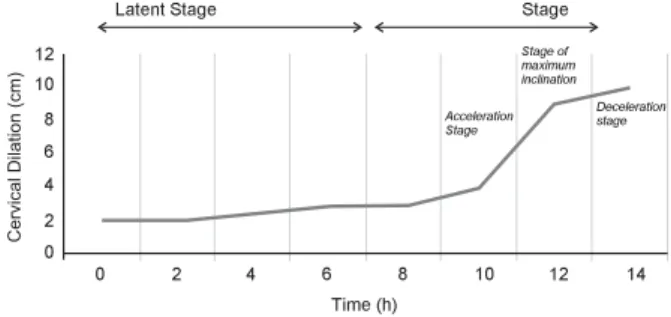
visualization, in the dilation stage, the analysis of
Friedman’s labor chart presents a latent and an active
phase(4) in the women. The active stage is subdivided in
three moments: acceleration, maximum inclination and
deceleration, according to the sigmoid curve of the cervix
dilation (cm) of the latent and active stages in the
preparatory divisions of pelvic dilation in labor (illustration
as a courtesy from Dr. Casey, re-drawn by Friedman,
1978), as seen in Figure 1.
0 2 4 6 8 10 12 14
0 2 4 6 8 10 12
Latent Stage Stage
Acceleration Stage
Deceleration stage Stage of maximum inclination
Time (h)
Figure 1 - Sigmoid curve of cervix dilation (cm) of the
latent and active stages and the preparatory divisions
of pelvic dilation in labor
The latent stage goes from the beginning of
labor up to a point where the curve starts a defined
upward tendency. In this stage, there are irregular, short,
weak uterine contractions, and the cervix dilates from
3 to 4 cm, although it may take several hours and the
parturient, when she goes to the maternity hospital or
health care unit, describes them as abdominal cramp,
and apprehension. The distribution of the pain is located
particularly in the central part of her back and the
sensation, quite often, is referred to as a slight intensive
cramp, becoming more severe(4).
The active stage starts when the dilation curve
begins an abrupt upward tendency and ends when full
cervical dilation is reached, that is, 10 cm. Dilation
evolves more rapidly, after an initial period of
acceleration, when the cervix dilates from 3 to 5 cm, a
stage of maximum inclination between 5 and 8 cm, with
contractions of moderate intensity and a stage of
deceleration with the cervix dilated between 8 and 10
cm, when intense and spasmodic contractions occur.
The distribution of pain at this stage is located in the
anterior abdomen, the duration becomes constant and
associated to full cervical dilation; the pain sensation is
most often referred to as intense, constrictive, frequently
excruciating. In summary, the acceleration stage is short
and variable; the maximum inclination reflects the
effectiveness of the uterine contraction, while
deceleration translates into the fetopelvic relation.
Therefore, the active stage extends up to the full dilation
of the cervix and the beginning of the expulsive period(4).
In view of these considerations, pain in the
active stage of the dilation period during labor is the
central focus of this pre-test, since, as the contractions
become more frequent and intense in this stage, they
cause tension, fear and, consequently, worsening of the
pain. Thus, an important task to help women in regular
child birth to bear the pain is through humanized support
and approach, identifying its quantitative and qualitative
aspects, for the systematic planning of information and
soothing orientation provided by health care
professionals or other people who assist these women.
Even if each parturient responds to pain in a
personal and adaptive way, non-pharmacological
interventions can help reduce the painful perceptions,
changing this response in most of the parturients. To
permit adequate interventions in this sensation, one
must understand the type of pain that is usually felt
during labor, the physical and psychological factors
that influence this perception and how the observation
of the behavioral pattern can clarify a parturient’s
response to pain(4).
In accordance with this information, a revision
study was performed to find out about women’s
satisfaction with delivery, especially in terms of pain
relief. The systematic review of this study identified four
expectations in the parturient’s satisfaction: personal
factors, the support of the professionals, the quality of
the professional-patient relation and the involvement
in the intervention decision. These expectations seem
to be more important in labor care in relation to age,
socioeconomic factor, race, preparation for child birth,
physical environment for child birth, pain, immobility,
medical interventions and care continuity. The authors
have come to the conclusion, in this revision, that the
evaluation of the parturients’ satisfaction with their child
birth experience are not related with the influences of
pain, pain relief and medical interventions, but rather
with the influence exerted by health professionals’
attitudes and behavior(5).
Therefore, professional posture is relevant in
parturient care, considering that this can all be
performed, in addition to the empathetic approach,
associated with the use of adequate
Non-Pharmacological Strategies (NFS), aimed at soothing
the ever-present pain in parturients, considering the
interpersonal relations in professional-parturient-family
interaction. Through the application of these strategies,
the labor process may be less painful, less tense, since
they need attention, counseling and communication
skills, aimed at better conducting child birth.
In this context, this research was motivated
by the need to select NFS for parturient pain relief in
the labor process, aiming at the construction of a data
collection instrument for a Doctoral Dissertation on
Health Sciences/UFRN, with the general aim of evaluating
the effectiveness of NFS to relieve the pain intensity
level and reduce the parturients’ level of state-anxiety
during their active stage of labor. So, this research tried
to select NFS and assess their effectiveness for parturient
pain relief during labor. Finally, we proposed the following
objectives for the research: to identify NFS for parturient
pain relief in the labor process in Bireme Data Base
Systems, Capes Periodicals and SIBI-USP; evaluate the
effectiveness of the NFS in parturient pain relief during
the active stage of labor and select the NFS that present
acceptance percentages of e” 80% by the parturients
and effective pain relief in the study participants for
inclusion in the data collection instrument used for the
Doctoral Dissertation.
METHOD
This is a quasi-experimental non-controlled and
non-randomized therapeutic intervention research with
a quantitative approach, also called “before and after”
and their condition is checked at baseline and at several
moments after treatment(6). The research scenario was
the Humanized Labor Unit (HLU) of the Januário Cicco
Teaching Maternity Hospital (MEJC) at the Federal
University of Rio Grande do Norte (UFRN), located in
Natal/RN, in the Northeast of Brazil. The HLU, which
served as the place of study for the pre-test and the
Doctoral’ Dissertation, consists of four suites destined
for individualized care delivery to women in labor and
is installed on the second floor of the institution.
Before the research, the study was submitted
to the Research Ethics Committee at the Federal
University of Rio Grande do Norte (UFRN) for
evaluation and received a favorable opinion, being
registered at the CEP-UFRN as 045-2005 on June 10,
2005, in accordance with Resolution 196/96 by the
National Health Council (CNS). The research was
developed in two stages: the first involved the
identification and selection of the NFS in the Bireme
Data, Capes Periodicals and SIBI USP Systems, and
the second the application and verification of the NFS’
effectiveness in the participating parturients.
1st Stage: Identification and selection of the NFS
In order to select the NFS, we consulted the
Systems of Bireme Data Bases, Capes Periodicals
and SIBI USP. This survey resulted in eleven scientific
studies in national and international scopes(5,7-17)
related to the evaluation of the parturients’ pain during
the active stage of labor with the use of NFS. Based
on the results of these studies, we selected the
strategies that presented the highest evidence of relief
in the parturients’ pain during the active phase of labor,
namely: respiratory exercises, muscle relaxation,
lumbosacral massage, walking, pelvic balancing and
shower bathing, as shown in Table 1.
Table 1 - NFS with best evidence at satisfactory levels
for pain relief during labor
In this respect, we decided to apply these
strategies (respiratory exercises, muscle relaxation,
lumbosacral massage, walking, pelvic balancing and
shower bathing) in this study, with a view to assessing
the parturients’ acceptance of these strategies and
the effectiveness in relieving their pain during the
active stage of labor.
The instrument for data collection consisted of
two parts. The first involved the parturients’ characteristics
and looked at the following variables of interest: age,
education, religion, origin, family income, parity,
pre-natal treatment, diagnosis, companion and prescribed
medication. The second included the NFS selected in the
first stage of the study (respiratory exercises, muscle
relaxation, lumbosacral massage, walking, pelvic
balancing and shower bathing), aiming at relieving the
parturients’ pain during the active stage of labor.
2nd Stage: Application and verification of the NFS’
effectiveness in the parturients.
Thirty parturients selected by accessibility
sampling participated in the study, as they were admitted
meeting the following inclusion criteria: being in regular
active labor of a second pregnancy, age > 20 years,
presenting dilated cervix of up to 6 centimeters, without
clinical indication of dystocia; accepting to participate
in the study and signing the informed consent term.
Exclusion criteria were: first pregnancy; age < 20
years; background of previous caesarian sections or
suggestion of medical indication, clinical diagnosis of
dystocia and requesting withdrawal from the study.
Data collection took place in a real situation
during the active stage of labor on three pre-defined
occasions: during the acceleration stage, when the
parturient was included in the study with up to 6 cm of
cervix dilation and application of EAV soon after the
first uterine contraction without the use of the NFS.
Afterwards, in the subsequent uterine contraction, the
joint strategies were applied (respiratory exercises,
muscle relaxation and lumbosacral massage) with the
evaluation of the EAV. During the maximum inclination
stage, between 7 and 8 cm of dilation, the parturient’s
pain intensity was also measured by means of the EAV,
after uterine contraction without the use of the NFS,
and subsequently in the following contraction with the
use of the jointly used (respiratory exercises, muscle
relaxation and lumbosacral massage) and isolated
strategies (walking and shower bathing). During the
deceleration stage, between 9 and 10 cm of dilation, ) s ( r o h t u
A NFS TypeofStudy
S M D a d l a u G , M A i a i h c
O Showerbathing Quanittaitvecilnicaltrial T E a n i d e
M Warmbathing Exploratoryquailtaitvecilnicaltrial C T s e p o
L BobathBall(BirthBal)lExperiencereport , T J a z u o S , M A N a d i e m l A A N a r i e v li S , M M n o i h c a B d n a g n i h t a e r B s e u q i n h c e t n o it a x a l e
r Experimentalifeldresearch
V J M S a r i e v il O , B M F a v li
S Bath(immersion) Randomizedstudy,experimental l a i r t l a c i n il c , C E o h l a v r a C , D A A a l u a P B C s o t n a S r a l u c s u m e v i s s e r g o r P n o it a x a l e r i s a u q d e ll o r t n o c , d e z i m o d n a r -n o N y d u t s n o it n e v r e t n i l a t n e m i r e p x e n o i h c a B , M A N a d i e m l A . T J a z u o S , M N a r i e v li S , M M d n a g n i h t a e r B n o it a x a l e r h t i w y d u t s e v it p i r c s e D n o it a v r e s b o e v it a p i c it r a p , C S A s o p m a C , P I a r i e v li S . C F A s e d n a n r e
F Massage Fieldresearch
. J M s i p a l C , C J o r t s a
EAV was applied after the contraction without the use
of the NFS, and at a second moment with the strategies
together (respiratory exercises, muscle relaxation and
lumbosacral massage) and separately (walking and
shower bathing).
The NFS selection criterion for inclusion in the
Doctoral Dissertation instrument referred to instruments
with acceptance percentages ≥ 80% by the study
participants, with effective pain relief during the active
stage of labor. The collected data were initially
transported to a spreadsheet in a database in Excel for
Windows 2000 program and, subsequently, submitted
to analysis, using Mann-Whitney’s U Test, with a statistical
significance level of p < 0.05, comparing the pain scores
of the EAV verified before and after the NFS during the
three moments of the active stage of labor.
RESULTS AND DISCUSSION
Of the 30 parturients under study, 70.0%
were between 21 and 29 years old, 83.3% had
incomplete elementary education, 80.0% were
catholic, 66.7% received up to 2 minimum wages as
family income, 56.7% were from Natal and 43.3%
were from the interior of the state. As to parity, 66.7%
had from 2 to 3 children, 100.0% received pre-natal
treatment with a minimum of 6 visits, as
recommended by the Ministry of Health. With reference
to the gestational age, in accordance with the medical
diagnosis, 83.3% were between 38 and 40 weeks
pregnant, and 70.0% had a companion, i.e. their
partner in 53.3% and their mother in 13.3%. The most
used medication was oxytocin (90.0%) and only 3.3%
did not receive any medication. As to the application
of the NFS (respiratory exercises, muscle relaxation,
lumbosacral massage, walking, pelvic balancing and
shower bathing), the acceptance percentages among
the women in this study are shown in Table 2.
Table 2 - Acceptance of the NFS by the study
participants during the active stage of labor according
to the selection criterion
The walking (6.6%) and pelvic balancing (3.3%)
strategies were not selected to verify effectiveness
because they did not meet the pre-established
acceptance criterion of e” 80.0%. Respiratory exercises,
muscle relaxation, lumbosacral massage and shower
bathing obtained acceptance percentages above 80.0%,
being therefore selected for the application of
Mann-Whitney’s U Test, with a statistical significance of p= <
0.05 for the verification of the effectiveness in parturient
pain relief during the active stage of labor.
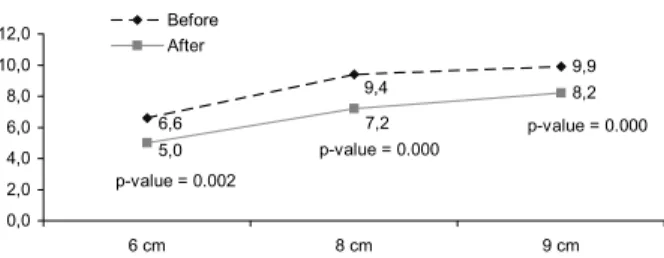
It was identified that, when three associated
NFS, respiratory exercises, muscle relaxation and
lumbosacral massage were applied together, there
was a significant different in the relief of pain intensity
among parturients with 6, 8 and 9 cm of dilation of
the cervix, as shown in Figure 2.
l a c i g o l o c a m r a h p -n o N ) S F N ( s e i g e t a r t s t n e i r u t r a P e c n a t p e c c a a i r e t i r c n o i t c e l e S ( d e t c e l e
s >80%) ) % 0 8 < ( d e t c e l e s t o n º N % s e s i c r e x e y r o t a r i p s e
R 30 100.0 Selected
n o i t a x a l e r e l c s u
M 30 100.0 Selected
e g a s s a m l a r c a s o b m u
L 30 100.0 Selected
g n i k l a
W 2 6.6 NotSelected
g n i c n a l a b c i v l e
P 1 3.3 NotSelected
g n i h t a b r e w o h
S 26 86.6 Selected
Figure 2 - Pain intensity “before and after” the
application of the combined NFS with 6, 8 and 9 cm of
dilation of the cervix during the active stage of labor.
Natal-RN-2006
The joint application of respiratory exercises,
muscle relaxation and lumbosacral massage
presented pain relief when they were used. When
looking at the different pain scores “before and after”
in the application of these NFS, the joint use was
effective at the three moments of cervix dilation
because they presented p < 0.05.
The analysis of the three moments “before
and after” in the application of the associated NFS
(respiratory exercises, muscle relaxation and
lumbosacral massage) revealed the relief of the
parturients’ pain, with a reduction in its intensity at 8
cm after the application of the joint strategies, as
compared with the 6 cm before in the use of the same
strategies, as well as at 9 cm after the application of
the NFS, when compared to 8 cm before these
strategies, since an increase in pain intensity would
be expected as the dilation of the cervix evolved
between 6 and 9 cm in this stage of labor.
In an experimental field research, the
respiratory exercise and muscle relaxation techniques
9,9 8,2 9,4 6,6 7,2 5,0 0,0 2,0 4,0 6,0 8,0 10,0 12,0
6 cm 8 cm 9 cm Before
After
p-value = 0.002
p-value = 0.000
showed that they did not reduce the pain intensity of
the parturients under analysis; however, they
maintained low anxiety levels in the child birth process
for a longer time(12).
On the other hand, in a quasi-experimental
intervention study, when progressive muscle
relaxation techniques were applied to women during
labor, this technique was observed as causing the
perception of relief in the parturients’ pain. This is
relevant as the effects of the researchers’ interference
in data collection during the application of the
technique showed an important reduction in the pain
level of the parturients under study(14).
A qualitative research that looked at how
obstetric nurses perceived the humanization of labor
care at a maternity in the interior of São Paulo State
showed that these nurses could support and guide
the parturients with courses, that they offer comfort
measures, such as a peaceful environment, shower
bathings and permission for a companion, and they
avoid unnecessary interventions(17).
It was identified from an experience report
that shower bathing associated with other
non-pharmacological techniques, such as the Bobath Ball
and lumbar massages, provides comfort during
contractions. In this respect, the water should fall over
the most painful places and that the Bobath Ball,
outside shower bathing, must also be associated to
lumbar massages to favor pain relief during the
contractions(9).
In an experimental randomized clinical assay,
performed at a philanthropic public maternity in São
Paulo City, it was noticed that the immersion bath in
pain relief during labor presented advantages in
reducing and postponing the use of drugs in pain
control, thus being a feasible option for the comfort
of the parturient, without interfering in the progression
of labor(13).
CONCLUSIONS
Among the NFS for pain relief in the labor
process identified in the database under analysis,
when they were applied to the parturients in this study,
the respiratory exercises, muscle relaxation,
lumbosacral massage and shower bathing presented
an acceptance percentage above 80.0%, while walking
and pelvic balancing were rejected, obtaining
percentages below those accepted by pre-established
criteria.
As to the effectiveness of the strategies the
parturients accepted for pain relief during the active
stage of labor, we noticed that the pain scores, when
compared “before and after” the application of the
respiratory exercises, muscle relaxation and
lumbosacral massage strategies at the three moments
they were used, at 6, 8 and 9 cm of cervix dilation,
and shower bathing at 8 and 9 cm, denote that these
strategies were effective in relieving pain, therefore
being appropriately included in the Doctoral
Dissertation instrument.
In this sense, this research offered relevant
experience in the identification of these strategies in
women giving birth, making it possible to apply them
in the relief of labor pains in the same study field
during data collection for the Doctor’s Thesis. In
addition, it reinforces the importance of seeking
humanization in the parturient care process at all
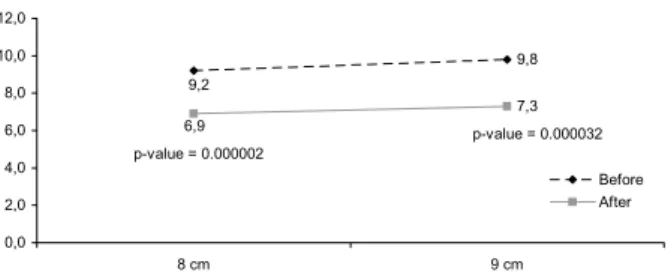
times. Figure 3 - Intensity of the pain “before and after” the
application of shower bathing at 8 and 9 cm of cervix
dilation during the active stage of labor. Natal/RN
-2006
In Figure 3, the results obtained for shower
bathing at 8 and 9 cm of cervix dilation show significant
pain relief at the two application times, confirming its
effectiveness in the reduction of the parturients’ pain
in this stage.
In a clinical assay, it was shown that shower
bathing reduced the time of labor and that the water
acted on the portal of the pain, reducing the sensation
of pain by causing gradual relaxation in the
parturients(8). Another clinical assay showed that
shower bathing during the active stage of the dilation
period promoted feelings of well-being and comfort,
such as relief, relaxation and reinvigoration. The
authors suggest that the strategy be encouraged at
obstetrical centers as a result of its availability,
accessibility and low cost of intervention(7).
9,8
7,3 9,2
6,9
0,0 2,0 4,0 6,0 8,0 10,0 12,0
8 cm 9 cm
Before After p-value = 0.000002
REFERENCES
1. Helman CG. Pain and culture. In: Helman CG. Culture, health and illness: introduction for health professionals. 3th ed. Oxford: Butterworth-Heinemann; 1994. p. 179-93. 2. Pimenta CAM. Avaliação da experiência dolorosa. Rev Med 1995 agosto-setembro; 74(2):69-75.
3. Lowe KN. The nature of labor pain. Am Obst Gynecol 2002; 186:S16-24.
4. Branden PS. Enfermagem materno-infantil. Rio de Janeiro (RJ): Reichmann & Affonso Editores; 2000.
5. Hodnett ED. Pain and women’s satisfaction with the experience of childbirth: a systematic review. Am J Obstet Gynecol 2002 May; 186:S160-72.
6. Medronho RA. Epidemiologia. São Paulo (SP): Atheneu; 2005. 7. Ochiai AM, Gualda DMS. O banho de chuveiro como medido de alívio da dor no trabalho de parto. In: International Conference on the Humanization of Childbirth; 2000. novembro 2-4; Fortaleza, Ceará. Fortaleza: JICA; 2000. p. 75. 8. Medina ET, Impacto do banho morno na redução do tempo de trabalho de parto. In: International Conference on the Humanization of Childbirth; 2000. novembro 2-4; Fortaleza, Ceará. Fortaleza: JICA; 2000. p. 76.
9. Lopes TC. Bola do nascimento: uma opção de conforto durante o trabalho de parto. In: International Conference on the Humanization of Childbirth; 2000 novembro 2-4; Fortaleza, Ceará. Fortaleza: JICA; 2000. p. 76.
10. Chan MY, Wang SY, Chen CH. Effects of message on pain and anxiety during labor: a randomized controlled trial in Taiwan. J Adv Nurs 2002 April; 38(1): 63-73.
11. Leeman L, Fontaine P, King V, Klein MC, Ratcliffe S. The nature and management of labor: Part I. Nonpharmacologic pain relief. Am Family Physician 2003; 68(6):1109-12. 12. Almeida NAM, Souza JT, Bachion MM, Silveira NA. Utilização de técnicas de respiração e relaxamento para alívio de dor e ansiedade no processo de parturição. Rev Latino-am Enfermagem 2005 janeiro-fevereiro; 13(1): 52-8.
13. Silva FMB, Oliveira SMJV. O efeito do banho de imersão na duração do trabalho de parto. Rev Esc Enfermagem USP 2006 março; 40(1): 57-63.
14. Paula AAD, Carvalho EC, Santos CB. The use of the “Progressive Muscle Relaxation” technique for pain relief in gynecology and obstetrics. Rev Latino-am Enfermagem 2002 setembro-outubro; 10(5): 654-9.
15. Almeida NAM, Bachion MM, Silveira NM, Souza JT. Avaliação de uma proposta de abordagem psicoprofilática durante o processo de parturição. Rev. Enfermagem UERJ 2004 dezembro; 12(3): 292-8.
16. Silveira IP, Campos ACS, Fernandes, AFC. O contato terapêutico durante o trabalho de parto: fonte de bem-estar e relacionamento. Rev RENE 2002 janeiro-junho; 3(1):67-72. 17. Castro JC, Clapis MJ. Parto humanizado na percepção das enfermeiras obstétricas envolvidas com a assistência ao parto. Rev Latino-am Enfermagem 2005 novembro-dezembro; 13(6): 960-7.