Disponible en castellano/Disponível em língua portuguesa SciELO Brasil www.scielo.br/rlae 1 Psychologist, Specialist in Health Psychologist, Master student, Professor, Vale do Acaraú State University, UVA, Brazil, e-mail: [email protected]; 2 PhD Professor, Rio Grande do Norte Federal University, Brazil, e-mail: [email protected]
NURSING PROFESSIONALS’ ANXIETY AND FEELINGS IN TERMINAL SITUATIONS IN ONCOLOGY
Daniella Antunes Pousa Faria1
Eulália Maria Chaves Maia2
Faria DAP, Maia EMC. Nursing professionals’ anxiety and feelings in terminal situations in oncology. Rev Latino-am Enfermagem 2007 novembro-dezembro; 15(6):1131-7.
This study aimed to investigate, through a cross-sectional study, factors that influence anxiety levels and feelings of a nursing team who care for terminal patients with cancer. The sample consisted of 50 Nursing Assistants and Technicians from the Hospital reference on cancer care in Rio Grande do Norte, Brazil. Data were collected through the State-Trait Anxiety Inventory. Results showed that 69.8% of the professionals have medium anxiety levels and 30.2% have high levels of anxiety. The Number of Patients attended and “Working in another Institution” interfered in the anxiety levels. The most remarkable professionals’ feelings were suffering and sadness, and Child was the most difficult age group to care for. Studies which develop support strategies to those health professionals are necessary to reduce and/or to prevent high anxiety and stress levels.
DESCRIPTORS: nursing; anxiety; terminally ill; neoplasms
ANSIEDADES Y SENTIMIENTOS DE LOS PROFESIONALES DE ENFERMERÍA EN
SITUACIONES DE TERMINALIDAD EN ONCOLOGÍA
Se trata de una investigación transversal que evaluó el nivel de ansiedad del equipo de enfermería que se dedica al enfermo terminal con cáncer, investigando los factores que influencian este equipo, así como los sentimientos de los profesionales ante la atención a estos enfermos. Fueron analizados 50 auxiliares y técnicos de enfermería del hospital de referencia de atención al cáncer de Rio Grande do Norte, Brasil. Datos fueron recolectados a través de un cuestionario y del Inventario de Ansiedad Rasgo-Estado. Resultados revelaron que el 69,8% posee ansiedad-estado media y el 30,2% alta. El número de enfermos atendidos y ‘trabajar en otra institución’ interfirieron en el nivel de ansiedad-estado. Los sentimientos más destacados fueron sufrimiento y tristeza, y ‘niño’ fue indicado como el grupo de edad más difícil de dedicarse. Se verifica la necesidad de estrategias de apoyo para los profesionales a fin de reducir y/o prevenir altos niveles de ansiedad y estrés.
DESCRIPTORES: enfermería; ansiedad; enfermo terminal; neoplasias
ANSIEDADES E SENTIMENTOS DE PROFISSIONAIS DA ENFERMAGEM NAS SITUAÇÕES DE
TERMINALIDADE EM ONCOLOGIA
Trata-se de investigação de caráter transversal que avaliou o nível de ansiedade da equipe de enfermagem que lida com o paciente terminal com câncer, procurando identificar os fatores que a influenciam, bem como os sentimentos dos profissionais frente ao atendimento destes pacientes. Foram analisados 50 auxiliares e técnicos de enfermagem do hospital de referência de atendimento ao câncer do Rio Grande do Norte. Os dados foram coletados através de questionário e do Inventário de Ansiedade Traço-Estado. Os resultados revelaram que 69,8% dos profissionais possuem Ansiedade-Estado média e 30,2% alta. O número de pacientes atendidos e ‘trabalhar em outra instituição’ interferiram na Ansiedade-Estado. Os sentimentos mais destacados foram sofrimento e tristeza, e ‘criança’ foi apontada como sendo a faixa-etária mais difícil de se lidar. Verifica-se a necessidade de realização de estratégias de apoio para profissionais a fim de reduzir e/ou prevenir altos níveis de ansiedade e estresse.
INTRODUCTION
S
tudies have demonstrated that health teamsin hospitals are under the risk of stress and tension at
work(1-2), especially those in nursing, highlighted as the
4th most stressing work in the public sector(3). This risk
of tension is due to the fact that these professionals
deal every day with several occupational stressors, such
as working in an environment were death and dying
are part of their routine(4-5), especially for professionals
working with patients with severe diseases(5), with
excessive workload and lack of physical, material and
human resources(6). Other variables may maximize this
tension; there are investigations that state that oncology
nursing is one of the most stressing activities(7), although
there are controversies(8). The fact is that dealing with
cancer patients(9) and with terminality(10) is described as
stressful and emotionally demanding for nursing
professionals(5,9-10), since death is seen as a failure to
give efficient and effective care(11).
In Brazil this becomes more complex,
because professionals frequently face a reality where
there are more patients than beds, crowded
emergency rooms, forcing them very often to select
who will be cared for, and how they will be treated(4).
Due to these issues and the absence, in our
environment, of more specific studies monitoring the
level of anxiety, and the feelings of the nursing team
dealing with terminal cancer patients, this study aimed
at: 1. Assessing the level of anxiety of the nursing
team dealing with terminal cancer patients, to identify
the factors that influence the last; 2. Identifying the
feelings of the team regarding terminal patients with
cancer; 3. Identifying in which stage of human
development (childhood, adolescence, adulthood, or
old age, in their corresponding age groups) of these
patients they find it harder to perform their job; and
4. What is the possible explanation given by these
professionals for the age group chosen?
It is important to highlight that anxiety is one
of the stress indicators (personal depletion interfering
in the life of individuals)(6) and may become pathologic
when it is more intensive(3). Worsening of this situation
may lead to syndromes, such as for example, the
Burnout, that involves exhaustion, caused by an excessive burnout of energy. This syndrome is
currently studied by several authors(5,12), who point
out the risk of burnout in health professionals,
especially nursing that, as already mentioned, is a
career considered extremely stressful(3,12).
Thinking about these issues, we believe that
the current study will help becoming aware of the
triggering factors of anxiety in professionals dealing
com dying cancer patients, enabling to identify the
level of anxiety of these professionals, as well as the
feeling they have when they are working within this
reality. Being aware of this may help designing care
strategies for professionals that dedicate themselves
to this work, so as to reduce high levels of anxiety
and stress, extremely harmful to health and to
professional performance.
SUBJECTS AND METHODS
Sample
Fifty nursing professionals (Nurse Assistants
and Technicians) from both genders of a reference
hospital in the care for cancer in Rio Grande do Norte
were contacted. It is worth mentioning the there was
a sample loss of 07 participants, that refused to take
part in the study, because they declared they had no
time to answer to these instruments. Thus, the study
had 43 professionals, 18 assistants and 25 technicians.
Inclusion criteria used were: care for patients in
terminal stage in all age groups, and written consent
to take part in the survey.
Instrument
To assess anxiety, Spielberger State-Trait
Anxiety Inventory (STAI)(13) was used in the Brazilian
version, known as IDATE. This instrument is the only
assessing Trait Anxiety (A-Trait) and State Anxiety
(A-State) and it has already been translated and
validated into Portuguese(14). IDATE is a self-applied
inventory, made by two different scales designed to
measure State (Part I) and Trait (Part II) of anxiety.
A-Trait is defined as a relatively long lasting
characteristic of subjects that goes beyond the
boundaries of time and place, therefore, arising
regardless of where they are or what they are doing.
A-State refers to the moment or certain situation, to
something external the triggers the process called
anxiety(13).
A questionnaire was also especially developed
with the purpose of tracing the profile of the sample
and to collect data referring to feelings of these
cancer patients. To that end, the questionnaire
approached the following issues: 1. If professionals
notice any different feeling or behavior when dealing
with terminally ill patients; 2. (If the previous answer
was positive) Description of the feeling and/or
behavior; 3. Description of the age group of the
terminal patient where professionals are more
encouraged to perform their work and the age group
where they are less encouraged; and 4. Explanation
for considering a certain age group as the most difficult
to work with.
Collection of the data
Data were obtained after approval by the
Ethical Committee in the period of 2005.2-2006.1.
Initially the researcher explained to nursing
professionals the objectives of the survey and the
instruments that would be used. When patients agreed
to take part on a survey, they gave their written
consent, and then IDATE and the questionnaire were
individually applied. The time to perform all procedure
was approximately 20 minutes.
Anxiety scores obtained through IDATE were
assessed following the guidelines of the instrument(13),
then they were tabulated and underwent, together
with the data from the questionnaire to statistical
analysis using the Statistic program, version 6.0. To
assess the outcomes obtained at IDATE, the following
theoretical and methodological reference has been
considered(14): scores under 33 correspond to low level
of anxiety, scores between 33 and 49, medium level
of anxiety, and above 49, a high level of anxiety. For
content analysis of the descriptive content of the
questionnaire, a computer program for Lexical
Analysis through Context of a Text Segment,
ALCESTE* was used.
OUTCOMES
Regarding the profile of the sample, data
demonstrated that 88% of professionals surveyed
were female, 40% were in the age group from 30 to
34. Regarding marital status, 53% is single, and 44%
married. 30% of these professionals have worked in
the institution from 12 to 24 months, 16% from 13 to
24 months, and 16% more than 97 months. Regarding
daily working hours, 74% of them work 6 hours a
day, and 26% 8 hours. Concerning the number of
patients cared for every day, 34% take care of up to
10 patients, 21% of 11 to15 patients, and 18% from
16 to 20 patients.
It was observed that the medium level of
anxiety of assistants and nursing technicians is 48.14
for A-State and 46.74 for A-Trait, with standard
deviation of 5.88 and 6.18, respectively. Regarding
categorization of this outcome, according to the
theoretical reference used(14), 69.8% of these
professionals present medium level of A-State (scores
from 33 to 49) and 30.2% presented high level of
A-State (score above 49). Regarding A-Trait, 74.4%
presented medium level, and 25.6% high level.
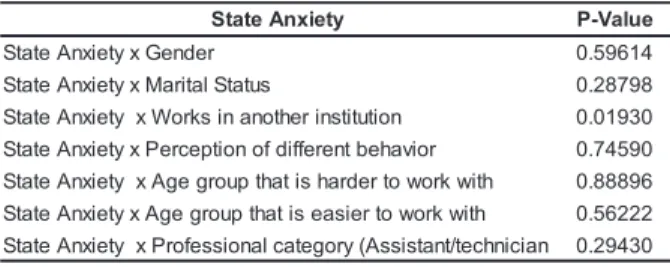
To assess which qualitative variables studied
would influence A-State, Pearson’s Chi-square test was
applied. We could see that one categorical variable (works
for another institution) is associated with A-State of nursing
professionals, since p-value < 0.05 (Table 1).
Table 1 - Pearson’s Chi-square test for A-State
variable
This program performs the analysis in four stages. The first organizes the material recognizing the unities of initial context (IUC), formed by the interviews, dividing them into text segments with similar size (called “Unities of Elementary Context” or UEC), grouping the occurrence of words according to their roots and performing calculations of their respective frequencies. Then, it classifies simple headings or the UEC, to obtain the greatest possible value in a test of association (Chi-square). On the third stage the classes found are described. In the level of analysis, the are made of several text segments (UEC) that have similar vocabulary. At the interpretative level, they are considered indicators of different notions. On the fourth stage, the UEC are provided with characteristics of each class, providing the context in which their vocabulary occurs
y t e i x n A e t a t
S P-Value
r e d n e G x y t e i x n A e t a t
S 0.59614
s u t a t S l a t i r a M x y t e i x n A e t a t
S 0.28798
n o i t u t i t s n i r e h t o n a n i s k r o W x y t e i x n A e t a t
S 0.01930
r o i v a h e b t n e r e f f i d f o n o i t p e c r e P x y t e i x n A e t a t
S 0.74590
h t i w k r o w o t r e d r a h s i t a h t p u o r g e g A x y t e i x n A e t a t
S 0.88896
h t i w k r o w o t r e i s a e s i t a h t p u o r g e g A x y t e i x n A e t a t
S 0.56222
n a i c i n h c e t / t n a t s i s s A ( y r o g e t a c l a n o i s s e f o r P x y t e i x n A e t a t
S 0.29430
This means that A-State is associated with these
professionals working or not in other institutions. The
proportion of high anxiety is greater when professionals
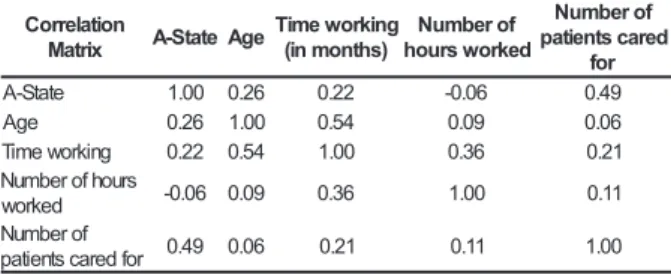
work in another institution. When Correlation Analysis
between A-State and Age, Time working in the
institution, number of hours worked per day and number
of patients cared for per day was performed, we could
see through the matrix of correlation that A-State is
correlated with the number of patients cared for
per day (r=0.49) with a value of 49% for a 5%
Table 2 - Correlation matrix for variable a-state make the model. Based on the regression model (Y
= β0 + β1 X1 + ε), in which the parameters β0 and β1
represent the regression coefficients, Y represents
the dependent variable, X1, the independent variable,
and e the error; the regression model estimated was:
Y
ˆ
= 44.388+ 0.197 X, when:Y
ˆ
= Estimated A-State,and X = number of patients cared for per day. This
means that:
Estimated A-State = 44.88 + 0.9718 * number
of patients cared for per day
Regarding feelings of health professionals
facing the terminal patient and cancer, outcomes
demonstrated that 65% of professionals stated they
felt different when they treat patients in this situation.
Among this 65%, 25% stated they suffered and felt
sad, 17% felt anguish, 7% had feeling of hopelessness,
5.1% fear, 5.1% attention, 5.1% apprehension, 5.1%,
love, 5.1% life, 5.1% humanity, 5.1% loss, 5.1%
delicate, 5.1% needy, 5.1%, concern. Additionally,
77% of nursing assistants and technicians point out
children as the age group where they find most
difficult in this type of care. On the other hand, 42%
of professionals say that the elderly is the age group
where they have less trouble caring for when they
are terminally ill.
To understand the outcomes above, using
ALCESTE, the explanation given by these professionals
for the choice of age group that most mobilized them
emotionally when dealing with terminally ill cancer
patient was assessed, in this case, the group was
children. It is important to highlight that we will
examine the fourth stage of this program, that is, the
stage where the UCE most characteristic of each Class
is given, so we can have the context where the
vocabulary was used. ALCESTE has identified the
presence of 4 classes. However, only Class 1 was
assessed, corresponding to the professionals (77%)
that pointed out children as the most difficult age
group to deal with when caring for terminal patients.
The other classes were made by professionals that
pointed out the remaining age groups (adolescent,
adult, or elderly) as the most demanding for them
when dealing with terminal patients. In this process,
ALCESTE identified that in the narrative of these
professionals there are some words that were more
frequently used in the speech, making it possible to
build a representation of what these professionals feel
and think when they care for patients in this reality.
The Lexical Analysis performed by ALCESTE in the
narrative of these professionals highlighted the
n o i t a l e r r o C x i r t a
M A-StateAge
g n i k r o w e m i T ) s h t n o m n i ( f o r e b m u N d e k r o w s r u o h f o r e b m u N d e r a c s t n e i t a p r o f e t a t S
-A 1.00 0.26 0.22 -0.06 0.49
e g
A 0.26 1.00 0.54 0.09 0.06
g n i k r o w e m i
T 0.22 0.54 1.00 0.36 0.21
s r u o h f o r e b m u N d e k r o
w -0.06 0.09 0.36 1.00 0.11
f o r e b m u N r o f d e r a c s t n e it a
p 0.49 0.06 0.21 0.11 1.00
When this same analysis was performed for
A-Trait, it was possible to see that A-Trait presented a
mild correlation with Age and with Time working in
the institution r =0.2 and r= 0.32 (respectively)
(Table 3).
Table 3 - Correlation matrix for variable A-Trait
n o i t a l e r r o C x i r t a
M A-Trait Age
g n i k r o w e m i T ) s h t n o m n i ( f o r e b m u N d e k r o w s r u o h f o r e b m u N d e r a c s t n e i t a p r o f t i a r T
-A 1.00 0.42 0.32 -0.14 0.21
e g
A 0.42 1.00 0.54 0.09 0.06
g n i k r o w e m i
T 0.32 0.54 1.00 0.36 0.21
s r u o h f o r e b m u N d e k r o
w -0.14 0.09 0.36 1.00 0.11
f o r e b m u N r o f d e r a c s t n e it a
p 0.21 0.06 0.21 0.11 1.00
That is, 42% of the variation in the A-Trait is
due to the variation in Time working in the institution,
for a 5% significance level (p-value <0.05).When the
correlation of variable A-State was performed with
variable A-Trait and the variables mentioned above,
it was seen that A-States presents a mild correlation
with A-Trait and with number of patients cared
for in the day (r = 0.53 and r = 0.49 respectively),
for a 5% significance level (p-value <0.05).
Although Correlation and Chi-Square tests
previously performed had demonstrated the number
of patients cared for per day and working in
another institution as the only variables related to
A-State, all variables considered in the questionnaire
have been considered (Refer to Table 1 and Table 2)
to perform Linear regression using the process
Backward Stepwise to select variables, using A-State as a dependent variable. Outcomes of ANOVA
(p=0.001931) demonstrated that there are strong
evidences that the adjusted model demonstrate the
relationship between the dependent and independent
variable. For the relationship described in the model,
independent variables selected explain 23.71% (R2 =
0.23715867) of the variation of A-State of the
professionals assessed, where only the variable
presence of 4 most significant words in Class 1:’Not’
(Chi- Square = 17.56), ‘Lived’ (Chi- Square = 10.86),
‘Yet/Still’ Square =10.86), and ‘a lot’
(Chi-Square = 8.55). ALCESTE selects these words based
on the answers described by professionals and the
greater the Chi-square, the more significant the word
is in the speech. Thus, the explanation given by these
professionals for the difficulty in dealing most with
children was guided by the reason that children “have
still not lived a lot” and because of that they got more
involved when children are terminally ill. The following
statements can be an example:
…I find it hard to see children sick, I am very touched.
I remember my grandchildren that still have a lot to live they have just lived a little and are already dying… C.L.U (Nurse Technician).
...Because they are young patients, children, they have their whole life ahead of them and this situation is very sad, one may be angry, despaired and so on in this situation. The family
get sad and professionals too… C.L.U (Nurse Assistant).
ANALYSIS
Based on these outcomes, it was observed
that mean level of A-State (48.14) and of A-Trait
(46.74) corresponded to mean level of anxiety
according to the reference used(14). This means that,
overall, in these professionals anxiety, both as a
personality trait and as due to a reaction to a certain
event (in this case, the anxiety after caring for a
patient with cancer terminally ill) is in the middle level.
However, we must point out that value A-State is
almost surpassing the maximum value to consider it
High Anxiety (>49), and also that level A-Trait was
lower than A-State, suggesting that the situation these
professionals face (caring for terminally ill patients)
increased their level of anxiety in some way. On the
other hand, IDATE was not applied before and after
the exposure of professionals to terminal patients,
preventing us to state more precisely that this
increase in anxiety comes from this care, also because
surveys show that hospitals are stressful and lead to
anxiety(4). Thus, this increase in anxiety may be only
due to hospital work.
For our sample only the Number of patients
cared for per day and Working in another
institution presented significant correlation for
A-State. Therefore, the more patients professionals see
every day, the greater their A-State will be. Thus,
high Number of patients cared for per day and working
in another institution would be risk factors for these
professionals dealing with this demand. More
precisely: Multiple Linear Regression could build a
model where it is estimated that, on average, A-State
increased 0.197 for each increase of one patient cared
for per day by these professionals. A similar
conclusion was published by a survey where the
outcomes show that Lithuanian General Practitioners
that have high load of patients are at risk of stress(1).
Double jobs are also pointed out as source of stress
and tension for health professionals(2).
Although the literature points our variables
such as the number of hours worked(2) as a factor
contributing to tension and anxiety of professionals;
in this sample correlations between anxiety and this
variable were not seen. There are studies that present
a correlation between level of tension and age(12). In
the present survey, a similar outcome was presented,
with a small correlation between A-Trait (anxiety as a
more stable characteristic of the subject) with Age
and Time working in the Institution: the greater
the age and the time working in the institution, the
greater A-Trait was. If A-Trait increases with the
advance of Age and Time Working in the Institution
and if it is correlated with A-State as suggested by
the literature(13) and the statistical analysis of our study,
this means that Age and Working time will not only
increase A-Trait but also A-State. This suggests that
dealing with this reality may lead to, in the long run,
an increase in anxiety of the subject, making this job
risky to the health of professionals.
Another essential fact to the discussion in the
practice of these professionals is the issue of the death
of patients. According to some studies the possibility
of death of patients may lead to stress and a feeling
of powerlessness of health professionals(10). This may
be understood because society makes these
professionals accountable for maintaining life(4), and
when this “mission” cannot be reached it leads to
anxiety, despair and frustration(4,10). This has also been
demonstrated by our study, when 65% of the
professionals studied stated that they felt different
when they cared for terminal patients, they have also
stated feelings such as suffering, sadness, anguish,
powerlessness, fear, apprehension, concern. These
feeling presented in our study were similar to those
of a survey(10) with cancer physicians of the city of
São Paulo/SP, and it was identified that in 80% of the
of powerlessness, sadness, pity, distress, frustration,
indignation, anxiety, depression, suffering, anguish,
emotional exhaustion, failure, and dissatisfaction.
Thus, terminal diseases are frequently feared, and it
is common that in hospitals, professionals change their
shifts to avoid dealing with terminal patients.
Avoiding death in hospitals, however, is not
possible, because as medicine had become a practice
urban-center and hospital-center, hospitals have
become the privileged “site” of death, and in terminal
patients, this reality becomes even more present and
objective, demanding a realistic attitude of
professionals regarding their patients who are dying(10).
In addition to the issue of terminality, for professionals
surveyed, there is another complementary issue: the
stigma of cancer as a fatal disease(9-10), which may
lead to tensions and anxiety for these professionals(5,10).
However, it is still unknown if working with cancer
patients is a more stressful activity than others,
because the studies in this area are contradictories(2).
On the other hand, we may conclude that
childhood was the development phase that was most
difficult for the assessed professionals to deal with
regarding terminal cancer. Overall, the explanation
given by these professionals was that children in
terminal stage are more difficult to deal with because
they have not lived enough and have their whole lives
ahead of them. This was one of the initial hypotheses
of this study, since death, especially during childhood,
is many times seen as medical failure(11). It is as if
childhood death was something unacceptable, against
the natural order, and thus, it is transferred to a remote
time, the elderly. Therefore, death of the elderly is
more acceptable than that of the young people by
the team(15). This perception seems to be shared by
members of our study when most of them pointed
out the elderly as the age group where they found it
easier to care in terminal stage.
From this study, it was possible to understand better the emotional aspects of the nursing team facing
terminality and cancer, issues that lead to anxiety and stress(1,4). However, it is important to highlight that this study presents limitations: first, it represents the
experience of a single Cancer center, although it is a reference in the State of Rio Grande do Norte; another
aspect is the refusal of some professionals to take part in the study, because they had no time. Additionally, we
cannot say that the increase in the level of anxiety of these professionals is because they deal with cancer and terminality, this could only be possible if the test
had been applied in two times before and after care -and the performance of the survey in another institution dealing with another specialty rather than oncology.
Last, the outcomes of the survey, suggest the need for intervention models of care, as for example,
support groups, and/or reflection groups, for health professionals facing this reality, because the emotional suffering of these professionals may interfere not only
in their health but also in the quality of care. Thus, further studies are necessary to deepen these issues
and also, other studies that not only design but also make support strategies viable for health professionals
dealing with terminality so as to contribute to the prevention of occupational diseases and to improve the quality of life of professionals and their patients.
These surveys will definitely corroborate the prevention of occupations diseases.
ACKNOWLEDGEMENTS
Our acknowledgements to professor João Carlos Alchieri from the Department of Psychology
at the Federal University of Rio Grande do Norte and to professor Horácio Accioly Júnior from the
Department of Physical Education at the Federal
University of Rio Grande do Norte.
REFERENCES
1. Vanagas G, Bihari-Axelsson S. Interaction among general practioners age and patient load in prediction of job strain, decision latitude and perception of job demands. A c r o s s - s e c t i o n a l s t u d y. B M C P u b l i c H e a l t h 2 0 0 4 ; 4(59):1-6.
2. Stacciarini JMR, Troccoli B. O estresse na atividade ocupacional do Enfermeiro. Rev Latino-am Enfermagem 2001 março-abril; 9(2):17-25.
3. Ortiz GCM, Platino NAM. El stress y su relación con las condiciones de trabajo del personal de enfermeria. Rev Invest Educ Enfermeria 1991; 9(2):91
4. Sebastiani RW. O ideal de cura no hospital e as manipulações da morte. Os Limites da vida: Simpósio realizado na Santa Casa São Paulo; 1993 novembro 34-37 São Paulo, 1993.
5. Dorz S, Novara C, Sica C, Sanavio E. Predicting burnout among HIV/AIDS and oncology health care workers. Psychol Health 2003; 18(5):677-84.
6. Velázquez MEU, Martínez AMS, Rios EV, Elizondo, MEG, Ledezma MAL, Ramírez MTE, et al. Ansiedad laboral em personal de enfermeria. Atención Primaria 1999 febrero; 23(3):116-20.
8. Wilkiinson SM. Stress in cancer nursing: does it really exist? Adv Nurs 1994; (20): 1079-84.
9. Corner J. Nurse’s experience of cancer. Eur Cancer Care 2002; (11):193-9.
10. Klafke TE. O médico lidando com a morte: aspectos da relação médico-paciente terminal em cancerologia. In: Carsola RMS. Da morte: estudos brasileiros. Campinas (SP): Papirus; 1998 p.25-50.
11. Graves S, Aranda S. When a child cannot be cured: reflections of health professionals. Eur Cancer Care 2005; 14(2):132-40.
12. Sobreques J, Cebria J, Segura J, Rodriguez C, Garcia M, Juncosa S. Job Satisfaction and burnout in general practitioners. Atención Primaria 2003; 31(4):227-33. 13. Spielberger CD, Gorsuch RL, Lushene RE. Inventário de Ansiedade Traço-Estado. Rio de Janeiro (RJ): CEPA; 1979. p.1-57.
14. Goresnstein C, Andrade L. Validation of Portuguese version of the Beck Depression Inventory and State-Trait Anxiety Inventory in Brasilian subjects. Braz Med Biol Res 1996; (29):453-7.
15. Gonçalves LHT, Scneider P. Enfermagem e o idoso hospitalizado em condição terminal. Acta Paul de Enfermagem 2001; 14(1):72-81.