a Original study from a nursing end-of-course monograph.
b Master’s student at Programa de Pós Graduação de Enfermagem at Universidade Federal do Rio Grande do Sul (UFRGS). Holder of a grant from Programa de Apoio a Planos de Reestruturação e Expansão das Unidades Federais (REUNI). RN. Effective member of Grupo de Estudo e Pesquisa em Enfermagem no cuidado ao Adulto e Idoso-GEPECADI-CNPq). Porto Alegre. Rio Grande do Sul. Brazil. c Nursing undergraduate student at Escola de Enfermagem, UFRGS. Effective member of GEPECADI-CNPq. Porto Alegre. Rio Grande do
Sul. Brazil.
d RN. Porto Alegre. Rio Grande do Sul. Brazil.
e RN at Hospital das Clínicas de Porto Alegre (HCPA). Porto Alegre. Rio Grande do Sul. Brazil.
f Ph.D. in Science. Adjunct professor at Escola de Enfermagem and Programa de Pós Graduação of UFRGS. Researcher of GEPECADI--CNPq. Porto Alegre. Rio Grande do Sul. Brazil.
PRESSURE ULCER CARE QUALITY INDICATOR:
ANALYSIS OF MEDICAL RECORDS AND INCIDENT REPORTa
Cássia Teixeira dos SANTOSb, Magáli Costa OLIVEIRAc, Ana Gabriela da Silva PEREIRAd,
Lyliam Midori SUZUKIe, Amália de Fátima LUCENAf
ABSTRACT
Cross-sectional study that aimed to compare the data reported in a system for the indication of pressure ulcer (PU) care quality, with the nursing evolution data available in the patients’ medical records, and to describe the clinical profile and nursing diagnosis of those who developed PU grade 2 or higher. Sample consisted of 188 patients at risk for PU in clinical and surgical units. Data were collected retrospectively from medical records and a computerized system of care indicators and statistically analyzed. Of the 188 patients, 6 (3%) were reported for pressure ulcers grade 2 or higher; however, only 19 (10%) were recorded in the nursing evolution records, thus revealing the underreporting of data. Most patients were women, older adults and patients with cerebrovascular diseases. The most frequent nursing diagnosis was risk of infection. The use of two or more research methodologies such as incident reporting data and retrospective review of patients’ records makes the results trustworthy.
Descriptors: Pressure ulcer. Nursing diagnoses. Quality indicators in health care. Nursing processes. Nursing care.
RESUMO
Estudo transversal, com objetivos de comparar os dados notificados em sistema de indicador de qualidade assistencial de úlcera por pressão (UP), com registros em evoluções de enfermagem nos prontuários dos pacientes, descrever o perfil clínico e os diagnósticos de enfermagem dos pacientes que desenvolveram UP grau II ou mais. Amostra de 188 pacientes em risco para UP, internados em unidades clínicas/cirúrgicas de um hospital universitário do sul do país. Dados coletados retrospectiva-mente em prontuário e sistema informatizado de indicador assistencial, analisados estatisticaretrospectiva-mente. Dos 188 pacientes, seis (3%) apresentaram notificação de UP grau II ou mais, entretanto, 19 (10%) tiveram registro nas evoluções de enfermagem, constatando-se subnotificação de dados. A maioria eram mulheres, idosos e portadores de doenças cerebrovasculares. O diag-nóstico de enfermagem mais frequente foi Risco de infecção. Utilizar duas ou mais metodologias de pesquisa como dados de notificação de incidente e revisão retrospectiva em prontuário torna o resultado fidedigno.
Descritores: Úlcera por pressão. Diagnóstico de enfermagem. Indicadores de qualidade em assistência à saúde. Processos de enfermagem. Cuidados de enfermagem.
Título: Indicador de qualidade assistencial úlcera por pressão: análise de prontuário e de notificação de incidente.
RESUMEN
Estudio transversal con el objetivo de comparar los datos reportados por el indicador de calidad de la atención de las úlceras por presión (UP) con de la evolución de enfermería; describir los diagnósticos clínicos y de enfermería de los que desarrollaron UP grado II o superior. La muestra fue 188 pacientes en riesgo de UP hospitalizado en unidades médicas/quirúrgicas. Los datos se recogieron retrospectivamente de los registros médicos y del sistema informatizado de indicadores, analizado estadísticamente. De los 188 pacientes, 6 (3%) notificados como UP de grado II o superior, 19 (10%) se registró en la evolución de la enfermera, constatándose subregistro de los datos. Las muestra eran compuestas por mujeres, ancianos, enfermedades cerebrovasculares. El diagnóstico de enfermería más frecuente fue Riesgo de la infección. El uso de dos métodos de investigación, como datos de notificación de incidente y revisión retrospectiva de registros médicos, hace con que los resultados sean fiables.
Descriptores: Úlcera por presión. Diagnóstico de enfermería. Procesos de enfermería. Indicadores de calidad de la atención de salud. Atención de enfermería.
INTRODUCTION
Pressure ulcer (PU) is a complication that causes suffering for the patient and makes recovery more difficult. Moreover, the treatment required for this complication not only generates costs to the institution, but also increases the work load of the health team(1,3).
It is estimated that between
0.4%
and 38
% of all hospitalized patients develop PU(4-5), whichis a persistent health problem. Studies evidence the importance of reducing its incidence through prevention and the identification of risk factors, which may occur by means of permanent education of the multiprofessional team, with evidence-based practice, in which a relationship is established with knowledge and clinical experiences(1,4,6).
The incidence of PU has also become an important nursing care quality indicator, allowing the analysis of cases regarding their distribution, most vulnerable patients and location in which they are more frequent. This indicator is used to guide preventive measures against the wound, subsidizes the planning, management and evaluation of nurs-ing actions, and guides educational actions towards the nursing team(7-8).
In light of this evidence, nurses from a
teaching hospital in the south of
Brazil, field of this investigation, use the Nursing Process (NP) as a guiding methodology of care, as well as care quality indicators and institutional protocols of prevention and treatment such as that of PU.The NP of this institution is computerized and includes all five steps(9). In the nursing
assess-ment, the nurse applies the Braden Scale (BS)(10), an
instrument that helps identify PU risk, and, based on that, the nurse performs the diagnosis, plans and prescribes nursing interventions, in accordance with the “Care Protocol for the Prevention and Treatment of Pressure Ulcer”(7,9,11).
In applying the BS, the nurses evaluate six specific factors (Braden subscales) that contribute to the development of PU: sensory perception, moisture, activity, mobility, nutrition and friction/ shear. In this hospital, a score <13 is the point of reference to identify a patient with PU risk. In case there is development of grade 2 PU, the nurse re-ports the case using the computerized system of “PU care quality indicator”(7-8,10,12). These data allow
to monitor the incidence of this complication and to
(re)think preventive measures for the improvement of the care delivered to the patient(13).
Despite this, an evaluation of the reliability of the data reported in the care quality indicator had not been performed until the present date, which motivated the development of this study. Hence, the purpose of this study was to compare the data reported through the PU care quality indicator with the nursing evolution records available in the pa-tients’ medical records, and to describe the clinical profile and the nursing diagnoses (ND) of patients who developed PU grade 2 or higher.
The relevance of this study stands on the use of different ways to obtain information regarding a certain complication such as PU, which makes it more reliable. Therefore, two different sources were used, considering the NP described on the medical records and the reporting of the incident in the PU care quality indicator. Moreover, it was verified that there are no other similar studies in the Brazilian literature, although the theme has already been approached in international publications(3,14).
METHODS
This cross-sectional study is the subanalysis of a broader study project(11), developed in a large
teaching hospital, located in the south of Brazil. The sample comprised 188 adult inpatients of the clinical and surgical units of the hospital, for a period of six months, considering the inclusion criteria and accessibility to their records. Inclusion criteria were the application of the Braden scale at the moment of admission or within the next 48h, with presentation of a total score < 13, and not having any PU(8).
Data collection was retrospective, regarding the hospitalizations that took place in the first semester of 2008, and developed in three stages. In the first stage, the authors searched for data previously collected in the database of a greater project(11), which allowed to identify the
PU care quality indicator system of the hospital, referring to the referred period(8).
Data were organized using Excel for Windows and analyzed through descriptive statistics utiliz-ing the Statistical Package for the Social Sciences – SPSS, version 18.0. The search was approved by the Research Ethics Committee of the institution, under the protocol no. 11-0010, and the authors signed a Commitment Term for data use(8).
RESULTS
The results obtained with the analysis of the nursing evolution data, performed during the hos-pitalization of the 188 patients with PU risk in the study period, allowed to identify records of signs and symptoms related to the integrity of the skin, and prevention and treatment of PU.
Therefore, among the 188 patients, it was identified that 36 (19%) presented records of nurs-ing evolution, such as, sacral hyperemia, dressnurs-ing with hydrogel in femur and use of papain in gluteal lesion, which indicated the development of PU during their hospitalization.
Among the 36 patients who presented the de-scription of signs and symptoms of PU in nursing evolution data, 17 (47.2%) had a lesion that may be classified as grade I PU and 19 (52.8%) patients had grade 2 PU. Thus, among the 188 patients studied, there was a 10% incidence rate of PU grade 2 or high-er, identified by the retrospective review of records. Regarding the data reported in the care quality indicator system, it was verified that for the same sample, 188 patients,there was communication of PU development in only six (3%) of them.
The comparison of the records obtained in the nursing evolution data, which demonstrated inci-dence rate of PU grade 2 or higher in 19 patients (10%), with the data obtained through the report of the PU care quality indicator, which presented incidence rate of grade 2 PU in six patients (3%), revealed a numerical difference of 13 (7%) patients. This fact evidences the existence of PU underre-porting in the care quality indicator.
The clinical profile and nursing diagnoses of the 19 patients who developed PU grade 2 or higher during hospitalization were analyzed. The mean age of these patients was 67 (+ 23.2) years,
Nursing diagnoses (n=19) n % Risk/related factor n %
Risk for infection 12 63 Invasive procedure 12 100
Bathing/hygiene self-care deficit 11 58 Disease evolution
Neuromuscular/ musculoskeletal damage 7 6
64 54.5 Ineffective breathing pattern 10 53 Neuromuscular/ musculoskeletal damage 6 60 Impaired physical mobility 9 47 Neuromuscular/ musculoskeletal damage 8 89 Self-care deficit syndrome 9 47 Neuromuscular/ musculoskeletal damage 9 100
Imbalanced nutrition: less than body
requirements 7 37
Alteration in metabolism and or increased caloric demands Lack of appetite
2
2 28.5
28.5 Impaired skin integrity 6 31.5 Immobility 6 100
Impaired urinary elimination 4 21 Urinary lesion
Neuromuscular/ musculoskeletal damage 2 2
50 50 Diarrhea 4 21 Alteration of absorption 4 100 Impaired tissue integrity 4 21 Impaired mobility 3 75 Risk for ineffective breathing pattern 3 16 Neuromuscular/ musculoskeletal damage 2 67 Risk for impaired skin integrity 3 16 Immobility 3 100
Table 1 – Nursing diagnoses and the main risk or related factors more frequently identified in patients with grade 2 or higher pressure ulcer. Porto Alegre, RS, 2008-2011.
with prevalence of women in 12 (63%) cases and median length of stay of 11 (+ 6-29) days, with the highest frequency of hospitalization in clinical medical units (11; 58%).
The main reasons for the admission of these patients were cerebrovascular diseases (6; 16%), cardiovascular diseases (6; 16%), urogenital dis-eases (6; 16%) and neoplasms (6; 16%). The most frequent comorbidities included cerebrovascular (9; 22%), cardiovascular (7; 17%), metabolic (5; 12.2%) and psychiatric (5; 12.2%) diseases. It is important to highlight that in 13 (76%) cases the patients presented more than one comorbidity.
Still regarding the clinical profile of these pa-tients, it was possible to identify a mean total score in the Braden scale of 11 (+ 10-13), which represents high risk for PU. As for the most frequent scores in each one of the six subscales, it was possible to iden-tify: in sensory perception, score two (very limited), in 12 (63%) cases; in moisture, score two and three (very moist/occasionally moist) in seven (37%) cases; in activity, score one (bedfast) in 14 (74%) cases; in mobility, score two (very limited) in 16 (84%) cases; in nutrition, score two (probably inadequate) in 16 (84%) cases, and in friction and shear, the most fre-quent score was one (problem), in 15 (79%) cases.
The analysis of the diagnostic profile of the 19 patients with PU grade 2 or higher indicated 27 different categories according to NANDA-Interna-tional14. The 12 most frequent nursing diagnoses,
with their respective risk or related factors are presented in table 1.
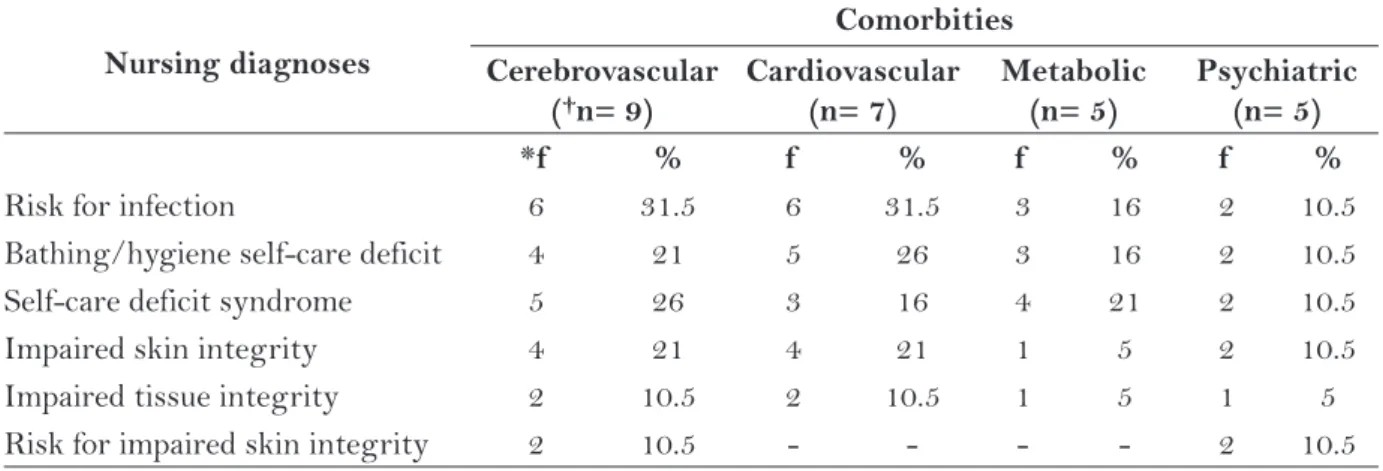
The main reasons for the hospitalization of the 19 patients with PU grade 2 or higher were as-sociated with the three most frequent ND (Risk for infection, Bathing/hygiene self-care deficit, and Self-care deficit syndrome) and with the three ND that described skin/tissue risk or damage ( Im-paired skin integrity, ImIm-paired tissue integrity and Risk for impaired skin integrity) – (Table 2). The main comorbidities of the 19 patients with PU grade 2 or higher were also associated with the three most frequent ND (Risk for infection, Bathing/hygiene self-care deficit, and Self-care deficit syndrome) and with the three ND that de-scribed skin/tissue risk or damage (Impaired skin integrity, Impaired tissue integrity and Risk for impaired skin integrity) – (Table 3).
DISCUSSION
The results of this study showed how reliable the data reported in a PU care quality indicator system were, and the way patients who developed this type of lesion during hospitalization were characterized, using two sources of information for this purpose.
The incidence rate of PU, regardless the grade, identified by the record of signs and symptoms de-scribed in the nursing evolution data of the studied patients was 19% during their hospitalization. Simi-larly, a study developed in a teaching hospital in Belo Horizonte showed a PU incidence of 18.3% among patients in the medical-surgical area(16). Another
Nursing diagnoses
Reasons for hospitalization Cerebrovascular
(†n= 6)
Cardiovascular (n= 6)
Urogenital (n= 6)
Neoplasms (n= 6)
*f % f % f % f %
Risk for infection 1 5 3 16 1 5 2 10.5
Bathing/hygiene self-care deficit 1 5 2 10.5 1 5 3 16 Self-care deficit syndrome 2 10.5 2 10.5 1 5 - -Impaired skin integrity - - 2 10.5 - - 1 5.2 Impaired tissue integrity 1 5 1 5 1 5 1 5 Risk for impaired skin integrity 1 5 - - 1 5 -
-Table 2 – Main reasons for the hospitalization of patients with grade 2 or higher pressure ulcer, associ-ated with the main nursing diagnoses. Porto Alegre, RS, 2008-2011.
†n = total number of patients in each reason for hospitalization associated with at least one of the nursing diagnoses.
study developed in three hospitals in the state of Mato Grosso reported a PU incidence of 25%, 66.6% and 31.7%, however, it included not only clinical and surgical hospitalization units, but also emergency and intensive care units (ICU)(17).
Regarding PU grade 2 or higher, the occur-rence of this complication was observed in 19 (10%) of the 188 studied patients. The overall incidence of this complication in hospitalized patients ranges considerably, oscillating between 0.4 and 38%(4-5).
This variance is probably related to patients’ in-trinsic factors and to exin-trinsic factors, since PU has multifactorial cause. However, it is known that critical patients, such as the ones in ICU, are more vulnerable to this complication(6).
In the light of this, it is understood that the 10% incidence rate found in this study is not the ide-ally acceptable rate, since the goal established by the institution is for the PU incidence to be ≤ 5 ulcers /1000 patients day. In order to achieve this goal, it is necessary to improve the diagnostic accuracy and to qualify preventive nursing interventions(7).
Among the 19 (10%) patients who developed PU grade 2 or higher, only six (3%) were reported by the system of care quality indicator, which dem-onstrates data underreporting and, consequently, the inappropriate use of this tool by the nurses. This represents a low index of communication of cases in the indicator, with information that is still poorly accurate, updated and pertinent to all cases of PU grade 2 or higher(18).
From these facts it is inferred that nurses per-haps still find it difficult to communicate the PU in the system of care quality indicator. Some studies propose that in order to solve these difficulties with clinical records it is fundamental to promote edu-cational programs that qualify health profession-als for the adequate staging and characterization of the PU, diagnostic accuracy and the choice of interventions aimed at the best possible results(2-3).
Confirming this idea, a study developed in
a teaching hospital, in the state of São Paulo
– Brazil, investigated the knowledge of the
nursing team regarding the evaluation,
clas-sification and prevention of pressure ulcers
, evidencing that all professionals in this category presented knowledge deficit regarding the theme and needed permanent education(1). It is
impor-tant to highlight that the hospital that served
as field for the present study aims to improve
the care delivered to patients with risk of PU
through permanent qualification, the use of NP
and care protocols
. Nevertheless, the challenge presented is centered on the issue of how to make nurses aware of the importance of “continuously notify” the care quality indicator, so as to qualify preventive actions(7-8-9).Another study indicates that in order to iden-tify an incident or adverse event more accurately it is important to use other tools that demonstrate greater details and reliability of the searched results.
Nursing diagnoses
Comorbities Cerebrovascular
(†n= 9)
Cardiovascular (n= 7)
Metabolic (n= 5)
Psychiatric (n= 5)
*f % f % f % f %
Risk for infection 6 31.5 6 31.5 3 16 2 10.5 Bathing/hygiene self-care deficit 4 21 5 26 3 16 2 10.5 Self-care deficit syndrome 5 26 3 16 4 21 2 10.5 Impaired skin integrity 4 21 4 21 1 5 2 10.5 Impaired tissue integrity 2 10.5 2 10.5 1 5 1 5 Risk for impaired skin integrity 2 10.5 - - - - 2 10.5
Table 3 – Main comorbidities of patients with grade 2 or higher pressure ulcer, associated with the main nursing diagnoses. Porto Alegre, RS, 2008-2011.
†n = total number of patients in each reason for hospitalization associated with at least one of the nursing diagnoses.
For instance, the use of retrospective research and daily review of medical records and encourage volun-tary reports(14). This idea confirms the importance of
this study, which allowed learning the real situation of PU in the hospital, through the research in differ-ent data sources: nursing evolution data in medical records and records in the PU care quality indicator. The characterization of the sample of patients who developed PU grade 2 or higher revealed a prevalence of women, older adults and patients with a mean period of hospitalization of 11 days, in clini-cal hospitalization units, most of the times. Old age is one of the most relevant factors involved in the PU physiopathogenesis, given the fact that as age advances the skin becomes drier due to the decrease in sweat and sebaceous glands, there is decrease in vascularization, hemodynamic alterations and muscular atrophy, which makes bone structures more prominent(9,19).
Regarding the greater prevalence of PU among women, demographic data indicate that they present greater longevity than men, which leads to a longer period of chronic diseases and, consequently, increase in the mean time of insti-tutionalization. These factors may, to some extent, explain this finding(9,19).
Concerning the main reasons for hospitaliza-tion and comorbidities of patients with PU grade 2 or higher, it was identified that cerebrovascular, cardiovascular, neoplasms, urogenital and meta-bolic diseases, were the most frequent. It is a fact that these diseases are the most prevalent among institutionalized older adults and among those at home as well(19).
Patients suffering from chronic-degenerative diseases, as well as cardiovascular and cerebrovas-cular diseases, present reduced mobility, which com-plicates the development of daily living activities. Patients who suffer a stroke remain bedfast and/ or chairfast for a longer period, which increases their predisposition to PU(9,19). On the other hand,
patients suffering from neoplasms have eating dif-ficulties, because of the disease progression and the adverse effects of the necessary therapy (ra-diotherapy and chemotherapy), which also allows a greater development of PU.
Regarding patients with urogenital diseases, it is known that the prolonged exposure of the skin to moisture, resulting from urinary/intestinal disposal and drainage of fistulae or wounds, may cause maceration in the skin, leading to PU. Hence,
it is extremely important for nurses to be attentive to the patient’s frequent need for hygiene(19,20).
Patients with metabolic diseases often present an unbalanced nutrition, which may lead to underweight and contributes to bone prominences to become more salient, increasing PU risk. However, others may present excess of body fat, which also means PU risk, since the adipose tissue is poorly vascularized and non-elastic, becoming more vulnerable to the pressure and to the development of this lesion(20).
Among the 12 NDs presented by the patients,
Risk for infection, Bathing/hygiene self-care deficit, and Self-care deficit syndrome were the most frequent. These are common ND among hos-pitalized patients, however, they do not constitute, specifically, risk factors for PU(8-9). Therefore, there
seems to be a need to improve the critical thinking of nurses, with the development of evidence-based clinical studies, as well as permanent qualifications that promote the discussion regarding the care practice and the orientation towards the develop-ment of the diagnostic reasoning(8-9).
The ND Impaired skin integrity, Impaired tissue integrity and Risk for impaired skin in-tegrity were not so frequent. However, despite not being specific, they are the closest to the descrip-tion of the risk situadescrip-tion for PU or to the wound itself(8-9,15). It has been emphasized that it is
neces-sary to develop a specific ND to describe the PU risk, with risk factors appropriate to this clinical context, which is so familiar to nursing and requires preventive interventions.
The risk and related factors more frequently established for Impaired skin integrity, Impaired tissue integrity and Risk for impaired skin in-tegrity were “Impaired mobility” and “Immobility”, which is confirmed by the literature as it indicates that immobility reduces the patient’s ability to re-lieve the pressure and increases the probability of prolonged and intense exposure to pressure and, consequently, to the development of PU(8,20).
CONCLUSION
In conclusion, this study evidences the exis-tence of data underreporting in the PU care quality indicator in comparison with the records of nursing evolution in the studied period.
Regarding the implications of this findings to the clinical nursing practice, it was evidenced that although care quality indicators already represent a great advance in the qualification of care, these systems need to be evaluated permanently in health institutions so as to become real care qualifying instruments. Moreover, it is observed that the ana-lyzed nursing evolution data presented important records, with essential clinical evidence to verify the reliability of the development of PU during the hospitalization of patients with risk of developing this complication. The limitation observed in this study was the difficulty to obtain some of the data in medical records, which resulted in the reduction of the sample size.
It was also concluded that the ND established for the patients were found common to the clinical nursing practice, but not as accurate. Thus, the au-thors suggest that they should be studied as a means to improve their accuracy. It was also possible to observe the lack of a specific diagnosis to describe the risk factors or the presence of PU, since all the existing ones comprise risk situations or skin and tissue impairment in a comprehensive way.
Therefore, for the NP and the PU care qual-ity indicator to be used as reliable and safe tools, nurses must be qualified and take responsibility for the improvement of the risk evaluation of their patients, in order to establish accurate ND and early interventions of prevention and treat-ment. Furthermore, these professionals must be involved in administrative and educational actions that promote knowledge, skills and com-petences for the permanent improvement of the nursing care.
REFERENCES
1 Miyazaki MY, Caliri MHL, Santos CB. Knowledge on pressure ulcer prevention among nursing professio-nals. Rev Latinoam Enferm. 2010;18(6):1203-1211.
2 Carson D, Emmons K, Falone W, Preston AM. Deve-lopment of pressure ulcer program across a universi-ty health system. J Nurs Care Qual. 2012;27(1):20-27.
3 Bergquist-Beringer S, Gajewski B, Dunton N, Klaus S. The reliability of the national database of nursing quality indicators pressure ulcer indi-cator: a triangulation approach. J Nurs Care Qual. 2011;26(4):292-301.
4 Faustino AM, Reis PED, Kamada I, Jesus CAC, Izido-rio SR, Ferreira SS. The knowledge of nurses about new descriptors for classification of pressure ulcers: descriptive study. Online Braz J Nurs [Internet]. 2010 [citado 2012 Mar 01];9(1). Disponível em: http://www.objnursing.uff.br/index.php/nursing/ article/view/2800.
5 Apold J, Rydrych D. Preventing device-related pres-sure ulcers using data to guide statewide change. J Nurs Care Qual. 2012;27(1):28-34.
6 Bavaresco T, Medeiros RH, Lucena AF. Implantação da Escala de Braden em uma unidade de terapia intensiva de um hospital universitário. Rev Gaúcha Enferm. 2011;32(4):703-10.
7 Moura GMSS, Juchem BC, Falk MLR, Magalhães AMM, Suzuki LM. Construção e implantação de dois indicadores de qualidade assistencial de enfermagem. Rev Gaúcha Enferm. 2009;30(1):136-140.
8 Santos CT. Indicador de qualidade assistencial e processo de enfermagem como ferramentas de qua-lificação para o cuidado ao paciente com úlcera por pressão [monografia]. Porto Alegre (RS): Escola de Enfermagem, Universidade Federal do Rio Grande do Sul; 2011.
9 Lucena AF, Santos CT, Pereira AGS, Almeida MA, Dias VLM, Friedrich MA. Clinical profile and nur-sing diagnosis of patients at risk of pressure ulcers. Rev Latinoam Enferm. 2011;19(3):523-30.
10 Paranhos WY, Santos VLCG. Avaliação de risco para úlceras de pressão por meio da escala de Bra-den, na língua portuguesa. Rev Esc Enferm USP. 1999;33:191-206.
Author’s address / Endereço do autor / Dirección del autor
Cássia Teixeira dos Santos
Rua Dr. Egydio Michaelsen, 290, Cavalhada 91751-140, Porto Alegre, RS
E-mail: [email protected]
Received: 26.07.2012 Approved: 18.01.2013
12 Klück M, Guimarães JR, Ferreira J, Prompt CA. A gestão da qualidade assistencial do Hospital de Clí-nicas de Porto Alegre: implementação e validação de indicadores. Rev Adm Saúde. 2002;4(16):27-32.
13 Pereira AGS. Cuidados de enfermagem a pacientes em risco para úlcera por pressão [monografia]. Porto Alegre (RS): Escola de Enfermagem, Universidade Federal do Rio Grande do Sul; 2011.
14 Jha AK, Kuperman GJ, Teich JM, Leape L, Shea B, Rittenberg E, et al. Identifying adverse drug events: development of a computer-based monitor and comparison with chart review and stimula-ted voluntary report. J Am Med Inform Assoc. 1998;5(3):305-314.
15 North American Nursing Diagnosis Association – International (NANDA-I). Diagnósticos de enfer-magem da NANDA: definições e classificação 2012-2014. Porto Alegre: Artmed; 2013.
16 Sales MCM, Borges EL, Donoso MTV. Risco e pre-valência de úlceras por pressão em uma unidade de internação de um hospital universitário de Belo Hori-zonte. REME: Rev Min Enferm. 2010;14(4):566-575.
17 Costa, IG. Incidência de úlcera por pressão em hos-pitais regionais de Mato Grosso, Brasil. Rev Gaúcha Enferm. 2010;31(4):693-700.
18 Schout D, Novaes HMD. Do registro ao indicador: gestão da produção da informação assistencial nos hospitais. Ciênc Saúde Coletiva. 2007;12(4):935-944.
19 Figueiredo MLF, Luz MHBA, Brito CMS, Sousa SN, Silva DRS. Diagnósticos de enfermagem do idoso acamado no domicílio. Rev Bras Enferm. 2008;61(4):464-9.