Prevalence of bruxism and emotional
stress and the association between them
in Brazilian police officers
Abstract: This study aimed to assess the prevalence of bruxism and emotional stress in Brazilian police oficers, due to exposure to stressful situations, and to assess the relationship between the type of work done by a police oficer and the presence of bruxism and emotional stress. A cross-sectional study was conducted at the Military Police of the State of São Paulo, Campinas, SP, Brazil. The inal sample included 394 male police oficers (mean age = 35.5 years). Bruxism was diagnosed by the presence of aligned dental wear facets associated with the presence of one of the following signs or symptoms: self-report of tooth-grinding, painful sensitivity of the masseter and temporal muscles, discomfort in the jaw musculature upon waking. The Stress Symptoms Inventory (SSI) was applied to evaluate emotional stress. The type of work done by the police was classiied as organizational or operational, the latter being as-sumed as the more stressful since it exposes the police oficer to life risk. The results showed a prevalence of bruxism of 50.2% and a prevalence of emotional stress of 45.7%. The Chi-square test indicated an associa-tion between stress and bruxism (P< .05). No signiicant association was found between emotional stress and type of work (P =.382) or between bruxism and work activity (P =.611). It could be concluded that emo-tional stress was associated with bruxism, independently of the type of work done by police oficers.
Descriptors: Bruxism; Stress, psychological; Police. Andréa Lúcia de Almeida
Carvalho(a)
Altair Antoninha Del Bel Cury(b)
Renata Cunha Matheus Rodrigues Garcia(b)
(a)Graduate Student; (b)PhD, Professor – Department of Prosthodontics and Periodontology, Piracicaba Dental School, State University of Campinas (UNICAMP), Piracicaba, SP, Brazil.
Corresponding author:
Renata Cunha Matheus Rodrigues Garcia Departamento de Prótese e Periodontia Faculdade de Odontologia de Piracicaba, Universidade de Campinas (UNICAMP) Av. Limeira, 901
Piracicaba - SP - Brazil CEP: 13414-903
E-mail: [email protected]
Introduction
The etiology of bruxism is controversial and it has still not been possible to establish a direct cause and effect relationship for setting off this parafunc-tional activity.1 Three main etiological factors are
involved in bruxism: morphological, patho-physi-ological and psychpatho-physi-ological factors.2 Morphological
factors are related to occlusion and articular dishar-mony; patho-physiological factors include smoking, alcohol and drugs.
The psychological factor is related to depression, anxiety and emotional stress, which play an impor-tant role in starting and perpetuating bruxism, as well as in its frequency, and severity.3-5 Manfredini
et al.6 (2004) found an association with anxiety, and
with depressive and manic symptoms in bruxers. It is also believed that depressed, anxious and emotion-ally stressed individuals present a greater predisposi-tion for developing bruxism, mainly during sleep, as a response to releasing daily emotional stress.7
Con-versely, other studies suggest that there is no relation-ship between sleep bruxism and stress, as reported by Watanabe et al.8 (2003) and Pierce et al.9 (1995).
The role of work-related stress in physical health in police oficers has long been a matter of concern. Police oficers have been reported to have higher rates of cardiovascular and gastrointestinal disor-ders, divorce rates twice the national average, and suicide rates three times the national average.10-12
They are exposed to many different types of stress that may affect sleep quality and physical health, such as physical injury, injuring others in the line of duty, and witnessing death or injuries to other of-icers and civilians. The impact of this high rate of exposure on emotional health has long been a sig-niicant public health concern.13
In addition, police oficers are exposed to chron-ic non-traumatchron-ic stress arising from the demands of their work environment. Therefore, it can be hy-pothesized that police oficers engaged in operation-al activities, which include exposure to danger and risk of life, would be more stressed and would pres-ent more general bruxism than police oficers who work in organizational or bureaucratic activities, who are supposedly exposed to a lower stress level.
This study aimed (1) to investigate the prevalence
of bruxism and emotional stress and the association between them in male police oficers; (2) to assess the association between the type of work done by police oficers and bruxism and emotional stress.
Material and Methods
A cross-sectional study was conducted. A total of 700 police oficers from the Military Police of the State of São Paulo, in the city of Campinas, SP, Bra-zil, were examined, and according to the inclusion criteria, only 394 were selected (mean age = 35.5). They signed a consent form, approved by the local ethical committee.
The selection criteria was: to be dentate with a minimum presence of 26 teeth, including third mo-lars, not to have made use of interocclusal applianc-es in the last 12 months and prapplianc-esent good general health. The exclusion criteria included police oficers presenting 1) temporomandibular joint dysfunction (TMJ) or orofacial problems, 2) absence of posterior dental support, 3) severe periodontitis, 4) deciduous teeth, complete or partial removable prostheses, 5) irreversible treatment for TMJ, 6) history of alco-hol, drug or medication abuse, with possible effects on sleep or motor behavior, and 7) psychiatric or neurological disturbances as indicated by the medi-cal charts of each police oficer. After selection, the volunteers were submitted to a psychological assess-ment and clinical examination.
Psychological assessment
The actual presence or absence of stress was identiied using a validated questionnaire, the Stress Symptoms Inventory (SSI).14
psychological symptoms, experienced by the volun-teer in the last month.
The police oficers had to participate in all three of the SSI sessions and answer all the questions. The score was calculated by adding one point for each positive answer from each session. Police oficers that presented scores above 6 for the alert stage, or up to 3 for resistance, or up to 8 for the exhaustion stage were considered to be stressed.14
Anamnesis and clinical examination
Subjects illed out a clinical card composed of data on identiication and type of work currently carried out at the general headquarters, whether it was organizational or operational work. Organiza-tional work was considered to be that of a bureau-cratic nature carried out inside the headquarters; and operational duties as being those activities car-ried out outside the headquarters, such as highway and forestry policing and patrolling roads and pris-ons. These activities expose police oficers to per-sonal aggressions that would supposedly be more stressing than bureaucratic work, since they could place the police oficers’ very lives at risk.
The presence of discomfort in the masticatory muscles upon waking, and any self-report of tooth grinding in the last four weeks were also registered.
The clinical exam was carried out by a single re-searcher, who did not have access to the police of-icers’ replies during the psychological assessments and clinical cards. Bruxism was diagnosed by the presence of aligned worn facets on the anterior and/or posterior teeth during protrusion and later-al movements of the mandible. Wear facets should present score 1, 2 or 3 in accordance with the or-dinal scale of wear severity.15 Besides, to be
consid-ered as bruxist, subjects should present at least one of the following criteria: grinding bruxism sounds during sleep and/or while awake for a recent four week period, as noted by his bed partner or room-mate; painful sensitivity upon touching the mastica-tory masseter and/or temporal muscles, discomfort in the jaw musculature upon waking.1
Statistical analysis
The data on bruxism and stress as well as a
com-parison made of the prevalence of stress in subjects with and without bruxism were analyzed using the Chi-square test with a signiicance level of 5%.
Results
The prevalence of bruxism in the 394 selected police oficers was 50.25% (n = 198), of whom only 64.6% were aware of the presence of this para-function. The presence of emotional stress was re-corded in 45.69% (n = 180) of them, and among the stressed police oficers almost half (48.3%) reported grinding their teeth while asleep and/or awake.
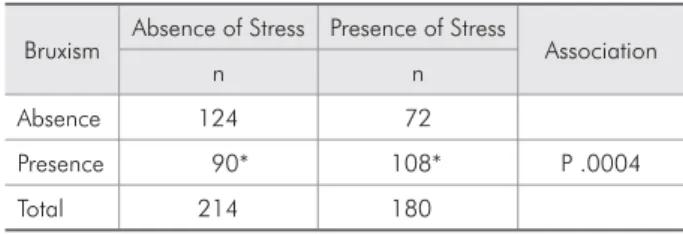
Signiicant association (P =.0004) was found be-tween the presence of emotional stress and bruxism among police oficers (Table 1).
No signiicant difference (P =.382) was found for the association between stress and type of work (Table 2). There was also no signiicant difference (P =.611) in the association between bruxism and type of work (Table 3).
Discussion
This study attempted to assess the relationship between general bruxism behavior and emotional stress by evaluating a speciic population composed
Table 2 - Association between emotional stress and police officers’ type of work.
Stress
Type of Work
Total Organizational Operational
n n
Absence 58 156 214
Presence 56 124 180
Total 114 280 394
Chi-square = .764; P-Value = .382.
Table 1 - Presence of bruxism and emotional stress and the association between them among police officers (n = 394).
Bruxism Absence of Stress Presence of Stress Association
n n
Absence 124 72
Presence 90* 108* P .0004
Total 214 180
of police oficers who perform organizational or op-erational duties.
Some authors emphasize the importance of dis-criminating between sleep-related bruxism and bruxism during wakefulness, because both types may have a different etiology4,16,17 and may
inlu-ence correlation studies.16 According to Manfredini
et al.18,19 (2005), sleep- and awake-bruxism seem
to have different pathogeneses and they are hard to be clinically discriminated. Polysomnography rep-resents the standard of reference for the diagnosis of sleep bruxism, but its use is limited by its high cost.18,19 The present study considered bruxism in
general, because the population studied could be considered to be more stressed than the public in general, and most of the related articles18,19 do not
distinguish adequately between the two phenomena. The prevalence of bruxism (50.2%) in this study was found to be lower than that found by Wigdoro-wicz-Makowerowa et al.20 (1979), who observed a
prevalence of 58.7% in 20 to 45 year-old soldiers. However, their bruxism frequency calculation took into consideration the bruxism associated with TMJ. This study excluded police oficers presenting TMJ, which may explain the results found.
Irrespective of their work, the prevalence of stress among the police oficers was 45.7% (Ta-ble 1), which is in agreement with the results of Col-lins, Gibbs21 (2003) who found 41% of police
ofi-cers with stress-related mental ill-health. However, these data differ from those obtained by Bültmann et al.22 (2002) who studied a working population
and found psychological distress in 25.42% of the sample. Thus, it would appear that when comparing the two, the proportion of police oficers presenting
stress is the double of that of the general population, supporting the idea that their occupation is gener-ally perceived as being highly stressful.13
The prevalence association between emotional stress in police oficers and bruxism was statisti-cally signiicant (P = .0004). It was also found that 36.7% of non-bruxist police oficers (n = 196) pre-sented emotional stress, while in the bruxist group (198) the percentage rose to 54.5%. Although the frequency of emotional stress in police oficers with bruxism was higher than that in those without bruxism, these results did not indicate a cause and effect relationship between emotional stress and bruxism (Table 1).
A similar result was observed by Pingitore et al.7
(1991), who found stress to be signiicantly related to general bruxism. In contrast, Pierce et al.9 (1995)
found no overall relationship between electromyo-graphic measures of sleep bruxism and self-reported stress. Watanabe et al.8 (2003) demonstrated that
sleep bruxism behaviors are not highly inluenced by day-to-day stress. However, the selected subjects for their studies included civilians, which could be considered as being a less stressful population when compared to the police oficers.
The association between bruxism and emotion-al stress is still present irrespective of the type of work carried out by the police oficer. This was to be expected since the studied population is consid-ered to be more stressful than the general working population.21,22
Although there was greater prevalence of emo-tional stress observed in police oficers with bruxism, some of them perform organizational duties, such as managerial structure, which one would assume to be less stressful. Thus, according to the hypothesis, police oficers carrying out operational duties, being more exposed to confrontation, violence and day-to-day involvement in a variety of traumatic incidents, would present a greater prevalence of emotional stress – and consequently bruxism – than those who do organizational work, who are less subject to risks.
However, no signiicant association (P> .05) was found between emotional stress and the police ofi-cers’ work, or between bruxism and the police of-icers’ work (Tables 2 and 3). A possible explanation Table 3 - Association between bruxism and police officers’
type of work.
Bruxism
Type of Work
Total Organizational Operational
n n
Absence 59 137 196
Presence 55 143 198
Total 114 280 394
refers to the sources of emotional stress in the police oficers, which are related to two large groups: na-ture of the work and nana-ture of the police organiza-tion.23 Thus, one should consider that although the
police oficer who carries out organizational work is not so exposed to personal risks, he is constantly facing up to internal pressures such as the headquar-ters hierarchy and rigid discipline, which may set off the occurrence of emotional stress. In this sense, ac-cording to some authors21,24-27, it is not operational
aspects, such as risk of violence or exposure to trau-matic events, which are perceived as most stressful,
but rather, organizational aspects such as the mana-gerial structure and work atmosphere.
Furthermore, while studying the police popula-tion in different countries, these authors came up with similar indings, which could lead one to sup-pose that the issue most associated with police stress is the same.
Conclusions
Within the limitations of this study, emotional stress was associated with bruxism, independently of the type of work done by the police oficer.
References
1. Lavigne GJ, Rompré PH, Montplaisir JY. Sleep bruxism: va-lidity of clinical research diagnostic criteria in a controlled polysomnographic study. J Dent Res. 1996;75(1):546-52. 2. Lobbezoo F, Naeije M. Bruxism is mainly regulated centrally,
not peripherally. J Oral Rehabil. 2001;28(12):1085-91. 3. Arnold A. Bruxism and the occlusion. Dent Clin North Am.
1981;25:395-407.
4. Rugh JD, Harlan J. Nocturnal bruxism and temporoman-dibular disorders. Adv Neurol. 1988;49:329-41.
5. Tsai CM, Chou SL, Gale EN, McCall Jr WD. Human masti-catory muscle activity and jaw position under experimental stress. J Oral Rehabil. 2002;29(1):44-51.
6. Manfredini D, Landi N, Romagnoli M, Bosco M. Psychic and occlusal factors in bruxers. Aust Dent J. 2004;49(2):84-9. 7. Pingitore G, Chrobak V, Petrie J. The social and psychologic
factors of bruxism. J Prosthet Dent. 1991;65(3):443-6. 8. Watanabe T, Ichikawa K, Clark GT. Bruxism levels and daily
behaviors: 3 weeks of measurement and correlation. J Orofac Pain. 2003;17(1):65-73.
9. Pierce CJ, Chrisman K, Bennett ME, Close JM. Stress, an-ticipatory stress, and psychologic measures related to sleep bruxism. J Orofac Pain. 1995;9(1):51-6.
10. Axelbend M, Vaile J. South Florida’s approach to police stress management. Police Stress. 1979;1:13-4.
11. Blackmore J. Are police allowed to have problems of their own? Police Mag. 1978;1:47-55.
12. Violanti JM. Police suicide: epidemic in blue. Springfield: Charles C Thomas; 1996.
13. Neylan TC, Metzler TJ, Best SR, Weiss DS, Fagan JA, Liber-mam A et al. Critical incident exposure and sleep quality in police officers. Psychosom Med. 2002;64(2):345-52. 14. Lipp MEN, Guevara AJH. Empiric validation of stress
symp-toms inventory (SSI). Estud Psicol. 1994;11:43-9.
15. Pigno MA, Hatch JP, Rodrigues Garcia RC, Sakai S, Rugh JD. Severity, distribution, and correlates of occlusal tooth wear
in a sample of Mexican-American and European-American adults. Int J Prosthodont. 2001;14(1):65-70.
16. Glaros AG. Incidence of diurnal and nocturnal bruxism. J Prosthet Dent. 1981;45(5):545-9.
17. Ramfjord SP. Bruxism, a clinical and electromyographic study. J Am Dent Assoc. 1961;62:21-44.
18. Manfredini D, Ciapparelli A, Dell’Osso L , Bosco M. Mood disorders in subjects with bruxing behavior. J Dent. 2005;33(6):485-90.
19. Manfredini D, Landi N, Fantoni F, Segù M, Bosco M. Anxiety symptoms in clinically diagnosed bruxers. J Oral Rehabil. 2005;32(8):584-8.
20. Wigdorowicz-Makowerowa N. Epidemiological studies on prevalence and etiology of functional disturbances of the masticatory system. J Prosthet Dent. 1979;41(1):76-82. 21. Collins PA, Gibbs ACC. Stress in police officers: a study of
the origins, prevalence and severity of stress-related symptoms within a county police force. Occup Med. 2003;53(4):256-64.
22. Bültmann U, Kant I, Kasl SV, Beurskens AJ, van der Brandt PA. Fatigue and psychological distress in the working popula-tion: psychometrics, prevalence, and correlates. J Psychosom Res. 2002;52(6):445-52.
23. Spielberg CC, Westberry LG, Grier KS, Greenfield G. The police stress survey: sources of stress in law enforcement. Tampa (FL): Human Resources Institute; 1981.
24. Kirkcaldy B, Cooper CL, Ruffalo P. Work stress and health in a sample of U.S. police. Psychol Rep. 1995;76(2):700-2. 25. Kroes WH, Gould S. Job stress in policemen: an empirical
study. Police Stress. 1979;1:9-10.
26. Violanti JM, Aron F. Ranking police stressors. Psychol Rep. 1994;75(2):824-6.