*Correspondence: M. Vitolo. Department of Biochemical and Pharmaceutical Technology, Faculty of Pharmaceutical Sciences, University of São Paulo. Av. Prof. Lineu Prestes, 580, B.16, 05508-900 - São Paulo - SP, Brazil. E-mail: [email protected]
A
rti
Pharmaceutical Sciences vol. 46, n. 3, jul./set., 2010
Inverted sugar syrup attained from sucrose hydrolysis using a
membrane reactor
Ester Junko Tomotani, Michele Vitolo*
Department of Biochemical and Pharmaceutical Technology, Faculty of Pharmaceutical Sciences, University of São Paulo
Invertase, whether adsorbed on styrene-divinylbenzene copolymers or otherwise, was used for continuous sucrose hydrolysis using a cell-type membrane reactor (CTMR), coupled with an ultra (UF-100kDa), or a microiltration (MF- pore diameter of 5 µm) membrane. In all tests, the pH (5.5), temperature (30 °C), reaction volume (10 mL) and agitation (100 rpm) were set constant; whereas, variable parameters were: feeding rate (0.4, 0.8 and 1.6 h-1), inlet sucrose concentration (2.5, 6.5, 50 and 100 mM) and enzyme/
resin ratio (1.64 mg or 3.28 mg of protein per 25, 50 or 100 mg of resin). The best result (yield of 100%, steady-state duration over 20h and speciic reaction rate over 243 x 10-3 mmol/h.m
E) was obtained when
insoluble invertase (1.64 mg protein/100 mg resin) was used to convert 50 mM or 100 mM of sucrose solution at 0.4 h-1 using a UF-CTMR.
Uniterms: Sucrose. Invert sugar. Membrane reactor.
Invertase, na forma adsorvida ou não em copolímeros de estireno-divinilbenzeno, foi usada para a hidrólise contínua de sacarose utilizando um reator com membrana (RM), acoplado a uma membrana de ultrailtração (UF-100kDa), ou de microiltração (MF - um diâmetro de poro de 5µm). Em todos os testes, o pH (5,5), a temperatura (30°C), o volume reacional (10mL) e a agitação (100 rpm) foram mantidas constantes; os parâmetros variados foram: a vazão de alimentação (0,4; 0,8 e 1,6 h-1), a concentração de
sacarose alimentada (2,5; 6,5; 50 e 100 mM) e a relação enzima/resina (1,64 mg ou 3,28 mg de proteína por 25, 50 ou 100 mg de resina). O melhor resultado (um rendimento de 100%, um período de estado estacionário acima de 20h e uma taxa de reação especíica maior de 243 x 10-3 mmol/h.m
E) foi obtido
quando a invertase insolúvel (1,64 mg de proteína/100 de mg resina) foi usado para converter 50 mM ou 100 mM de solução de sacarose a 0,4 h-1 usando UF-RM.
Unitermos: Sacarose. Açúcar invertido. Reator com membrana.
INTRODUCTION
There is increasing interest in the applications of enzymes. Due to their advantages compared with conven-tional chemical catalysts, enzymes´ selective and speciic processes under very mild conditions allow the obtention of products of commercial interest with less toxic and pollutant efluents (Tomotani et al., 2005). The advent of immobilization technique in the 1960s represented a great step forward in enzyme technology, leading to the re-utilization of the enzyme and the use of continuous reactors. Therefore, new and/or more puriied products,
such as, inverted sugar syrup, aspartame, high-fructose-corn syrup, L-amino acids, lactose-free whey, and 6-amino penicillanic acid have become commercially available (Godfrey, West, 1996). Among these products, the hy-drolysis of sucrose to produce inverted syrup deserves special attention. It is used as a sweetener, carbon source in fermentation processes, and as a raw material to obtain chemicals, such as glucose, fructose, gluconic acid, sorbi-tol and oligosaccharides (Erzinger, Visorbi-tolo, 2006).
submitted to low pH and high temperature – which must be removed from the inal product before its commercializa-tion. In spite of the obligatory submission of the acid-attai-ned syrup to a downstream procedure, the increase in the overall process cost is compensated by the less expensive hydrochloric acid used as a catalyst. Currently however, a concern over environmental spoilage as well as pollution has led us to the search for alternatives to minimize these detrimental outcomes. Thereby, the application of invertase becomes useful because it is available in the market, obtai-ned from baking and/or brewer’s yeasts – microorganisms fully accepted by the sanitation authorities all over the world and widely applied by the food industry – and used as an analytical tool (biosensors) and in confectionary (Said, Pietro, 2004).
Although the acid can be replaced by invertase for the sucrose hydrolysis, it becomes costly to do so. Con-sequently, the use of immobilized invertase would be a viably practical alternative (Said, Pietro, 2004).
Among many methods for enzyme immobilization, adsorption on ionic resins (such as Dowex® resins) is one of the most simple and suitable procedures (Tomotani, Vi-tolo, 2004) - after the end of the reaction, both the enzyme and the support are easily recovered for further re-use.
Another approach would be using a continuous reactor such as a membrane reactor (MR). This device can be formed either by coupling the stirred tank in series with a membrane iltration cassette (bi-module MR) or by placing the membrane at the bottom of the stirred vessel (cell-type MR). It can operate with ultrailtration or micro-iltration membrane depending on the form of the enzyme employed, i.e., soluble or immobilized, respectively. The type of membrane to be chosen could also depend on the desired dilution rate to be used throughout the continuous reactor. The microiltration membrane may be selected when a high dilution rate is preferred, as mentioned in previous work (Tomotani, Vitolo, 2006).
In this study, invertase was immobilized in styrene-divinylbenzene copolymers – a class of anionic resins, widely used in water desalinization and ion exchange chromatography (Tomotani, Vitolo, 2005) - for continuous sucrose hydrolysis. This procedure, which included both soluble and immobilized invertase, was carried out in a cell-type MR coupled with an ultra or microiltration membrane.
MATERIAL AND METHODS
Material
Invertase (β-D-fructofuranosidase, EC.3.2.1.26), commercially known as Bioinvert®, was purchased from
Quest International (São Paulo, SP, Brazil). One milliliter of original invertase solution corresponds to 120 units. One Unit (U) is deined as the amount of invertase activity that results in one milligram of total reducing sugars (TRS) per minute from 200mM sucrose at initial concentration at 37oC and pH 5.5 (Tomotani, Vitolo, 2005). The kinetic constants, Vmax and KM, for the soluble invertase were 0.0240 U/mL and 17.0 mM, respectively (Tomotani, Vi-tolo, 2006). The Dowex® 1X4:200 resin and BSA (Bovine Serum Albumin) were purchased from Sigma Chemical Co. (St. Louis, MO, USA). The 100kDa-UF-membrane (PLHK07610) and the MF-membrane (TMTP09030, pore diameter of 5 µm) made of regenerated cellulose were
purchased from Millipore (Bedford, MA, USA). Other chemicals used were analytical grade.
Methods
Standard procedure for immobilization
Immobilizing invertase through adsorption on anionic-polystyrene beads (Dowex®-1X4:200 resin) was described elsewhere (Tomotani, Vitolo, 2004). An amount of Dowex®-1X4:200 resin (25 mg, 50 mg or 100 mg), previously equilibrated for 24h in deionized water (pH 5.5; 32oC and agitation of 100 rpm), was mixed with 3 mL of invertase solution containing 1.64 mg or 3.28 mg of protein, and then the system was left for 4h at pH 5.5, 32oC and agitation of 100 rpm. The resin-invertase complex was then centrifuged (2880g, 30min), rinsed three times with deionized water, and the inal suspension stored at 4oC in deionized water. One milligram of resin-invertase complex (RIC) had a total activity of 3.6U. The activity of immobilized invertase was measured by mixing 108 mL of sucrose solution (120g/L in 0.010M acetate buffer, pH 5.5) with 12 mL of an aqueous suspension of RIC. Hydrolysis was carried out for 6 min at 37oC under agitation (100 rpm), as previously described (Vitolo et al., 1995). One immobilized invertase unit was deined as the amount of total reducing sugars (mg) formed per minute under the test conditions. The kinetic constants, (Vmax)app and (KM) app, for the immobilized invertase were 0.0450 U/mL and 18.3 mM, respectively (Tomotani, Vitolo, 2006). Under the conditions cited, the immobilization yield was 100%.
Membrane reactor
ster-ilized (autoclave up to 134oC for 30 min) and can resist high temperatures (up to 150oC) and corrosion by most substances (except strong acids, pH <1.0; and alkalis, pH > 12.0). Moreover, it has a safety valve (set to nominal six-bar pressure limit) and can be coupled to a dosing pump, a pressure probe, a sterile ilter, and a bubble trap (Tomotani, Vitolo, 2007).
Membrane-reactor tests
Ten milliliters of buffered solution (0.01M acetic acid/acetate buffer, pH 5.5) containing soluble or immobi-lized invertase, both at a total activity of 36U, was poured into the MR, whose bottom was itted with a 100kDa-UF-membrane or 5 µm-MF-membrane. The reactor was fed
continuously (feeding rates (D) of 0.4 h-1, 0.8 h-1 or 1.6 h-1) with a sucrose solution (2.5 mM, 50 mM or 100 mM). The reaction was carried out for 25h at 30oC and at an agitation of 100 rpm. The concentration of TRS as well as soluble protein was determined from the aliquot samples taken from the outlet solution. None of the tests performed pre-sented protein leakage from the MR. The yield (Y) and the speciic reaction rate (r) were calculated according to Eqs. (1) and (2), respectively. A total of thirteen tests were
performed – each done in duplicate – using the operational conditions presented in Table 1.
Y (%) = 0.95x[TRS] ÷ (S)0 (Eq.1)
r (mmol/h.mE) = (Q x [TRS]) ÷ mE (Eq.2)
Where: [S]0 = inlet sucrose concentration (mM); [TRS] = outlet total reducing sugars concentration (mmol/L) ; Q = volumetric rate (L/h); mE = weight of protein (mg).
Analytical techniques
• Protein determination
Protein was determined based on the difference between UV absorbance measured at 215 nm and at 225 nm, using 0.1 mg/mL bovine serum albumin solution as a standard (Segel, 1976). To establish the standard curve, the concentration of BSA was varied from 0.01 to 0.1 mg/mL.
• Measurement of total reducing sugars (TRS)
The TRS were measured by the conventional
Somo-TABLE I - Conditions under which all continuous experiments were conducted and their respective average conversion (Y), speciic reaction rate (r) and steady-state duration (tst) attained. The temperature (30oC) and agitation (100 rpm) were kept constant. In test 8 an MF-membrane (pore diameter of 5 µm) was used, whereas an UF-membrane (100 kDa) was used in all other tests.
TEST
(n.) PROTEIN (mg) RESIN (mg) SUCROSE (mM) (hD -1) (mmol/h.mr
E)x103
Y
(%) (h)tst
1(a) 1.64 - 2.5 1.6 49 100 25
2(a) 3.28 - 2.5 1.6 24 100 25
3 1.64 25 2.5 1.6 -(b) -
-4 1.64 50 2.5 1.6 - -
-5 3.28 25 2.5 1.6 - -
-6 3.28 50 2.5 1.6 24 100 10
7 1.64 100 2.5 1.6 36 95 20
8 1.64 100 2.5 1.6 50 100 25
9(c) 1.64 100 6.5
6.5 6.5
0.4 0.8 1.6
32 46 114
100 73 90
10 15 20
10 1.64 100 50 0.4 243 100 22
11 1.64 100 50 0.8 439 90 23
12 1.64 100 50 1.6 585 60 25
13(d) 1.64 100 50
100 0.40.4 244488 100100 2020
gyi method, using a 0.2 mg/mL (w/v) glucose pA solution as a standard (Arruda, Vitolo, 1999). To establish the standard curve, the concentration of glucose was varied from 0.04 to 0.20 mg/mL.
RESULTS AND DISCUSSION
In a previous study (Tomotani, Vitolo, 2004), it was shown that the Dowex-1X4-200 resin adsorbed invertase thoroughly. In the present study, resin-invertase complexes (RIC) were prepared by combining different amounts of invertase (1.64 mg and 3.28 mg, in terms of protein) and resin (25, 50 and 100 mg), in order to verify their catalytic performance in a membrane reactor. The main results are presented in Table 1 and Figures 1 and 2.
In Table 1, it can be seen that the reaction rate varied from 24x10-3 mmol/h.m
E (tests 2 and 6) to 585x10-3mmol/h.
mE (test 12), and that unsteady-state regimes occurred in tests 3, 4 (Figure 1) and test 5 (Figure 2). The yield of su-crose hydrolysis was near 100% (Table 1) for tests in which the reactor was fed with 2.5 mM sucrose solution and the steady-state remained for at least 20 h (tests 1, 2, 7 and 8). Out of tests 3-8, carried out with insoluble invertase, only 7 and 8 (RIC consisting of enzyme/resin ratio of 1.64 mg of protein/100mg of resin) presented the best results in terms of the speciic reaction rate, the yield and the steady-state duration. Tests 7 and 8 also differed on the type of mem-brane coupled to the reactor, i.e., a 100-kDa-UF-memmem-brane (test 7) and a 5µm-MF-membrane (test 8). Focusing on the values of specific reaction rates of both tests (Table 1), test 7 presented a reaction rate about 28% lower than that of test 8. This is in accordance with previous indings of Tomotani, Vitolo (2007), in which the speciic reaction rate for the test carried out with UF-membrane (reaction conditions: 0.0164 mg protein/mg of resin; 30oC, pH 5.5, 100rpm, 2.5mM sucrose and 1.6h-1) was approximately 15% lower than that of the test done with MF-membrane under the same conditions. The hindrance to the outlet lux caused by the MF-membrane was probably lower than that caused by the UF-membrane. However, this rate difference could also result from the fact that different membranes have different back-pressures, insofar as these experiments were pump-driven. In the literature, the importance of this result in the scaling-up of the process has been reported where in contrast to the case of UF-membrane, by using the MF-membrane, high outlet lux can be attained with low or zero pressurization of the reactor (Tomotani, Vitolo, 2006). Undoubtedly, the data presented in Table I – par-ticularly tests 3-8, which differed on the enzyme/resin ratio – led to the conclusion that a compromise between the amounts of enzyme and resin must be established (in this case, 1.64 mg of protein/100mg of resin), considering an optimized sucrose hydrolysis using a membrane reac-tor. By using a certain enzyme/resin ratio, the continuous process (through a membrane reactor, in the present case) may or may not occur in a consistent steady-state regime (Figure 1). In addition, the effect of enzyme to substrate ratio on the speciic reaction rate (r) and on the duration of the steady-state regime can also be ascertained by compa-ring tests 6 (3.28 mg of protein to 2.5mM sucrose) and 7 (1.64 mg of protein to 2.5mM sucrose) (Table I).
As shown in Table I, in tests 3, 4 and 7, the enzyme/ resin ratio was 1.64mg of protein to 25mg, 50mg and 100mg of resin, respectively. However, test 7 presented the highest yield (95%) and reaction rate (36x10-3mmol/h. mE) as well as a tst of 20h (Table I and Figure 1). No en-zyme leakage from the carrier was detected for any of the enzyme/resin proportions studied (data not shown). FIGURE 1 - Variation in conversion during continuous sucrose
hydrolysis catalyzed by soluble invertase [test 1 ()] and immobilized invertase [test 3 (); test 4 () and test 8 ()]. In all tests, the protein loading was equal to 1.64 mg/mL.
It can be concluded that a higher amount of the resin (in this case 100mg) offered the most adequate surface area to accommodate the enzyme molecules.
Speciically in the case of invertase – an enzyme which presents a quaternary structure level constituted by two inter-twisted glycoprotein chains held together by weak chemical bonds – the molecules, which are natural dimmers, can aggregate forming more complex structures (tetramers, hexamers and octamers) (Reddy, MacColl, Maley, 1990). It was also demonstrated that the aggrega-tes are in equilibrium in solution (dimmers D tetramers D hexamers D octamers), their catalytic activity and the overall negative charge grow as the degree of aggregation increases (Reddy, MacColl, Maley, 1990). Thereby, a high amount of resin implies more particles available to attach high molecular weightaggregates (mainly, hexamers and octamers), resulting in more active resin/enzyme com-plexes. Conversely, high enzyme/resin ratio (over 0.0164 mg of protein/mg of resin) would lead the octamers to imbricate on the surface of resin beads, resulting in a less active invertase-DOWEX complex.
The effects of substrate concentration and feeding rate (D) on sucrose hydrolysis by invertase conducted in a membrane reactor were therefore focused on the best selected enzyme/resin ratio.
In Figure 3, the feeding rate signiicantly affects the yield of sucrose conversion, which oscillated between 70% and 100% as D varied from 0.4 h-1 to 1.6 h-1. The steady-state was always observed at different yield (Y) values. Such a response from a continuous reactor (particularly in a membrane reactor) is a clear indication of its suitability for sucrose hydrolysis. A similar pattern was also obser-ved in tests 10-12, in which 50 mM sucrose solution was hydrolyzed under the same D values (Table 1). However,
when the reactor was fed with a 50 mM sucrose solution, the yield diminished as the dilution rate increased. This corroborates the data published by Tomotani, Vitolo (2007), which stated that in a cell-type-MR fed with sucro-se solution at concentrations over 12.5mM, the yield and feeding rate were inversely correlated. This is a plausible behavior considering that a high D implies low residence time, reducing the contact time between the enzyme and substrate. This critical situation occurs when the inlet sucrose concentration is increased.
Regarding the specific reaction rate (r), Table 1 (tests 9-12) shows that under ixed sucrose concentration (test 9: 6.5 mM, and tests 10-12: 50 mM) its value always increased with D. For these tests, a four-fold increase in D (from 0.4 h-1 to 1.6 h-1) led to an approximate 3.5- (test 9) and 2.4- (tests 10-12) fold augmentation in the speciic reaction rate. The high feeding rate leading to a high speciic reaction rate or vice-versa might be due to the fact that the interaction invertase/sucrose was dimin-ished by better removal of the products. This relationship could be indirectly explained by comparing tests 7 (Y = 95% and r = 36x10-3mmol/h.m
E) and 8 (y = 100% and r = 50x10-3 mmol/h.m
E), in which the only difference between them was the type of the membrane used (Table 1). The MF-membrane (test 8) has far larger pores than the UF-membrane (test 7). Therefore the microiltration membrane might cause less constraint on the mass lux throughout the reactor, leading to the high conversion yield (100%) and increase in speciic reaction rate (around 28%). Moreover, the improvement of the lux throughout the membrane reactor could also explain the high stabil-ity and equal duration (25h) of the steady-state observed in test 1 (soluble invertase and UF-membrane) and test 8 (insoluble invertase and MF-membrane) (Table 1).
According to the previous argument, both feeding rate and inlet substrate concentration are important param-eters to optimize the operation of the membrane reactor. Other factors which must be observed, i.e., temperature and pH have been studied previously (Tomotani, Vitolo, 2007). Further evaluations of the membrane reactor at highest values of feeding rate and sucrose concentration must be assessed, if a future industrial application is to be considered.
The following points represented the intrinsic limita-tion of the membrane reactor used. The small operalimita-tional volume of the reactor restricts the use of D over 1.6 h-1. The narrowness of the Telon tubes may reduce the low of sucrose solution when its concentration increases due to its viscosity (sucrose solution over 100 mM).
To clarify the perspective of the scale-up process, an exploratory assay was designed (test 13), in which the FIGURE 3 - Variation in conversion during continuous sucrose
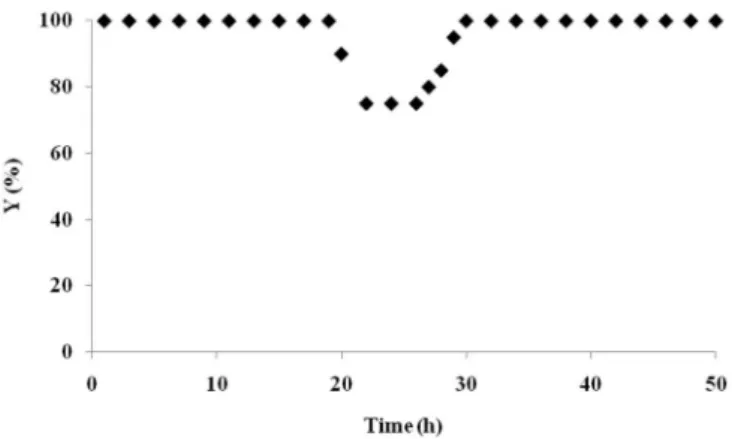
FIGURE 4 - Variation in conversion during continuous sucrose hydrolysis catalyzed by immobilized invertase for test 13: [Sucrose] = 50 mM (time interval: 0-20h) and [Sucrose] = 100 mM (time interval: 21-50h).
inlet concentration of the sucrose solution was changed from 50mM to 100mM (Figure 4). The feeding rate was set at 0.4 h-1 (Table 1). Figure 4 shows a conversion yield of 100% and a steady-state for 20h. This occurred when the reactor was fed consecutively with a 50mM and a 100mM sucrose solution. Although the results matched those attained in tests 7, 8 and 10 (Table 1), the reaction rate increased about 50% as the inlet sucrose concentra-tion was varied from 50mM to 100mM (Table 1). This result showed that the current process allowed conversion of forty times more sucrose under the same operational conditions (except for the type of membrane) than that previously described (Tomotani, Vitolo, 2007). These results are promising with regard to potential for scaling up the process. The engineering required to attain scale-up already exists (Said, Pietro, 2004). The products resulting from sucrose hydrolysis have a signiicant market appeal, especially for sugarcane rich countries (Das Neves, Vitolo, 2007).
CONCLUSIONS
The most adequate proportion (w/w) of invertase (expressed as mg of protein) and resin was 1.64 mg of protein/100 mg of resin. The feeding rate was an impor-tant parameter to operate the MR at the steady-state and must be adjusted for each inlet sucrose concentration used. The best conditions for sucrose hydrolysis (50 – 100mM) were pH 5.5, 30oC, D = 0.4 h-1 using a UF-membrane-CTMR. It should be emphasized that process scaling up can be envisaged, insofar as at least up to 100 mM sucrose solution were shown to be eficiently hydrolyzed using invertase.
ACKNOWLEDGEMENT
This work was inancially supported by FAPESP (Fundação de Amparo à Pesquisa do Estado de São Paulo), Brazil. The authors would like to thank Philip Barsanti for his invaluable and constructive assessment of the manuscript.
REFERENCES
ARRUDA, L.M.O.; VITOLO, M. Characterization of invertase entrapped into calcium alginate beads. Appl. Biochem. Biotechnol., v.81, p.23-33, 1999.
DAS NEVES, L.C.M.; VITOLO, M. Use of glucose oxidase in a membrane reactor for gluconic acid production. Appl. Biochem. Biotechnol., v.136-140, p.161-170, 2007.
ERZINGER, G.S.; VITOLO, M. Zymomonas mobilis as catalyst for the biotechnological production of sorbitol and gluconic acid. Appl. Biochem. Biotechnol., v.129-132, p.787-794, 2006.
GODFREY, T.; WEST, S. Industrial enzymology. 2. ed. London: MacMillan, 1996. p.64.
REDDY, A.V.; MACCOLL, R.; MALEY, F. Effect of oligossacharides and chloride on the oligomeric structures of external, internal and deglycosylated invertase. Biochemistry, v.29, p.2482-2487, 1990.
SAID, S.; PIETRO, R.C.L.R. Enzimas como agentes biotecnológicos. Ribeirão Preto: Legis Summa Publisher, 2004. p.412.
SEGEL, I.H. Biochemical calculations. 2.ed. New York: John Wiley & Sons Inc., 1976. p.232.
TOMOTANI, E.J.; DAS NEVES, L.C.M.; VITOLO, M. Oxidation of glucose to gluconic acid by glucose in a membrane bioreactor. Appl. Biochem. Biotechnol., v.121-124, p.149-162, 2005.
TOMOTANI, E.J.; VITOLO, M. Catalytic performance of invertase immobilized by adsorption on anionic exchange resin. Process Biochem., v.41, p.1325-1331, 2006.
TOMOTANI, E.J.; VITOLO, M. Screening of Dowex® anion exchange resins for invertase immobilization. Appl. Biochem. Biotechnol., v.113-116, p.145-159, 2004.
VITOLO, M.; DURANTI, M.A.; PELLEGRIM, M.B. Effect of pH, aeration and sucrose feeding on the invertase activity of intact Saccharomyces-cerevisiae cells grown in sugarcane blackstrap molasses. J. Ind. Microbiol., v. 15, p.75-79, 1995.

![FIGURE 2 - Variation in conversion during continuous sucrose hydrolysis catalyzed by soluble invertase [test 2 ( )] and immobilized invertase [test 5 ( ) and test 6 ( )]](https://thumb-eu.123doks.com/thumbv2/123dok_br/15412459.586751/4.892.62.436.810.1029/variation-conversion-continuous-hydrolysis-catalyzed-invertase-immobilized-invertase.webp)