www.ijera.com DOI: 10.9790/9622-0702023640 36 | P a g e
Kinetics and Mechanism of the Reaction of Coherently
Synchronized Oxidation and Dehydrogenation of Cyclohexane by
Hydrogen Peroxide
S. Aghamammadova
1, I. Nagieva
2, L. Gasanova
1, T. Nagiev
1, 2, a1Nagiev Institute of Catalysis and Inorganic Chemistry, National Academy of Sciences of Azerbaijan
2Baku State University, Azerbaijani Republic
ABSTRACT
Inducing effect of hydrogen peroxide on synchronous oxidation reaction is accompanied by the occurrence of two interconnected and interacting reactions. The reaction of 2 2 decomposition (primary) generates the leading active OH and HO 2 free radicals in a system. During the interaction of active and free radicals with the
substrate, the conversion of the substrate occurs in the secondary reaction, coherently-synchronized with the primary one.
The mechanism of such coherently synchronized reactions is being examined in the process of cyclohexane oxidation with hydrogen peroxide in homogeneous and heterogeneous systems.
The process of coupling dehydrogenation of cyclohexane to cyclohexene and cyclohexadiene with hydrogen peroxide was carried out without catalyst. This process was also carried out at a fairly low temperature in a heterogeneous catalytic system.
Biomimetic catalyst, which simulates the basic functions of the enzyme group of oxidoreductase - catalase and monooxygenase, was used as the catalyst here. Characterised by its highly active and selective action these biomimetic catalysts are synthesized based on iron-porphyrin complexes simulating the active component of cytochrome P-450.
Based on this experimental researches, the complex reaction, consisting of parallel-sequential oxidation and dehydrogenation reactions, which are coherently synchronized, proceeds during the process of cyclohexane oxidation with biomimetic catalyst. Depending on the reaction parameters it is possible to deliberately adjust the direction of oxidation reaction and reaction rate.
I.
INTRODUCTION
Inducing effect of hydrogen peroxide on synchronous oxidation reaction is accompanied by the occurrence of two interconnected and interacting reactions [1, 2]. TСО rОaМtТon of 2 2 decomposition (primary) generates the leading active OH andHO 2
free radicals in a system. During the interaction of active and free radicals with the substrate, the conversion of the substrate occurs in the secondary reaction, coherently-synchronized with the primary one [3].
The mechanism of such coherently synchronized reactions is being examined in the process of cyclohexane oxidation with hydrogen peroxide in homogeneous and heterogeneous systems. The cyclohexane oxidation is the most commonly studied process, where the valuable for organic synthesis compounds are achieved during oxidative dehydrogenation or during oxidation [4-7]. The implementation of thermodynamically hindered reactions is of great interest for petrochemical and organic synthesis. Among them the reactions of partial dehydrogenation of cyclohexane to
cyclohexene and cyclohexadiene should be mentioned.
kJ/mol ,
G
2 10 6 12
6H C H H
C 39.88
C6H10 C6H8H2 115.37
It is of course more beneficial in terms of energy to carry out such reactions in conjunction with other reactions, in this case, with the reaction of hydrogen peroxide decomposition.
II.
RESULTS AND DISCUSSION
The process of coupling dehydrogenation of cyclohexane to cyclohexene and cyclohexadiene with hydrogen peroxide was carried out without catalyst [8].
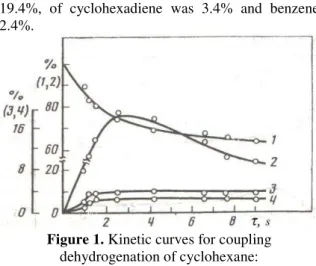
The reaction was examined at a temperature range of 450-650 ºC at various flow rates and ratios of starting reactants. The process was of sequential and autocatalytic nature with the period of self-acceleration (kinetic curves for cyclohexadiene and benzene), as shown in Figure 1. Under optimum conditions, the yield of cyclohexene was up to
www.ijera.com DOI: 10.9790/9622-0702023640 37 | P a g e
19.4%, of cyclohexadiene was 3.4% and benzene 2.4%.
Figure 1. Kinetic curves for coupling dehydrogenation of cyclohexane:
1-cyclohexane; 2-cyclohexene; 3-benzene; 4-cyclohexadiene
Kinetic curves show that the accumulation of cyclohexene as an intermediate product at the initial stage of the process increases up until the rate of its consumption and the rate of accumulation at
tСО МonvОntТonal МontaМt tТmО Оqual to τ = 4.2М,
becomes equal, and cyclohexene concentration reaches a maximum value. Cyclohexene yield decreases with the further increase in contact time. The rate of formation of cyclohexene and cyclohexadiene initially increases, and reaches its maximum at the inflection point, which is typical for sequential reactions.
At a temperature range of 450-500 ºC the cyclohexene is formed, with the increase in temperature range between 560 ºC and 650 ºC dehydrogenation products contain cyclohexadiene and benzene along with cyclohexene. These data also suggest that with further increase in temperature the ring-opening decomposition reaction of the cyclohexane occurs along with the process of the dehydrogenation. The consequence is the formation
of gasОous proНuМts suМС as 2, 2, 4, 2 4... These experimental data aggregate show that in the studied range of variations by reaction parameters under the best conditions reaction proceeds in the direction of the oxidative dehydrogenation of cyclohexane achieving the yield of desired products C6H10, C6H8 и C6H6 – 19,4%; 3.4% and 2.4% respectively.
It is necessary to identify the nature of the
ТntОraМtТon of 2 2 with the hydrocarbon, resulting with the formation of unsaturated compound under high-temperature oxidation conditions in order to identify the mechanism of dehydrogenation of cyclohexane.
A prerequisite for the coherently synchronized reactions to proceed in the reaction system is its quantitative characteristic defined by the determinant equation [1]:
1 2
1/ / )
(
r rас r rас
D
where r1 and r2–МonsumptТon ratО of an aМtor ( 2 2) in the primary and secondary reactions respectively, rac - МonsumptТon ratО of an aММОptor ( 6 12), ν -
stoТМСТomОtrТМ faМtor (Тn our МasО ν = 1). TСО valuО of
the determinants calculated by using experimental
Нata D≈0.1 indicates the induced nature of dehydrogenation of cyclohexane.
Under the conditions of the high-temperature cyclohexane gas-phase oxidation with hydrogen peroxide, the reaction proceeds by a free radical mechanism, where active OH and HO 2
radicals are formed in the primary reaction - in the
rОaМtТon of 2 2 decomposition, and they are consumed in the secondary one - in the dehydrogenation of cyclohexane. Considering that at a high temperature the concentration of HO 2
radicals in the reaction system is much higher than the concentration of OH radicals [9], the HO 2
radicals play a key role in the mechanism of the dehydrogenation: chain initiation kJ/mol 9 , 217 2 2
2
OH O H chain propagation kJ/mol 9 , 66 kJ/mol 6 , 104 kJ/mol 17 , 40 kJ/mol 7 , 107 2 6 6 2 8 6 2 8 6 2 10 6 2 10 6 2 12 6 2 2 2 2 OH O H H C HO H C OH O H H C HO H C OH O H H C HO H C O H HO OH O H chain termination ) ( ) ( 2 2 wall HO ads HO
ads OH wall OH
Each successive reaction of oxidative dehydrogenation of cyclohexane is a combination of chain initiation, propagation and termination stages. The system of kinetic equations, adequately describing the experimental data, is as follows [10]:
] ][ [ /
]
[C6H12 d k 1 C6H12 H2O2
d eff
] ][ [ ] ][ [ / ]
[C6H10 d k 1 C6H12 H2O2 k 2 C6H10 H2O2
d eff eff
] ][ [ ] ][ [ / ]
[C6H8 d k 2 C6H10 H2O2 k 3 C6H8 H2O2
d eff eff
where s mol sm RT
www.ijera.com DOI: 10.9790/9622-0702023640 38 | P a g e s
mol sm RT
keff2 1023,9exp( 222000 ) 3/
s mol sm RT
keff31022,8exp( 205000 ) 3/
Examination of the process of coherently synchronized cyclohexane oxidation with hydrogen peroxide was carried out also at a fairly low temperature in a heterogeneous catalytic system. Biomimetic catalyst [11], which simulates the basic functions of the enzyme group of oxidoreductase - catalase and monooxygenase, was used as the catalyst here. Characterised by its highly active and selective action these biomimetic catalysts are
synthesized based on iron-porphyrin complexes simulating the active component of cytochrome P-450 [12].
The process of cyclohexane gas phase oxidation was carried out with heterogeneous biomimetic catalysts per-FTPhPFe(III)/Al2O3 and PPFe(III)/Al2O3 at a temperature of 130 – 250 º
anН a molar ratТo 6 12: 2 2 = 1:1.7 with 25%
aquОous 2 2 solution. The results of these studies are shown in Figure 2.
Figure 2. The dependence of the reaction yield of cyclohexanecoherently synchronized oxidation with bio simulator per-
Table 1. The dependence of the reaction yield of cyclohexanol coherently synchronized oxidation with bio simulator per-FTPhPFe(III)/Al2O3 on the temperature: [H2O2]=20%,
2 2O H
V =1,41 mL/h,
12 6H C
V =0,9 mL/h, C6H11 :H2O2=1:1
Composition of feedstock, % Composition of obtained reaction yield, %
t, 0C C6H11OH
2-methyl cyclohex anol
Hexanoi c acid
Hexanoic acid cyclohexy
l ester
C6H11OH C6H10
1,2 cyclo hexane
diol
1,3 cyclohexa
diene
2-methyl cyclohexa nol
other oxygena tes
Conversi on
150 180 200 230
97,524 97,524 97,524 97,524
0,481 0,481 0,481 0,481
0,712 0,712 0,712 0,712
0,845 0,845 0,845 0,845
83,921 78,186 67,494 55,255
2,321 7,841 16,688 30,374
2,248 2,875 2,887 2,0
0,105 0,145 0,279 0,1
0,093 0,583 0,295 0,641
9,405 10,753 10,652 10,271
14,079 19,814 30,506 42,745
As shown in Figure 2 at the temperature up to150-160 º tСО rОaМtТon tСat maТnly proМООНs Тs cyclohexane oxidation reaction, forming cyclohexanol and cyclohexanone. At the temperature above 180°C the reaction of oxidative dehydrogenation of cyclohexane to cyclohexene (curve 4, Figure 2) begins to accelerate, respectively, the yield of cyclohexanol and cyclohexanone decreases. The sharp increase in the yield of cyclohexene along with the decrease in the yield of formed cyclohexanol indicates that at the tempОraturО of 230 º or СТgСОr МyМloСОxanol Мan also be converted into cyclohexene at lower
МonМОntratТons of 2 2 in the reaction system. This conclusion is confirmed by the results of experimental studies of the process of cyclohexanol oxidation with hydrogen peroxide at a lower concentration (20%) with the biomimetic catalyst,
where at elevated temperature (200-230 º ) tСО cyclohexene yield is high (16-30%).
TСО ОxpОrТmОnts on tСО ОffОМt of tСО 2 2
МonМОntratТon at a Мonstant tОmpОraturО (200 º ) anН
contact time were conducted. As shown in Figure 3,
ТnМrОasОН 2 2 concentration in the reaction zone contributes to the increase of oxidation reaction rate, which results with the increase of cyclohexanone yield and decrease of cyclohexene yield.
Such results are obtained in a pilot study of cyclohexane oxidation over biomimetic depending on the 6H12 : H2O2 ratio at different temperatures.
www.ijera.com DOI: 10.9790/9622-0702023640 39 | P a g e
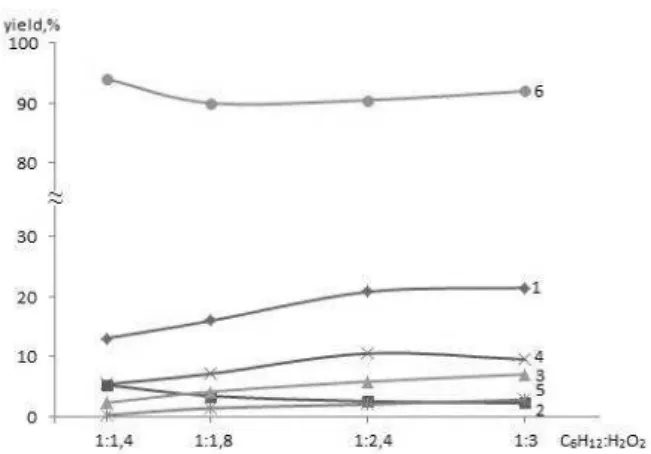
As it can be seen from the Figure 4 the reaction rate of oxidative dehydrogenation is higher than oxidation reaction rate and the yield of cyclohexane increases at the highest temperature (t = 230 °C).
Figure 3. The dependence of the reaction yield of cyclohexanecoherently synchronized oxidation with bio simulator per-FTPhPFe(III)/Al2O3 on
МonМОntratТon 2 2: t=2000C, VH2O2 =1,41 mL/h,,
12 6H C
V =0,9 mL/h,,
1- conversion; 2- cyclohexanol; 3- cyclohexanone; 4- cyclohexene; 5- cyclohexadiene; 6- O2 yield
Figure 4. The dependence of the reaction yield of cyclohexane coherently synchronized oxidation over per-FTPhPFe(III)/Al2O3catalyst on 6H12 : H2O2ratio at the temperature t=1500C,
2 2O H
V =1,41mL/h,,
12 6H C
V =0,9mL/h,,
1- conversion; 2- cyclohexanol; 3- cyclohexanone; 4- O2yield
Figure 5. The dependence of the reaction yield of cyclohexane coherently synchronized oxidation over per-FTPhPFe(III)/Al2O3catalyst on 6H12 : H2O2ratio at the temperature t=2300C,
2 2O H
V =1,41mL/h,,
12 6H C
V =0,9mL/h,,
1- conversion; 2- cyclohexanol; 3- cyclohexanone; 4- cyclohexene; 5- cyclohexadiene; 6- O2 yield
Thus, the complex reaction, consisting of parallel-sequential oxidation and dehydrogenation reactions, which are coherently synchronized, proceeds during the process of cyclohexane oxidation with biomimetic catalyst. Depending on the reaction parameters it is possible to deliberately adjust the direction of oxidation reaction and reaction rate.
It should be noted that in terms of the mechanism of each stage of this complex reaction of cyclohexane parallel-sequential oxidation with hydrogen peroxide with biomimetics, each oxidation reaction is carried out under inducing effect of hydrogen peroxide intermediates and consists of two coherently synchronized reactions - 1) МatalasО ( 2 2 decomposition reaction) and 2) monooxygenase (cyclohexane oxidation reaction) with biomimetic catalyst.
The probable mechanism of cyclohexane coherently synchronized oxidation, considering the parallel-sequential nature of oxidation and dehydrogenation, can be expressed by the general scheme [3]:
The mechanism of primary and secondary reactions proceeding over biomimetic catalyst is given:
1
2
H2O + O2
react. prod. ( 6H11OH;
C6H10O; C6H10; C6H8;
C H )
6 12; C6H10; C6H8; 6H11OH
ImtOH
ImtOOH H2O
H2O2
www.ijera.com DOI: 10.9790/9622-0702023640 40 | P a g e
1) Mechanism of catalase reaction
2) The mechanism of reaction of cyclohexane oxidation to cyclohexanol
H2C
H2C CH2 C CH2 H2C
H
H OH
O Fe
H2C
H2C
H2C CH2 C CH2
H
OH
B B
H
A
H
A
Fe OH
III.
CONCLUSION
The scheme shows that formed active intermediate complex of hydroperoxide (ImtOOH), as in the case of free radical HO 2, is the key active
centre for coherent synchronization of catalase (primary) and monooxygenase (secondary) reactions. Coherently synchronized nature of the cyclohexane oxidation reaction follows from the experimental data (Figure 2 and 3). The changes in the catalase reaction rate (curve 6) and the rate of cyclohexane oxidation consumption (curve 1) are shown by the kinetic curves of Figures 2 and 3.
REFERENCES
[1]. T. M. Nagiev, CСОmТМal ConjugatТon, .: Nauka, 216 (1989)
[2]. T. M. Nagiev, The Theory of Coherent Synchronized Reactions: Chemical Interference Logics, International Journal of Chemical Engineering and Applications, 6, 5 (2015)
[3]. T. M. Nagiev, Coherent Synchronized Oxidation by Hydrogen Peroxide, Elsevier, Amsterdam, 325 (2007)
[4]. V. I. Timokhin, M. T. Lisovska, A. P. Pokucha, Kinetics and Catalysis, 41, 2, pp.179-185 (2000)
[5]. Eric C. Tyo, Chunrong Yin, Marcel Di Vece, etc. ACS Catal., 2, 11, 2409–2423 (2012)
[6]. Olsen M. H. N., Salomao G. C., Drago V. J. Supercrit. Fluids, 34, 2, 119-124 (2005)
[7]. Yu K. M. Kerry, Hummeida Ranya, Abutaki Afaf. Catal.Lett., 111, 1-2, 51-55 (2006)
[8]. T. M. Nagiev, F. G. Bayramov, Petrochemistry, 27, 2, 170-176 (1987) [9]. . M. Nagiev, S. I. Agaeva, F. G.
Bayramov, Z. M. Nagieva, Azerb. Jour. Chem., 4, 16-21 (1997)
[10]. T. M. Nagiev, Vestn. Mosc. Univ. Ser. 2. Chemistry, 34, 3, 260-266 (1993)
[11]. T. M. Nagiev, L. M. Gasanova, S. Z. Zulfugarova, etc. Chemical Engineering Communications, An International Journal for Communication of Research. 190, 5-8, 726-748 (May-August 2003)
![Table 1. The dependence of the reaction yield of cyclohexanol coherently synchronized oxidation with bio simulator per- per-FTPhPFe(III)/Al 2 O 3 on the temperature: [H 2 O 2 ]=20%,](https://thumb-eu.123doks.com/thumbv2/123dok_br/18427475.361719/3.892.111.794.683.829/dependence-reaction-cyclohexanol-coherently-synchronized-oxidation-simulator-temperature.webp)