Substance use and sexual risk among at-risk
adolescents in Juiz de Fora, Minas Gerais
State, Brazil
O uso de substâncias e o risco sexual entre
adolescentes em situação de risco social
em Juiz de Fora, Minas Gerais, Brasil
Consumo de sustancias estupefacientes y riesgo
sexual entre adolescentes en situaciones de
riesgo en Juiz de Fora, Minas Gerais, Brasil
1 Magee-Womens Research Institute, Pittsburgh, U.S.A. 2 Iowa State University, Ames, U.S.A.
Correspondence P. Morrison
Magee-Womens Research Institute.
3380 Boulevard of the Allies, Suite 333, Pittsburgh, PA 15213, USA.
Penelope Morrison 1
Amy Erica Smith 2
Aletha Akers 1
Abstract
We examined the difference in prevalence of substance use and sexual risk behaviors among at-risk youth participants in programs offered by community-based organizations in Juiz de Fora, Minas Gerais State, Brazil, by gender and organization type (governmental vs. non-gov-ernmental). 388 adolescents were recruited from 25 intervention-based organizations servicing at-risk youth between the ages of 12 and 17 in Juiz de Fora. Participants completed a 15-item survey assessing substance use and sexual risk behaviors, along with socio-demographic pre-dictors of these behaviors. Males were more likely to report drug and alcohol use associated with homelessness and abandonment. Females were more likely to report sexual risk taking as-sociated with neighborhood crime. Participants from non-governmental organizations were less likely to engage in all measured risk behaviors. The present analysis points to the need to un-derstand how Brazil’s Child and Adolescent Act is being applied and the implications this has for intervention and the promotion of positive health outcomes for young people.
Counterfeit Drugs; Sanitary Supervision; Drug and Narcotic Control
Resumo
Examinou-se a diferença na prevalência do uso de drogas e comportamento sexual de risco entre os jovens de alto risco em programas oferecidos por organizações localizadas na comunidade de Juiz de Fora, Minas Gerais, Brasil .Foram re-crutados 388 adolescentes de 25 organizações de intervenções preventivas que servem jovens de alto risco entre as idades de 12-17. Participantes completaram um questionário com 15 pergun-tas que avalia o uso de substâncias e o compor-tamento sexual de alto risco, juntamente com indicadores sociodemográficos. Os adolescen-tes do sexo masculino foram mais propensos a relacionar o uso de drogas e álcool com a falta de moradia e abandono. As adolescentes do se-xo feminino foram mais propensas a reportar comportamentos sexuais de alto risco em as-sociação com o crime comum. Participantes de ONGs foram menos propensos a se envolver nos comportamentos de alto risco pesquisados. A presente análise aponta para a necessidade de se entender as implicações que isso tem para a in-tervenção preventiva e a promoção de resultados positivos na saúde dos jovens.
Introduction
National surveys of youth risk behaviors, such as the U.S. Youth Risk Behavior Survey and the Brit-ish Columbia Adolescent Health Survey 1,2, help
monitor health risks that contribute to the lead- ing causes of mortality and morbidity among youth, as well as assess the impact of local and national policies. Many emerging countries have no national assessment tools for monitoring of youth risk behaviors. Lingering structural in-equalities, coupled with a lack of infrastructure make implementation of systematic instruments difficult 3. Much of what we know about youth
risk taking in parts of the world, including East-ern Europe, Africa and the Caribbean, comes from small, cross-sectional studies that assess single risk behaviors and their relationship to adverse social conditions (e.g. poverty) 4,5,6.
De-spite the limitations of this approach, these stud-ies provide important insights into the kinds of behavioral health problems youth around the world face. They also contribute to a broader understanding of global adolescent health and well-being.
Brazil is a country where a growing body of research on youth risk behaviors exists. This re-search demonstrates that young people in condi-tions of social adversity in Brazil engage in high rates of substance use and sexual risk-taking 7,8,9.
While rates of substance use and sexual risk-taking vary, previous research has nonetheless shown that substance use (e.g. alcohol, ecstasy or methamphetamines) among at-risk adolescents in Brazil has been linked to exposure to violence, crime, neglect, low-socio-economic status and homelessness 10,11,12. Additionally, adolescents
who are exposed to violence at home or in their neighborhood, or who are from low socio-eco-nomic backgrounds have also been shown to be more likely to engage in sexual risk taking 12,13,14.
Furthermore, a lack of condom use and other sexual risk behaviors, such as prostitution or ex-change sex, have been associated with abandon-ment and homelessness 11. Finally, youth who
engage in substance use are at an increased risk of sexual risk taking behaviors, namely lack of condom use 10,11. Both substance use and sexual
risk taking are linked to high rates of sexually transmitted infections, unintended pregnancy, and early death, meaning that a reduction of these health risk behaviors represents an impor-tant public health issue 7,15.
Gender differences in Brazilian youth’s en-gagement in health risk behaviors are also evi-dent. Compared to young women, young men in Brazil are more likely to report initiating drug use at an early age, engaging in heavy episodic
drink-ing, being subjected to physical violence, and spending time living and working in the streets 9, 16,17,18,19. Young women are more likely to report
engaging in sexual risk taking and experiencing abuse or exploitation within the home 14,16,19.
Brazil has made a concerted effort in recent years to improve the health of its youth through social programs that mediate youth risk-tak-ing 20,21. The Child and Adolescent Act (ECA) of
1990 22 proliferated locally based socio-educative
programs as an approach to reducing adolescent engagement in risk behaviors and as a means of diminishing the impact of social risk factors. To-day there are many governmental (GO) and non-governmental organizations (NGOs) in Brazil that specifically target at-risk youth. These entities represent key stakeholders in addressing youth risk behaviors “on the ground”. Very little, how-ever, is known about the youth who attend these organizations, how different kinds of social pro-grams may be associated with different types of youth behavior, or to what extent youth in these programs are engaging in substance use and sex-ual risk taking 23. These data are important for
monitoring trends in youth health risk behaviors, informing the allocation of resources for youth programs and devising future interventions.
Objectives
In this paper, we examine the overall prevalence of substance use and sexual risk behaviors among youth in programs offered by non-governmental and governmental organizations in Juiz de Fora, as well as differences in such behaviors by gen-der and organization type. We engaged key stake-holders at GO and NGOs throughout the city to develop a youth risk behavior survey, which was administered within 25 organizations with di-verse youth programs. Measures were adapted from existing surveys used in the United States and elsewhere 1,2,10,24.
Methods
Sampling
We conducted a cross-sectional survey in Juiz de Fora, which is located in the southeastern state of Minas Gerais, Brazil and has a population of 520,000 25. Youth from 25 intervention-based
youth aged 12-17 were attending local programs for at risk youth in the city of Juiz de Fora 26. It was
calculated that approximately 360 youth were needed to reach a confidence level of 95% and confidence interval of 5% 27.
12 NGOs and 13 GOs were selected for par-ticipation. Organizations were eligible based on the following criteria: first, organizations had to specifically work with at-risk youth; second, or-ganizations were randomly selected to represent a range of programs in terms of size (i.e. number of participating youth), organizational structure (non-governmental vs. governmental) and kinds of programs offered, including vocational train-ing, sports, arts, tutortrain-ing, and civic courses 26;
third, organizations had to serve both boys and girls; and finally, organizations had to be “pro-gram based,” as opposed to “service based” enti-ties. In other words, they had to maintain a set of regular group-based, instructional activities (e.g., soccer programs or job training) for youth, rather than simply providing access to social assistance or legal or health related services.
Youth were randomly selected at each orga-nization and were eligible if they were between the ages of 12-17, currently enrolled in one of the organization’s programs and had a record of regular attendance, defined as visiting the pro-gram once a week. Some youth were mandated to participate by the local juvenile council, an entity responsible for dealing with youth in trouble with the law. Others were referred by teachers, parents or social workers, and thus voluntarily recruited.
Survey instrument
The self-administered, close-ended paper sur-vey contained 15 items assessing four behavioral outcomes of interest (two forms of substance use and two outcomes related to sexual risk behaviors) along with socio-demographic and contextual correlates of these behaviors. The survey took approximately 15 minutes to com-plete. Data was collected between July and Sep-tember 2008 by the first author, a Ph.D. trained applied medical anthropologist, and two trained research assistants from local universities. Paren-tal consent was waived and verbal assent from the youth participants obtained in order to en-sure adequate recruitment and minimize the po-tential for negative consequences due to study participation. Many of the youth participants in this study come from unstructured households where parents and/or a legal guardian may be absent or where conditions of abuse, neglect or other adverse situations may have made paren-tal consent impossible, thus limiting enrollment. Similarly, research related to risk often results in
insufficient numbers as many youth do not wish for their parents to find out about the behaviors they are engaging in 28; thus, a waiver of parental
consent was considered necessary to protect the youths’ privacy, and minimize fear of exposure or harm or punishment within the household. The study was approved by the Institutional Review Board at University of Pittsburgh.
Items on the survey instrument were adapted from existing surveys used in other countries. The U.S. Youth Risk Behavior Survey and the Brit-ish Columbia Adolescent Health Survey are both highly validated, relevant measures for assess-ing a number of risk behaviors cross culturally, as they have been applied to diverse populations in the USA and Canada. The first author, therefore, reviewed measures from the Youth Risk Behavior Survey 1 and British Columbia Adolescent Health
Survey 2, as well as an instrument developed and
tested in Brazil 10,12 in order to identify items that
could be translated directly for use in the local context. A list of 25 potential survey items was generated. Each item was reviewed for their rel-evance to the study population by the first au-thor and a panel of experts from youth services community in Juiz de Fora, including adminis-trative staff, educators, and social workers. Panel members focused on assessing four outcomes re-lated to substance use and sexual risk behaviors, as these were the most common behaviors they encountered, and identified seven potential cor-relates of adolescent engagement in health risk behaviors for inclusion. Panel members reviewed similar items across the various validated instru-ments selecting items for inclusion via consen-sus. All items were translated into Portuguese by a professional translator and reviewed by the panel of experts for language relevance and accessibility for the targeted youth population. Where items could not be translated directly, the panel of experts worked alongside the first au-thor to adapt questions to meet the study needs. Other items were developed anew by the panel where no validated items existed to assess con-structs considered essential (e.g. willingness to forgo condoms in the heat of the moment). Ad-ditional experts in youth services in Juiz de Fora then reviewed the adapted measures, along with items created by the panel, before pilot testing. For additional insight, we also asked a youth ad-visory panel to review these measures.
appropriateness respondents might encounter. This information was then presented once more to the panel of experts, who once more tailored to ensure comprehension by the study population. This pilot data was not included in the current study sample.
Health risk behavior outcomes
Substance use: (1) youth were asked with what frequency they used drugs, exemplified as mari-juana, cocaine, aerosol spray cans or other in-halants (glue, paint), heroin, ecstasy, and meth-amphetamines 1,2,11,29; (2) youth were also asked
with what frequency they used alcohol. Response options for each question were, “frequently,” “sometimes,” “rarely,” or “never”.
Sexual risk-taking: (1) to assess sexual activ-ity, youth were asked with what frequency they engaged in sex. Response options were “fre-quently,” “sometimes,” “rarely,” or “never”; (2) condom use is reported only for respondents re-porting sexual activity. Participants were asked to respond ‘yes’ or ‘no’ to each of these sexual risk-taking items.
Correlates of risk behaviors
Adolescents were asked to respond yes or no to four separate questions that assessed whether they had ever experienced physical violence, psychological violence, abandonment, and homelessness. In the analysis, abandonment and homelessness are grouped together with a single variable that is coded “1” if the respondent had experienced either condition, and “0” otherwise.
In regression models analyzing the factors as-sociated with sexual risk-taking, we also included the other two outcome measures related to sub-stance abuse as much of the literature on at-risk youth shows a strong correlation between these two behaviors 12.
Socio-demographic measures: neighbor-hood crime and low neighborneighbor-hood income have been shown to contribute to risk taking in Bra-zil 8,10,29. We used an index that measures the
amount of neighborhood crime, as reported by youth in response to three questions regarding how common drug trafficking and gangs are, and how safe they feel in the neighborhood. This in-dex was standardized to range from 0 to 1, where 0 indicates the most secure neighborhoods, and 1 indicates the least secure. Second, we used a measure of neighborhood income which was estimated based on data from the Brazilian na-tional statistics bureau 15. Again, this index has
been standardized to run from 0 to 1, where 0 represents the lowest-income neighborhood in
the sample, and 1 represents the highest income neighborhood in the sample. We also examined gender and organizational type (whether NGO or GO) as independent variables (each coded as a binary variable).
Analysis
We used regression modeling to determine cor-relates of youth engagement in each of the four health risk behaviors. Drug use, alcohol use and sexual activity were coded on a four-point scale: frequently, sometimes, rarely, or never. These variables were examined using Ordinary Least Squares (OLS). The final variable was coded “1” for respondents who said “yes” and “0” for those who said “no” to the following question: “If you’re in the heat of the moment (“na hora H” in Portu-guese) and you realize you don’t have a condom, do you have sex anyway?”. We used multivariable logistic regression to model correlates of this final health risk behavior. The multivariate analysis first assesses correlates of the four risk behaviors in the entire sample, that is, for both boys and girls. The sample is then divided between ado-lescent males and females, and correlates of risk behaviors are assessed in each subgroup. While simple, non-interacted models are presented in the paper, the statistical significance of the differ-ences in findings was also assessed using models in which each of the main independent variables was interacted with the sex of the respondent. The table notes where differences in effects be-tween males and females are statistically signifi-cant. All analysis was conducted using Stata v. 11 (Stata Corp., College Station, USA).
Results
Sample characteristics
Prevalence of health risk behaviors
The proportion reporting drug use and condom non-use was low at 10% and 15%, respectively. More than a third reported that they would have sex without a condom in the heat of the moment (39%). Half reported regular sexual activity (49%) and alcohol use (42%). Only 3% reported having ever had exchange sex.
When stratified by gender, males were more likely to report regular drug use (13% vs. 8%, p < 0.05) and regular sexual activity (58% vs. 42%, p < 0.05) compared to females. No statistically signif-icant gender differences were reported for alco-hol use, exchange sex, condom non-use (among the sexually active), or willingness to forgo con-doms in the “heat of the moment.” Alcohol use was frequently reported by both males (43%) and females (39%) while exchange sex was reported rarely by both (5% vs. 2%).
When stratified by organizational type, risk behaviors are statistically significantly lower among NGO participants for alcohol use (27% in NGOs vs. 49% in GO), sexual activity “frequently” or “sometimes” (27% in NGOs vs. 59% in GO), and willingness to forgo condoms in the “heat of the moment” (29% vs. 42%; estimated only for those reporting any sexual activity). A
find-ing counter to this pattern is that among those reporting any sexual activity the probability of not using condoms is significantly higher for NGO participants (28% vs. 12%). However, only 27% of NGO participants report ever having had sex (“sometimes” or “frequently”), while 59% of GO participants report ever having done so. No differences were found between NGO and GO participants in reported rates of exchange sex, abandonment and homelessness, or physical and psychological violence.
Correlates of substance use and sexual risk behaviors among at-risk youth
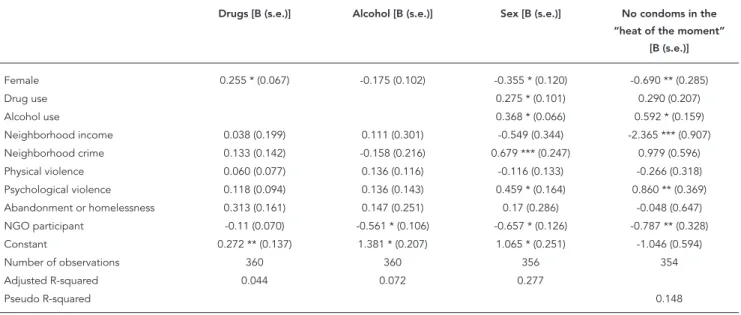
Table 1 shows the results of the regression analy-ses. Since all independent variables are stan-dardized on a 0-1 scale, coefficients can be in-terpreted as the effect associated with moving from the sample minimum to the sample maxi-mum on the respective independent variables. As discussed above, the first three columns of coefficients present OLS results for dependent variables that run from 0 to 3. First we report fac-tors significantly associated with drug use, based on the first column. Drug use was associated with gender. Controlling for other factors, females re-port levels of drug use that were 0.255 units lower
Table 1
Correlates of substance use and sexual risk behaviors among at-risk youth participating in non-governmental and governmental organization programs in Juiz de Fora, Minas Gerais State, Brazil.
Drugs [B (s.e.)] Alcohol [B (s.e.)] Sex [B (s.e.)] No condoms in the “heat of the moment”
[B (s.e.)]
Female 0.255 * (0.067) -0.175 (0.102) -0.355 * (0.120) -0.690 ** (0.285)
Drug use 0.275 * (0.101) 0.290 (0.207)
Alcohol use 0.368 * (0.066) 0.592 * (0.159)
Neighborhood income 0.038 (0.199) 0.111 (0.301) -0.549 (0.344) -2.365 *** (0.907) Neighborhood crime 0.133 (0.142) -0.158 (0.216) 0.679 *** (0.247) 0.979 (0.596) Physical violence 0.060 (0.077) 0.136 (0.116) -0.116 (0.133) -0.266 (0.318) Psychological violence 0.118 (0.094) 0.136 (0.143) 0.459 * (0.164) 0.860 ** (0.369) Abandonment or homelessness 0.313 (0.161) 0.147 (0.251) 0.17 (0.286) -0.048 (0.647)
NGO participant -0.11 (0.070) -0.561 * (0.106) -0.657 * (0.126) -0.787 ** (0.328) Constant 0.272 ** (0.137) 1.381 * (0.207) 1.065 * (0.251) -1.046 (0.594)
Number of observations 360 360 356 354
Adjusted R-squared 0.044 0.072 0.277
Pseudo R-squared 0.148
s.e.: standard errors.
on the 0-3 scale than did males. Abandonment or homelessness was also significantly associated with a 0.313 unit increase in drug use on the 0-3 scale.
Alcohol use, like drug use, was significantly associated with gender, such that females re-ported levels of alcohol use that were 0.175 units lower than those reported by males. Alcohol use was also strongly and significantly associated with participation in a specific organizational type. NGO participants had alcohol use levels that were 0.561 units lower than GO participants.
Reports of frequency of sexual activity were associated with gender, drug use, alcohol use, neighborhood crime, psychological violence, and organizational participation. Females re-ported levels of sexual activity that were 0.355 units lower on the 0-3 scale than did males. Those who lived in neighborhoods with the highest crime rates reported levels of sex that were 0.679 units higher than did those living in neighbor-hoods with the lowest crime rates. In addition, those who had experienced psychological vio-lence engaged in significantly more sex, with lev-els of sexual activity that were 0.459 units higher on the 0-3 scale. Participants in GO youth pro-grams reported more frequent sexual activity, with program type associated with a 0.657 unit difference. Finally, the most important correlates of sexual activity are drug and alcohol use, the dependent variables from the first two columns of results. Since drug and alcohol use are coded on a 0-3 scale, rather than a 0-1 scale, the coficients must be multiplied by 3 to obtain the ef-fect associated with moving from the minimum to the maximum on each independent variable. Those who report they use drugs “frequently” have levels of sexual activity that are 0.825 units higher on the 0-3 scale than do those who report they “never” use drugs. In addition, those who report they use alcohol “frequently” have levels of sexual activity that are 1.104 units higher than those who “never” use alcohol.
Willingness to forgo condom use in the “heat of the moment” was associated with gender, al-cohol use, neighborhood income, psychologi-cal violence, and organizational participation. The predicted probability of agreement with the statement among females is 0.197, and among males it is 0.328 (all probabilities are calculated holding dichotomous control variables at their minimums and continuous and ordered control variables at their means). At the highest level of alcohol use, the probability of willingness to forgo condom use in the “heat of the moment” is 0.598, while at the lowest level of alcohol use the probability is 0.201. Residents of the lowest-income neighborhoods had a probability of
agreeing with the statement of 0.561, while those in the highest income neighborhood had a prob-ability of only 0.107. Victimization by psychologi-cal violence raises the probability of agreement from 0.328 to 0.536, and GO participation raises the probability of being willing to forgo condoms from 0.182 to 0.328.
Risk factors as determinants of substance use and sexual risk behaviors by gender
A gender-stratified analysis examining correlates of engagement in each health risk-behavior is shown in Table 2. The first two columns of co-efficients examine risk factors associated with drug use among males and females, respectively. Among males, drug use is associated with aban-donment or homelessness, while they are unas-sociated among females. That is, males who have experienced abandonment or homelessness re-port higher levels of drug use. As represented by the bold coefficients and standard errors, analy-sis of the gender interaction indicates that the difference between males and females in the as-sociation between abandonment/homelessness and drug use is statistically significant.
The third and fourth columns of coefficients examine risk factors associated with alcohol use among females and males. Among females, al-cohol use is negatively correlated with NGO par-ticipation and positively correlated with physical violence. Among males, by contrast, alcohol use is positively associated with psychological vio-lence and abandonment or homelessness, while it is negatively associated with NGO participa-tion. That is, males who have been victims of psy-chological violence or abandonment and home-lessness report more alcohol consumption. Both males and females in GOs report greater alcohol use. Analysis of the gender interaction indicates that the difference between males and females is statistically significant only for the effects of psy-chological violence and abandonment or home-lessness.
Table 2
Risk factors as determinants of substance use and sexual risk behaviors by gender, among at-risk youth participating in social programs in Juiz de Fora, Minas Gerais State, Brazil.
Drugs Alcohol Sex No contraceptives in the “heat of the moment”
Girls Boys Girls Boys Girls Boys Girls Boys
Drug use 0.245 (0.179) 0.332 *
(0.124)
0.238 (0.370) 0.480 ** (0.275)
Alcohol use 0.400 *
(0.090) 0.321 * (0.100) 0.817 * (0.240) 0.431 *** (0.231) Neighborhood income 0.017
(0.213) 0.093 (0.363) -0.021 (0.401) 0.299 (0.451) 0.117 (0.490) -1.356 * (0.474) -2.212 (1.357) -2.786 *** (1.280) Neighborhood crime 0.055
(0.149) 0.254 (0.268) -0.087 (0.282) -0.226 (0.332) 1.109 * (0.346) 0.019 (0.353) 1.921 *** (0.907) -0.090 (0.842) Physical violence 0.142 *
(0.086) 0.005 (0.135) 0.280 * (0.162) 0.063 (0.168) -0.209 (0.201) -0.022 (0.177) -0.263 (0.509) -0.417 (0.429)
Psychological violence 0.07 (0.092) 0.166 (0.199) -0.092 (0.174) 0.519 *** (0.248) 0.499 *** (0.214) 0.445 ** (0.264) 0.924 ** (0.506) 0.905 (0.595) Abandonment or homelessness 0.191
(0.137) 1.185 *** (0.560) -0.042 (0.267) 1.629 *** (0.696) 0.130 (0.326) 0.119 (0.747) 0.493 (0.710)
NGO participant -0.067 (0.074) -0.215 (0.133) -0.533 * (0.140) -0.635 * (0.164) -0.787 * (0.177) -0.428 *** (0.182) -1.430 *** (0.593) -0.149 (0.433) Constant 0.055 (0.141) 0.221 (0.244) 1.234 * (0.265) 1.331 * (0.303) 0.216 (0.341) 1.688 * (0.341) -2.663 * (0.892) -0.237 (0.827)
Observations 207 153 205 155 203 153 202 150
Adjusted R-squared 0.020 0.015 0.049 0.128 0.256 0.286
Pseudo R-squared 0.199 0.125
Note: standard errors in parentheses.
* Coefficients are statistically significant at p < 0.01 (two-tailed); ** Coefficients are statistically significant at p < 0.10 (two-tailed); *** Coefficients are statistically significant at p < 0.05 (two-tailed).
Coefficients in bold are ones for which the difference between males and females is statistically significant at p < 0.10. Models of drug and alcohol use and sexual activity are estimated using ordinary least squares (OLS). The model of no contraceptive use “in the heat of the moment” is estimated using logistic regression. The indicator of homelessness is omitted from the final model because homelessness is a perfect negative predictor of this risk behavior among males.
have been victims of psychological violence and live in high crime neighborhoods also have more frequent sexual activity, while males who report more frequent drug use and who live in lower income neighborhoods report having sex more often. The difference in coefficients between males and females is statistically significant for neighborhood income and neighborhood crime. That is, males are more sensitive to neighbor-hood income, while females are more sensitive to neighborhood crime.
Finally, the remaining columns examine the risk factors associated with a willingness to forgo condoms “in the heat of the moment”. Among fe-males, this behavior is positively associated with neighborhood crime and psychological violence,
Discussion
The goal of the present analyses was to examine the prevalence of substance use and sexual risk behaviors among youth engaged in programs offered by NGOs and GOs overall, as well as dif-ferences in risk behaviors by gender and organi-zational type. Our findings support the extant lit-erature on socially vulnerable youth populations and risk behaviors from Brazil and elsewhere, and suggest that efforts to address the individual needs of males and females are warranted 9,16,17,18.
Over half of all participants reported frequent alcohol use, however, no statistically significant differences were found between males and fe-males. Additionally, sexual activity was positively correlated with alcohol use for both males and females. This finding is not surprising given that literature from the USA, South Africa and Brazil have found similar associations between alcohol use and engagement in sexual activity among so-cially vulnerable populations of youth 8,30,31,32.
Similarly, in Brazil studies have shown a correla-tion between alcohol use and sexual risk taking among both young men and women, leading to issues such as unplanned pregnancies and sexu-ally transmitted infections (STIs) 32. Our study
supports these findings and suggests that per-haps more focused education is needed for at-risk youth in Brazil around the area of alcohol use and safe sex practices.
We found that males are more likely to en-gage overall in sexual activity and drug use than females. Thus, our study supports some of the literature from Brazil that reports higher rates of alcohol and drug use among young men in general 16,17,18. We also found that homelessness
and abandonment increased the likelihood that males will engage in drug and alcohol use. Stud-ies from other parts of Latin America and India have shown that a lack of family connectedness is often associated with an increased engagement in risk behaviors, including drug and alcohol use, particularly for young men 33,34,35. In Brazil, de
Carvalho et al. 11 showed that boys who spend
more time living or working in the street exhibit lower levels of family connectedness than their female counterparts, but also engage more in substance abuse. Furthermore, though drug use here is relatively low, our data nonetheless sup-port studies from Brazil showing that boys, par-ticularly those in conditions of social adversity, are generally more likely to engage in substance abuse than girls 17. This work, therefore, suggests
that targeted efforts to reduced substance abuse among boys are needed in Brazil.
Among females, we found that sexual activity was also associated with psychological violence
and neighborhood crime, and a willingness to forgo condoms in the heat of the moment was also associated with neighborhood crime. It is unclear why psychological violence and neigh-borhood crime might have this affect; two rea-sons can be postulated: first, young women liv-ing in tenuous settliv-ings in Brazil may couple with partners out of fear or for protection; second, such pairings together with lingering traditional gender roles in Brazil may make condom ne-gotiation difficult for women. Indeed, evidence from Brazil and elsewhere suggests that gender power dynamics can impact upon the ability of young women, particularly those living in condi-tions of socio-economic disparity, to negotiate and advocate for condom use in their relation-ships 36,37. Nonetheless, considering that
ado-lescent females aged 15 to 19 are responsible for almost 20% of all new births in Brazil, this study suggest that perhaps more contraceptive educa-tion overall is needed for youth, and that specific education regarding condom negotiation skills is needed for young women 38.
Finally, our study also found differences in youth risk behaviors across organization types. NGO participants were less likely to engage in all risk behaviors, although NGOs reduce will-ingness to forgo condom use only among girls. Though the impact of organization type on risk behaviors is unclear, several possible explana-tions can be given. NGOs tend to be community based and limited in their outreach capacity. They therefore may have larger proportions of youth in their programs that are simply not en-gaging in risk behaviors. Relatedly, NGOs serve a smaller number of participants, which may facilitate their capacity to offer more tailored programs (e.g. condom use efficacy among fe-males). Nonetheless, in the absence of national measures, this present analysis serves as a base-line from which to suggest ways that both gov-ernmental and non-govgov-ernmental organizations can improve their outreach by working to tailor their services to better meet the unique demands of the populations they serve.
Limitations
might differ depending on how they were re-cruited into organizations (social services vs. vol-untary). However, as participating organizations recruit youth known to engage in risk behaviors and others who need alternative opportunities for development, we argue that our sample was fairly representative of a broad range of youth in the city of Juiz de Fora.
Differences between males and females must also be interpreted with caution given the num-ber of pairwise comparisons being performed. At a 95% confidence level, one can expect 5% of statistical tests to yield a Type I error, falsely rejecting the null hypothesis. With 28 paired comparisons between males and females, this would mean that at least one comparison would appear to be statistically significant by chance. In fact, out of 28 comparisons, six were found to be statistically significant. In this case, we prefer to report all comparisons uncorrected, while ac-knowledging the challenges in assessing statisti-cal significance.
The cross-sectional nature of our data is also a limitation. While our data do not reveal how programs affect participants’ risk behaviors and factors over time, this research is nonetheless an important first step to prepare the empirical and conceptual groundwork for future longitudi-nal research in this area. Such data is needed as baseline to begin to address the efficacy of these programs for mediating risk behaviors of Brazil-ian youth.
Finally, while the measures were developed in close consultation with local service provid-ers and youth and were pretested, their reliability and validity needs further investigation. All data are based on self-report on a survey implement-ed in the participating organizations, and the bi-as relative to external mebi-asures of risk behaviors is not known for this population. It is also unclear what effect the programs utilized in this study may have had on the variables investigated. Sur-vey replication in other areas, as well as longitu-dinal investigations of youth in such programs, are needed to address some of these issues.
Conclusion
Resumen
Examinamos las diferencias en la prevalencia de uso de sustancias estupefacientes y el riesgo sexual entre los jóvenes participantes de los programas ofrecidos por las organizaciones de base comunitaria en Juiz de Fora, Minas Gerais, Brasil. Se incorporaron 388 adolescentes de 25 organizaciones de apoyo e intervención a la ju-ventud, que atienden a chicos de entre de 12-17 años en Juiz de Fora. Los participantes completaron un estudio con 15-ítems para evaluar el consumo de sustancias es-tupefacientes y el riesgo sexual, junto a aspectos socio-demográficos predictores de estos comportamientos. Los varones tenían más probabilidades de uso de dro-gas y alcohol, asociado al desamparo y abandono. Las mujeres tenían más probabilidades de riesgos sexuales, relacionados con la delincuencia del barrio. Los par-ticipantes de las organizaciones no gubernamentales tenían menos probabilidades de comportamientos de riesgo. El presente análisis apunta la necesidad de en-tender cómo se está aplicando la ley del niño y del ado-lescente y las consecuencias que tiene para la interven-ción y la promointerven-ción de los resultados positivos para la salud.
Medicamentos Falsificados; Fiscalización Sanitaria; Control de Medicamentos y Narcóticos
Contributors
P. Morrison contributed to the study design, paper pro-posal, data collection, data analysis and manuscript preparation. A. E. Smith contributed to the data col-lection, data analysis and manuscript preparation. A. Akers contributed to the data analysis and manuscript preparation.
References
1. Eaton DK, Kann L, Kinchen S, Shanklin S, Ross J, Hawkins J, et al. Youth risk behavior surveillance-United States, 2009. MMWR Surveill Summ 2010; 59:1-142.
2. Smith A, Stewart D, Peled M, Poon C, Saewyc E. A picture of health: highlights from the 2008 BC ado-lescent health survey. Vancouver: McCreary Centre Society; 2009.
3. Fatusi AO, Hindin MJ. Adolescents and youth in developing countries: health and development is-sues in context. J Adolesc 2010; 33:499-508. 4. Calazans G, Araujo TW, Venturi G, França IJ.
Fac-tors associated with condom use among youth aged 15-24 years in Brazil in 2003. AIDS 2005; 19 Suppl 4:S42-50.
5. Kissin DM, Zapata L, Yorick R, Vinogradova EN, Volkova GV, Cherkassova E, et al. HIV seropreva-lence in street youth, St Petersburg, Russia. AIDS 2007; 21:2333-40.
6. Magnani RJ, Karim AM, Weiss LA, Bond KC, Lemba M, Morgan GT. Reproductive health risk and pro-tective factors among youth in Lusaka, Zambia. J Adolesc Health 2002; 30:76-86.
7. Carlini-Cotrim B, Gazal-Carvalho C, Gouveia N. Comportamentos de saúde entre jovens estudan-tes das redes pública e privada da área metropo-litana do Estado de São Paulo. Rev Saúde Pública 2000; 34:636-45.
8. Cardoso AR, Verner D. Youth risk-taking behavior in Brazil: drug use and teenage pregnancy. Wash-ington DC: World Bank; 2008.
9. Vieira PC, Aerts DRGC, Freddo SL, Bittencourt A, Monteiro L. Uso de álcool, tabaco e outras drogas por adolescentes escolares em município do Sul do Brasil. Cad Saúde Pública 2008; 24:2487-98. 10. Anteghini M, Fonseca H, Ireland M, Blum RW.
11. de Carvalho FT, Neiva-Silva L, Ramos MC, Evans J, Koller SH, Piccinini CA, et al. Sexual and drug use risk behaviors among children and youth in street circumstances in Porto Alegre, Brazil. AIDS Behav 2006; 10(4 Suppl):S57-66.
12. Verner D, Alda E. Youth at risk, social exclusion, and intergenerational poverty dynamics: a new survey instrument with application to Brazil. Washington DC: World Bank; 2004.
13. Peres CA, Rutherford G, Borges G, Galano E, Hudes ES, Hearst N. Family structure and adolescent sex-ual behavior in a poor area of Sao Paulo, Brazil. J Adolesc Health 2008; 42:177-83.
14. Teixeira SAM, Taquette SR. Violence and unsafe sexual practices in adolescents under 15 years of age. Rev Assoc Med Bras 2010; 56:440-6.
15. Instituto Brasileiro de Geografia e Estatística. Sín-tese de indicadores sociais: uma análise das condi-ções de vida da população brasileira. Rio de Janei-ro: Instituto Brasileiro de Geografia e Estatística; 2009.
16. de Farias JC Jr., Nahas MV, de Barros MV, Loch MR, de Oliveira ES, De Bem MF, et al. Comportamentos de risco é saúde em adolescentes no Sul do Brasil: prevalência e fatores associados. Rev Panam Salud Pública 2009; 25:344-52.
17. Carlini-Marlatt B, Gazal-Carvalho C, Gouveia N, de Fátima Marinho Souza M. Drinking practices and other health-related behaviors among adoles-cents of São Paulo City, Brazil. Subst Use Misuse 2003; 38:905-32.
18. Raffaelli M, Koller SH, Reppold CT, Kuschick MB, Krum FM, Bandeira DR, et al. Gender differences in Brazilian street youth’s family circumstances and experiences on the street. Child Abuse Negl 2000; 24:1431-41.
19. Martins CBG, Jorge MHPM. Abuso sexual na infân-cia e adolescêninfân-cia: perfil das vítimas e agressores em município do sul do Brasil. Texto & Contexto Enferm 2010; 19:246-55.
20. Rizzini I. The promise of citizenship for Brazilian children: what has changed? Ann Am Acad Pol Soc Sci 2011; 633:66-79.
21. de Almeida Dias SL, Sieben M, Cozer P, Borghetti Alves R, Haubert T. Estatuto da Criança e do Ado-lescente: aprendendo cidadania. Inclusão Social 2007; 2:116-23.
22. Brasil. Lei no 8.069, de 13 de Julho de 1990. Dispõe sobre o Estatuto da Criança e do Adolescente, e dá outras providências. Diário Oficial da União 1990; 16 jul.
23. Morrison PK, Nikolajski C, Borrero S, Zickmund S. Youth perspectives on risk and resliency: a case study from Juiz de Fora, Brazil. Youth & So-ciety 2012; XX:1-24. http://yas.sagepub.com/con tent/early/2012/04/01/0044118X12441614.full. pdf+html.
24. Noto AR. Levantamento nacional sobre o uso de drogas entre crianças e adolescentes em situação de rua nas 27 capitais brasileiras, 2003. São Pau-lo: Centro Brasileiro de Informações sobre Drogas Psicotrópicas, Departamento de Psicobiologia, Es-cola Paulista de Medicina, Universidade Federal de São Paulo; 2004.
25. Universidade Federal de Juiz de Fora. Anuario es-tatistico 2009. http://www.cps.ufjf.br/anuarios/ Anuario2010/index.html. (accessed on 15/Apr/ 2012).
26. Associação Municipal de Apoio Comunitário. Pro-jecto Novo Cidadão: guia de instituições e serviços de atendimento à criança e ao adolescente de Juiz de Fora. Juiz de Fora: Prefeitura de Juiz de Fora; 2008.
27. Bartlett JE, Kotrlik JW, Higgins CC. Organizational research: determining apropriate sample size in survey research. Informational Technology, Learn-ing and Performance Journal 20001; 19:43-50. 28. Wagener DK, Sporer AK, Simmerling M, Flome JL,
An C, Curry SJ. Human participants challenges in youth-focused research: perspectives and prac-tices of IRB administrators. Ethics Behav 2004; 14:335-49.
29. Kokkevi A, Richardson C, Florescu S, Kuzman M, Stergar E. Psychosocial correlates of substance use in adolescence: a cross-national study in six Eu-ropean countries. Drug Alcohol Depend 2007; 86: 67-74.
30. Morojele NK, Brook JS, Millicent A, Kachieng A. Perceptions of sexual risk behaviours and sub-stance abuse among adolescents in South Africa: a qualitative investigation. AIDS Care 2006; 18: 215-9.
31. Tapert SF, Aarons GA, Sedlar GR, Brown SA. Ado-lescent substance use and sexual risk-taking be-havior. J Adolesc Health 2001; 28:181-9.
32. Correia D, Pontes A, Cavalcante J, Egito E, Maia E. Adolescents: contraceptive knowledge and use, a Brazilian study. ScientificWorldJournal 2009; 9: 37-45.
33. Parsai M, Voisine S, Marsiglia FF, Kulis S, Nieri T. The protective and risk effects of parents and peers on substance use, attitudes, and behaviors of Mexican and Mexican American female and male adolescents. Youth Soc 2009; 40:353-76. 34. Horner P, Grogan-Kaylor A, Delva J, Bares C,
An-drade F, Castillo M. The association of family and peer factors with tobacco, alcohol, and marijuana use among Chilean adolescents in neighborhood context. Subst Abuse Rehabil 2011; 2:163-72. 35. Pagare D, Meena G, Singh M, Saha R. Risk factors
of substance use among street children from Del-hi. Indian Pediatr 2004; 41:221-5.
36. Varga CA. How gender roles influence sexual and reproductive health among South African adoles-cents. Stud Fam Plann 2003; 34:160-72.
37. Tschann JM, Adler NE, Millstein SG, Gurvey JE, Ellen JM. Relative power between sexual partners and condom use among adolescents. J Adolesc Health 2002; 31:17-25.
38. Teva I, Bermúdez MP, Buela-Casal G. Sexual sensa-tion seeking, social stress, and coping styles as pre-dictors of HIV/STD risk behaviors in adolescents. Youth Soc 2010; 42:255-77.
Submitted on 13/Sep/2012