RBCCV 44205-1545 DOI: 10.5935/1678-9741.20140031
Left subclavian artery stenting: an option for
the treatment of the coronary-subclavian steal
syndrome
Angioplastia com stent de artéria subclávia esquerda: uma opção no tratamento da síndrome do roubo
coronário-subclávio
Bruno Lorenção de Almeida
1, MD; Antonio Massamitsu Kambara
1, MD; Fabio Henrique Rossi
1,
MD; Samuel Martins Moreira
1, MD; Eduardo Silva Jordao de Oliveira
1, MD; Frederico Augusto
de Carvalho Linhares Filho
1, MD; Patrick Bastos Metzger
1, MD; Aldo Zampieri Passalacqua
1, MD
1Instituto Dante Pazzanese de Cardiologia (IDPC), São Paulo, SP, Brazil. Work carried out at the Instituto Dante Pazzanese de Cardiologia (IDPC), São Paulo, SP, Brazil.
No inancial support.
Correspondence address: Bruno Lorenção de Almeida
Instituto Dante Pazzanese de Cardiologia
Av. Dr. Dante Pazzanese, 500 - Vila Mariana - São Paulo, SP, Brazil – Zip code: 04012-180
E-mail: [email protected]
Article received on May 5th, 2013 Article accepted on August 19th, 2013
Abstract
Introduction: The subclavian steal syndrome is characterized
by the vertebral artery low inversion, due to a stenotic lesion in
the origin of the subclavian artery. The Coronary-subclavian Steal Syndrome is a variation of the Subclavian Steal Syndrome
and is characterized by inversion of low in the Internal Thracic
artery that has been used as conduct in a myocardial
revas-cularization. Its diagnosis must be suspected in patients with difference in pulse and arterial pressure in the upper limbs, that present with angina pectoris and that have done a myocardial revascularization. Its treatment must be a surgical bypass or a transluminal angioplasty.
Objective: The objective is to show the left subclavian artery
stenting as a safe and effective method to treat the coronary-sub-clavian steal syndrome.
Methods: Historical prospective, non-randomized trial,
through revision of the hospital records of the patients treated with the stenting of the left subclavian artery, from January 2006 to September 2012.
Results: In the mentioned period, 4.291 miocardial revascular
-izations were performed with the use of the left mammary artery, and 16 patients were identiied to have the Coronary-subclavian steal syndrome. All of them were submitted to endovascular treat
-ment. The success rate was 100%; two patients experienced minor complications; none of them presented with major complications. Eleven of the 16 patients had ultrassonographic documentation of patent stent for at least one year; two patients lost follow up and other two died.
Conclusion: The stenting of the left subclavian artery is a
good option for the treatment of the Coronary-subclavian Steal Syndrome, with high level of technical and clinical success.
Descriptors: Angioplasty. Peripheral Arterial Disease. Cor
-onary Disease. Subclavian Artery. Cor-onary-Subclavian Steal
Syndrome.
Resumo
Introdução: A síndrome do roubo de subclávia caracteriza-se
por inversão de luxo na artéria vertebral, decorrente de lesão estenótica na origem da artéria subclávia. A síndrome do roubo coronário-subclávio é uma variante da síndrome do roubo de subclávia e caracteriza-se por inversão de luxo na artéria to
wire of the same diameter, to give support to the stent (Figure 1). This approach allows several attempts of recanalization, whether proximal or distal to the lesion and appropriate an-giographic control (Figure 2).
Balloon expandable stents were used in the majority of the cases; only one selfexpandable stent was used. The sizes varied form 7 to 10 mm in diameter and 25 to 60 mm in length. The material selection was made by visual angiographic analysis and was based on the nominal diameter of the target vessel, diameter proximal and distal to the lesion and the extension of it (Figure 3). Only one of the four cases of occlusion demanded
pre dilatation (Figure 4), due to the dificulty of moving the
balloon expandable stent through the lesion. INTRODUCTION
The subclavian steal syndrome (SSS) is characterized by
the vertebral artery low inversion, due to a stenotic lesion in
the origin of the subclavian artery. The Coronary-subclavian Steal Syndrome is a variation of the SSS and is characterized
by inversion of low in the Internal Mammary artery that has
been used as conduct in a myocardial revascularization, leading to miocardial infarction.
Its diagnosis must be suspected in patients with difference in pulse and arterial pressure in the upper limbs, that present with angina pectoris and that have done a myocardial revas-cularization.
Its treatment must be a surgical bypass or, after the rise of the minimal invasive techniques, a transluminal angioplasty.
Objective
The objective of this article is to show the left subclavian artery stenting as a safe and effective method to treat the Coronary-subclavian Steal Syndrome.
METHODS
Retrospective, non-randomized trial, through revision of the hospital records of the patients treated with the stenting of the left subclavian artery, from January 2006 to September 2012. Epidemiological and clinical data were assessed, as well as technique and materials used in the procedure. The study was approved by the ethics commission.
The procedures were performed after local anesthesia and positioning of a valvulated sheath in the common right femoral artery and in the left brachial artery, by the Seldinger technique. After systemic heparin, the lesion was crossed with a 0.035’’ hydrophilic guidewire, and then it was exchanged by a stiff
Abbreviations, acronyms & symbols
ASA acetylsalicylic acid
CSSS Coronary-subclavian steal syndrome SSS Subclavian Steal Syndrome
apresentem quadro anginoso e com histórico de revascularização miocárdica. Seu tratamento pode ser realizado através de bypass cirúrgico ou por meio de angioplastia transluminal percutânea.
Objetivo: O objetivo deste artigo é mostrar a angioplastia com
stent da artéria subclávia esquerda como um tratamento efetivo
e seguro da síndrome do roubo coronário-subclávio.
Métodos: Estudo prospectivo histórico, não randomizado,
através da revisão de prontuários dos pacientes submetidos a angioplastia de artéria subclávia, no período de Janeiro de 2006 a Setembro de 2012.
Resultados: Foram realizadas neste período, 4.291 revascu
-larizações miocárdicas com uso de torácica interna esquerda, sendo identiicados 16 pacientes portadores da síndrome do
roubo coronário-subclávio. Todos foram submetidos a
trata-mento endovascular. O índice de sucesso terapêutico foi de 100%; dois pacientes experimentaram complicações menores; nenhum apresentou complicações maiores. Do total, 11 pacientes apresentavam documentação ultrassonográica de stent pérvio por pelo menos um ano; dois pacientes perderam seguimento e
outros dois foram a óbito.
Conclusão: A angioplastia com stent da artéria subclávia
esquerda é uma boa opção para o tratamento da Síndrome do roubo coronário-subclávio, com altas taxas de sucesso técnico.
Descritores: Angioplastia. Doença Arterial Periférica. Do
-ença das Coronárias. Artéria Subclávia. Síndrome do Roubo
Coronário-Subclávio.
All patients were receiving antiplatelet therapy with acetyl-salicylic acid (ASA) at the time of diagnosis, in doses ranging from 75 to 325 mg/day. In addition, Clopidogrel was started 75 mg/day orally, or 300 mg loading dose in the morning of the procedure, maintaining the dual antiplatelet therapy for 30 days.
The monitoring was carried out on an outpatient basis and by performing ultrasound duplex color of the left subclavian artery. Routinely the patient returned to the Endovascular clinic in a week for initial evaluation of pulse and pressure measurement in the upper limbs. Then we continued moni-toring in the sector of origin.
RESULTS
Four thousand two hundred and ninety one coronary artery bypasses were performed in this period with the use of the left internal mammary artery angioplasty and 69 angioplasties of the subclavian artery in this Institute, identifying 16 patients with the Coronary-subclavian steal syndrome (CSSS). All of them underwent endovascular treatment.
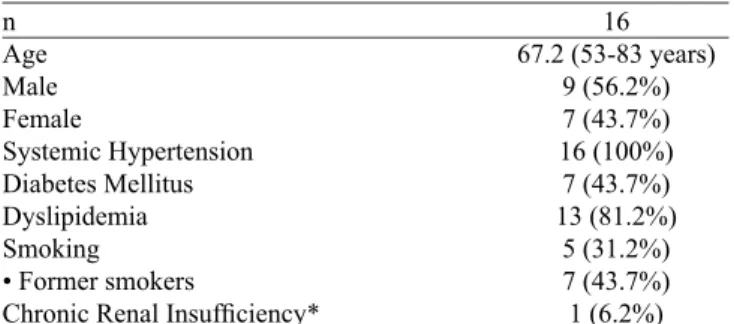
The mean age of patients was 67.2 (53-81 years), seven-females and nine males. Table 1 shows the distribution of risk factors among patients treated. The clinical presentation leading to diagnosis of CSSS varied, and three patients presented with acute myocardial ischemia and in the other 12, the diagnosis was made by coronary angiography after provocative test positive for ischemia. In only one case the diagnosis was made after coronary angiography prior to percutaneous valve replacement (Table 2). Of the 16 patients included, 13 had stenoses and three had occlusions, in all cases in the proximal left subclavian artery.
The therapeutic success rate was 100%, with the criterion of
antegrade low in the internal mammary through digital angi
-ography. Two patients experienced minor complications, being a minor hematoma and pseudoaneurysm that did not require
Fig. 2 - Proximal and distal access to the lesion access and facilitating overtaking angiographic control
Fig. 3 - Balloon Expandable stent being released by brachial access
surgical correction. No patient had major complications. Upon examination of the medical records, 11 patients had sonographic documentation of stent patency for at least one year; two pa-tients lost follow-up and two died. One of infection and sepsis in diabetic foot and other unknown cause. In all cases there was clinical improvement of symptoms after the procedure.
Table 1. Demographical Characteristics of the analyzed patients.
n Age Male Female Systemic Hypertension Diabetes Mellitus Dyslipidemia Smoking • Former smokers
Chronic Renal Insuficiency*
16 67.2 (53-83 years)
9 (56.2%) 7 (43.7%) 16 (100%) 7 (43.7%) 13 (81.2%) 5 (31.2%) 7 (43.7%) 1 (6.2%) *Non dialysis chronic renal insuficiency patient, being treated after adequate renal preparation
Table 2. Clinical characteristics of the patients.
Acute Myocardial Infarction Angina/Positive provocative test
Others*
3 (18.7%) 12 (75%) 1 (6.2%)
*Asymptomatic patient; diagnosis in the coronary angiography previous to valve replacement surgery
vian-subclavian, carotid-subclavian, axillary- axillary grafts, subclavian- carotid transposition or even transposition of the internal mammary artery. Potential complications include
istula of the thoracic duct, Horner’s syndrome, supraclavic
-ular nerve injury (eg N. Phrenic and recurrent laryngeal) and decompensation of preexisting atherosclerotic disease in the supra-aortic trunks, thereby leading to ischemic or neurological symptoms[7,8].
In the cases presented, there were two minor complica-tions and no major complicacomplica-tions, besides the therapeutic and clinical success of 100%. The technical literature reports success of more than 80%, with rates of complications from 3 to 6% and high patency up to ten years of follow-up[5,7,9,10].
None of the patients experienced vertebrobasilar acute
neu-rological symptoms due to reverse low in vertebral artery,
which protects cerebral circulation leading to embolic events
fragments plate to the upper member. The forward low is
restored gradually from 20 seconds to 30 minutes, probably due systems of cerebral selfregulation by decreasing vascular resistance[3,8]. There are reports in the literature of internal
mammary artery blockage and aspiration of blood through the brachial catheter during the procedure, to avoid potential embolization to coronary territory, especially when it is noted
an antegrade low in the internal mammary - a variant of the
CSSS[3,10]. However, in the patients presented, this technique
was not used, without any harm to the result.
The choice of balloon expandable stents rather than selfex-pandable in most cases is due to its greater radial strength and greater accuracy in delivery. However, in very tight lesions or occlusions when it perceives a certain resistance in the position-ing of the stent, may be necessary pre-dilation to facilitate their passage and to prevent it from deforming over the balloon. In the cases presented, only one required a pre-dilatation.
One should remember that the label of the balloon- ex-pandable stents available on the market today does not include its use in the supra -aortic area. The use of these stents in this region is due to the excellent results in case series.
In most services is not routine an angiographic study of aortic arch and supra-aortic trunks prior to Coronary artery bypass[7,11]. Thus, the physical examination of the upper limbs
is necessary, so you can detect any change in pulse/pressure
or supraclavicular soufle before surgery[5,12]. In contrast, in
revascularized patients presenting with acute or insidious myocardial ischemia, we must always remember the CSSS as a possible etiology. In fact, the development of this syndrome in less than a year after myocardial revascularization suggests the presence of subclavian steal syndrome not diagnosed by the time of surgery[5].
CONCLUSION
Angioplasty and stenting of the left subclavian artery is a good option for the treatment of coronary subclavian steal DISCUSSION
With an incidence between 0.5% and 2% of patients undergoing coronary artery bypass grafting[1], the CSSS was
initially described by Hargola / Valle and Tyras / Barner in the 70s, concurrently with the beginning of the use of the internal mammary artery as a conduit artery[2]. The use of this artery
is widely accepted because of its high long-term patency rate and low atherosclerosis, being used in most Coronary artery bypasses[3 -6]. The incidence of this syndrome was 0.3% in our
study, being equivalent to that found in the literature. All cases diagnosed underwent endovascular treatment.
The left subclavian artery is the branch of the aortic arch most affected by atherosclerosis[7], which is the main cause of
the syndrome. This also explains why the vast majority of cases in the literature CSSS occur on the left side, not being different in the cases presented. Other causes include Takayasu arteritis, actinic arteritis and giant cell arteritis[1]. The occlusion of the proximal subclavian artery causes low reversal in arteries
downstream (vertebral and internal mammary), leading to several vertebral- basilary symptoms (dizziness, nystagmus, nausea) and myocardial ischemia[2].
Conventional surgical revascularization procedures have good long-term patency[7], but contain a risk of morbidity of
REFERENCES
1. Tariq S, Tuladhar S, Wingield E, Poblete H. Coronary subclavian
steal syndrome unamenable do angioplasty successfully managed with subclavian-subclavian bypass. Case Report Vasc Med. 2012;2012:784231.
2. Chokyu I, Terada T, Matsuda Y, Okumura H, Shintani A, Nakamura Y, et al. Stenting for left subclavian artery stenosis before and after coronary artery bypass grafting using the internal mammary artery: a report of three cases. Interv Neuroradiol. 2008;14(2):209-14.
3. Kneale BJ, Irvine AT, Coltart DJ. Coronary subclavian steal syndrome following coronary bypass surgery. Postgrad Med J. 1996;72(848):358-60.
4. Miiller JC, Candemil PC, Loures JMGR, Zucco FM, Belz WE, Loures NGR, et al. Síndrome do roubo coronário-subclávio: relato de caso e revisão de literatura. J Vasc Bras. 2012;11(2):166-70. syndrome, with high rates of technical and clinical success. Besides, does not preclude surgical treatment, in the case of more than one unsuccessfull endovascular attempt.
BLA Author
AMK Coauthor, scientiic reviewer
FHR Coauthor, scientiic reviewer
SMM Coauthor, scientiic reviewer
ESJO Coauthor, data collection FACLF Coauthor, data collection PBM Coauthor, statistical analysis AZP Coauthor, statistical analysis Authors’ roles & responsibilities
5. Westerband A, Rodriguez JA, Ramaiah VG, Dietrich EB. Endovascular therapy in prevention and management of coronary-subclavian steal. J Vasc Surg .2003;38(4):699-704
6. Dinkhuysen JJ, Souza LCB, Fichino MZS, Chaccur P, Arnoni AS, Piegas LS, et al. Anastomose mamária-coronária: análise de 2923 casos. Rev Bras Cir Cardiovasc. 1987;2(1):7-21.
7. Costa SM, Fitzsimmons PJ, Terry E, Scott RC. Coronary-subclavian steal: case series and review of diagnostic and therapeutic strategies: three case reports. Angiology. 2007;58(2):242-8.
8. Martinez R, Rodriguez-Lopez J Torruella L, Ray L, Lopez-Galarza L, Diethrich EB. Stenting for occlusion of the subclavian arteries. Technical aspects and follow-up results. Tex Heart Inst J. 1997;24(1):23-7.
9. Van Noord BA, Lin AH, Cavendish JJ. Rates of symptom reoccurrence after endovascular therapy in subclavian artery stenosis and prevalence of subclavian artery stenosis prior to coronary artery bypass grafting. Vascular Health Risk Manag. 2007;3(5):759-62.
10. Nishio A, Takami T, Ichinose T, Masamura S, Hara M, Shimada K, et al. Percutaneous transluminal angioplasty and stent placement for subclavian steal syndrome with concomitant anterograde
low in the left internal mammary artery graft for coronary artery
bypass. Neurol Med Chir (Tokyo). 2003;43(10):488-92.
11. Fergus T, Pacanowski JP Jr, Fasseas P, Nanjundappa A, Habeeb Ahmed M, Dieter RS. Coronary-subclavian steal: presentation and management: Two case reports. Angiology. 2007;58(3):372-5.