ABSTRACT:Introduction: Schistosomiasis is considered an endemic disease in Vitória de Santo Antão, Pernambuco, a district which has presented both high incidence and prevalence of it for decades. Poor environmental conditions lead to contamination of water sources in rural areas, which are used by the population during daily activities, resulting in typical transmission. Recently, there has been evidence of vector snails in urban areas, which could set a new model for schistosomiasis transmission in this district. Objective: To identify the new epidemiological situation for the urban transmission of schistosomiasis in Vitória de Santo Antão, Pernambuco. Methods: A malacological survey was conducted in all water sources in the city limits to investigate schistosomiasis vector snails (Biomphalaria spp.). The collected snails were examined for taxonomic identiication and Schistosoma mansoni infection. All breeding sites were georeferenced to build risk maps through the TrackMaker PRO program and ArcGIS software. Results: We identiied 22 Biomphalaria straminea breeding sites and collected 1,704 snails. One of these breeding sites was identiied as a source of transmission and seven as potential sources of transmission. The designed maps identiied two risk areas of urban transmission of schistosomiasis and expansion areas for breeding sites, establishing an increased risk of transmission to the population. Conclusion: This study veriied the existence of a new epidemiological situation in which the possibility of the urban transmission of the disease was conirmed.
Keywords: Schistosomiasis. Transmission. Biomphalaria. Schistosoma mansoni. Urban sanitation. Epidemiological proile.
Urban transmission of schistosomiasis:
new epidemiological situation in
the forest area of Pernambuco
Transmissão urbana da esquistossomose: novo cenário
epidemiológico na Zona da Mata de Pernambuco
Elainne Christine de Souza GomesI, Millena Carla da Silva MesquitaII,
Vitorina Nerivânia Covello RehnII, Wheverton Ricardo Correia do NascimentoI,
Rodrigo LoyoI, Constança Simões BarbosaI
oRiginAl ARTiCle / artigo original
IAggeu Magalhães Research Center, Fundação oswaldo Cruz – Recife (PE), Brazil.
IIVitória Academic Center, Universidade Federal de Pernambuco – Vitória de Santo Antão (PE), Brazil.
Corresponding author: Elainne Christine de Souza Gomes. Centro de Pesquisas Aggeu Magalhães da Fundação Oswaldo Cruz. Departamento de Parasitologia. Laboratório e Serviço de Referência em Esquistossomose (Ministério da Saúde). Avenida Professor Moraes Rego, s/n, Campus da Universidade Federal de Pernambuco, Cidade Universitária, CEP: 50740-465, Recife, PE,
Brasil. E-mail: [email protected]
Conlict of interests: nothing to declare – Financial support: Pernambuco Research Foundation, BIC (Scientiic Initiation Scholarship)
INTRODUCTION
Schistosomiasis ranks second among the most prevalent infectious and parasitic diseases in the world, afecting about 240 million people in 76 countries1. In Brazil,
schis-tosomiasis continues to be a public health problem; seven to eight million people are estimated to be infected withSchistosoma mansoni (S. mansoni)1-3. This is a neglected
dis-ease that has been fought by health services at all government levels for decades, primarily through the Schistosomiasis Control Program (SCP). However, although control strategies have had positive efect regarding the reduction in prevalence in many regions of the coun-try4,5, its control and elimination still seem a distant reality, given the appearance of new
areas of disease transmission.
In Pernambuco, schistosomiasis is considered an endemic disease in the state forest area, being present in the 43 districts of the region6. Among them, the district of Vitória de Santo
Antão stands out, as it has recorded high incidence and prevalence of the disease for years; it is considered a priority district for actions aimed at epidemiological surveillance and the control of parasitic diseases by the State Department of Health7,8. A study conducted with
a community of small rural farmers in this district found a 35.1% prevalence of schistoso-miasis9, which is high according to the parameters of the Ministry of Health. The occurrence
of schistosomiasis in the region is closely related to substandard social and environmental conditions in rural areas9.
ReSUMo:Introdução: A esquistossomose é considerada uma endemia em Vitória de Santo Antão, Pernambuco, o qual apresenta há décadas altas incidências e prevalências para essa doença. Nesse município ocorre a transmissão clássica da doença por meio do contato da população de áreas rurais com águas contaminadas durante o desenvolvimento de suas atividades de vida diárias. Recentemente surgiram indícios da presença do caramujo vetor na área urbana da cidade, o que pode conigurar um novo modelo de transmissão para esquistossomose nesse município. Objetivo: Identiicar novo cenário epidemiológico para ocorrência da transmissão urbana da esquistossomose em Vitória de Santo Antão, Pernambuco. Métodos: Foi conduzido um inquérito malacológico, investigando-se todas as coleções hídricas do perímetro urbano quanto à presença do caramujo vetor da esquistossomose (Biomphalaria spp.). Os caramujos coletados foram examinados para identiicação taxonômica e de infecção pelo Schistosoma mansoni. Todos os criadouros (CRs) foram georreferenciados para construção de mapas de risco por meio dos software TrackMaker-Pro e ArcGIS. Resultados: Foram identiicados 22 CRs da espécie Biomphalaria straminea, nos quais foram coletados 1.704 caramujos. Desses CRs, um foi identiicado como foco de transmissão da doença e sete como focos potenciais para transmissão. Os mapas construídos identiicaram duas áreas de risco para transmissão urbana da esquistossomose, bem como áreas de expansão dos CRs, conigurando um aumento no risco de transmissão para a população. Conclusão: Os resultados constatam a existência de um novo cenário epidemiológico, no qual a possibilidade de transmissão urbana dessa doença foi conirmada.
The lack of sanitation is a determinant for schistosomiasis, as it enables fecal contamina-tion of water sources — natural breeding sites of the vector snail —, initiating the disease transmission cycle7,10. In addition, the migration of parasitized people has spread
schistoso-miasis to unafected areas, such as urban centers of inland cities and coastal towns of the state of Pernambuco11,12. In this context, a process of disordered urban occupation on
the city outskirts is observed, being identiied by the lack of sanitation infrastructure, where organic sediments from wastewater and open sewage as well as food sources for the mol-lusk enable the maintenance of peridomestic sources of transmission and, consequently, the maintenance of schistosomiasis11,13.
Seasonal climate variations also inluence the disease transmission process, since periods of heavy rains facilitate the spread of temporary and permanent Biomphalaria ssp. breed-ing sites, increasbreed-ing chances of contact with man, and, therefore, disease transmission14.
Such environmental conditions have been implicated in an epidemic of the parasitic disease in the population of Porto de Galinhas/Ipojuca, Pernambuco15, aiding the emergence of a
new endemic area for schistosomiasis transmission on the coast of the state16.
In the forest area of Pernambuco, this environmental and epidemiological scenario can occur in urban areas of the districts, considering the increasing development of cities and the seasonal looding caused by overlowing rivers that low through the city, leaving much of their urban areas submerged. Hence, vector snails can be transported to these locations, establishing new Biomphalaria ssp. breeding sitesor sources of schistosomiasis transmis-sion. Therefore, the objective of this study is to identify the peridomestic presence of these sources, proving the risk of the urban transmission of this parasitic disease.
METHODS
This is an epidemiological study based on a malacological survey, conducted between September 2014 and August 2015 in the district of Vitória de Santo Antão, Pernambuco, located 53 km away from the capital, Recife. According to data from the Brazilian Institute of Geography and Statistics (IBGE), this district has a land area of 372,637 km². It occupies the 10th place among the most populated districts in the state and its population in 2014 was estimated at 134,871 inhabitants.
These breeding sites were subclassified as source of transmission — when the col-lected snails released S. mansoni cercaria through a light-exposure technique — and potential source — when S. mansoni DNA was detected in the collected snails through a molecular biology technique.
There were two collections in each breeding site: the first during the dry season (September to February) and the second during the rainy season (March to August), with a view to assessing the inluence of rainfall on the density of snails. Snails were collected with sieves and forceps for 15 minutes in each selected breeding site and properly stored in plastic containers dampened with paper towels, all aired and identiied17 for transport to the
Schistosomiasis Laboratory and Reference Service at the Aggeu Magalhães Research Center of the Oswaldo Cruz Foundation (CPqAM/Fiocruz). Approximately 5% of the snails col-lected in each breeding site were randomly secol-lected for taxonomic identiication through the dissection of the genital tract to determine species18.
For the diagnosis of S. mansoni infection and the detection of sources of transmission, snails were exposed to artiicial lighting for 1 to 2 hours for cercariae release19. Snails that
tested negative for the infection through this technique were submitted to DNA extraction in a pool of snails by breeding site, through an extraction technique using phenol:chloro-form:isoamyl alcohol; subsequently, the molecular biology method of nested polymerase chain reaction (PCR) was performed, which was speciic and eicient for S. mansoni DNA identiication20. The density of snails by breeding site was established as the total number
of snails collected by site during the study period.
In the breeding sites, data related to fecal contamination were collected both by observa-tion of the sewage released directly into water sources and the presence of total coliforms, fecal coliforms, and Escherichia coli (E. coli), using the Colitag™ test kit. To use the kit, water
samples were obtained from the same mollusk collection stations in 100-mL sterile contain-ers. The chromogenic reagent was added to the container of collected water, homogenized for further incubation for 24 hours at a temperature of 35 ºC. The irst assessment was per-formed using the direct method, in which samples that migrated from a natural color to a vibrant yellow went to phase two. The second assessment was carried out with the aid of a Loccus™ Biotechnology photo-documentation imager (L-Pix), which irradiated samples
with a beam of ultraviolet light to determine the presence of E. coli.
To design thematic and risk maps for schistosomiasis transmission, all breeding sites were georeferenced with the aid of a Garmin eTrex GPS receiver. The TrackMaker-Proprogram and the ArcGIS 10.1 software were used for spatial analysis of data. A kernel intensity estimator identiied the areas of greatest risk of schistosomiasis transmission, based on geolocation and the number of snails by breeding site. The kernel intensity estimator is a simple alter-native to analyze behavior standards of locations throughout the study area. Therefore, the following parameters were considered:
1. stratiication of quantile data; and
A bufer map with a 50-m radius was also designed from the location of each breeding site and/or source of transmission for the expansion simulation of risk areas, representing loods in the city.
This study did not require approval by the Research Ethics Committee as human beings were not used as subjects.
RESULTS
During the study period, we identified 22 breeding sites within the city limits of Vitória de Santo Antão, where 1,704 snails of the Biomphalaria straminea (B. straminea) species were collected (Table 1). Figure 1 shows a thematic map with the boundaries of the study area, in which the distribution of B. straminea breeding sites, schistoso-miasis potential sources, and sources of transmission is observed. Most breeding sites were located at the sides of the PE-60 Highway that cuts the city, a commercial area with heavy movement of people. From the 22 breeding sites, seven were classified as potential sources (site nos. 1, 5, 7, 10, 13, 18, and 20) and one as a source of trans-mission (site no. 15), verifying the real risk of urban transtrans-mission of schistosomiasis (Figure 1). Breeding site no. 20 (potential source) was the only one that presented the greatest number of snails in the two collected samples (n = 323). Breeding site no. 14, however, was the one with the lowest density (Table 1).
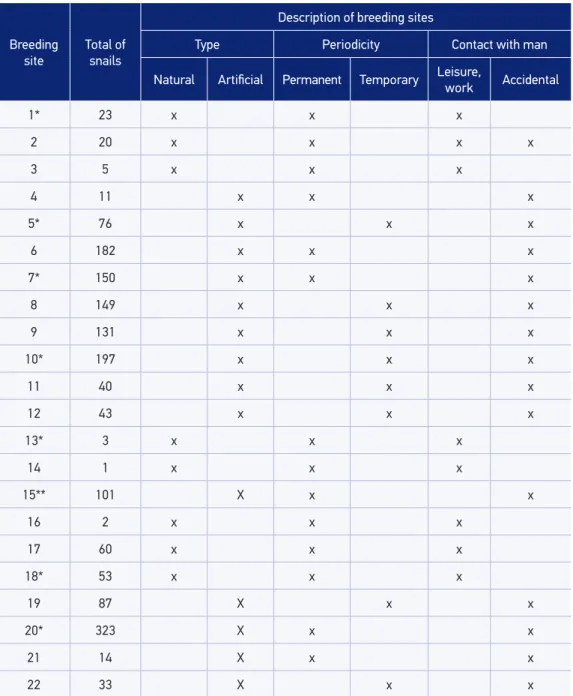
A description of the breeding sites is shown in Table 2, where they are quantiied by type — 8 are natural and 14 artiicial — periodicity — 14 are permanent and 8 tempo-rary — and type of contact with man — 8 as work and leisure activities and 15 as accidental contact. For the latter, the same breeding site has been classiied in both categories (breed-ing site no. 2). Regard(breed-ing sources, 75% of the breed(breed-ing sites are artiicial and permanent and 62.5% expose man to accidental contact with S. mansoni. The source of transmission (breeding site no. 15) was classiied as artiicial and permanent, with accidental contact.
The largest number of snails was collected in the dry season (September to February). During the rainy season (March to August), snails were not found in some of the previously identiied breeding sites. However, it was during this period that the only active source of disease transmission was identiied — breeding site no. 15 (Table 1). All collected water samples tested positive for total coliforms, fecal coliforms, and E. coli, which establishes the contamination of breeding sites by sewage and wastewater.
Figure 2 shows risk maps that represent the total number of breeding sites and sources of transmission (Figure 2(A)). A more intense sprawl is conirmed, comprising breeding site nos. 6 to 10 and 19. A lower potential for transmission is identiied in areas surrounding breeding site nos. 11, 12, 15 to 18, 21 and 22. The absence of the risk sprawl for some breeding sites and sources of transmission is explained by the low number of snails detected in the area.
1. the risk sprawl was intensiied over potential source no. 20;
2. the source of disease transmission (breeding site no. 15) showed a small increase in the risk sprawl; and
3. breeding site nos. 5–10 presented moderate risk.
Breeding site
Number of snails
(First collection – September to February)
Number of snails
(Second collection – March to August) Total
1* 20 3* 23
2 8 12 20
3 2 3 5
4 8 3 11
5* 70 6* 76
6 120 62 182
7* 68 82* 150
8 87 62 149
9 77 54 131
10* 124 73* 197
11 40 0 40
12 43 0 43
13* 3* 0 3
14 1 0 1
15** 41 60** 101
16 2 0 2
17 60 0 60
18* 45 8* 53
19 45 42 87
20* 200* 123 323
21 10 4 14
22 30 3 33
Total 1,104 600 1,704
*Potential sources of transmission — snails with S. mansoni DNA; **source of transmission — snails that tested positive for infection with a S. mansoni light-exposure technique (releasing cercariae).
Figure 3 shows the expansion of breeding sites during the rainy season, when their areas merge and some may be contaminated by water from sources, like breeding site nos. 6 to 10, 19 and 20, which expanded up to 100 m, coming into contact with each other.
DISCUSSION
The identiication of only one source of transmission (breeding site no. 15) through a light-exposure technique (Table 1) is what is expected in B. straminea breeding sites, considering the species resistance to release cercariae, even if infected19. This source of
transmis-sion consists of an open sewage channel that exposes the population to the risk of accidental infection when walking on the street. The use of a molecular biology method of nested-PCR20 in the identiication of the seven potential sources in the region was
deter-minant to map the risk of urban transmission of the disease, which afects the population that lives and daily moves in the area, exposing themselves to these sources. Such results conirm the hypothesis that this population is at high risk of becoming infected with S. man-soni, as potential sources can transform into active sources, since the presence of parasite DNA in snails has been proven.
Figure 1. Distribution map of B. straminea breeding sites and sources of schistosomiasis transmission in Vitória de Santo Antão, PE.
Brazil
Vitória de Santo Antão Pernambuco
City limits
City limits
Captions
District boundaries
Breeding site
Source of transmition Potencial source
PE-60 Highway Road System
Breeding site
Total of
snails
Description of breeding sites
Type Periodicity Contact with man
Natural Artiicial Permanent Temporary Leisure, work Accidental
1* 23 x x x
2 20 x x x x
3 5 x x x
4 11 x x x
5* 76 x x x
6 182 x x x
7* 150 x x x
8 149 x x x
9 131 x x x
10* 197 x x x
11 40 x x x
12 43 x x x
13* 3 x x x
14 1 x x x
15** 101 X x x
16 2 x x x
17 60 x x x
18* 53 x x x
19 87 X x x
20* 323 X x x
21 14 X x x
22 33 X x x
*Potential sources of transmission — snails with S. mansoni DNA; **source of transmission — snails that tested positive for infection with a S. mansoni light-exposure technique (releasing cercariae).
Table 2. Description of breeding sites and sources of schistosomiasis transmission. Vitória de Santo Antão, PE, 2014–2015.
Figure 2. Kernel of the density of snails (B. straminea) by breeding sites (A) and sources of schistosomiasis transmission (B). Vitória de Santo Antão, PE.
1 cm = 205 m Minimum risk
Captions
Breeding site
Source of transmission Potential source
Kernel - 250 m Maximum risk City limits PE-60 Highway Road system
Breeding site
City limits
1 cm = 206 m
Minimum risk
Caption
Source of transmission Potential source
Kernel - 250 m
Maximum risk PE-60 Highway Road system
A
and intermediate hosts exposed to the infection. In addition, most breeding sites (Table 2) are artiicial and permanent, which shows a disordered occupation of the urban space and results in optimal sources of disease transmission and exposure areas for contact with man.
The absence of snails in six breeding sites and the lowest density recorded during the rainy season (Table 1) can be explained by the increased water low that fosters the sweeping of these vectors to other sites21,22. Furthermore, the highest density of snails found in post-rain periods and the dry
sea-son corroborates the tropism of these animals by water ecotopes with low current or still waters21,22.
The data found in this study comprise a new epidemiological situation of urban transmission of the disease. A district in which there was only rural typical transmission — linked to the presence of the infected snail in rivers used by men during work and leisure activities9,23 — now has looded
breeding sites in the streets and within city limits; that fact may lead to human infection through accidental contact with peridomestic sources14,15,24 during the movement of individuals in the city.
A similar epidemiological situation has been described in various urban locations in Brazil12, 25,26 and worldwide27,28. In Pernambuco, coastal areas have been the target of the migratory
low of individuals parasitized with S. mansoni for decades, which, in search of better liv-ing conditions, settle on the city outskirts, where the lack of basic sanitation is maintained. Furthermore, intermediate hosts in the coastal regions lead to the completion of the trans-mission cycle, enabling cases of the disease12,13,17,24. In this context, Porto de Galinhas can be
mentioned as a model for the understanding of such epidemiological situation, where, in
Figure 3. Risk map for the spread of breeding sites of B. straminea and sources of schistosomiasis transmission in Vitória de Santo Antão, PE.
1 cm= 240 m Caption
Breeding site
City limits 100 150 200 250
Source of transmission Potential source
a decade, the disease established itself and became endemic11,14-16. From that example, the
situation for schistosomiasis transmission in Vitória de Santo Antão may be reaching a new phase, in which the disease is no longer solely rural and becomes an urban endemic disease, putting a huge portion of the population at risk of becoming infected.
The identiication of the risk sprawl shown in Figure 2 (A)/(B) (breeding site nos. 6–10) indicates a higher concentration of breeding sites and snails in areas of pedestrian traic. The detection of low-risk locations around breeding site no. 15 (Figure 2(B)) deserves spe-cial attention from Epidemiology Surveillance because it is a source of transmission, setting a high real risk of schistosomiasis transmission.
The rainy season has strong inluence on the urban transmission of schistosomiasis by causing the overlow and dispersion of urban breeding sites of Biomphalaria29. In Vitória de
Santo Antão, the loods experienced by the population seasonally lead to the transport of snails to city limits, where there are favorable ecotopes for ixation and maintenance in the environment, exposing residents to the risk of becoming infected.
CONCLUSION
This study veriied the risk of urban transmission of schistosomiasis in Vitória de Santo Antão. Such epidemiological situation, although new to the district, may be repeating itself in other endemic districts in the state forest area with similar risk conditions to those presented in this study.
It is necessary to broaden malacological and epidemiological studies in the area; fur-thermore, it is essential that local health services create new research protocols for the early diagnosis of new cases. Therefore, a new conception of the disease is imperative, in which the origin and risk behavior are not only related to populations from the countryside and who had contact with river water, but also populations of urban areas, who can expose themselves to unintentional contact with sources of transmission of this parasitic disease.
Given the results presented here, we intended to expand research on urban transmis-sion of schistosomiasis in Vitória de Santo Antão, in search of endemic cases of the disease through prevalence surveys in schools.
1. Useh MF. Control of Shistosomiasis. In: Rokni MB. Shistosomiasis. Croatia: Rijeka; 2012. cap. 4, p. 73-102. 2. Katz N, Peixoto SV. Análise crítica da estimativa do
número de portadores de esquistossomose mansoni no Brasil. Rev Soc Bras Med Trop 2000; 33: 303-8. 3. Brasil. Ministério da Saúde. Secretaria de Vigilância
em Saúde. Esquistossomose Mansônica. In: Guia de Vigilância Epidemiológica. 6 ed. Brasília: Ministério da Saúde; 2005. p. 297-306.
4. Brasil. Ministério da Saúde. Secretaria de Vigilância em Saúde. Depar tamento de Vig ilância em Doenças Transmissíveis. Plano integrado de ações estratégicas de eliminação da hanseníase, filariose, esquistossomose e oncocercose como problema de saúde pública, tracoma como causa de cegueira e controle das geohelmintíases: plano de ação 2011-2015. 1 ed., 1 reimpr. Brasília: Ministério da Saúde; 2013. 100p.
5. Barbosa CS, Favre TC, Amaral RS, Pieri OS. Epidemiologia e Controle da Esquistossomose Mansoni. In: Carvalho OS, Coelho PMZ, Lenzi HL.
Schistosoma mansoni e esquistossomose: uma visão multidisciplinar. Rio de Janeiro: Editora Fiocruz; 2008. p. 965-1008.
6. Favre TC, Ximenes RAA, Galvão AF, Pereira APB, Wanderley TN, Barbosa CS, et al. Reliability of current estimates of schistosomiasis prevalence in the Rainforest Zone of the state of Pernambuco, Northeastern Brazil. Mem Inst Oswaldo Cruz 2006; 101(Suppl 1): 73-8.
7. Pernambuco. Secretaria Estadual de Saúde. Secretaria Executiva de Vigilância em Saúde. Esquistossomose e geo-helmintíases: relatório das condições de saneamento das áreas/localidades hiperendêmicas em Pernambuco. Recife: Secretaria Estadual de Saúde de Pernambuco; 2013. 134p.
8. Pernambuco. Secretaria Estadual de Saúde. Secretaria Executiva de Vigilância em Saúde. Programa de Enfretamento das Doenças Negligenciadas no Estado de Pernambuco SANAR – 2011/2014. Recife: Secretaria Estadual de Saúde; 2013. 39p.
9. Barbosa CS, Barbosa FS. Padrão epidemiológico da esquistossomose em comunidade de pequenos produtores rurais de Pernambuco, Brasil. Cad Saúde Públ 1998; 14(1): 129-37.
10. Ximenes R, Southgate B, Smith PG, Guimarães Neto L. Socioeconomic determinants of schistosomiasis in an urban area in the Northeast of Brazil. Rev Panam Salud Publica 2003; 14(6): 409-421.
11. Gomes ECS, Leal-Neto OB, Albuquerque J, Silva HP, Barbosa CS. Schistosomiasis transmission and environmental change: a spatio-temporal analysis in Porto de Galinhas, Pernambuco – Brazil. Int J Health Geogr 2012; 11: 51.
12. Barbosa CS, Pieri OS, Silva CB, Barbosa FS. Ecoepidemiologia da esquistossomose urbana na ilha de Itamaracá, Estado de Pernambuco. Rev Saúde Públ 2000; 34(4): 337-41.
13. Silva PB, Barbosa CS, Pieri OS, Travassos A, Florencio L. Aspectos físico-químicos e biológicos relacionados à ocorrência de Biomphalariaglabrata em focos litorâneos de esquistossomose em Pernambuco. Quím Nova 2006; 29(5): 901-6.
14. Gomes ECS, Leal-Neto OB, Oliveira FJ, Campos JV, Souza-Santos R, Barbosa CS. Risk analysis for occurrences of schistosomiasis in the coastal area of Porto de Galinhas, Pernambuco, Brazil. BMC Infect Dis. 2014; 14: 101. 15. Barbosa CS, Abath F, Montenegro SML, Domingues
ALC, Spinelli V, Guida U, et al. Epidemia de
esquistossomose aguda na praia de Porto de Galinhas, Pernambuco, Brasil. Cad Saúde Pública 2001; 17(3): 725-8.
16. Barbosa CS, Araujo K, Leal-Neto OB, Gomes ECS, Domingues AL. The endemisation of schistosomiasis in Porto de Galinhas, Pernambuco, Brazil: 10 years after the irst epidemic outbreak. Mem Inst Oswaldo Cruz 2011; 106(7): 878-83.
17. Brasil. Ministério da Saúde. Secretaria de Vigilância em Saúde. Departamento de Vigilância Epidemiológica. Vigilância e controle de moluscos de importância epidemiológica – diretrizes técnicas: Programa de Vigilância e Controle da Esquistossomose (PCE). 2 ed. Brasília: Ministério da Saúde; 2008. 178p. 18. Deslandes N. Técnicas de dissecção e exame de
planorbídeos. Rev Serv Espec Saude Publica 1951; 4: 371-82.
19. Kuntz ER. Efect of light and temperature on shedding of Schistosoma mansoni cercarie. Nav Med Res Inst 1946: 7-16.
20. Melo FL, Gomes AL, Barbosa CS, Werkhauser RP, Abath FG. Development of molecular approaches for the identif ication of transmission sites of Schistosomiasis. Trans R Soc Trop Med Hyg 2006; 100(11): 1049-55.
21. Giovanelli A, Soares MS, D´Andréa PS, Gonçalves MML, Rey L. Abundância e infecção do molusco
Biomphalaria glabrata pelo Schistosoma mansoni no Estado do Rio de Janeiro, Brasil. Rev Saúde Pública 2001; 35(6): 523-30.
22. Favre TC, Pieri OS, Zani LC, Ferreira JM, Domas GG, Beck LH, et al. Longitudinal Study on the Natural Infection of Biomphalaria straminea and B. glabrata by Schistosoma mansoni in an Endemic Area of Schistosomiasis in Pernambuco, Brazil. Mem Inst Oswaldo Cruz 2002; 97(4) 465-75.
23. Lima-Costa MF, Guerra HL, Firmo JOA, Pimenta Jr F, Uchoa E. Um estudo epidemiológico da efetividade de um programa educativo para o controle da esquistossomose em Minas Gerais. Rev Bras Epidemiol 2002; 5(1): 116-28.
24. Paredes H, Souza-Santos R, Resendes AP, Souza MA, Albuquerque J, Bocanegra S, et al. Spatial pattern, water use and risk levels associated with the transmission of schistosomiasis on the north coast of Pernambuco, Brazil. Cad Saúde Pública 2010; 26: 1013-23. 25. Barbosa CS, Gonçalves JF, Barbosa FS, Albuquerque Y.
26. Lima VLC . A Esquistossomose Urbana e a Heterogeneidade Social e Epidemiológica da População do Município de Campinas, São Paulo, Brasil. Cad Saúde Pública 1995; 11(1): 45-56.
27. Dabo A, Diarra AZ, Machault V, Touré O, Niambéle DS, Kanté A, et al. Urban schistosomiasis and associated determinant factors among school children in Bamako, Mali, West Africa. Infect Dis Poverty 2015; 4: 4.
28. Mbutolwe E. Mwakitalua, Mwele N. Malecelaa, Franklin WM, Paul ES. Urban schistosomiasis and soil transmitted
helminthiases in young school children in Dar es Salaam and Tanga, Tanzania, after a decade of anthelminthic intervention. Acta Trop 2014; 133: 35-41.
29. Barbosa CS, Souza-Santos R, Gomes ES, Araújo K, Albuberque J, Melo F, et al. Epidemiologia da esquistossomose no litoral de Pernambuco. Rev Patol Trop 2014; 43(4): 436-45.
Received on: 11/27/2015