Spatial analysis of
schistosomiasis human cases in
the horticultural community of
Zona da Mata of Pernambuco
state, Brazil
Análise espacial dos casos humanos
de esquistossomose em uma
comunidade horticultora da Zona
da Mata de Pernambuco, Brasil
Onicio Batista Leal Neto
IThiago Yury Cavalcanti Galvão
IIFabrício Andrade Martins Esteves
IIIAyla Maritcha Alves Silva Gomes
IIElainne Christinne de Souza Gomes
I,IIIKarina Conceição Gomes Machado de Araújo
IVConstança Simões Barbosa
II Aggeu Magalhães Research Center of the Oswaldo Cruz Foundation
(CPqAM-FIOCRUZ/PE).
II Caruaruense Association of Higher Education (ASCES). III Vitória Academic Center (CAV-UFPE).
IV Federal University of Sergipe.
Correspondence to: Onicio Batista Leal Neto. Centro de Pesquisas Aggeu Magalhães, Serviço de Referência em Esquistossomose. Av. Professor Moraes Rego s/n, Cidade Universitária, Recife, PE, Brasil, CEP 50670-420. E-mail: [email protected]
Abstract
The objective of this study was to describe the spatial distribution of schistosomiasis in horticultural community of Natuba, district of Vitória de Santo Antão, Pernambuco state. It was conducted a parasitological survey, examined the fecal material of 310 community residents. The cases positive for Schistosoma mansoni were geocoded and included in the computerized template of the community, generating maps of spatial distribution with kernel estimators. The results showed a high prevalence of schistosomiasis, with 28.4% of the parasites. Other parasites were found in 25.8% of the population. The use of GIS tools to map and understand the possible distribution of cases of schistosomiasis in the space occupied by the community highlighting and listing locations of lower elevation (able to flooding), with a higher frequency of human cases. Studies like this provide information to the local health services, may intervene and bring about change for individuals living in areas with low housing conditions to minimize their exposure to risk of contracting schistosomiasis.
Resumo
O objetivo deste trabalho foi descrever a distribuição espacial da esquistossomose na comunidade horticultora de Natuba, Vitória de Santo Antão, Pernambuco. Foi conduzido um inquérito parasitológico onde se exa-minou o material fecal de 310 moradores da comunidade. Os casos positivos para
Schistosoma mansoni foram georreferen-ciados e incluídos no croqui da localidade, gerando os mapas de distribuição espacial com estimadores de kernel. Os resultados apresentaram uma alta prevalência para esquistossomose, com 28,4% da população parasitada. Outros parasitos foram encon-trados em 25,8% da população. O uso das ferramentas de geoprocessamento permi-tiu mapear e compreender a distribuição dos casos de esquistossomose no espaço ocupado pela comunidade, destacando e relacionando locais de menor altitude (passíveis de alagamento), com uma maior frequência de casos humanos. Estudos como este fornecem informações para que os serviços de saúde local possam intervir e promover mudanças para que indivíduos residentes em áreas com baixas condições habitacionais minimizem sua exposição ao risco de contrair a esquistossomose.
Palavras-chaves: Esquistossomose. Análise espacial. Epidemiologia. Saúde Pública.
Introduction
Brazil, a developing country, has public health problems due to the lack of policies oriented toward health promotion and education and due to the low investments in basic and environment sanitation, leading to not very healthy spaces for less privileged populations. Certain infectious-parasitic diseases are still quite widespread and have
high prevalence ratesin this
socio-environ-mental setting1-6. Endemic diseases such
as schistosomiasis mansoni are chronic in individuals infested at sites where the health status is a manifestation of unhealthy
envi-ronments7. The space-time approach
con-siders that sites have historical, social and political inheritances, and thus persisting endemic diseases may be represented by risky cultural practices molded throughout
a long process of absence of health care8.
By trying to understand the relationship between environment and health, the stu-dies that approach the theme have succes-sfully used geoprocessing tools to analyze hazards spatially, trying to assess the impact of adverse environmental conditions on the
integrity of individuals in time and space9.
Geoprocessing is a set of techniques to collect, show and treat spatial information, used along with Geographical Information System (GIS) and Global Positioning System (GPS) tools to develop appropriate models for the surveillance, forecast and prevention
of risks for diseases10. Using maps has shown
to be the best form of representation, as it gives the researcher an immediate and direct vision of the distribution of an event in space. Moreover, by using GIS, it is easier to check any spatial associations between health events and different aspects of the
natural and built environment11.
The World Health Organization (WHO) underscores the importance of identi-fying foci of transmission of diseases in environments of high prevalence and/or incidence of parasite infections, generating information to substantiate and support the implementation of health education
The search and identification of potential foci of parasite infections are extremely important to public health, given they can provide prophylactic and educational information to fight the forms of transmis-sion and development of these conditions, mainly in regions where schistosomiasis is historically endemic, such as the Zona da Mata of Pernambuco, where several control strategies been thought of, although no advance has been sustainable enough for its control14-17.
The present study aimed to describe the occurrence of parasite infections in the community of Natuba in Vitória de Santo Antão, Pernambuco, relating age group and work activity. Trying to evaluate the expres-sion of schistosomiasis at the site through spatial analysis (spatial distribution, Kernel estimator and analysis of altimetry) was particularly pursued, given the location has had a scenario prone to the introduction and maintenance of the biological cycle of the Schistosoma mansoni for decades.
Methods
A cross-sectional analytical study was performed between October 2008 and March 2009 at the vegetable farming community of Natuba, district of the mu-nicipality of Vitória de Santo Antão-PE, located in the Zona da Mata of the state of Pernambuco, 45.1 kilometers from Recife,
with a population of 896 inhabitants8.
The referred community is crossed by the Natuba River, downstream to the South por-tion of the community, part of the Tapacurá water basin. River waters are used to irrigate and support daily household activities, such as washing clothes and leisure for the com-munity. The climate is hot and humid, with an annual average temperature of 24.6ºC. The main route of access is the BR-232, a road of great economic importance for the state of Pernambuco. The vegetables grown by the community are sold at road sides and are also distributed to the markets of neighboring cities, making it one of the largest vegetable producing poles of the
State of Pernambuco. The population of this region is in daily contact with the waters of this spring that harbors the snail vectors of this disease, due to work and daily activities. Therefore, most individuals are exposed to the risks of acquiring schistosomiasis and continuing its cycle.
The coproscopy survey was done by sampling, covering the entire community. EpiInfo 3.5.1 was used to calculate the mi-nimum sample necessary to obtain results with statistical significance, with a 35% estimated prevalence and a maximum error of 5% for schistosomiasis in the community,
based on a previous study15. A minimum
number of 284 patients was established for a 95% level of confidence. Aimed at guaranteeing the reliability of results and minimizing the risk of bias due to sample loss, coproscopy was performed in 310 community dwellers.
The material for coproscopy was stored in a thermal box at 8ºC and transported to the Parasitology laboratory of the Associação Caruaruense de Ensino Superior – ASCES/ FAAPE for processing. Parasitology feces tests were performed using two techniques, Hoffmann, Pons & Janner19 and Kato-Katz20,
for each patient. Patients with any kind of parasite were duly referred for treatment. All households with cases of schistosomiasis were used for georeferencing for thematic and analytical maps.
A malacological survey was performed, electing the ridges of vegetable gardens as the site of highest exposure of farmers,
gi-ven pools of Biomphalaria straminea were
(FUNASA)21 was used, according to the
Geographical Indication guide. Group te-chnicians systematically went through the community making the digital design of the locality. Data were transferred from the GPS to the computer and processed by GPS TrackMaker PRO software to correct polygons on the computerized template and to adjust for the virtual spectrum gene-rated by trails. The river network map was purchased at the Pernambuco Technology Institute (ITEP). After treatment, points, lines and polygons were imported to the ArcGIS version 10(ESRI) software, where spatial analysis was performed. Descriptive data were analyzed by the EpiInfo 3.5.1 sta-tistical package, using a p-value of 0.05 with a 95% confidence interval.
The Kernel estimator, a non-parametric technique that promotes statistical suaviza-tion generating chromatic gradients with “hot spots”, was adopted for spatial analysis and identification of patterns of distribution
and density of cases, given it concentrates
the density of cases in a certain area. The gradient level is controlled by choosing a parameter known as band width (in the present study, 200 meters for positive cases), which indicates the area to be considered in the calculation and should reflect the geographical scale of the assumption of
interest, and the previous knowledge on the event studied. The Kernel Polynomial 5 Interpolation with barriers technique, capable of generating chromatic intensity gradients was used for the interpolation between the dependent variable (case) and the geographical variable (elevation).
The study was registered at the Ethics in Research Committee of Associação Caruaruense de Ensino Superior (CEP/ ASCES), approved by letter ACP nº155/08 CEP/ASCES. Volunteer participation of dwellers of the farming region included in the study was confirmed by the signature of the Consent Form.
Results
Of the 310 individuals analyzed, 190
(61.3%) had at least one parasite, S.mansoni
having been the most frequent species, with a 28.4% frequency in the population studied
(Table 1). The mean parasite load for S.
mansoni in these individuals was 60.2 eggs per gram of feces (opg), ranging between 24 and 408 opg.
Polyparasitism was observed in 25.8% of the population studied, 58.7% of which with two parasites, 25% with three parasites and 16% with four parasites. Among age groups, the age group between 10-19 and
Table 1 - Prevalence of parasites in the researched population, Natuba, Vitória de Santo Antão, PE, Brazil.
Tabela 1 - Prevalência das parasitoses na população estudada, Natuba, Vitória de Santo Antão, PE.
Parasites n %
Schistosoma mansoni 88 28.4
Entamoeba coli 61 19.7
Ancilostomídeos 56 18.0
Entamoeba histolytica/dispar 42 13.5
Giardia lamblia 37 11.9
Ascaris lumbricoides 10 3.2
Endolimax nana 10 3.2
Hymenolepis nana 6 1.9
Trichuris trichiura 4 1.3
Enterobius vermicularis 2 0.6
Table 2 - Infection percent of S. mansoni by age group, Natuba, Vitória de Santo Antão – PE, Brazil.
Tabela 2 - Percentual de infecção pelo S.mansoni por faixa etária, Natuba, Vitória de Santo Antão,
PE.
Age group Positivity (%)*
0 to 9 4.2 (n=1)
10 to 19 34.2 (n=25)
20 to 29 37.1 (n=26)
30 to 39 28.3 (n=17)
40 to 49 25.0 (n=10)
> 50 20.9 (n=9)
* P-value < 0.0321; χ2 =12.2; gl = 5
20-29 years was affected most, with 29.6%
of individuals infected by S. mansoni (Table
2). No significant differences were observed between the proportion of men and women infected.
Forty-three samples of snails of the
Biomphalaria straminea species were col-lected during the malacological survey on the ridges of vegetable gardens. After the specimens were exposed to an artificial light source (60 w bulb) for 2 hours, the
elimination of S. mansoni cercariae was not
observed. Other species of snails at capture
sites such as Melanoides tuberculatus and
Pomacea sp. were also detected.
The computerized template of the location (Figure 1) shows the distribution
of vegetable gardens and of Biomphalaria
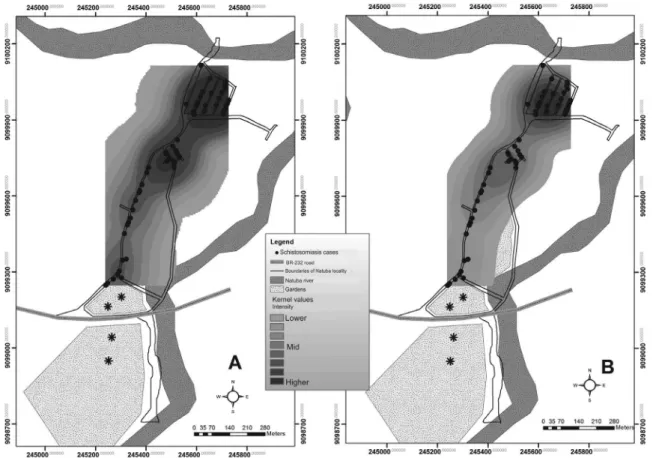
pools. Figure 2 shows the concentration of
positive cases for S. mansoni in the
com-munity. Figure 3 has an interpolation map of cases with the elevation, which is related to the flood area highlighted at the location.
Discussion
In Natuba, the site built by the commu-nity for economic support is represented by a vast extension of vegetable gardens with irrigation ridges, a system that represents 75% of the local area. Vegetable gardens are irrigated with water extracted from the river by suction pumps and sprinkling hoses car-ry and spread the vector snails throughout the plantation. As the gardens are irrigated
constantly, their side ridges are always so-aked in water, forming excellent artificial pools where snails find food (lettuce waste) and reproduce themselves abundantly.
In 1998, Barbosa CS & Barbosa FS15 had
already registered that sanitary sewages from most homes drained into the Natuba River, leading to the contamination of the water environment, favoring the esta-blishment and maintenance of the cycle of
parasites like S. mansoni. The present study
observed that the same sanitation and envi-ronment conditions remain and modulate the current local epidemiological landscape. The flooding of the ridges where vege-tables are cultivated creates the necessary
and ideal conditions for the survival of B.
straminea. Although this snail is considered
a bad biological host for S. mansoni, as the
exposure of farmers is intense and systema-tic, and due to their work activity, it guaran-tees the high prevalence and maintains the intensity of the infection in the community. The non-shedding of cercariae in the lab from snails collected may be explained by the low susceptibility of this vector species22.
A previous study performed at this
lo-cation15 registered 35.1% of the population
infected by S. mansoni. On that occasion,
Figure 1 - Spatial distribuition Schistosomiasis cases at Natuba, Vitória de Santo Antão, Pernambuco, Brazil.
Figura 1 - Mapa de distribuição espacial dos casos de esquistossomose em Natuba, Vitória de Santo
Antão, Pernambuco, Brasil.
pattern of contamination of the environ-ment and infection also is stable, in face of the observation of the maintenance of the unhealthy environment and working conditions that promote the maintenance of
Figure 2 - Kernel estimator map, by location of human cases (A) and parasitary load (B), Natuba, Vitória de Santo Antão, Pernambuco, Brazil.
Figura 2 - Mapa Estimador de Kernel segundo localização dos casos humanos (A) e carga parasitária (B), Natuba, Vitória de
Santo Antão, Pernambuco, Brasil.
group is more productive and, consequently more exposed, which can be corroborated
by other studies23,24. On the other hand,
schoolchildren (regardless of gender) were observed to be more exposed to activities related to using river water for leisure. The transmission model found in Natuba is similar to those identified in studies that approach eco-epidemiology, in which the understanding of the disease cannot be dissociated from the analysis of the
spa-ce in which the individual is inserted25.
The polyparasitism shown in the present study can be understood in a similar way
to previous studies26-28, in which there are
the characteristics of living conditions and routine of individuals that live at sites with precarious sanitary conditions.
The theme map presented by Figure 2 shows that most individuals infested by the
S. mansoni live in the north region of the location. In this region, there are important water collections that are potential natural
pools for Biomphalaria, although they were
not found there. The location of individuals infected near these rivers represents a favo-rable setting for the expansion of schistoso-miasis to the site and to neighboring areas, putting in risk a part of the population living there and not comprised of farmers.
important impact on the transmission of the disease than the daily exposure of farmers in the pools of the vector snails detected in the gardens.
In general, using geotechnologies for
building epidemiological settings is of great value for diseases such as schistoso-miasis, that have a major environmental component in the understanding of their transmission29,30.
Figure 3 - Kernel interpolation map with altimetry attribute. Natuba, Vitória de Santo Antão, Pernambuco, Brazil.
Figura 3 - Mapa de Interpolação de Kernel com o atributo de altimetria do terreno. Natuba, Vitória
The results of the present study indicate that the transmission of schistosomiasis at this site has remained throughout the years due to the geographical structure and work activities of the population, associated with the precarious sanitation conditions. Based on what was exposed, interventions for interrupting the transmission cycle should be based on improvements in sanitation and in the environment, such as basic sani-tation and drainage of rain water, given the impossibility and inconvenience of promo-ting changes in the physical structure or in
the work model of the community without affecting the local economy and disturbing the social order established there.
Acknowledgements: To the Health Department of Vitória de Santo Antão, in the person of Francisco Santos, to the health community agents of the Family Health Center of Natuba and to technician Valdeci Oliveira for his contribution to field activities.
Disclosure: All authors declare no con-flicts of interest.
References
1. Carmo HE, Barreto ML. Esquistossomose mansônica no estado da Bahia, Brasil: Tendências histórias e medidas
de controle. Cad Saúde Pública 1994. 10(4): 425-39.
2. Ludwig KM, Frei F, Filho FA, Ribeiro-Paes JT. Correlação entre condições de saneamento básico e parasitoses intestinais na população de Assis, Estado de São Paulo.
Rev Soc Bras Med Trop 1999; 32(5): 547-55.
3. ‘Machado ER, Santos DS, Costa-Cruz JM.
Enteroparasites and commensals among children in four peripheral disctricts of Uberlândia, State of Minas
Gerais. Rev Soc Bras Med Trop 2008; 41(6): 581-5.
4. Machado MT, Machado TMS, Yoshikae RM, Schimidt ALA, Faria RCA, Paschoalotti MA et al. Ascariasis in the subdistrict of Cavacos, municipality of Alterosa(MG), Brazil: Effect of mass treatmente with albendazole on the
intesity infection. Rev Inst Med Trop 1996; 38(4): 265-71.
5. Rocha RS, Silva JG, Sérgio VP, Caldeira RL, Firmo JOA, Carvalho OS et al. Avaliação da esquistossomose e de outras parasitoses intestinais, em escolares do
município de Bambuí, Minas Gerais, Brasil. Rev Soc Bras
Med Trop 2000; 33(5): 431-6.
6. Tavares-Dias M, Grandini AA. Prevalência e aspectos epidemiológicos de enteroparasitoses na população de
São José da Bela Vista, São Paulo. Rev Soc Bras Med Trop
1999; 32(1): 63-5.
7. Souza MAA, Barbosa VS, Wanderlei TNG, Barbosa
CS. Criadouros de Biomphalaria, temporários e
permanentes, em Jaboatão dos Guararapes, PE. Rev Soc
Bras Med Trop 2008; 41(3): 252-6.
8. Barcellos C et al: Organização espacial, saúde e qualidade de vida: análise espacial e uso de indicadores
na avaliação de situações de saúde. Inf Epidemiol Sus
2002; 11(3).
9. Barcellos C, Bastos FI. Geoprocessamento, ambiente e
saúde: Uma união possível? Cad Saúde Pública 1996;
12(3): 389-97.
10. Rodrigues M. Introdução ao geoprocessamento. In:
Simpósio Brasileiro de Geoprocessamento. São Paulo: Sagres Editora; 1990.
11. Brasil. Ministério da Saúde. Secretaria de Vigilância
em Saúde. Fundação Oswaldo Cruz. Sistemas de
Informações Geográficas e Análise Espacial na Saúde Pública. Ministério da Saúde, Fundação Oswaldo Cruz. Brasília: Ministério da Saúde; 2007.
12. Guerra EM, Vaz AJ, Toledo LAS, Ianoni AS, Quadros CMS, Dias RMDS et al. Infecções por helmintos e protozoários intestinais em gestantes de primeira consulta atendidas em centros de saúde da rede estadual no subdistrito
do Butantã, município de São Paulo. Rev Inst Med Trop
1991; 33(4): 303-8.
13. Pordeus LC, Aguiar LR, Quinino LRM, Barbosa CS. A ocorrência das formas aguda e crônica da esquistossomose mansônica no Brasil no período de
1997 a 2006: uma revisão de literatura. Epidemiol Serv
Saúde 2008; 17(3): 163-75.
14. Barbosa CS, Araújo KC, Antunes L, Favre T, Pieri OS. Spatial distribution of Schistosomiasis foci on Itamaracá
island, Pernambuco, Brazil. Mem Inst Oswaldo Cruz
2004; 99(1): 79-83.
15. Barbosa CS, Barbosa FS. Padrão epidemiológico da esquistossomose em comunidade de pequenos
produtores rurais de Pernambuco, Brasil. Cad Saúde
Pública 1998; 14(1): 129-37.
16. Carvalho EMF, Acioli MD, Branco MAF, Costa AM, Cesse EAP, Andrade AG et al. Evolução da esquistossomose na zona da mata sul de Pernambuco. Epidemiologia
e situação atual: controle ou descontrole? Cad Saúde
Pública 1998. 14(4): 787-95.
17. Fontbonne A, Freese-de-Carvalho E, Acioli MB, Sá GA, Cesse EAP. Fatores de risco para poliparasitismo intestinal em uma comunidade indígena de Pernamuco,
18. Instituto Brasileiro de Geografia e Estatística. Censo 2010.
Disponível em http://www.ibge.gov.br. [Acessado em 18 de janeiro de 2011].
19. Hoffman WA, Pons JA, Janer JL. Sedimentation concentration method in schistosomiasis mansoni.
Puerto Rico. J Pub Health 1934; 9: 283-98.
20. Kato K, Miura M. Comparative examinations. Japan J
Parasitol 1954; 3: 35.
21. Fundação Nacional de Saúde. Manual de
Reconhecimento Geográfico da Fundação Nacional de Saúde – FUNASA; 1996.
22. Kuntz ER. Effect of light and temperature on shedding of
Schistosoma mansoni cercarie. Naval Med Res Inst 1946; 7:16.
23. Martins Jr. DF, Barreto ML. Aspectos
macroepidemiológicos da esquistossomose mansônica: análise da relação da irrigação no perfil espacial da
endemia no estado da Bahia, Brasil. Cad Saúde Pública
2003. 19(2): 383-93.
24. Vasconcelos CH, Cardoso PCM, Quirino WC, Massara CL, Amaral GL, Cordeiro R et al. Avaliação de medidas de controle da esquistossomose mansoni no município
de Sabará, Minas Gerais, Brasil, 1980-2007. Cad Saúde
Pública 2009; 25: 997-1006.
25. Ariza E et al. Eco-epidemiología: El futuro posible de La
epidemiologia. Rev La Fac Nac Salud Publica 2004; 22(1):
139-45.
26. Fontbonne A, Freese-de-Carvalho E, Acioli MD, Sá GA, Cesse EAP. Fatores de risco para poliparasitismo intestinal em uma comunidade indígena de
Pernambuco, Brasil. Cad Saúde Pública 2001; 17(2):
367-73.
27. Agudelo-Lopez S, Gómez-Rodríguez L, Coronado X, Valencia-Gutierrez CA, Restrepo-Betancur LF, Galvis-Gómez LA et al. Prevalencia de Parasitosis Intestinales Factores Asociados en un Corregimiento de la Costa
Atlántica Colombiana. Rev Salud Pública 2008; 10(4):
663-64.
28. Santos SA & Merlini LS. Prevalência de enteroparasitoses na população do município de Maria Helena, Paraná.
Ciênc Saúd Coletiva 2010; 15(3): 899-905.
29. Xu B, Gong P, Biging G, Liang S, Seto E, Spear RC. Snail density prediction for schistosomiasis control using
Ikonos and Aster images. Photogramm Eng Rem Sens
2004; 70 (1): 1285-94.
30. Raso G, Vounatsou P, Singer BH, Goran EKN, Tanner M, Utzinger J. An integrated approach for risk profiling and spatial prediction of Schistosoma mansoni-hookworm
coinfection. Proc Nat Acad Sci 2006; 103: 6934-9.
Received: 09/08/11 Final version: 25/06/12