542 ISSN 0102-695X
DOI: 10.1590/S0102-695X2013005000031 Received 17 Dec 2012
Accepted 28 Feb 2013 Available online 10 May 2013
electroanalytical applications
Eric S. Gil,
1Renê O. Couto
*,21Faculdade de Farmácia, Universidade Federal de Goiás, Brazil,
2Faculdade de Ciências Farmacêuticas de Ribeirão Preto, Universidade de São
Paulo, Brazil.
Abstract:Flavonoids are polyphenolic compounds widespread in vegetal kingdom. They present a C-15 skeleton, which is divided into three units A, B and C. Unit C is an
oxygen containing heterocyclic, whose oxidation state and saturation level dei ne major subclasses. Units A and B are aromatic rings, in which four major types of substituents, i.e. hydroxyl, methoxyl, prenyl and glycosides, lead to over 8000 different l avonoids.
The great healthy-protecting value of these phytochemical biomarkers has attracted
the attention of scientii c community. Their main biological actions include anticancer and anti-inl ammatory properties, which are strictly linked to antioxidant activities. So
that, electroanalysis have been extensively applied on mechanistic studies and also for analytical determinations. This review presents the state of the art regarding the main
applications of electroanalysis on the l avonoid research. The approaches on redox
behavior characterization leading to a better understanding of structure antioxidant activity relationships are highlighted.
Keywords:
antioxidant activity phytopharmaceuticals quality control
structure-activity relationship redox behavior
voltammetry
Introduction
Flavonoid is a generic name for a large group of plant metabolites, which as other polyphenols are mostly derived from the biosynthetic route of shikimic acid. They have a C6-C3-C6 general core, which is represented by three units, A, B and C (1). Units A and B are essentially aromatic rings of phenolic nature, whilst unit C is an
oxygen containing hetereocycle, benzo-γ-pirone, whose
level of oxidation, namely the presence or absence of: C2=C3 double bond; C3-OH hydroxyl group; and C4-keto
group dei nes their subclasses and also the controversial
nomenclature (Cook & Samman, 1996; Tsao, 2010). Accordingly to these narrow structural differences they
have been divided in six major classes, l avones (1),
l avonols (1), l avanones (2), l avanonol (3), catechins,
l avonols and l avan-3-ols (4) and anthocyanins (5), which
can be extended to ten by the inclusion of isol avonoids
(6), neol avonoids (7) and also the open ring chalcones (8) and aurones (9) (Cook & Samman, 1996; Rice-Evans et al., 1996; Harborne & Williams, 2000; Narayana et al., 2001; Erlund, 2004; Taylor & Grotewold, 2005; Tsao,
2010; Hidalgo et al., 2010; Mülazımoğlu et al., 2011).
Furthermore, the hydrogen atoms in each unit A, B or C, can be replaced by three main types of substituent, hydroxyl (-OH), acetyl (-OR), or sugar (CxHyOz). Whereas, the low molecular weight aglycones can coexist with numerous glycosides, dimeric, oligomeric and polymeric derivatives (Cook & Samman, 1996; Erlund, 2004; Tsao,
2010). Hence, despite the lack of diversity of recognized substituents, it is already known the existence of almost
thousand l avonoids (Tsao, 2010; Mülazımoğlu et al.,
2011).
Among such subgroups, l avones, l avonols, l avanones and l avanonols are almost ubiquitous in the
plant kingdom. They can be isolated from fruits, seeds,
l owers and other vegetal tissues of uncountable number
of plants (Cook & Samman, 1996; Rice-Evans et al., 1996; Harborne & Williams, 2000; Erlund, 2004; Taylor & Grotewold, 2005; Tsao, 2010; Hidalgo et al., 2010;
Mülazımoğlu et al., 2011). In turn, anthocyanins and their precursors catechins, also named as l avan-3-ols or l avanols, are mostly found in the peel of red fruits, tea leaves, coffee and cacao bean. Yet, isol avones are typical
biomarkers in soybeans and other leguminous plants (Tsao, 2010). On the other hand, the open ring chalcones have been detected in apples, hops and beers, whereas the
scarcer occurrence neol avonoids is mainly represented by dalgerbin, a 6-hydroxy-7-methoxy-neol avonoid (Tsao,
2010).
The relevance of such widespread class of phytochemicals refers to the chemical properties of phenol and benzenediol isomers (Cook & Samman, 1996; Rice-Evans et al., 1996; Harborne & Williams, 2000; Tsao, 2010). In fact, they have been explored as precursors in organic synthesis of drugs, antioxidants and other complex molecules (Cook & Samman, 1996; Rice-Evans, et al., 1996; Harborne & Williams, 2000).
Rev. Bras. Farmacogn. Braz. J. Pharmacogn. 23(3): May/Jun. 2013 543
Indeed, lavonoids are crucial for the plant survival,
playing important physiological roles, which include UV protection, antifungal and phytoalexin properties, as well as some contributions as plant regulators (Harborne & Williams, 2000; Taylor & Grotewold, 2005). On the
other hand, the sensorial characteristics of lavonoids, i.e. color and tasting properties have also key functions on the plant life cycle. For instance, the attractive colors of
lowers and fruit peel are useful for pollination and seeds
dissemination, yet in leaves such coloring properties are hidden by the intense green of chlorophylls; meanwhile the bitter taste preserves the photosynthesis level by repulsing herbivorous (Harborne & Williams, 2000; Taylor & Grotewold, 2005).
In turn, lavonoids have proved to be essential for
animal kingdom, though they must be supplied by vegetal
intake. Furthermore, the biological relevance of lavonoids
has driven the nutritional human habits, leading to upsurge of consume of natural foodstuffs (Cook & Samman, 1996; Rice-Evans et al., 1996; Harborne & Williams, 2000; Erlund, 2004; Tsao, 2010; Hidalgo et al., 2010). Hence, many plant derivatives containing high levels of such healthy-protecting biomarkers have been extensively commercialized as phytopharmaceuticals, whereas some isolated compounds, i.e. rutin and diosmin have been
classiied as vitamins and drugs (Hidalgo et al., 2010).
Some pharmacological actions that highlight the
health beneits of lavonoids include antibacterial, antiviral, antineoplasic, antiinlammatory, antiallergic, vasodilactory
and cardioprotective activity (Cook & Samman, 1996; Rice-Evans et al., 1996; Harborne & Williams, 2000;
Narayana et al., 2001; Tsao, 2010; Chaves et al, 2011;
Mülazımoğlu et al., 2011).
It was demonstrated that the plant phenolic compounds have protective effects against liver, colon and tongue carcinogenesis. According to some data, onion, lettuce, apples and red wine are important sources
of dietary lavonoids, which are probably responsible
for the anti-mutagenic activity associated with food and beverages. It was further suggested that smokers ingesting
dietary lavonoids are partly protected against harmful
effects of tobacco carcinogens within their bladder mucosal cells (Cook & Samman, 1996; Rice-Evans et al., 1996; Harborne & Williams, 2000; Narayana et al., 2001;
Nijveldt et al., 2001; Erlund, 2004; Taylor & Grotewold, 2005; Hidalgo et al., 2010; Tsao, 2010; Mülazımoğlu et al.,
2011).
Perhaps, the mechanism of action for all these biological actions, as a rule, lay on their antioxidant and/ or radical scavenging properties, which is centered on their phenolic groups (Rice-Evans et al., 1996; Narayana et al.,
2001; Nijveldt et al., 2001; Montoro et al., 2005). In fact,
the electron/hydrogen donor and metal chelator ability
of lavonoids depend on the number and position of their oxygenated substituent (Rice-Evans et al., 1996; Nijveldt
et al., 2001; Montoro et al., 2005).
These compounds donate hydrogen and the mechanism of their action as antioxidants involves the
ability of lavonoids to scavenge radicals by an H-atom
or electron transfer process. The resulting antioxidant free radical does not lead to formation of another free radical due to the stabilization by delocalization of radical electron, O
O R
R=H Flavones
R=OH Flavonols or f lavon-3-ols
O
O
O
O
3
OH
O
OH
4
O
OH
5
OH O
O
6
O
7
O
O
8
O
O
9 2
7
5
Rev. Bras. Farmacogn. Braz. J. Pharmacogn. 23(3): May/Jun. 2013 544
thus terminating the chain reaction (Cook & Samman, 1996; Rice-Evans et al., 1996; Harborne & Williams, 2000; Erlund, 2004; Taylor & Grotewold, 2005; Hidalgo
et al., 2010; Tsao, 2010; Mülazımoğlu et al., 2011).
Furthermore, it has been found that they can inhibit some redox active enzymes, such as cyclooxygenase, lipoxygenase and NADPH oxidase
(Nijveldt et al., 2001; Tsao, 2010). Indeed, it is well
known that the extension of enzymatic inhibition lay on chemical interaction strengthens, which in this case is again enhanced by electrostatic interactions, i.e. hydrogen bonds, ionic interactions, and once more favored by oxygenated groups (Cook & Samman, 1996; Rice-Evans et al., 1996; Harborne, & Williams, 2000; Narayana et
al., 2001; Nijveldt et al., 2001; Montoro et al., 2005;
Tsao, 2010).
In spite of that, all these antioxidant mechanisms can contribute positively to the stress oxidative balance. It is well established that upon determined physiological conditions, an antioxidant can act as pro-oxidant, generating free radicals, which in turn can exert dual functions, as defense or deleterious agents, i.e. apoptosis in immunological defense and aging process (Narayana et
al., 2001; Nijveldt et al., 2001; Erlund, 2004; Montoro et al., 2005; Mülazımoğlu et al., 2011).
Therefore, the understanding of redox behavior
of lavonoids, as well their analytical determination
is quite clearly of great relevance. In this context, the electroanalysis comes to supply data for both purposes (Hendrickson et al., 1994; Romani et al., 2000; Escarpa et al., 2007; Simic et al., 2007; Reis et al., 2009). Thus,
the electrochemical characterization of lavonoids is an
useful approach to evaluate the mechanisms involved in the stability, antioxidant activity, pro-oxidant effect and other chemical structural aspects of their redox behavior (Hendrickson et al., 1994; Cao et al., 1997; Simic et al., 2007; Reis et al., 2009; Abdel-Hamid & Newair, 2011).
On the other hand, the electroanalytical techniques have advantages over other analytical methods, such as rapid response, higher sensitivity and low detection limits, as well the possibility to improve the selectivity by using suitable electrode conditions (Vestergaard et al., 2005; Reis et al., 2009; Zielinska &
Zielinski, 2010; Mülazımoğlu et al., 2011).
Among the electrochemical methods, coulometry (Peyrat-Maillard et al., 2000) and voltammetry (Adam et al., 2007; Escarpa et al., 2007; Bara et al., 2008; Rene et al., 2010, Santos et al., 2013) are the most representative examples of genuinely electroanalytical approaches, but coupled techniques, in which electrochemical detectors are employed in chromatographic (Aguilar-Sanchez et al., 2005; Novak et al., 2008; Kilinc, 2009) or FIA systems (Volikakis & Efstathiou, 2005), as well electrochemical
biosensors have been intensively applied on lavonoid
analysis (Korbut et al., 2003; Labuda et al., 2003).
Accordingly, for a representative number of compounds and also for the great biological importance
of lavonoids, many reviews of treasured value have been
published. However, their biological properties have been often discussed by means of electron donor ability and no review has focused their redox behavior and
electrochemical proile (Cook & Samman, 1996;
Rice-Evans et al., 1996; Cao et al., 1997; Harborne & Williams,
2000; Narayana et al., 2001; Nijveldt et al., 2001; Erlund,
2004; Montoro et al., 2005; Tsao, 2010). Nevertheless, the aim of this review is to present the state of the art regarding the main applications of electroanalysis on the
lavonoid research. The approaches on redox behavior
characterization, leading to a better understanding of structure antioxidant activity relationships are highlighted.
Redox behavior of lavonoids
The electrochemical proile of lavonoids, akin
to their redox behavior is mainly driven by the stability of electro generated phenoxyl radicals, which as a consequence determines the overall electrode reactions (Hendrickson et al., 1994; Jovanovic et al., 1996; Jorgensen et al., 1999; Volikakis & Efstathiou, 2000; Labuda et al., 2003; Yamamura, 2003; Nasr et al., 2005; Vestergaard et al., 2005; Ferreira et al., 2006; Simic et al., 2007; Dueñas et al., 2010; Zielinska & Zielinski, 2010; Abdel-Hamid & Newair, 2011; Enache & Oliveira-Brett, 2011). Furthermore, as it occurs for other organic compounds, the redox behavior is characterized by proton-electron transfer mechanisms in a wide range of pH, whose extension is
deined by chemico-structural properties, such as pka
and Ks (Jovanovic et al., 1996; Jorgensen et al., 1999; Volikakis & Efstathiou, 2000; Yamamura, 2003; Nasr et al., 2005; Ferreira et al., 2006; Dueñas et al., 2010; Enache & Oliveira-Brett, 2011).
Therefore, the experimental conditions and chemical properties have an interdependent role on the stability of radical intermediates as well as on the course of electrochemical reactions. Indeed, such aspects lay on structural relationships, especially the number and position of hydroxyl substituent (Hendrickson et al., 1994; Jovanovic et al., 1996; Jorgensen et al., 1999; Volikakis & Efstathiou, 2000; Nasr et al., 2005; Simic et al., 2007; Dueñas et al., 2010; Enache & Oliveira-Brett, 2011).
Phenol pattern and electrochemical proile
Since there is an unambiguous connection between biological activity and redox behavior
of lavonoids, a large number of papers, in which
electroanalysis were employed, have been published
(Jovanovic et al., 1996; Cao et al., 1997; Nijveldt et al.,
Rev. Bras. Farmacogn. Braz. J. Pharmacogn. 23(3): May/Jun. 2013 545 Adam et al., 2007; Escarpa et al., 2007; Reis et al., 2009;
Dueñas et al., 2010; Masek et al., 2011; Diculescu et al., 2012; Gil et al., 2012). Therefore, it is already possible to
postulate the structural aspects that have major inluence on the electrochemical proile of lavonoids. In turn, the
attempts to establish structural relationships begin with the correct numbering. The numbering of rings A and C begin with the heteroatom (O) in the ring C and continues clockwise around these fused rings. Whereas, in the ring B, it starts in the bridge carbon and follows the usual rule of small numbers, by using superscript coma 1´, 2´ to
6´(Erlund, 2004; Tsao, 2010; Mülazımoğlu et al., 2011)
(1).
Table 1 show some examples of lavonoids, where the electroanalytical assays have been applied. The irst
observation, from the undertaken analysis of literature data
is that while ring C is the basis for lavonoid classiication, its inluence on their redox behavior is reduced (Hendrickson
et al., 1994; Cao et al., 1997; Romani et al., 2000; Escarpa et al., 2007; Simic et al., 2007; Reis et al., 2009). In fact,
the electroactivity of lavonoids regards on rings B and
A, in which phenolic groups dictates the electrochemical
proile (Hendrickson et al., 1994; Rice-Evans et al., 1996;
Pannala et al., 2001; Tsimogiannis & Oreopoulou, 2004). Whilst, other type of substituents, methoxyl,
acetylesters, glucosides, and keto have secondary inluence
on the redox behaviour and formation of oxidation products (Hendrickson et al., 1994; Jovanovic et al., 1996; Jorgensen et al., 1999; Yamamura, 2003; Nasr et al., 2005; Ferreira et al., 2006; Simic et al., 2007; Dueñas et al., 2010; Abdel-Hamid & Newair, 2011; Enache & Oliveira-Brett, 2011). So that, the phenolic groups of rings A and especially the
ring B, have great inluence not only on the electrochemical proile but also on the electron/proton donor ability and
resulting antioxidant power (Slabbert, 1977; Hendrickson
et al., 1994; Pannala et al., 2001; Yang et al., 2001; Tsimogiannis & Oreopoulou, 2004; Simic et al., 2007; Gomez-Pineda et al., 2009).
Another assumption is that the phenol pattern drives the electron delocalization, affecting the stability of radical intermediates, which can even lead to different
electrode reaction pathways and electrochemical proile
(Jovanovic et al., 1996; Zoulis & Efstathiou, 1996; Jorgensen et al., 1999; Volikakis & Efstathiou, 2000; Labuda et al., 2003; Oliveira-Brett & Ghica, 2003; Yamamura, 2003; Nasr et al., 2005; Ferreira et al., 2006; Wu et al., 2007; Dueñas et al., 2010; Medvidovic-Kosanovic et al., 2010; Enache & Oliveira-Brett, 2011). For example, the electrochemical oxidation of phenol and resorcinol is an irreversible process, occurring in one step, though the catechol and hydroquinone oxidation is two electron-proton reversible mechanisms (Zoulis & Efstathiou, 1996; Jorgensen et al., 1998; Volikakis & Efstathiou, 2000; Oliveira-Brett & Ghica, 2003; Ghica & Oliveira-Brett, 2005; Nasr et al., 2005; Wu et al., 2007; Sokolova et al., 2008; Medvidovic-Kosanovic et al., 2010; Enache & Oliveira-Brett, 2011; Masek et al., 2011; Mulazimoglu et al., 2012).
Electrooxidation of mono-phenol and resorcinol moieties
Phenol is oxidized in an one-electron and one proton step, to a phenoxy radical which is thermodynamically unstable and coexists in three isomeric forms. The highest spin density of this radical is in the
ortho- and para-positions, whereas the meta position is not favoured for any kind of chemical reaction (Jovanovic et al., 1996; Jorgensen et al., 1999; Yamamura, 2003; Nasr et al., 2005; Enache & Oliveira-Brett, 2011). Therefore, the stabilisation of the phenoxyl radical is followed by
Figure 1. The oxidation mechanism of phenol (A) and First (straight line) and second (dotted Line) scan obtained for 30 μM phenol solution in pH 7.0 0.1 M phosphate buffer, ν = 50 mV.s-1 (B).
- 1e-, - 1H+
+ 2e-, + 2H+
- 2e-, - 2H+ - 2e-, - 2H+ + 2e-, + 2H+
1a
3a 2a
OH O O O
O
O
+H2O +H2O
O
O
OH
OH
OH
HO
µ
A.
0.2 0.3 0.4 0.5 0.6 0.7 0.8 0.9
2c 3c
3a 2a
1a
0.1 µA
E
/V
vs.
Ag/AgCl
Rev. Bras. Farmacogn. Braz. J. Pharmacogn. 23(3): May/Jun. 2013 546
Table 1. Structural pattern of electroanalyzed lavonoids.
Compound Subclass 3 5 7 8/2´/5´ 3´ 4´ References
myricetin lavonol OH OH OH 5´-OH OH OH Zoulis & Efstathiou, 1996; Volikakis & Efstathiou, 2000; Wu et al., 2007
quercetin lavonol OH OH OH H OH OH Zoulis & Efstathiou, 1996; Jorgensen et al., 1998; Volikakis & Efstathiou, 2000; Oliveira-Brett & Ghica, 2003; Sokolova et al., 2008; Dueñas et al., 2010;
Medvidovic-Kosanovic et al., 2010; Mülazımoğlu et al.,
2012
rutin lavonol O-rham-glu OH OH H OH OH Zoulis & Efstathiou, 1996; Volikakis & Efstathiou, 2000; Ghica & Brett, 2005; Medvidovic-Kosanovic et al., 2010; Masek
et al., 2011; Mülazımoğlu et al., 2012
quercetrin lavonol O-rham OH OH H OH OH Volikakis & Efstathiou, 2000; Adam et al., 2007
isetin lavonol OH H OH H OH OH Volikakis & Efstathiou, 2000; Markovic et
al., 2009; Brondani et al., 2010
rhamnetin lavonol OH OH M H OH OH Zoulis & Efstathiou, 1996; Volikakis & Efstathiou, 2000
isorhamnetin lavonol OH OH M H OH OH Liu et al., 2008
morin lavonol OH OH OH 2´-OH H OH Janeiro & Oliveira-Brett, 2005a; Xiao et al., 2006; Masek et al., 2011; Temerk et al.,
2011; Mülazımoğlu et al., 2012
kampferol lavonol OH OH OH H H OH Zoulis & Efstathiou, 1996; Jorgensen et al., 1998; Volikakis & Efstathiou, 2005
galangin lavonol OH OH OH H H H Rapta et al., 1995; Volikakis & Efstathiou, 2000; Masek et al., 2011;
robinin lavonol O-gal-rham OH O-rham H OH H Gil et al., 2012
luteolin lavone H OH OH H OH OH Liu et al., 2008; Dongming et al., 2011
orientin lavone H OH OH 8-glu OH OH Gil et al., 2012
apigenin lavone H OH OH H H OH Xing et al., 2009; Masek et al., 2011;
Mülazımoğlu et al., 2011
diosmin lavone H OH O-rham-glu H OH M El-Shahaw, 2006; Diculescu et al., 2012
diosmetin lavone H OH OH H OH M Diculescu et al., 2012
isorhoifolin lavone H OH O-rham-glu H H OH Diculescu et al., 2012
linarin lavone H OH O-rham-glu H H M Diculescu et al., 2012
chrisin lavone H OH OH H H H Janeiro et al., 2005b; Masek et al., 2011
taxifolin lavanonol OH OH OH H OH OH Janeiro et al., 2005b
eriodictyol lavanone H OH OH H OH OH Gil et al., 2012
hesperitin lavone H OH OH H OH M Zhang et al., 2011
hesperidin lavanone H OH O-rham-glu H OH M Volikakis & Efstathiou, 2000; Temerk et al., 2009
naringenin lavanone H OH OH H H OH He et al., 2009; Mülazımoğlu et al., 2011; Zhang et al., 2011
naringin naringin H OH O-rham-glu H H OH Reichart & Obendorf, 1998; Volikakis & Efstathiou, 2000
catechin lavanol OH OH OH H OH OH Martinez et al., 2005; Dueñas et al., 2010; Medvidovic-Kosanovic et al., 2010; Zhang et al., 2011;
epicatechin lavanol OH OH OH H OH OH Dueñas et al., 2010; Zhang et al., 2011
epicatechin gallate
lavanol Gall OH OH H OH OH Novak et al., 2009
epigallocatechin gallate
lavanol Gall OH OH H OH OH Novak et al., 2009
Rev. Bras. Farmacogn. Braz. J. Pharmacogn. 23(3): May/Jun. 2013 547 delphinidin anthocyanin OH OH OH 5´-OH OH OH Lima et al., 2007
cyanidin anthocyanin OH OH OH H OH OH Lima et al., 2007
kuromanin anthocyanin O-glu OH OH H OH OH Janeiro & Oliveira-Brett, 2007; Lima et al., 2007
cyanin anthocyanin O-glu O-glu OH H OH OH Janeiro & Oliveira-Brett, 2007
oenin anthocyanin O-glu OH OH 5´-M M OH Janeiro & Oliveira-Brett, 2007
peonidin anthocyanin OH OH OH H M OH Lima et al., 2007
petunidin anthocyanin OH OH OH 5´-M M OH Janeiro & Oliveira-Brett, 2007
malvin anthocyanin O-glu O-glu OH 5´-M M OH Janeiro & Oliveira-Brett, 2007
pelargonidin anthocyanin OH OH OH H H OH Lima et al., 2007
callistephin anthocyanin O-glu OH OH H H OH Lima et al., 2007
genistein isolavone - OH OH H H OH Wu et al., 1997; Volikakis & Efstathiou, 2000; Han et al., 2009; Fogliatto et al., 2010
biochanin a isolavone - OH OH H H M Fogliatto, Barbosa, & Ferreira, 2010
daidzein isolavone - H OH H H OH Liang et al., 2008; Han et al., 2009;
Fernandes et al., 2010
equol (lavan) isolavone - H OH H H OH Han et al., 2009
puerarin isolavone - H OH 8-O-glu H OH Han et al., 2009
Galactose (gal); glucose (glu); rhamnose (rham); OCH3 (M); gallate residue (Gall).
hydrolysis at a high potential mainly at ortho- and para- positions (Figure 1A).
The oxidation of mono-phenols is always irreversible on the whole pH range (Jorgensen et al., 1999; Yamamura, 2003; Enache & Oliveira-Brett, 2011). It is often followed by electrodeposition of oxidation products, hydroquinone and catechol, that undergoes reversible oxidation at lower potentials (Jovanovic et al., 1996; Jorgensen et al., 1999; Nasr et al., 2005; Enache & Oliveira-Brett, 2011). Figure 1B shows a typical voltammetric
proile of mono phenol like compounds. The irreversible
anodic peak 1a, at Epa>0.7 (neutral pH) is followed on the reverse scan by two reversible redox pairs at low potentials corresponding to the oxidation products (Figure 1A).
The mono phenol pattern can occur on ring B, where there are higher number of examples, i.e. kampferol (Zoulis & Efstathiou, 1996; Jorgensen et al., 1998; Volikakis & Efstathiou, 2005), naringenin (Oliveira-Brett & Ghica,
2003; He et al., 2009; Sims et al., 2009; Mülazımoğlu et
al., 2011), apigenin (Xing et al., 2009; Masek et al., 2011;
Mülazımoğlu et al., 2011), genistein (Wu et al., 1997;
Volikakis & Efstathiou, 2000; Han et al., 2009; Fogliatto et al., 2010), pelargonidin (Lima et al., 2007), on ring
A, exempliied by isetin (Volikakis & Efstathiou, 2000;
Markovic et al., 2009; Brondani et al., 2010), as well on both aromatic rings, i.e. naringin (Reichart & Obendorf, 1998; Volikakis & Efstathiou, 2000), diosmin (El-Shahaw, 2006; Adam et al., 2007; Diculescu et al., 2012), daidzen (Volikakis & Efstathiou, 2000; Liang et al., 2008; Han et al., 2009; Fernandes et al., 2010) (Table 1).
Perhaps, the resorcinol like pattern is the most
frequent one in lavonoid compounds. Indeed, this
pattern is almost ubiquitous in A ring unit, meanwhile its occurrence in B ring is rare, accordingly represented
on Table 1 by the lavonoid morin (Janeiro &
Oliveira-Brett, 2005; Xiao et al., 2006; Temerk et al., 2011). The
meta pattern of substitution does not allow stabilization of intermediates, thus the resorcinol group is oxidized at higher positive potentials (>0.7 V, neutral pH) (Jovanovic et al., 1996; Jorgensen et al., 1999; Yamamura, 2003; Janeiro & Oliveira-Brett, 2005; Nasr et al., 2005; Enache & Oliveira-Brett, 2011; Mulazimoglu et al., 2012). As in mono phenol moiety, such oxidation mechanism occurs in EC mechanism involving one electron-proton transfer and the formation of an electroactive product. Although the
irst step is irreversible in all pH range, the electroactive
product undergoes reversible process in non-alkaline medium (Jovanovic et al., 1996; Jorgensen et al., 1999; Yamamura, 2003; Nasr et al., 2005; Enache & Oliveira-Brett, 2011).
The reversibility of each process is easily demonstrated by Square Wave Voltammetry (SWV) experiments (Enache & Oliveira-Brett, 2011) (Figure 2). The SW voltammogram obtained at a clean electrode surface shows an irreversible process, peak 1a (Figure 2A) which leads to adsorption of oxidation products. On the second SW voltammogram recorded immediately after, without cleaning the electrode surface, peak 2a corresponding to oxidation product appears and its reversibility is evidenced by two symmetrical peaks (dotted lines), thus corresponding to equal oxidation and reduction process (Janeiro & Oliveira-Brett, 2005; Enache & Oliveira-Brett, 2011) (Figure 2B).
And so, the electrochemical proile of lavonoids
presenting only resorcinol or mono-phenol groups is closely similar. Actually, morin, a 5,7,2´,4´-tetra-hydroxy
lavonoid, and other representative examples of
Rev. Bras. Farmacogn. Braz. J. Pharmacogn. 23(3): May/Jun. 2013 548
and hydroquinone undergo a two electron two proton reversible oxidation process (Jovanovic et al., 1996; Jorgensen et al., 1999; Yamamura, 2003; Nasr et al., 2005; Sims et al., 2009; Enache & Oliveira-Brett, 2011; Zhang et al., 2011).
The reversibility is explained by means of electron delocalization resonance in para and orto
positions, which leads to the stabilization of phenoxy radicals and reduces the required overpotential (Jovanovic et al., 1996; Jorgensen et al., 1999; Volikakis & Efstathiou, 2000; Nasr et al., 2005; Dueñas et al., 2010; Enache & Oliveira-Brett, 2011). Thus, the oxidation of such phenolic pattern groups undergoes at very low positive potentials, Epa ~0.2 V (pH 7.0), for catechol, and 0.15 V for hydroquinone.
The deconvolution of total currents in SWV obtained for catechol and hydroquinone like compounds may lead to symmetrical forwards and backwards peaks. Although, in alkaline media (pH >9.0) the deprotonation of OH groups leads to lower peak potentials, the reversibility and pH dependence is higher in acid medium (Zoulis & Efstathiou, 1996; Oliveira-Brett & Ghica, 2003; Janeiro & Oliveira-Brett, 2007; Xing et al., 2009; Medvidovic-Kosanovic et al., 2010). Indeed, in higher pH the phenol oxidation undergoes a non-proton electron transfer mechanism, which often includes irreversible bond breaking followed by chemical reactions, i.e. dimerizations and fall of peak currents (Rapta et al., 1995; Yamamura, 2003; Ferreira et al., 2006; Fernandes et al., 2010; Zhang et al., 2011).
Though to the best of our knowledge no
hydroquinone and also no A-ring catechol like lavonoid
have been described, both benzenediol patterns might be possible in their oxidation products (Sims et al., 2009; Enache & Oliveira-Brett, 2011). Yet, the B ring catechol moiety is present in the strongest antioxidants (Hendrickson et al., 1994; Zoulis & Efstathiou, 1996; Wu et al., 1997; Abdel-Hamid & Newair, 2011; Zhang et al., 2011). Indeed, the inherent redox reversibility and low anodic potentials of 3´,4´-di-hydroxyl is in accordance with the higher electron-donating properties of catechol B ring compounds (Hendrickson et al., 1994; Jovanovic et al., 1996; Zoulis & Efstathiou, 1996; Jorgensen et al., 1998; Jorgensen v, 1999; Volikakis & Efstathiou, 2000; Pannala et al., 2001; Oliveira-Brett & Ghica, 2003; Nasr et al., 2005; Wu et al., 2007; Sokolova et al., 2008; Dueñas et al., 2010; Medvidovic-Kosanovic et al., 2010; Mulazimoglu et al., 2012).
Electrooxidation of other hydroxyl groups
Besides the aforementioned mono and di-phenol
patterns, it is also possible to ind compounds with a
“gallocatechol like” pattern (Table 1). Such phenol pattern is characterized by the presence of a third oxidizable
electrochemical proile (Rapta et al., 1995; Wu et al., 1997;
Volikakis & Efstathiou, 2000; Janeiro & Oliveira-Brett 2005; Janeiro et al., 2005; Xiao et al., 2006; Liang et al., 2008; Han et al., 2009; Fernandes et al., 2010; Fogliatto et al., 2010; Temerk et al., 2011; Zhang et al., 2011; Diculescu et al., 2012; Gil et al., 2012; Mulazimoglu et al., 2012).
Then, all these derivatives undergoes an irreversible anodic process at potentials higher than 0.8 V in mild acid pH, while on successive scans the reversible redox pair corresponding to catechol like products may appear at lower peak potentials (Wu et al., 1997; Volikakis & Efstathiou, 2000; Janeiro & Oliveira-Brett 2005; Nasr et al., 2005; Xiao et al., 2006; Liang et al., 2008; Han et al., 2009; Fernandes et al., 2010; Fogliatto et al., 2010; Enache & Oliveira-Brett, 2011; Temerk et al., 2011; Mulazimoglu et al., 2012).
0.0 0.2 0.4 0.6 0.8 1.0 1a
200 nA
E/V vs. Ag/AgCl
(A)
0.0 0.2 0.4 0.6 0.8 1.0 2a
1a
200 nA
E/V vs. Ag/AgCl
(B)
Figure 2. SW voltammograms obtained in pH 7.0 0.1 M
phosphate buffer with a GCE in 25 μM resorcinol (A) irst
and (B) second scan; f = 25 Hz, ΔEs = 2 mV, νeff = 50 mV s-1,
pulse amplitude 50 mV; It: total current; If: forward current, Ib: backward current.
Furthermore, the difference between required potential for mono-phenol and resorcinol oxidation are usually very narrow, and can increase or even be annulled upon other structural aspects (Janeiro & Oliveira-Brett 2005; Xiao et al., 2006; Liang et al., 2008; Han et al., 2009; Fernandes et al., 2010; Fogliatto et al., 2010; Temerk et al., 2011). For instance, phenolic groups in B-ring undergo electrochemical oxidation at lower potential than more acidic A-ring ones (Janeiro & Oliveira-Brett 2005; Fogliatto et al., 2010; Zhang et al., 2011). Likewise, owing
to speciic solvation effect, isolavones and lavanones are usually less acidic than isomeric lavones, thus
leading to lower peak potentials. Meanwhile, the higher hydrosolubility of 3-OH derivatives may also reduce the bond dissociation enthalpy for phenolic groups in B-ring (Liang et al., 2008; Han et al., 2009; Zhang et al., 2011).
Electrooxidation of catechol and hydroquinone moieties
Rev. Bras. Farmacogn. Braz. J. Pharmacogn. 23(3): May/Jun. 2013 549
hydroxyl group adjacent to catechol moiety, i.e. myricetin, delphinidin, gallocatechins and catechin gallates.
The gallocatechol moiety akin to catechol, is reversibly oxidized at low potential, thus conferring high electron donor ability, but minor effect on the voltammetric
proile (Volikakis & Efstathiou, 2000; Martinez et al., 2005;
Sims et al., 2009; Medvidovic-Kosanovic et al., 2010). In order, the non-phenolic hydroxyl group,
3-OH, of lavonols can be electrochemically oxidized at
potential close to that one observed for A ring phenolic groups (Volikakis & Efstathiou, 2000; Janeiro et al., 2005).
Meanwhile, in lavanonols and catechins, the absence of conjugated double bond hampers this oxidation process,
shifting the expected peak potential to very positive values (Janeiro et al., 2005; Sims et al., 2009; Zhang et al., 2011).
Due to the narrow differences between oxidation processes observed for catechol and gallacatechol or
lavonol 3-OH and A ring phenolic groups, the anodic waves
might overlap. Nevertheless, upon certain experimental conditions, the appearance of shoulder and/or additional peaks can be observed, thus producing changes on the
voltammetric proile (Zoulis & Efstathiou, 1996; Wu et
al., 2007). For instance, it has been described for quercetin two, three or even four anodic peaks, depending on pH solution and electrodic material (Sokolova et al., 2008; Dueñas et al., 2010; Medvidovic-Kosanovic et al., 2010; Mulazimoglu et al., 2012). In fact, as the acidity of each hydroxyl group is different, also will be the deprotonation and extension of potential shift upon different experimental conditions (Slabbert, 1977; Sokolova et al., 2008; Gomez-Pineda et al., 2009; Medvidovic-Kosanovic et al., 2010; Mulazimoglu et al., 2012).
Electrochemical parameters and antioxidant activity
On the biological point of view, the electron/
proton donor ability of lavonoids is one of their most
relevant chemical properties (Cook & Samman, 1996; Rice-Evans et al., 1996; Harborne & Williams, 2000; Tsao, 2010). Indeed, by H-atom or electron transfer process,
lavonoids can scavenge radicals, thus terminating chain
reactions and then exerting their biological actions (Montoro et al., 2005; Reis et al., 2009).
Flavonoids as antioxidants have been reviewed several times including outlines of many claims to
their beneicial health effects. Due to their complex
structures and different classes (eight thousand different compounds are known (Reis et al., 2009; Hidalgo et al.,
2010; Tsao, 2010; Mülazımoğlu et al., 2011), researchers
often resorted to qualitative screening methods to evaluate their antioxidant potentials in mixed aqueous/ lipid phases. For example, the concentration of Trolox (a water-soluble derivative of vitamin E) with ‘equivalent antioxidant activity’ of a 1 mM concentration of the
substrate is frequently used in heterogeneous systems. Unfortunately, this can be an unreliable measure of the activity of the substance, especially if initiation is also carried out in the aqueous phase. Nevertheless, there have been some efforts made to evaluate antioxidant
activities of speciic lavonoids using more quantitative
methods in heterogeneous systems in order to mimic natural environments (Aaby et al., 2004; Reis et al., 2009; Zielinska & Zielinski, 2010; Mishra et al., 2012).
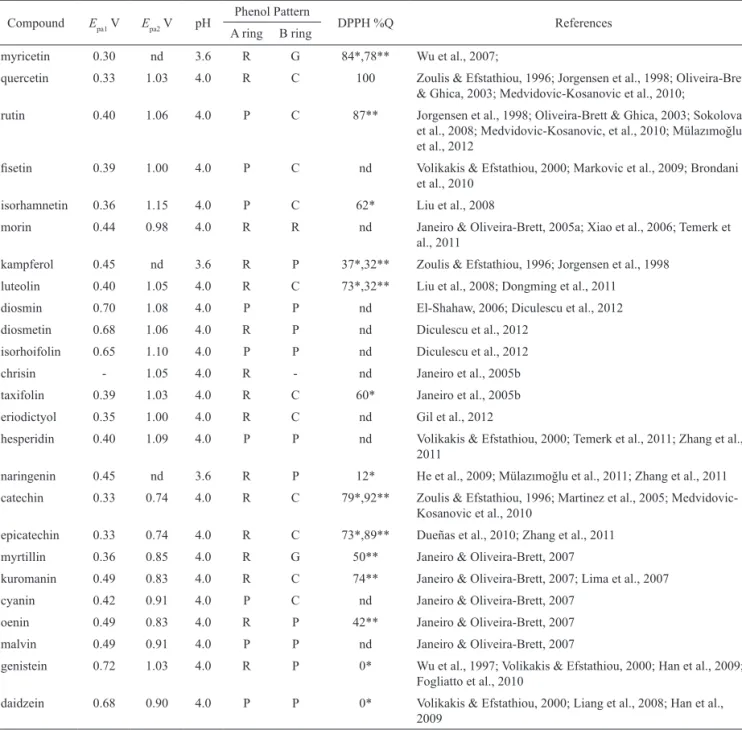
In turn, the radical scavenging activity, as well as the reductor power is intrinsically connected to the redox behavior, which is dictated by electroactive groups (Bara et al., 2008; Zielinska & Zielinski, 2010; Abdel-Hamid & Newair, 2011). Hence, the antioxidant activity driven by its electron donor ability is feasibly traduced by peak potentials, Epa and also peak currents, Ipa. In simple words, the lower the Epa value, the higher the electron donor ability, whilst the higher the Ipa, the higher may be the rate and/or number of transferred electrons (Yang et al., 2001; Amic et al., 2003; Blasco et al., 2004; Huang et al., 2004; Escarpa et al., 2007; Simic et al., 2007; Yakovleva et al., 2007; Gomez-Pineda et al., 2009; Zielinska & Zielinski, 2010). Indeed, good correlations between such electroanalytical and spectrophotometric assays have been reached i.e. Epa value versus radical scavenging activity against 2,2-diphenyl-1-picrylhydrazyl (DDPH) (Aaby et al., 2004; Zhang et al., 2011; Mishra et al., 2012). A few selected examples from different groups to illustrate some of the relationships between their detailed structures and related antioxidant properties are
enrolled on Table 2, and the basic lavonoid structure was
aforementioned in Table 1.
In order to achieve comparable values, Table
2 was constructed taking into account the inluence of
experimental conditions, thus since cyclic voltammetry carried out at glassy carbon electrode in mild acid medium have been mostly used, it was chosen as criterion.
However, it is a ‘risky’ business to attempt an evaluation of literature reports on antioxidant properties of
lavonoids, since it is not surprising that these polyphenols
give different results from different experimental methods, some DPPH values relatively to quercetin activity are also presented in order to offer tentative comparisons (Aaby et al., 2004; Zhang et al., 2011; Mishra et al., 2012).
Therefore, lavonoids with lower Epa values, i.e. myricetin, quercetin, rutin, luteolin, taxifolin, myrtillin and catechin (Table 2) will be better antioxidant defense agents than derivatives lacking catechol moiety on ring B, where the expected Epa values are higher (Nasr et al., 2005; Yakovleva et al., 2007; Fernandes et al., 2010).
For instance, 3´,4´-dihydroxylavonoids
with peak potentials ranging around 0.35 V would be thermodynamically able to scavenge peroxyl radicals (Epa
Rev. Bras. Farmacogn. Braz. J. Pharmacogn. 23(3): May/Jun. 2013 550
Table 2. Anodic peak potentials and DPPH values* for different lavonoids.
Compound Epa1 V Epa2 V pH Phenol Pattern DPPH %Q References A ring B ring
myricetin 0.30 nd 3.6 R G 84*,78** Wu et al., 2007;
quercetin 0.33 1.03 4.0 R C 100 Zoulis & Efstathiou, 1996; Jorgensen et al., 1998; Oliveira-Brett & Ghica, 2003; Medvidovic-Kosanovic et al., 2010;
rutin 0.40 1.06 4.0 P C 87** Jorgensen et al., 1998; Oliveira-Brett & Ghica, 2003; Sokolova
et al., 2008; Medvidovic-Kosanovic, et al., 2010; Mülazımoğlu
et al., 2012
isetin 0.39 1.00 4.0 P C nd Volikakis & Efstathiou, 2000; Markovic et al., 2009; Brondani et al., 2010
isorhamnetin 0.36 1.15 4.0 P C 62* Liu et al., 2008
morin 0.44 0.98 4.0 R R nd Janeiro & Oliveira-Brett, 2005a; Xiao et al., 2006; Temerk et al., 2011
kampferol 0.45 nd 3.6 R P 37*,32** Zoulis & Efstathiou, 1996; Jorgensen et al., 1998
luteolin 0.40 1.05 4.0 R C 73*,32** Liu et al., 2008; Dongming et al., 2011
diosmin 0.70 1.08 4.0 P P nd El-Shahaw, 2006; Diculescu et al., 2012
diosmetin 0.68 1.06 4.0 R P nd Diculescu et al., 2012
isorhoifolin 0.65 1.10 4.0 P P nd Diculescu et al., 2012
chrisin - 1.05 4.0 R - nd Janeiro et al., 2005b
taxifolin 0.39 1.03 4.0 R C 60* Janeiro et al., 2005b
eriodictyol 0.35 1.00 4.0 R C nd Gil et al., 2012
hesperidin 0.40 1.09 4.0 P P nd Volikakis & Efstathiou, 2000; Temerk et al., 2011; Zhang et al., 2011
naringenin 0.45 nd 3.6 R P 12* He et al., 2009; Mülazımoğlu et al., 2011; Zhang et al., 2011
catechin 0.33 0.74 4.0 R C 79*,92** Zoulis & Efstathiou, 1996; Martinez et al., 2005; Medvidovic-Kosanovic et al., 2010
epicatechin 0.33 0.74 4.0 R C 73*,89** Dueñas et al., 2010; Zhang et al., 2011
myrtillin 0.36 0.85 4.0 R G 50** Janeiro & Oliveira-Brett, 2007
kuromanin 0.49 0.83 4.0 R C 74** Janeiro & Oliveira-Brett, 2007; Lima et al., 2007
cyanin 0.42 0.91 4.0 P C nd Janeiro & Oliveira-Brett, 2007
oenin 0.49 0.83 4.0 R P 42** Janeiro & Oliveira-Brett, 2007
malvin 0.49 0.91 4.0 P P nd Janeiro & Oliveira-Brett, 2007
genistein 0.72 1.03 4.0 R P 0* Wu et al., 1997; Volikakis & Efstathiou, 2000; Han et al., 2009; Fogliatto et al., 2010
daidzein 0.68 0.90 4.0 P P 0* Volikakis & Efstathiou, 2000; Liang et al., 2008; Han et al., 2009
Electroactive Groups: Gallic (G), Catechol (C), Resorcinol (R), Phenol (P); Data calculated from *Zhang et al., 2011 and **Aaby et al., 2004 and expressed by means of quercetin activity; non determined (nd).
2010).
Furthermore, the catechol B ring derivatives, i.e. quercetin (~0.4 V), catechin (~0.4 V), epigalocatechin gallate (~0.3 V) can also exert their antioxidant activity by restoring some low molecular weight bioantioxidants, i.e.
tocopherol (~0.5 V). In turn, guaicolic (3´-OH, 4´-OCH3) derivatives, i.e. hesperidin, presenting intermediate reduction potentials (~0.7 V), can still donate an electron
to free radical but slower. Meanwhile, in this speciic case, the antioxidant function of lavonoid would be limited to
radical scavenging activity (Rapta et al., 1995; Nasr et al., 2005).
Effect of substituent on electron donor ability
Several investigations on how the substitution
pattern on lavonoid core relects the electron-hydrogen
donating ability have been published (Montoro et al., 2005; Reis et al., 2009; Tsao, 2010). It has been well established
that the B ring chemistry has far great inluence on the electron donor properties of lavonoids, whilst the number
Rev. Bras. Farmacogn. Braz. J. Pharmacogn. 23(3): May/Jun. 2013 551 However, such redox behavior is directly related
to the phenol pattern, the effect of other substituents
may not be neglected. The inluence of non-electroactive
substituent on peak potentials and overall electrode reactions is expressed by electronic and steric effects, which might also have substantial effect on the solubility and diffusion properties (Rice-Evans et al., 1996; Cao et
al., 1997; Nijveldt et al., 2001; Blasco et al., 2004; Huang
et al., 2004; Montoro et al., 2005; Gomez-Pineda et al., 2009). In turn, such properties not only can alter the redox behavior, but also the antioxidant activity in physiological conditions (Amic et al., 2003; Montoro et al., 2005; Tsao, 2010).
Electronic effects
The electrochemical oxidation of phenolic groups shifted to more positive values, when the substituent present higher Hammett´s constants. In simple words, electron withdrawing groups hamper electron loss, while electron-donor substituent may reduce the expected peak potentials (Rice-Evans et al., 1996; Cao et al., 1997; Simic et al., 2007; Han et al., 2009).
Likewise, the presence of C2=C3 double bond, and also the C3-OH group on C unity enhance the electron delocalization stabilizing the phenoxyl radical stabilization, and then lowering the expected potentials (Tsimogiannis & Oreopoulou, 2004; Simic et al., 2007; Han et al., 2009). Indeed, the relatively low Epa1 values (Table 2) observed for
lavonoids, morin and kaempferol, both lacking catechol
moiety on ring B, can be attributed to the presence of 3-OH and C2=C3 double bond (Pannala et al., 2001; Tsimogiannis & Oreopoulou, 2004; Han et al., 2009; Markovic et al., 2009). On the other hand, the slight shift to higher potential
observed for the lavanonol, taxifolin, when compared to the lavonol, quercetin reinforces that the double bond has
at least a minor importance on the electron donor ability (Rice-Evans et al., 1996; Tsimogiannis & Oreopoulou, 2004; Janeiro et al., 2005).
By contrast, catechin has Epa1 values and closer to quercetin, which might be associated to the absence of carbonyl group on C unity (Zoulis & Efstathiou, 1996; Martinez et al., 2005; Markovic et al., 2009). In fact, carbonyl group exerts a dual effect on antioxidant activity, while it enhances the acidity of phenolic groups, increasing their peak potentials, when coupled to C5-OH or C3-OH, such group offers a strong site for metal quelation, thus improving the indirect antioxidant mechanism (Yakovleva et al., 2007; Gomez-Pineda et al., 2009).
In order, the peak potentials are positively shifted if the hydroxyl hydration is decreased. So, hydrophilic substituents enhance the proton donor ability and antioxidant activity in aqueous media. Therefore,
owing to the presence of 3-OH group, lavonols generally oxidize at lower potentials than lavones (Rice-Evans et
al., 1996; Zoulis & Efstathiou, 1996; Tsimogiannis & Oreopoulou, 2004; Montoro et al., 2005).
Steric effects
As mentioned before, according to electron donor and hydrophilic contribution, non-oxidizable substituent can push down the required overpotentials. The comparison of peak potentials between apigenin and its isomer genistein (Han et al., 2009), obtained in similar conditions have pointed to the importance of structural symmetry on the hydration and electron transfer
mechanism. Thus in aqueous medium the isolavonoid
showed to undergo oxidation at lower peak potential (Liang et al., 2008; Han et al., 2009; Fogliatto et al., 2010). In turn, the diastereomization have very small effect on
the redox behavior of lavonoids. Therefore, catechin
and epicatechin present quite similar antioxidant activity (Martinez et al., 2005; Medvidovic-Kosanovic et al., 2010; Zhang et al., 2011; Mishra et al., 2012).
On the other hand, the inherent steric effects of such substituent may not be discarded. In fact, bulky groups might sterically hinder the electrode reactions (Ferreira et al., 2006; Dueñas et al., 2010). For instance, anthocyanidins have presented higher antioxidant activity and slightly lower peak potentials than anthocyanins, which agrees with the steric hindrance effect of sugar moieties (Sokolova et al., 2008; Markovic et al., 2009; Brondani et al., 2010; Medvidovic-Kosanovic et al., 2010; Masek et al., 2011; Temerk et al., 2011; Gil et al., 2012; Mulazimoglu et al., 2012).
On the other hand, the steric hindrance effect on electron transfer is also expressed by the fall of peak currents in experiments carried out in equimolar concentrations. As an example, voltammograms obtained for quercetin have showed higher peak currents than its derived glycosides as rutin and quercetrin (Adam et al., 2007; Sims et al., 2009). Thus, although in such cases the number of transferred electrons should be the same, the rate of electrode reaction may not (Yakovleva et al., 2007).
Furthermore, the secondary chemical reactions between phenoxyls radicals can be driven by non-oxidizable substituent (Nasr et al., 2005; Ferreira et al., 2006; Diculescu et al., 2012). It was found that the electrochemical oxidation of methyl substituted derivatives
results in more linear eletropolymerized ilms, thus
producing faster blockade of electrode surface (Ferreira et al., 2006).
Inluence of experimental conditions on electroanalytical assays
Rev. Bras. Farmacogn. Braz. J. Pharmacogn. 23(3): May/Jun. 2013 552
depends greatly on experimental conditions (Arslan et al., 2005; Reis et al., 2009). In the case of organic compounds, in which redox reactions often involve
proton/electron transfer processes, it is mainly deined by
pH of electrolyte solution (Slabbert, 1977; Arslan et al., 2005; Gomez-Pineda et al., 2009).
As a rule, owing to the easier deprotonation, peak potentials decrease as the pH increases, while the reaction is pH dependent at least in non-alkaline medium (Liang et al., 2008; Han et al., 2009; Brondani et al., 2010; Fogliatto et al., 2010; Medvidovic-Kosanovic et al., 2010; Masek et al., 2011).
The plot, Epaversus pH, commonly obtained for
lavonoids results in a straight line up to their pKa, and a
typical slope of around 59 mV is consistent with electrode reactions involving a 1:1 ratio of electrons/protons (Liang et al., 2008; Han et al., 2009; Brondani et al., 2010; Fogliatto et al., 2010; Medvidovic-Kosanovic et al., 2010; Masek et al., 2011; Gil et al., 2012).
For instance, the anodic peak, Epa1 observed for daidzen shift from 0.73 V to 0.38 V, as the pH change from 2.0 to 8.0 (Liang et al., 2008; Fernandes et al., 2010). Thus,
the inluence of pH on peak shifts is far greater than the usually observed for different lavonoids presenting the
same phenol pattern, Tables 1 and 2.
In turn, higher Epa values are usually found when low ionic strength electrolyte solution or mixed solvent systems, i.e. ethanol:water, acetonitrile:water are employed. Such fact is in agreement with the lower strength of electrolyte solution, which leads to overpotential drop
(Xing et al., 2009; Masek et al., 2011; Mülazımoğlu et al.,
2011).
Therefore, the correlation between Epa and antioxidant power must always consider the electrolyte conditions. Furthermore, the electrode material, concentration of electroactive species and also the electrochemical technique might also produce great peak shifts, whereas temperature and pressure have minor impact (Arslan et al., 2005; Reis et al., 2009; Abdel-Hamid & Newair, 2011; Masek et al., 2011).
The common cell used in electrochemical
investigation of lavonoids is a three electrode cell. In this coniguration, the potential of the working electrode is
monitored relative to the reference potential (Ag/AgCl or SCE); however, the current passes between the working electrode and a counter electrode (platinum electrode). The tip of the reference electrode should be placed as close as possible to the working electrode in order to minimize solution resistance. Generally, the experiments were performed at the room temperature in aqueous supported electrolytes (citrate, HCl+KCl, acetate, phosphate, ammonia etc.) (Reis et al., 2009; Zielinska & Zielinski, 2010; Abdel-Hamid & Newair, 2011), but organic solvents (Sokolova et al., 2008; Han et al., 2009) were also used as a media buffer.
Although exist a high variety of working electrode materials, the must involved in the electrochemical studies of flavonoids are carbon electrodes, especially glassy carbon electrode (GCE) (Medvidovic-Kosanovic et al., 2010; Temerk et al., 2011; Zhang et al., 2011; Diculescu et al., 2012; Gil et al., 2012; Mulazimoglu et al., 2012). One explication for this is the oxidation potential of phenol derivatives which fit in the windows working potential of GCE (- 1.0 V to + 1.4 V). Nevertheless, other electric and mechanical properties such as extreme chemical inertness, highly resistant to acid attack, impermeability to gases and reproducible performance are considered.
Since the lavonoids, with some exception, are
hardly soluble or even insoluble in water, the stock solutions were prepared in ethanol, methanol, NaOH or mixture of these in different proportions, and the sample solutions are diluted in the supporting electrolyte at the desired concentrations. However, due to the high sensitivity of voltammetric techniques, the electrochemical experiments request a small amount of stock solution, a concentration
of sample of 5 to 25 μM being suficient.
On the other hand, the solid-state electrochemistry, a methodology based on the mechanical immobilization of solid particles at the electrode surface, widens the investigation possibilities due to its broad applicability (Mulazimoglu et al., 2012).
The main involved techniques in the
electrochemical studies and analysis of lavonoids are
cyclic, differential pulse and square wave voltammetry in stationary state, although exist many reports of the
low analysis (Volikakis & Efstathiou, 2000; Volikakis &
Efstathiou, 2005).
Quality control purposes
Besides the well-established use of the electrochemical parameters, Ep and Ip, on the evaluation of redox behavior and antioxidant capacity, they also have promising applications on the quantitative and qualitative analysis of electroactive antioxidants (Romani et al., 2000; Escarpa et al., 2007; Simic et al., 2007; Reis et al., 2009). Therefore, considering the almost ubiquitous presence
of lavonoids in natural products, the electrochemical
techniques may be very helpful for their quality control purposes (Bara et al., 2008; Novak et al., 2008; Kilinc, 2009; Rene et al., 2010; Zielinska & Zielinski, 2010).
Quantitative assays
The quantitative determination of lavonoid
is based on Faraday Law, and good linear correlations have been obtained between concentration and peak
Rev. Bras. Farmacogn. Braz. J. Pharmacogn. 23(3): May/Jun. 2013 553 Liu et al., 2008a; Liu et al., 2008b; Xing et al., 2009;
Dongming et al., 2011; Temerk et al., 2011; Macikova et al., 2012). In spite of remarkable advantages, i.e. low cost of apparatus, low reagent consuming, good sensitivity and suitable selectivity, regardless the low reproducibility, the use of electroanalysis in quantitative analysis of phytopharmaceuticals still remains neglected (Reis et al., 2009; Zielinska & Zielinski, 2010). Indeed, the reproducibility of electrochemical reactions requires the same experimental conditions, which is hard to afford after the renewal of electrode surface prior to each measurement (Huang et al., 2004; Ferreira et al.,
2006; Adam et al., 2007; Mülazımoğlu et al., 2011; Mülazımoğlu et al., 2012).
Another obstacle is concerned to the interfering effect of other polyphenolic compounds in real samples,
which may dificult the direct analysis of one speciic lavonoid (Reichart & Obendorf, 1998; Adam et al.,
2007; Novak et al., 2008; Reis et al., 2009). Therefore,
the analysis of lavonoids in complex matrices, i.e. teas, beverages, crude extracts and phytopharmaceuticals often requires methods of separation, where owing to the inherent electroactivity, electrochemical detectors is always suitable. Thus, it has driven the development of High Performance Liquid Chromatography coupled to electrochemical detection (HPLC-ED) methods (Romani et al., 2000; Aaby et al., 2004; Kilinc, 2009).
Other efforts to overcome the effect of interferences, enabling the direct quantitative analysis is the development of selective electrodes (Vestergaard et al.,
2005; Reis et al., 2009; Brondani et al., 2010; Mülazımoğlu
et al., 2011), as well as the use of other coupled systems FIA (Volikakis & Efstathiou, 2000; Volikakis & Efstathiou, 2005), and electrophoresis (Moreno et al., 2011).
Table 3 shows some few examples of electroanalytical approaches, where it was used
different modiied electrodes on direct detection of the
phytopharmaceutical, rutin in pharmaceutical samples.
Qualitative assays
The characterization of redox behavior can be a
useful tool for the tentative identiication of electroactive
species (Aaby et al., 2004; Bara et al., 2008; Reis et al., 2009; Abdel-Hamid & Newair, 2011; Diculescu et al.,
2012). In the case of lavonoids, the voltammetric proile
is archetypal, accordingly to phenol pattern. Nevertheless, additional peaks and shoulders can appear upon determined
experimental conditions in lavonoids containing diverse
number of substituents, whilst voltammograms with no
deined peaks are associated to the absence of free phenolic
groups (Vestergaard et al., 2005; Fernandes et al., 2010; Fogliatto et al., 2010; Zhang et al., 2011; Diculescu et al., 2012).
The main electroanalytical techniques employed on the electrochemical characterization are cyclic voltammetry (CV), differential pulse voltammetry (DPV) and square wave voltammetry (SWV) (Adam et al., 2007; Novak et al., 2009a; 2009b; Fernandes et al., 2010; Temerk et al., 2011). The reversibility of each electron transfer process can be evaluated by means of CV and SWV (Ghica & Oliveira-Brett, 2005; Adam et al., 2007; Fernandes et al., 2010; Abdel-Hamid & Newair, 2011).
On the other hand, CV assays carried out at different scan rates can provide information about the
coeficient of diffusion of the electroactive species,
while the plot Ipversus ν or ν1/2, indicates if the process is controlled by adsorption or diffusion (Janeiro et al., 2005; El-Shahaw, 2006; Liu et al., 2008a; Liu et al., 2008b; Xing et al., 2009; Abdel-Hamid & Newair, 2011; Dongming et al., 2011; Diculescu et al., 2012; Gil et al., 2012).
In turn, the number of electrons involved can
Table 3. Modiied electrodes and related limit of detection (LoD) on the direct electroanalytical detection of rutin in pharmaceutical
samples.
Electrode Technique LoD (nM) References
LF-GCE SWV 0.25 Tyszczuk, 2009
ss-HGCE SWV 1 Wu et al., 2008
DNA-IL-CPE DPV 1.3 Wang et al., 2010
IL-CPE DPV 5 Macikova & Skopalova, 2010
Copper(II)-resin-CPE CV 26.5 Freitas et al., 2009
AuNPs/En/MWNTs/GCE DPV 32 Oliveira & Mascaro, 2011
CNT-CPE DPV 33.9 Yang et al., 2010
MWCNT-CPE SWV 50 Behzad et al., 2011
PABSA-GC SWV 100 Chen et al., 2010
Biomimetic Sensor SWV 175 Ziyatdinova, et al., 2011
MWNT-GCE CV 710 Franzoi et al., 2009
Carbon paste electrode (CPE); Multiwall carbon nanotube (MWCNT); Carbon nanotubes (CNT); Glassy carbon electrode (GCE); Ionic Liquid (IL); gold nanoparticles (AuNPs); ethylenediamine (En); poly(p-aminobenzene sulfonic acid (PABSA/GC); Lead ilm (LF); Single-sided heated graphite
Rev. Bras. Farmacogn. Braz. J. Pharmacogn. 23(3): May/Jun. 2013 554
be stated by means of CV, DPV or coulometry (Peyrat-Maillard et al., 2000; Oliveira-Brett & Ghica, 2003; Reis et al., 2009; Abdel-Hamid & Newair, 2011). From CV assays, the calculated values, (|Epa - Epa/2|) of about 29 mV and 57 mV points to the involvement of two and one electrons, respectively. Whereas, from DPV assays, bi and mono-electron transfer process is theoretically determined by the half width, W1/2 of 45 mV and 90 mV, respectively (Janeiro & Oliveira-Brett, 2005; Janeiro et al., 2005; El-Shahaw, 2006; Abdel-Hamid & Newair, 2011; Enache & Oliveira-Brett, 2011; Diculescu et al., 2012).
The establishment of an electrochemical index (Blasco et al., 2004; Escarpa et al., 2007) and the analysis of such voltammetric parameters have been proposed as attempts for qualitative analysis of such natural products (Kilmartin et al., 2002; Volikakis & Efstathiou, 2005; Bara et al., 2008; Kilinc, 2009; Reis et al., 2009).
Conclusions
The electroactivity of lavonoids resides on the
phenolic groups and the electron donor ability is mainly governed by B-ring chemistry. The redox behavior varies according to the number and position of chemical substituent, and the potential required for oxidation is reduced as the stability of radicals is improved. Consequently, catechol like patterns, as well as electron donor substituent leads to compounds with higher electron donor ability, which may be capable to neutralize deleterious free radicals and also to restore physiological low molecular weight antioxidant agents.
So that, in most cases, the potential peak determination truly expresses the antioxidant power
of each lavonoid. Furthermore, owing to the variable mechanisms of antioxidant action presented by lavonoids,
the electroanalytical methods are the most suitable techniques for the evaluation of antioxidant capacity, as well as to characterize electroactive species. Furthermore, the electrochemical approaches have showed good correlations with spectrometric methods, and have also been applied to evaluate metal quelation properties.
Nevertheless, the mechanism of oxidation of each phenolic group often involves the transfer of one electron and one proton, being easier for hydroxyl groups with low acid character, and might be lower in non-acidic medium. Therefore, the association between electrochemical parameters and antioxidant activity may be always
correlated to well-deined experimental conditions.
Acknowledgmets
The authors gratefully acknowledge inancial
support from CAPES and CNPq, and Dr. Andrian Teodor Enache for its valuable suggestions and criticisms.
Authors´ contributions
ESG, study guidance and development; ROC, editing and critical reading of the manuscript.
References
Aaby K, Hvattum E, Skrede G 2004. Analysis of lavonoids
and other phenolic compounds using High-Performance Liquid Chromatography with coulometric array detection: relationship to antioxidant activity. J Agric Food Chem 52: 4595-4603.
Abdel-Hamid R, Newair EF 2011. Electrochemical behaviour of antioxidants: I. Mechanistic study on electrochemical oxidation of gallic acid in aqueous solutions at glassy carbon electrode. J Electroanal Chem 657: 107-112. Adam V, Mikelova R, Hubalek J, Hanustiak P, Beklova M,
Hodek P, Horna A, Trnkova L, Stiborova M, Zeman L, Kizek R 2007. Utilizing of square wave voltammetry to
detect lavonoids in the presence of human urine. Sensors 7: 2402-2418.
Aguilar-Sanchez R, Ahuatl-Garcia F, Davila-Jimenez MM, Elizalde-Gonzalez MP, Guevara-Villa MRG 2005. Chromatographic and electrochemical determination of quercetin and kaempferol in phytopharmaceuticals. J Pharmaceut Biomed 38: 239-249.
Amic D, Davidovic-Amic D, Beslo D, Trinajstic N 2003.
Structure-radical scavenging activity relationships of
lavonoids. Croatica Chim Acta 76: 55-61.
Arslan G, Yazici B, Erbil M 2005. The effect of pH, temperature and concentration on electrooxidation of phenol. J Hazard Mater B124: 37-43.
Bara MTF, Serrano SHP, Asquieri ER, Lúcio TC, Gil ES 2008. Medida del potencial anódico en estado sólido: Una herramienta para la determinación del potencial
antioxidante de itoterápicos. Lat Am J Pharm 27: 89-92.
Behzad R, Najmeh M, Ali AE, Hassan KM 2011. Molecularly
imprinted-multiwall carbon nanotube paste electrode as a biosensor for voltammetric detection of rutin. Anal Method 3: 2510-2516.
Blasco AJ, Gonzalez MC, Escarpa A 2004. Electrochemical approach for discriminating and measuring predominant
lavonoids and phenolic acids using differential pulse
voltammetry: towards an electrochemical index of natural antioxidants. Anal Chim Acta 511: 71-81.
Brondani D, Vieira IC, Piovezan C, Silva JMR, Neves A, Dupont
J, Scheeren CW 2010. Sensor for isetin based on gold
nanoparticles in ionic liquid and binuclear nickel complex immobilized in silica. Analyst 135: 1015-1022.
Cao G, Soic E, Prior RL 1997. Antioxidant and prooxidant behavior of lavonoids: structure-activity relationships. Free Rad Bio Med. 22: 749-760.
Chaves DS, Frattani FS, Assaim M, de Almeida AP, de Zingali
Rev. Bras. Farmacogn. Braz. J. Pharmacogn. 23(3): May/Jun. 2013 555 of Petroselinum crispum extract and its effect on
haemostasis. Nat Prod Commun 6: 961-964.
Chen X, Wang Z, Zhang F, Zhu L, Li Y, Xia Y 2010. Determination of rutin on the poly(p-aminobenzene sulfonic acid)
modiied glassy carbon electrode. Chem Pharm Bull 58: 475-478.
Cook NC, Samman S 1996. Flavonoids-chemistry, metabolism, cardioprotective effects, and dietary sources. J Nutr Biochem 7: 66-76.
Diculescu V, Santana HE, Gil ES, Oliveira-Brett AM 2012. Methoxylation and glycosylation effect on the redox
mechanism of citrolavones. Electroanal 24: 1019-1026.
Dongming Z, Xiuhua Z, Lijun F, Qi Q, Wang S 2011. Sensitive
electrochemical determination of luteolin in peanut
hulls using multi-walled carbon nanotubes modiied
electrode. Food Chem 127: 694-698.
Dueñas M, González-Manzano S, González-Paramás A,
Santos-Buelga C 2010. Antioxidant evaluation of O-methylated metabolites of catechin, epicatechin and quercetin. J Pharmaceut Biomed 51: 443-449.
El-Shahaw MS 2006. Determination of trace levels of diosmin in a pharmaceutical preparation by adsorptive stripping voltammetry at a glassy carbon electrode. Anal Sci 22: 1351-1354.
Enache TA, Oliveira-Brett AM 2011. Phenol and para-substituted phenols electrochemical oxidation pathways.
J Electroanal Chem 655: 9-16.
Erlund I 2004. Review of the lavonoids quercetin, hesperetin
and naringenin. Dietary sources, bioactivities, bioavailability, and epidemiology. Nutr Res 24: 851-874.
Escarpa A, González MC, Blasco AJ, Rogerio MC, Hervás
M 2007. Evaluation of accuracy of electrochemical
isolavonoid index for the determination of total isolavones in soy samples. Electroanal 19: 952-957. Fernandes IPG, Oliveira SCB, Ghalkhani M, Shahrokhian S,
Oliveira-Brett AM 2010. Antioxidants daidzein and 7-hydroxy-4-chromone electrochemical oxidation mechanisms. Anal Chim Acta 22: 1-9.
Ferreira M, Varela H, Torresi RM, Tremiliosi-Filho G 2006. Electrode passivation caused by polymerization of different phenolic compounds. Electrochim Acta 52: 434-442.
Fogliatto DK, Barbosa AMJ, Ferreira VS 2010. Voltammetric
determination of the phytoestrogen genistein in soy lours
and soy based supplements using cationic surfactant cetyltrimetylammonium bromide. Colloid Surf B: Biointerfaces 78: 243-249.
Franzoi AC, Peralta RA, Neves A, Vieira IC 2009. Biomimetic sensor based on Mn(III)Mn(II) complex as manganese peroxidase mimetic for determination of rutin. Talanta 78(1): 221-226.
Freitas KHG, Medeiros RA, Fatibello-Filho O 2009. Voltammetric determination of rutin using a carbon
composite electrode modiied with Copper(II)-resin.
Anal Lett 42: 881-897.
Ghica ME, Oliveira-Brett AM 2005. Electrochemical oxidation of rutin. Electroanalysis 17: 313-318.
Gil ES, Enache AT, Oliveira-Brett AM 2012. Anodic behaviour
of lavonoids orientin, eriodictyol and robinin at a glassy
carbon electrode. Electroanal 24: 1576-1583.
Gomez-Pineda LE, Oropeza-Guzman MT, Pina-Luis GE 2009.
Identiication of lavonoid oxidation potentials as a
function of pH. ECS Transactions 20: 141-149.
Han RM, Tian YX, Liu Y, Chen CH, Ai XC, Zhang JP, Skibsted
LH 2009. Comparison of lavonoids and isolavonoids as
antioxidants. J Agric Food Chem 57: 3780-3785.
Harborne JB, Williams CA 2000. Advances in lavonoid research
since 1992. Phytochemistry 55: 481-504.
He JB, Yuan SJ, Du JQ, Hu XR, Wang Y 2009. Voltammetric
and spectral characterization of two lavonols for
assay-dependent antioxidant capacity. Bioelectrochem 75: 110-116.
Hendrickson HP, Kaufman AD, Lunte CE 1994. Electrochemistry
of catechol-containing lavonoids. J Pharmaceut Biomed 12: 325-334.
Hidalgo M, Sánches-Moreno C, Pascual-Teresa S 2010. Flavonoid-lavonoid interaction and its effect on their
antioxidante activity. Food Chem 121: 691-696. Huang T, Gao P, Hageman MJ 2004. Rapid screening of
antioxidants in pharmaceutical formulation development using cyclic voltammetry - potential and limitations.
Curr Drug Disc Tech 1: 173-179.
Janeiro P, Oliveira-Brett AM 2005. Solid state electrochemical oxidation mechanism of morin in aqueous media.
Electroanal 17: 733-738.
Janeiro P, Corduneanu O, Oliveira-Brett AM 2005. Chrysin and (±)taxifolin electrochemical oxidation mechanisms.
Electroanal 17: 1059-1064.
Janeiro P, Oliveira-Brett AM 2007. Redox Behavior of Anthocyanins present in Vitis vinifera L. Electroanal 19: 1779-1786.
Jorgensen LV, Cornett C, Justesen U, Skibsted LH, Dragsted LO 1998. Two-electron electrochemical oxidation of
quercetin and kaempferol changes only the lavonoid
C-ring. Free Rad Res 29: 339-350.
Jorgensen LV, Madsen HL, Thomsen MK, Dragsted LO, Skibsted LH 1999. Regeneration of phenolic antioxidants from phenoxyl radicals: an ESR and electrochemical study of antioxidant hierarchy. Free Rad Res 30: 207-220. Jovanovic SV, Steenken S, Hara Y, Simic MG 1996. Reduction
potentials of lavonoid and model phenoxyl radicals. Which ring in lavonoids is responsible for antioxidant activity? J Chem Soc Perk T 2 11: 2497-2504.
Kilinc E 2009. Signiicance of chromatographic and voltammetric data for the classiication of green teas
in Türkiye: a principle component analysis approach. J Liq Chromatogr R T 32: 221-241.