Ethical considerations when
offering noninvasive prenatal testing
Considerações éticas na oferta do teste pré-natal não invasivo
Melody Menezes1,2siMon Meagher1 Fabricioda silva costa1,3
Technology in the prenatal setting is advancing at an exceptional rate, and these ad-vancements will likely result in major changes to current pregnancy screening and testing paradigms. In Australia, prenatal testing is increasingly becoming a routine part of ante-natal care and pregnant women are offered an assortment of screening and diagnostic tests, which give them information about their fetus, and can identify potential anomalies before it is born. In Victoria (Australia), each year approximately 4% of babies will be born with
a birth defect or fetal abnormality1 many of which are diagnosed in uterus.
Greater than 97% of women in Victoria have at least one or more ultrasounds during
pregnancy2 and greater than 80% of pregnant women take up screening for Down syndrome,
with the majority having First Trimester Combined Screening (FTCS). FTCS combines maternal serum analytes — pregnancy associated plasma protein-A (PAAP-A) and beta
human chorionic gonadotrophin (free β-hCG) — with results from the nuchal translucency
ultrasound to give a risk igure for Down syndrome and Trisomy 18. Approximately 5%
of women will receive a false positive result from FTCS3, meaning they screen positive for
Down syndrome or Trisomy 18 and do not have an affected pregnancy.
Women who are considered to be “increased risk” either because of a screening result or ultrasound inding are offered invasive diagnostic testing whereby a fetal sample is ob-tained via chorionic villus sampling (CVS) or amniocentesis and sent for conventional or molecular karyotyping (microarray). These tests carry a miscarriage risk of up to 1% above
the background rate of miscarriage4.
There has been increasing demand for a safe and reliable alternative to invasive diagnostic testing and very recently, noninvasive prenatal testing (NIPT) has become commercially available to women in America (2012), Australia and many other countries, including Brazil (2013). NIPT is an advanced screening test, which relies on the fact that small fragments
of cell-free fetal DNA and RNA circulate in maternal serum5. In the irst and second
tri-mesters of pregnancy, approximately 6–10% of total cell free DNA (cfDNA) circulating in maternal serum is thought to be fetal in origin; this fetal fraction rises to 10–20% in the
third trimester6,7. Using massively parallel sequencing technology, scientists can sequence
cfDNA fragments in maternal plasma and detect speciic chromosome aneuploidies such as
trisomies 21, 13 and 188-17, much earlier in pregnancy than has previously been possible,
1Monash Ultrasound for Women – Melbourne (Victoria) Australia.
2Genetic Education and Health Research, Murdoch Children’s Research Institute, Royal Children’s Hospital – Melbourne (Victoria), Australia. 3University of Melbourne Department of Obstetrics and Gynaecology and Department of Perinatal Medicine, Pregnancy Research
Centre, Royal Women’s Hospital – Melbourne (Victoria), Australia.
Correspondence
Fabricio da Silva Costa Monash Ultrasound for Women Suite 2.5, Level 2, 32 Erin St, Richmond, 3121 Melbourne (Victoria), Australia
Received
10/04/2013
Accepted with modiications
02/05/2013
196 Rev Bras Ginecol Obstet. 2013; 35(5):195-8 Menezes M, Meagher S, Costa FC
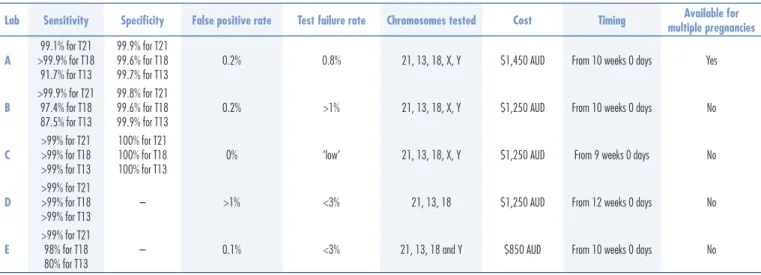
and without having to perform an “invasive” procedure. There are currently ive different companies marketing NIPT to obstetricians and pregnant women in Victoria. A summary of the key features of each test can be found in Table 1.
There are many advantages to NIPT, the most signiicant of which, is that it provides highly accurate informa-tion about Down syndrome without a miscarriage risk. Thus it is likely to reduce the number of invasive tests being performed. However, there are also a number of ethical considerations, which need to be taken into account when implementing NIPT in clinical practice.
Ethical aspects of offering noninvasive prenatal testing
1. Is the Noninvasive Prenatal Testing affordable?
The cost of noninvasive testing is currently prohibitive for many Australians. The most economical test retails at $850 AUD (~ $890 USD) with the other four tests retailing from $1,250–1,450 AUD ($1,300 to $1,500 USD). Currently there are no subsidies provided by Australia’s government funded universal healthcare system (Medicare) or by any of the private health insurance providers so these costs are wholly paid by the patient. While it is likely NIPT will become more cost effective in the future, the current pricing raises equity concerns as women who cannot afford the test are at a disadvantage.
2. It is important that women and their referring doctors understand the limitations of the Noninvasive Prenatal Testing
NIPT is an advanced screening test and while the sensitivity is high (i.e. >99% for Down syndrome), it does not
provide a deinitive result. The false positive rate is approximately 1% and thus, patients who received a positive result for aneuploidy are advised to have prenatal diagnosis to conirm this result. The origin of the cell free fragments of fetal DNA is
thought to be from placental trophoblast cells5,18, therefore there is a risk of conined placental mosaicism18. Equally, where
no aneuploidy is detected, there is a residual risk that the pregnancy may be affected.
The resolution of NIPT is not as high as current diagnostic testing however, this will likely improve in the future. Current NIPT providers are offering detection of Trisomy 21, 18, 13 and in some cases sex chromosome aneuploidy. In contrast, conventional karyotyping provides structural and numerical information on all 23 pairs of chromosomes, which means many abnormalities currently detected by karyotyping will not (at present) be detected with NIPT. Furthermore, molecular karyotyping (microarray) has become the irst tier test in Victoria for prenatal patients with
abnormal ultrasound indings19. Array based technology provides a signiicantly higher resolution (100 fold increase)
when compared with conventional karyotyping20,21. It is able to detect copy number variants (gains or losses in DNA)
across the genome and provides increased detection of “pathogenic” and “likely pathogenic” abnormalities19. There
has been suggestion that array based technology should be the irst tier test for all patients having prenatal diagnostic
testing22. It can provide useful clinical information, which will not be detected with current NIPT technology. Thus,
it is important patients are making informed decisions about NIPT and about the detail of information they want to receive about their pregnancy, balanced with the miscarriage risks of invasive diagnostic testing. Where ultrasound examination has identiied structural abnormalities or multiple soft markers, array-based technology should be re-commended in preference to NIPT as it will provide the most comprehensive clinical information.
Lab Sensitivity Speciicity False positive rate Test failure rate Chromosomes tested Cost Timing multiple pregnanciesAvailable for
A
99.1% for T21 >99.9% for T18 91.7% for T13
99.9% for T21 99.6% for T18 99.7% for T13
0.2% 0.8% 21, 13, 18, X, Y $1,450 AUD From 10 weeks 0 days Yes
B
>99.9% for T21 97.4% for T18 87.5% for T13
99.8% for T21 99.6% for T18 99.9% for T13
0.2% >1% 21, 13, 18, X, Y $1,250 AUD From 10 weeks 0 days No
C
>99% for T21 >99% for T18 >99% for T13
100% for T21 100% for T18 100% for T13
0% ‘low’ 21, 13, 18, X, Y $1,250 AUD From 9 weeks 0 days No
D
>99% for T21 >99% for T18 >99% for T13
– >1% <3% 21, 13, 18 $1,250 AUD From 12 weeks 0 days No
E
>99% for T21 98% for T18 80% for T13
– 0.1% <3% 21, 13, 18 and Y $850 AUD From 10 weeks 0 days No
197 Rev Bras Ginecol Obstet. 2013; 35(5):195-8 Ethical considerations when offering noninvasive prenatal testing
3. The importance of informed decision-making
Studies have shown that many women take up Down syndrome screening in pregnancy because they view it as a
“routine” test23-25 and as such often have inadequate knowledge and understanding of prenatal screening and diagnostic
tests26-28. This implies that a large number of women are not making informed decisions about having prenatal testing.
Given that NIPT has a much higher sensitivity when compared with any of the current screening programs, it is even more imperative that women understand the conditions that are being tested for and are given balanced and up to date information. Pre-test counselling is therefore crucial in ensuring women not only understand the limitations of the test, but that they have thought about whether or not they want this information about their fetus, and what they would do in the event of an adverse result. As NIPT involves a safe and simple blood test rather than a miscarriage risk, there is a danger that participation will be passive as it has been with current pregnancy screening programs.
Facilitating informed decision-making is one of the central tenants of genetic counselling practice29. Genetic
counsellors provide women with non-directive information and support to promote autonomous decision-making, and are well placed to provide pre-test counselling to all women considering NIPT.
4. Access to termination of pregnancy
When a fetal abnormality is detected during pregnancy women and their partners are faced with the dificult choice deciding whether or not to continue the pregnancy based on their understanding and perceptions of the abnormality and its potential impact on their lives. Victorian records concur with overseas data, indicating that the majority of
women will choose to have an abortion following a prenatal diagnosis of Down syndrome30,31.
In Australia, abortion law falls under state and territory jurisdiction and in most states it remains in the criminal statutes. However, abortion has been decriminalised in the Australian Capital Territory, Western Australia and Victoria.
In Victoria, abortion is permitted until 24 weeks of pregnancy or later if 2 doctors believe it is medically appropriate32.
In Brazil, abortion is “only permitted so save a woman’s life, or in cases of rape” and recently in cases of
anen-cephaly33. Thus, women cannot legally access an abortion on the grounds of fetal abnormality. When faced with the
diagnosis of a fetal abnormality, there is a risk that women in Brazil and (other countries where abortion is illegal) may choose clandestine and unsafe means of procuring an abortion thereby putting their own health at risk.
It is important women undertaking NIPT in countries where abortion is not permitted understand that they will not have safe and legal access to this procedure, and are making informed choices about whether or not they want this information about their fetuses prior to birth.
For many women and their partners, having access to NIPT will allow them to prepare for the birth of a child with Down syndrome. In the past, women who would continue their pregnancy regardless of the diagnosis of a fetal abnormality, may have decided not to take up prenatal diagnosis due tot he miscarriage risks. NIPT is able to provide these families with highly accurate information about Down syndrome, Trisomy 13 and 18 without a miscarriage risk. As such, the number of women continuing the pregnancy knowing that their baby is affected by one of these conditions is likely to increase, which will pose additional resource demands for fetal medicine units and perinatal palliative care programs. It is ethically imperative that when offering prenatal screening and testing, women and their partners are provided with appropriate medical and social resources to ensure that they are well supported regardless of whether or not they choose to continue their pregnancy.
1. Riley M, Halliday J. Birth defects in Victoria 2005-2006. Melbourne: Victorian Perinatal Data Collection Unit; 2008.
2. Chew C, Halliday JL, Riley MM, Penny DJ. Population-based study of antenatal detection of congenital heart disease by ultrasound examination. Ultrasound Obstet Gynecol. 2007;29(6):619-24.
3. Nicolaides KH. Screening for chromosomal defects. Ultrasound Obstet Gynecol. 2003;21(4):313-21.
4. Tabor A, Vestergaard CH, Lidegaard O. Fetal loss rate after chorionic villus sampling and amniocentesis: an 11 year national registry study. Ultrasound Obstet Gynecol. 2009;34(1):19-24.
5. Lo YM, Corbetta N, Chamberlain PF, Rai V, Sargent IL, Redman CW, et al. Presence of fetal DNA in maternal plasma and serum. Lancet. 1997;350(9076):485-7.
6. Lun FM, Chiu RW, Allen Chan KC, Yeung Leung T, Kin Lau T, Dennis Lo YM. Microluidics digital PCR reveals a higher than expected fraction of fetal DNA in maternal plasma. Clin Chem. 2008;54(10):1664-72.
198 Rev Bras Ginecol Obstet. 2013; 35(5):195-8 Menezes M, Meagher S, Costa FC
7. Lo YM, Chan KC, Sun H, Chen EZ, Jiang P, Lun FM, et al. Maternal plasma DNA sequencing reveals the genome-wide genetic and mutational proile of the fetus. Sci Transl Med. 2010;2(61):61-91.
8. Chiu RW, Chan KC, Gao Y, Lau VY, Zheng W, Leung TY, et al. Noninvasive prenatal diagnosis of fetal chromosomal aneuploidy by massively parallel genomic sequencing of DNA in maternal plasma. Proc Natl Acad Sci USA. 2008;105(51):20458-63.
9. Chiu RW, Sun H, Akolekar R, Clouser C, Lee C, McKernan K, et al. Maternal plasma DNA analysis with massively parallel sequencing by ligation for noninvasive prenatal diagnosis of trisomy 21. Clin Chem. 2010;56(3):459-63.
10. Chiu RW, Akolekar R, Zheng YW, Leung TY, Sun H, Chan KC, et al. Non-invasive prenatal assessment of trisomy 21 by multiplexed maternal plasma DNA sequencing: large scale validity study. BMJ. 2011;342:c7401.
11. Fan HC, Blumenfeld YJ, Chitkara U, Hudgins L, Quake SR. Noninvasive diagnosis of fetal aneuploidy by shotgun sequencing DNA from maternal blood. Proc Natl Acad Sci USA. 2008;105(42):16266-71.
12. Chu T, Bunce K, Hogge WA, Peters DG. Statistical model for whole genome sequencing and its application to minimally invasive diagnosis of fetal genetic disease. Bioinformatics. 2009;25(10):1244-50.
13. Ehrich M, Deciu C, Zwiefelhofer T, Tynan JA, Cagasan L, Tim R, et al. Noninvasive detection of fetal trisomy 21 by sequencing of DNA in maternal blood: a study in a clinical setting. Am J Obstest Gynecol. 2011;204(3):205.e1-11.
14. Lau TK, Chen F, Pan X, Pooh RK, Jiang F, Li Y, et al. Noninvasive prenatal diagnosis of common fetal chromosomal aneuploidies by maternal plasma DNA sequencing. J Matern Fetal Neonatal Med. 2012;25(8):1370-4.
15. Palomaki GE, Kloza EM, Lambert-Messerlian GM, Haddow JE, Neveux LM, Enrich M, et al. DNA sequencing of maternal plasma to detect Down syndrome: an international clinical validation study. Genet Med. 2011;13(11):913-20.
16. Sehnert AJ, Rhees B, Comstock D, de Feo E, Heilek G, Burke J, et al. Optimal detection of fetal chromosomal abnormalities by massively parallel DNA sequencing of cell-free fetal DNA from maternal blood. Clin Chem. 2011;57(7):1042-9.
17. Bianchi DW, Platt LD, Goldberg JD, Abuhamad AZ, Sehnert AJ, Rava RP, et al. Genome-wide fetal aneuploidy detection by maternal plasma DNA sequencing. Obstet Gynecol. 2012;119(5):890-901.
18. Masuzaki H, Miura K, Yoshiura KI, Yoshimura S, Niikawa N, Ishimaru T. Detection of cell free placental DNA in maternal plasma: direct evidence from three cases of conined placental mosaicism. J Med Genet. 2004;41(4):289-92.
19. Ganesamoorthy D, Bruno DL, McGillivray G, Norris F, White SM, Adroub S, et al. Meeting the challenge of interpreting high-resolution single nucleotide polymorphism array data in prenatal diagnosis: does increased diagnostic power outweigh the dilemma of rare variants? BJOG. 2013;120(5):594-606.
20. Bui TH, Vetro A, Zuffardi O, Shaffer LG. Current controversies in prenatal diagnosis 3: is conventional chromosome analysis necessary in the post‐array CGH era? Prenat Diagn. 2011;31(3):235-43.
21. Friedman JM. High‐resolution array genomic hybridization in prenatal diagnosis. Prenat Diagn. 2009;29(1):20-8.
22. Scott F, Murphy K, Carey L, Greville W, Mansield N, Barahona P, et al. Prenatal diagnosis using combined quantitative luorescent polymerase chain reaction and array comparative genomic hybridization analysis as a irst-line test: results from over 1000 consecutive cases. Ultrasound Obstet Gynecol. 2013;41(5):500-7.
23. Fuchs KM, Peipert JF. First trimester Down syndrome screening: public health implications. Semin Perinatol. 2005;29(4):267-71. 24. Gates EA. Communicating risk in prenatal genetic testing. J Midwifery Womens Health. 2004;49(3):220-7.
25. Suter SM. The routinization of prenatal testing. Am J Law Med. 2002:28(2-3):233-70.
26. Al-Jader LN, Parry-Langdon N, Smith RJ. Survey of attitudes of pregnant women towards Down syndrome screening. Prenat Diagn. 2000;20(1):23-9. 27. Bryant LD, Murray J, Green JM, Hewison J, Sehmi I, Ellis A. Descriptive information about Down syndrome: a content analysis of serum screening
lealets. Prenat Diagn. 2001;21(12):1057-63.
28. Jaques AM, Shefield LJ, Halliday JL. Informed choice in women attending private clinics to undergo irst-trimester screening for Down syndrome. Prenat Diagn. 2005;25(8):656-64.
29. Hodgson JM, Gillam LH, Sahhar MA, Metcalfe SA. “Testing times, challenging choices”: an Australian study of prenatal genetic counseling. J Genet Couns. 2010;19(1):22-37.
30. Lewis S, McGillivray G, Rowlands S, Halliday J. Perinatal outcome following suspected fetal abnormality when managed through a fetal management unit. Prenat Diagn. 2010;30(2):149-55.
31. Mansield C, Hopfer S, Marteau TM. Termination rates after prenatal diagnosis of Down syndrome, spina biida, anencephaly, and Turner and Klinefelter syndromes: a systematic literature review. European Concerted Action: DADA (Decision-making After the Diagnosis of a fetal Abnormality). Prenat Diagn. 1999;19(9):808-12.
32. Victorian Consolidated Acts. Abortion law reform act [Internet]. 2008 [cited 2008 Oct 23]. Available from: http://www.austlii.edu.au/au/ legis/vic/consol_act/alra2008209/