Tuberculin reactivity in a population
of schoolchildren with high
BCG vaccination coverage
Ana L. Bierrenbach,
1Sérgio S. Cunha,
1Maurício L. Barreto,
2Susan M. Pereira,
2Inês Dourado,
2Maria Y. Ichihara,
1,3Silvana C. Brito,
2and Laura C. Rodrigues
1Objective. To investigate the influence of BCG vaccination or revaccination on tuberculin skin test reactivity, in order to guide the correct interpretation of this test in a setting of high neonatal BCG vaccination coverage and an increasing BCG revaccination coverage at school age.
Methods. We conducted tuberculin skin testing and BCG scar reading in 1 148 children aged 7–14 years old in the city of Salvador, Bahia, Brazil. We measured the positive effect of the presence of one or two BCG scars on the proportion of tuberculin skin test results above different cut-off levels (induration sizes of ≥5 mm, ≥10 mm, and ≥15 mm) and also using several ranges of induration size (0, 1–4, 5–9, 10–14, and ≥15 mm). We also measured the ef-fects that age, gender, and the school where the child was enrolled had on these proportions.
Results. The proportion of tuberculin results ≥10 mm was 14.2% (95% confidence inter-val (CI) = 8.0%–20.3%) for children with no BCG scar, 21.3% (95% CI = 18.5%–24.1%) for children with one BCG scar, and 45.0% (95% CI = 32.0%–58.0%) for children with two BCG scars. There was evidence for an increasing positive effect of the presence of one and two BCG scars on the proportion of results ≥5 mm and ≥10 mm. Similarly, there was evidence for an increasing positive effect of the presence of one and two scars on the proportion of tuberculin skin test results in the ranges of 5–9 mm and of 10–14 mm. The BCG scar effect on the pro-portion of results ≥5 mm and ≥10 mm did not vary with age. There was no evidence for BCG effect on the results ≥15 mm.
Conclusions. In Brazilian schoolchildren, BCG-induced tuberculin reactivity is indistin-guishable, for results under 15 mm, from reactivity induced by Mycobacterium tuberculo-sisinfection. BCG revaccination at school age increases the degree of BCG-induced tuberculin reactivity found among schoolchildren. This information should be taken into account in tu-berculin skin test surveys intended to estimate M. tuberculosisprevalence or to assess trans-mission patterns as well as in tuberculin skin testing of individuals used as an auxiliary tool in diagnosing tuberculosis. Taking this information into consideration is especially important when there is increasing BCG revaccination coverage.
Tuberculosis, BCG vaccine, tuberculin test, immunization programs, Brazil. ABSTRACT
The tuberculin skin test (TST) re-mains at present the only routinely available method for the diagnosis of Mycobacterium tuberculosisinfection. It is used to decide whether or not to Key words
1 London University, London School of Hygiene and Tropical Medicine, London, United Kingdom. Send correspondence to: Ana L. Bierrenbach, In-fectious Disease Epidemiology Unit, Department of Infectious and Tropical Diseases, London School of Hygiene and Tropical Medicine, Keppel Street, London WC1E 7HT, United Kingdom; telephone:
(44) 0207 9272144; fax: (44) 0207 4364230; e-mail: [email protected]
2 Universidade Federal da Bahia, Instituto de Saúde Coletiva, Salvador, Bahia, Brazil.
administer preventive chemotherapy and also as an auxiliary for diagnosis of tuberculosis disease in infants and young children (1). TST surveys are used to monitor M. tuberculosis infec-tion in a community in order to plan the activities of tuberculosis control programs, by identifying areas of high prevalence of infection and revealing potential cases. Periodic surveys in se-lected areas are used to estimate the annual risk of M. tuberculosisinfection. This annual risk has been considered a useful epidemiological index for monitoring the effectiveness of control programs by providing indicators of trends (2, 3). However, in addition to the well-known technical difficulties associated with performing the TST, there are also interpretational difficul-ties associated with its high cross-sensitivity with antigens of the BCG vaccine and environmental mycobac-teria, and with its loss of sensitivity over time (4, 5).
Tuberculosis is the cause of more deaths globally than any other single infectious disease (2). Approximately one-third of the world’s population is infected with M. tuberculosis, and the World Health Organization (WHO) has estimated that each year there are 8 million new cases and over 1.8 mil-lion deaths from the disease (2). In 1998, Brazil ranked 13th among the countries of the world in terms of the tuberculosis burden, even though noti-fication rates had declined from 70 per 100 000 population to 50 per 100 000 over the preceding two decades (6). The Ministry of Health in Brazil has a well-run National Tuberculosis Pro-gram (NTP). The NTP is responsible for coordinating the surveillance sys-tem, establishing standards, and defin-ing guidelines for tuberculosis control (6). However, Brazil is a federation of states, with a decentralized structure for its health system. Therefore, the recommendations of the Ministry of Health may or may not be imple-mented by local health authorities. Up to 1994 the Brazilian NTP followed the WHO recommendation of administer-ing BCG only once at birth or on first contact with health services. In early 1994 the Brazilian NTP made a new
recommendation, that a second dose be administered nationwide at school age, with the aim of adding to or restoring the waning protection im-parted by the first dose (7, 8). In 1995 a joint statement from the WHO’s Global Tuberculosis Programme and Global Programme on Vaccines rec-ommended against repeated BCG vaccination, based on the argument that there was a lack of evidence as to whether repeated doses offered addi-tional protection (9). In 1996, given the gap in knowledge and the opportunity created by the fact that not all Brazilian states had implemented the national recommendation, a large randomized controlled trial started in Brazil. This trial is intended to evaluate the impact on tuberculosis of BCG revaccination at school age in two Brazilian cities that are the capitals of their respective states (Salvador in Bahia, and Manaus in Amazonas). A recent publication (10) explains in detail the reasons for, de-sign of, and baseline results of this trial, which is called “BCG-REVAC.”
This paper reports the results of a tuberculin survey performed in 1997 in the city of Salvador, in a sample of the BCG-REVAC trial population. The survey was intended to investigate the influence of neonatal BCG vaccination and schoolchild revaccination on tu-berculin reactivity, in order to guide the correct interpretation of TST re-sults in a setting of high neonatal BCG vaccination coverage and of increasing BCG revaccination coverage at school age. This information is important if we plan to continue to use this test as an auxiliary tool in the diagnosis of tu-berculosis or in the epidemiological es-timation of the tuberculosis problem.
Located in the Northeast region of Brazil, the city of Salvador had a pop-ulation of some 2.2 million at the time of our survey. Salvador has a high prevalence of tuberculosis, low rates of childhood HIV infection, and high BCG vaccination coverage (11). The city’s age-specific tuberculosis inci-dence rate in 1996 was 18.1/100 000 for the age group of 7–10 years and 30.6/100 000 for those 11–14 years old (10). In 1994, BCG vaccination started very slowly to be administered at
school age in the city of Salvador, for two groups: a) a minority of children who had missed being vaccinated at birth or on first contact with health services and b) revaccination for the majority of children who had already been vaccinated at birth or on first con-tact with health services. However, the Health Department of the state of Bahia decided to interrupt this policy in 1995 so that the BCG-REVAC trial could be begun in Salvador.
METHODS
included children who did not have a scar reading and children with doubt-ful readings). The team of health care workers responsible for the scar read-ings had no access to the information on the vaccination cards or the other information received in response to the letters sent to the guardians.
As part of the TST survey reported on in this article, four schools partici-pating in the BCG-REVAC trial in the city of Salvador were selected based on convenience (logistics, number of children in each school, and the size of our budget). The study population of the TST survey consisted of chil-dren aged 7 to 14 years old enrolled in these four schools. The guardians of these children received a second let-ter, which offered information on the TST survey, made clear their right to deny permission for their children to participate, and asked for their agree-ment for the TST injections and read-ings. Children whose parents refused to grant permission to participate were excluded from the TST survey. Two nurses trained according to standard-ized methods contained in the pub-lished guidelines of the International Union of Tuberculosis and Lung Dis-ease (3) applied the tests. The nurses used the standard Mantoux test, which consists of an intradermal injection of
a dose of 0.1 mL (corresponding to two tuberculin units) of a soluble purified protein derivative (PPD) of M. tuber-culosis. We used PPD RT23 produced by the Statens Serum Institute (Co-penhagen, Denmark). After 48–72 hours, the site of injection was pal-pated and the transverse diameter of induration was measured with a trans-parent ruler. In three of the four schools, each child had his or her induration read only once, by one or the other of the two nurses. In one school, 144 children had their indu-rations read twice, one time each by the two nurses, and with the nurses being blind to each other’s readings. The purpose of these double readings was to assess the agreement between the readings by the two nurses.
The guardians of children with tu-berculin reactions ≤10 mm received a letter informing them of this result, ex-plaining its implications, and advising them to take their children to be checked at a local tuberculosis refer-ence center. A list of the local tubercu-losis centers was attached to each of these letters.
We analyzed the TST survey data using Stata 6 software (Stata Corpora-tion, College StaCorpora-tion, Texas, United States of America). We used the kappa statistic to analyze the concordance
of the TST double readings. We per-formed two separate analyses of the TST results: (1) TST results categorized as positive or negative based on the cut-off points of 5 mm, 10 mm, and 15 mm and (2) TST results categorized as 0 mm, 1–4 mm, 5–9 mm, 10–14 mm, and ≥15 mm. We used logistic regres-sion to explore the effects of BCG scar status, age, gender, and the school in which each child was enrolled, with these effects expressed as odds ratios. We also used logistic regression to ex-plore the differences between the par-ticipants and nonparpar-ticipants in terms of BCG scar status, age, gender, and the school in which each child was enrolled. We used ordered logistic re-gression exclusively to explore the dif-ferences between the proportion of children with none, one, or two scars in terms of age, as the BCG scar status variable had three ordered values.
Neither the BCG-REVAC trial nor the TST survey collected data on the presence of acute or chronic illnesses or on the nutritional status of the study population.
RESULTS
Table 1 shows the number of school-children aged 7–14 years old
participat-TABLE 1. Study population according to BCG scar status, gender, and age group. Salvador, Bahia, Brazil, 1997
BCG scar status
Total None One Two Othera
no. No. % No. % No. % No. %
BCG-REVAC trial 195 381 21 657 11.1 107 880 55.2 7 771 4.0 58 073 29.7
Tuberculin skin test survey
Enrolled 1 930 187 9.7 1 172 60.7 89 4.6 482 25.0
Completed 1 148 127 11.1 818 71.2 60 5.2 143 12.5
Gender
Male 563 63 11.2 386 68.6 30 5.3 84 14.9
Female 585 64 10.9 432 73.9 30 5.1 59 10.1
Age group
7–8 years 195 15 7.7 138 70.8 16 8.2 26 13.3
9–10 years 339 29 8.6 252 74.3 23 6.8 35 10.3
11–12 years 370 36 9.7 268 72.4 17 4.6 49 13.3
13–14 years 244 47 19.3 160 65.6 4 1.6 33 13.5
aFor the BCG-REVAC trial population, the “Other” category includes children who did not have a scar reading and also scar readings with doubtful classifications. For the tuberculin skin test
ing in the BCG-REVAC trial in Sal-vador, the number of those enrolled in the four schools participating in the TST survey, and the number of those who ultimately completed the TST readings, by BCG scar status. The num-ber of those who ultimately completed the TST readings is also shown sepa-rately by age group and gender. The “other” category of BCG scar status included children who did not have a scar reading and also children with doubtful readings. No doubtful read-ings were recorded among the four schools that participated in the TST survey, and doubtful readings were recorded in just 624 children (0.3%) out of the entire BCG-REVAC trial popu-lation. There were three main reasons for the low overall participation rate of 1 148 out of 1 930 (59.5%) in the TST survey: (1) absence from school on the days on which tests were administered or read, (2) children whose guardians refused to allow them to participate, and (3) children who themselves de-clined to participate.
The participation rate varied accord-ing to BCG scar status, age group, gen-der, and the particular school in which each child was enrolled. Children with scar readings participated more than those for whom scars were not read (69.3% versus 29.7%, respectively; P < 0.001). The age groups also differed in their participation rate; it was 49.6% for those 7–8 years old, 61.1% for those 9–10, 66.2% for those 11–12, and 57.7% for those 13–14 (P = 0.03). Excluding those with no scar reading results, fe-males participated more than fe-males (62.3% versus 56.8%, P = 0.039). De-pending on the school, the participa-tion rate ranged from 50.5% to 65.6% (P = 0.033).
The proportion of children with none, one, and two scars varied with age (Table 1). There was a higher pro-portion of children with one or two scars among the younger age groups, reflecting an increase in the vaccina-tion coverage over the last decade (P < 0.001).
Out of the 1 148 children who partic-ipated in the TST survey, the guard-ians of only 98 of them returned letters with valid information on their
chil-dren’s BCG vaccination status. Of these 98, 93 reported one vaccination and 5 reported two vaccinations. Us-ing the information on dates of vacci-nation provided by the letters, we found that 85 of the 98 children (86.7%) had received their first dose of BCG in their first year of life, that is, some 7 to 14 years before our survey. Vaccina-tions that occurred within 2 years of our tuberculin survey were reported in 2 out of 93 children with one reported dose (2.2%) and in 4 out of 5 children with two reported doses (80.0%).
With respect to the results for the 144 TST double readings that were done, if we consider as concordant the readings with a difference of up to 1 mm, the agreement between the dou-ble readings was 97.2% (kappa = 0.96, P < 0.001). There were 71 double read-ings in which both results were zero. If we exclude those 71, the agreement for the remaining 73 double readings was 95.9% (kappa = 0.95; P < 0.001). These results show an excellent agreement beyond the level of chance and thus in-dicate a high internal validity of our TST procedures.
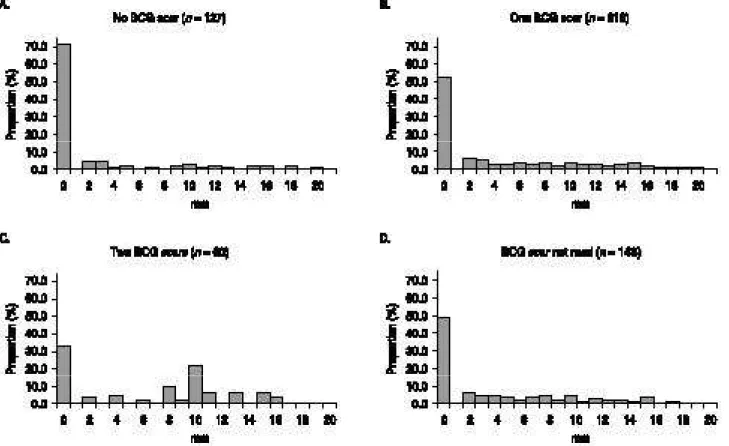
Figure 1 shows, for each of the four BCG scar statuses in our survey, the frequency distribution of the size of the TST indurations. This figure shows that the proportion of children with a reading of 0 mm decreases with num-ber of scars. The frequency distribu-tions are similar if we compare the children with one scar and those for whom scars were not read. There is no clear mode or antimode for results ≥1 mm, except for those with two scars, who had a mode of 10 mm.
Table 2 shows the TST results by ranges of induration sizes and BCG scar status. In addition, the last column of Table 2 shows the “BCG effect” on each range of induration sizes, that is, the odds ratio for the effect of a one–unit in-crease in the number of scars, according to logistic regression estimates. There was evidence that the proportions of children in the ranges of 0 mm, 5–9 mm, and 10–14 mm were influenced by BCG scar status. The proportion with 0-mm indurations decreased as the number of scars increased. In contrast, the propor-tion with indurapropor-tions of 5–9 mm and of
10–14 mm increased as the number of scars increased.
Table 3 presents the proportion of positive TST results by BCG scar sta-tus. As explained above, the propor-tion of positive results was defined using three different cut-off points for induration size: 5 mm, 10 mm, and 15 mm. There was evidence that the pro-portions above the cut-offs of 5 mm and 10 mm, but not 15 mm, were pos-itively influenced by prior BCG scar status.
When we controlled for the BCG effect, the proportion of TST results above each of the cut-offs increased with age (all with P < 0.05). There was some indication that the increase with age of TST results ≥10 mm was differ-ent depending on BCG scar status, but the modification effect was not statis-tically significant (P= 0.22). For chil-dren with one BCG scar the TST re-sults ≥ 10 mm were 14.5%, 19.8%, 21.6%, and 28.8% for the groups of 7–8, 9–10, 11–12, and 13–14 years, respec-tively (P < 0.001). However, for chil-dren with no scar, the age trend was less clear, with the TST results being 6.7%, 13.8%, 5.6%, and 23.4% for those same age groups (P = 0.09). There was also no evidence that BCG scar modi-fied the effect of age on TST ≥5, 10 and 15 mm, or on TST in any of the in-duration ranges (all with P> 0.52, data not shown).
There was no difference by gender or school in the proportion of children above any of the TST cut-offs (data not shown). There was no evidence that gender modified the effect of age or the BCG effect on TST ≥10 mm or on TST above any other cut-off point or in any of the induration ranges (data not shown).
DISCUSSION
scars. Second, there was evidence for an increasing positive effect of number of BCG scars on the proportion of TST results above the cut-offs of 5 mm and 10 mm and also on the proportion of TST results in the ranges of 5–9 mm and 10–14 mm. Third, the BCG scar
ef-fect on the proportion of TST results above the cut-offs of 5 mm and 10 mm did not vary with age. Finally, there was no evidence for BCG effect on the results above the cut-off of 15 mm.
Measuring the proportion of tuber-culin skin test results of 10 mm or
larger is one of the recommended ways to estimate the prevalence of M. tuberculosis infection in unvacci-nated children (3, 12, 13). However, we believe that the results presented in this survey do not adequately estimate the prevalence of M. tuberculosis infecFIGURE 1. Frequency distribution of tuberculin indurations (size in mm) among school children aged 7–14 years, by BCG scar sta -tus. Salvador, Bahia, Brazil, 1997
TABLE 2. Distribution of tuberculin skin test results by ranges of induration sizes and BCG scar status, and esti -mates of the BCG effect on each range of induration sizes. Salvador, Bahia, Brazil, 1997
BCG scar status
Induration size None One Two BCG effecta
(mm)/Total No. % No. % No. % Odds ratio 95% CIb
0 91 71.7 429 52.4 20 33.4 0.6 0.4–0.7
1–4 13 10.2 110 13.5 5 8.3 1.0 0.7–1.6
5–9 5 3.9 105 12.8 8 13.3 1.8 1.1–2.8
10–14 9 7.1 111 13.6 21 35.0 3.0 1.9–4.4
15 9 7.1 63 7.7 6 10.0 1.4 0.8–2.7
Total 127 100.0 818 100.0 60 100.0 NAc NA
aBCG effect shows the odds ratio for the effect of one unit increase in the number of scars, according to logistic regression estimates. b95% CI = 95% confidence interval.
tion in unvaccinated schoolchildren aged 7–14 years, for several reasons. First, our TST survey study population does not represent the entire popula-tion of schoolchildren aged 7–14 years, as logistics and budget size deter-mined the selection of a convenience sample of the schools. Second, chil-dren with no scar in the TST survey do not represent the entire population of schoolchildren aged 7–14 years, given the high BCG vaccination coverage of schoolchildren aged 7–14 years (14). Children with no scar participating in the TST survey also do not represent the entire population of the TST sur-vey. Third, the shape of the frequency distribution of our TST results did not show a clear antimode that could have been used to logically choose a cut-off point that would differentiate between infected and uninfected individuals (12, 15). We did not have any other way to determine how many of the TST children in each of the induration sizes or above each of the cut-offs would represent true M. tuberculosis infection and not cross-reactions with environmental mycobacteria. We do have unpublished data from a small dual skin test survey performed by our group in the city of Salvador in which each child was tested with one injection of tuberculin (PPD derived from M. tuberculosis) and with one injection of one of the two sensitins
(PPD derived from M. scrofulaceumor M. kansasii, two environmental species of the genus mycobacteria). This dual skin test survey showed that many schoolchildren living in Salvador have been sensitized by these antigens.
It is unlikely that our results have been affected in any significant way by misclassification of TST readings, by misclassification of BCG scar readings, or by misclassification of vaccination status obtained from using the pres-ence of BCG scars as a single marker. We demonstrated the high internal va-lidity of the TST results with the high concordance between the TST double readings performed by our two study nurses. We demonstrated high inter-nal and exterinter-nal validity of the BCG scar readings in the city of Salvador in another recently published study per-formed with data from the entire BCG-REVAC trial population in this city (14).
Information on the dates of vaccina-tion was obtained for only a small number of children participating in the TST survey and just a small pro-portion of children participating in the BCG-REVAC trial (14). Nevertheless, we believe both of those sources of in-formation are representative of the en-tire population of schoolchildren aged 7 to 14 years. According to data from the Brazilian Ministry of Health, most children in Brazil receive the first dose
of BCG during the first year of life. As explained earlier in this article, revac-cination only became a national rec-ommendation in 1994, that is, 3 years before this survey in Salvador (7). The Department of Health of the state of Bahia had just started to implement the revaccination policy in Salvador when the Department decided to in-terrupt it, so that the BCG-REVAC trial could be initiated in the city.
It is well known that BCG induces TST reactivity, especially in the short term. For some populations skin tested on two occasions after vaccination the BCG-induced TST reactivity seems to remain practically unchanged for many years (16). However, for other populations it appears to wane, partic-ularly for those whose first TST was done shortly after vaccination (17–26). This waning may explain the findings of the relatively low reactivity (14.5% using the cut-off of 10 mm) among children with one BCG scar in the youngest age group (7–8 years), which agrees with the findings from a study in the country of Malawi (26). The magnitude of the BCG-induced TST sensitivity seems to vary among indi-viduals and communities, but it is usu-ally of an intermediate size. The more stringent the criteria are for consider-ing a TST reaction to be positive, the less the influence of BCG vaccination seems to be. Our study agrees with the TABLE 3. Proportion of positive tuberculin skin test results, using three different cutoff points, by BCG scar status, Sal
-vador, Bahia, Brazil, 1997a
BCG scar status
None One Two
(n= 127) (n= 818) (n= 60)
BCG effectb
Cut-off % % %
point positivec 95% CIc positivec 95% CIc positivec 95% CIc Odds ratio 95% CId
5 mm 18.1 11.3–24.9 34.1 30.9–37.4 58.3 45.5–71.2 2.7 1.9–3.8
10 mm 14.2 8.0–20.3 21.3 18.5–24.1 45.0 32.0–58.0 2.5 1.7–3.7
15 mm 7.1 2.6–11.6 7.7 5.9–9.5 10.0 2.2–17.8 1.4 0.8–2.4
aPositive results are defined as those above the induration sizes of 5 mm, 10 mm, and 15 mm. Estimates of the BCG effect are given for the proportion of positive
results above each of these cut-offs.
bBCG effect = odds ratio for the effect of one unit increase in the number of scars, according to logistic regression estimates.
cThe denominators used for calculating the proportion of positive results are the numbers 127, 818 and 60 for children with respectively none, one and two BCG
scars. The numerators used for these calculations are the numbers of positive results, which were defined using three different cut-offs of induration sizes (5 mm, 10 mm, and 15 mm).
positive influence of BCG on tuber-culin reactivity of ≥ 10 mm found by some studies (26–31) but differs from other studies (32–36). It also agrees with the findings of an absence of the BCG effect on tuberculin reactivity of a more stringent criterion (15 mm in our study) as reported in a few studies (26, 37) but disagrees with another study (29). Our finding of a constant BCG ef-fect from 7 to 14 years on TST results of ≥5 mm and ≥10 mm has also been shown in a detailed study in Malawi that included individuals of all ages (26). That is, only a minority of our schoolchildren vaccinated as neonates or infants have tuberculin reactivity that can be attributable to BCG, but for those who do have that reactivity, it seems to last at least up to their early adolescence (24, 26).
Studies that describe tuberculin re-activity after BCG vaccination have methodological differences in relation to vaccine strain and dose, vaccination schedule and coverage, tuberculin strain and dose, and time elapsed since vaccination. However, analyzed sepa-rately, these differences do not explain the variations in the proportion of BCG-induced tuberculin reactivity above different cut-offs. The complexi-ties of this subject can be exemplified with one recent review that empha-sized the importance of age at vac-cination (38). It is possible that age at vaccination explains some of the above-mentioned variations found in different settings. If vaccination is ad-ministered at birth, BCG-induced reac-tions tend to be smaller and to wane more rapidly than if vaccination is ad-ministered later in life (16, 39). This is believed to be related to the “matura-tion” of the immune system (40). How-ever, age at vaccinations alone cannot explain the differences found in re-gions or countries that use similar vac-cination and TST procedures. Expo-sure to environmental mycobacteria or
other immunological cross-experiences as well as genetic factors may also play important and perhaps concomitant roles (26, 41–43).
Another possibility is that differ-ences in the BCG vaccine strains and/ or in the methods of BCG culture em-ployed by the various manufacturers may also influence the vaccine’s ca-pacity to induce persistent TST reac-tivity (26). A recent genomic study has provided a detailed description of the differences found among the many BCG strains (44). Comparative stud-ies in mice and in humans could dis-tinguish between the different TST reactogenicities induced by different strains, and three of these comparative studies indicated that the Moreau (Rio de Janeiro) strain showed a tendency for stronger reactogenicity (45–47). The Moreau (Rio de Janeiro) strain is used throughout Brazil.
We found evidence that the pres-ence of two BCG scars induced higher tuberculin reactivity than did the pres-ence of only one scar, which agrees with results from one study in Ku-wait (48) and one in Turkey (49). This may be due to the fact that the great majority of the second vaccinations probably occurred within 2 years of our survey. BCG revaccination in Bra-zil was not an accepted policy until 1994, and that revaccination only started in the city of Salvador later in that year, while this survey was done in the beginning of 1997. Alter-natively, there may be a real cumula-tive effect of repeated vaccination on TST reactivity. In our study, it was not possible to separate any effects of age of vaccination and interval since vac-cination from the effect of the number of vaccinations.
We believe that the patterns of the vaccination-induced and BCG-revaccination-induced tuberculin reac-tivity presented in this survey could be generalized to schoolchildren of 7–14
years in the city of Salvador and could even be generalized to schoolchildren in other Brazilian cities. These are not novel aspects in the world scientific lit-erature, but we wanted to have a local picture, given the variety of results found in different settings.
In summary, in interpreting TST results in Brazilian schoolchildren one must take into account that BCG-induced tuberculin reactivity is indis-tinguishable, for results under 15 mm, from reactivity induced by M. tuber-culosis infection. BCG revaccination at school age increases the degree of BCG-induced tuberculin reactivity found among schoolchildren. This in-formation should be kept in mind in tuberculin skin test surveys intended to estimate the prevalence of infection by M. tuberculosis or to assess trans-mission trends as well as in tuberculin skin testing of individuals used as an auxiliary tool in diagnosing tuberculo-sis. This is especially important when there is increasing BCG revaccination coverage.
Acknowledgments.This survey was
1. Lee E, Holzman RS. Evolution and current use of the tuberculin test. Clin Infect Dis 2002; 34:365–370.
2. Dye C, Scheele S, Dolin P, Pathania V, Rav-iglione MC. Consensus statement. Global burden of tuberculosis: estimated incidence, prevalence, and mortality by country. WHO Global Surveillance and Monitoring Project. JAMA 1999;282(7):677–686.
3. Arnadottir T, Rieder HL, Trebucq A, Waaler HT. Guidelines for conducting tuberculin skin test surveys in high prevalence countries. Tuber Lung Dis 1996;77(suppl 1):1–19. 4. Menzies R, Vissandjee B. Effect of bacille
Calmette-Guerin vaccination on tuberculin reactivity. Am Rev Respir Dis 1992;145(3): 621–625.
5. Fine PEM, Floyd S, Stanford JL, As LC, Chag-uluka S, Warndorff DK, et al. Environmental mycobacteria in Northern Malawi: implica-tions for the epidemiology of tuberculosis and leprosy. Epidemiol Infection 2001;126:379– 387.
6. Ruffino-Netto A, de Souza AM. Evolution of the health sector and tuberculosis control in Brazil. Rev Panam Salud Publica 2001;9(5): 306–310.
7. Brasil, Ministério da Saúde do Brasil. Segundo informe técnico sobre vacinação/revacinação BCG. Brasília: Ministério da Saúde; 1994. 8. Sterne JA, Rodrigues LC, Guedes IN. Does the
efficacy of BCG decline with time since vacci-nation? Int J Tuberc Lung Dis 1998;2(3):200– 207.
9. Global Tuberculosis Programme and Global Program on Vaccines. Statement on BCG re-vaccination for the prevention of tuberculosis. Wkly Epidemiol Rec 1995;70(32):229–231. 10. Barreto ML, Rodrigues LC, Cunha SS, Pereira
S, Hijjar MA, Ichihara MY, et al. Design of the Brazilian BCG-REVAC trial against tubercu-losis: a large, simple randomized community trial to evaluate the impact on tuberculosis of BCG revaccination at school age. Control Clin Trials 2002;23:540–553.
11. Brasil, Departamento de Informática do Sis-tema Único de Saúde. Indicadores e dados bá-sicos de saúde 1998 [Internet site]. Available from: http://www.datasus.gov.br/cgi/idb98/ matriz.htm. Accessed 10 October 2001. 12. Rieder HL. Methodological issues in the
esti-mation of the tuberculosis problem from tu-berculin surveys. Tuber Lung Dis 1995;76(2): 114–121.
13. Borgdorff MW, Egwaga SM, Muwinge H, Kalisvaart NA, Nagelkerke NJD. Density of tuberculin skin reaction and its association with tuberculosis infection as defined by dual skin testing. Int J Tuber Lung Dis 2000;4(11): 1060–1065.
14. Pereira SM, Dourado MI, Barreto ML, Cunha SS, Ichihara MY, Rodrigues LC. Sensitivity and specificity of BCG scar reading in Brazil. Int J Tuberc Lung Dis 2001;5(11):1067–1070. 15. Neuenschwander BE, Zwahlen M, Kim SJ,
Engel RR, Rieder HL. Trends in the preva-lence of infection with Mycobacterium tubercu-losisin Korea from 1965 to 1995: an analysis of
seven surveys by mixture models. Int J Tuber Lung Dis 2000;4:719–729.
16. Horwitz O, Bunch-Christensen K. Correlation between tuberculin sensitivity after 2 months and 5 years among BCG vaccinated subjects. Bull WHO 1972;47:49–58.
17. Baily GV. Tuberculosis prevention trial, Madras. Indian J Med Res 1980;72 Suppl:1–74. 18. Dawodu AH. Tuberculin conversion follow-ing BCG vaccination in preterm infants. Acta Paediatr Scand 1985;74(4):564–567.
19. Karalliedde S, Katugaha LP, Uragoda CG. Tu-berculin response of Sri Lankan children after BCG vaccination at birth. Tubercle 1987;68: 33–38.
20. Sedaghatian MR, Shana’a IA. Evaluation of BCG at birth in the United Arab Emirates. Tu-bercle 1990;71(3):177–180.
21. Aggarwal A, Dutta AK. Timing and dose of BCG vaccination in infants as assessed by postvaccination tuberculin sensitivity. Indian Pediatr 1995;32(6):635–639.
22. Ferreira AA, Bunn Moreno MM, Sant’Anna CC, Ferreira MF. BCG vaccination in low birth weight newborns: analysis of lymphocyte proliferation, IL-2 generation and intradermal reaction to PPD. Tuber Lung Dis 1996;77(5): 476–481.
23. Hoft DF, Kemp EB, Marinaro M, Cruz O, Kiyono H, McGhee JR, et al. A double-blind, placebo-controlled study of Mycobacterium-specific human immune responses induced by intradermal bacille Calmette-Guerin vacci-nation. J Lab Clin Med 1999;134(3):244–252. 24. Black GF, Weir RE, Floyd S, Bliss L,
Warn-dorff DK, Crampin AC, et al. BCG-induced increase in interferon-gamma response to my-cobacterial antigens and efficacy of BCG vac-cination in Malawi and the UK: two random-ised controlled studies. Lancet 2002;359(9315): 1393–1401.
25. Aydinlioglu H, Caglayan S, Kansoy S, Yaprak I, Seckin E, Bakiler AR, et al. The decline of BCG immunity after neonatal vaccination: what about revaccination at one year? Paedi-atr Perinat Epidemiol 1993;7:334–348. 26. Fine PE, Bruce J, Ponnighaus JM, Nkhosa P,
Harawa A, Vynnycky E. Tuberculin sensitiv-ity: conversions and reversions in a rural African population. Int J Tuberc Lung Dis 1999;3(11):962–975.
27. Gloyd S, Lopez JL, Mercado FJ, Durning J. Riesgo de infección por Mycobacterium tuber-culosis en Jalisco, México. Bol Oficina Sanit Panam 1991;111(5):393–401.
28. Larsson LO, Magnusson M, Skoogh BE, Lind A. Sensitivity to sensitins and tuberculin in Swedish children. IV. The influence of BCG-vaccination. Eur Respir J 1992;5(5):584–586. 29. Miret Cuadras P, Pina Gutierrez JM, Juncosa
S. Tuberculin reactivity in Bacillus Calmette-Guerin vaccinated subjects. Tuber Lung Dis 1996;77(1):52–58.
30. Waddell RD, von Reyn CF, Baboo KS, Mwinga A, Chintu C, Zumla A. The effects of BCG immunization and human immunodeficiency virus infection on dual skin test reactions to purified protein derivative and Mycobacterium
aviumsensitin among adults in Zambia. Int J Tuberc Lung Dis 1999;3(3):255– 260. 31. Bierrenbach AL, Cunha SS, Barreto ML,
Pereira SM, Rodrigues LC. Skin test reactivity to mycobacterial antigens parallels the phylo-genetical structure of their genus. Int J Tuberc Lung Dis 2001;5(7):656–663.
32. Young TK, Mirdad S. Determinants of tuber-culin sensitivity in a child population covered by mass BCG vaccination. Tuber Lung Dis 1992;73(2):94–100.
33. Mudido PM, Guwatudde D, Nakakeeto MK, Bukenya GB, Nsamba D, Johnson JL, et al. The effect of bacille Calmette-Guerin vaccination at birth on tuberculin skin test reactivity in Ugandan children. Int J Tuberc Lung Dis 1999;3(10):891–895.
34. Johnson H, Lee B, Doherty E, Kelly E, Mc-Donnell T. Tuberculin sensitivity and the BCG scar in tuberculosis contacts. Tuber Lung Dis 1995;76(2):122–125.
35. Rumisha D, Baratedi J, Chimidza N, Hirschfeld C, Reed M, Notha M, et al. Tuber-culin skin test survey in a pediatric popula-tion with high BCG vaccinapopula-tion coverage — Botswana, 1996. MMWR Morb Mortal Wkly Rep 1997;46(36):846–851.
36. Lockman S, Tappero JW, Kenyon TA, Ru-misha D, Huebner RE, Binkin NJ. Tuberculin reactivity in a pediatric population with high BCG vaccination coverage. Int J Tuberc Lung Dis 1999;3(1):23–30.
37. Kuyucu N, Kuyucu S, Bakirtas A, Karacan C. BCG revaccination and tuberculin reactivity. Indian J Pediatr 2001;68:21–25.
38. Menzies D. What does tuberculin reactivity after Bacille Calmette-Guérin vaccination tell us? Clin Inf Dis 2000;31 (suppl 3):71–4. 39. Suciliene E, Ronne T, Plesner AM, Semenaite
B, Slapkauskaite D, Larsen SO, et al. Infant BCG vaccination study in Lithuania. Int J Tuberc Lung Dis 1999;3:956–961.
40. Al Zahrani K, Al Jahdali H, Menzies D. Does size matter? Utility of size of tuberculin reac-tions for the diagnosis of mycobacterial dis-ease. Am J Respir Crit Care Med 2000;162: 1419–1422.
41. Snider DE Jr. Bacille Calmette Guerin vaccina-tions and tuberculin skin tests. JAMA 1985; 253:3438–3439.
42. Brewer TF, Wilson ME, Nardell EA. BCG im-munization: review of past experience, cur-rent use, and future prospects. Curr Clin Top Infect Dis 1995;15:253–270.
43. Black GF, Dockrell HM, Crampin AC, Floyd S, Weir RE, Bliss L, et al. Patterns and im-plications of naturally acquired immune responses to environmental and tuberculous mycobacterial antigens in northern Malawi. J Infect Dis 2001;184(3):322–329.
44. Behr MA, Small PM. A historical and molecu-lar phylogeny of BCG strains. Vaccine 1999; 17(7–8):915–922.
45. Vallishayee RS, Shashidhara AN, Bunch-Christensen K, Guld J. Tuberculin sensitivity and skin lesions in children after vaccination with 11 different BCG strains. Bull World Health Organ 1974;51(5):489–494.
46. Junior LP, Filho PP. Comparative immuno-genicity of BCG substrains for mice. Rev Bras Pesqui Med Biol 1979;12(4–5):311–316. 47. Lagranderie MR, Balazuc AM, Deriaud E,
Leclerc CD, Gheorghiu M. Comparison of im-mune responses of mice immunized with five different Mycobacterium bovis BCG vaccine strains. Infect Immun 1996;64(1):1–9.
48. Shaaban MA, Abdul Ati M, Bahr GM, Stand-ford JL, Lockwood DN, McManus IC. Revac-cination with BCG: its effects on skin tests in Kuwaiti senior school children. Eur Respir J 1990;3(2):187–191.
49. Ildirim I, Hacimustafaoglu M, Ediz B. Cor-relation of tuberculin induration with the
number of Bacillus Calmette-Guerin vaccines. Pediatr Infect Dis J 1995;14:1060–1063.
Manuscript received 12 June 2002. Revised version ac-cepted for publication 20 February 2003.
Objetivo. Evaluar la influencia de la vacunación o revacunación con BCG sobre la
prueba de reactividad a la tuberculina, con el fin de ayudar a la correcta interpretación de esta prueba en lugares con una amplia cobertura neonatal con la vacuna BCG y una revacunación en edad escolar cada vez más frecuente.
Métodos. Se realizaron la prueba cutánea de la tuberculina y la lectura de la cicatriz de la BCG a 1 148 niños de 7 a 14 años de edad de Salvador, Bahía, Brasil. Se evaluó si la presencia de una o dos cicatrices de BCG influía en los resultados de la prueba cutánea de la tuberculina utilizando diferentes puntos de corte (induración ≥5 mm, ≥ 10 mm y ≥15 mm), y agrupando la induración según su diámetro (0, de 1 a 4 mm, de 5 a 9 mm, de 10 a 14 mm y ≥ 15 mm). También se evaluó si la edad, el sexo o la es-cuela del niño influyeron sobre los resultados de esta prueba.
Resultados. La induración cutánea provocada por la prueba de la tuberculina
re-sultó ≥ 10 mm en 14,2% de los casos (intervalo de confianza de 95% [IC 95%]: 8,0 a 20,3%) en niños sin cicatriz de BCG; 21,3% (IC 95%: 18,5 a 24,1%) en niños con una ci-catriz de BCG; y 45,0% (IC 95%: 32,0 a 58,0%) en niños con dos cicatrices de BCG. Se evidenció que la presencia de una o dos cicatrices de BCG aumentó la proporción de resultados ≥5 mm y ≥10 mm. Este efecto también se evidenció en la proporción de resultados de las pruebas cutáneas de la tuberculina de 5 a 9 mm y de 10 a 14 mm de diámetro. El efecto de las cicatrices de BCG sobre la proporción de resultados ≥5 mm y ≥10 mm no varió con la edad. No se hallaron indicios de que la vacunación previa con BCG influyera cuando el diámetro resultó ≥15 mm.
Conclusiones. En los escolares brasileños, la reactividad tuberculínica inducida por la vacunación con BCG <15 mm no puede distinguirse de la reactividad causada por la infección por Mycobacterium tuberculosis. La revacunación durante la edad escolar aumenta la reactividad tuberculínica provocada por la vacunación inicial. Estos re-sultados deben tomarse en consideración al utilizar la prueba cutánea de la tuber-culina para estimar la prevalencia de M. tuberculosis o determinar los patrones de transmisión, así como al emplear esta prueba como herramienta auxiliar en el diag-nóstico de la tuberculosis. Estos resultados son de especial importancia frente a la cre-ciente ampliación de la cobertura de la revacunación con BCG.
RESUMEN