Objective: To describe clinical, radiological, epidemiological, and microbiological characteristics of pediatric patients with diagnosis of tuberculosis in a period of 15 years.
Methods: Retrospective study including children and adolescents younger than 18 years diagnosed with tuberculosis in the Clinical Hospital of the Universidade Estadual de Campinas in São Paulo State, Brazil. Active tuberculosis was deined by the identiication of Mycobacterium tuberculosis in culture, microscopy, or histopathological examination. Children with positive clinical history and radiological tests who had been exposed to sick adults or with positive tuberculin skin test were also considered as having active tuberculosis. Statistical analysis compared the data obtained from children younger and older than 10 years of age, since they present a disease pattern more similar to adults. Results: There were 145 identiied cases, 61.4% in patients under 10 years of age. The main symptoms reported were coughing (55.9%) and fever (46.9%), and the variables of fever, coughing, weight-loss, and pain were signiicantly inluenced by age, with a higher frequency in older children. Diagnosis was conirmed by culture, microscopy, or histopathology in 67.6% of the cases. The other cases (32.4%) had the diagnosis of tuberculosis based on clinical, radiological, and epidemiological characteristics, as well as tuberculin skin test. The positivity for culture, microscopy, and tuberculin skin test was, respectively, 65.8, 35.7, and 72.3%. History of contact with a sick adult was conirmed in 37.2%, without inluence of age.
Conclusions: Diagnosis of tuberculosis in children is still a challenge, since all the conirmation tests have low positivity. These results demonstrate the need for new diagnostic methods and improved strategies for searching sick contacts.
Keywords: Pediatrics; tuberculosis; diagnosis.
Objetivo: Descrever o quadro clínico, radiológico e o perfil epidemiológico e microbiológico de pacientes diagnosticados com tuberculose em um período de 15 anos.
Métodos: Estudo retrospectivo de crianças e adolescentes menores de 18 anos diagnosticados com tuberculose no Hospital de Clínicas da Universidade Estadual de Campinas. Tuberculose ativa foi deinida pela identiicação de M. tuberculosis em cultura, baciloscopia ou exame histopatológico ou, ainda, casos com quadro clínico e radiológico compatível e com história de exposição à tuberculose ou com teste tuberculínico positivo. Foi realizada análise estatística, com comparação entre os dados de crianças menores e maiores de 10 anos, já que estas apresentam doença com padrão mais próximo do adulto.
Resultados: Foram identiicados 145 casos, 61,4% em pacientes menores de 10 anos. Os principais sintomas relatados foram tosse (55,9%) e febre (46,9%), sendo que as variáveis febre, tosse, emagrecimento e dor se associaram à idade, estando mais presentes em crianças maiores de 10 anos. O diagnóstico foi conirmado (cultura, baciloscopia ou histopatológico) em 67,6% dos casos. Os demais (32,4%) tiveram seu diagnóstico realizado com base no quadro clínico, radiológico, epidemiológico e teste tuberculínico. A positividade da cultura, da baciloscopia e do teste tuberculínico foram, respectivamente, 65,8; 35,7 e 72,3%. História de contato com adulto tuberculoso foi conirmada em 37,2% dos casos.
Conclusões: O diagnóstico de tuberculose em pediatria é complexo, considerando‑se que todos os parâmetros usados têm baixa positividade. Os resultados apontam a necessidade de novos métodos diagnósticos e também de melhorias nas estratégias de busca de comunicantes.
Palavras‑chave: pediatria; tuberculose; diagnóstico.
ABSTRACT
RESUMO
*Corresponding author. E-mail: [email protected] (A.P.G. Cano).
aFaculdade de Ciências Médicas da Universidade Estadual de Campinas (Unicamp), Campinas, SP, Brazil. bHospital de Clínicas da Unicamp, Campinas, SP, Brazil.
cDepartment of Pediatrics of the Faculdade de Ciências Médicas da Unicamp, Campinas, SP, Brazil.
Tuberculosis in pediaTric paTienTs:
how has The diagnosis been made?
Tuberculose em pacientes pediátricos: como tem sido feito o diagnóstico?
Ana Paula Ghussn Cano
a,*, Mariana Tresoldi Neves Romaneli
b,
INTRODUCTION
TB was deined by the detection of Mycobacterium tuberculosis in culture, smear microscopy (bacillus resistant acid – BAAR), or histopathology indicative of TB, evidencing a chronic granulomatous inlammatory process with caseous necrosis. Children with a compatible clinical and radiological condition and a history of exposure to TB or positive tuberculin test were also considered cases of active TB (≥5 mm in non-BCG vacci-nated children, children vaccivacci-nated for more than 2 years and immunosuppressed, or ≥10 mm in children vaccinated for less Tuberculosis (TB) in Brazil presents a major public health chal-lenge. Despite current eforts to control it, data from the World Health Organization (WHO) indicate that Brazil is among 22 countries with the highest number of TB cases, accounting for 82% of global cases and 75% of cases involving children.1 here are approximately 1 million TB cases in the world’s child population, and the disease accounts for 130,000 deaths per year, making TB one of the 10 leading causes of death among children worldwide.2 According to the SINAN reporting sys-tem, 83,617 TB cases were registered in Brazil in 2015, of which 7,106 cases (8.5%) occurred in children under 19 years of age.3
he major challenge related to childhood TB is its diagno-sis, since there is no examination to date that can be consid-ered a gold standard.4,5 Diagnostic techniques classically used in adults have low sensitivity and speciicity in children and conirmation by bacteriological identiication is not always possible. hus, treatment often begins in the absence of iso-lation of the mycobacteria and is based only on the follow-ing three factors:
1. clinical and radiological indings;
2. positive tuberculin skin test; and
3. contact with an adult with TB.6,7
However, even clinical and radiological indings of TB in children are diicult to analyze. While adolescents express a disease with a pattern similar to that of adults, younger children often present a nonspeciic and oligosymptomatic presentation, therefore constituting the age group of greater diagnostic dii-culty and higher risk of progression to severe illness and death.6,8 Although the diagnostic diiculties in the pediatric age group are many, few studies have been conducted to evaluate how the diagnosis of childhood TB is carried out in Brazil.9-11 Such a scarcity of studies impairs the identiication and moni-toring of cases and hinders the development of public policies aimed at the prevention and control of the disease.
his study aims to describe the clinical and radiological proile as well as the epidemiological and microbiological proile of children and adolescents diagnosed with TB at any time between 1999 and 2014 at the Hospital of the State University of Campinas (HC-Unicamp).
METHOD
A retrospective study was carried out and approved by the Research Ethics Committee of Unicamp under opinion num-ber 570,646. he data consisted of records of children and adolescents up to 18 years of age who were diagnosed with TB at HC Unicamp sometime during the 15-year period between 1999 and 2014. Active TB was deined by the detec-tion of Mycobacterium tuberculosis in culture, smear microscopy (bacillus resistant acid – BAAR), or histopathology indicative of TB, evidencing a chronic granulomatous inlammatory pro-cess with caseous necrosis. Children with a compatible clinical and radiological condition and a history of exposure to TB or positive tuberculin test were also considered cases of active TB (≥5 mm in non-BCG vaccinated, vaccinated for more than 2 years and immunosuppressed, or ≥ 10 mm in vaccinated for less than 2 years). Patients who did not it these deinitions were excluded even if treatment was prescribed. In addition, patients who began follow-up in the post-relapse or retreatment service were likewise excluded, as were cases of latent TB and BCGitis infection (infection caused by the BCG vaccine at the site of application and in regional lymph nodes). he Epidemiological Surveillance Nucleus (NVE) of the Surveillance System at HC Unicamp (TB Web) identiied the cases from 2007 to 2014, and the Patient Information System of HC Unicamp identiied the cases from 1999 to 2006. Cases were identiied according to the International Classiication of Diseases (ICD).
he information collected from the medical records included personal identiication data, clinical history, physical exam-ination, form of presentation of the disease, radiological and microbiological studies, epidemiological data, and the conduct and outcome of each case. Whenever available, descriptions of images of radiological indings in the medical records or oi-cial reports were also taken into consideration.
Statistical analysis was performed with descriptions of vari-ables according to their frequencies, and comparison between them used the chi-square test or Fisher’s exact test. he com-parison between the data of children was made by age group, as those older than 10 years present a disease pattern similar to that of adults, whereas the younger age group presents partic-ular and unique manifestations, diferent clinical conditions, and distinct diagnostic diiculties.8
RESULTS
of clinical history; 15% from 5 to 8 weeks; and 15%, from 9 to 16 weeks. here is no information on the time of clinical history in 25% of the cases, and the remaining 15% varied with durations of clinical history ranging from extremes of 6 months to 14 years.
Among the types of active disease, 88 cases (60.7%) had pulmonary type and 57 (39.3%) had extrapulmonary types. he age group did not signiicantly inluence the presentation of the disease as pulmonary or extrapulmonary (p=0.631). However, there were more cases of pleural TB in patients older than 10 years and all cases of bone TB occurred uniquely in patients younger than 10 years of age (Table 1).
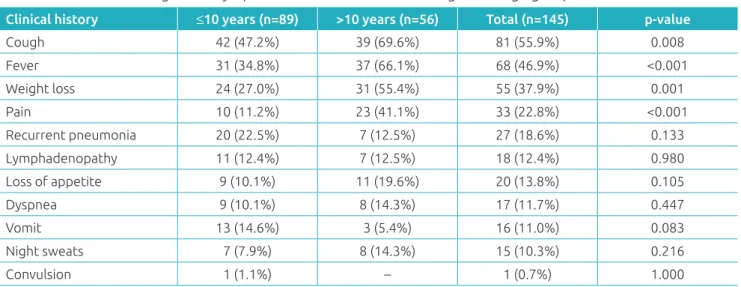
he main clinical history data are described in Table 2. Coughing, fever, and weight loss were the most commonly reported symptoms. he variables of fever, coughing, weight loss, and pain were signiicantly inluenced by age, with a higher
frequency in children older than 10 years of age. he pain vari-able was present in 13 patients with pulmonary type (chest pain – ventilatory dependent); in 9 patients with the pleu-ral type (pleuritic pain); and in 4 patients with the bone type (bone pain with claudication). he other cases were described in patients with the meningeal type (2 cases – headache), lymph node type (2 cases – pain in the afected lymph nodes), articu-lar type (1 case – coxofemoral pain), ophthalmic type (1 case – ocular pain), and miliary type (1 case – chest pain).
With respect to the physical examination, the main data were altered pulmonary auscultation (53 cases/36.6%), lymph-adenopathy (45 cases; 31.0%), fever on admission (25 cases; 17.2%), and malnutrition (11 cases; 7.6%).
Of the 145 cases examined in the study, 98 (67.6%) had a diagnosis of TB conirmed by culture, bacilloscopy (BAAR sur-vey), or a histopathology indicative of TB, evidencing chronic granulomatous inlammatory process with caseous necrosis. In the majority of the cases (63 of 98 cases, or 64.3%), conirmation was made with a positive result in only one of these three conir-matory tests. In 33 cases (33.7%), conirmation was made with a positive result in two of these tests, and in 2 cases (2.0%) there was a positive result in all three tests. here were more conirma-tory examinations for the extrapulmonary conditions (p<0.001). Diagnostic conirmation correlated with age (p=0.025), with 60.7% diagnostic conirmation among those under 10 years of age, and 78.6% among patients older than 10 years. he remain-ing cases (47 cases; 32.4%) were diagnosed based on the clinical condition, radiological aspects, tuberculin skin test, and history of contact with adult tuberculosis without bacteriological con-irmation. Positive results in the culture, bacilloscopy, and tuber-culin skin test are presented in Table 3. Tubertuber-culin skin test has turned positive in 12 patients (8.3% of the total, representing 20% of those with a positive tuberculin skin test).
Table 1 Distribution of tuberculosis presentation by
age group.
Type ≤10 years >10 years Total
Pulmonary 55 33 88
Lymph node 10 8 18
Pleural 4 9 13
Bone 12 – 12
Meningeal 3 2 5
Peritoneal 2 – 2
Miliary 1 1 2
Ophthalmic 1 1 2
Articular 1 – 1
Disseminated – 1 1
Splenic – 1 1
Total 89 56 145
Table 2 Distribution of signs and symptoms of tuberculosis according to the age group.
Clinical history ≤10 years (n=89) >10 years (n=56) Total (n=145) p‑value
Cough 42 (47.2%) 39 (69.6%) 81 (55.9%) 0.008
Fever 31 (34.8%) 37 (66.1%) 68 (46.9%) <0.001
Weight loss 24 (27.0%) 31 (55.4%) 55 (37.9%) 0.001
Pain 10 (11.2%) 23 (41.1%) 33 (22.8%) <0.001
Recurrent pneumonia 20 (22.5%) 7 (12.5%) 27 (18.6%) 0.133
Lymphadenopathy 11 (12.4%) 7 (12.5%) 18 (12.4%) 0.980
Loss of appetite 9 (10.1%) 11 (19.6%) 20 (13.8%) 0.105
Dyspnea 9 (10.1%) 8 (14.3%) 17 (11.7%) 0.447
Vomit 13 (14.6%) 3 (5.4%) 16 (11.0%) 0.083
Night sweats 7 (7.9%) 8 (14.3%) 15 (10.3%) 0.216
Culture was performed in 85 cases, with mycobacteria iden-tiied in 56 cases (65.8%), of which 44 cases were pulmonary TB and 12 cases were extra-pulmonary TB. his corresponds with 50% and 21% of pulmonary and extrapulmonary types, respectively. In the pulmonary type, culture was positive in the following materials: sputum (25 cases), gastric lavage (11 cases), bronchoalveolar lavage (5 cases), tracheal secretion (2 cases), and lung biopsy (1 case). Gastric lavage analysis was performed in 20 patients, of which smear microscopy was positive in 5 patients and culture was positive in 11 patients.
he histopathological examination conirmed the diagno-sis of TB in 41 cases. he main sites from which biopsies were extracted were lymph node (23 cases), bone (7 cases), and pleura (6 cases), as well as other less frequent sites such as liver, spleen, sclera, central nervous system, and synovium (1 case each). In addition to the ganglion form, lymph node biopsy contributed to the diagnosis in three cases of pulmonary TB, one case of miliary TB, and one case of peritoneal TB.
Radiological alterations were present in 94 (81%) of 116 cases in which the examination was performed. he main alter-ations were the presence of opacities in the pulmonary paren-chyma (33 cases; 22.7%), hilar adenopathy (13 cases; 9.0%), pleural efusion (13 cases; 9.0%), cavitation (8 cases; 5.5%), and miliary pattern (2 cases; 1.4%). Computed tomography was performed in 39 cases (26.9%), with evidence of alteration in 34 (87.2%), of which 24 (70.6%) were cases of pulmonary TB and the remaining cases were extrapulmonary.
In 14 cases (9.7%) diagnosed with TB, there was a previ-ous diagnosis of HIV infection. Investigation of co-infection was carried out in 73 other cases, but it was negative in all the cases. Contact with adult tuberculosis was conirmed in 54 cases (37.2%), with no relation to age (p=0.972). here was no infor-mation on the search for contacts in 59 cases (40.7%). Previous vaccination with BCG was reported in 89 cases (61.4%), being absent in only 2 cases (1.4%) and without information in 54 cases (37.2%). Of the 2 cases of miliary TB, 1 child had been vaccinated and there was no information about the other. In the
meningeal type, 4 children had been vaccinated and there was no information about 1 of the patients.
Of the patients considered, all started adequate treatment and 120 (82.8%) patients were cured; 12 (8.3%) patients per-formed follow-up in the basic health network, and there were no records of the outcome of these cases; 5 (3.4%) patients aban-doned treatment; and 4 (2.8%) patients presented recurrence of the disease. One case (0.7%) was still receiving treatment at the time of data collection; 2 (1.4%) resulted in death (one case of miliary TB and one case of pulmonary TB with HIV co-infection), and there is no information on the follow-up of 1 patient. Drug hepatitis was diagnosed in 6 (4.1%) patients.
DISCUSSION
he results demonstrate the complexity of the diagnosis of TB in the pediatric age group, as well as its complexity in the absence of bacteriological conirmation. Diiculty in diagno-sis among children is evident because of its delay: despite the lack of information about the duration of clinical history in a quarter of the cases, it is notable that only 30% of children started treatment within the irst four weeks of clinical history, meaning that many others endured months and even years of clinical history before obtaining a diagnosis.
he most commonly reported symptoms were coughing (55.9%), fever (46.9%), and weight loss (37.9%), which were also described as the main symptoms in similar cohorts.12-14 he occurrence of these symptoms were correlated with age: they were more present in the group of children over 10 years of age. he low frequency of these symptoms in the patients younger than 10 years of age and the oligosymptomatic nature of TB in this age group reinforce the diiculty of diagnosing the disease in younger children.
The literature demonstrates that although mycobacteria research and culture are the most commonly used diagnostic methods when TB is suspected, less than 20% of the children with the diagnosis have positive smear microscopy and the culture detects M. tuberculosis in less than 50% of the cases.6,7 he results of this current study are similar, with smear microscopy positive in 35.7% of cases and positive culture detected in 65.8% cases. hese data are consistent with the literature, which rarely presents bacteriological conirmation in children and conirms the greatest diagnostic diiculty in children younger than 5 years of age.2,15,16
he low positivity of bacteriological examinations in the pediatric age group can be explained by the fact that TB in chil-dren is usually paucibacillary. his is due to the fact that most of the time these children are unable to spit voluntarily, a chal-lenge that can compromise the diagnosis in cases of pulmonary TB. he alternative method to obtain sputum in these cases
Table 3 Positivity of culture, bacilloscopy, and tuberculin
skin test according to age group (positive results / total of examinations performed).
Method Positivity Total positivity
≤10 years >10 years
Culture 31/48
(64.6%) (67.5%)25/37 (65.8%)56/85
Bacilloscopy (26.2%)16/61 (47.9%)23/48 (35.7%)39/109
Tuberculin test
44/60
is the collection of gastric lavage, a relatively invasive method that requires hospitalization for three days. In this study, gas-tric lavage culture conirmed the presence of mycobacteria in 55% of the cases in which it was investigated.
In the absence of bacteriological conirmation and other methods in the public service system to conirm the diagnosis of TB, treatment is prescribed using the three factors previously mentioned (clinical radiological criteria, tuberculin skin test, and epidemiology). hese criteria are analyzed using a point system proposed by the Ministry of Health in 2010 and vali-dated in our country for children not infected with HIV. his system considers the nutritional status of the child and assigns a score that classiies the diagnosis of pulmonary TB as “unlikely” (≤25 points), “possible” (between 30 and 35 points) and “very likely” (≥40 points).15,17 Studies that validated the use of this score in Brazil determine that the intermediate punctuation limits for indication of treatment (“possible” diagnosis) increase the sensitivity of the algorithm from 58% to 89%, but also lead to a drop in speciicity from 98% to 86%.15 Consequently, an increase in false positives may occur, which means that approx-imately 30% of patients starting treatment for TB might be carriers of other diseases.18 he analysis of the use of the point system was not possible in this study due to the long time span considered (1999–2014), as it includes periods prior to the implementation of the system by the Ministry of Health.
More recently developed methods, such as polymerase chain reaction techniques, microscopic observation drug sus-ceptibility (MODS), bacteriophage ampliication, and assays for the detection of interferon-gamma (IFN ) (Interferon-Gamma Release Assays – IGRAS) have not yet been validated for use in children or are not yet available for use in Brazilian public services and have not been used for diagnosis in any of the cases reported in this study.17 Research on IGRAS has received particular attention today and includes methods such as QuantiFERON TB Gold or T SPOT.TB. Recent studies evaluating these methods and comparing their performance with the tuberculin test have indicated that the IGRAS method achieves superior speciicity compared with the tuberculin test. his supports the possibility of its use in place of the tuber-culin test and as a form of efective disease screening in chil-dren.19-21 Nevertheless, the new diagnostic techniques require further studies involving the pediatric age group in order to deine parameters that guide their use and to evaluate the cost efectiveness of their use in the public health system.5
As children can only be infected after birth by close contact with a bacillary TB carrier, conirmation of the disease in the pediatric age group is a sentinel event that alerts to the presence of adults with tuberculosis in the child’s life.16 In this study, there was a sick adult in 37.2% of the cases. Moreover, 50% of TB
cases occurred in children under 7 years of age, the age range in which the child’s main contacts are in the home environment.
This fact evidences the need to actively seek out adult patients at home whenever a child with TB is identiied. Failure to detect the adult source of the disease is a risk to the child’s own treatment (as the child remains susceptible to re-infec-tion), and is a greater public health issue as it does not prevent the transmission of the disease to other adults. hus, there is a need for greater investment in strategies for epidemiological surveillance of TB with the implementation of a systematized method of searching for contagious contacts.22-24
Regarding HIV TB co-infection, this occurred in 9.7% of the cases. All of these patients were previously diagnosed with HIV and received follow-up care at HC Unicamp. he high percentage is due to the fact that Unicamp is a reference center for HIV, keeping track of infected children sent from the inte-rior of the state of São Paulo and all of Brazil. However, the need to investigate HIV in patients diagnosed with TB (even in the pediatric age group) is more urgent and imperative given that TB is found to be one of the main causes of death in HIV-positive patients. Early identiication of these cases may lead to a more efective treatment and better control of the underlying disease.17
Considering that this was a retrospective study, the research-ers could only rely on the information available in the patients’ charts. In some cases, this information was incomplete or parts were missing, therefore impairing some conclusions. It is worth mentioning that the authors believe that the 100% positiv-ity of histopathological examinations can be explained by the method applied in the research, that is to say, from the identi-ication of CIDs related to TB. Indeed, when the examination was inconclusive or identiied another agent, the CID did not detect such a case in the database search.
In summary, the diagnosis of TB in children remains chal-lenging. he results of this study echo the indings of pre-ex-isting literature and illustrate both the diagnostic diiculty in children and the health system’s need for new, cost-efective diagnostic methods that have been validated for the pediatric population. Furthermore, strategies aimed at identifying con-tagious carriers should be reviewed in order to ensure a break in the transmission link of the disease. When coupled together, these actions may provide better control of TB in Brazil.
Funding
Institutional Program for Scientiic Initiation Scholarships of the National Council for Scientiic and Technological Development (PIBIC/CNPq), Brazil, case number 118558/20145.
conflict of interests
REFERENCES
1. World Health Organization. Global tuberculosis report 2012. Genebra: WHO; 2012.
2. Buonsenso D, Lancella L, Delogu G, Krzystoiak A, Testa A, Ranno O, et al. A twenty-year retrospective study of pediatric tuberculosis in two tertiary hospitals in Rome. Pediatr Infect Dis J. 2012;31:1022-6.
3. Brazil – Ministério da Saúde – DATASUS [http://datasus. saude.gov.br]. Informações de saúde – Epidemiológicas e Morbidade – Tuberculose [cited 2016 Aug 31]. Available from: http://tabnet.datasus.gov.br/cgi/tabcgi.exe?sinannet/ cnv/tubercbr.def
4. Starke JR. Childhood tuberculosis. A diagnostic dilemma. Chest. 1993;104:329-30.
5. Marais BJ, Pai M. Recent advances in the diagnosis of childhood tuberculosis. Arch Dis Child. 2007;92:446-52. 6. Newton SM, Brent AJ, Anderson S, Whittaker E, Kampmann
B. Paediatric tuberculosis. Lancet Infec Dis. 2008;8:498-510.
7. Khan EA, Starke JR. Diagnosis of tuberculosis in children: Increased need for better methods. Emerg Infect Dis. 1995;1:115-23.
8. Marais BJ, Gie RP, Schaaf HS, Hesseling AC, Obihara CC, Starke JJ, et al. The natural history of childhood intra-thoracic tuberculosis: a critical review of literature from the pre-chemotherapy era. Int J Tuberc Lung Dis. 2004;8:392-402. 9. Maciel EL, Martinato CA, Bandeira CF, Tonini MS, Dietze
R, Ramos MC. O peril epidemiológico da tuberculose em crianças e adolescentes menores de 15 anos na Grande Vitória, Brasil, no período de 1990-2001. Cad Saúde Colet. 2006;14:81-94.
10. Watanabe A, Ruino-Netto A. O peril epidemiológico dos casos de tuberculose notiicados em hospital terciário. Ribeirão Preto - São Paulo. Bol Pneumol Sanit. 2001;9:19-34.
11. Matos TP, Kritski AL, Netto AR. Aspectos epidemiológicos da tuberculose em crianças e adolescentes no Rio de Janeiro. J Pediatr (Rio J). 2012;88:335-40.
12. Lotian F, Bolursaz MR, Khalilzadeh S, Baghaie N, Hassanzad M, Velayati A. Features of adolescents tuberculosis at a referral TB’s Hospital in Tehran, Iran. Mediterr J Hematol Infect Dis. 2016;8:e2016005.
13. Galli L, Lancella L, Tersigni C, Venturini E, Chiappini E, Bergamini BM, et al. Pediatric tuberculosis in Italian children: Epidemiological and clinical data from the Italian register of pediatric tuberculosis. Int J Mol Sci. 2016:17:E960.
14. Turel O, Kazanci S, Gonen I, Aydogmus C, Karaoglan E, Siraneci R. Paediatric tuberculosis at a referral hospital in Istanbul: analysis os 250 cases. Biomed Res Int. 2016;2016:6896279.
15. Sant’Anna CC, Orfaliais CT, March MF, Conde MB. Evaluation of a proposed diagnostic scoring system for pulmonary tuberculosis in Brazilian children. Int J Tuberc Lung Dis. 2006;10:463-5.
16. Seddon JA, Jenkins HE, Liu L, Cohen T, Black RE, Vos T, et al. Counting children with tuberculosis: why numbers matter. Int J Tuberc Lung Dis. 2015;19 Suppl 1:9-16.
17. Brazil - Ministério da Saúde. Manual de recomendações para o controle da tuberculose no Brasil. Brasília: Ministério da Saúde; 2011.
18. Coelho JC, Caribé MA, Caldas SC, Martins E. Is tuberculosis diicult to diagnose in childhood and adolescence? J Bras Pneumol. 2011;37:288-93.
19. Laurenti P, Raponi M, Waure C, Marino M, Ricciardi W, Damiani G. Performance of interferon-ƴ release assays in the diagnosis of conirmed active tuberculosis in immunocompetent children: a new systematic review and meta-analysis. BMC Infect Dis. 2016;16:131.
20. Sali M, Buonsenso D, Goletti D, D’Alfonso P, Zumbo A, Fadda G, et al. Accuracy of QuantiFERON-TB Gold Test for tuberculosis diagnosis in children. PLoS One. 2015;10:e0138952. 21. Grinsdale JA, Islam S, Tran OC, Ho CS, Kawamura LM,
Higashi JM. Interferon-gamma assay and pediatric public health tuberculosis screeining: The San Francisco Program experience 2005 to 2008. J Pediatric Infect Dis Soc. 2016;5:122-30.
22. Chiang SS, Roche S, Contreras C, Alarcón V, Castillo H, Becerra MC, et al. Barriers to the diagnosis of childhood tuberculosis: a qualitative study. Int J Tuberc Lung Dis.
2015;19:1144-52.
23. Hartwig SV, Ignotti E, Oliveira BF, Pereira HC, Scatena JH. Evaluation of surveillance of contacts of new tuberculosis cases in the state of Mato Grosso - Brazil. J Bras Pneumol.
2008;34:298-303.
24. Gazetta CE, Ruino-Netto A, Pinto JM, Santos ML, Cury MR, Vendamini SH, et al. Investigation of tuberculosis contacts in the tuberculosis control program of a medium‑sized municipality in the southeast of Brazil in 2002. J Bras Pneumol. 2006;32:559-65.