1
A Work Project presented as part of the requirements for the Award of a Masters Degree in
Management from the NOVA School of Business and Economics.
The importance of relationship closeness expectations in
brand-page communication in social networking sites
Rui Alberto Móia Praça Frias #890
A Project carried out on the CCB Field Lab, under the supervision of: Professor Luísa Agante
January 2013
2
Index
Abstract 3
1. Introduction 4
2. Literature Review 6
2.1 Relationship Theory in Consumer Research 6
2.2 Relationships on Social Networking Sites (SNSs) 7
2.3 Brand Personality 9
2.4 Spokes-Characters
10
3. Experiment 1: Consumer’s Relationship Expectations 11
3.1Method 12
3.2 Results 13
3.3 Discussion 13
4. Experiment 2: Switching Communication Sources 15
4.1 Method 16
4.2 Results 18
4.3 Discussion 20
5. Theoretical Contributions 21
6. Managerial Contributions
7. Directions for Future Research
22
23
8. References 24
3
The importance of relationship closeness expectations in
brand-page communication in social networking sites
Abstract
While there is extensive research regarding the way users in social networking sites
(SNSs) connect and communicate with each other, literature on consumer-brand
relationships in SNSs is scarce. This paper hypothesizes and tests the impact of varying
the source of communication in Facebook brand pages on key characteristics of brand
equity, examining whether this impact is conditioned by relationship closeness
expectations. More specifically, two experiments assess how relationship closeness
expectations vary according to brand category and brand affiliation and how the use of a
spokes-character as the source of communication in brand pages versus communicating
institutionally affects consumer’s attitudes towards two real-world brands. To measure
these variables, structured questionnaires were conducted with three groups of
undergraduate students. The results suggest that the appropriateness of opting for a more “informal” source of communication in brand pages such as a spokes-character varies depending on whether this is in(congruent) with existing relationship closeness
expectations. Implications for researchers, brand and social media managers are
presented.
4
1. INTRODUCTION
The continuous growth of social media has revolutionized the way people
communicate and share information amongst each other, contributing to the creation,
maintenance and dissolution of both online and offline relationships. One need to look
no further than their unifying role in events such as the Arab Spring or Barack Obama’s
2008 presidential campaign as well as the part they played in numerous divorces and
employee terminations.
There is a wide diversity of tools included in the notion of social media, ranging
from blogs to social networking sites (SNSs) (e.g., Facebook), content communities
(e.g., Youtube), collaborative projects (e.g., Wikipedia), virtual social worlds (e.g.,
Second Life) and virtual game worlds (e.g., World of Warcraft) (Kaplan and Haenlein,
2010). For brands, the unlimited potential of these new technologies in allowing for
customers to be both more available and easier to reach and engage with is already clear
and, as of September 2012, Youtube, Facebook, Coca-Cola, MTV and Disney are the 5
top brands with the highest combination of Facebook fans, Twitter followers and Klout
score1. Between them, they have more than 290 million fans/followers2.
Facebook which is clearly top of mind when one thinks of social media, with its
more than 1 billion monthly active users3, is also the most popular tool for marketers,
being used by about 83% of companies4. However, both Facebook ads and Facebook
pages seem to be under delivering when it comes to brand engagement5. This might be
explained, in part, by Facebook’s recalibration of its EdgeRank News Feed
Optimization formula, which affects how post content from fan pages syndicates into
1
The Klout score is a tool which incorporates more than 400 signals from seven different networks (Facebook, Twitter, Google+, LinkedIn, Klout, foursquare and Wikipedia) in order to determine social media activity. http://klout.com/corp/klout_score
2
fanpagelist.com
3
Data from September 30, 2012 - http://investor.fb.com/releasedetail.cfm?ReleaseID=715607
4
http://www.emarketer.com/Article.aspx?R=1009273
5
5
users’ news feeds6
and has made it so that a brand’s status updates will only appear in a
fan’s Facebook stream if he/she has been active in the brand’s Facebook page in a
continuous way. This means that users who have no further interaction with a brand
page beyond “liking” it will, with time, stop receiving its updates in their newsfeed.
Adding to this is the fact that, literature on SNSs, especially that on Facebook,
has revealed that the majority of “Friendships” represent, on the one hand, pre-existing
offline connections as opposed to new relationships forged online (Ellison et al., 2007,
2011; Boyd & Ellison, 2007; Lampe et al., 2006) and, on the other, “in person”
relationships (Mayer and Puller, 2008; Subrahmanyam et al., 2008). Fournier and Avery
(2011: 194) summarize this very clearly when stating that “social media was made for
people, not for brands”. The fact that SNSs such as Facebook and MySpace were
originally designed in order to connect people with each other online and not as new
media channels for marketers to sell branded products makes it much more difficult for
brands to leverage them to their advantage.
With this in mind, this paper examines the effects of humanizing brand
page-based communication through the usage of a spokes-character, arguing that it will
positively impact brand attitude and behavioural intention, also contributing to an
increase in fan engagement, when congruent with consumers’ closeness expectations. It
will begin by drawing on the existing literature regarding relationship theory in
consumer research and social networking sites, brand personality and spokes-characters.
This will be followed by the presentation and analysis of the results of the experiments
undertaken, as well as a discussion on the theoretical and managerial contributions of
the findings and recommendations for future research.
6
6
2. LITERATURE REVIEW
2.1RELATIONSHIP THEORY IN CONSUMER RESEARCH
The notion of consumers relating to and attributing symbolic meaning to brands
has been given a considerable amount of attention in consumer research. Consumers
seem to have no problem viewing brands as if they were human characters (Levy, 1985)
and credit them as having charisma (Smothers, 1993) and personality (Durgee, 1988;
Batra et al., 1993; Aaker and Fournier, 1995; Aaker, 1997).
Fournier’s 1998 article “Consumers and their Brands: Developing Relationship
Theory in Consumer Research” is the cornerstone of the research on the nature and
functions’ of consumers’ relationships with brands and how both consumers and brands
influence the way these relationships evolve over time. On it, the author argues for the
role of brands as viable relationship partners, active contributing members of the
consumer-brand relationship dyad; for the validity of consumer-brand relationships at
the level of lived experience and for the specific and distinct nature of this relationship.
In the context of this theoretical framework, consumer’s evaluative conceptions
of brands are based on trait inferences formed by the various brand management
decisions and marketing mix activities, behaviours that the brand pursues as part of its
partnership role (Bengtsson, 2003). Not all are supportive of relationship thinking with
regards to brands, however, with some authors raising concerns and even excluding the
possibility of an existing relationship with brands that would parallel human
relationships (Bengtsson, 2003). Others question the mere existence of any kind of
relationship between consumers and businesses (O’Malley and Tynan, 2000).
Relationship marketing has additionally been criticized for its inability in levelling the
role of consumers in market exchanges (Fitchett and McDonagh, 2000).
The current paradigm of co-creation in brand marketing is deeply rooted in
7
(Fournier, 2009). Fournier (2009) defines three important avenues that have been
advancing relationship theory research. The first is the identification of the relationship
dimensions that allow for mapping of the consumer-brand relationship space. A second
stream of research is looking at people’s perceptions and the higher-order relationship
models organizing them. Here, it has been shown that there is a manifestation of
different types of consumer-brand relationality in the form of partnerships, benign
acquaintanceships and negative relations, resulting in unique emotion constellations
(Fournier et al., 2008). Finally, works such as that of Fournier et al. (2004) have been
gathering insights into relationship phenomenology through leveraging contract theory.
2.2RELATIONSHIPS ON SOCIAL NETWORKING SITES (SNSS)
Boyd and Ellison (2008: 211), define social networking sites as “web-based
services that allow individuals to (1) construct a public or semi-public profile within a
bounded system, (2) articulate a list of other users with whom they share a connection,
and (3) view and traverse their list of connections and those made by others within the
system”. Some SNSs are designed with specific audiences in mind. There are SNSs that
target specific geographical regions (e.g. Cyworld, for Korea), religious, ethnic (e.g.
AsianAvenue, MiGente, BlackPlanet), political, sexual orientation groups and even pets
(e.g. Dogster, Catster).
Due to the inherently interpersonal nature of SNSs, real world contact often
follows the formation of online relationships, an online-to-offline trend showcased by
most SNSs (Ross et al., 2009), meaning they exhibit mixed mode relationships, in the
sense that participants move from computer-mediated to face-to-face communication
(Walther and Parks, 2002). In the particular case of Facebook, however, research has
shown that it exemplifies an offline-to-online trend, meaning that the majority of
8
as opposed to new relationships forged online (Ellison et al., 2007, 2011; Boyd and
Ellison, 2008; Lampe et al., 2006) and, on the other, “in person” relationships (Mayer
and Puller, 2008; Subrahmanyam et al., 2008). This also establishes the more
shared-geography-based nature of personal relationships in SNSs versus the shared-interests
based nature of personal relationships in earlier online communities (Rheingold, 1993).
Friending practices differ in terms of motivation depending on the previous
strength of the ties involved. From indiscriminate friending involving previously
non-existing ties, such as those emerging from application-based games such as Farmville
(Ellison et al., 2011), to social browsing involving latent ties (connections that are
achievable but have yet to be socially activated (Haythornthwaite, 2005); e.g.: casual
acquaintances), such as those based on a shared birthplace or a mutual friend (Lampe et
al., 2006), to more common friending practices involving previously existing strong ties
such as being close friends, there is a wide variety of connection strategies amongst
Facebook users (Ellison et al., 2011).
Research on SNSs has mainly focused on their role in social interactions,
descriptive user analysis, usage motivations, impression management and identity
presentation, networks and networks structure and privacy issues (Boyd and Ellison,
2008; Wilson et al., 2012). Social networking sites (SNSs) have, in the recent years,
started attracting the attention of both marketers and marketing scholars (Trusov et al.,
2009). However, virtually all relationship-based SNS-related literature, whether in the
marketing field or in others, such as psychology, sociology or IT, focuses on the
behaviour and actions of users and how they interact with each other and not on how
9
2.3BRAND PERSONALITY
The concept of brand personality is known and accepted by many marketing
academics and by most advertising practitioners (Aaker and Fournier, 1995) and the
contribution of brands to the consumer’s self-conception has long been a theme in
marketing and consumer behaviour research (Sirgy, 1982; Aaker and Fournier, 1995).
Previous literature on brand personality suggests its contribution to an increase in a
brand’s personal meaning to the consumer (Levy, 1959), in the development of the
emotional part of a brand (Landon, 1974), in consumer usage and preference (Sirgy,
1982), in brand differentiation (Crask and Laskey, 1990), in the emotional connection to
the brand (Biel, 1993) and in the levels of brand trust and loyalty (Fournier, 1994).
Aaker (1997: 347) formally defined the construct brand personality as “the set of
human characteristics associated with a brand”. As such, a brand could, for example,
be sophisticated (e.g., Revlon), exciting (e.g., Disney) or rugged (e.g., Marlboro). This
definition has been criticized by Azoulay and Kapferer (2003) as it allows for the
inclusion of on the one hand, human characteristics such as physical attributes and inner
values and, on the other hand, of non-physical attributes such as gender, social class and
intellectual abilities. Brand personality should therefore be more appropriately
considered as “the set of human personality traits that are both applicable to and
relevant for brands”, as presented in the “Dictionnaire Fondamental de la
Psychologie” (Azoulay and Kapferer, 2003).
The literature routinely refers to the role of brand personality in symbolic
consumption and in the creation of affective bonds between consumers and brands
(Keller, 1993; Aaker and Fournier, 1995; Aaker, 1997). Aaker et al. (2004) showcased
how relationship expectations can be originated by brand personality and how this can
10
can be communicated to the consumer even through indirect contact with the brand
(Plummer 1985), by the way of a product/service´s benefits and attributes, advertising,
distribution, price and brand identity signs such as name, logo, etc. (Batra et al., 1993;
Kapferer, 1994).
2.4SPOKES-CHARACTERS
For years, advertisers have used different techniques in order to imbue brands
with human personality traits including personification (assigning human-like traits to
non-humans - e.g., Geico’s talking gecko; Aflac’s duck; the M&M characters),
anthropomorphization (attributing both human traits and human form to non-humans –
e.g., The Pillsburry Dough Boy, Mr. Clean and the Kool-Aid man) and creation of user
imagery (communicating information about the lifestyle of the user e.g., the Oxo
family) (Kardes et al., 2010; Keller et al., 2011). Despite this, there has been little
empirical examination and support of the importance of brand personality and its
consequences in this context (Jin and Sung, 2010).
According to Garretson and Burton (2005), spokes-characters are humanlike
visual images through which a brand’s benefits, attributes or personality can be
symbolically conveyed. In communication with consumers, their purpose can be to
promote a brand’s personality, create brand identification and differentiation (Phillips,
1996), with the ultimate goal being the development of an emotional tie with the
consumer (Zacher, 1967). Callcott and Lee (1995) developed a multi-dimensional
framework for spokes-character definition along 4 parameters: the physical Appearance
of the character (human or non-human), the Medium it appears in (print, film, radio and
merchandise), advertising or non-advertising Origin, and spokes-character Promotion of
the product (active or passive) (AMOP). This framework was enhanced by Phillips and
11
distinguishing variables: quantity and weight, high or low involvement product
categories, gender and race.
Personality, physical characteristics, humour and consumer experience are
considered the main factors in spokes-character likeability (Callcott and Phillips, 1996)
and Garretson and Niedrich (2004) found that relevance to product, expertise and
nostalgia were the three main factors influencing consumer attention to
spokes-characters. Hoy et al. (1986) and Van Auken and Lonial (1985) have studied the impact
of spokes-characters on youth. Since then, literature has focused on the influence of
spokes-characters on memory and attitudes (Neeley and Schumann, 2004; Phillips and
Lee, 2005). Pierce (2001) reported a link between spokes-character’ gender and product
type congruence and positive consumer attitudes, Garretson and Niedrich (2004)
examined how spokes-character expertise positively impacted character trust and Sung
and Kim (2010) established a relationship between brand personality traits, including
sincerity and excitement, and brand trust.
3. EXPERIMENT 1 - CONSUMERS’ RELATIONSHIP EXPECTATIONS:
COMPARING MOBILE PHONE OPERATOR AND LAPTOP PROVIDER
BRANDS
Sela et al. (2012) examined consumers’ relationships with their retail bank and
health insurance provider brands, having inferred that the first were perceived as being
relatively close and the second relatively distant. Additionally they concluded that, in
the case of the closer brand category, brand affiliation had a moderating role in
relationship expectations with the results of customer respondents being significantly
higher than their non-customer counterparts. As for the distant brand category, results
from customers revealed no significant differences when compared to non-customers in
12
In order to choose the categories to use in the main experiment, Experiment 1
tested two brand categories with which the familiarity of the respondents
(undergraduate students) would be very high: mobile phone operators and laptop
providers. It was hypothesized that these two categories are ones in which consumers
generally expect their relationships with brands to be relatively close (mobile phone
operators) and relatively distant (laptop providers) and thus similar conclusions to those
by Sela et al. (2012) would be reached. Therefore:
H1: Customers of mobile phone operator brands will have significantly higher
closeness expectations than customers of laptop provider brands.
H2: Customers of mobile phone operator brands will have significantly higher
closeness expectations than non-customers.
H3: Customers of laptop provider brands will not have significantly different closeness
expectations from non-customers in either brand category.
3.1METHOD
One hundred and forty undergraduate students from a Portuguese business
school (mean age = 19, range 17-22; 54% females) were randomly assigned to a 2
(brand affiliation: customer vs. non-customer) x 2 (brand category: mobile operator vs.
laptop provider) between-subjects design and asked to consider one of four
self-generated real-world brands: their mobile operator, a mobile operator they were not
affiliated with, their laptop provider, or a laptop provider they were not affiliated with
(see Table 1).
Following the procedure used by Sela et al. (2012), participants were asked to
rate the extent to which they expect their relationship with the brand to be characterized
Table 1: Overview of the participants in Experiment 1 (n=140)
Customer Non-Customer
Laptop Provider Brand Group 1 (n=35) Group 2 (n=35)
13
by closeness, shared beliefs, shared goals, equality, openness, warmth, fairness, care,
comfort, friendliness, mutual respect, and a sense of being teammates, each a dimension
identified in prior literature. Participants rated their expectations from the relationship
on 7-point scales (1 = I would not expect that at all; 7 = I would certainly expect that)
and responses were aggregated to form a closeness expectations index (α = 0.9). Results
for the brand Apple (n=9) were removed due to being exceptionally high for both
customers and non-customers (M Apple = 5,82)7.
3.2RESULTS
After performing Levene’s tests of homogeneity of variances on the results (all p
> 0.05 meaning equality of variances can be assumed), a factorial ANOVA on the
variable “closeness expectations” revealed a significant main effect of product category
(F(1, 131) = 4.85, p < 0.05) as well as a category x brand affiliation interaction (F(1,
131) = 5.16, p < 0.05). Specifically, participants thinking about their affiliated brands
(i.e., customers) expected their relationship with their mobile phone operator to be
significantly closer than their relationship with their laptop provider (M Customers Mobile =
5.06 versus M Customers Laptop = 4.31; (F(1, 66) = 10.44, p < 0.01), supporting H18. In
contrast, closeness expectations of noncustomers did not vary as a function of the brand
category (M Mobile Non-Customers = 4.37 vs. M Laptop Non-Customers = 4.38; (F(1, 65) < 0.01, NS).
Essentially, the expectations of mobile phone operator customers were significantly
higher than those of noncustomers (F(1, 70) < 9.71, p < 0.01), supporting H29, but in
the case of the expectations of laptop provider customers, these were not different from
those of noncustomers in either the mobile (F(1, 64) < 0.05, NS) or the laptop category
(F(1, 61) < 0.08, NS), supporting H310. Table 2 summarizes these results.
7
This is not very surprising when considering Apple’s dominating presence and brand personality.
8
For more information please refer to Appendix 13.2 in Booklet 2.
9
For more information please refer to Appendix 13.2 in Booklet 2.
10
14
: There is evidence to support the hypothesis.
3.3 DISCUSSION
These results are consistent with the prevailing relationship norms defined by
both mobile phone operator brands and laptop provider brands through their marketing
strategies. These become clear if we look at, for example, how advertising for mobile
phone operator brands is generally much more emotionally driven and oriented towards
establishing closeness with the consumer than that for laptop provider brands, which is
typically more technically-based and less relationship-oriented. Moreover, how brands
of both categories interact with their customers in the eventuality of a problem is
another showcase for how these two types of consumer-brand relationships differ from
one another. While mobile phone operator brands have their own stores where a variety
of services are offered to consumers, including addressing doubts, concerns or problems
related not only to the services provided but also to the products themselves, laptop
provider brands are much less involved with after-sales services, the majority of the
heavy lifting being typically left up to the retailers. These are just two of the elements
that help shape consumer’s closeness expectations.
This experiment also confirms the role of brand affiliation and brand category as
determinants of closeness expectations. Note, however, that due to the use of real-world
brands the results could potentially have been affected by consumers’ prior attitudes
towards them. The results of this experiment were additionally used as support for the
identification of domains in which consumers expected their relationships with brands Table 2 - Main Results of the Analysis of Experiment 1
Hypothesis Subgroups Analysed Mean (1) Mean (2) ANOVA Oneway Sig. Result
H1 Laptop Customers (1) vs. Mobile Customers (2) 4.31 5.06 F = 10.442 0.002
H2 Mobile Customers (1) vs. Mobile Non-Customers (2) 5.06 4.37 F = 9.708 0.003
H3 Laptop Customers (1) vs. Mobile Non-Customers (2) 4.31 4.37 F = 0.048 0.827
15
to be relatively close (mobile operators) and relatively distant (laptop providers) and
were the basis for the selection of brands for Experiment 2.
4. EXPERIMENT 2 - VARYING COMMUNICATION SOURCES:
INSTITUTIONAL BRAND VERSUS SPOKES-CHARACTER
Spokes-characters may function as mediators in consumer-brand relationships
(Fournier, 1998), possibly affecting consumers’ brand evaluations (Callcott and Lee,
1994). Folse et al. (2012) examined how the usage of spokes-characters’ impacted
indicators of consumer-brand relationship strength such as brand trust and brand
attitude, concluding that there could be positive influences in terms of consumer’s trust
and attitude towards the brand. Sela et al. (2012) analyzed the effects of pronoun change
in marketing communications on consumers’ perceptions of brands, showing that both
attitude towards the brand and the behavioural intent of recommending the brand were
dependent on the congruence between the pronoun used and the consumers’ closeness
expectations in regards to their relationship with the brand. Moreover, they were
moderated by brand type and people’s affiliation with the brand.
This study is an attempt to extend these conclusions in terms of attitudes towards
the brand and behavioural intent of recommending the brand to the analysis of the
option of having a spokes-character as the source of communication of the brand in
SNSs or using the institutional brand itself to communicate. Additionally, it looks at
whether these influences are moderated by people’s affiliation with the brand (i.e.,
customers vs. non-customers) and brand category. Therefore, it is posited that:
H4: Customers in the close relationship expectations situation will have more
favourable (a) attitudes toward the brand and (b) behavioural intent of recommending
the brand when a spokes-character is used as the source of communication as opposed
16
H5: Customers in the distant relationship expectations situation will have less
favourable (a) attitudes toward the brand and (b) behavioural intent of recommending
the brand when a spokes-character is used as the source of communication as opposed
to the institutional brand.
H6: Non-customers’ (a) attitudes towards the brand and (b) behavioural intent of
recommending the brand will not be significantly affected by the use of a
spokes-character as the source of communication as opposed to the institutional brand.
4.1METHOD
Participants and procedure
A pre-test was conducted with thirty undergraduate students in order to verify
language appropriateness and understanding of the questionnaire. Very minor changes
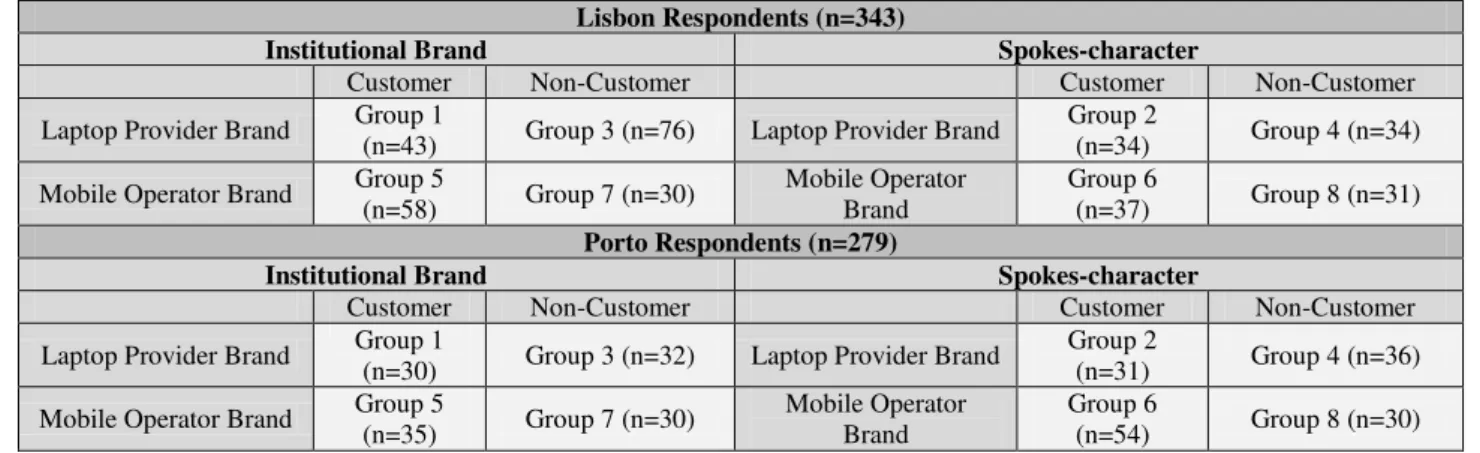
in the formulation of some questions were done as a result. Six hundred and twenty-two
undergraduate students (mean age = 19, range 17-26; 54% females) from two
Portuguese business schools in two different cities participated in this experiment11. The
study thus had a 2 (source of communication: spokes-character vs. institutional brand) x
2 (brand affiliation: customers vs. noncustomers) x 2 (brand category: mobile operators
vs. laptop providers) between-subjects design (see Table 3).
Table 3: Overview of the participants in Experiment 2 (n=622) Lisbon Respondents (n=343)
Institutional Brand Spokes-character
Customer Non-Customer Customer Non-Customer
Laptop Provider Brand Group 1
(n=43) Group 3 (n=76) Laptop Provider Brand
Group 2
(n=34) Group 4 (n=34)
Mobile Operator Brand Group 5
(n=58) Group 7 (n=30)
Mobile Operator Brand
Group 6
(n=37) Group 8 (n=31)
Porto Respondents (n=279)
Institutional Brand Spokes-character
Customer Non-Customer Customer Non-Customer
Laptop Provider Brand Group 1
(n=30) Group 3 (n=32) Laptop Provider Brand
Group 2
(n=31) Group 4 (n=36)
Mobile Operator Brand Group 5
(n=35) Group 7 (n=30)
Mobile Operator Brand
Group 6
(n=54) Group 8 (n=30)
Participants looked at one of four mock Facebook profiles (see Appendix I for
an example): some looked at either a mobile operator’s or a laptop provider’s profile
11
17
where the source of communication was the institutional brand, whereas others looked
at either a mobile operator’s or a laptop provider’s profile that used a spokes-character
as the source of communication. After this, they were asked to indicate their attitudes
toward the brand and whether they would recommend it to a friend. This was followed
by a series of questions regarding their engagement intention with the brand page and
their relationship with Facebook. At the end of the experiment, participants were asked
about their affiliation (i.e. whether they were customers of the brand).
Seeing as the stimuli for this experiment were mock Facebook profiles and in an
attempt to be as realistic as possible (the quantity of text in each post is usually small),
the researcher opted to test the difference in communication sources also through the
usage of visual elements rather than only text-based ones due to concerns that these
would not be sufficiently noticeable to participants. Therefore, the following elements
were manipulated: the cover and profile pictures (visual), the name of the profile, the
welcome message and some of the copy of the posts [e.g. “Do you usually work until
late?” (institutional) vs. “Do you usually work until late like us?” (spokes-character)]
(text). In order to be certain that respondents’ answers would be influenced by the usage
of the spokes-character as the source of communication and not by the introduction of
the spokes-character itself, the institutional communication versions of the profiles also
included pictures of the spokes-character. Taking into account the results of Experiment
1 as well as their performance in Portugal, the brands chosen for this experiment were
Vodafone (mobile phone operator) and Toshiba (laptop provider).
Dependent Variables
All dependent measures, with the exception of engagement intention, were item
scales drawn from prior measures in the literature. After participant exposure to the
mock profiles, attitude towards the brand was assessed with four semantic differential
18 “favourable/unfavourable,” and “like it/dislike it” with a coefficient α of .95 (Folse et
al., 2012). Recommendation intention was measured with one item: “I would
recommend this brand to a friend” (Folse et al., 2012). Engagement intention was
assessed with six items, based on the official Facebook engagement measures12: “I
would click on the content (images, videos, links) of this brand page on Facebook”, “I
would ´like´ one or more posts of this brand page on Facebook”, “I would comment on
one or more posts of this brand page on Facebook”, “I would mention this brand page
on Facebook on my profile”, “I would share one or more posts of this brand page on
Facebook” and “I would make one or more posts on this brand page on Facebook”
with a coefficient α of .88. Finally, Facebook usage was assessed with six items from
the Facebook Intensity Scale (Ellison et al, 2007): “Facebook is part of my everyday
activity”, “I am proud to tell people I’m on Facebook”, “Facebook has become part of
my daily routine”, “I feel out of touch when I haven’t logged onto Facebook for a
while”, “I feel I am part of the Facebook community” and “I would be sorry if
Facebook shut down”, with a coefficient α of 0.86. To measure brand affiliation,
participants were asked whether they were existing customers of the brand and, finally,
demographic information, such as age and gender, was requested to detect potentially
relevant population differences.
4.2RESULTS
After performing Shapiro-Wilk tests of normality (mostly p < 0.05 meaning the
results do not follow a normal distribution) and Levene’s tests of homogeneity of
variances (with several p < 0.05 meaning equality of variances cannot be assumed)13
and taking into account the results had different sample sizes, the researcher opted to
conduct both parametric (t-tests for independent samples) and non-parametric
12
Facebook Page Insights: http://ads.ak.facebook.com/ads/creative/insights/page-insights-guide.pdf
13
19
Whitney U) tests on the results. Three dependent variables were analysed: “brand
attitude”, “brand recommendation intention” and “brand page engagement intention”.
The results were first analysed separately for the two groups of respondents and
combined after verifying that virtually all groups were homogeneous14.
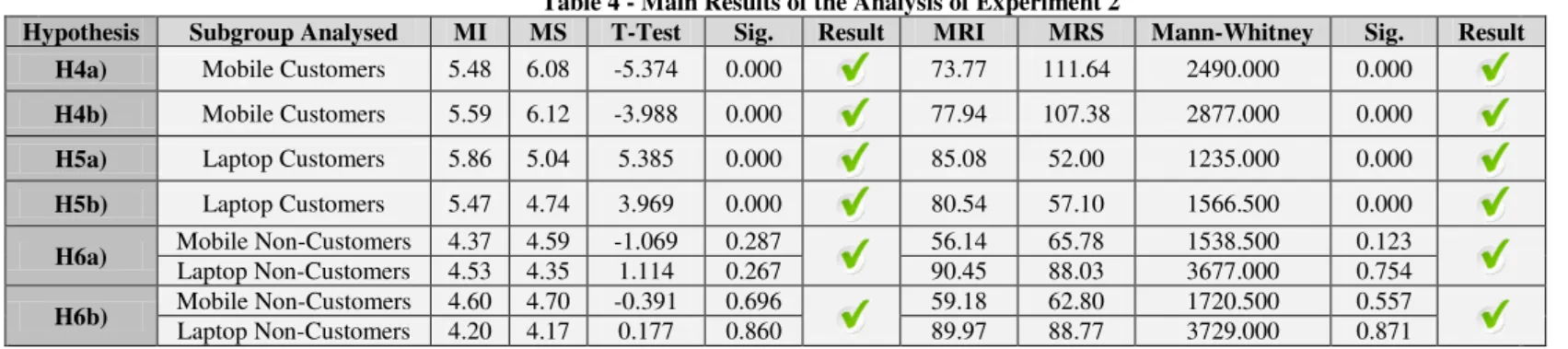
Starting with “brand attitude”, a t-test focusing on existing mobile customers
revealed significantly higher results in the presence of a spokes-character as the source
of communication than when the source was the institutional brand (t Mobile Customers(173)
= -5.374, p < 0.001). A Mann-Whitney test confirmed these results (U Mobile Customers =
2490, p < 0.001), supporting H4a).15 Looking at existing laptop customers revealed the
same results in the opposite direction, with higher brand attitude values being associated
with the institutional source of communication [(t Laptop Customers(114) = 5.385, p <
0.001); (U Laptop Customers = 312, p < 0.01)], supporting H5a).16
Finally, the results relating to non-customers of both mobile and laptop revealed
no significant differences in terms of brand attitude when either source of
communication was used [(t Mobile Non-Customers(119) = -1.069, NS); (U Mobile Non-Customers =
1538.5, NS)] and [(t Laptop Non-Customers(128) = 1.114, NS); (U Laptop Non-Customers = 3677,
NS)], supporting H6a)17. In examining the “brand recommendation intention” and
“brand page engagement intention” results, similar conclusions to those found for
attitudes were reached, thus supporting H4b), H5b) and H6b)18, with the exception that
the “brand page engagement intention” results for mobile clients for the Porto group
were non-significant ((t Porto Mobile Customers(87) = -1.10, NS); (U Porto Mobile Customers = 836,
NS))19, meaning that the use of the spokes-character did not have a significant positive
14 For more information please refer to Appendix 15 in Booklet 2. 15
For more information please refer to Appendix 16.1.1 in Booklet 2.
16
For more information please refer to Appendix 16.1.1 in Booklet 2.
17
For more information please refer to Appendix 16.1.1 in Booklet 2.
18
For more information please refer to Appendices 16.1.2 and 16.1.3 in Booklet 2.
19
20
effect as had happened with the other variables and in the NOVA SBE group. A series
of t-tests for independent samples and Mann-Whitney tests revealed no significant
differences associated with either gender or Facebook usage (all p > 0.05).20 Table 4
summarizes the hypothesis-related results.
4.3DISCUSSION
Experiment 2 examined whether the use of a spokes-character as the source of
communication on a brand profile in a social networking site influences people’s
attitudes towards and recommendation intention of two real-world brands. On the basis
of these results it was verified that, as predicted, the usage of a spokes-character had a
significant positive effect on customers´ attitudes and recommendation intention in the
mobile operator category, because they expect the brand to be a close relationship
partner, but a negative effect in the laptop provider category, because the brand is
expected to be a more distant relationship partner. Additionally, the effect among
noncustomers was attenuated in both domains.
Interestingly, these results were also mostly verified in terms of engagement
intention, meaning that mobile customers showed a significantly higher intention to
engage with the mock Facebook brand page (either through posting on it, mentioning it
in their profiles, clicking on its content or liking, commenting on and/or sharing its
posts) in the presence of the spokes character as the source of communication, with
20
For more information please refer to Appendices 17 and 18 in Booklet 2.
Table 4 - Main Results of the Analysis of Experiment 2
Hypothesis Subgroup Analysed MI MS T-Test Sig. Result MRI MRS Mann-Whitney Sig. Result
H4a) Mobile Customers 5.48 6.08 -5.374 0.000 73.77 111.64 2490.000 0.000
H4b) Mobile Customers 5.59 6.12 -3.988 0.000 77.94 107.38 2877.000 0.000
H5a) Laptop Customers 5.86 5.04 5.385 0.000 85.08 52.00 1235.000 0.000
H5b) Laptop Customers 5.47 4.74 3.969 0.000 80.54 57.10 1566.500 0.000
H6a) Mobile Non-Customers 4.37 4.59 -1.069 0.287 56.14 65.78 1538.500 0.123
Laptop Non-Customers 4.53 4.35 1.114 0.267 90.45 88.03 3677.000 0.754
H6b) Mobile Non-Customers 4.60 4.70 -0.391 0.696 59.18 62.80 1720.500 0.557
Laptop Non-Customers 4.20 4.17 0.177 0.860 89.97 88.77 3729.000 0.871
21
laptop customers exhibiting the opposite behaviour. The only exception to this was the
results for mobile clients from the Porto group, which might reflect Vodafone’s strong
brand presence having a moderating effect on the use of a spokes-character to
communicate. In fact, if we compare the results for clients of both brand categories in
both groups, the higher mean differences are associated with the laptop clients (MD
Lisbon Customers Laptop = 0.73 vs. MD Lisbon Customers Mobile = 0.56 and MD Porto Customers Laptop =
0.74 vs. MD Porto Customers Mobile = 0.29).
This study is perhaps a first step in getting a better understanding of the
importance of closeness expectations in brand-page communication in social
networking sites. Facebook users mostly interact with their real-life friends, with whom
they have higher closeness expectations and from whom they allow and expect more
playful communication. In the same way, and despite users’ apparent disinterest in
engaging with brands (which was also manifested in the answers given to items 1.3 and
1.4 of Part 4 of the questionnaire, with about 60% of respondents having answered they
only “like” 10 or less brands on Facebook and 43% stating they look for or visit brand
pages less than once every two weeks), they show higher intention to engage with
brands with whom they expect a closer relationship when their communication efforts
are congruent with these expectations, the same being valid for brands with whom they
expect a more distant relationship. This showcases the ever-growing need for companies
to devote more time to crafting their social media communications taking into account
customers’ relationship closeness expectations.
5. THEORETICAL CONTRIBUTIONS
The present research contributes to the literature on the impact of using specific
sources of communication in interpersonal cognition by suggesting that the source of
22
intention through implicit assessments of (in)congruity between the source of
communication and prior relationship expectations. This means that humanizing
communication in social networking sites through the usage of spokes-characters can
actually hurt the communicating brand when it is inconsistent with expectations.
Additionally, this research contributes to literature on the effects of using
spokes-characters in marketing communications by examining the impact of brand
affiliation (i.e., customer versus noncustomer) as a determinant factor of closeness
expectations. Brand customers, whose psychological involvement with their affiliated
brands is much higher than that of non-customers, generally tend to make a bigger effort
to process brand information, which resulted in the effects of the experiment among this
group being particularly pronounced.
Finally, this work contributes to the literature on consumers’ relationships with
brands in online contexts, namely social networking sites, and their reactions to brand
behaviours that are in(congruent) with previously established expectations. As people
sometimes truly think of brands as if they were other people (Fournier, 1998), they will
respond to differences in communication choices on the part of the brand. Moreover,
people’s previous relationship status with the brand (i.e. customers versus
noncustomers) can impact their reactions, resulting in different and sometimes even
opposite reactions to the same communications. Whereas most prior work in this area in
the online context used hypothetical brands (i.e. Aaker et al, 2004), this paper examines
the attitudes of actual customers toward two real-life brands with which they have
actual working relationships.
6. MANAGERIAL CONTRIBUTIONS
Given the importance of producing consumer-brand relationship theory research
23
relationships in the context of social networking sites (SNSs) is a highly relevant
attempt to add impact to previous research and make it more concrete. The main finding
that the choice of source of communication of a brand page in a social networking site
can impact consumers’ attitudes as well as recommendation and engagement intentions
underlines the fact that, when developing a social media marketing strategy, marketers
need not only consider their consumers as relationship partners in general but should
also take into account how the product category of their brands affects how different
types of consumers relate to them. Depending on consumers’ relationship expectations,
the same communications can be evaluated differently, as brands in different categories
are considered to be different relationship partners and thus expected to behave
differently from each other. Given the relative ease in creating and managing different
social networking site profiles for the same brand it may make sense, for example, for
brands which encompass several product categories for which consumers have opposing
closeness expectations to have distinct brand pages with different sources of
communication.
7. DIRECTIONS FOR FUTURE RESEARCH
While this research has focused on the effects of relationship closeness
expectations in the context of brand pages in social networking sites, future research
might focus on other relationship-related dimensions. Brand pages where a specific
dimension of brand personality is emphasized through the visuals and copy associated
to the source of communication, for example, might elicit different reactions from
consumers, namely if the dimension emphasized is in(congruent) with the brand’s real
personality. Other markers of closeness such as colloquial versus formal copy style
might also be explored. Finally, considering that only real-world brands were used and
24
students from two Portuguese business schools, researchers might repeat the
experiments with sets of respondents that are more representative of the general
population and using fictitious brands.
8. REFERENCES
Aaker, David A. 1993. “Are Brand Equity Investments Really Worthwhile?” In Brand Equity and
Advertising: Advertising’s Role in Building Strong Brands, ed. David A. Aaker, Alexander L. Biel,
pp. 333-341. Hillsdale, NJ: Lawrence Erlbaum Associates.
Aaker, Jennifer L. 1997. “Dimensions of Brand Personality.” Journal of Marketing Research, 34(3): 347-356.
Aaker, Jennifer and Fournier, Susan. 1995. “A Brand as a Character, a Partner and a Person: Three Perspectives on the Question of Brand Personality.”Advances in Consumer Research, 22(1): 391-395.
Aaker, Jennifer, Fournier, Susan and Brasel, Adam.2004. “When Good Brands Do Bad.” Journal of Consumer Research, 31(1): 1-16.
Azoulay, Audrey and Kapferer, Jean-Noël. 2003. “Do Brands Personality Scales Really Measure Brand Personality?”Journal of Brand Management, 11(2): 143-155.
Batra, Rajeev, Lehmann, Donald R. and Singh, Dipinder. 1993. “The brand personality component of brand goodwill: some antecedents and consequences.” In Brand Equity and
Advertising, ed. David A. Aaker and Alexander L. Biel, pp.83-97. Hillsdale, NJ: Lawrence Erlbaum
Associates.
Bengtsson, Anders. 2003. "Towards A Critique of Brand Relationships". Advances in Consumer
Research, 30: 154-158.
Biel, Alexander L. 1992. “How brand image drives brand equity.”Journal of Advertising Research, 32(6): 6-12.
Biel, Alexander L. 1993. “Converting Image into Equity.” In Brand Equity and Advertising:
Advertising’s Role in Building Strong Brands, ed. David A. Aaker and Alexander L. Biel, pp. 67-82.
Hillsdale, NJ: Lawrence Erlbaum Associates.
Boyd, Danah M. and Ellison, Nicole B. 2008. “Social Network Sites: Definition, History, and Scholarship.” Journal of Computer-mediated Communication, 13(1): 210–30.
Callcott, Margaret F. and Lee, Wei-Na. 1994. "A Content Analysis of Animation and Animated Spokes-Characters in Television Commercials." Journal of Advertising, 23(4): 1-12.
Callcott, Margaret F. and Lee, Wei-Na. 1995. "Establishing the Spokes-Character in Academic Inquiry: Historical Overview and Framework For Definition", in Advances in Consumer Research, 22(1): 144-151.
Callcott, Margaret F., Phillips, Barbara J. 1996. “Observations: elves make good cookies.”
Journal of Advertising Research, 36(5): 73-78.
Clarke, Barbie H. 2009. "Early Adolescents' Use of Social Networking Sites to Maintain Friendship and Explore Identity: Implications for Policy." Policy & Internet, 1(1): 55-89.
Crask, Melvin R. and Laskey, Henry A. 1990. "A Positioning-Based Decision Model for Selecting Advertising Messages," Journal of Advertising Research, 30(4): 32-38.
Durgee, Jeffrey F. 1988. “Understanding brand personality”, Journal of Consumer Marketing, 5(3): 21-25.
Ellison, Nicole B., Steinfield, Charles and Lampe, Cliff. 2007. “The benefits of Facebook 'friends': Exploring the relationship between college students' use of online social networks and social capital.”Journal of Computer-Mediated Communication, 12(3): 1143-1168.
Ellison, Nicole B., Steinfield, Charles and Lampe, Cliff. 2011. “Connection strategies: Social capital implications of Facebook-enabled communication practices”. New Media & Society, 13(6): 873-892.
Fitchett, James A. and McDonagh, Pierre. 2000. "A citizen’s critique of relationship marketing in risk society." Journal of Strategic Marketing, 8(2): 209-222.
25
Fournier, Susan. 1994. "A Consumer-Brand Relationship Framework for Strategic Brand Management."Doctoral Dissertation, University of Florida.
Fournier, Susan. 1998. “Consumers and their Brands: Developing Relationship Theory in Consumer Research.” Journal of Consumer Research, 24(4): 343-373.
Fournier, Susan. 2009. “Lessons Learned about Consumers’ Relationships with their Brands.” In
Handbook of Brand Relationships, ed. Joseph R. Priester, Deborah J. MacInnis, and C.Whan Park, pp.
5-23. N.Y: Society for Consumer Psychology and M.E. Sharp.
Fournier, Susan and Avery, Jill. 2011. "The Uninvited Brand." Business Horizons, 54(3): 193-207.
Fournier, Susan, Solomon, Michael and Englis, Basil. 2008. “When Brands Resonate.” InHandbook
on Brand and Experience Management, ed. Schmitt, B.H. and D.L. Rogers pp. 35-57. Cheltenham,
UK and Northampton, MA, USA: Edward Elgar.
Fournier, Susan, Avery, Jill, and Wojnicki, Andrea. 2004. “Contracting for Relationships.” Presentation at Association for Consumer Research Conference, Portland: Oregon.
Garbarino, Ellen and Johnson, Mark S. 1999. “The Different Roles of Satisfaction, Trust, and Commitment in Customer Relationships.”Journal of Marketing, 63(2): 70-87.
Garretson, Judith A. and Niedrich, Ronald W. 2004. "Creating Character Trust and Positive Brand Attitudes." Journal of Advertising, 33(2): 25-36.
Garretson, Judith A. and Burton, Scot. 2005. "The Role of Spokes-Characters as Advertisement and Package Cues in Integrated Marketing Communications." Journal of Marketing, 69(4): 118-132.
Gosling, Samuel D., Rentfrow, Peter J., & Swann, William B., Jr. 2003. “A Very Brief Measure of the Big Five Personality Domains.”Journal of Research in Personality, 37(6): 504-528.
Haythornthwaite, Caroline. 2005. “Social networks and Internet connectivity effects.” Information, Communication, & Society, 8(2):125-147.
Holzwarth, Martin, Janiszewski, Chris and Neumann, Marcus M. 2006. “The influence of
avatars on online consumer shopping behavior.”Journal of Marketing, 70(4): 19-36.
Hoy, Mariea G., Young, Clifford E., and Mowen, John C. 1986. "Animated Host-Selling Advertisements: Their Impact on Young Children's Recognition, Attitudes, and Behavior." Journal
of Public Policy and Marketing, 5(1): 171-184.
Jin, Seung-A A. and Sung, Yongjun. 2010. “The roles of spokes-avatars’ personalities on brand communication in 3D virtual environments.”Journal of Brand Management, 17(5): 317-327.
Kaplan, Andreas M. and Haenlein, Michael. 2010. "Users of the world, unite! The challenges and opportunities of social media." Business Horizons, 53(1): 59-68.
Kardes, Frank R., Cronley, Maria L. and Cline, Thomas W. 2010. Consumer Behavior: Science
and Practice. South-Western: Cengage Learning.
Keller, Kevin L., Aperia, Tony and Georgson, Mats. 2011. Strategic Brand Management: A
European Perspective (2nd ed.). Financial Times/Prentice Hall.
Lampe, Cliff, Ellison, Nicole B. and Steinfield, Charles. 2006. “A Face(book) in the Crowd: Social Searching vs. Social Browsing.” In Proceedings of the 2006 20th Anniversary Conference on Computer-Supported Cooperative Work (CSCW 2006), pp 167-170. New York, NE: ACM Press.
Landon, E. Laird Jr. 1974. “Self Concept, Ideal Self Concept, and Consumer Purchase Intentions.”
Journal of Consumer Research, 1(2): 44-51.
Levy, Sidney J. 1959. “Symbols for Sales.”Harvard Business Review, 37(4): 117-124.
Levy, Sidney J. 1985. “Dreams, Fairy Tales, Animals and Cars.” Psychology & Marketing, 2(2): 67-81.
Livingstone, Sonia, Ólafsson, Kjartan and Staksrud, Elisabeth. 2011. “Social networking, age and privacy.” London, EU Kids Online, London School of Economics.
Mayer, Adalbert and Puller, Steven 2008. “The old boy (and girl) network: Social network formation on university campuses.”Journal of Public Economics, 92(1-2): 329-347.
McCracken, Grant. 1986. “Culture and Consumption: A Theoretical Account of the Structure: A Theoretical Account of the Structure and Movement of the Cultural Meaning of Consumer Goods.”
Journal of Consumer Research, 13(1): 71-74.
McCracken, Grant. 1989. “Who Is the Celebrity Endorser? Cultural Foundations of the Endorsement Process.” Journal of Consumer Research, 16(3): 310-323.
Neeley, Sabrina and Schumann, David. 2004. “Using animated spokes—characters in advertising to children.” Journal of Advertising, 33(3):7-25.
26
Phillips, Barbara J. 1996. "Defining Trade Characters and Their Role in American Popular Culture." Journal of Popular Culture, 29(4): 143-158.
Phillips, Barbara J. and Lee, Wei-Na. 2005. “Interactive animation: exploring spokescharacters on the Internet.”Journal of Current Issues & Research in Advertising, 27(1): 1-17.
Phillips, Barbara J. and Gyoerick, Barbara. 1999. “The cow, the cook, and the quaker: Fifty years of spokes-character advertising.” Journalism & Mass Communication Quarterly, 76(4): 713-728.
Pierce, Kate. 2001. “What if the Energizer Bunny were female? Importance of gender in perceptions of advertising spokes-character effectiveness.”Sex Roles, 45(11/12): 845-858.
Podsakoff, Philip M.; MacKenzie, Scott B.; Lee, Jeong-Yeon and Podsakoff, Nathan P. 2003. “Common method biases in behavioral research: A critical review of the literature and recommended remedies.”Journal of Applied Psychology, 88: 879-903.
Rheingold, Howard. 1993. The Virtual Community: Homesteading on the Electronic Frontier. Reading, Massachusetts: Addison-Wesley.
Ross, Craig; Orr, Emily S.; Sisic, Mia; Arseneault, Jaime M.; Simmering, Mary G. and Orr, Robert R. 2009. “Personality and motivations associated with Facebook use.” Computers in Human Behavior, 25(2): 578-586.
Sela, Aner; Wheeler, Christian and Sarial-Abi, Glen. 2012. “We Are Not the Same as You and I: Causal Effects of Minor Language Variations on Consumers’ Attitudes toward Brands.”Journal of
Consumer Research, 39(3): 644-661.
Sirgy, Joseph. 1982. “Self-concept in consumer behavior: a critical review.”Journal of Consumer Research, 9: 287-300.
Smothers, Norman. 1993. “Can products and brands have charisma?” In Brand Equity and Advertising, advertising's role in building strong brands, ed. David A. Aaker and Alexander Biel, pp. 97-111. Hillsdale, NJ: Lawrence Erlbaum Associates.
Subrahmanyam, Kaveri; Reich, Stephanie M.; Waechter, Natalia and Espinoza, Guadalupe.
2008. “Online and offline social networks: Use of social networking sites by emerging adults.”
Journal of Applied Developmental Psychology, 29(6): 420-433.
Sung, Yongjun and Kim, Jooyoung. 2010. "Effects of Brand Personality on Brand Trust and Brand Affect." Psychology and Marketing, 27(7): 639-661.
Trusov, Michael; Bucklin, Randolph E. and Pauwels, Koen. 2009. “Effects of Word-of-Mouth Versus Traditional Marketing: Findings from an Internet Social Networking Site.” Journal of
Marketing, 73(5): 90-102.
Van Auken, Stuart and Lonial, Subhash C. 1985. "Children's Perceptions of Characters: Human Versus Animate; Assessing Implications for Children's Advertising." Journal of Advertising, 14(2): 13-22.
Walther, Joseph B. and Parks, Malcolm R. 2002. “Cues filtered out, cues filtered in: Computer-mediated communication and relationships.” In Handbook of interpersonal communication (3rd ed.), ed. M. L. Knapp & J. A. Daly, pp. 529-563. Thousand Oaks, CA: Sage.
Wilson, Robert E., Gosling, Samuel D., & Graham, Lindsay T. 2012. “A review of Facebook research in the social sciences.”Perspectives on Psychological Science, 7(3): 203-220.
27
Appendix I - Mock Facebook Profile representing mobile operator (Vodafone) and