Informed Consent as Viewed by Patients Participating in Cardiology
Drug Trial
Silmara Meneguin
1, Elma L. C. P. Zoboli
2, Raquel Z. L. Domingues
1, Moacyr R. Nobre
1, Luiz A. M. César
1InCor-Instituto do Coração do Hospital das Clínicas da Faculdade de Medicina da USP1; Escola de Enfermagem da USP2, São Paulo, SP - Brazil
Abstract
Background: In clinical tests, the Informed Consent is critical to preserve the ethics, but due to its high complexity level, it cannot be fully understood. This study assesses the Informed Consent as viewed by patients.
Objective: We addressed the issue of what do patients understand about the studies based on the IC.
Methods: We invited participants of outpatient clinical drug trials phase II, III and IV to answer a questionnaire with 9 questions, such as: why have you accepted to participate? Did you read the Informed Consent before signing it? By signing it, were you sure you have fully understood it? Eighty individuals (0 women and 60 men) showed up, from 06 patients. The variables of each question were considered as often as they appeared. The comparison of the averages among the groups was made by t tests of Student or Wilcoxon; and for associations, Chi-square or Likelihood Ratio, or Fisher’s exact test..
Results: Ages averaged 58.7 ± 9. years. Concerning their reasons to taking part in the survey, 66.% pointed out their own benefit; 4.5%, for science’s sake; 5.0% claimed they were doing so at their doctor’s request; 50% did not understand the Informed Consent properly; and .9% did not read it, but signed it. Among those who were administered placebo after randomization (n = 47), 66.7% did not understand the meaning of the informed consent. A strong correlation between failure to understand the meaning of placebo with literacy level (p = 0,0) was verified, which is an evidence that the smaller is the literacy level, the smaller is the understanding level.
Conclusion: The Informed Consent is poorly understood by patients and for some of them, trusting a doctor affected their decision in taking part in the clinical trial with drugs. Their literacy level also influenced their understanding of the term “placebo”. (Arq Bras Cardiol 00; 94() : 4-9)
Key words: Randomized controlled trials as topic; informed consent; comprehension; ethic.
Mailing address: Luiz Antônio Machado César •
Rua Constantino de Souza, 1580 - Campo Belo - 04605-004 - São Paulo, SP – Brazil
E-mail: [email protected], [email protected]
Manuscript received January 27, 2009; revised manuscript received May 25, 2009; accepted June 23, 2009.
Introduction
Trials with human beings are still critical, mainly in cardiology, as new drugs are usually for continued use. In Brazil, there was an increase in the number of sponsored trials, after the Brazilian Health Council authorized trials with human beings (CNS/MS 196/96)1. Then, the Informed Consent was
introduced. The Informed Consent is a document that contains information on the study and the responsibilities involved. The Informed Consent is often taken for granted. Sometimes it is even viewed as a disclaimer2. Investigators may also be
faced with a conflicting double role (doctor/researcher)3,4,
besides the power he has on the patient, taking into account the asymmetrical relationship among them5,6.
One of the challenges posed in the 21st century is not
allowing the power of technology to gain importance over the respect to people dignity, mainly in developing countries7.
Cardiology presents an expressive number of studies in this area, which explains why we seek to assess, in these first 10, 12 years after the establishment of Ethics Committees in Brazilian hospitals, how the individuals participating in scientific trials view a study, starting with the Informed Consent, and which explanation given by those who develop the trial. We conducted this study by means of cross-sectional descriptive exploratory research, with qualitative and quantitative approach.
Methods
should have been randomized in the trial.
Data collection instrument
The data were collected from interviews and reference to patients’ files. As there is no specific form to assess the interpretation of an Informed Consent, we drew on questions that could assess the understanding of the content and meaning of words. The questionnaire contained 29 items, including general information data and specific multiple-choice questions and open-ended questions. Besides the general characteristics of individuals, we assessed their literacy level considering the following levels:
1) elementary/middle education; 2) high school; or
3) higher education, considering complete or incomplete studies. As to the specific understanding matter, both in the trial itself and in the use of placebo, the individuals were submitted to an objective questionnaire which included the following questions and options:
I) Who invited you to take part in this trial? Options: 1 - researcher; 2 - another patient; 3 - nurse; 4 - secretary; 5 - others;
II) Was the inviter a contributing factor for you to take part in the trial? Options: Yes or No;
III) How were you contacted to come to the hospital to take part in the trial? Options: 1 – by telephone; 2 – in person; 3 - others;
IV) Were you told that you would take part in a trial? Options: Yes or No;
V) Why did you accept to take part in the trial? Options: 1 – for science’s sake; 2 – for my own benefit; 3 – because my doctor asked me to; 4 – because my doctor told me it would be good to me; 5 – because I feared not being assisted or losing my turn; 6 – because this is a public hospital; 7 - other.
The following were yes or no questions: VI) Were you informed about how important is the trial? VII) Of the potential risks and distresses that could arise due to the trial? VIII) Of treatments other than those included in the trial? Then, the questions were specifically directed to the Informed Consent: IX) When you decided to take part in the trial, did you sign any documents? X) Have you read the document before signing it? XI) Did you discuss the Informed Consent with the researcher? XII) Upon signing the Informed Consent, were you sure you have understood what the Informed Consent explained? They also answered to the following: XIII) If you were not sure of having understood it, what did you do? Options: 1 – you signed it even though you had not understood it; 2 – you asked explanation from the researcher ; 3 - other.
Then, the following yes or no questions were asked: XIV) Were you provided with a copy of the document? XV) Did you understand what “placebo” meant?
Then, an open ended question was made: XVI) What did you understand (or not)?
Then, the following yes or no questions were asked: XVII) Did you know you could take a pill with no effect for some months? (this question applied only to those patients
administered placebo as a treatment); XVIII) Was it important for you to have taken part in a trial? Why? (free answer).
Statistical analysis
The quantitative variables were analyzed in terms of averages and standard deviations. The classifying variables were presented in tables containing absolute (n) and relative (%) frequencies.
In order to check whether there was association among some issues, the potential associations of these variables were analyzed through Student’s t test, Chi-square or Likelihood Ratio, or Fisher’s exact test, as applicable8. The statistical
analysis was conducted with the support of the software SPSS version 15.0 (SPSS Inc., EUA). The values p < 0,05 were considered statistically significant for the analysis. As for the analysis of descriptive data obtained through direct contact of researchers with patients by means of open-ended questions, we used the content analysis proposed by Bardin9.
Focal group
In order to complement the data obtained through the qualitative and quantitative survey, especially to confirm patients’ understanding of the term “placebo”, we decided to build a focal group, once it is widely used technique intended to obtain data from previously planned discussions, where participants express their experiences, values, beliefs, attitudes and social representations on specific questions10.
This technique is particularly appropriate when the interviewer has a number of open-ended and multiple-choice questions and wishes to encourage participants to explore a subject of extreme importance for them, in their own words and following their own priorities11. We also sought to get answers
that could easily explore and clarify opinions and viewpoints by speaking their language, considering their perceptions on the subject, as compared to others’ views12.
Results
Data related to the Informed Consent
Specifically concerning the Informed Consent (Table 3), 25.0% of individuals declare they have not received any type of information on the importance of the trial to which they were invited to take part, and almost half (42.5%) was neither informed of the risks nor the distresses involved. Worth of note is that the guarantee of confidentiality, which is critical during a trial, was not known by almost half of individuals (47.5%). On the other hand, only 67.1% have read the Informed Consent before signing it, and 52 individuals (65.0%) did not discussed it with the researcher. When asked about their understanding of the information contained in the Informed Consent, 50.0% of individuals did not understand the content or the information explained by the researcher. More importantly: even though they did not understand the information contained in the Informed Consent, 39 individuals (97.5%) signed it.
The meaning of “placebo”
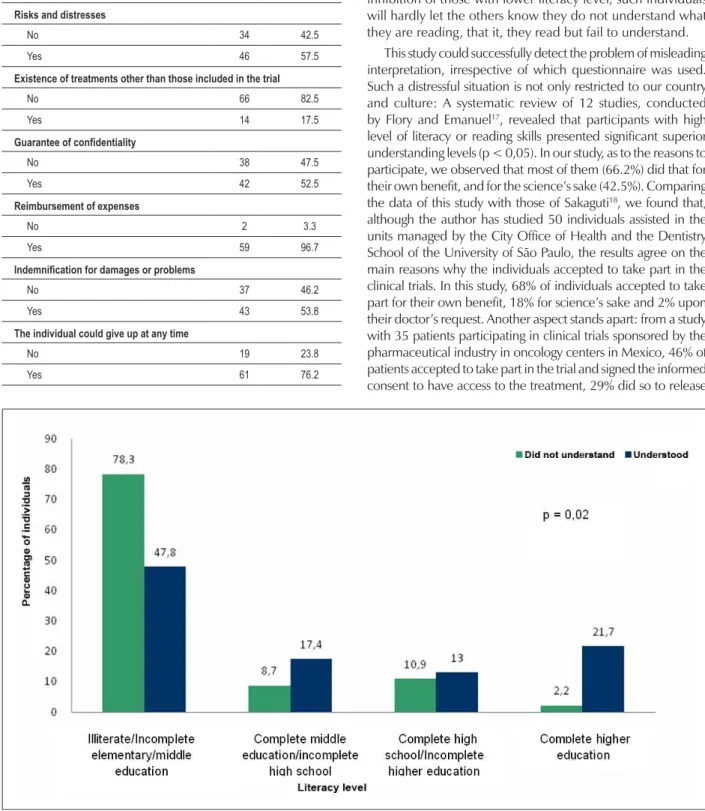
When the 69 individuals were asked about what they understood from “placebo”, 46 interviewees (66.7%) declared they have not learned about it. When asked about what they understood from it, 47.8% confirmed they did not know what “placebo” means and 18.8% have misleading beliefs as to its meaning. Therewith, we observe that only 20.3% of interviewees understood its meaning. We also observed that 13.0% of participants did not remembered the information they read when the interview was applied. As to the associations among the characteristics of individuals and Table 1 – Social and demographic characteristics of individuals
Characteristics n %
Gender
F 20 25,0
M 60 75,0
Literacy level
Illiterate/incomplete elementary/middle education 51 63,8
Complete middle school/Incomplete high school 9 11,2
Complete high school and incomplete higher education 12 15,0
Complete higher education 8 10,0
Marital status
With partner 64 80,0
Without partner 16 20,0
Professional activity
No 42 52,5
Yes 38 47,5
Working status
On leave 1 1,2
Retired 30 37,5
Homemaker 11 13,8
Working 38 47,5
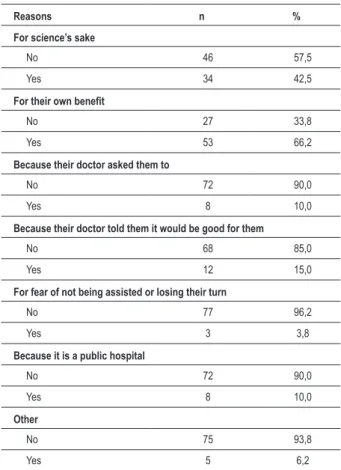
Table 2 – Spontaneous answers about reasons to take part in the trial
Reasons n %
For science’s sake
No 46 57,5
Yes 34 42,5
For their own beneit
No 27 33,8
Yes 53 66,2
Because their doctor asked them to
No 72 90,0
Yes 8 10,0
Because their doctor told them it would be good for them
No 68 85,0
Yes 12 15,0
For fear of not being assisted or losing their turn
No 77 96,2
Yes 3 3,8
Because it is a public hospital
No 72 90,0
Yes 8 10,0
Other
No 75 93,8
Yes 5 6,2
their answers on the term “placebo”, Chart 1 shows that the literacy level was not necessarily a contributing factor to the patients’ understanding (p = 0.02).
Discussion
There are several aspects related to the individuals’ perception while taking part in a clinical trial. This study confirms and brings forward key concepts to implement Informed Consent application strategies to those patients with lower literacy levels, especially the ones coming from public institutions. As to the educational level, most interviewees were illiterate or had dropped out elementary/middle school (63.8%). Souza13 observed similar results, in data collected
from 793 patients invited to take part in clinical trial protocols conducted in public and private institutions. In this study (53% males, averaged 58.2 years of age), the prevailing literacy level among the 444 individuals (96%) from public institutions was similar to our sample. Therefore, this is a sign of the high educational debt in Brazil, where 47% of Brazilians, aged between 14 and 64, did not complete grade 8 of middle school14. Among the ones who completed it, only 11% are
considered fully literate15. That impacts in the clinical trial,
once many patients may not be able to read and understand the Informed Consents16. According to Resolution 196/961,
Chart 1 – Understanding of the term “placebo”, in the informed consent, and association to the literacy level in 69 individuals.
Table 3 – Frequency of explanations provided by researchers on the information contained in the Informed Consent, as answered by the individuals.
Explanations given n %
Importance of the trial
No 20 25.0
Yes 60 75.0
Risks and distresses
No 34 42.5
Yes 46 57.5
Existence of treatments other than those included in the trial
No 66 82.5
Yes 14 17.5
Guarantee of conidentiality
No 38 47.5
Yes 42 52.5
Reimbursement of expenses
No 2 3.3
Yes 59 96.7
Indemniication for damages or problems
No 37 46.2
Yes 43 53.8
The individual could give up at any time
No 19 23.8
Yes 61 76.2
explaining verbally and interacting, by means of dialogues, with the doctor delivering the Informed Consent. That applies mainly to outpatient studies, once there is sufficient time for researchers to dedicate to this application. In a study on acute myocardial infarction requiring immediate treatment, for instance, something different occurs: in this circumstance, more often than not, information are verbal and not read, at least by the patient. Because of that, and to the natural inhibition of those with lower literacy level, such individuals will hardly let the others know they do not understand what they are reading, that it, they read but fail to understand.
This study could successfully detect the problem of misleading interpretation, irrespective of which questionnaire was used. Such a distressful situation is not only restricted to our country and culture: A systematic review of 12 studies, conducted by Flory and Emanuel17, revealed that participants with high
level of literacy or reading skills presented significant superior understanding levels (p < 0,05). In our study, as to the reasons to participate, we observed that most of them (66.2%) did that for their own benefit, and for the science’s sake (42.5%). Comparing the data of this study with those of Sakaguti18, we found that,
the doctors and the hospital from any accountabilities none of them thought the informed consent would serve to protect them as patients19. Also in our study, 25% of individuals accepted the
invitation to take part in the trial upon their doctor’s request or recommendation. The words of a doctor may change the course of life or exercise great influence on a patient’s20 decision, not to
mention the permanent possibility of conflicts of interest in trials sponsored by the pharmaceutical industry21,22.
Data related to the Informed Consent
There is a huge variation in patients’ understanding of the Informed Consent, which may also be due to the various information provided by investigators. In our study, 25% of individuals declare they have not received any type of information on the importance of the trial, and almost half (42.5%) was neither informed of the risks nor the distresses involved. The same is true as to other existing treatments – 66 individuals (82.5%) did not receive such information. These individuals may have had difficulties in recalling this information, due to the interval between the trial and the interview. Then, an effective communication between the doctor and the patient is extremely important to deliver effective information upon assigning an Informed Consent. Thus, we may infer that the way through which the doctor communicates with patient influences their judgment on the risks, benefits and barriers to take part in the study23.
Professionals often consider the informed consent a statutory requirement, but not a means to afford autonomy to the individuals24. The complex information found in
the Informed Consent, as well as the technical terms and the excessive number of pages, are contributing factors to prevent it from being properly understood25,26. Although our
study has not analyzed the terms used in the performance of clinical trials, literature is unanimous in recognizing the “literary abilities” of individuals as a determining factor in the understanding process. Participants with insufficient “literary abilities” understand a minimum quantity of information contained in the Informed Consent27.
Insights on the term “placebo”
As to the meaning of “placebo”, the specific question was asked to 69 (87%) individuals—from 80—whose trials included the word “placebo” in the Informed Consent. When asked about they have understood or not from the meaning of placebo, almost half of them confirm they did not understand the meaning of this word (47.8%) or hold misleading beliefs as to its meaning (18.8%). Therewith, we observe that only 20.3% of interviewees understood its meaning. Moodley et al28
interviewed 334 individuals from 4 to 12 months after a study conducted in South Africa to test the vaccine for influenza. Data reveal that, although 91% declare to have understood
the explanation about study, 81% did not understand the meaning of the word placebo.
Final insights and constraints
The Informed Consent is still poorly understood and for individuals, trusting their doctor is critical to their decision to take part in a clinical trial with drugs. We could also verify the influence of the literacy level of individuals in understanding the term “placebo”, strongly suggesting that some words and expressions presented in the Informed Consent are still very complex and fail to fulfill the need they are supposed to. A wide range of strategies may be used to improve participants’ understanding, but these are not being tested yet. In the systematic review conducted by Flory and Emanuel17, who
addressed the interventions used to improve participants’ understanding of the informed consent, some methods seem to be more effective than the others in this process.
We a in recent process of application of a structured Informed Consent. The assessment made in this study focused on sponsored trials, in which informed consents are usually more structured than those of independent trials. On the other hand, a huge number of pieces of information prevent the participants from properly understanding the trial. Such difficulties of understanding, however, are not only found in Brazil. Rather, they are found in many other countries. Lastly, the sample of 80 patients may be considered small to get accurate information on this subject. It is also true that the questionnaire applied, which is not a specific one, may pose constraints to the study. Nevertheless, specific questions on and Informed Consent understanding were direct and objective. Despite these constraints, this information has never been introduced before, and we conducted a quantitative analysis with this material. The confirmation of interpretation data by the individuals taking part in the survey, through other interviewing techniques, will certainly bring greater contribution to corroborate these results, which is included in a future analysis for this study.
Potential Conflict of Interest
No potential conflict of interest relevant to this article was reported.
Sources of Funding
There were no external funding sources for this study.
Study Association
References
1. Ministério da Saúde. Conselho Nacional de Saúde. Resolução Nº 196, de 10 de Outubro de 1996. [Acesso em 2008 set 22]. Disponível em: http:// conselho.saude.gov.br/docs/resoluçoes/reso196.doc.
2. Hossne WS. Poder e injustiça na pesquisa com seres humanos. In: Garrafa V, Pessini L. (orgs.). Bioética: poder e injustiça. São Paulo: Loyola; 2003. p. 271-86.
3. Edwards SJF, Lilford RJ, Thornton J, Hewison J. Informed consent for clinical trials: in search of the best method. Soc Sci Med. 1998; 47 (11): 1825-40.
4. Sugarman J, McCrory DC, Hubal RC. Getting meaningful informed consent from older adults: a structured literature review of empirical research. J Am Geriatr Soc. 1998; 46 (4): 517-24.
5. Sánches S, Salazar G, Tijero M, Días S. Informed consent procedures: responsabilities of researchers in developing countries. Bioethics. 2001; 15 (5/6): 398-412.
6. Angell M. The ethics of clinical research in the third world. N Engl J Med. 1997; 337 (12): 847-8.
7. Azevedo ES. Ética na pesquisa em genética humana em países em desenvolvimento. In: Garrafa V, Pessini L. (orgs.). Bioética: poder e injustiça. São Paulo: Loyola; 2003. p. 323-30.
8. Rosner B. Fundamentals of biostatistics. 4th ed. New York: Duxbury Press; 1994. p. 682.
9. Bardin L. Análise de conteúdo. Lisboa: Edições 70; 1977.
10. Westphal MF, Bógus CM, Faria MM. Grupos focais: experiências precursoras em programas educativos em saúde no Brasil. Bol Oficina Sanit Panam. 1996; 120 (6): 472-82.
11. Kitzinger J. Qualitative research. BMJ. 1995; 311: 299-302.
12. Patton MQ. Qualitative research and evaluation methods. 3rd ed. California: Sage Publications; 2002. p. 385-90.
13. Souza MK. Termo de consentimento livre e esclarecido (TCLE): fatores que interferem na sua adesão [dissertação]. São Paulo: Faculdade de Medicina, Universidade de São Paulo; 2005.
14. Instituto Paulo Montenegro. 5º Indicador Nacional de Alfabetismo Funcional: um diagnóstico para a inclusão social pela educação [avaliação de leitura e escrita]. 2005 [Acesso em 2008 jan 10]. Disponível em: http://www. acaoeducativa.org.br/downloads/inaf05.pdf.
15. Instituto Paulo Montenegro. Indicador Nacional de Alfabetismo Funcional. Boletim INAF, 2007 [Acesso em 2008 jun 13] Disponível em: http://www. ipm.org.br/download/bol_inaf_2007_03.pdf.
16. Willians MV, Parker RM, Baker DW, Parikh NS, Pitkin K, Coates WC, et al. Inadequate functional health literacy among participants at two public hospital. JAMA. 1995; 274: 1677-82.
17. Flory J, Emanuel E. Interventions to improve research participants’ unders-tanding in informed consent for research: a systematic review. JAMA. 2004; 292: 1593-601.
18. Sakaguti NM. O conhecimento de usuários de serviços públicos de saúde envolvidos em pesquisas clínicas, sobre seus direitos [dissertação]. São Paulo: Faculdade de Odontologia, Universidade de São Paulo; 2005.
19. Verástegui EL. Consenting of the vulnerable: the informed consent procedure in advanced cancer patients in Mexico. BMC Med Ethics. 2006; 7: E13.
20. Osuch JR. The power of the doctor, the vulnerability of the patient, and informed consent. Surg Neurol. 2004; 61: 494-6.
21. Horton R. The clinical trial: deceitful, disputable, unbelievable, unhelpful, and shameful – what next. Control Clin Trials. 2001; 22 (6): 593-604.
22. Alves EMO, Tubino P. Conflito de interesses em pesquisa clínica. Acta Cir Bras. 2007; 22: 412-5.
23. Albrecht TL, Blanchard C, Ruckdeschel JC, Coovert M, Strongbow R. Strategic physician communication and oncology clinical trials. J Clin Oncol. 1999; 17: 3324-32.
24. Lidz CW, Meisel A, Osterweis M, Holden JL, Marx JH. Munetz MR. Barries to informed consent. Ann Intern Med. 1993; 99: 539-43.
25. Andrus MR, Roth MT. Health literacy: a review. Pharmacoterapy. 2002; 22: 282-302.
26. Fitzmaurice DA, Adams JL. A systematic review of patient information leaflets for hypertension. J Hum Hypertens. 2000; 14: 259-62.
27. Davis TC, Holcombe RF, Berkel HJ, Pramanik S, Divers SG. Informed consent for clinical trials: a comparative study of standard versus simplified forms. J Natl Cancer Inst. 1998; 90: 668-74.