Gas exchange and yield response to foliar phosphorus application
in
Phaseolus vulgaris
L. under drought
Mauro Guida dos Santos1*, Rafael Vasconcelos Ribeiro1, Ricardo Ferraz de Oliveira1 and Carlos Pimentel2
1 Laboratório de Fisiologia de Plantas sob Estresse, Departamento de Ciências Biológicas, Escola Superior de Agricultura “Luiz de
Queiroz”, Universidade de São Paulo, CP 09, CEP 13418-900, Piracicaba, SP, Brasil; 2 Departamento de Fitotecnia, Instituto de Agronomia,
Universidade Federal Rural do Rio de Janeiro, CEP 23851-970, Itaguaí, RJ, Brasil; *Corresponding author:[email protected] Received: 17/09/2004, Accepted: 25/11/2004
Abstract - This study was conducted to evaluate the effect of foliar Pi application on gas exchange and yield of bean genotypes submitted to a mild water deficit at the pre-flowering stage. In the first experiment, when extra Pi (10 g.L-1) was sprayed on
leaves during water stress or during recovery, there was no effect on gas exchange or yield in the A320, Carioca and Ouro Negro genotypes. However, net CO2 assimilation (A) of A320 and Ouro Negro was less affected, but not significantly, than Carioca at the end of the stress, when Pi was supplied five days before water deficit. In the second experiment, two different doses of Pi (10 and 20 g.Pi L-1) were sprayed five days before water deficit on the Carioca genotype. During the last three days of
the mild water deficit, A values were significantly higher for the Pi20 treatment when compared to the control plants without extra Pi supply. The intrinsic water use efficiency for plants receiving Pi20 was significantly higher than for the other treatments. In addition, seed dry weight per plant was higher for plants receiving Pi20 dose than for plants with Pi10 and its control.
Key words: common bean,inorganic phosphorus, photosynthesis, water deficit.
Resposta das trocas gasosas e da produtividade à aplicação foliar de fósforo em Phaseolus vulgaris L. sob seca: Este estudo foi conduzido para avaliar o efeito do suprimento extra de fósforo foliar nas trocas gasosas e produção de genótipos de feijoeiro submetidos a déficit hídrico moderado no estádio de pré-floração. No primeiro experimento, quando o suprimento extra de fósforo (10 g.L-1) foi aplicado durante o estresse hídrico ou na recuperação, não houve efeito significativo sobre as
trocas gasosas ou produção nos genótipos A320, Carioca e Ouro Negro. Contudo, a assimilação líquida de CO2 (A) de A320 e Ouro Negro foi menos afetada, mas não significativamente, que o Carioca no final do período de estresse, quando o Pi foi suprido cinco dias antes do déficit hídrico. No segundo experimento, duas doses diferentes de Pi (10 e 20 g.L-1) foram aplicadas
cinco dias antes do início da seca no genótipo Carioca. Nos últimos três dias da deficiência hídrica moderada, os valores de A
foram significativamente maiores para o tratamento Pi20 quando comparado às plantas-controle sem suprimento extra de Pi. A eficiência intrínseca do uso da água das plantas que receberam Pi20 foi significativamente maior em relação aos outros tratamentos. Além disso, o peso seco de sementes por planta foi maior nas plantas do tratamento Pi20.
Palavras-chave: déficit hídrico, feijão, fósforo inorgânico, fotossíntese.
INTRODUCTION
Common bean (Phaseolus vulgaris L.) is an important food crop grown under natural conditions in Latin America, where drought is one of the major limiting factors for plant production (Rosales-Serna et al., 2004). Drought effects can be enhanced when water stress occurs at specific phenological stages, such as pollination (Pimentel et al., 1999a), decreasing
this stage, net CO2 assimilation rate (A) is increased (Pimentel et al., 1999b), leading to greater leaf carbohydrate reserves, which can then sustain embryo growth after pollination (Kramer and Boyer, 1995; Schussler and Westgate, 1995).
Under drought, the photosynthetic rate can be limited by stomatal and non-stomatal factors (Chaves et al., 2004). Lauer and Boyer (1992) and Tang et al. (2002) suggested that metabolic factors are the main limitation in leaves under low water potential. Under water deficit conditions mechanisms are necessary to avoid plant dehydration (Jones, 1985; Laffray and Loughet, 1990). Therefore, reduced stomatal conductance and biochemical impairment are common resopnses of water-stressed plants.The latter is a photosynthetic metabolism reduction due to decreased chloroplast ability to regenerate RuBP (Flexas and Medrano, 2002). The intrinsic water use efficiency (IWUE), i.e., the rate of CO2 assimilation obtained for a given stomatal conductance (A/gs), can be considered a relevant index for selection of water deficit tolerant plants, mostly among C3 species (Osmond et al., 1980), such as bean (Pimentel et al., 1999b).
Water deficit has a direct effect on the stomatal and enzymatic apparatus, as well as a long-term influence on uptake and shoot accumulation of phosphorus by crops (Mouatt and Nes, 1986), especially for a poor inorganic phosphate (Pi) extractor, such as bean (Fageria et al., 1997). Phosphorus is an important element that is also required for photosynthetic energy production and carbohydrate transport (Alam, 1999; Raghothama, 1999). In view of the Pi and triose-P antiport system present in chloroplast membranes, a decreased sink demand for sucrose can causes either an increase in starch synthesis or a reduction in CO2 assimilation, both of which can be a consequence of low Pi recycling in the cytoplasm (Stitt and Quick, 1989; Holbrook and Keys, 2003). Lawlor and Cornic (2002) have reported that an inadequate Pi supply to the chloroplast can limit ATP synthesis. Pi supply to the chloroplast is crucial for maintaining phosphorylation reactions during CO2 assimilation, when Pi is released from phosphorylated carbohydrates in the cytosol as a consequence of sucrose synthesis and export to other tissues (Leegood, 1996). Hendrickson et al. (2004), studying detached grapevine leaves under low temperature stress, found a large stimulation of photosynthetic O2 evolution by feeding Pi to the leaves.
Therefore, low cytoplasmatic free Pi levels induced by water deficit, associated with leaf accumulation of sugars-P, can limit crop productivity by reducing the triose-P exchange rate between chloroplast and cytosol (Pieters et al., 2001).
The effect can be enhanced at the pollination stage, when leaf carbohydrate content will be crucial for reproductive growth and, thus, for yield (Westgate and Boyer, 1986; Wardlaw, 1990). The hypothesis tested in this study was that extra Pi supply may alleviate the limitation induced by drought stress on bean photosynthesis, when supplied as a foliar spray.
MATERIALS AND METHODS
Plant material and growth condition: The genotypes of
Phaseolus vulgaris L. A320 (a line that maintains high leaf water potential under drought condition; Pimentel et al., 1991), Carioca (a genotype widely used by farmers, Vicente et al., 2000) and Ouro Negro (a new black seeded cultivar) were used in this study. The plants were grown in 10 L pots (one plant per pot) with 8 kg of vermiculite (Plantimax – Eucatex Inc., Brazil). All the genotypes flowered at same time. Pots were arranged in a completely randomized block design, using 108 pots (3 genotypes x 2 foliar spray levels x 3 Pi supply dates x 2 irrigation regimes x 3 replications) in the first experiment, and 32 pots (1 genotype x 4 foliar spray levels x 2 irrigation regimes x 4 replications) in the second experiment. The experiments were conducted in a greenhouse where minimum and maximum air temperature varied from 10ºC to 33ºC and 12ºC to 38 ºC during the first and second experiments respectively. Pots were fertilized with K2O (30 kg.ha-1), P
2O5 (90 kg.ha-1) and dolomitic lime (1,500 kg.ha-1),
as proposed by Raij (1997), and also with micronutrients (300 mL of Hoagland’s solution) according to McCree (1986). Before sowing, seeds were inoculated with Rhizobium leguminosarum biovar phaseoli (EMBRAPA/CNPAB, Brazil). Additional fertilizer was applied 25 days after seedling emergency (DAE), using soluble urea (40 kg N.ha-1), as
proposed by Vieira (1998). In both experiments, plants were watered regularly before imposing a water deficit. Irrigation was discontinued when genotypes were at the pre-flowering stage. After the water deficit treatment, the plants were rehydrated up to the end of their cycle.
Pi spray was applied five days before withholding irrigation (Ψlaround -0.2 MPa); in the second, foliar Pi supply was sprayed when Ψl was around -0.4 MPa (on the sixth day of water deficit); and in the third, the foliar Pi spray was applied on the day of rehydration (11th day of water deficit).
In the second experiment, only the genotype Carioca (genotype indicated for semi-arid areas or for use in breeding programs for drought tolerance) was used and the two different Pi doses were applied five days before water deficit. Water was withheld at the pre-flowering stage (34 days after sowing) for 10 days, and plants were rehydrated when Ψl was around -0.7 MPa, which characterizes a mild water deficit.
Phosphorus foliar supply and leaf phosphorus content: The treatment with extra Pi supply in both experiments was done by spraying leaves with a solution containing ammonium dihydrogen phosphate ((NH4)H2PO4). Control plants were supplied with urea to balance the effect of nitrogen applied in Pi-supplied plants. In the first experiment, only one Pi concentration was used (10 g Pi.L-1), and the control plants
were sprayed with 2.64 g N.L-1. All solutions were prepared
according to Teixeira and Araújo (1999). In the second experiment, two Pi concentrations were used: Pi10 (10 g Pi.L-1)
and Pi20 (20 g Pi.L-1). There were two control treatments in
this second experiment: N10 (2.64 g N.L-1) and N20 (5.28 g
N.L-1). Leaf phosphorus content was assayed (Malavolta et
al., 1997) at day zero of the water deficit, for a leaf at the same position and age as those used for gas exchange measurements.
Gas exchange, leaf water potential and yield components:
Measurements of net CO2 assimilation rate (A) and stomatal conductance (gs) were taken with an infra-red gas analyzer (IRGA), using an open system with a 6 cm2 clamp-on leaf
cuvette (LI-6400, LICOR, Lincoln, NE, USA). The middle leaflet of the third trifoliolate leaf, which was the youngest fully expanded leaf, was used for gas exchange measurements. The gas exchange system was zeroed daily using CO2-free air.
In the first experiment, gas exchange measurements were done between 09:00 and 10:30 h, under a photosynthetic photon flux density (PPFD) of 800 µmol.m-2.s-1. The other
microclimate conditions prevailing in the leaf cuvette were the same as the outside atmosphere. In the second experiment, the gas exchange measurements were done between 09:00-10:30 h, 12:00-13:30 h and 15:00-16:30 h, under a PPFD of 500, 1000 and 600 µmol.m-2.s-1, respectively. These PPFD
values are natural sunlight at the moment of the measurements, so these values were natural sunlight at the moment of the measurements. In both experiments, the air CO2 concentration inside the leaf cuvette was around 370 µmol.mol-1.
The intrinsic water use efficiency (IWUE) was calculated by the relationship A/gs (Osmond et al., 1980). The pre-dawn tension in the xylem was measured daily with a Scholander pressure chamber (Soilmoisture Equipment Corp., Santa Barbara, CA, USA), for the fourth trifoliolate leaf from the base of the plant, which was a mature but not senescent leaf. These measurements were assumed to measure the leaf water potential (Ψl). At the end of the cycle of the plants, the effects of both water deficit and extra Pi supply were evaluated on plant yield components: seed weight per plant and number of pods per plant.
Statistical analysis: Data were subjected to analysis of variance (ANOVA), and means were compared by the Tukey test at 0.05 of probability, when significance was detected.
RESULTS
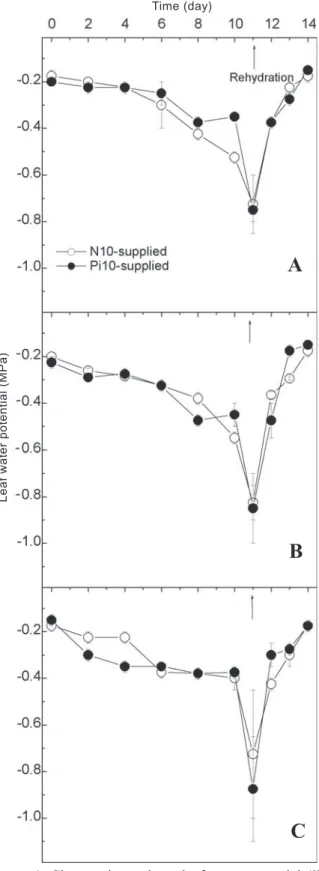
Effects of foliar phosphorus supply at different dates(first experiment): On the 11th day after suspending irrigation
(figure 1), when plants were watered for recovery, the predawn leaf water potential (Ψl) was around -0.9 MPa, which corresponds to a mild water deficit for bean (Sharkey and Seemann, 1989). In this experiment, supplying extra Pi did not significantly affect Ψl among genotypes. In addition, stomatal conductance (gs) was not significantly affected by extra Pi supply or genotypes under drought (data not shown), but gs was reduced on the 11th day of water stress by 92 %, 90
%, and 94 % for A320, Carioca, and Ouro Negro respectively, when compared with the well-watered plant (data not shown). Net CO2 assimilation (A) of A320 and Ouro Negro was less affected, but not significantly, when Pi was supplied five days before water deficit. In this Pi supply treatment, both genotypes showed higher A than Carioca on the 8th and 10th
day of water stress (figures 2A and 2G). Also, Carioca exhibited higher A values when Pi was supplied during water shortage (figure 2E). Almost all Pi-supplied genotypes showed higher A values on recovery for all treatments, especially when Pi was supplied five days prior drought (figures 2A, 2D and 2G).
In the first experiment, extra Pi supply on the last day of water deficit (11th day) had no significant effect on A for any
Figure 1. Changes in predawn leaf water potential (Ψl) of bean genotypes A320 (A), Carioca (B), and Ouro Negro (C) under water deficit. Leaves were supplied with 10 g Pi.L-1 (Pi10, closed circles) or 2.64 g N.L-1 (N10, open
circles) by foliar spraying. Arrows indicate plant re-watering (evening of the 11th day). Data points represent
the mean value (± S.E.) of three replications.
period, extra Pi supply did not improved yield components for any treatment (data not shown).
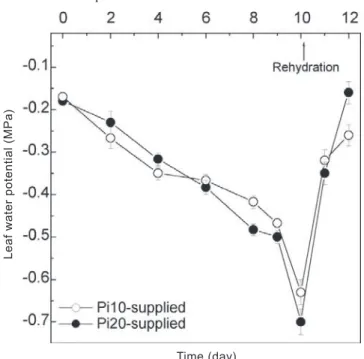
Effects of foliar phosphorus concentrations (second experiment): In the second essay, Ψl of the genotypes decreased during water deficit to a value of around -0.7 MPa on 10th day (figure 3). As in the first experiment, there was
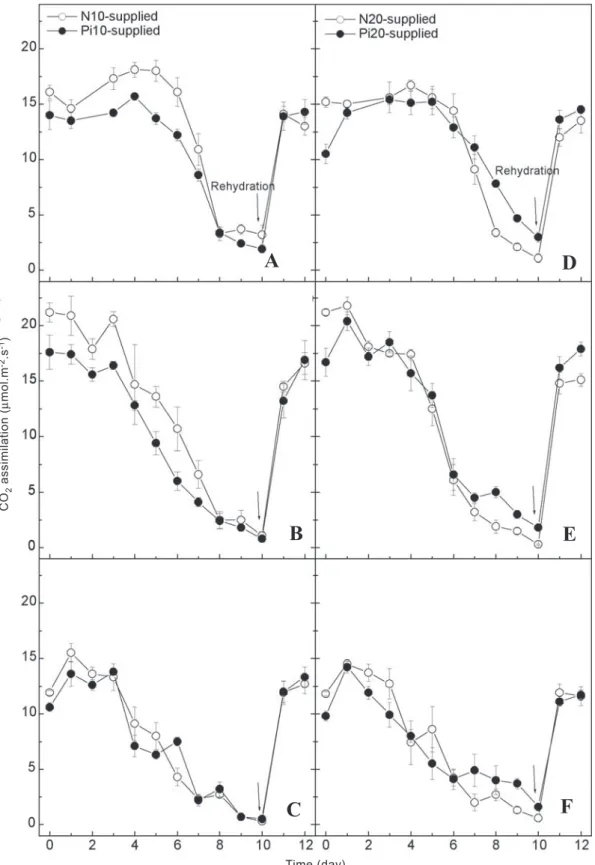
no significant effect for extra Pi supply on gas exchange of well-watered plants and in gs of water-stressed plants (data not shown). Nevertheless, Pi20-supplied and stressed leaves exhibited higher A values (p<0.05) at 09:00 h on days six, eight and ten of water deficit (figure 4D), and at 12:00 h from days eight to ten of stress (figures 4D and 4E) and the second day of rehydration (figure 4E). The IWUE on the last day of drought (10th day of stress) at 15:00 h was higher for
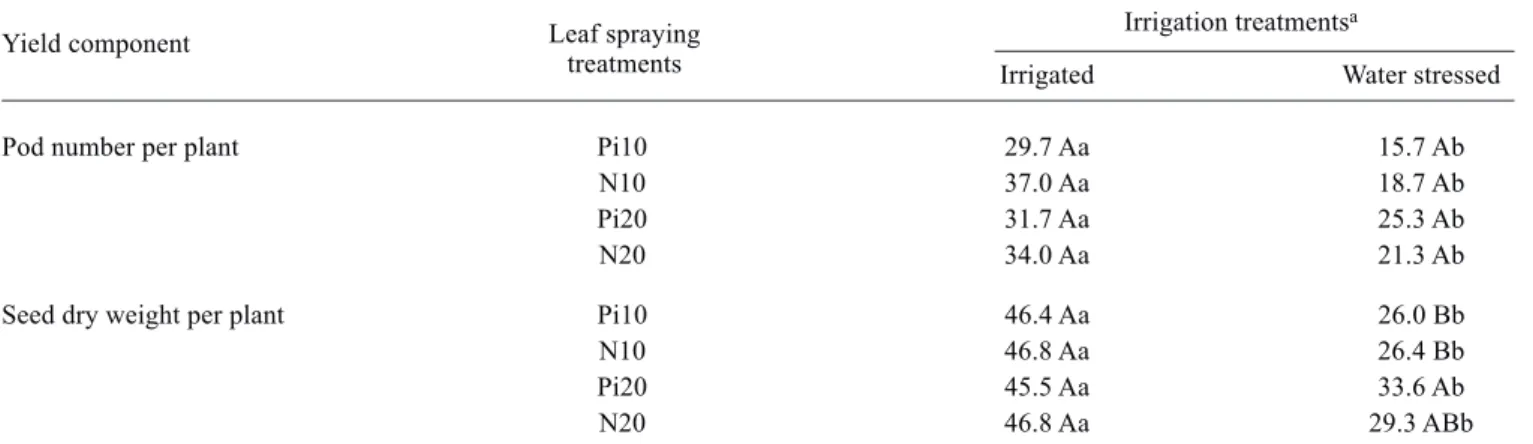
Pi20-supplied leaves (p<0.01) than for the other treatments (Pi10, N10, and N20), as shown in table 2. Considering yield components of Pi-supplied and water-stressed Carioca plants, seed dry weight was higher in Pi20 treatment (table 3).
DISCUSSION
Drought stress can decrease the Pi uptake from soil (Mouatt and Nes, 1986), reducing the availability of leaf Pi for the Pi/triose-P translocator resulting in impaired chloroplast photoassimilatory metabolism (Leegood, 1996; Flügge et al., 2003). At the same time, an increase in photosynthetic phosphorylated intermediates may occur in the cytoplasm and vacuoles, which represents an additional limitation to the photosynthetic metabolism. Extra foliar Pi supply for well-watered plants did not affect A over the first four days of measurements (data not shown). This was probably due to continued growth and photoassimilate export in well-watered plants, maintaining the vacuolar and cytosolic Pi reservs (Sivak and Walker, 1986; Mimura, 2001).
During the mild water deficit in the first experiment (plants were rehydrated when Ψl was around -0.9 MPa) when A320, Carioca and Ouro Negro genotypes were at the pre-flowering stage, no significant effect of foliar Pi spray was found on Ψl , gs and A. The lowest Ψl values of Ouro Negro under maximum water stress (figures 1A, 1B and 1C) can be due to the non-conservative stomatal behaviour of this genotype, that is, lower IWUE values for Ouro Negro compared to Carioca and A320, as reported by Pimentel et al. (1999a). Also, the genotype A320 needs further studies with Pi supplied before water stress, because it has a lower stomatal conductance than other bean cultivars under drought (Pimentel et al., 1991; Pimentel el al., 1999a).
Time (day)
L
e
a
f
w
a
te
r
p
o
te
n
ti
a
l
(MPa
)
A
B
Extra Pi supply induced changes in photosynthetic rate only when it was sprayed before drought. During water stress, extra foliar Pi may not be absorbed preventing its utilization by cellular metabolism. When extra Pi was supplied at rehydration, there was a probable recovery of growth and photoassimilate export from mildly water-stressed leaves (Boyer, 1978), inducing Pi release from sugars-P compounds accumulated during stress. On the other hand, in the first experiment, the lack of an effect
for extra Pi supplied before water stress can also be a consequence of low Pi spray concentration (table 1).
In general, beans have two main mechanisms for adapting to water deficit: stomatal control (Laffray and Louguet, 1990; Pimentel et al., 1999b) and root development (Kuruvadi and Aguilera, 1990). Although there was no effect of Pi supply on gs of water-stressed bean plants, higher A values were found under water deficit in plants supplied with Pi20 solution (figures 4D, 4E and 4F) as well as higher IWUE values
Figure 2. Changes in CO2 assimilation of bean genotypes A320 (A-C), Carioca (D-F), and Ouro Negro (G-I) under water deficit. Leaves were supplied with 10 g Pi.L-1 (Pi10, closed circles) or 2.64 g N.L-1 (N10, open circles) by foliar spraying
applied at different dates: five days before suspending irrigation (A, D, G); on the 6th (B, E, H) and 11th (C, F, I) days of
water stress. The mean air temperature on each day of measurement was 25.8, 26.0, 23.4, 23.2, 25.4, 22.6, 16.5, 19.0, 21.2, 19.5, 19.6, 20.3, 21.2 and 20.9 ºC, respectively. Arrows indicate plant re-watering (evening of the 11th day). Data points
represent the mean value (± S.E.) of three replications.
Time (day)
A
B
C
D
E
F
G
H
I
C
O2
a
ssi
mi
la
ti
o
n
(
µ
mo
l.
m
Time (day)
L
e
a
f
w
a
te
r
p
o
te
n
ti
a
l
(MPa
)
Time
Table 2. Intrinsic water use efficiency (IWUE), i.e. A/gs [(µmol CO2.(mol H2O)-1], of Carioca supplied with 10 g Pi.L-1 (Pi10)
or 20 g Pi.L-1 (Pi20) sprayed five days before suspending irrigation. IWUE was calculated from gas exchange measurements at
09:00-10:30, 12:00-13:30, and 15:00-16:30 h, ten days after suspending irrigation (maximum water stress) and after two days from re-watering (rehydration).
Maximum water stressa Rehydration
N10 Pi10 N20 Pi20 N10 Pi10 N20 Pi20
09:00 91.54 a 78.38 ab 61.26 b 91.97 a 21.96 a 12.58 a 19.99 a 19.31 a
12:00 61.23 a 45.60 ab 21.99 b 73.95 a 21.09 a 17.20 ab 14.31 b 18.36 ab
15:00 29.31 b 44.17 b 26.01 b 84.60 a 23.33 ab 17.33 b 27.06 ab 31.67 a
a Means within rows followed by same letter are not statistically different by the Tukey test (P>0.05). Data represent the mean value of four replicates.
Table 1. Leaf phosphorus content of bean genotypes not supplied (NS) and supplied with 10 g Pi.L-1 (Pi10) or 20 g Pi.L-1 (Pi20)
by spraying leaves five days before suspending irrigation.
Leaf phosphorus contenta [g.(100 g dry weight)-1]
NS Pi10 Pi20
I A320 0.56 0.67 ——
Carioca 0.44 0.64 ——
Ouro Negro 0.45 0.69 ——
II Carioca 0.65 0.74 0.89
a Samples were harvested on the first day of water stress. Data represent the mean value of four plants.
Experiment Genotypes
(p<0.01) in Pi20-supplied plants under maximum drought stress (table 2). Therefore, reduced gs in a photosynthetically efficient genotype can decrease leaf transpiration, improving
IWUE and maintaining plant growth and yield (Ehleringer, 1990; Pimentel et al., 1999a). As pointed out by Pimentel et al. (1999a), high IWUE values under water deficit, especially at the pollination stage, can be a useful physiological parameter for screening drought tolerance in bean breeding programs. Under low Ψl one factor reducing CO2 availability in the chloroplast during drought might be stomatal closure (Chaves et al., 2004). However, loss of photosynthetic biochemical activity also seems to be involved (Lauer and Boyer, 1992; Tang et al., 2002).
The results show an alleviation of drought effects on A
(figures 4D and 4F) by foliar Pi20 supply, increasing foliar Pi content (table 1) and seed dry weight in plants (p<0.05) (table 3). Under water deficit, Mouatt and Nes (1986) and Alam (1999) reported a low leaf Pi status of water-stressed plants due to reduced Pi uptake from soil. Since there was high leaf Pi content in Pi-supplied plants (table 3), it can be suggested that Pi is one of the factors inducing high A values in stressed-plants, especially with Pi20 concentration (figures 4D, 4E and 4F). In an elegant study with detached grapevine leaves, Hendrickson et al. (2004) found a great influence of Pi supply (47 to 80 %) on photosynthetic metabolism under low temperature stress.
For all plants, water stress caused reductions in pod number and seed dry weight per plant (table 3). The production of beans can be decreased by more than 50 % when water deficit occurs during the pollination or flowering stages (Norman et al., 1995; Pimentel et al., 1999a, b). These negative drought consequences in plant yield were reduced in Pi20-supplied plants, where a smaller decrease in pod number (20 %) and seed dry weight (26 %) was found compared with Pi10 (47 and 43 %,
Figure 3. Changes in predawn leaf water potential (Ψl) of bean genotypes Carioca under water deficit. Leaves were supplied with 10 g Pi.L-1 (Pi10, open circles) or 20 g Pi.L -1 (Pi20, closed circles) by foliar spraying. Arrows indicate
plant re-watering (evening of the 10th day). Data points
Figure 4. Changes in CO2 assimilation rates of the bean genotype Carioca under water deficit. Leaves were supplied with 10 g Pi.L-1 (Pi10, closed circles in a-c) or 2.64 g N.L-1 (N10, open circles in A-C); 20 g Pi.L-1 (Pi20, closed circles, in D-F) or
5.28 g N.L-1 (N20, open circles in D-F) by spraying leaves five days before suspending irrigation. Measurements were taken
at 09:00-10:30 h (A, D), 12:00-13:30 h (B, E) and 15:00-16:30 h (C, F). The mean air temperature on each day of measurement was 21.5, 18.8, 22.7, 22.8, 21.9, 21.6, 21.8, 22.8, 20.8, 20.9, 20.6 and 21.2 ºC, respectively. Arrows indicate plant re-watering (evening of the 10th day). Points represent the mean value (± S.E.) of four replications.
Time (day)
C
O2
a
ssi
mi
la
ti
o
n
(
µ
mo
l.
m
-2.s -1)
A
B
C
D
E
respectively), N10 (37 and 49.5 %, respectively) and N20 (37 and 43 %, respectively) supplied plants. However, more studies are necessary in order to understand the alleviation of photosynthetic metabolism and yield in common bean genotypes under water deficit, when they are supplied with extra foliar Pi.
Acknowledgements: M.G. Santos is grateful to CAPES (Comissão de Aperfeiçoamento de Pessoal de Nível Superior, Brazil), R.V. Ribeiro to FAPESP (Fundação de Amparo à Pesquisa do Estado de São Paulo, Brazil), and C. Pimentel to CNPq (Conselho Nacional de Desenvolvimento Científico e Tecnológico, Brazil) for fellowships granted. We also thank Dr. E. Malavolta and C. Cabral for helpful support concerning foliar phosphorus concentration.
REFERENCES
Alam SM (1999) Nutrient uptake by plants under stress conditions. In: Pessarakli M (ed), Handbook of plant and crop stress, pp. 285-313. Marcel Dekker, United States, New York.
Boyer JS (1978) Water deficit and photosynthesis. In: Kozlowski TT (ed) Water Deficits and Plant Growth, Vol. IV, pp. 154-191. Academic Press, England, London. Chaves MM, Oliveira MM (2004) Mechanisms underlying
plant resilience to water deficits: prospects for water-saving agriculture. J. Exp. Bot. 55:2365-2384.
Ehleringer JR (1990) Correlations between carbon isotope discrimination and leaf conductance to water vapor in common beans. Plant Physiol. 93:1422-1425.
Fageria NK, Balligar VC, Jones CA (1997) Common bean and cowpea. In: NK Fageria, VC Balligar, CA Jones (eds), Growth and mineral nutrition of field crops, pp. 441-489. Marcel Dekker, United States, New York.
Flexas J, Medrano H (2002) Drought-inhibition of photosynthesis in C3 plants: stomatal and non-stomatal limitations revisited. Ann. Bot. 89:183-189.
Flügge UI, Häusler RE, Ludewig F, Fischer K (2003) Functional genomics of phosphate antiport systems of plastids. Physiol. Plant. 118:475-482.
Hendrickson L, Chow WS, Furbank RT (2004) Low temperature effects on grapevine photosynthesis: the role of inorganic phosphate. Funct. Plant Biol. 31, 789-801. Holbrook GP, Keys AJ (2003) Evidence for recycling of
inorganic phosphate by wheat chloroplasts during photosynthesis at air levels of CO2 and O2. J. Plant Physiol. 160:1351-1360.
Jones HG (1985) Partitioning stomatal and non-stomatal limitation to photosynthesis. Plant Cell Environ. 8:95-104. Kramer PJ, Boyer JS (1995) Water relations of plants and
soils. Academic Press, San Diego.
Kuruvadi S, Aguilera DM (1990) Patrones del sistema radicular en frijol común (Phaseolus vulgaris L.). Turrialba 40:491-498.
Laffray D, Louguet P (1990) Stomatal responses and drought resistance. Bull. Soc. Bot. Fr., 137, Actual Bot. 1:47-60. Lauer MJ, Boyer JS (1992) Internal CO2 measured directly
in leaves. Plant Physiol. 98:1310-1316.
Lawlor DW, Cornic G (2002) Photosynthetic carbon assimilation and associated metabolism in relation to water deficits in higher plants. Plant Cell Environ. 25:275-294. Leegood RC (1996) Primary photosynthate production: physiology and metabolism. In: Zamski E, Schaffer AA (eds), Photoassimilate distribution in plants and crops. Source –sink relationships, pp. 21-42. Marcel Dekker, United States, New York.
Magalhães AA, Millar AA (1978) Efeito de déficit de água no período reprodutivo sobre a produção de feijão. Pesq. Agropec. Bras. 13:55-60.
Table 3. Yield components (pod per plant and seed dry weight per plant) of bean genotype Carioca submitted to water deficit, and supplied with 10 g Pi.L-1 (Pi10), 20 g Pi.L-1 (Pi20), 2.64 g N.L-1 (N10) or 5.28 g N.L-1 (N20) five days before suspending
irrigation.
Irrigation treatmentsa
Irrigated Water stressed
Pod number per plant Pi10 29.7 Aa 15.7 Ab
N10 37.0 Aa 18.7 Ab
Pi20 31.7 Aa 25.3 Ab
N20 34.0 Aa 21.3 Ab
Seed dry weight per plant Pi10 46.4 Aa 26.0 Bb
N10 46.8 Aa 26.4 Bb
Pi20 45.5 Aa 33.6 Ab
N20 46.8 Aa 29.3 ABb
a In columns, means followed by same capital letter are not statistically different, whereas values in rows followed by same minuscule letter are not statistically different by the Tukey test (P>0.05). Data represent the mean value of four replicates.
Malavolta E, Vitti GC, Oliveira SA (1997) Metodologia para análise de elementos em material vegetal. In: Malavolta E, Vitti GC, Oliveira SA (eds), Avaliação do estado nutricional das plantas princípios e aplicações, pp. 231-305. Associação brasileira para pesquisa da potassa e do fosfato, Brazil, Piracicaba.
McCree KJ (1986) Measuring the whole-plant daily carbon balance. Photosynthetica 20:82-93.
Mimura T (2001) Physiological control of phosphate uptake and phosphate homeostasis in plant cells. Aust. J. Plant Physiol. 28:653-658.
Mouatt MCH, Nes P (1986) Influence of soil water content on the supply of phosphate to plants. Aust. J. Soil Res. 24:435-440.
Norman MJT, Pearson CJ, Searle PGE (1995) The ecology of tropical food crops, pp 208-224. Cambridge University Press, Cambridge.
Osmond CB, Winter K, Powles SB (1980) Adaptive significance of carbon dioxide cycling during photosynthesis in water-stressed plants. In: Turner NC, Kramer PJ (eds), Adaptation of plants to water and high temperature stress, pp. 139-154. John Wiley & Sons, United States, New York.
Pieters AJ, Paul MJ, Lawlor DW (2001) Low sink demands limits photosynthesis under Pi deficiency. J. Exp. Bot. 52:1083-1091.
Pimentel C, Hebert G, Vieira da Silva J (1999a) Effects of drought on O2 evolution and stomatal conductance of beans at the pollination stage. Environ. Exp. Bot. 42:155-162.
Pimentel C, Laffray D, Louguet P (1999b) Intrinsic water use efficiency at the pollination stage as a parameter for drought tolerance selection in Phaseolus vulgaris. Physiol. Plant. 106:184-198.
Pimentel C, Jacob Neto J, Goi SR, Pessanha GG (1991) Efeito do estresse hídrico em cultivares de Phaseolus vulgaris
L., em simbiose com o Rhizobium leguminosarum biovar
phaseoli. Turrialba 40:521-526.
Raghothama KG (1999) Phosphate acquisition. Annu. Rev. Plant Physiol. Plant Mol. Biol. 50:665-693.
Raij B van, Cantarella H, Quaggio JA, Furlani AMC (1997) Recomendações de adubação e calagem para o Estado de
São Paulo, 2nd ed. pp.194-195. Instituto Agronômico/
Fundação IAC, Campinas.
Rosales-Serna R, Shibata JK, Gallegos JAA, López CT, Cereceres JO, Kelly JD (2004) Biomass distribution, maturity acceleration and yield in drought-stressed common bean cultivars. Field CropsRes. 85:203-211. Schussler JR, Westgate ME (1995) Assimilate flux determines
kernel set at low water potential. Crop Sci. 34:1569-1576. Sharkey TD, Seemann, JR (1989) Mild water stress effects on carbon-reduction-cycle intermediates, ribulose bisphosphate carboxylase activity, and spatial homogeneity of photosynthesis in intact leaves. Plant Physiol. 89:1060-1065. Sivak MN, Walker DA (1986) Photosynthesis in vivo can be limited by phosphate supply. New Phytol. 102:499-512. Stitt M, Quick WP (1989) Photosynthetic carbon partitioning:
its regulation and possibilities for manipulation. Physiol. Plant. 77:633-641.
Tang AC, Kawamitsu Y, Kanechi M, Boyer JS (2002) Photosynthetic oxygen evolution at low water potential in leaf discs lacking an epidermis. Ann. Bot. 89:861-870. Teixeira MG, Araújo AP (1999) Aumento do teor de fósforo
em sementes de feijoeiro através da adubação foliar. In: 6a
Reunião Nacional de Pesquisa de Feijão, Salvador, 1999. Resumos expandidos. EMBRAPA Arroz e Feijão. Santo Antônio de Goiás, Brazil, pp 756-759.
Vassey TL; Sharkey TD (1989) Mild water stress of Phaseolus vulgaris plants leads to reduced starch synthesis and extractable sucrose phosphate synthase activity. Plant Physiol. 89:1066-1070.
Vieira C (1998) Adubação mineral e calagem. In: Vieira C, de Paula Júnior TJ, Borém A (eds). Feijão: aspectos gerais e cultura no estado de minas. pp. 123-152. Editora UFV, Brazil, Viçosa.
Vicente JR, Almeida LDA, Gonçalves JS, Souza SAM (2000) Impactos da geração de tecnologia pela pesquisa paulista: o caso do feijão Carioca. Agric. São Paulo 47:41-51. Wardlaw IF (1990) The control of carbon partioning in plants.
New Phytol. 116:341-381.