and goby fish (Karplus, 1987). The association of these shrimps with other crustaceans is also documented, such as with upogebiid (Schembri and Jaccarini, 1978) and xanthoid crabs (Vannini, 1985; Silliman et al., 2003), and with other alpheids such as Alpheopsis chilensis Coutière, 1897 which is a commensal of burrows of Alpheus inca Wicksten and Méndez, 1981 (Boltaña and Thiel, 2001). Many species exhibit social monogamy, which consists in forming stable heterosexual pairs (Mathews, 2002; Rahman et al., 2003).
The genus Alpheus includes 296 valid species worldwide (De Grave and Fransen, 2011; Anker, 2012; Anker and De Grave, 2012; Almeida et al., 2013; Anker and Pachelle, 2013), the most of any genus of caridean shrimps. However, this number represents an underestimate of the actual diversity of the taxon. Empirical evidence and molecular studies point to the existence of cryptic diversity in Alpheus (Anker et al., 2006;
INTRODUCTION
Snapping shrimps of the genus Alpheus
Fabricius, 1798 live from the intertidal zone to great depths, occurring especially in coastal tropical and subtropical ecosystems such as estuaries, mangroves and coral reefs (Chace, 1988; Anker et al., 2006). These shrimp inhabit a wide variety of microhabitats, from soft to hard bottoms (Chace, 1988; Anker et al., 2006). Although they are more abundant in marine and estuarine environments, the genus includes at least one true freshwater species, A. cyanoteles Yeo and Ng, 1996, from Malaysia (Yeo and Ng, 1996). Species of
Alpheus are also frequently found in association with other organisms such as sponges (Anker
et al., 2008a, 2008d), corals (Patton, 1966; Castro, 1971), sea anemones (Knowlton and Keller, 1983, 1985), bryozoans (Anker et al., 2008a, 2008c), echiuran worms (Anker et al., 2007a), polychaetes (Anker et al., 2007b, 2008a, 2008d), echinoderms (Criales, 1984)
Snapping shrimps of the genus
Alpheus
Fabricius, 1798 from Brazil
(Caridea: Alpheidae): updated checklist and key for identification
Guidomar Oliveira Soledade and Alexandre Oliveira Almeida
Universidade Estadual de Santa Cruz, Departamento de Ciências Biológicas. Rodovia Jorge Amado, km 16. 45662-900 Ilhéus, Bahia, Brazil. E-mails: (GOS) [email protected]; (AOA) [email protected]
ABSTRACT -
We provide an updated checklist of the snapping shrimps of thegenus Alpheus Fabricius, 1798 (Crustacea: Alpheidae) from the Brazilian coast, as well as a key for their identification. The checklist was based on an exhaustive analysis of the literature published up to now, supported by analysis of material of 24 of the 33 species presently recorded from Brazil. Illustrations of the main diagnostic characters are provided to facilitate the identification process, as well as color photographs of 16 species collected by the authors, to facilitate the iden-tification of fresh specimens. For each species, we provide information on the distribution and a list of previous records for the Brazilian coast. Comments on dubious records or taxonomic remarks are provided when appropriate. Finally, the zoogeography of the species is briefly discussed.
Key words: Alpheid, Brazilian coast, Crustacea, Decapoda, diversity
Mathews, 2006; Mathews and Anker, 2009). Indeed, studies with a multidisciplinary approach, involving not only the morphology but also genetics, analysis of color pattern, and ecological data, have revealed the existence of cryptic lineages in a number of species that were previously considered to be widely distributed (Anker, 2001; Anker et al., 2007b, 2008a, 2008b, 2008c, 2009; Mathews and Anker, 2009).
A total of 52 species of Alpheus have been recorded in the western Atlantic (Anker, 2012; Almeida et al., 2013), and most of them have been reported for the Brazilian coast. However, some of the Brazilian records need to be confirmed because many taxa belong to species complexes as mentioned above, but also because some records were published in general lists of species from certain localities and regions, without morphological descriptions and illustrations of diagnostic characters or color patterns [e.g., A. armatus
Rathbun, 1901, A. belli Coutière, 1898,
A. candei Guérin-Méneville, 1855 and A. macrocheles (Hailstone, 1835) (Coelho et al., 1983; Guterres et al., 2005; Coelho Filho, 2006; Alves et al., 2008)]. Confirmation of some doubtful records is difficult because in some cases the reported material was not deposited in any carcinological collection or is no longer available (damaged). Other species are indeed rare, and it is difficult to obtain new samples for analysis.
Studies of the species of Alpheus from Brazil began in the mid-19th century. Dana (1852), describing A. malleator based on material collected by the U.S. Exploring Expedition, mentioned that the type material was probably from Rio de Janeiro. Spence Bate (1888) described A. intrinsecus from off Salvador, based on a specimen collected during the Challenger Expedition. Pocock (1890) and Coutière (1898) described A. ridleyi Pocock, 1890 (a junior synonym of A. websteri Kingsley, 1880) and A. belli Coutière, 1898 [possible junior synonym of A. malleator (see Anker and Pachelle, 2013)], respectively, from Fernando de Noronha Archipelago. Rathbun (1900), studying the material obtained by the
Branner-Agassiz Expedition in northeastern Brazil, attributed the new name A. cristulifrons to material from Fernando de Noronha reported by Pocock (1890) as Alpheus obeso-manus
Dana, 1852. Christoffersen (1979) studied the taxonomy of the Alpheoidea collected during the Calypso Expedition, which carried out sampling along the Brazilian coast in 1961, and also included other material from the western Atlantic in his analyses. His study included 11 species of Alpheus from Brazil, and descriptions of the new taxa A. maxilliplanus
Christoffersen, 1979, A. pouang Christoffersen, 1979 and A. puabeba Christoffersen, 1979; the type localities of the first two are on the coasts of Sergipe and São Paulo, respectively. Christoffersen (1984), revising a group of species morphologically similar to A. heterochaelis Say, 1818, described A. estuariensis
Christoffersen, 1984 (type locality: estuary of the Potengi River, Rio Grande do Norte), and considered A. maxilliplanus a junior synonym of A. chacei Carvacho, 1979. Besides these major taxonomic works, species of Alpheus
from Brazil have been recorded in several lists of species (e.g., Coelho and Ramos, 1972; Fausto Filho, 1974; Christoffersen, 1998; Coelho
et al., 2006; Coelho Filho, 2006; Santos et al., 2012), some of them of great historical importance (e.g., Smith, 1869; Moreira, 1901; Luederwaldt, 1919). A few ecological and biological studies (Mossolin et al., 2006; Pavanelli et al., 2008, 2010; Rodrigues et al., 2009) or larval descriptions (Pires et al., 2008) have been published.
In recent years, several new species were described from the western Atlantic, some of which have been reported from the Brazilian coast, such as A. brasileiro Anker, 2012 (type locality: Fortaleza area and Camocim, Ceará),
A. carlae Anker, 2012, A.christofferseni Anker, Hurt and Knowlton, 2007 (type locality: Cemitério Island, Atol das Rocas) and A.
rudolphi Almeida and Anker, 2011 (type
2007a, 2009; Anker, 2012; Almeida et al., 2013). Alpheus vanderbilti Boone, 1930, which until recently was believed to be a junior synonym of A. cylindricus Kingsley, 1878a, was resurrected after revision (Anker et al., 2008d).
Alpheus cylindricus is currently restricted to the eastern Pacific, and the previous records of this species from Brazil (e.g., Coelho and Ramos, 1972; Christoffersen, 1998) correspond to A. vanderbilti (Anker et al., 2008d). On the other hand, A. agilis Anker, Hurt and Knowlton, 2009 and A. buckupi Almeida, Terossi, Araújo-Silva and Mantelatto, 2013 (type locality: Timbó River, Pernambuco) were recognized as new species of amphi-Atlantic distribution. Finally, species that have long been recorded along the Brazilian coast, such as A. heterochaelis
and A. armillatus H. Milne Edwards, 1837 (see Christoffersen, 1984), may not occur in Brazil. New evidence suggests that A. heterochaelis is a species complex (A.O. Almeida, under study). The A. armillatus complex was recently revised, and the occurrence of the sensu stricto form was not confirmed in Brazil (see Anker, 2012).
The process of identifying species of
Alpheus is difficult, not only because it is a taxonomically complex group, including several cryptic lineages as mentioned above, but also because of the scarcity of keys for identification and illustrations of the diagnostic characters for regional faunas. Therefore, our present objective is to provide an updated list of members of the shrimp genus Alpheus from Brazil, including all recent changes regarding species composition, as well as a key for their identification, with illustrations of the main characters of taxonomic significance and photographs of color patterns of some species.
MATERIAL AND METHODS
The Brazilian coast is about 8,500 km long (Lavrado, 2007). The checklist contains species recorded from coastal areas extending from Cape Orange, northern Amapá State (04°17’N / 51°32’W) to the mouth of Chuí Stream, southern Rio Grande do Sul State (33°45’S / 53°23’W) (Fig. 1). Oceanic areas
include: (1) the seamounts of the North Chain (= seamounts off Ceará) (01°00’–04°00’S / 37°00’–39°00’W) (Coelho Filho, 2006); (2) the Atol das Rocas (03°45’–03°56’S / 33°37’– 33°56’W), 260 km east of Natal, Rio Grande do Norte State (Kikuchi, 2000); (3) the Fernando de Noronha Archipelago (03°45’–03°57’S / 32°19’–32°41’W), located 345 km east off the coast of Rio Grande do Norte (Leão and Dominguez, 2000); and (4) the seamounts of the Vitória-Trindade Chain, which extends over about 1,000 km (approx. 20–21°S / 28– 38°W) off the coast of Espírito Santo State, southeastern Brazil (Ferrari and Riccomini, 1999). The eastern limits of this chain are Trindade Island (20°28’–20°32’ / 29°17’– 29°20’W) and the Martin Vaz Archipelago (20°30’–20°31’ / 28°51’–29°20’W), located about 1,100 and 1,145 km off the Espírito Santo coast, respectively (Castro and Antonello, 2006) (Fig. 1).
The checklist presented herein was based on an exhaustive analysis of the literature published up to 2013. Sources with restricted access such as monographs, theses, and congress communications were not used in the checklist. The list is supported by the analysis of material of 24 of the 33 species recorded from Brazil. This material consists largely of specimens deposited in the Crustacean Collection of the Universidade Estadual de Santa Cruz, Ilhéus, Bahia, Brazil. Other material analyzed
is deposited at the carcinological collections of the Universidade de São Paulo, São Paulo State, Brazil (Museu de Zoologia – MZUSP and Departamento de Biologia, Faculdade de Filosofia, Ciências e Letras de Ribeirão Preto - CCDB).
The key for identification was developed taking as a starting point the adaptation of the keys proposed by Chace (1972) for species of Alpheus from the Caribbean Sea, by Christoffersen (1984) for species related
to A. heterochaelis, and by Anker (2012) for the A. armillatus complex. Morphological characteristics of each taxon were also obtained through examination of the available material, complemented with descriptions of the species obtained in the literature. Illustrations of the
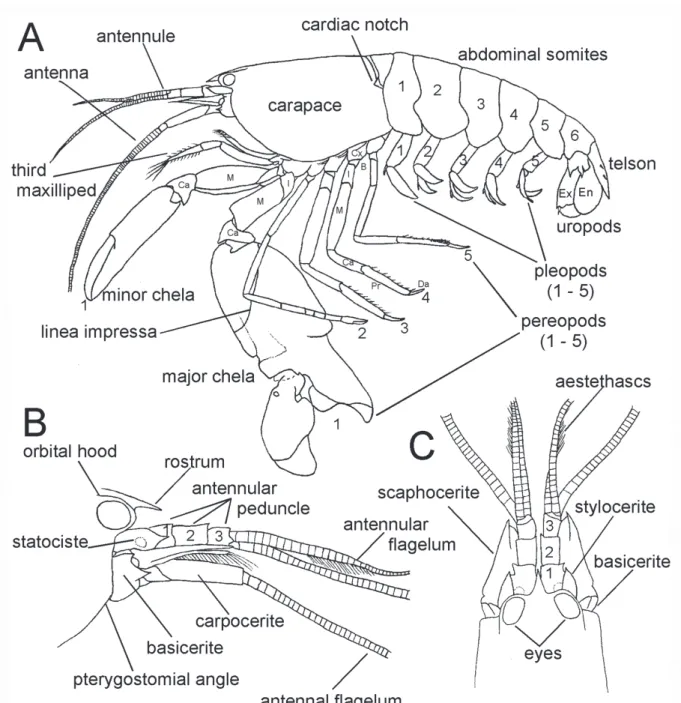
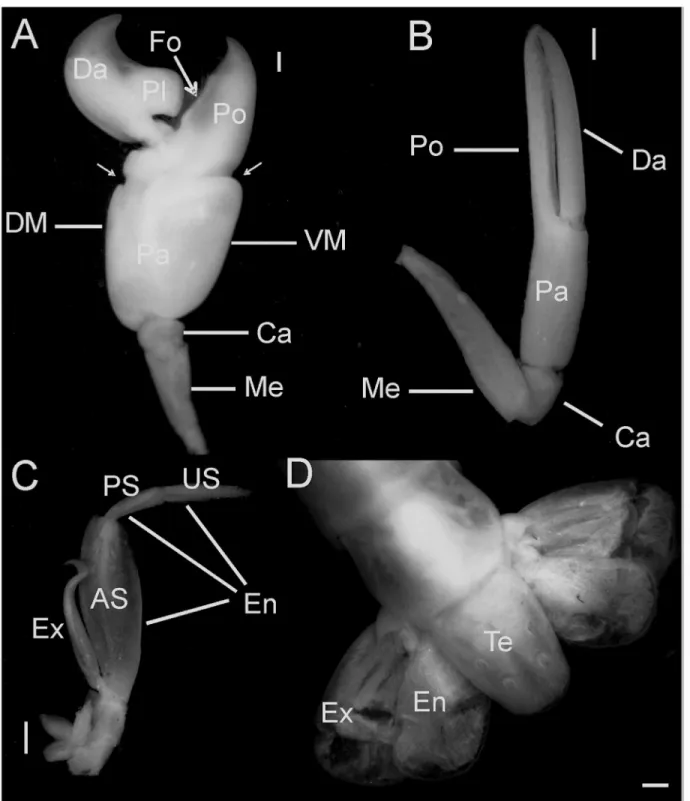
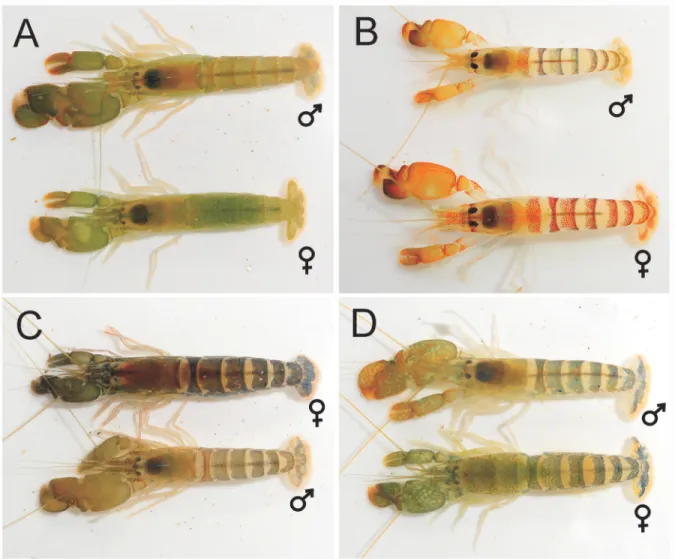
main diagnostic characters are provided to facilitate the identification process (Figs. 2, 3). Color photographs of 16 species collected by the authors on the coast of Bahia are also provided to facilitate the identification of fresh specimens, since some taxa listed in this study
can only be distinguished by analysis of their coloration in life. For each species, we provide the reference to the original description and the distribution, as well as a list of previous records for the Brazilian coast. Comments on dubious records or taxonomic remarks are provided. The existence of illustrations based on Brazilian material, when available, is also mentioned. The species marked with an asterisk had material examined in this study. We used the status cf. (e.g., Alpheus cf.
floridanus Kingsley, 1878a) to designate a taxon belonging to a species complex which has not been taxonomically revised and the identity of the Brazilian material remains unknown.
The longitudinal and latitudinal distribution patterns (see discussion) were classified based on the proposal of Melo (1985). In the western Atlantic, the species are treated as having disjunct distributions where the gap in their range corresponds at least to the Guyana region (Guyanas, Amapá, and Pará) (Coelho and Ramos, 1972).
R
ESULTSFamily Alpheidae Rafinesque, 1815 Genus Alpheus Fabricius, 1798
Alpheus agilis Anker, Hurt and Knowlton, 2009
Alpheus agilis Anker, Hurt and Knowlton, 2009: 12, figs. 4-5F.
Distribution: Western Atlantic - Brazil (Atol das Rocas). Eastern Atlantic - São Tomé and Cape Verde (Anker et al., 2009).
Previous records: Atol das Rocas (Anker
et al., 2009).
Remarks: In the western Atlantic, A. agilis is presently known only from Atol da Rocas (Anker et al., 2009).
Alpheus amblyonyx Chace, 1972
Alpheus amblyonyx Chace, 1972: 59, fig. 16.
Distribution: Western Atlantic - Gulf of Mexico, Yucatan Peninsula, Caribbean Sea, and Brazil (Seamounts of the North Chain, Atol das Rocas, Fernando de Noronha, Ceará to Espírito Santo) (Christoffersen, 1979, 1998; Coelho Filho, 2006).
Previous records:Seamounts of the North Chain (Coelho Filho, 2006), Atol das Rocas (Christoffersen, 1979, 1998; Coelho et al., 2002; Paiva et al., 2007; Souza et al., 2011), Fernando de Noronha (Coelho Filho, 2006; Paiva et al., 2007; Souza et al., 2011), Ceará (Coelho et al., 2006; Coelho Filho, 2006), Paraíba (Christoffersen, 1979, 1998; Coelho
et al., 2006), Bahia (Christoffersen, 1979, 1998; Coelho et al., 2006; Serejo et al., 2006, 2007; Almeida et al., 2012), Espírito Santo (Christoffersen, 1979, 1998; Serejo et al., 2006, 2007), Vitória-Trindade Chain and Trindade Island and Martin Vaz Archipelago (Serejo et al., 2007). Locality not provided: Coelho and Ramos-Porto (1995).
Remarks: Due to their similarity, part of the western Atlantic records of A. macrocheles
(Hailstone, 1835) may refer to A. amblyonyx
(see also remarks on A. macrocheles). The only published illustrations of the Brazilian material were provided by Christoffersen (1979; Bahia: fig. 1).
Alpheus angulosus McClure, 2002 * (Fig. 4A)
Alpheus angulosus McClure, 2002: 368.
Distribution: Western Atlantic - North Carolina to Florida, Gulf of Mexico, Caribbean Sea, French Guyana, and Brazil (Atol das Rocas, Fernando de Noronha, Ceará, Paraíba, Bahia, Rio de Janeiro, São Paulo, Santa Catarina, and Rio Grande do Sul) (Anker, 2012).
Previous records: Atol das Rocas (Mathews and Anker, 2009, as A. cf. angulosus A2), Ceará (Anker, 2012), Paraíba (Rodrigues et al., 2009, as A. cf. angulosus, see Anker, 2012), Bahia (Almeida et al., 2012, as A. cf. armillatus, in part; Anker, 2012), Rio de Janeiro and São Paulo (Anker, 2012), Santa Catarina (Anker, 2012; Boos et al., 2012) and Rio Grande do Sul (Anker, 2012).
Soledade and A.O. Almeida, pers. obs.). Illustrations of the Brazilian material were provided by Anker (2012; Atol das Rocas: figs. 19, 20; Ceará: figs. 26A, 68E, F; Bahia: fig. 26B). Anker (2012) reported the occurrence of the species in Fernando de Noronha, but did not mention material or provide a reference from there.
Alpheus armatus Rathbun, 1901
Alpheus armatus Rathbun, 1901: 108, fig. 20.
Distribution:Western Atlantic – Florida, Yucatan Peninsula, Bahamas, Caribbean, and Brazil (Alagoas) (Chace, 1972; Rodríguez, 1980, Coelho et al., 1983; Martínez-Iglesias et al., 1997).
Previous records: Alagoas (Coelho et al., 1983, 1990, 2006).
Remarks:Material reported by Coelho et al. (1983) and subsequently by Coelho et al. (1990, 2006) may correspond to A. rudolphi
(see Almeida and Anker, 2011). For this reason, the occurrence of A. armatus in Brazil remains to be confirmed.
Alpheus bouvieri A. Milne-Edwards, 1878 * (Fig. 4B)
Alpheus bouvieri A. Milne-Edwards,
1878: 231.
Distribution: Western Atlantic –
Bermuda, Florida, West Indies, Panama, and Brazil (Atol da Rocas, Fernando de Noronha, and Ceará to Rio Grande do Sul). Central Atlantic - Ascension Island. Eastern Atlantic - Cape Verde, Senegal to Gulf of Guinea and Congo (Crosnier and Forest, 1966; Chace, 1972; Christoffersen, 1979, 1998; Manning and Chace, 1990; Anker et al., 2009).
Previous records: Atol da Rocas (Fausto Filho, 1980; Christoffersen, 1998; Paiva et al., 2007; Anker et al., 2009; Souza et al., 2011), Fernando de Noronha [Pocock, 1890, as A. edwardsii (Audouin, 1826), in part, see Coutière, 1898 and Crosnier and Forest, 1966; Coutière, 1898; Crosnier and Forest, 1966; Fausto Filho, 1974; Christoffersen, 1998; Coelho et al., 2002; Alves et al., 2008; Souza
et al., 2011], Ceará (Fausto Filho and Furtado,
1970; Coelho et al., 2006), Rio Grande do Norte (Christoffersen, 1979; Coelho et al., 1986, 2006; Ferreira and Sankarankutty, 2002), Paraíba (Rathbun, 1900, as A. heterochaelis, in part, see Christoffersen, 1979; Christoffersen, 1979; Coelho et al., 2006; Riul et al., 2008), Pernambuco (Rathbun, 1900, as A. heterochaelis, see Christoffersen, 1979; Christoffersen, 1979; Calado, 1996; Coelho-Santos and Coelho, 1998; Coelho
et al., 2002, 2006; Nascimento and Torres, 2007; Almeida et al., 2008; Anker et al., 2009), Alagoas (Sousa and Calado, 1998; Calado and Sousa, 2003; Coelho et al., 2006), Bahia (Christoffersen, 1979; Almeida et al., 2006, 2012; Coelho et al., 2006; Santos et al., 2012), Espírito Santo (Christoffersen, 1979), Rio de Janeiro (Christoffersen, 1979; Anker
et al., 2009); São Paulo (Luederwaldt, 1919, as A. heterochaelis, in part, see Christoffersen, 1984; Christoffersen, 1979; Costa et al., 2000; Mossolin et al., 2006; Amaral et al., 2010), Paraná (Christoffersen, 1979; Masunari and Dubiaski-Silva, 1998; Masunari et al., 1998), Santa Catarina (Christoffersen, 1979; Boos et al., 2012), Rio Grande do Sul (Christoffersen, 1979). Locality not provided: Coelho and Ramos-Porto (1995), Christoffersen (1998).
Remarks: Illustrations of the Brazilian material were provided by Christoffersen (1979) [São Paulo: figs. 2-5, in part reproduced by Coelho-Santos and Coelho (1998, figs. 12-13)], Calado and Sousa (2003) (Alagoas, 1 fig., unnumbered, impossible to verify species identity), Almeida et al. (2012; Bahia, fig. 2a) and Santos et al. (2012; Bahia, fig. 3b).
Alpheus brasileiro Anker, 2012 * (Fig. 4C)
Alpheus brasileiro Anker, 2012: 74, figs. 54-56, 64I, 65J, 66J, 67H, 68C.
Distribution: Western Atlantic - Brazil (Pará, Ceará, Rio Grande do Norte, Alagoas, Bahia, Rio de Janeiro, São Paulo, and Santa Catarina) (Anker, 2012).
Previous records: Pará, Ceará, Rio Grande do Norte, Alagoas, Bahia, Rio de Janeiro, São Paulo, and Santa Catarina (Anker, 2012).
1998; Coelho et al., 2006) from Brazil may represent, at least in part, A. brasileiro. Illustrations of the type material, from Ceará, were provided by Anker (2012, figs. 54-56, 68C).
Alpheus buckupi Almeida, Terossi, Araújo-Silva and Mantelatto, 2013 *
Alpheus buckupi Almeida, Terossi,
Araújo-Silva and Mantelatto, 2013: 440, figs. 1-4.
Distribution: Western Atlantic –
Venezuela (Orinoco Delta) and Brazil (Ceará, Rio Grande do Norte, Pernambuco, Alagoas, Bahia and São Paulo). Eastern Atlantic – São Tomé and Príncipe (Almeida et al., 2013).
Previous records: Ceará, Rio Grande do Norte, Pernambuco, Alagoas, Bahia and São Paulo (Almeida et al., 2013).
Remarks: Alpheus buckupi (type locality: Timbó River, Pernambuco), distributed in the western and eastern Atlantic, was recently recognized as new based on morphological and molecular data. The resemblance between that species and members of the A. lobidens De Haan, 1850 complex indicated they are cryptic taxa (Almeida et al., 2013). Illustrations, including drawings and colour photographs, from Brazilian material were provided by Almeida et al. (2013; Pernambuco, holotype and paratypes, figs 1-3, 4B; Bahia: figs 4A, C-E).
Alpheus candei Guérin-Méneville, 1855
Alpheus candei Guérin-Méneville, 1855 [in Guérin-Méneville, 1855-1856]: xix; pl. 2, figs. 9-9a.
Distribution: Western Atlantic – Florida (Dry Tortugas), Cuba, Dominica?, Colombia, and Brazil (Seamounts of the North Chain) (Chace, 1972; Martínez-Iglesias et al., 1997; Coelho Filho, 2006).
Previous records: Seamounts of the North Chain (Coelho Filho, 2006).
Remarks: Alpheus candei has only been recorded from Brazil in listings (Coelho and Ramos, 1972; Coelho Filho, 2006). Actually, the record of Coelho and Ramos (1972) from Rio de Janeiro consists of a misidentification (= A. puapeba, see Christoffesersen, 1979). For this reason, Christoffersen (1998) did not include the species in his list of Brazilian species of Alpheus. A new record of A. candei
was provided by Coelho Filho (2006) from the seamounts of the North Chain, although with no reference to morphological characters or illustrations.
Alpheus carlae Anker, 2012 * (Fig. 4D) Alpheus carlae Anker, 2012, 61, figs. 41-48, 64H, 65H, 67G, 68D.
Distribution: Western Atlantic - southern Florida, Puerto Rico, Jamaica, Belize, Panama, Venezuela, French Guyana, and Brazil (Ceará to São Paulo) (Anker, 2012).
Previous records: Ceará, Pernambuco, and Alagoas (Anker, 2012), Bahia (Almeida
et al., 2006, as A. armillatus, in part; 2007a, as A. cf. armillatus, in part; 2012, as A. cf.
armillatus, in part; Anker, 2012; Santos et al., 2012), Rio de Janeiro (Anker, 2012), São Paulo (Holthuis, 1956, as A. armillatus, see Anker, 2012; Mossolin et al., 2006, as A. armillatus, see Anker, 2012; Pavanelli et al., 2008, as A. armillatus, see Anker, 2012; Anker, 2012).
Remarks: Other records of A. armillatus
(e.g., Coelho and Ramos, 1972; Christoffersen and Ramos, 1988; Christoffersen, 1998; Coelho et al., 2006, and many others) from Brazil may represent, at least in part, A. carlae. Material from Bahia (Almeida et al., 2006, 2007a, 2012) refers in part to A. carlae (G.O. Soledade and A.O. Almeida, pers. obs.). Based on the description of the color pattern, material referred to as “A. armillatus sensu stricto” by Rodrigues et al. (2009) is possibly
A. carlae (see Anker, 2012). Information on population structure and on egg production for a population from northern São Paulo was published by Mossolin et al. (2006) and Pavanelli et al. (2008) (both as A. armillatus, see Anker, 2012). Illustrations of the Brazilian material were provided by Anker (2012; Pernambuco: figs. 43H-J; Ceará: figs. 43K, L, M-O, 68D; Bahia: 47D, E) and Santos et al. (2012; Bahia: fig. 3C).
Alpheus chacei Carvacho, 1979 * (Fig. 5A)
Alpheus chacei Carvacho, 1979: 455, figs. 4-6.
Distribution: Western Atlantic - French Antilles (Guadeloupe) and Brazil (Pará and Paraíba to São Paulo) (Christoffersen, 1979, as A. maxilliplanus; 1984; 1998; Barros and Pimentel, 2001).
Previous records: Pará (Barros and
Pimentel, 2001), Paraíba (Christoffersen, 1979, as A. maxilliplanus; 1984, 1998; Coelho
et al., 2006), Pernambuco (Coelho et al., 2006; Souza et al., 2011), Sergipe (Christoffersen, 1979, as A. maxilliplanus; 1998; Melo et al., 2003; Coelho et al. 2006), Bahia (Almeida et al., 2007a; 2012), Rio de Janeiro (Christoffersen, 1979, as A. maxilliplanus; 1998) and São Paulo (Christoffersen, 1979, as A. maxilliplanus; 1998; Wakabara et al., 1996). Locality not provided: Coelho and Ramos-Porto (1995).
Remarks: The only illustrations of
this species from Brazil were provided by Christoffersen (1979, figs. 11-13), when describing A. maxilliplanus, a junior synonym of A. chacei (see Christoffersen, 1984), described by him from Sergipe.
Alpheus christofferseni Anker, Hurt and Knowlton, 2007a
Alpheus christofferseni Anker, Hurt and Knowlton, 2007a: 3, figs. 1-6, 11a-c, 12b, c.
Distribution: Western Atlantic – Panama and Brazil (Atol das Rocas) (Anker et al., 2007a).
Previous records: Atol das Rocas (Anker
et al., 2007a).
Remarks: Illustrations of the type
Alpheus cristulifrons Rathbun, 1900 * (Fig. 5B)
Alpheus cristulifrons Rathbun, 1900: 152.
Distribution: Western Atlantic – Florida, Gulf of Mexico, West Indies, Central America, northern South America, and Brazil (Atol das Rocas, Fernando de Noronha, and Rio Grande
do Norte to Rio de Janeiro) (Christoffersen, 1998; Anker et al.,2008a).
Previous records: Atol das Rocas
(Christoffersen, 1998; Paiva et al., 2007; Anker
Fausto Filho, 1974; Christoffersen, 1998; Coelho et al., 2002; Alves et al., 2008; Anker
et al., 2008a; Souza et al., 2011), Rio Grande do Norte (Fausto Filho, 1970; Coelho et al., 1986, 2006; Christoffersen, 1998), Paraíba (Young, 1986; Christoffersen, 1998; Coelho
et al., 2006), Pernambuco (Fausto Filho, 1980; Christoffersen, 1998; Coelho et al., 2006; Anker et al., 2008a; Souza et al., 2011), Alagoas (Rathbun, 1900; Christoffersen, 1979, 1998; Fausto Filho, 1980; Coelho et al., 1990, 2006; Anker et al., 2008a), Bahia (Almeida et al., 2012; Santos et al., 2012), Espírito Santo (Christoffersen, 1979; Serejo et al., 2006) and Rio de Janeiro (Christoffersen, 1979). Locality not provided: Coelho and Ramos (1972), Coelho and Ramos-Porto (1995).
Remarks: The record of Serejo et al. (2006) from Espírito Santo (not Bahia as in Almeida et al., 2012) is below the typical depth reported for A. cristulifrons and therefore needs confirmation. Anker et al. (2008a) provided line drawings of material from Atol das Rocas. Color photographs of material from Bahia were provided by Almeida et al. (2012, fig. 2B) and Santos et al. (2012, fig. 3D).
Alpheus estuariensis Christoffersen, 1984 * (Fig. 5C)
Alpheus estuariensis Christoffersen, 1984: 191, figs. 1-2.
Distribution: Western Atlantic – Florida, Mississippi to Texas, Cuba, Dominican Republic, Trinidad and Tobago, Curaçao, and Brazil (Pará to Paraná) (Christoffersen, 1984; Pires et al., 2008).
Previous records: Pará (Pires et al., 2008), Maranhão (Coelho et al., 2006), Ceará (Christoffersen, 1984, 1998; Coelho et al., 2006), Rio Grande do Norte (Christoffersen, 1984, 1998; Coelho et al., 1986, 2006; Melo
et al., 2003), Paraíba (Rathbun, 1900, as A. heterochaelis, in part, see Christoffersen, 1984; Christoffersen, 1984, 1998; Coelho et al., 2006), Pernambuco (Christoffersen, 1984, 1998; Coelho and Coelho-Santos, 1990; Coelho-Santos and Coelho, 2001; Coelho et al., 2002, 2006; Souza et al., 2011), Alagoas (Sousa et al., 2000; Calado and Sousa, 2003;
Coelho et al., 2006), Sergipe (Arraes and Ramos-Porto, 1994), Bahia (Almeida et al., 2006, 2007a, 2012; Coelho et al., 2006), Rio de Janeiro and São Paulo (Christoffersen, 1984, 1998), Paraná (Christoffersen, 1984, 1998; Azambuja Corrêa and Loyola e Silva, 1995; Blankensteyn and Moura, 2002). Locality not provided: Coelho and Ramos-Porto (1995).
Remarks: Illustrations of the type material from the Potengi River estuary, Rio Grande do Norte, were provided by Christoffersen (1984, figs. 1-2). Calado and Sousa (2003) also provided a photograph (unnumbered) of a preserved specimen. Pires et al. (2008, figs. 1-4) described the first four zoeal stages based on material from Pará.
Alpheus cf. floridanus Kingsley, 1878a *
Alpheus floridanus Kingsley, 1878a: 193.
Distribution: Western Atlantic –
southern Florida, Bahamas, Mexico (Veracruz and Quintana Roo), West Indies (Cuba to Curaçao), and Brazil (Atol das Rocas, and Piauí to Rio Grande do Sul) (Christoffersen, 1979, 1998, as A. floridanus; Martínez-Iglesias
et al., 1997, as A. floridanus).
Previous records: Seamounts of the
North Chain (Coelho Filho, 2006), Atol das Rocas (Crosnier and Forest, 1966; Coelho and Ramos, 1972; Christoffersen, 1979, 1998; Coelho Filho, 2006; Paiva et al., 2007; Souza et al., 2011), Fernando de Noronha (Coelho et al., 2002; Alves et al., 2008; Souza
et al., 2011), Piauí (Ramos-Porto et al., 1996; Coelho Filho, 2006), Paraíba (Coelho Filho, 2006), Pernambuco (Ramos-Porto et al., 1996; Coelho et al., 2002, 2006; Souza et al., 2011), Alagoas (Coelho et al., 1983; 1990; 2006; Silva and Calado, 2002), Bahia (Christoffersen, 1979; Carqueija et al., 1995; Coelho et al., 2006; Serejo et al., 2006, 2007; Almeida et al., 2007a, 2012), Espírito Santo (Serejo et al., 2007), Rio de Janeiro (Christoffersen, 1979, 1982), São Paulo (Ejchel, 1965; Christoffersen, 1979, 1982; Pires-Vanin et al., 1997; Costa
2012), and Rio Grande do Sul (Christoffersen, 1979, 1982). Locality not provided: Coelho et al. (1980), Coelho and Ramos-Porto (1995), Spivak (1997). All references above as A. floridanus, except Crosnier and Forest (1966) and Coelho and Ramos (1972) (as A. floridanus floridanus Kingsley, 1878a), and Masunari and Dubiaski-Silva (1998), Masunari et al. (1998) and Almeida et al. (2007a, 2012) (as
A. cf. floridanus). Crosnier and Forest (1966) and Coelho and Ramos (1972) also reported the occurrence of the subspecies A. floridanus africanus Balss, 1916 from Pernambuco to Bahia.
Remarks: Alpheus floridanus is a species complex (Anker, 2001; Williams et al., 2001). The eastern-Pacific and Atlantic records (e.g., Crosnier and Forest, 1966; Kim and Abele, 1988) refer to other species (A. Anker, pers. com.). The identity of the Brazilian material is presently unknown. Christoffersen (1979, figs. 6-8) provided line drawings of material from Rio de Janeiro.
Alpheus formosus Gibbes, 1850 * (Fig. 5D)
Alpheus formosus Gibbes, 1850: 196.
Distribution: Western Atlantic –
Bermuda, North Carolina, Florida, Gulf of Mexico, Bahamas, West Indies, Central America, Colombia, Venezuela, and Brazil (Atol das Rocas, Fernando de Noronha, and Ceará to Paraná) (Christoffersen, 1998; Masunari et al., 1998; Anker et al., 2008c).
Previous records: Atol das Rocas (Anker
et al., 2008c), Fernando de Noronha (Pocock, 1890, as A. panamensis Kingsley, 1878a; Fausto Filho, 1974, as A. panamensis; Christoffersen, 1998; Coelho et al., 2002; Alves et al., 2008; Souza et al., 2011), Ceará (Fausto Filho, 1970, 1980; Coelho et al., 2006), Rio Grande do Norte (Rathbun, 1900; Christoffersen, 1979; Fausto Filho, 1980; Coelho et al., 1986; 2006), Paraíba (Fausto Filho, 1980; Young, 1986; Riul et al., 2008), Pernambuco (Rathbun, 1900; Christoffersen, 1979; Fausto Filho, 1980; Austregésilo-Filho and Ramos-Porto, 1995; Coelho-Santos and Coelho, 1995, 1998; Calado, 1996; Coelho et al., 2002, 2006; Almeida et al., 2008, as A. cf. formosus;
Anker et al., 2008c; Souza et al., 2011), Alagoas (Rathbun, 1900; Christoffersen, 1979; Fausto Filho, 1980; Coelho et al., 1983, 1990, 2006), Bahia (Gomes Corrêa, 1972; Christoffersen, 1979; Coelho et al., 2006; Almeida et al., 2007a, as A. cf. formosus; 2012; Santos et al., 2012), Espírito Santo and Rio de Janeiro (Christoffersen, 1979), São Paulo (Williams, 1965; Christoffersen, 1979; Morgado and Tanaka, 2001), Paraná (Masunari and Dubiaski-Silva, 1998; Masunari et al., 1998). Locality not provided: Coelho and Ramos (1972), Coelho and Ramos-Porto (1995), Christoffersen (1998).
Remarks: Illustrations of the Brazilian material were provided by Anker et al. (2008d; Atol das Rocas, figs. 1-3), Almeida et al. (2012; Bahia, fig. 2C), Santos et al. (2012; Bahia, fig. 3E). Coelho-Santos and Coelho (1998) reproduced Williams’ (1984) drawings.
Alpheus heterochaelis Say, 1818 * Alpheus heterochaelis Say, 1818: 243.
Distribution: Western Atlantic –
Delaware, North Carolina, Gulf of Mexico, and Brazil (Pará, Paraíba, and Bahia) (Christoffersen, 1984; Silliman et al., 2003; Almeida et al., 2006).
Previous records: Pará (Christoffersen, 1984, 1998; Barros and Pimentel, 2001; Coelho et al., 2006), Paraíba (Christoffersen, 1984, 1998; Coelho et al., 2006), Bahia (Almeida et al., 2006; 2012).
Remarks: Many previous records
of A. heterochaelis from Brazil were based on misidentifications and confusion of A. armillatus with various congeners [for more details see Chace (1972) and Christoffersen (1984, 1998)]. We listed in previous records only material examined by Christoffersen (1984) and by us (reported by Almeida et al., 2006, 2012), and the references from Brazil based on these reports (Christoffersen, 1998; Barros and Pimentel, 2001; Coelho et al., 2006). All other records (e.g., Kingsley, 1878b; Moreira, 1901; Luederwaldt, 1929; Oliveira, 1940; Coelho, 1964, 1966a, 1966b; Coelho
1978; Abreu, 1980; Coelho and Ramos-Porto, 1980a, 1995; Fausto Filho, 1980; Ramos-Porto, 1980; Coelho and Coelho-Santos, 1990; Sousa et al., 2000; Bosa and Masunari, 2002; Ferreira and Sankarankutty, 2002; Calado and Sousa, 2003; Young and Serejo, 2005; Mortari and Negreiros-Fransozo, 2007; Souza et al., 2011) must be treated with much caution because they potentially include misidentified material. The records of Smith (1869) from Bahia, Rathbun (1900) from Paraíba (in part), and Luederwaldt (1919) from São Paulo (in part) correspond to species of the A. armillatus
complex (see Christoffersen, 1984; Anker, 2012). Finally, morphological and molecular evidence indicates that A. heterochaelis is a species complex (A.O. Almeida, under study), with at least two species involved in the western Atlantic. For this reason, the occurrence of A. heterochaelis still needs to be confirmed. Material from Brazil was illustrated by Christoffersen (1984; Pará, figs. 5-7).
Alpheus intrinsecus Spence Bate, 1888 * (Fig. 5E)
Alpheus intrinsecus Spence Bate, 1888: 557, pl. 100, fig. 1.
Distribution: Western Atlantic - Puerto Rico to Brazil (Piauí to Santa Catarina). Eastern Atlantic - Western Sahara to Gabon (Crosnier and Forest, 1966; Christoffersen, 1979; Coelho et al., 2006).
Previous records: Piauí (Fausto Filho, 1980; Coelho et al., 2006), Ceará (Fausto Filho, 1970, 1978, 1980; Christoffersen, 1979; Sampaio and Fausto-Filho, 1984; Coelho et al., 2006), Rio Grande do Norte (Fausto Filho, 1980; Coelho et al., 1986, 2006), Paraíba (Fausto Filho, 1980), Pernambuco (Coelho and Ramos, 1972; Fausto Filho, 1980; Ramos-Porto, 1980; Coelho-Santos and Coelho, 1995, 1998; Coelho et al., 2002, 2006; Souza
et al., 2011), Alagoas (Fausto Filho, 1980; Silva and Calado, 2002; Coelho et al., 2006), Bahia (Spence Bate, 1888; Moreira, 1901; Almeida et al., 2006, 2007a, 2007b, 2012; Coelho et al., 2006; Santos et al., 2012), Espírito Santo and Rio de Janeiro (Christoffersen, 1979, 1982), São Paulo (Moreira, 1906; Luederwaldt, 1919,
1929; Christoffersen, 1979, 1982; Costa et al., 2000) and Santa Catarina (Christoffersen, 1979, 1982; Boos et al., 2012). Locality not provided: Coelho et al. (1980), Coelho and Ramos-Porto (1995), Christoffersen (1998).
Remarks: Illustrations of the Brazilian material were provided by Spence Bate (1888; Bahia, fig. 1, original description), Christoffersen (1979; São Paulo and Santa Catarina, figs. 9-10) and Santos et al. (2012; Bahia, fig. 3F). The drawings provided by Coelho-Santos and Coelho (1998) were reproduced from Christoffersen (1979).
Alpheus macrocheles (Hailstone, 1835)
Hippólyte macrochèles Hailstone, 1835: 395.
Distribution:Western Atlantic – Antilles (?) and Brazil (Seamounts of the North Chain, Fernando de Noronha, Amapá to Espírito Santo). Central Atlantic – Ascension and Saint Helena. Eastern Atlantic – southwestern England to Gabon, Mediterranean Sea (Ramos-Porto, 1979; Manning and Chace, 1990; d’Udekem d’Acoz, 1999; Guterres et al., 2005; Souza et al., 2011).
Previous records: Seamounts of the North Chain (Coelho Filho, 2006), Fernando de Noronha (Souza et al., 2011), Amapá (Fausto Filho and Sampaio Neto, 1976; Ramos-Porto, 1979; Coelho et al., 2006), Pará (Ramos-Porto, 1979; Ramos-Porto et al., 1996; Barros and Pimentel, 2001; Coelho et al., 2006), Maranhão (Coelho and Ramos, 1972; Ramos-Porto, 1979; Coelho and Ramos-Ramos-Porto, 1980b; Ramos-Porto et al., 1996; Coelho et al., 2006), Ceará (Ramos-Porto, 1979; Fausto Filho, 1980; Ramos-Porto et al., 1996; Coelho
et al., 2006), Rio Grande do Norte (Fausto Filho, 1980; Coelho et al., 1986; 2006), Paraíba (Fausto Filho, 1980), Pernambuco (Coelho and Ramos, 1972; Ramos-Porto, 1979, 1980; Fausto Filho, 1980; Coelho et al., 2002, 2006; Alves et al., 2008; Souza et al., 2011), Bahia (Guterres et al., 2005; Almeida
Remarks: Alpheus macrocheles is very similar to A. amblyonyx, and its occurrence in the western Atlantic has long been discussed. In fact, some authors considered all western-Atlantic material as belonging to the latter species (e.g., Chace, 1972; Christoffersen, 1979). On the other hand, possible morphological differences between material of
A. macrocheles from Brazil and A. amblyonyx
were also observed (Ramos-Porto, 1979). According to Anker and De Grave (2012), all records of A. macrocheles in the western Atlantic must be treated with caution because they may actually represent A. amblyonyx or other species of the complex present in the western Atlantic. Drawings of the Brazilian material from Maranhão (“Estampas” 1-3, 5, 6) and Amapá (“Estampa” 4) were provided by Ramos-Porto (1979).
Alpheus malleator Dana, 1852a * Alpheus malleator Dana, 1852a: 23.
Distribution: Western Atlantic – Gulf of Mexico, Florida, Caribbean Sea (Panama, Cuba, Puerto Rico, Trinidad and Tobago, Barbados), and Brazil (Fernando de Noronha ?, Rio de Janeiro and São Paulo). Eastern Atlantic – Cape Verde, Senegal, Guinea, São Tomé, Annobon and Congo (Anker and Pachelle, 2013).
Previous records: Fernando de Noronha? (Coutière, 1898; Christoffersen, 1998; Coelho
et al., 2006; Alves et al., 2008; Souza et al., 2011 – all references as A. belli), Rio de Janeiro (Dana, 1852a; Smith, 1869; Moreira, 1901; Oliveira, 1940, 1945; Christoffersen 1998) and São Paulo (Luederwaldt, 1919; Christoffersen, 1998; Anker and Pachelle, 2013). Locality not provided: Coelho and Ramos (1972).
Remarks: According to Dana (1852a), the type locality of A. malleator is probably Rio de Janeiro. Drawings of the holotype were published by Dana (1852b; pl. 35, fig. 9a-h). In a recent revision of the A. malleator species complex, A. malleator was recognized as the species occurring in the Atlantic basin and a full specific status was given to the eastern Pacific form (A. wonkimi Anker and Pachelle, 2013) (Anker and Pachelle, 2013). Moreover, those
authors also tentatively synonymized A. belli
and A. malleator. Alpheus belli was described by Coutière (1898) from Fernando de Noronha and, since then, it has been reported from Brazil only from that archipelago (Christoffersen, 1998; Coelho et al., 2006; Alves et al., 2008; Souza et al., 2011). Unfortunately, the holotype of A. belli is apparently no longer available and the synonymy proposal was based on drawings and comments provided by Coutière (1998) in the original description (see Anker and Pachelle, 2013). Analysis of material from the type locality is highly desirable in order to confirmate the status of that species.
Alpheus nuttingi (Schmitt, 1924) * (Fig. 5F)
Crangon nuttingi Schmitt, 1924: 78, pl. 2, figs. 4-6.
Distribution: Western Atlantic - southern Florida, southwestern Gulf of Mexico, and West Indies to Brazil (Ceará to Santa Catarina) (Coelho et al., 2006; Anker et al., 2007b; Boos
et al., 2012).
Previous records: Ceará and Rio Grande do Norte (Coelho et al., 2006), Paraíba (Rathbun, 1900, as A. heterochaelis, in part, see Christoffersen, 1984; Coelho et al., 2006; Riul
et al., 2008), Pernambuco (Austregésilo-Filho and Ramos-Porto, 1995; Coelho-Santos and Coelho, 1995, 1998; Calado, 1996; Coelho et al., 2002, 2006; Souza et al., 2011), Alagoas (Rathbun, 1900, as A. heterochaelis, in part, see Christoffersen, 1984, 1998; Sousa and Calado, 1998; Calado and Sousa, 2003; Coelho et al., 2006); Bahia (Coelho et al., 2006?; Santos
et al., 2012), Rio de Janeiro (Cardoso et al., 2011) and São Paulo (Luederwaldt, 1919, as
A. heterochaelis, in part, see Christoffersen, 1984; Costa et al., 2000; Mossolin et al., 2006; Amaral et al., 2010, 2011; Pavanelli et al., 2010; Nucci and Melo, 2011), Santa Catarina (Boos
et al., 2012). Locality not provided: Coelho and Ramos-Porto (1995), Spivak (1997).
– figure not found there [most likely based on Christoffersen, 1980: Ph.D. thesis]), Calado and Sousa (2003; unnumbered figure, of a preserved specimen from Alagoas), and Santos
et al. (2012; fig. 3G, color photograph of a specimen from Bahia).
Alpheus cf. packardii Kingsley, 1880 * (Fig. 6A)
Alpheus packardii Kingsley, 1880: 417.
Distribution: Western Atlantic –
Bermuda, Virginia to South Carolina, Florida, Gulf of Mexico, Bahamas, Mexico (Quintana Roo and Yucatan), West Indies, and Brazil (Atol das Rocas, Fernando de Noronha, and Amapá to São Paulo) (Christoffersen 1979, 1998, as A. normanni Kingsley, 1878c; Martínez-Iglesias et al. 1997, as A. normanni).
Previous records: Seamounts of the North Chain (Coelho Filho, 2006, as A. beanii Verrill, 1922), Atol das Rocas (Christoffersen, 1979, 1998, as A. normanni; Coelho et al., 2002, as
A. normanni; Paiva et al., 2007, as A. normanni; Souza et al., 2011, as A. cf. packardii), Fernando de Noronha (Christoffersen, 1979, 1998, as A. normanni; Coelho et al., 2002, as A. normanni; Alves et al., 2008, as A. normanni; Souza et al., 2011, as A. cf. packardii), Amapá (Christoffersen, 1979, as A. normanni; Coelho
et al., 2006, as A. normanni), Pará? (Barros and Pimentel, 2001), Piauí (Ramos-Porto et al., 1996, as A. normanni; Coelho Filho, 2006, as
A. beanii), Ceará (Ramos-Porto et al., 1996, as
A. normanni), Rio Grande do Norte (Ramos-Porto et al., 1996, as A. normanni; Ferreira and Sankarankutty, 2002, as A. normanni), Paraíba (Christoffersen, 1979, as A. normanni; Coelho
et al., 2006, as A. normanni; Riul et al., 2008, as A. normanni), Pernambuco (Christoffersen, 1979, as A. normanni; Ramos-Porto et al., 1996, as A. normanni; Coelho et al., 2002, 2006, as A. normanni; Almeida et al., 2008, as A. cf. packardii; Souza et al., 2011, as A.
cf. packardii), Alagoas (Christoffersen, 1979, as A. normanni; Coelho et al., 1990, 2006, as A. normanni; Silva and Calado, 2002, as
A normanni), Bahia (Christoffersen, 1979, as
A. normanni; Young and Serejo, 2005, as A. normanni; Coelho et al., 2006, as A. normanni; Almeida et al., 2007a, 2012, as A. cf. packardii;
Santos et al., 2012, as A. cf. packardii), Rio de Janeiro (Christoffersen, 1979, 1982, as A. normanni), São Paulo (Christoffersen, 1979, 1982, as A. normanni; Amaral et al., 2010, as
A. normanni). Locality not provided: Coelho and Ramos-Porto (1995, as A. normanni).
Remarks: Most Brazilian records of
A. packardii were given as A. normanni, an eastern-Pacific species (see Kim and Abele, 1988), or as A. beanii, a junior synonym of A. packardii (see Christoffersen, 1979). However, the taxonomy of A. normanni and A. packardii
remains unsettled due to the presence of cryptic taxa on both sides of the Americas (Williams et al., 2001; A. Anker, under study). Currently, the true identity of the material from Brazil remains unknown. Santos et al. (2012, fig. 3H) provided a color photograph of material from Bahia.
Alpheus cf. paracrinitus Miers, 1881 * (Fig. 6B)
Alpheus paracrinitus Miers, 1881: 365, pl. 16, fig. 6.
Distribution: Western Atlantic –
Bermuda, West Indies, Panama and Brazil (Fernando de Noronha, Paraíba and Espírito Santo). Central Atlantic – Ascension Island. Eastern Atlantic – Cape Verde to Gulf of Guinea and Angola. Eastern Pacific and Indo-West Pacific (Crosnier and Forest, 1966; Chace, 1972, 1988; Banner and Banner, 1982; Kim and Abele, 1988; Manning and Chace 1990; Christoffersen, 1998 – all references as
A. paracrinitus).
Previous records: Fernando de Noronha (Coelho Filho, 2006; Alves et al., 2008; Souza et al., 2011), Paraíba (Young, 1986; Christoffersen, 1998; Coelho et al., 2006), Pernambuco (Coelho et al., 2006; Souza et al., 2011), Bahia (Almeida et al., 2012; Santos
et al., 2012), Espírito Santo (Christoffersen, 1998). All references above as A. paracrinitus, except Almeida et al. (2012) and Santos et al. (2012), as A. cf. paracrinitus.
Remarks: Color-pattern analyses as well as preliminary molecular data indicate that A. paracrinitus is a species complex (Knowlton and Mills, 1992; Anker, 2001; Williams et al.,
study). For this reason, the true identity of the Brazilian material remains uncertain and all records of this species from Brazil must be treated with caution (Almeida et al., 2012). Color photographs of material from Bahia were provided by Almeida et al. (2012, fig. 2D) and Santos et al. (2012, fig. 3I).
Alpheus peasei (Armstrong, 1940) * (Fig. 6C)
Crangon peasei Armstrong, 1940: 1.
Distribution: Western Atlantic - Bermuda and Florida Keys to Tobago, westward to Providencia Island and the Yucatan Peninsula, Brazil (Bahia) (Chace, 1972; Rodríguez, 1980; Santos et al., 2012).
Previous records: Bahia (Santos et al., 2012).
Remarks: In the southwestern Atlantic,
A. peasei has only been recorded from Bahia (Santos et al., 2012, fig. 3F).
Alpheus pontederiae de Rochebrune, 1883 * (Fig. 6D)
Alpheus pontederiae de Rochebrune,
1883: 174.
Distribution: Western Atlantic -
Venezuela to Brazil (Pará, Maranhão, Paraíba, Alagoas, Bahia, São Paulo, Paraná). Eastern Atlantic - Senegal to Congo (Crosnier and Forest, 1966; Christoffersen, 1984; Almeida et al., 2006).
Previous records: Pará (Christoffersen, 1984, 1998; Barros and Pimentel, 2001; Coelho
et al., 2006), Maranhão (Christoffersen, 1984, 1998; Coelho et al., 2006), Paraíba (Coelho et al., 2006), Alagoas (Sousa et al., 2000; Calado and Sousa, 2003; Coelho et al., 2006), Bahia (Almeida et al., 2006, 2012), São Paulo and Paraná (Christoffersen, 1984, 1998).
Remarks: Material from São Paulo
was illustrated by Christoffersen (1984, figs. 3-4). Calado and Sousa (2003) provided a photograph (unnumbered) of a specimen from Alagoas.
Alpheus pouang Christoffersen, 1979
Alpheus pouang Christoffersen, 1979: 324, figs. 14-15.
Distribution: Western Atlantic - Brazil (São Paulo to Rio Grande do Sul) and Uruguay (Christoffersen, 1979, 1998).
Previous records: São Paulo
(Christoffersen, 1979, 1982, 1998; Melo et al., 2003), Paraná (Christoffersen, 1979, 1982, 1998), Santa Catarina (Christoffersen, 1979, 1982, 1998; Boos et al., 2012), Rio Grande do Sul (Christoffersen, 1979, 1998). Locality not provided: Spivak (1997).
Remarks: The original description of A. pouang contains illustrations of the holotype, from off São Paulo and of a paratype from Rio Grande do Sul (Christoffersen, 1979, figs. 14 and 15 respectively).
Alpheus puapeba Christoffersen, 1979 *
Alpheus puapeba Christoffersen, 1979: 328, figs. 16-18.
Distribution: Western Atlantic - Brazil (Espírito Santo to Rio Grande do Sul) to Argentina (Province of Buenos Aires) (Christoffersen, 1979, 1998).
Previous records: Espírito Santo
(Christoffersen, 1979, 1998), Rio de Janeiro (Moreira, 1906, as A. dentipes Guérin, 1832, see Christoffersen, 1979; Coelho and Ramos, 1972, as A. candei, see Christoffersen, 1998; Christoffersen, 1979, 1982, 1998), São Paulo, Santa Catarina and Rio Grande do Sul (Christoffersen, 1979, 1982, 1998). Locality not provided: Spivak (1997).
Remarks: The only illustrations available are those in the original description, of the holotype and a paratype from Argentina (Christoffersen, 1979, figs. 16-18).
Alpheus cf. rostratus Kim and Abele, 1988 * (Fig. 6E)
Alpheus rostratus Kim and Abele, 1988: 51, fig. 21.
Distribution: Western Atlantic - Brazil (Bahia) (Almeida et al., 2012; Santos et al., 2012).
Previous records: Bahia (Almeida et al., 2012; Santos et al., 2012).
Remarks: Alpheus cf. rostratus may represent a new species of the A. paracrinitus
been documented from Bahia [see color photographs provided by Almeida et al. (2012, fig. 2E) and Santos et al. (2012, fig. 4A)], but it is possibly widespread along the northeastern Brazilian coast where suitable hard substrata are available. For more details, see Almeida et al. (2012) and Santos et al. (2012).
Alpheus rudolphi Almeida and Anker, 2011 *
Alpheus rudolphi Almeida and Anker, 2011: 3, figs. 1-22.
Distribution: Western Atlantic - Brazil (Alagoas) (Almeida and Anker, 2011).
Previous records: Alagoas (Almeida and Anker, 2011).
Remarks: Presently known only from the type locality (off Alagoas) (Almeida and Anker, 2011).
Alpheus simus Guérin-Méneville, 1855 * (Fig. 6F)
Alpheus simus Guérin-Méneville, 1855
[in Guérin-Méneville, 1855-1856]: xix; pl. 2, fig. 11.
Distribution: Western Atlantic - Florida, Yucatan, West Indies, Central America, northern South America, and Brazil (Rio Grande do Norte and Bahia) [Chace, 1972,
as Thunor rathbunae (Schmitt, 1924);
Christoffersen, 1979, as T. rathbunae; Bezerra and Almeida, 2008].
Previous records: Rio Grande do Norte (Bezerra and Almeida, 2008) and Bahia (Christoffersen, 1979, as T. rathbunae; 1998; Coelho et al., 2006; Almeida et al., 2012; Santos et al., 2012). Locality not provided: Coelho and Ramos-Porto (1995).
Remarks: Line drawings and a color
photograph of Brazilian material were provided by Bezerra and Almeida (2008, fig. 2) and Santos et al. (2012, fig. 4B), respectively.
Alpheus thomasi Hendrix and Gore, 1973 *
Alpheus thomasi Hendrix and Gore,
1973: 415, figs. 1-3.
Distribution: Western Atlantic –
Florida, Cuba, Gulf of Mexico, Panama, and Brazil (Paraíba, Espírito Santo to Paraná) (Christoffersen, 1998; Blankensteyn and Moura, 2002; Anker et al., 2008b; Felder et al., 2009).
Previous records: Paraíba (? Young, 1986, as A. cf. thomasi; Riul et al., 2008), Espírito Santo (Christoffersen, 1998), Rio de Janeiro (Christoffersen, 1998) and São Paulo (Christoffersen, 1998; Morgado and Tanaka, 2001), Paraná (Blankensteyn and Moura, 2002).
Remarks: In view of similarities in the morphology and color pattern, A. thomasi
may be part of the A. websteri species complex (Anker et al., 2008b).
Alpheus vanderbilti Boone, 1930 *
Alpheus vanderbilti Boone, 1930: 163, pl. 58, fig. 5.
Distribution: Western Atlantic –
Bermuda, Florida, Gulf of Mexico, Bahamas, Caribbean Sea, and Brazil (Maranhão, Paraíba, Pernambuco, Alagoas, and Bahia). Eastern Atlantic – Gulf of Guinea (São Tomé, Príncipe
and Annobon) (Crosnier and Forest, 1966, as A. cylindricus; Christoffersen, 1998, as A. cylindricus; Anker et al., 2008d).
Previous records: Maranhão (Coelho
and Ramos, 1972; Coelho and Ramos-Porto, 1980b; Christoffersen, 1998; Coelho et al., 2006), Paraíba (Christoffersen, 1979, 1998; Coelho et al., 2006), Pernambuco (Coelho et al., 2006; Souza et al., 2011), Alagoas (Coelho
et al., 1990, 2006), Bahia (Christoffersen, 1979, 1998; Coelho et al., 2006; Almeida et al., 2012). Locality not provided: Coelho et al. (1980), Coelho and Ramos-Porto (1995). All records above as A. cylindricus, except that of Souza et al. (2011) and Almeida et al. (2012) as A. vanderbilti.
Remarks: The occurrence of A. cylindricus, previously believed to be distributed in the Atlantic and the eastern Pacific, now appears to be restricted to the latter basin (see Anker et al., 2008d).
Alpheus verrilli (Schmitt, 1924)
Crangon verrilli Schmitt, 1924: 77, pl. 2, figs. 7-10 (part, holotype only, see Anker, 2012).
Distribution: Western Atlantic - Florida, Belize, Panama, Barbados and Brazil (Rio de Janeiro and São Paulo) (Anker, 2012).
Previous records: Rio de Janeiro (Anker, 2012) and São Paulo (Amaral et al., 2010, as
A. armillatus, see Anker, 2012; Anker, 2012).
Remarks: Anker (2012) pointed out that the status of the Brazilian material requires confirmation, based on minor morphological and color-pattern differences observed by him. A color photograph of a specimen from São Paulo was provided by Anker (2012, fig. 18D).
Alpheus websteri Kingsley, 1880
Alpheus websteri Kingsley, 1880: 416.
Distribution: Western Atlantic - Florida, Bahamas, eastern Mexico (Quintana Roo) to Panama, Cuba to Tobago, Venezuela, and Brazil (Atol das Rocas, Fernando de Noronha and Alagoas?) (Chace, 1972; Rodríguez, 1980; Anker et al., 2008b).
Previous records: Atol das Rocas (Anker
1890, as A. ridleyi, see Anker et al., 2008b; Coelho and Ramos, 1972, as A. ridleyi; Fausto Filho, 1974, 1980, as A. ridleyi; Christoffersen, 1998; Alves et al., 2008; Souza et al., 2011), Alagoas (Coelho et al., 2006).
Remarks: The record from Alagoas,
which would be the current southern limit of the distribution of A. websteri in the western Atlantic, needs confirmation because of a possible mistaken identification of A. thomasi
(see Anker et al., 2008b). Drawings of the material from Atol das Rocas were provided by Anker et al. (2008b, fig. 2).
Key for the identification of the snapping-shrimp genus Alpheus from the Brazilian coast
1. Rostrum lacking, front emarginated between orbital hoods. (Orbital hoods rounded, unarmed) (Fig. 7A)...A. simus
1’. Rostrum present (Fig. 7B-F)...2
2. Frontal region evenly convex dorsally, adrostral depressions lacking; fingers of minor first chela strongly curved laterally (Fig. 8E)... ...A. vanderbilti
2’. Orbital hoods mesially delimited by adrostral depressions or furrows; fingers of minor first chela not noticeably curved laterally...3
3. Rostrum dorsally flat, at least in distal portion (Fig. 7C); orbital hoods armed with teeth arising from surface of hood, not from margin...4
3’. Rostrum either rounded or carinate in dorsal midline, not flat (Fig. 7E-F); orbital teeth, if present, arising from margin of hood .. ...8
4. Teeth on orbital hoods arising from mesial slope, overhanging adrostral furrows (Fig. 7D); merus of third and fourth pereiopods armed with distal tooth on ventral margin (Fig. 10A)...5
4’. Teeth on orbital hoods arising from anterior slope, overhanging frontal margin (Fig. 7C); merus of third and fourth pereiopods unarmed at distal end of ventral margin (Fig. 10B)...7
5. No tooth or tubercle on midline of carapace; palm of major first chela notched both dorsally and ventrally (Fig. 9A); pollex not notched distal to fossa...A. intrinsecus
5’. Small tooth or tubercle on midline of carapace in line with posterior limits of adrostral furrows; palm of major first chela with dorsal and ventral margins entire, not notched (Fig. 9C); pollex notched on opposable margin distal to fossa...6
6. Lateral margin of rostrum broadly concave; setae on lateral margins of rostrum present along entire margin; notch between mesial teeth and anterior margin of orbital hoods wide, more or less V-shaped...A. armatus
6’. Lateral margin of rostrum straight; setae on lateral margins of rostrum present only on distal half; notch between mesial teeth and anterior margin of orbital hoods narrow, U-shaped...A. rudolphi
7. Merus of chelipeds with distal tooth on ventromesial margin (Fig. 8A); palm of major first chela with both dorsal and ventral margins entire, not notched (Fig. 9C); minor first chela with balaeniceps setae (Fig. 8C) in both males and females; spiniform setae of the lateral branch of uropod dark-colored (Fig. 10I)...A. formosus
7’. Merus of chelipeds without distal tooth on ventromesial margin (Fig. 8B); palm of major first chela notched dorsally (Fig. 9B); minor first chela with no balaeniceps setae (Fig. 8D) in either male or female; spiniform setae of the lateral branch of uropod light in color.... ...A.malleator
8. Orbital hoods armed with teeth (Fig. 7C-D) ...9
8’. Orbital hoods unarmed (Fig. 7E-F) ...16
9. Ventrolateral tooth on basal segment of antennal peduncle distinctly overreaching stylocerite...10
10. Third and fourth pereiopods without distal tooth on ventral margin of merus (Fig. 10B)...A. candei
10’. Third and fourth pereiopods with distal tooth on ventral margin of merus (Fig. 10A)...A. peasei
11. Palm of major chela without sharp tooth at lateral articulation with dactylus...12
11’. Palm of major chela with sharp tooth at lateral articulation with dactylus (Fig. 9D)...13
12. Frontal margin between rostrum and orbital hoods more deeply notched; ischium of third pereiopods with spiniform setae on ventrolateral surfaces; uropodal exopod with one distolateral tooth external to spiniform se tae...A. thomasi
12’. Frontal margin between the rostrum and the orbital hoods being less deeply notched; ischium of third pereiopods without spiniform setae on ventrolateral surfaces; uropod with two distolateral teeth lateral and mesial to spiniform setae...A. websteri
13. Dactylus of third pereiopod with minute denticle on dorsal margin; uropodal
exopod ending posterolaterally in two sharp teeth (Fig. 10H)...14
13’. Dactylus of third pereiopod unarmed on dorsal margin; uropodal exopod ending posterolaterally with a single tooth (Fig. 10G)...15
14. Dactylus of major chela more bulbous distally; transverse notch on mesiodorsal
surface of palm of major chela broader and less sharply defined...A. amblyonyx
14’. Dactylus of major chela less bulbous distally; transverse notch on mesiodorsal
surface of palm of major chela sharply defined ...A. macrocheles
15. Scaphocerite with distal tooth reaching end of antennular peduncle; fingers
of minor chela not curved; dactylus of major chela with molar tooth vestigial...A. puapeba
15’. Scaphocerite with distal tooth distinctly overreaching end of antennular peduncle; fingers of minor chela strongly curved in vertical plane (forming an angle of 90°); dactylus of major chela with molar tooth triangular...A. pouang
16. Merus of third and fourth pereiopods with prominent acute tooth on distal end of ventral margin (Fig. 10A)...A. cristulifrons
16’. Merus of third and fourth pereiopods with distal end of ventral margin rounded or rectangular, not produced into prominent tooth (Fig. 10B)...17
17. Major first chela not notched ventrally (Fig. 9B)...18
17’. Major first chela notched ventrally (Fig. 9A)...22
18. Major first chela notched dorsally (Fig. 9A)...19
18’. Major first chela not notched dorsally (Fig. 9C)...20
19. Palm of minor first chela as wide as long (fingers longer than palm); minor first chela with balaeniceps setae in both males and females (Fig. 8C)...A. christofferseni
19’. Palm of the minor first chela distinctly longer than broad (fingers as long as palm); minor first chela with balaeniceps setae in males only...A. cf. packardii
20. Rostrum dorsally carinate or subcarinate; proximal article of carpus of second pereiopod shorter than second article; dactylus of third and fourth pereiopods subspatulate (Fig. 10F)...A. cf. floridanus
20’. Rostrum dorsally convex, not subcarinate; proximal article of carpus of second pereiopod longer than second article; dactylus of third and fourth pereiopods conical (Fig. 10E)...21
21. Abdomen with narrow transverse bands, without dorsal spots on third segment (fresh specimens)...A. cf. paracrinitus
21’. Abdomen with broad transverse bands, with pair of dorsal spots on third segment (fresh specimens)...A. cf. rostratus
22. Merus of chelipeds unarmed at distal end of ventromesial margin (Fig. 8B)...23
22’. Merus of first chelipeds armed with sharp tooth at distal end of ventromesial margin (Fig. 8A)...29
23. Dactylus of third and fourth pereiopods conical, not subspatulate (Fig. 10E) ...24
23’. Dactylus of third and fourth pereiopods usually subspatulate (Fig. 10F).... ...27
24. Fingers of male minor chela without balaeniceps setae (Fig. 8D)...A. nuttingi
24’. Fingers of male minor chela with balaeniceps setae (Fig. 8C)...25
25. Dactylus of major first chela not strongly convex in proximal part of dorsal margin; second article of carpus of second pereiopod distinctly longer than fifth article... ...A. heterochaelis
25’. Dactylus of major first chela regularly and highly arched throughout length of dorsal margin; second article of carpus of second pereiopod subequal to fifth article in le ngth...26
26. Third and fourth pereiopods with spiniform setae on ventrolateral surface of ischium (Fig. 10C)...A. agilis
26’. Third and fourth pereiopods without spiniform setae on ventrolateral surface of ischium (Fig.10D)...A. bouvieri
27. Distal margin of pollex of major chela with rounded ending, not truncate (Fig. 9F); fingers of minor chela with balaeniceps setae in males (Fig. 8C); uropodal exopod with two sharp teeth on posterolateral margin, one on each side of spiniform setae (Fig. 10H)... ...A. pontederiae
exopod with one sharp tooth on posterolateral margin, lateral to spiniform setae (Fig. 10G).... ...28
28. Fingers of minor chela distinctly longer than palm (Fig. 8F); antepenultimate segment of third maxilliped broadly enlarged (Fig. 8H)...A. chacei
28’. Fingers of minor chela as long as palm (Fig. 8D); antepenultimate segment of third maxilliped not enlarged (Fig. 8G)... ...A. estuariensis
29. Adrostral furrows shallow, not sharply delimited; fingers of minor chela of male with balaeniceps setae (Fig 8D)...A.buckupi
29’. Adrostral furrows deep, sharply delimited (Fig. 7E-F); fingers of minor chela of male without balaeniceps setae (Fig. 8D)... ...30
30. Post-rostral plate abruptly delimited, with lateral margins clearly overhanging adjacent adrostral furrows, forming deep longitudinal channel...A. verrilli
30’. Post-rostral plate more or less markedly delimited, with lateral margins not or only slightly overhanging adjacent adrostral furrows, not forming deep longitudinal channel...31
31. Major chela with dactylus plunger relatively short, with proximal height at most 0.6 length of distolateral margin (Fig. 9H); dactylus plunger orange mesially (fresh specim ens)...A. brasileiro
31’. Major chela with dactylus plunger relatively long, with proximal height more than 0.7 length of distolateral margin (Fig. 9G); dactyls plunger whitish mesially (fresh specimens)...32
32. First and second abdominal sternite with strong median process in males; fifth pereiopod ischium with or without spiniform seta on ventrolateral surface...A. carlae
32’. First abdominal sternite with small median process, second abdominal sternite unarmed in males; fifth pereiopod ischium always unarmed on ventrolateral surface... ...A. angulosus
D
ISCUSSIONOf the 33 species of Alpheus recorded from Brazil, 31 occur in shallower waters (less than 100 m deep) and two at depths over 100 m (A. pouang from 120 to 268 m and A. puapeba
from 45 to 175 m; see Christoffersen, 1979). The former group comprises tropical species ranging, in the western Atlantic, mostly from North Carolina, Florida or the West Indies to southern Brazil; whereas the latter group includes subtropical species ranging from southeastern Brazil to Uruguay (A. pouang) or Argentina (A. puapeba) (sensu Christoffersen, 1982).
A more accurate analysis of the geographic distribution of certain shallow-water caridean groups is difficult at present, mainly because of factors such as the existence of areas or habitats that are still underexplored, the little-known ranges of some recently described species (e.g.,
A. agilis, A. christofferseni, A. rudolphi), the difficulty of collecting some small-sized and (ecologically) cryptic or symbiotic taxa, and the existence of a number of (morphologically) cryptic species complexes, especially in the Alpheidae (Almeida et al., 2012).
Twenty-one of the 33 species currently known from Brazil are restricted to the western Atlantic, and eight are amphi-Atlantic (Table 1). The remaining four taxa treated here for which the status still needs to be confirmed were not included in this classification. According to Melo’s (1985) patterns of latitudinal distribution, the group of western Atlantic species comprises 14 Antillean, 2 Carolinian, 2 Argentinian, 1 Virginian, and 2 species that are presently endemic to Brazil (Table 1). Regarding the amphi-Atlantic species, eastern- and western-Atlantic populations of
A. intrinsecus, A. pontederiae and A. macrocheles
have not been examined for possible cryptic biodiversity.
Of the 29 species classified according to distributional pattern, 14 have disjunct ranges in the western Atlantic (e.g., A. peasei, A.